
The Short Answer
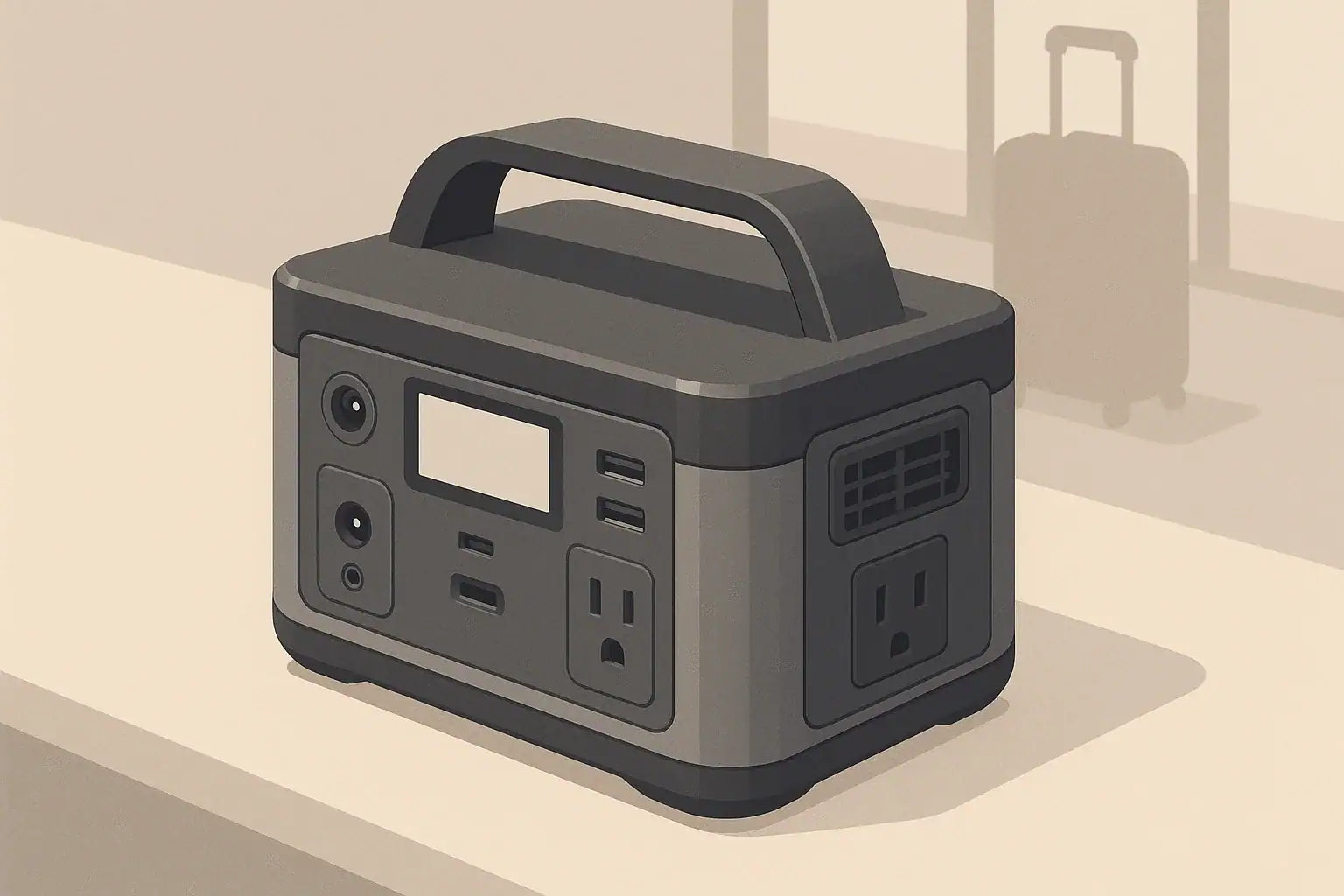
Most portable power stations cannot be taken on a passenger flight because their batteries exceed normal airline watt-hour limits. The deciding number is the battery’s watt-hour rating, or Wh—not the product name, inverter wattage, or physical size.
Under current FAA PackSafe guidance, lithium-ion batteries rated at 100 Wh or less are normally allowed in carry-on baggage. Batteries from 101 to 160 Wh require airline approval and are generally limited to two spare batteries per passenger. Batteries above 160 Wh are not permitted as ordinary passenger baggage. Airlines and national authorities may impose stricter limits, so always confirm the exact model and route with your carrier before traveling.
Check the Watt-Hour Rating First
Look for a Wh rating on the power station’s label or specification sheet. If only voltage and amp-hours are shown, calculate capacity using:
Watt-hours = volts × amp-hours
A battery rated at 12.8 V and 8 Ah stores approximately 102.4 Wh, placing it in the airline-approval range. A 12.8 V, 20 Ah battery stores about 256 Wh and exceeds the normal passenger limit.
Do not confuse battery capacity with inverter output. A power station advertised as “300 W” may describe the inverter’s output, while the battery itself could store 250 Wh or more.
Carry-On Versus Checked Baggage
Power banks, portable rechargers, and spare lithium-ion batteries must be carried in cabin baggage, not checked baggage. Their terminals must be protected against short circuits. If your carry-on bag is taken at the gate and placed in the aircraft hold, remove the power station or battery and keep it with you in the cabin.
IATA guidance for lithium batteries also advises passengers to keep power banks in hand luggage, protect them from damage and short circuits, and verify any battery above 100 Wh with the airline.
Why Most Portable Power Stations Are Too Large
Even small camping power stations commonly store 200–500 Wh, while medium and large models can exceed 1,000 Wh. That makes most conventional power stations unsuitable for passenger flights even when they are compact enough to fit in cabin baggage.
A sub-100 Wh power bank may be a practical alternative for phones, tablets, cameras, and some USB-C laptops. For larger energy requirements, consider renting or buying a power station at the destination. Shipping a large lithium battery requires specialist dangerous-goods handling and should not be treated as ordinary parcel shipping.
Pre-Flight Checklist
Before traveling:
- Find the Wh rating on the device or calculate it from volts and amp-hours.
- Confirm the airline’s current rules for the exact model and route.
- Obtain written airline approval for a battery in the 101–160 Wh range.
- Pack allowed batteries in carry-on baggage only.
- Protect exposed terminals and prevent accidental activation.
- Remove batteries from any carry-on bag that is checked at the gate.
- Do not travel with a damaged, swollen, defective, or recalled battery.
- Tell the cabin crew immediately if a battery becomes hot, expands, smokes, or produces an unusual smell.
Frequently asked questions
What technical specifications and features determine if a portable power station is allowed on a plane?
Airlines and regulators focus on battery chemistry (lithium types are most restricted), the watt‑hour (Wh) capacity, and whether the unit can be carried in the cabin. Other useful features are clear Wh labeling, an accessible on/off switch, protected terminals, and built‑in safety protections such as over‑current and temperature cutoffs. Units under about 100 Wh are the least likely to cause issues, 100–160 Wh may need airline approval, and higher capacities are usually not permitted as passenger baggage.
Can I put a portable power station in checked baggage to avoid carry‑on limits?
Generally no: lithium batteries that are allowed on passenger flights are typically required to be in carry‑on baggage so they can be accessed quickly if they overheat. Checked baggage is usually off‑limits for most lithium power stations, especially medium and large units, and attempting to check them can result in removal or confiscation. Always confirm with your airline before travel.
What safety precautions should I take to reduce fire risk when traveling with lithium battery power devices?
Do not travel with a damaged, defective, swollen, or recalled battery. Protect the terminals against short circuits, keep the device accessible in your carry-on, and prevent accidental activation. If the battery becomes hot, expands, smokes, or produces an unusual smell, notify the cabin crew immediately.
How do I calculate the watt‑hour rating if my power station only lists voltage and amp‑hours?
Multiply voltage (V) by amp‑hours (Ah) to get watt‑hours: Wh = V × Ah. For example, a 12.8 V battery rated at 20 Ah is about 256 Wh (12.8 × 20 ≈ 256 Wh), which is typically above common passenger limits.
Are there limits on how many small power banks I can carry on a plane?
Many airlines allow multiple small power banks under roughly 100 Wh for personal use, but they may impose quantity limits or require that each unit be carried in carry‑on baggage. Mid‑size units in the 100–160 Wh range often need airline approval and are usually limited to a small number per passenger. Check your airline’s specific policy before packing several units.
Related guides
Browse this topic →
- Beginner-friendly sizing, runtime & specs
- Solar & charging (MPPT, fast charging, cables)
- Batteries (LiFePO4, cycles, care & storage)
- Safety, cold-weather performance, real-world tips
More in FAQ
See all →- Why Does My Portable Power Station Show 0W Even When Something Is Plugged In?
- What Happens When a Portable Power Station Is Overloaded?
- Can a Portable Power Station Run Multiple Appliances at Once?
- Can You Use a Portable Power Station in a Dorm Room?
- Portable Power Station Error Codes: What Common Warnings Mean
Keep reading
About this site
Portable Energy Lab publishes practical, independent guides about portable power—clear sizing, safe use, and real-world expectations.
Affiliate disclosure
Some links on this site may be affiliate links. If you buy through these links, we may earn a small commission at no extra cost to you. This helps support our content. Read our affiliate disclosure.