
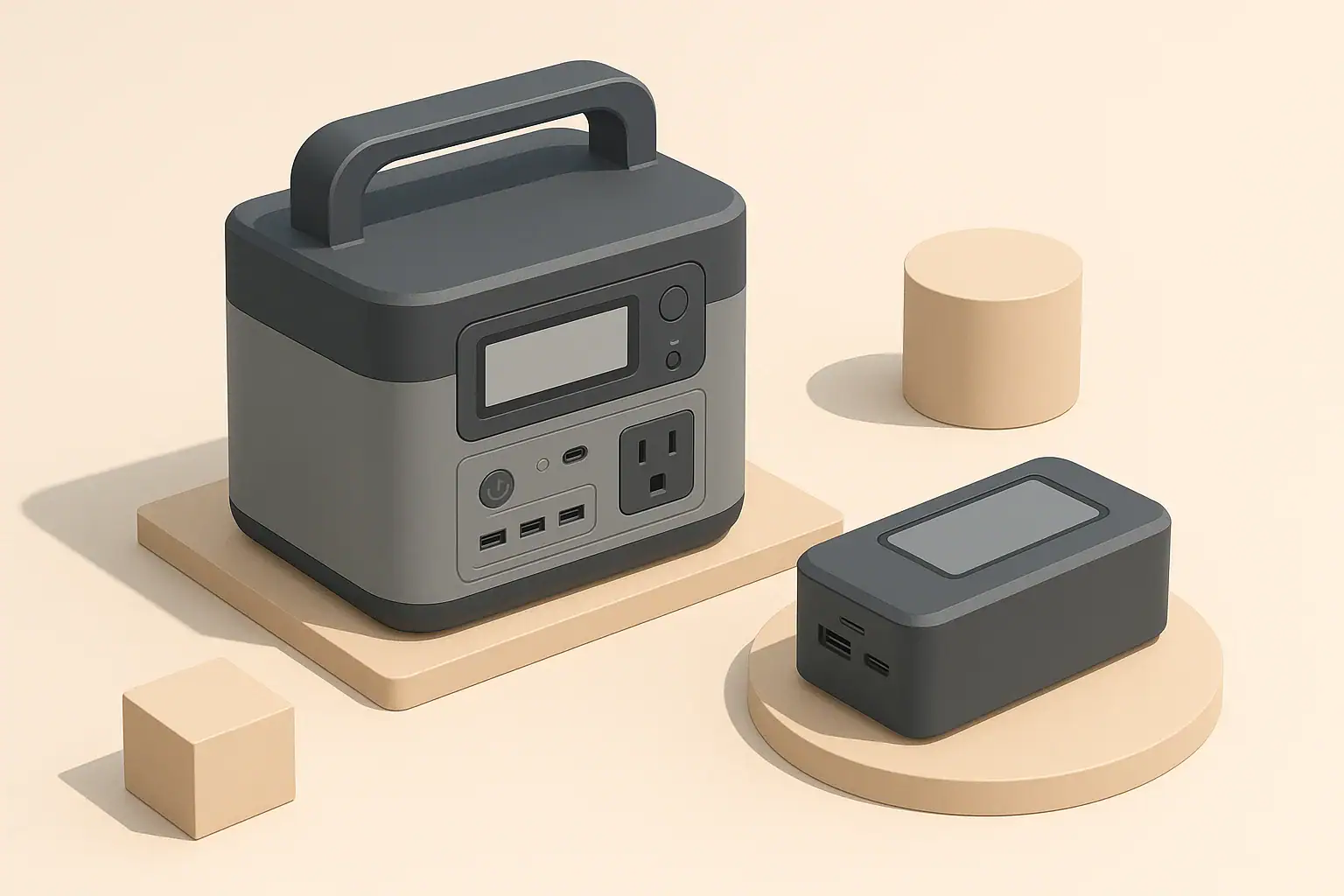
The real difference between a portable power station and a power bank is that a power bank is built to recharge small devices, while a portable power station is built to run devices and small appliances. Both are portable batteries, but they are designed for very different jobs and power levels.
If you only need to keep phones, earbuds, or a laptop topped up, a high-capacity power bank is usually enough. If you want to run a Wi ‑Fi router, mini fridge, CPAP (with appropriate medical guidance), or power tools during an outage or camping trip, you are in portable power station territory.
This guide walks through what actually separates these two categories, how to estimate runtimes, where each option makes sense in real life, and how to avoid common sizing and safety mistakes before you spend money.
What Each Device Really Is and Why It Matters
Both power banks and portable power stations are rechargeable battery packs, but they sit at different points on the portable energy spectrum.
Power banks are compact, light, and focused on USB or low ‑voltage DC outputs. They are meant to recharge internal batteries in phones, tablets, earbuds, cameras, and sometimes laptops.
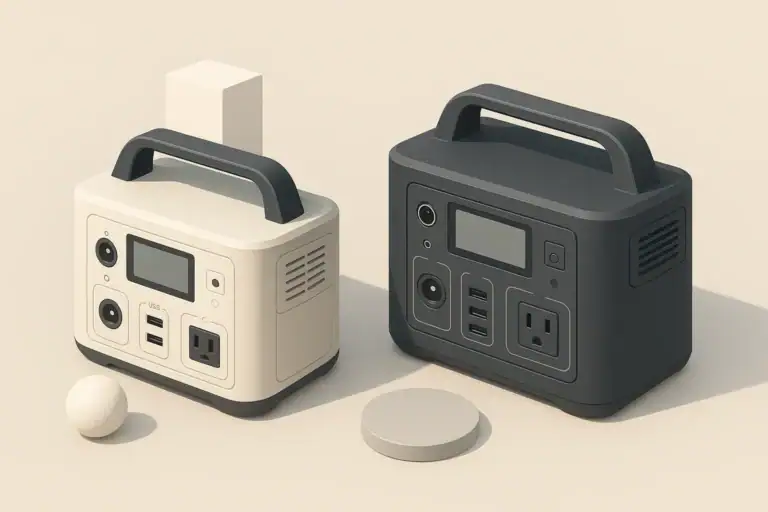
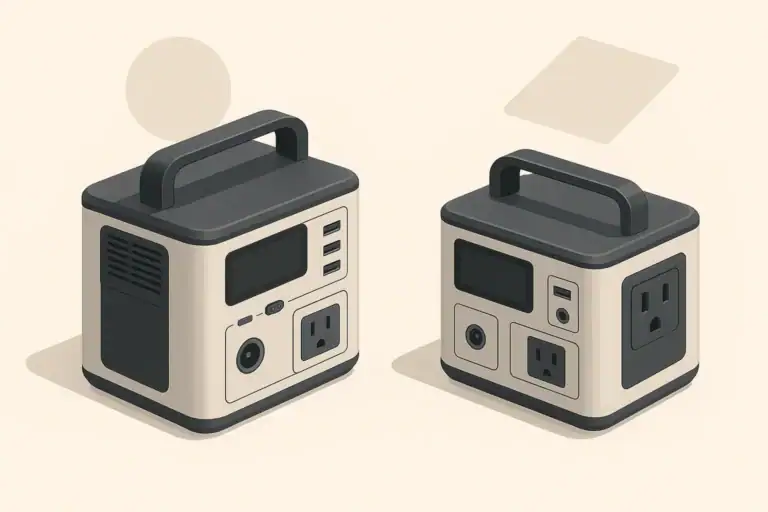
Portable power stations are larger, heavier units with higher capacity and built ‑in AC inverters. They are meant to power devices directly, including things you normally plug into a wall outlet.
This distinction matters because it affects:
- What you can plug in: USB gadgets only, or full size AC plugs as well.
- How long things run: minutes of laptop use vs hours of appliance runtime.
- How you recharge: simple USB wall chargers vs wall, car, and solar options.
- How you plan: counting phone recharges vs planning wattage and watt hours.
Thinking clearly about what you need to power, not just what you need to charge, is the fastest way to choose between a portable power station vs power bank.
Key Technical Concepts: Capacity, Outputs, and Power Limits
You can draw the line between power banks and portable power stations by looking at three core specs: capacity, outputs, and power ratings.
Capacity: mAh vs Wh and a Simple Runtime Formula
Power banks are usually advertised in milliamp hours (mAh), while power stations use watt hours (Wh). Watt hours make comparison easier because they already include voltage.
To roughly convert a power bank rating to watt hours, you can use:
Wh ≈ (mAh ÷ 1000) × 3.7 (assuming a typical 3.6–3.7 V internal battery).
Once you know watt hours, a simple planning rule is:
Estimated runtime (hours) ≈ Battery Wh × 0.85 ÷ Device watts
The 0.85 factor roughly accounts for conversion losses and is only an estimate, but it is good enough for planning.
| Device type | Typical capacity | Example load | Approximate runtime or recharges* |
|---|---|---|---|
| Small power bank | 10,000 mAh (≈7 Wh) | Smartphone (10 Wh battery) | About 2–3 full recharges |
| Large power bank | 27,000 mAh (≈100 Wh) | Laptop (50 Wh battery) | About 1–1.5 full recharges |
| Small portable power station | 300 Wh | Wi ‑Fi router (15 W) | About 17 hours (300×0.85÷105) |
| Mid size portable power station | 600 Wh | Mini fridge (60 W average) | About 8.5 hours (600×0.85÷60) |
| Large portable power station | 1,200 Wh | Mixed loads (120 W total) | About 8.5 hours (1,200×0.85÷120) |
*These are planning numbers, not guarantees. Actual results vary with efficiency, age, temperature, and how devices cycle on and off.
Outputs: USB vs AC Household Outlets
Outputs are where the functional divide becomes obvious.
- Power bank outputs:
- USB A for phones and small gadgets.
- USB C (often with fast charging power delivery) for phones, tablets, and some laptops.
- Occasionally a low voltage DC barrel jack or wireless charging pad.
- Portable power station outputs:
- One or more 120 V AC outlets via an internal inverter.
- USB A and USB C for mobile devices.
- 12 V DC car socket and/or DC barrel ports for coolers and other DC gear.
If you need to plug in a standard household AC plug, you are looking for a portable power station, not a basic power bank.
Power Ratings: Continuous and Surge
Portable power stations list two important watt ratings for the AC inverter:
- Continuous watts: what the inverter can supply steadily.
- Surge (peak) watts: short bursts for startup spikes, such as fridges or pumps.
To avoid overload shutdowns, the total watts of everything you plug in should stay below the continuous rating, and any single device’s startup spike should stay below the surge rating. Power banks rarely publish these numbers because they are not intended for high wattage AC loads.
Real ‑World Examples: When Each Option Makes Sense
Choosing between a portable power station vs power bank becomes easier when you look at specific scenarios instead of abstract specs.
Short Power Outages at Home
For brief outages of a few hours, most people care about communication, light, and maybe keeping food safe.
- Power bank is enough when:
- You mainly want to keep phones charged for calls and updates.
- You use small USB lanterns or headlamps for light.
- You do not need to run a router or fridge.
- Portable power station is better when:
- You want your Wi ‑Fi router and modem to stay on.
- You need to power a laptop for work during the outage.
- You want to cycle a compact fridge or freezer to protect food.
As a rough guide, a 300–500 Wh power station can keep a router, a laptop, and a few LED lights going through a typical evening outage.
Remote Work, Study, and Mobile Offices
If you work from coffee shops, libraries, vehicles, or temporary spaces, your main loads are usually laptops, phones, and networking gear.
- Power bank use: a 20,000–30,000 mAh bank with strong USB C output can add several hours of laptop time and many phone charges during a long workday.
- Portable power station use: a 300–600 Wh station can run a laptop, monitor, and mobile hotspot or router for an entire day, with enough spare capacity to recharge other devices.
Power stations also make it easier to support multiple people sharing one power source in a meeting room, van, or cabin.
Camping, Vanlife, and RV Trips
Outdoors, you often need a mix of low power electronics and a few higher draw items.
- Power banks shine when:
- You are backpacking and every ounce matters.
- You only need to charge phones, GPS units, cameras, and headlamps.
- You are staying just a night or two between access to wall outlets.
- Power stations shine when:
- You are car camping or in a van and can handle extra weight.
- You want to run a 12 V fridge, air pump, or fan.
- You plan to add folding solar panels for multi day or off grid stays.
Many people use a power station as the central hub in the vehicle or tent and then carry smaller power banks during day hikes.
Everyday Carry vs Stationary Backup
Another practical way to draw the line is how often you want to carry the device.
- Power banks: live in a backpack, purse, or pocket every day and are easy to take on flights, trains, and commutes (within airline capacity limits).
- Portable power stations: behave more like small appliances. You move them when needed—to the living room during a storm, to the car for a road trip, or to a campsite—but you do not carry them everywhere.
If the idea of carrying it all day sounds annoying, it is almost certainly a portable power station, not a power bank.
Common Mistakes and Simple Troubleshooting Cues
Misunderstanding the difference between a portable power station vs power bank often leads to the same avoidable problems. Knowing these patterns helps you troubleshoot quickly or avoid the issue entirely.
Common Planning and Sizing Mistakes
- Buying only by mAh: Treating a 30,000 mAh power bank as if it can replace a 300 Wh power station. They are not equivalent; the station typically has several times more usable energy.
- Ignoring watts: Looking at battery capacity but not checking whether the inverter (or USB C port) can actually supply the required watts to your device.
- Overestimating runtime: Forgetting that conversions and heat losses reduce usable capacity, especially when using AC outlets.
- Using the wrong outputs: Powering a router through an inefficient AC adapter when a more efficient DC output is available on the station.
| Symptom | Likely cause | Quick things to check |
|---|---|---|
| Device will not turn on when plugged into power bank | Output too weak or wrong connector | Confirm USB C power rating, cable quality, and whether the device needs AC instead of USB |
| Portable power station shuts off when an appliance starts | Startup surge exceeds inverter rating | Compare appliance wattage to station surge watts; try a lower watt device |
| Runtime is much shorter than expected | Loads higher than assumed or AC losses | Check live watt readout if available; recalculate using total watts and 0.85 efficiency factor |
| Battery gets hot while charging and powering devices | High load plus pass through charging | Reduce the number of devices, improve ventilation, or avoid pass through for long periods |
| Car will not start after charging a station overnight | Vehicle battery discharged | Only charge from car outlets while driving, or use low draw settings and built in protections |
Pass Through Charging Pitfalls
Pass through charging means using the battery to power devices while it is being charged. It is convenient, but there are trade offs:
- Not every port on every device supports pass through; some will shut off or limit power.
- Heat buildup is common, especially on small power banks under heavy load.
- If the input wattage is lower than the output wattage, the battery still drains over time.
For always on setups like routers or low wattage electronics, a portable power station with clearly rated continuous output and good cooling is usually more robust than a small bank pushed to its limits.
Charging Time Surprises
Another common surprise is how long it takes to refill a larger battery.
- Power banks charging from a 10–20 W USB wall adapter may still take several hours.
- Portable power stations can take many hours to recharge from a standard wall outlet, especially if capacity is 500 Wh or more.
- Car and solar charging are typically slower than wall charging and depend heavily on driving time or sun conditions.
Use the simple estimate “battery Wh ÷ charger watts” as a starting point, then add extra time for real world inefficiencies.
Safety Basics for Portable Power Stations and Power Banks
Both types of devices are generally safe when used as intended, but they store a lot of energy in a compact space. A few habits go a long way toward minimizing risk.
Placement and Ventilation
- Place portable power stations on stable, dry, non flammable surfaces.
- Keep vents and fans clear on all sides; do not push the unit against walls or soft furnishings while in use.
- Avoid covering power banks or stations with blankets, clothing, or bags while charging or under heavy load.
Cords, Adapters, and Load Management
- Use cables rated for the current and wattage you need, especially for high output USB C charging.
- Avoid long chains of adapters, splitters, and extension cords from a single outlet on a power station.
- Do not exceed the rated output of any port or the total inverter capacity. If the device has a display, watch the wattage while you plug in new loads.
Interaction With Home Electrical Systems
Some users want a portable power station to support part of a home during outages. That can be useful, but there are important limits.
- Do not attempt to backfeed a home electrical panel through improvised cords or connectors.
- Do not bypass transfer switches or safety interlocks.
- For any setup that involves your home’s wiring rather than just plugging appliances into the station’s outlets, consult a qualified electrician.
For many households, the simplest and safest method is to plug individual devices directly into the portable power station and leave the main electrical system alone.
Battery Handling and Damage Signs
- Do not open or modify any battery pack or portable power station.
- Stop using devices that show swelling, cracking, strong chemical smells, or unusual heat at light loads.
- Keep all battery devices away from flammable materials while charging.
- Follow the manufacturer’s guidance on operating and charging temperature ranges.
Maintenance, Storage, and Long Term Use
With basic care, both power banks and portable power stations can last for years. A few habits help preserve capacity and keep them ready for emergencies.
Cold and Hot Weather Considerations
Temperature strongly affects lithium based batteries.
- Cold: Capacity appears lower, and charging at very low temperatures can be harmful. Keep power banks in a pocket or insulated pouch; keep power stations in a sheltered, dry area such as inside a vehicle or tent, within the stated temperature range.
- Heat: High temperatures accelerate battery wear. Avoid leaving either type of device in a closed vehicle or direct sun for long periods.
Storage and Self Discharge
- Avoid storing batteries completely full or completely empty for months at a time.
- A mid range state of charge (often around half) is a reasonable target for long term storage.
- Top up stored units every few months to offset self discharge and check that everything still works.
- Store in a cool, dry place away from ignition sources.
For portable power stations used as backup, it is helpful to schedule a quick function check before storm seasons: power a small load for a short time, confirm the display and ports work, and then recharge.
Routine Care and Inspection
- Keep ports free of dust and moisture; use covers if supplied.
- Inspect cables for frayed insulation, bent connectors, or overheating marks.
- Make sure power station vents and fans are clean and unobstructed.
- If the device supports firmware updates and clear instructions are provided, apply them in a controlled environment, not during a critical outage.
Practical Takeaways and Specs to Look For
By now, the dividing line between a portable power station vs power bank should be clearer: power banks are for recharging small devices, while power stations are for running devices and small appliances. The right choice depends on what you need to power, for how long, and how often you want to carry the battery with you.
Quick Takeaways
- Choose a power bank for everyday carry, travel, and topping up phones, tablets, and sometimes laptops.
- Choose a portable power station when you need AC outlets, longer runtimes, or support for multiple devices and small appliances.
- Plan using watt hours and watts, not just mAh, and use the simple runtime formula to sanity check expectations.
- Think about recharging methods (wall, car, solar) and how often you can realistically refill the battery.
Specs to Look For Before You Buy
Use this checklist to compare options and avoid common mismatches.
- Capacity (Wh or mAh): Convert to watt hours if needed and compare against your estimated daily energy use.
- Output types: Count how many USB A, USB C, 12 V DC, and AC outlets you truly need at the same time.
- Output power: For power banks, check maximum USB C wattage; for stations, check inverter continuous and surge watts against your devices.
- Input power and charging options: Note maximum wall, car, and solar input so you know how fast you can realistically recharge.
- Display and monitoring: A clear wattage and battery percentage display makes planning and troubleshooting much easier.
- Weight and size: Decide whether this is an everyday carry item or a mostly stationary backup appliance.
- Pass through capability: If you plan to run devices while charging, confirm which ports support it and under what limits.
- Operating temperature range: Check that the device fits your climate and intended use (indoor only vs outdoor and vehicle use).
- Cycle life and warranty information: Higher cycle ratings and clear support terms matter if you will use the battery heavily.
Matching these specs to your actual devices and routines will help you choose the right tool, avoid disappointment, and get the most value from your portable power setup.
Frequently asked questions
Which specs and features matter most when choosing between a portable power station and a power bank?
Prioritize capacity (Wh or converted mAh), output types (USB C, AC, 12 V DC), and output power (continuous and surge watts for inverters). Also consider input/charging options, weight/portability, and whether the unit supports pass-through or has a clear display for monitoring.
Can I compare a power bank and a portable power station using mAh alone?
No. mAh ignores voltage, so it can be misleading across different devices. Convert mAh to Wh for a like-for-like comparison and also check output wattage and inverter capabilities for real-world use.
Is it safe to use portable power stations and power banks indoors?
Yes, when used as directed: keep units on stable, ventilated, non-flammable surfaces, avoid covering them, and do not modify batteries or bypass safety features. For any connection to home wiring or more complex setups, consult a qualified electrician.
How can I estimate how long a power station will run an appliance?
Use the simple rule: estimated runtime (hours) ≈ Battery Wh × 0.85 ÷ Device watts. Remember this is an estimate; actual runtime varies with efficiency, device cycling, and environmental conditions.
What common mistakes should I avoid when buying these devices?
Avoid choosing only by mAh or ignoring continuous/surge watt ratings, overlooking required output types, and underestimating charging times or the impact of efficiency losses. Match specs to your actual devices and typical usage patterns.
Can I charge a power station from solar panels while powering devices?
Many power stations accept solar input and allow simultaneous use, but charging rate depends on panel wattage, sun conditions, and the station’s maximum input. Check the station’s supported solar voltage/current and expect lower net efficiency during pass-through use.
Related guides
Browse this topic →
- Beginner-friendly sizing, runtime & specs
- Solar & charging (MPPT, fast charging, cables)
- Batteries (LiFePO4, cycles, care & storage)
- Safety, cold-weather performance, real-world tips
More in Comparison
See all →Keep reading
About this site
Portable Energy Lab publishes practical, independent guides about portable power—clear sizing, safe use, and real-world expectations.
Affiliate disclosure
Some links on this site may be affiliate links. If you buy through these links, we may earn a small commission at no extra cost to you. This helps support our content. Learn more.