
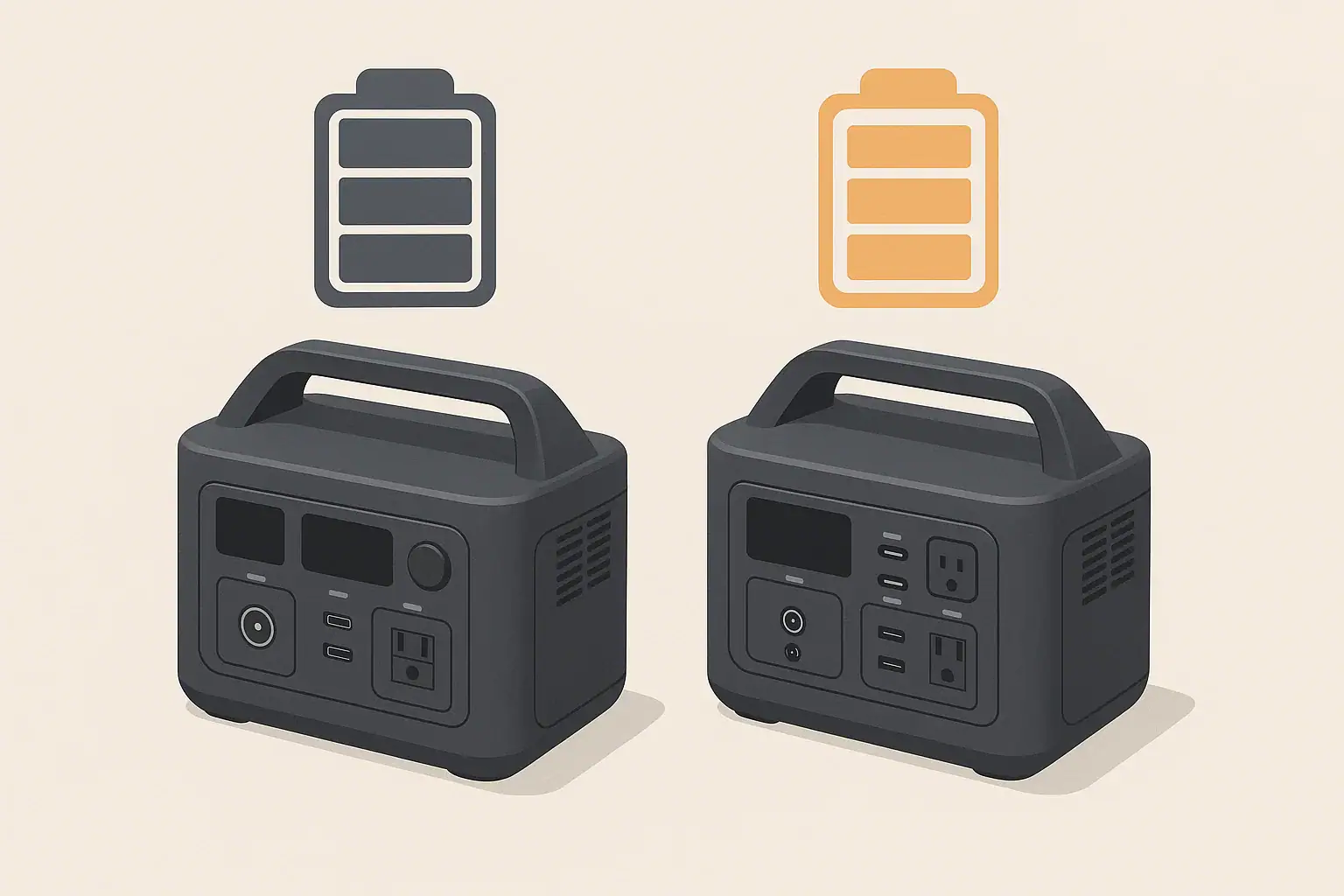
LiFePO4 batteries are usually the better choice for long-lasting portable power stations, while NMC batteries are usually better when low weight and compact size matter most.
Both are lithium-ion battery chemistries, but they are not interchangeable in real-world use. LiFePO4, short for lithium iron phosphate, tends to offer longer cycle life, stronger thermal stability, and more predictable aging. NMC, short for lithium nickel manganese cobalt oxide, usually stores more energy in less weight and space, which can make a portable power station easier to carry.
The right choice depends on how you use the unit. A weekend camper may care more about pounds and handle comfort. A homeowner, RV user, or remote worker who cycles a power station often may care more about long-term battery health, cold charging limits, and safety margin.
What LiFePO4 and NMC Mean and Why It Matters
LiFePO4 and NMC describe the battery cell chemistry inside the power station. The chemistry affects energy density, voltage behavior, charging limits, heat tolerance, and how quickly the pack loses capacity over time. The inverter, battery management system, charger, enclosure, and cooling design still matter, but chemistry sets important boundaries.
LiFePO4 cells have lower energy density than many NMC cells. That means a LiFePO4 power station often needs a larger and heavier battery pack to reach the same watt-hour rating. In exchange, LiFePO4 usually handles frequent cycling better. Many LiFePO4 packs are marketed for thousands of cycles before reaching a specified remaining capacity, often around 80 percent under controlled test conditions.
NMC cells generally have higher energy density, so they can support lighter and smaller designs. That is why NMC has been common in compact electronics and some portable power stations where portability is the main selling point. The tradeoff is that NMC is typically more sensitive to high heat, long storage at full charge, and repeated deep discharges.
For buyers, this matters because watt-hours alone do not tell the whole story. Two power stations can both claim 1000 Wh, but one may be easier to carry while the other may tolerate years of frequent use with less capacity loss. The better battery is the one that matches your actual pattern of use.
Key Performance Differences and How They Work
The biggest difference between LiFePO4 vs NMC batteries is not whether they can power your devices. Both can run lights, laptops, routers, refrigerators, tools, and small appliances when paired with the right inverter. The difference is how much weight it takes to store that energy, how the pack behaves at temperature extremes, and how long it is likely to remain useful under repeated cycling.
Energy density is the main advantage for NMC. If you need to carry a unit up stairs, lift it into a vehicle, or move it often between rooms, the lighter chemistry can be a real benefit. This is especially noticeable as capacity increases. A few pounds may not matter for a 300 Wh unit, but it can matter a lot for a 1500 Wh or 2000 Wh station.
Cycle life is the main advantage for LiFePO4. A cycle is usually counted as one full equivalent discharge and recharge, even if it happens across partial uses. For example, using 50 percent of the battery one day and 50 percent the next roughly equals one full cycle. If you use a power station daily for tool charging, refrigerator backup, or off-grid work, the chemistry with higher cycle life can provide better long-term value.
Cold performance is more nuanced. NMC often retains usable discharge performance better in moderately cold conditions, though capacity still drops as temperature falls. LiFePO4 can also discharge in the cold, but it is commonly more restricted when charging near or below freezing. Many modern power stations block charging when the cell temperature is too low because charging cold lithium cells can cause permanent damage.
| Factor | LiFePO4 tendency | NMC tendency | What it means for portable power stations |
|---|---|---|---|
| Weight for same Wh | Heavier and often larger | Lighter and more compact | NMC is easier to carry when capacity is high |
| Cycle life | Usually much higher | Usually lower | LiFePO4 is better for daily or frequent deep use |
| Thermal stability | Strong inherent stability | More heat sensitive | LiFePO4 provides more safety margin, though design still matters |
| Cold charging | Often restricted near freezing | May be less restrictive, but still limited | Check operating temperature specs before winter use |
| Voltage behavior | Flatter discharge curve | More gradual voltage decline | State-of-charge displays may behave differently |
| Best fit | Frequent cycling, backup, RV, workshop use | Travel, lighter camping kits, occasional backup | Choose based on use pattern, not chemistry labels alone |
Real-World Examples
For a short home outage, either chemistry can work well if the watt-hour capacity and inverter rating are adequate. Suppose you run a 12 W router, a 60 W laptop, and 20 W of LED lighting. That is about 92 W before inverter losses. On a 500 Wh power station, a realistic AC runtime may be around four to four and a half hours after efficiency losses. At this modest load, the chemistry is less important than the unit size, inverter efficiency, and state of charge when the outage begins.
For regular refrigerator backup, LiFePO4 starts to look more attractive. A refrigerator does not draw its rated surge power continuously, but it cycles throughout the day. If the power station is used every storm season or as part of a routine backup plan, cycle life and heat tolerance become more important than saving a few pounds. The inverter still must handle compressor startup surge, so chemistry alone will not solve an undersized output rating.
For tent camping or car camping, NMC can be appealing when the power station is moved frequently. A lighter unit is easier to load, unload, and reposition around camp. If you only use it a few weekends per year for phones, cameras, a fan, and lights, you may never come close to wearing out an NMC pack. In that case, portability may matter more than maximum cycle count.
For RV, van, and remote work use, LiFePO4 often makes more sense. These users may discharge and recharge the station many times, sometimes from solar during the day and AC loads at night. A heavier battery is less of a problem if the station stays in one place. The longer cycle life can become meaningful after hundreds of partial cycles.
For cold-weather use, think about where the power station will sit. A unit stored overnight in a freezing vehicle may refuse to charge from solar in the morning until the cells warm up. This is especially common with LiFePO4 units that protect against low-temperature charging. If winter charging is important, look for clear low-temperature charging specifications and any built-in warming features.
Common Mistakes and Troubleshooting Cues
The most common mistake is choosing by battery capacity alone. Watt-hours tell you how much energy the battery can store, but they do not tell you whether the inverter can start your appliance. A small power station may have enough stored energy to run a device for a while, yet still shut down instantly if the startup surge is too high.
Another mistake is assuming cold-weather slowdowns mean the battery is defective. Lithium batteries lose performance in the cold, and protective electronics may block charging outside the safe temperature range. If the display shows input power dropping to zero on a freezing morning, the battery management system may be doing exactly what it should.
Users also misread cycle life claims. A rated cycle life is usually based on controlled testing at specified temperature, discharge rate, and depth of discharge. Real use may include heat, high loads, full-charge storage, or deep discharge, all of which can shorten practical life. LiFePO4 usually has the advantage, but it is not immune to aging.
| Symptom | Likely cause | What to check first | Practical response |
|---|---|---|---|
| Unit shuts off when appliance starts | Surge exceeds inverter rating | Startup watts and overload message | Use a lower-surge load or a larger inverter rating |
| Charging stops in freezing weather | Low-temperature charging protection | Battery temperature range in specs | Warm the unit before charging |
| Runtime is shorter than expected | Inverter losses or high actual load | Device watt draw and AC versus DC use | Measure load and plan for efficiency losses |
| Display drops quickly from full | Load calibration, age, or voltage curve | Runtime under a steady known load | Run a controlled test after fully charging |
| Charging slows near 100 percent | Normal charge tapering | Input watts at different charge levels | Expect slower final charging |
| Fans run often under load | Heat from inverter or charger | Vent clearance and ambient temperature | Improve airflow and reduce load if needed |
Safety Basics
LiFePO4 has an inherent safety advantage because it is more thermally and chemically stable than NMC. That does not make any portable power station risk-free. Safety depends on the cells, battery management system, charger design, inverter design, enclosure, cooling, and how the owner uses the unit.
Keep any power station on a stable, dry surface with ventilation space around the intake and exhaust areas. Do not cover it with bedding, pack it tightly under gear while operating, or place it next to heaters. Heat is bad for both chemistries, and it is especially hard on NMC over time.
Treat the AC outlets like household power. Do not exceed the continuous watt rating, do not daisy-chain overloaded power strips, and use appropriately rated cords. High-watt devices such as space heaters, kettles, microwaves, hair dryers, and induction cooktops can drain a battery quickly and may exceed inverter limits.
Moisture is a separate safety issue from battery chemistry. Keep the station away from rain, puddles, snowmelt, and wet floors unless the product is specifically rated for that exposure. If the unit gets wet, is dropped hard, smells unusual, swells, or shows repeated overheat warnings, stop using it and follow the manufacturer’s service guidance.
Do not open the battery enclosure or attempt cell-level repair. A short circuit inside a lithium pack can create extreme heat very quickly. Battery chemistry affects risk level, but it does not make internal repair appropriate for typical users.
Maintenance, Storage, and Long-Term Use
Good storage habits can extend the useful life of both LiFePO4 and NMC power stations. For long-term storage, a moderate state of charge is usually better than storing completely full or nearly empty. Many owners aim for roughly 40 to 60 percent when the unit will sit unused for weeks or months.
NMC is more sensitive to being stored at full charge, especially in heat. If an NMC power station is kept at 100 percent in a hot garage or vehicle for long periods, capacity loss can accelerate. LiFePO4 is more tolerant, but it still benefits from cool, dry storage and periodic checks.
Avoid letting any lithium battery sit fully depleted. Even though the display may show zero percent, the battery management system usually reserves some energy to protect the cells. Over long storage, self-discharge and standby electronics can continue to draw the pack lower. If the unit will be stored for months, check it occasionally and top it up before it gets too low.
For seasonal use, run a simple readiness check before you need the power station. Charge it to the level you plan to use, plug in a small known load, confirm AC and DC outputs work, and listen for abnormal fan noise. Check cords for damage and make sure vents are clear of dust. A ten-minute test before storm season or a trip is better than discovering a problem during an outage.
If the station has been in a freezing vehicle or unheated shed, let it warm gradually before charging. This is especially important for LiFePO4. If the unit supports a storage mode, charge limit, or battery care setting, use it when it matches your use pattern.
Practical Takeaways and Specs to Look For
LiFePO4 vs NMC batteries is not a simple good-versus-bad comparison. LiFePO4 usually wins for frequent cycling, long service life, thermal stability, and stationary backup use. NMC usually wins when you need the lightest practical unit for a given capacity. Both can be reliable when the power station is correctly sized and used within its limits.
If you use a power station every day, discharge it deeply, run it in an RV, or keep it ready for repeated outages, LiFePO4 is often the more practical chemistry. If you only need occasional backup or you carry the unit often, an NMC design may be easier to live with. Cold-weather users should pay special attention to charging temperature, not just discharge temperature.
Specs to look for
- Battery chemistry: Confirm whether the pack is LiFePO4 or NMC instead of relying on vague lithium wording.
- Usable watt-hours: Compare capacity, but remember that AC inverter losses reduce real runtime.
- Continuous output rating: Make sure the inverter can run your largest device without overload.
- Surge output rating: Check startup requirements for refrigerators, pumps, compressors, and tools.
- Cycle life rating: Note the remaining-capacity condition, such as cycles to 80 percent capacity.
- Charging temperature range: Look closely if you expect solar or vehicle charging in winter.
- Weight and dimensions: Compare actual carry weight, not just capacity.
- Storage guidance: Prefer clear instructions for state of charge, temperature, and periodic top-ups.
- Battery management protections: Look for overcurrent, overtemperature, low-temperature charge protection, and short-circuit protection.
The practical rule is straightforward: choose LiFePO4 when longevity and safety margin matter most, and choose NMC when compact energy storage and lighter carrying weight matter more. Then verify inverter output, temperature limits, and charging options before assuming the chemistry alone will meet your needs.
Frequently asked questions
Which is better for a portable power station, LiFePO4 or NMC?
Neither chemistry is universally better. LiFePO4 is usually better for frequent use, longer cycle life, and higher thermal stability, while NMC is usually better when lower weight and smaller size matter most. The best choice depends on how often you plan to charge and discharge the unit and how portable it needs to be.
What specs should I compare when choosing between LiFePO4 vs NMC batteries?
Compare battery chemistry, usable watt-hours, continuous output, surge output, cycle life rating, charging temperature range, and total weight. It also helps to check storage guidance and battery management protections. These specs matter more than chemistry alone because they affect real-world runtime, portability, and reliability.
Is LiFePO4 safer than NMC?
LiFePO4 is generally considered more thermally stable and less prone to overheating than NMC. That said, both are lithium-ion chemistries and still need proper charging, ventilation, and protection circuitry. Safe use depends on the full system design and how the power station is operated.
Can I charge a LiFePO4 power station in cold weather?
Sometimes, but many LiFePO4 systems restrict charging near or below freezing to protect the cells. Discharge may still work in cold conditions, but charging is the bigger concern. Always check the manufacturer’s charging temperature range before using solar or vehicle charging in winter.
What is a common mistake people make when buying these batteries?
A common mistake is choosing only by watt-hour capacity and ignoring inverter limits, weight, and temperature specs. A power station can have enough stored energy but still fail to start an appliance with a high surge. Buyers should match the battery, inverter, and operating conditions to the actual use case.
Which battery chemistry lasts longer with frequent cycling?
LiFePO4 usually lasts longer when the battery is cycled often. It is commonly rated for more charge and discharge cycles before reaching a lower remaining capacity. NMC can still be durable, but it typically has a shorter cycle-life advantage in demanding daily-use scenarios.
Related guides
Browse this topic →
- Beginner-friendly sizing, runtime & specs
- Solar & charging (MPPT, fast charging, cables)
- Batteries (LiFePO4, cycles, care & storage)
- Safety, cold-weather performance, real-world tips
More in Comparison
See all →Keep reading
About this site
Portable Energy Lab publishes practical, independent guides about portable power—clear sizing, safe use, and real-world expectations.
Affiliate disclosure
Some links on this site may be affiliate links. If you buy through these links, we may earn a small commission at no extra cost to you. This helps support our content. Read our affiliate disclosure.