
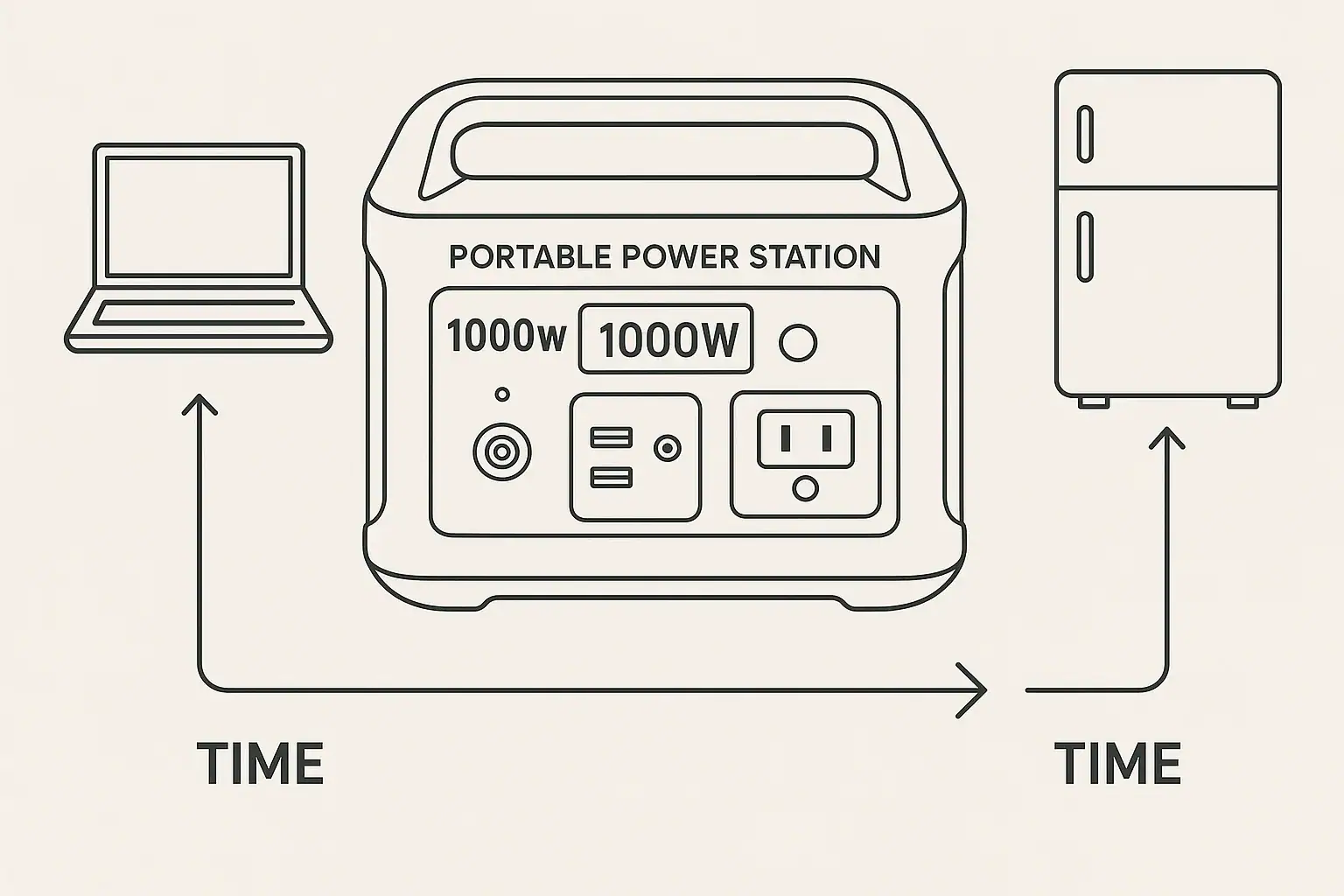
Watt-hours on a portable power station tell you how much total energy the battery can deliver, and they are the key to estimating runtime and matching capacity to your devices. Understanding watt-hours, wattage, surge watts, and input limits helps you avoid running out of power too soon or overpaying for capacity you do not need. When you know how watt-hours work, you can compare models, plan off-grid use, and troubleshoot why your runtime does not match the marketing claims.
People often search for terms like battery capacity, Wh rating, runtime calculator, AC output watts, and power draw when trying to figure out if a portable power station can handle a fridge, CPAP, laptop, or power tools. This guide explains watt-hours in plain language, walks through real-world examples, and highlights the specs that matter most so you can size a unit correctly for camping, outages, and everyday backup power.
What Watt-Hours Mean on a Portable Power Station and Why They Matter
Watt-hours (Wh) are a measure of energy. On a portable power station, the watt-hour rating tells you how much total work the battery can do before it needs to be recharged. Think of it as the size of the fuel tank, but for electricity instead of gasoline.
One watt-hour is one watt of power used for one hour. If a device draws 50 watts continuously for one hour, it consumes 50 watt-hours of energy. If you have a 500 Wh battery and you run that 50 W device, the simple math suggests up to 10 hours of runtime (500 Wh ÷ 50 W = 10 hours), before accounting for losses and inverter efficiency.
Watt-hours matter because they directly influence:
- Runtime: How long you can power a device or combination of devices.
- Use cases: Whether a station is suitable for phones and laptops only, or also for fridges, CPAP machines, or power tools.
- Size and weight: Higher Wh capacity usually means a larger, heavier unit.
- Charging needs: Bigger batteries take longer to recharge unless they support higher input wattage.
Without understanding watt-hours, it is easy to misinterpret marketing numbers like peak watts or surge power and end up with a station that can technically start a device but cannot run it for long.
Key Watt-Hour Concepts and How Portable Power Capacity Really Works
To make sense of watt-hours on a portable power station, it helps to break down a few related concepts: power (watts), energy (watt-hours), voltage, and efficiency.
Power (Watts) vs. Energy (Watt-Hours)
Watts (W) describe the rate of energy use at a given moment. A 100 W light bulb uses energy faster than a 10 W LED. Watt-hours (Wh) describe the total amount of energy used over time. If that 100 W bulb runs for 3 hours, it uses 300 Wh.
Portable power stations usually list both:
- Battery capacity in Wh (for example, 300 Wh, 500 Wh, 1000 Wh, 2000 Wh).
- Output power in W (for example, 300 W continuous, 600 W surge).
The Wh rating tells you how long; the W rating tells you how much at once.
Battery Capacity vs. Usable Capacity
The stated watt-hour capacity is usually based on the internal battery cells at their nominal voltage. However, what you can actually use at the AC outlets is lower because of:
- Inverter losses: Converting DC battery power to AC typically wastes 5–15% of energy.
- Electronics overhead: The internal electronics consume some power even at low loads.
- Discharge limits: To protect the battery, the system may not let you use 100% of the stored energy.
A practical rule of thumb is that usable AC energy is often around 80–90% of the rated Wh, depending on design and how you use it. DC outputs (like USB or 12 V ports) are usually more efficient than AC.
How Voltage and Amp-Hours Relate to Watt-Hours
Sometimes capacity is described in amp-hours (Ah) at a certain voltage. The relationship is:
Watt-hours = Volts × Amp-hours
For example, a 12 V battery rated at 50 Ah has about 600 Wh (12 V × 50 Ah). Portable power stations often use battery packs with nominal voltages around 12 V or 24 V internally, but they convert that to standard AC and DC outputs for your devices.
Continuous Watts, Surge Watts, and Watt-Hours
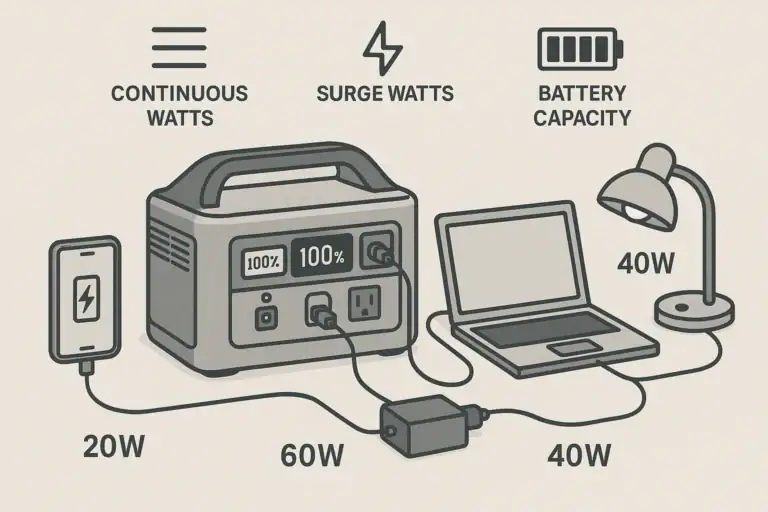
Continuous watts is the maximum power the station can supply steadily. Surge watts is the short burst available to start devices with high inrush current, such as compressors or motors. Watt-hours are independent of these limits but interact with them in practice:
- A station might have enough surge watts to start a fridge but not enough Wh to run it for many hours.
- A unit with high Wh but low continuous watts might run small devices for days but cannot power a microwave.
Input Limits and Charging Watt-Hours
Charging the battery also involves watts and watt-hours:
- Input watts (from wall, solar, or car) determine how fast energy flows into the battery.
- To estimate charge time, divide battery Wh by input W, then adjust for efficiency and tapering near full charge.
For example, a 1000 Wh station charging at 200 W might take around 5–6 hours from low to full, depending on losses and charge profile.
| Term | Typical Unit | What It Describes | Simple Example |
|---|---|---|---|
| Power | Watts (W) | Rate of energy use | 100 W bulb |
| Energy | Watt-hours (Wh) | Total energy over time | 100 W for 3 h = 300 Wh |
| Battery Capacity | Wh | Size of energy “tank” | 500 Wh station |
| Continuous Output | W | Max steady load | 600 W continuous |
| Surge Output | W | Short start-up burst | 1200 W surge |
| Input Power | W | Charging rate | 200 W wall charger |
Real-World Watt-Hour Examples: How Long Will a Portable Power Station Last?
To turn watt-hours into something practical, you need to estimate how much power your devices draw and for how long you will use them. The basic formula is:
Runtime (hours) ≈ Usable Wh ÷ Device Power (W)
Remember to adjust the Wh rating for efficiency, especially when using AC outputs.
Example 1: Charging Phones and Laptops
Imagine a compact 300 Wh portable power station used for light electronics:
- Smartphone charging: about 10 Wh per full charge.
- Laptop charging: around 50–70 Wh per full charge, depending on size and usage.
If we assume 85% usable energy from 300 Wh, that is about 255 Wh available. You could roughly:
- Charge a phone 10–15 times (10–15 × 10 Wh = 100–150 Wh).
- Charge a laptop 2–3 times (2–3 × 60 Wh = 120–180 Wh).
In practice, you might mix both uses and still have some reserve, depending on screen brightness, background tasks, and whether you are using the devices while charging.
Example 2: Running a CPAP Machine Overnight
Consider a CPAP drawing an average of 40 W without a heated humidifier, running for 8 hours:
- Energy needed ≈ 40 W × 8 h = 320 Wh.
With a 500 Wh station and 85% usable energy (425 Wh), you might get:
- 425 Wh ÷ 40 W ≈ 10.6 hours of runtime.
That is typically enough for a full night plus some margin. If you enable a heated humidifier and the draw rises to 80 W, the same station would provide:
- 425 Wh ÷ 80 W ≈ 5.3 hours.
This is why knowing your device’s actual watt draw is critical.
Example 3: Powering a Mini Fridge or Small Fridge
A compact fridge might average 40–70 W over time but draw several hundred watts briefly when the compressor starts. Suppose the average is 60 W over 24 hours:
- Daily energy ≈ 60 W × 24 h = 1440 Wh.
A 1000 Wh station with about 850 Wh usable AC energy would not run that fridge for a full day. You might see:
- 850 Wh ÷ 60 W ≈ 14 hours of runtime, assuming typical cycling.
For occasional use (for example, keeping food cool for part of a day during an outage), that might be acceptable. For continuous 24/7 operation, you would need significantly more capacity or supplemental charging such as solar.
Example 4: Running a Router and Laptop During an Outage
Assume:
- Wi-Fi router: 10 W.
- Laptop in light use: 30 W average.
Total load is about 40 W. On a 500 Wh station with 85% usable (425 Wh):
- 425 Wh ÷ 40 W ≈ 10.6 hours.
That is generally enough for a workday of connectivity and computing during a power cut.
Example 5: Power Tools and High-Draw Appliances
A small microwave might draw 800–1000 W. A circular saw might draw 900–1200 W while cutting. Even if your station’s continuous watt rating can handle that, watt-hours determine how long:
- Using a 1000 W microwave for 15 minutes (0.25 h) uses about 250 Wh.
- On a 1000 Wh station (850 Wh usable), that is nearly 30% of your usable capacity.
This is why high-power appliances drain even large portable power stations quickly. For short, occasional use, the capacity may be fine; for frequent or extended use, you will need much higher Wh or alternate power sources.
Common Watt-Hour Mistakes and Troubleshooting When Runtime Seems Wrong
Many users are surprised when their portable power station does not last as long as they expect based on the watt-hour rating. Most discrepancies come from a few common misunderstandings.
Mistaking Watts for Watt-Hours
One frequent error is confusing the station’s output watt rating with its energy capacity. A unit labeled “1000 W” might only have 500 Wh of battery capacity. That means it can power up to 1000 W of load, but only for a short time. To estimate runtime, you need the Wh figure, not just the watts.
Ignoring Inverter and Conversion Losses
Marketing numbers often assume ideal conditions. In reality:
- AC output usually has 5–15% losses.
- Running multiple converters (for example, AC to laptop brick to DC) adds more inefficiency.
If your calculations assume 100% of the rated Wh is usable, your runtime estimate will be too optimistic. Applying an 80–90% factor to account for losses yields more realistic numbers.
Underestimating Device Power Draw
Device labels often show maximum rating, not typical usage. Conversely, some devices draw more than expected under certain conditions:
- Laptops can spike when charging and under heavy processing loads.
- Fridges and freezers draw more in hot environments or with frequent door openings.
- CPAP machines use more power with heated humidifiers or higher pressure settings.
To troubleshoot, use a plug-in power meter or the station’s built-in display (if available) to observe real-time watt draw.
Not Accounting for Standby and Idle Loads
Even when devices seem “off,” they may still draw some power. The power station itself also consumes energy to keep the inverter and control electronics running. Over many hours, those small draws add up and reduce effective runtime.
Running Near Maximum Output Continuously
Operating close to the station’s continuous watt limit for long periods can increase heat and reduce efficiency. In some designs, the inverter may throttle or shut down if temperatures climb too high, cutting runtime short or causing unexpected shutdowns.
Signs Your Watt-Hour Expectations Need Adjusting
Clues that your assumptions about watt-hours and runtime may be off include:
- The station shuts down much sooner than your simple Wh ÷ W math predicted.
- The display shows higher watt draw than the device’s label suggests.
- The battery gauge drops quickly when using AC, but slowly when using DC ports.
- Runtime varies a lot with ambient temperature or device settings.
If you see these signs, revisit your calculations using realistic watt draw, efficiency factors, and actual usage patterns.
Watt-Hours and Safety Basics for Portable Power Stations
Watt-hours describe energy capacity, and higher capacity means more stored energy. While portable power stations are designed with multiple safety features, it is important to respect the amount of energy they contain and use them within their intended limits.
Respecting Output Limits
Never exceed the continuous watt rating of the station’s AC or DC outputs. Drawing more than the rated power can:
- Trigger overload protection and shut the unit down.
- Cause excessive heat buildup in cables or connectors.
- Stress internal components over time.
Always check both the watt-hour capacity and the continuous watt rating when planning which devices to connect.
Using Appropriate Cables and Connectors
Higher wattage and longer runtimes mean more current flowing through wires. To reduce risk:
- Use cables and adapters rated for the expected current and voltage.
- Avoid daisy-chaining multiple extension cords or power strips.
- Keep connections secure and avoid pinched or damaged cords.
Undersized or damaged cables can overheat, especially during extended high-power use.
Ventilation and Heat Management
Portable power stations convert stored watt-hours into usable power, and some of that energy becomes heat. To maintain safe operation:
- Place the unit on a stable, dry surface with good airflow.
- Keep vents clear of dust, fabric, or other obstructions.
- Avoid operating in direct sunlight or inside tightly closed containers.
High ambient temperatures and poor ventilation can reduce efficiency, shorten runtime, and trigger thermal protection.
Safe Charging Practices
Charging also involves significant energy transfer. To stay within safe limits:
- Use charging methods and input wattages recommended by the manufacturer.
- Avoid mixing incompatible chargers, adapters, or homemade wiring solutions.
- Do not cover the unit while charging, and keep it away from flammable materials.
If you are integrating a portable power station with other electrical systems or external batteries, consult a qualified electrician for safe, code-compliant solutions, rather than attempting custom wiring yourself.
Environment and Placement
Because watt-hours represent stored energy, treat the station with the same respect you would give to other high-capacity batteries:
- Keep away from standing water and excessive moisture.
- Avoid exposure to extreme cold or heat beyond specified operating ranges.
- Protect from impacts or crushing forces that could damage the housing or internals.
These precautions help ensure that the energy stored in the battery is released only through the intended outputs, under controlled conditions.
How Watt-Hours Affect Maintenance and Storage of Portable Power Stations
Watt-hour capacity is closely tied to battery health. Over time, all rechargeable batteries lose some capacity, which effectively reduces the number of watt-hours you can use per charge. Proper maintenance and storage can slow this process and preserve usable Wh. Before regular use, follow a first-time portable power station setup that verifies charging, outputs, firmware, and storage settings.
State of Charge for Storage
Storing a portable power station fully charged or fully depleted for long periods can accelerate capacity loss. Many battery chemistries are happiest when stored around the middle of their charge range. As general guidance:
- Aim to store the unit at roughly 40–60% charge if it will sit unused for months.
- Check the charge level every few months and top up if it has dropped significantly.
Following these habits helps maintain more of the original watt-hour capacity over the life of the station.
Temperature and Capacity Loss
Temperature strongly affects both immediate performance and long-term capacity:
- Cold conditions can temporarily reduce available Wh and output power.
- High heat can permanently reduce capacity and shorten battery life.
For storage, choose a cool, dry place out of direct sunlight. For operation, keep within the temperature ranges listed in the user documentation so the station can deliver its rated watt-hours more consistently.
Regular Cycling and Calibration
Some portable power stations estimate remaining watt-hours and runtime based on internal measurements and assumptions. Over time, the accuracy of these estimates can drift. Periodically:
- Use the station under a moderate load and allow it to discharge to a low but safe level.
- Recharge it fully using a recommended charging method.
This can help the internal management system recalibrate, providing more accurate readings of remaining Wh and runtime.
Monitoring Capacity Fade
As units age, you may notice:
- Shorter runtimes for the same devices and usage patterns.
- Faster drop from full charge to mid-level on the battery gauge.
These signs indicate that the effective watt-hour capacity has decreased. While some loss is normal over hundreds of cycles, extreme or rapid loss may suggest heavy use at high temperatures, deep discharges, or other stress factors.
Cleaning and Physical Care
Keeping the station clean and physically protected also supports safe, efficient use of its watt-hours:
- Wipe dust and debris from vents and ports with a dry cloth.
- Inspect cables and connectors for wear before long trips or critical use.
- Avoid dropping or striking the unit, especially larger, high-capacity models.
Good physical care helps ensure that the stored energy can be delivered reliably when you need it.
| Practice | Effect on Watt-Hours | Suggested Habit |
|---|---|---|
| Store at mid charge | Slower long-term capacity loss | Keep around 40–60% when unused |
| Avoid high heat | Preserves usable Wh | Store in cool, shaded areas |
| Moderate discharge depth | Extends cycle life | Avoid frequent full drain |
| Periodic full charge | Improves gauge accuracy | Fully charge every few months |
| Clean vents and ports | Maintains efficiency | Dust off surfaces regularly |
Related guides: Inverter Efficiency Explained: Why Your Runtime Is Shorter Than Expected • 300Wh vs 500Wh vs 1000Wh: Choosing Capacity for Your Use Case (With Examples) • How to Estimate Runtime for Any Device: A Simple Wh Formula + 5 Worked Examples
Practical Takeaways and Watt-Hour Specs to Look For
Understanding watt-hours turns the capacity number on a portable power station from a vague marketing claim into a practical planning tool. By combining Wh with your devices’ watt draw and expected usage time, you can estimate runtime, choose appropriate capacity, and avoid common surprises.
When comparing portable power stations, think in terms of your scenarios: how many hours of backup do you need for networking and a laptop, or how many nights of CPAP use without recharging, or how long you want to run a fridge during an outage. Then match those needs to realistic usable Wh, not just the printed capacity.
Specs to look for
- Battery capacity (Wh) – Look for a watt-hour rating that covers your total daily energy use with some margin (for example, 1.3–1.5× your estimated need). This directly determines how long your devices can run.
- Usable capacity estimate – Seek information or reviews that indicate real-world usable Wh (often 80–90% of rated). This helps you make more accurate runtime calculations than relying on the raw number alone.
- Continuous AC output (W) – Choose a continuous watt rating comfortably above your maximum simultaneous load (for example, 30–50% headroom). This ensures the station can power everything you plan to run at once.
- Surge / peak output (W) – Check that surge watts exceed the startup draw of inductive loads like fridges or pumps. Adequate surge capacity prevents nuisance shutdowns when motors start.
- Charging input power (W) – Look for input wattage that can refill the battery in a reasonable time for your use (for example, 3–6 hours from wall or solar for daily cycling). Faster input makes large Wh capacity more practical.
- Supported charging methods – Confirm compatibility with AC wall charging, vehicle DC, and solar input ranges that match your setup. Flexible charging options help you reliably replenish the watt-hours you use.
- Display and monitoring – A clear screen showing remaining percentage, estimated runtime, and real-time watts in/out makes it easier to manage Wh usage and avoid unexpected shutdowns.
- Battery chemistry and cycle life – Compare expected cycle counts at a given depth of discharge. Higher cycle life means the station will retain more of its original watt-hours after years of use.
- Operating and storage temperature range – Check ranges that fit your climate and use cases. Staying within these limits helps preserve capacity and ensures the station can deliver its rated Wh when you need it.
- Weight and form factor per Wh – Consider how much capacity you can realistically carry or move. A good balance of watt-hours to weight makes the station practical for camping, road trips, and home backup.
By focusing on these watt-hour related specs instead of just headline watt numbers, you can choose and use a portable power station that reliably meets your real-world power needs.
Frequently asked questions
What features and specifications should I prioritize when choosing a portable power station?
Prioritize battery capacity in watt-hours (Wh) for total energy, continuous AC output (W) for simultaneous device power, and surge watts for motor starts. Also consider usable capacity after inverter losses, input/charging wattage, cycle life, and weight/portability to match your use case.
How can mixing up power (watts) and energy (watt-hours) lead to wrong expectations?
Watts measure the rate of power at an instant, while watt-hours measure total energy over time. Confusing the two can make a unit that handles a high-watt load seem like it will run for long periods when its Wh capacity is actually small, producing overly optimistic runtime estimates.
What basic safety precautions should I follow when using and storing a portable power station?
Keep the unit on a stable, ventilated surface, avoid exceeding output limits, use cables rated for the expected current, and follow recommended charging practices. Store in a cool, dry place at mid state of charge for long-term storage and keep it away from water and heat sources.
How do I estimate runtime when running several devices at the same time?
Add the average power draw (watts) of all devices to get total load, then divide usable Wh by that total to estimate runtime (Usable Wh ÷ Total W). Remember to include inverter losses, standby loads, and a safety margin for more realistic results.
How does charging input wattage affect recharge time and daily use?
Higher input wattage charges the battery faster; estimate charge time by dividing battery Wh by input W and adjusting for efficiency and tapering near full. Also check the station’s maximum input limit and supported charging methods (AC, solar, vehicle) because practical recharge speed depends on both the charger and the unit’s input rating.
Why do runtimes sometimes differ between AC outlets and DC/USB ports?
DC and USB outputs bypass the inverter or use simpler conversion, so they typically have lower conversion losses and yield slightly longer runtimes. AC outputs require inverter conversion, which incurs additional energy loss and can make measured runtime shorter for the same stored Wh.
Related guides
Browse this topic →
- Beginner-friendly sizing, runtime & specs
- Solar & charging (MPPT, fast charging, cables)
- Batteries (LiFePO4, cycles, care & storage)
- Safety, cold-weather performance, real-world tips
More in Capacity
See all →- Wh per Pound: How to Compare Portable Power Station Weight and Capacity
- Two Small Power Stations vs One Large Power Station: Which Backup Setup Is Better?
- How to Build a Load Priority List for a Portable Power Station During Blackouts
- Usable Capacity vs Advertised Capacity: Why 1,000Wh Doesn’t Mean 1,000Wh at the Outlet
- Why Output Ports Have Separate Watt Limits on Portable Power Stations
Keep reading
About this site
Portable Energy Lab publishes practical, independent guides about portable power—clear sizing, safe use, and real-world expectations.
Affiliate disclosure
Some links on this site may be affiliate links. If you buy through these links, we may earn a small commission at no extra cost to you. This helps support our content. Read our affiliate disclosure.