
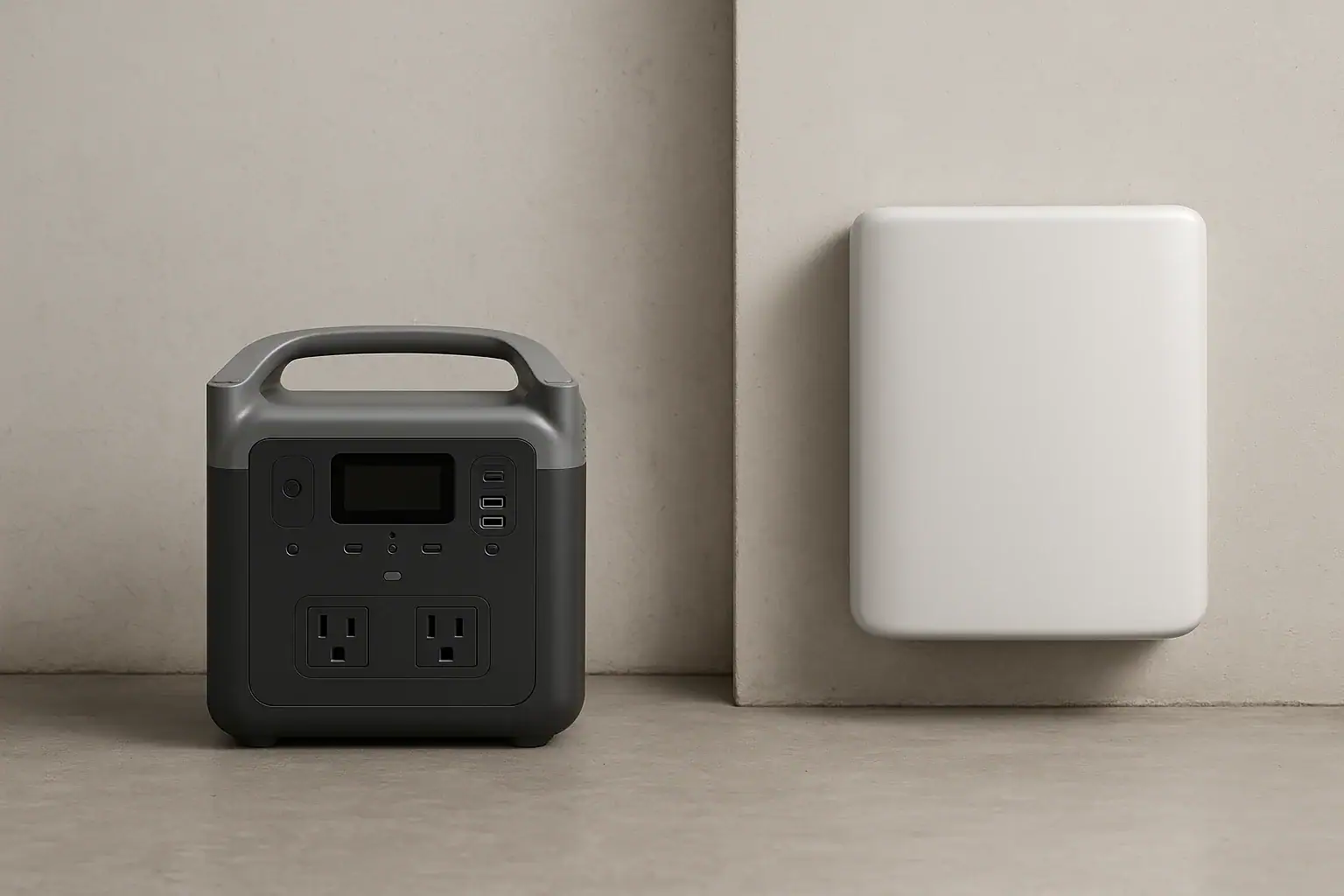
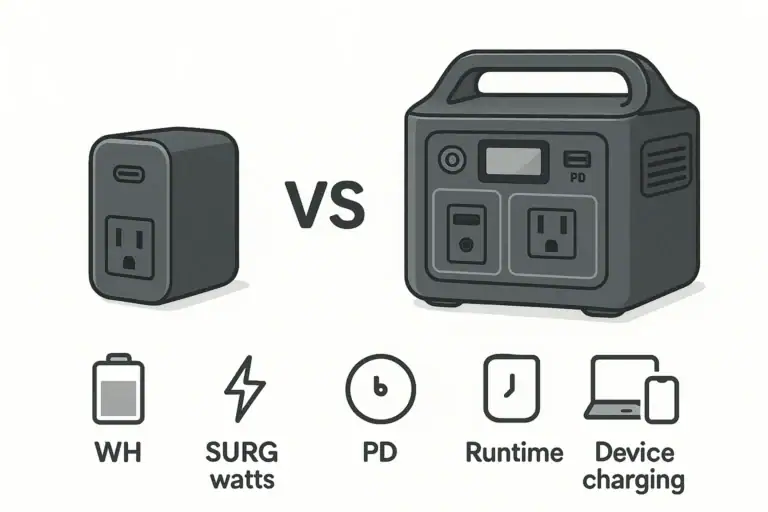
A portable power station is best for movable, plug-in backup power, while a small home energy storage system is best for installed, higher-capacity home backup. Both store energy in batteries, but they differ in runtime, inverter output, surge watts, input limit, battery capacity, and how they connect to appliances or circuits.
The right choice depends on what you need to power, how long you need it to run, and whether you want a temporary device or a permanent home energy setup. A power station can run selected loads through its own outlets, often with solar or wall charging. A small home energy storage system is usually designed around a fixed inverter, battery modules, and code-compliant integration with household loads.
For most users, the comparison comes down to portability versus capacity, simplicity versus installation, and occasional backup versus planned home resilience.
What Each System Means and Why the Difference Matters
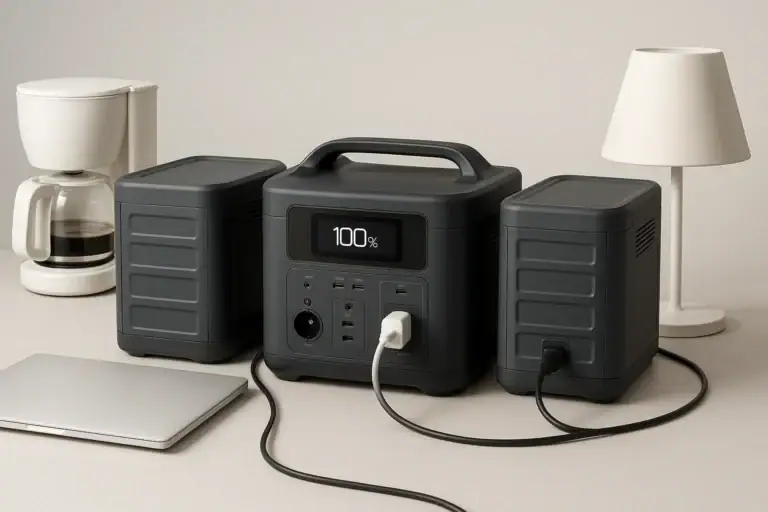
A portable power station is a self-contained battery system with an internal inverter, charge controller, display, and output ports. It is designed to be carried or rolled to where power is needed. You plug devices directly into it, such as a refrigerator, router, computer, CPAP machine, lights, or small tools, as long as the load stays within its rated output.
A small home energy storage system is a fixed battery backup setup for a home or part of a home. It typically includes one or more battery modules, an inverter or hybrid inverter, control hardware, and electrical integration performed by qualified professionals. Instead of plugging appliances into the battery, selected circuits or loads can be supplied through a safe, code-compliant installation.
This distinction matters because the two categories solve different problems. A portable unit is flexible and easy to deploy, but limited by outlet count, inverter size, and battery capacity. A home storage system is less mobile and more complex, but it can provide longer runtime, higher continuous power, and a cleaner user experience during outages.
In simple terms, choose a portable power station when you want backup you can move, store, and use without home electrical work. Consider a small home energy storage system when you want a more permanent backup solution for essential household circuits and are prepared for planning, installation, and permitting considerations.
Key Concepts: Capacity, Output, Charging, and Integration
The most important technical difference is scale. Portable power stations are commonly described by watt-hours, continuous watts, surge watts, charging input, and port types. A unit with 1,000 watt-hours can theoretically power a 100-watt load for about 10 hours before losses, but real runtime is usually lower because inverters, temperature, and battery management consume energy. For a deeper breakdown of those numbers, see portable power station watt hours.
Home energy storage systems are often measured in kilowatt-hours and kilowatts. Kilowatt-hours describe stored energy, while kilowatts describe how much power can be supplied at one time. A small system may be sized to cover critical loads such as refrigeration, internet equipment, lighting, and a furnace blower, rather than every appliance in the home.
Charging also differs. A portable unit may charge from an AC wall outlet, a vehicle socket, or portable solar panels. Its input limit determines how fast it can recharge. A home storage system may charge from the grid, solar, or both, depending on system design. Because it connects to a household electrical environment, installation quality and electrical code compliance become central concerns.
Integration is the other major dividing line. A portable power station is a point-of-use device. A home energy storage system is part of the home’s electrical infrastructure. That affects cost, safety requirements, convenience, and what happens during an outage.
| Comparison point | Portable power station | Small home energy storage system |
|---|---|---|
| Typical use | Plug-in backup for individual devices | Backup for selected home loads or circuits |
| Capacity range | About 300 Wh to 3,000 Wh for many units | About 5 kWh to 20 kWh for many small setups |
| Connection method | Built-in outlets and ports | Installed electrical integration |
| Mobility | Portable or semi-portable | Fixed in place |
| Planning level | Load matching and charging plan | Load analysis, installation, and safety review |
Real-World Examples of When Each Option Fits
If you need to keep a refrigerator cold, charge phones, run a Wi-Fi router, and power a few LED lights during a short outage, a portable power station may be enough. It can be placed near the appliance, monitored through its display, and recharged later from wall power, solar input, or another permitted source. The main limitation is that you must manage cords, prioritize loads, and watch the remaining battery percentage.
For a work-from-home setup, a portable power station can be especially practical. A modem, router, laptop, monitor, and desk light often use far less power than large kitchen or heating loads. With the right capacity and output rating, the station may keep basic productivity online for several hours or longer.
A small home energy storage system makes more sense when the goal is to support several essential household loads without moving cords around. For example, a home may need backup for refrigeration, internet, lighting, garage access, a sump pump, and a gas furnace blower. These loads can start and stop unpredictably, so capacity, surge handling, and circuit design matter more than they would for a single plugged-in device.
Another example is a home with frequent outages or time-of-use electricity rates. A fixed battery system can be planned around daily cycling, solar charging, or automatic backup behavior. A portable station can sometimes assist with these needs, but it is usually not intended to replace a designed home energy system for repeated whole-home or multi-circuit operation.
Camping, apartments, mobile work, and emergency go-bags tend to favor portable power stations. Larger homes, critical medical needs, water pumps, and longer outages tend to push the decision toward professionally planned home storage or another standby power strategy.
Common Mistakes and Troubleshooting Cues
The most common mistake is buying based only on watt-hours. Capacity matters, but it does not tell you whether the unit can start a compressor, support a microwave, or run multiple devices at once. Continuous output and surge watts are just as important. A refrigerator may use modest power while running but require a much higher starting surge for a brief moment. That is why surge watts vs running watts is worth checking before you buy.
Another mistake is assuming estimated runtime will match the label math exactly. If a device uses 100 watts and the battery is rated at 1,000 watt-hours, the real runtime may not be a full 10 hours. Inverter losses, battery reserve, cold temperatures, and display calibration can reduce usable energy. For critical loads, it is wise to build in a margin rather than sizing to the exact number.
For portable stations, troubleshooting often starts with overload messages, unexpected shutdowns, slow charging, or devices that will not start. These cues may point to loads exceeding the inverter rating, a surge requirement that is too high, an input limit restricting charging speed, or a device that needs a specific USB-C PD profile or AC waveform quality.
For home energy storage systems, common issues include insufficient backup duration, unexpected load shedding, nuisance shutdowns, or confusion over which circuits are backed up. These are not problems to solve by bypassing protections or altering wiring. They usually require reviewing load calculations, settings, system monitoring, and installation details with a qualified electrician or energy professional.
A final mistake is comparing price without comparing scope. A portable unit is usually a device purchase. A home storage system includes design, equipment, installation, permitting, and long-term service considerations. The sticker price alone does not reflect the same level of function.
Safety Basics for Backup Power at Home
Safety starts with using each system as intended. A portable power station should power devices through its built-in outlets or approved accessory outputs. It should not be used to energize household wiring through improvised cords or unsafe backfeed methods. Backfeeding can endanger utility workers, damage equipment, and create fire or shock hazards.
A small home energy storage system should be installed according to applicable electrical codes, manufacturer requirements, and local permitting rules. This is especially important when batteries, inverters, solar equipment, utility power, and home circuits interact. A qualified electrician should handle any connection to an electrical panel, transfer equipment, load center, or other fixed wiring.
Ventilation and placement also matter. Most modern battery systems are designed with internal battery management and protective electronics, but they still need an appropriate environment. Keep devices away from standing water, excessive heat, blocked vents, and flammable clutter. Avoid covering cooling fans or stacking items on top of equipment.
Extension cords can become a weak point. If you use a portable station, use cords rated for the load and keep runs as short as practical. Warm plugs, tripped protection, flickering devices, or repeated overload warnings are signs to reduce the load and reassess the setup.
Medical, heating, refrigeration, and water-management loads deserve extra caution. If a device is essential to health or property protection, confirm its power requirements in advance and create a backup plan that does not depend on guesswork during an outage.
Maintenance, Storage, and Long-Term Use
Portable power stations should be stored with attention to battery state of charge and temperature. Many lithium battery devices age faster when stored fully charged in heat or left fully depleted for long periods. A moderate charge level in a cool, dry location is generally better for long-term storage, though the product documentation should guide exact practices. For more on this, see best storage charge percentage.
Periodic testing is useful. Every few months, power a realistic load, confirm the outlets work, check the display, and verify that charging still behaves normally. This helps reveal a failing cord, a forgotten setting, or a battery that no longer holds capacity as expected. If the unit supports firmware or app-based monitoring, review status information without relying on it as the only confirmation of readiness.
Home energy storage systems need a different maintenance mindset. They are usually monitored through system software and should be inspected according to the installer’s guidance. Owners should know which loads are backed up, where disconnects are located, what alerts mean, and whom to call for service. Because the system is fixed electrical equipment, maintenance should not involve opening enclosures or modifying components.
Battery life is affected by cycles, temperature, charge levels, and discharge depth. A battery used daily for energy management will age differently from one reserved mainly for outages. For both portable and fixed systems, realistic expectations are important: capacity slowly declines over time, and backup runtime may be shorter after years of use than it was when new.
| Maintenance item | Portable power station | Small home energy storage system |
|---|---|---|
| Readiness check | Test outlets and recharge every few months | Review monitoring and service alerts |
| Storage concern | Avoid long-term empty storage and high heat | Maintain approved installation environment |
| User action | Inspect cords, ports, vents, and charge level | Confirm backed-up loads and call support for faults |
| Service boundary | Do not open or modify the unit | Use qualified service for electrical work |
Practical Takeaways and Specs to Look For
Related guides: Portable Power Station Buying Guide • Common Mistakes When Buying a Portable Power Station • Portable Power Station vs Home Battery
The practical answer is that a portable power station is the simpler choice for renters, short outages, individual appliances, and mobile use. A small home energy storage system is the stronger choice for homeowners who want automatic or semi-automatic backup for selected circuits, longer runtime, and a planned connection to the home’s energy setup.
Before choosing either option, list the devices you must run, their running watts, their starting surge if applicable, and the number of hours you need them powered. Then add a margin for inverter losses, cold weather, and future needs. This load-first approach is more reliable than shopping by battery size alone.
Specs to look for
- Usable capacity: Look for watt-hours or kilowatt-hours that exceed your calculated load by 20 to 40 percent, because losses and battery reserve reduce real runtime.
- Continuous inverter output: Match the rated watts to the total loads you may run at once; examples include 600 to 2,000 watts for many portable setups or several kilowatts for home storage.
- Surge rating: Check short-duration surge watts for refrigerators, pumps, and tools; a surge rating around 2 times the running wattage can matter for motor loads.
- Recharge input limit: Look at maximum AC and solar input, such as 500 watts, 1,000 watts, or more, because input limit determines how quickly the battery can recover after use.
- Battery chemistry and cycle rating: Compare expected cycle life and operating temperature range; longer cycle ratings are useful for frequent cycling, not just emergency storage.
- Output types: For portable stations, check AC outlets, USB-C PD output, DC ports, and regulated voltage; for home systems, confirm which loads or circuits the design can support.
- Expandability: Look for add-on battery capability if future runtime may need to increase; this is more common and more structured in fixed home systems.
- Monitoring and alerts: A clear display, app status, or system monitor helps track remaining runtime, charging watts, overload warnings, and service needs.
- Physical and environmental limits: Check weight, dimensions, noise, ventilation needs, and allowed operating temperature so the system fits where it will actually be used.
Neither option is universally better. The better choice is the one sized to your loads, safe for your home, practical to maintain, and matched to how often you expect to use backup power.
Frequently asked questions
How do I choose between a portable power station and a small home energy storage system?
Choose a portable power station if you need movable backup for a few devices, short outages, or apartment and travel use. Choose a small home energy storage system if you want installed backup for selected circuits, longer runtime, and more automatic operation. The best option depends on your load size, outage duration, and whether you want portability or a fixed setup.
What specs matter most when comparing these systems?
The most important specs are usable capacity, continuous inverter output, surge rating, and recharge input limit. Capacity affects runtime, while output and surge determine what appliances can start and run at the same time. For home systems, also check expandability, monitoring, and which circuits the system can support.
What is a common mistake people make when buying backup power?
A common mistake is focusing only on battery size and ignoring inverter output and surge watts. A unit may have enough stored energy but still fail to start a refrigerator, pump, or other motor load. It is also easy to overestimate runtime if you do not account for inverter losses and battery reserve.
Is it safe to use a portable power station indoors?
In general, portable power stations are designed for indoor use because they do not produce exhaust like fuel-powered generators. Even so, they should be kept dry, well-ventilated, and used with cords and loads that match the rating. Never try to backfeed a home panel with an improvised connection.
Can a small home energy storage system power the whole house?
Some systems can support many household loads, but a small setup is often sized for essential circuits rather than the entire home. High-demand appliances such as central air conditioning, electric ovens, or large water heaters may exceed the system’s design. The actual coverage depends on inverter size, battery capacity, and how the installation is configured.
How long will backup power last during an outage?
Runtime depends on the battery’s usable capacity and the wattage of the devices you run. A small load can last much longer than a heavy load, even on the same battery. To estimate runtime more accurately, total the running watts of your essential devices and compare that to the system’s usable energy.
Related guides
Browse this topic →
- Beginner-friendly sizing, runtime & specs
- Solar & charging (MPPT, fast charging, cables)
- Batteries (LiFePO4, cycles, care & storage)
- Safety, cold-weather performance, real-world tips
More in Comparison
See all →Keep reading
About this site
Portable Energy Lab publishes practical, independent guides about portable power—clear sizing, safe use, and real-world expectations.
Affiliate disclosure
Some links on this site may be affiliate links. If you buy through these links, we may earn a small commission at no extra cost to you. This helps support our content. Learn more.