
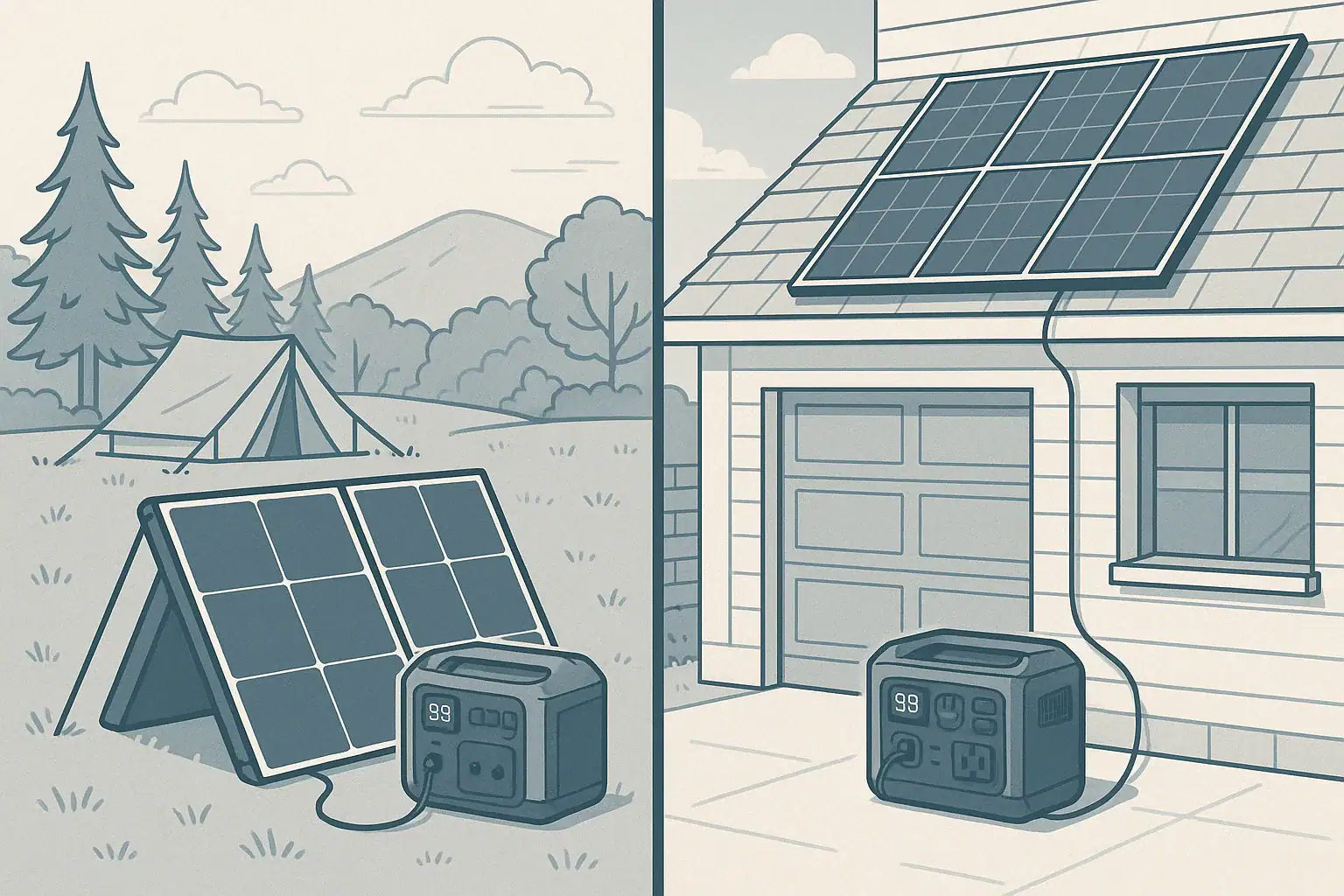
Portable solar panels are usually better for a portable power station if you need mobility and flexible charging, while fixed panels are better if you want maximum daily energy, higher efficiency, and a set‑and‑forget setup. The right choice depends on how much power you need, your input watts limit, your typical runtime needs, and whether your main use is camping, RV, off‑grid backup, or home emergency power.
Both portable and fixed solar kits can keep a power station charged, but they differ in cost per watt, output stability, and how they handle shading, orientation, and seasonal changes. Understanding these differences helps you size your array correctly, avoid undercharging, and pick the right combination of panel wattage, voltage, connectors, and charge controller settings.
This guide compares portable vs fixed solar panels specifically for charging portable power stations, explains how each setup works, and shows what specs matter most before you invest.
Portable vs Fixed Solar Panels: What They Are and Why It Matters
For a portable power station, “portable solar panels” usually means foldable or lightweight rigid panels designed to be moved frequently, while “fixed panels” are rigid modules mounted permanently on a roof, rack, or frame. Both convert sunlight into DC power, but they serve different use cases and charging patterns.
Portable solar panels are built around convenience. They fold or stack for transport, often include kickstands or integrated handles, and are sized so one person can carry and deploy them. Their main role is to recharge a power station in changing locations: campsites, RV parks, job sites, tailgates, or temporary off‑grid cabins.
Fixed solar panels are designed to stay in one place for years. They are mounted on roofs, ground racks, or vehicle roofs and wired into a more permanent system. When paired with a portable power station, fixed panels turn the station into a semi‑permanent battery bank that still remains removable but is usually charged from the same array every day.
This distinction matters because it affects daily energy harvest, total cost, long‑term reliability, and how well your solar input matches the power station’s charging profile. Choosing the wrong type often leads to slow charging, poor runtime, or an overbuilt system that never reaches its potential.
How Solar Panels Work With a Portable Power Station
Both portable and fixed solar panels work the same way at the cell level: sunlight hits photovoltaic cells, generating DC electricity. The main differences for a portable power station are how the panels are wired, how they connect to the DC input, and how well their voltage and wattage match the station’s solar charging specs.
Every power station has a maximum solar input rating, usually listed as watts (W) and a voltage range (V). The internal or external solar charge controller converts panel voltage into the correct charging profile for the battery. If your panel array exceeds the allowable voltage or current, the station may refuse to charge or could be damaged. If the array is undersized, you will never reach the station’s full solar charging speed.
Portable panels are often sold in wattage sizes that align with common input limits, and they typically include MC4 or proprietary connectors plus adapter cables. Fixed panels can be wired in series, parallel, or series‑parallel to hit a specific voltage and current window for the power station’s MPPT or PWM controller.
In real use, solar output is rarely equal to the panel’s rated watts. Temperature, angle to the sun, shading, dust, and cable losses all reduce actual input watts. This is why understanding how panels are rated and how they interact with your power station’s input specs is more important than just picking the highest wattage panel you can afford.
| Feature | Portable Panels | Fixed Panels |
|---|---|---|
| Typical use | Camping, RV, mobile work | Home, cabin, long‑term off‑grid |
| Mounting | Freestanding, temporary | Roof, ground rack, vehicle roof |
| Weight per watt | Lighter, easier to move | Heavier, more robust |
| Output consistency | Variable, depends on setup each day | More consistent once optimized |
| Cost per watt | Higher | Lower |
Solar panel ratings and real‑world output
Solar panels are rated under standard test conditions (STC), which assume a specific temperature and irradiance. In practice, you might see only 60–80% of the nameplate watts during a typical sunny day. Portable panels are more sensitive to poor tilt or casual placement, while fixed panels can be optimized once and left alone, often yielding more consistent daily watt‑hours.
The key concepts that tie everything together for a power station are:
- Input watts limit: The maximum solar power the station can accept at once.
- Voltage window: The acceptable range of panel or array voltage.
- Charge controller type: MPPT is more efficient and flexible than PWM, especially with higher‑voltage strings.
- Daily energy needs: The watt‑hours you must replace each day to avoid slowly draining the battery.
Real‑World Use Cases: When Portable or Fixed Panels Make More Sense
The right choice between portable and fixed solar panels depends heavily on how and where you use your portable power station. Looking at common scenarios makes the trade‑offs clearer.
Camping and overlanding
For car camping, overlanding, and tent camping, portable panels are usually the better match. You can park in the shade while placing the panels in full sun, reposition them every few hours to follow the sun, and pack them away when you move. A pair of 100–200 W portable panels often provides enough solar input to recharge a mid‑size power station used for lights, phones, a small fridge, and camera gear.
Fixed panels on a vehicle roof can also work, but they force you to park in the sun to get good output. If you often move during the day or prefer shaded campsites, portable panels offer more flexibility and can deliver more watt‑hours despite similar rated wattage.
RV, vanlife, and travel trailers
In RVs and vans, both options are common. Fixed roof‑mounted panels provide continuous charging whenever the vehicle is in sun, ideal for topping up the power station during driving or while parked. Portable panels can supplement the roof array when parked in partial shade or during high‑demand days.
For full‑time vanlife, a hybrid approach is often best: a core fixed array sized to cover baseline loads (fridge, fans, devices) plus a portable panel or two for cloudy days or power‑hungry trips. The power station becomes the central battery, fed by both the roof array and portable panels via separate inputs or a combiner that respects voltage and current limits.
Home backup and small off‑grid cabins
When using a portable power station for home backup or a small cabin, fixed panels are usually more effective. A roof or ground‑mounted array can be sized to match typical daily consumption and oriented for the best year‑round performance. Because the power station tends to stay in one location, the extra effort of a fixed installation pays off in more reliable charging and better winter performance.
Portable panels can still play a role as an emergency or seasonal add‑on. For example, you might keep a foldable panel stored indoors for storm outages, then deploy it temporarily to extend runtime. But if you are relying on solar as a primary energy source, fixed panels offer better long‑term value and consistency.
Job sites and mobile work
On job sites, portable panels make sense when the work location changes frequently. Contractors, surveyors, and field technicians can bring a power station plus one or more portable panels to run tools, laptops, and communications gear. The panels can be moved between vehicles or set up near the work area without permanent mounting.
For semi‑permanent job sites, a small fixed array on a trailer, container, or shed can provide a more robust solution. The power station can remain portable, but the solar input is always available and less likely to be misplaced, stolen, or damaged during transport.
Common Mistakes When Pairing Solar Panels With a Power Station
Misconfiguring solar panels with a portable power station can lead to slow charging, error codes, or even damage. Many of these issues are avoidable with a basic checklist.
Oversizing or undersizing solar input
One common mistake is ignoring the power station’s maximum solar input. Connecting far more panel wattage than the station can use does not usually increase charging speed; the charge controller simply clips the excess. In some cases, exceeding voltage limits can trigger protective shutdowns.
On the other hand, undersizing the array is just as problematic. A single 100 W panel may only deliver 60–80 W in real conditions, which can be insufficient to recharge a large power station used heavily each day. This leads to a slow downward drift in state of charge over multi‑day trips.
Voltage and wiring mismatches
Another frequent issue is wiring fixed panels in series or parallel without checking the resulting voltage and current against the power station’s specs. A series string of high‑voltage panels can exceed the station’s input voltage limit, while a large parallel array can push current above safe levels for cables and connectors.
Portable panels are less prone to this because they are often designed with voltage ranges that match common power station inputs, but adding extra panels or mixing different models can still cause problems. Always calculate the open‑circuit voltage (Voc) and short‑circuit current (Isc) of the array and compare them to the station’s stated limits.
Ignoring shading, tilt, and orientation
Users often assume that a panel pointed roughly toward the sun is “good enough.” In reality, partial shading from trees, a roof rack, or nearby objects can dramatically reduce output, especially in series‑wired arrays. Portable panels placed flat on the ground or at a poor angle may only deliver a fraction of their potential.
Fixed arrays that are never adjusted can also underperform if they were installed with a suboptimal tilt or orientation for the location. Over time, this adds up to noticeably less energy and longer recharge times for the power station.
Using the wrong adapters or cable lengths
Long cable runs, undersized wire, or low‑quality adapters can cause voltage drop and connection issues. Portable panels often ship with thin, flexible cables that are convenient but not ideal for long distances. Fixed arrays can suffer from similar problems if wired with cables that are too small for the current.
Signs of trouble include the power station intermittently dropping the solar input, lower than expected watts despite good sun, or connectors that feel warm. Keeping cable runs reasonably short and using appropriately sized wire helps maintain stable charging.
Safety Basics for Portable and Fixed Solar Setups
Solar charging a portable power station is generally safe when you stay within the manufacturer’s electrical limits and use proper mounting and handling practices. The main safety considerations differ slightly between portable and fixed panels.
Electrical safety and input limits
Always verify the power station’s maximum solar voltage, current, and wattage before connecting any panel or array. Exceeding voltage limits is particularly risky and can damage internal components. If you are combining multiple fixed panels, confirm the total open‑circuit voltage at the lowest expected temperatures, when Voc can be highest.
Use connectors and adapters rated for the current they will carry, and avoid homemade cables unless you fully understand polarity, insulation ratings, and strain relief. If you are unsure about wiring a fixed array, consult a qualified electrician or solar installer, especially when mounting on a building.
Mechanical safety: mounting and stability
Portable panels should be placed where wind, pets, or people will not easily knock them over. Kickstands must be stable, and panels should not be leaned against sharp edges that could crack the glass or cells. In high winds, it may be safer to fold and store portable panels rather than risk damage or injury.
Fixed panels require secure mounting with appropriate hardware for the roof or ground structure. Loose or improperly anchored panels can become hazardous in storms. Use mounting systems designed for the panel type and surface, and ensure all bolts and clamps are tightened to specified torque values.
Heat, weather, and fire risk
Both portable and fixed panels can get hot in full sun, but they are designed to operate at elevated temperatures. The greater risk is from flammable materials or damaged wiring nearby. Keep dry leaves, paper, and other combustibles away from the back of panels and cable runs. Inspect for cracked insulation, exposed conductors, or melted connectors and replace any compromised parts.
Portable panels should be kept away from standing water and not used in severe storms. While many panels are weather‑resistant, the connectors and adapters leading to the power station may not be fully waterproof. Avoid placing the power station itself in direct sun or rain; it should remain in a shaded, dry, ventilated area.
Maintaining and Storing Portable vs Fixed Solar Panels
Good maintenance practices help both portable and fixed solar panels deliver closer to their rated output and last longer. The approach differs slightly because of how each type is used and stored.
Cleaning and inspection
Dust, pollen, bird droppings, and grime can noticeably reduce solar output. For both panel types, periodic cleaning with water and a soft cloth or sponge is usually sufficient. Avoid abrasive cleaners, high‑pressure washers, or harsh chemicals that could damage the glass or coatings.
Inspect panels for cracks, delamination, yellowing, or hot spots (areas that appear discolored or unusually warm). Check cables and connectors for corrosion, bent pins, and strain at entry points. Portable panels are more prone to wear at hinges and folding points; fixed panels are more exposed to long‑term UV and weathering.
Storage practices for portable panels
When not in use, portable panels should be folded or stacked according to the manufacturer’s instructions and stored in a dry, cool place. Avoid stacking heavy objects on top of them, which can stress cells and frames. Keep them away from sharp objects that might puncture the surface or wiring.
Coil cables loosely to prevent kinks and avoid tight bends at connectors. If the panels are transported frequently, a padded case can reduce impact damage and extend their useful life.
Long‑term durability of fixed panels
Fixed panels generally have longer service lives and more robust frames, but they are continuously exposed to sun, rain, wind, and temperature swings. Over time, seals, junction boxes, and mounting hardware can degrade. Periodic checks of mounting brackets, roof penetrations, and cable clamps help prevent water ingress and mechanical failure.
Snow and ice loads should be considered in cold climates. While most fixed panels are designed to handle typical snow loads, heavy accumulation can stress mounts. Gently clearing snow, when safe to do so, can restore output and reduce weight on the structure.
| Maintenance Task | Portable Panels | Fixed Panels |
|---|---|---|
| Cleaning frequency | Before/after trips | Every 1–3 months |
| Physical inspection | Check hinges, fabric, cables | Check mounts, seals, wiring |
| Storage | Indoors, dry, folded | Always outdoors, mounted |
| Typical lifespan | Several years with care | 10+ years with proper install |
Related guides: How Many Solar Watts Do You Need to Fully Recharge in One Day? • MC4, Anderson, DC Barrel: Solar Connectors and Adapters Explained • Why Won’t It Charge From Solar? A Troubleshooting Checklist
Which Is Better for Your Power Station? Key Takeaways and Specs to Look For
Choosing between portable and fixed solar panels for a portable power station comes down to how you balance mobility, daily energy needs, and budget. Portable panels excel when you move often, need flexible placement, and value compact storage. Fixed panels are better when you want maximum daily watt‑hours, long‑term reliability, and lower cost per watt.
For many users, a combination works best: a modest fixed array providing baseline charging, plus one or two portable panels for trips, seasonal boosts, or emergencies. Regardless of the mix, aligning your solar array with the power station’s input specs and your actual consumption is more important than the panel style alone.
Specs to look for
- Solar input wattage rating (W): Look for a power station that accepts at least 1.5–2x your typical continuous load in solar watts so you can recharge while using it. This determines how much panel capacity you can effectively use.
- Acceptable input voltage range (V): A wider range (for example, 12–60 V or higher) gives more flexibility in wiring fixed panels in series and improves MPPT efficiency. Staying within this window prevents shutdowns and damage.
- Charge controller type (MPPT vs PWM): MPPT controllers typically recover 10–30% more energy, especially with higher‑voltage arrays or in cold weather. This matters more for fixed systems and larger portable setups.
- Panel wattage and configuration: For portable use, 100–400 W of foldable panels is common; for fixed arrays, 400–1200 W or more may be appropriate. Matching configuration to your input limits maximizes real charging speed.
- Connector type and cable gauge: Standardized connectors (such as MC4) and appropriately sized cables reduce voltage drop and make it easier to expand or reconfigure your system safely.
- Weight and portability (for portable panels): Panels in the range of 5–20 lb per module are easier to set up and move frequently. Lower weight improves usability but may trade off some durability.
- Weather resistance and build quality: Look for panels with robust frames, UV‑resistant materials, and sealed junction boxes, especially for fixed installations. This improves lifespan and maintains output over time.
- Operating temperature range: Panels and the power station should be rated for the temperatures you expect in your climate. Stable performance in heat and cold protects both output and safety.
- Daily energy target (Wh/day): Estimate your consumption and size your total panel wattage so that, in typical sun (4–6 hours of good sun), your array can replace what you use each day. This keeps the battery from slowly draining.
By matching these specs to your actual use case, you can decide whether portable solar panels, fixed panels, or a hybrid setup will keep your portable power station charged reliably and efficiently.
Frequently asked questions
What specs and features should I prioritize when choosing solar panels for a power station?
Prioritize the panel wattage relative to your daily watt‑hour needs, the panel or array voltage range to match the station’s input, and connector compatibility. Also consider charge controller type (MPPT vs PWM), cable gauge to limit voltage drop, and weather resistance for the intended use.
What is the most common mistake people make when pairing panels with a power station?
The most common mistake is mismatching the array size or wiring with the station’s input limits — either oversizing voltage or underestimating real‑world wattage. Ignoring shading, tilt, and cable losses also causes systems to underperform relative to expectations.
What safety precautions should I take when connecting solar panels to a portable power station?
Verify the power station’s maximum voltage, current, and wattage before connecting panels, use properly rated connectors and cable gauge, and avoid exposing connectors and the station to water. For fixed installations or high‑voltage arrays, consult a qualified electrician if you’re unsure about wiring or mounting.
Do portable solar panels produce significantly less energy than fixed panels?
Portable panels can produce less energy in practice because they’re often deployed flat or in suboptimal positions and can suffer more shading and heat buildup. When correctly positioned and angled, portable panels can approach the output of fixed panels, but fixed arrays generally deliver more consistent, optimized daily watt‑hours.
How many solar watts do I need to recharge my power station in a typical day?
Estimate by dividing the watt‑hours you need to recover by the expected peak sun hours (commonly 4–6 hours) and add a margin for system losses (about 20% or more). For example, to replace 1,200 Wh in 5 sun hours you’d want roughly (1,200 / 5) × 1.2 ≈ 288 W of panel capacity, while staying within the station’s input limits.
Can I mix portable and fixed panels on the same power station?
Yes — mixing is common and can be effective, but ensure the combined voltage and current stay within the station’s specifications and that connectors are compatible. Use an MPPT controller or appropriate combiner wiring to manage differing panel characteristics and avoid unsafe overvoltage or current conditions.
Related guides
Browse this topic →
- Beginner-friendly sizing, runtime & specs
- Solar & charging (MPPT, fast charging, cables)
- Batteries (LiFePO4, cycles, care & storage)
- Safety, cold-weather performance, real-world tips
More in Solar
See all →- How to Clean Portable Solar Panels Without Damage
- Solar Charging on Cloudy Days: What Output Can a Portable Power Station Expect?
- How Many Portable Solar Panels Do You Need for a 1,000Wh Power Station?
- Solar Adapter Polarity Mistakes: How to Avoid Reverse-Polarity Charging Problems
- Portable Solar Panel Waterproof Ratings: What Rain, Dew, and Splash Resistance Mean
Keep reading
About this site
Portable Energy Lab publishes practical, independent guides about portable power—clear sizing, safe use, and real-world expectations.
Affiliate disclosure
Some links on this site may be affiliate links. If you buy through these links, we may earn a small commission at no extra cost to you. This helps support our content. Read our affiliate disclosure.