
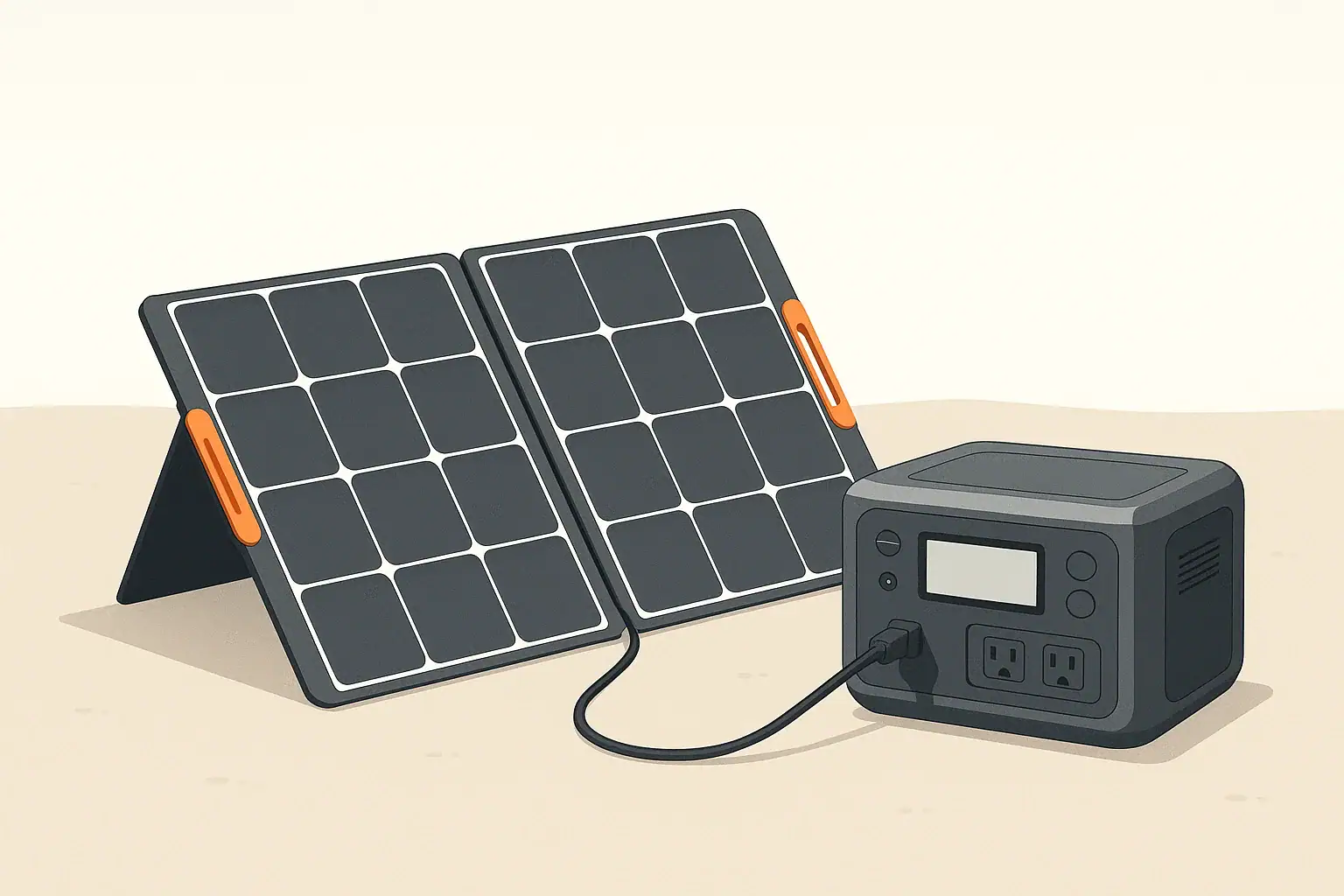
For most small portable power stations, parallel wiring is usually safer and more forgiving, while larger units often benefit from series or series-parallel wiring if their specs allow it. The best choice depends on your power station’s maximum solar voltage, current, and watt limits, plus how many panels you use and how shaded your setup is.
This guide explains solar panel series vs parallel wiring in plain language, focusing on portable power stations, solar generators, and small off-grid setups. You will see how each wiring method changes voltage and current, how to match panel strings to your power station input, and how shade, cable length, and temperature affect real charging speed.
By the end, you will be able to look at a panel label and a power station spec sheet and quickly decide whether series, parallel, or a mix of both makes the most sense for your camping, RV, or backup power system.
What Series and Parallel Mean for Portable Power Stations
When you combine solar panels to charge a portable power station, you can wire them in series, parallel, or a combination of both. These wiring choices change the voltage (V) and current (A) that reach the solar input, even if the total wattage (W) of the array stays similar in ideal sun.
Understanding this matters because every power station has hard limits, such as:
- Maximum solar input voltage (V)
- Maximum solar input current (A), sometimes
- Maximum solar input power (W)
If your series voltage goes too high, you can trip protections or damage the input. If your parallel current goes too high, you can overheat cables or connectors. Getting series vs parallel right helps you:
- Charge as fast as the power station allows, without exceeding limits
- Handle shade and mixed conditions more predictably
- Use reasonable cable sizes and lengths
- Maintain safety margins in hot and cold weather
For portable systems used at home, in vehicles, or at campsites, this is usually less about squeezing out every last watt and more about staying within safe operating windows while keeping the setup simple to use.
How Series and Parallel Wiring Work
direct current (DC) is produced by solar panels. When you connect multiple panels, you can decide whether to add their voltages (series) or their currents (parallel). The basic rules are simple, but the implications for a power station are important.
Series wiring: higher voltage, same current
In a series connection, you connect the positive lead of one panel to the negative lead of the next, forming a chain. The remaining free positive and negative leads go to the power station’s solar input.
- Voltage adds (Vtotal ≈ V1 + V2 + …)
- Current stays roughly the same as one panel
- Power ≈ Vtotal × I (same total watts as parallel in ideal sun)
Example: two similar 100 W panels, each with about 20 V and 5 A under load:
- Series: ~40 V and ~5 A → ~200 W potential in good sun
This higher voltage can be helpful when:
- Your power station allows a higher input voltage window
- You need longer cable runs and want to reduce voltage drop
- You are building a larger roof-mounted or semi-permanent array
The trade-off is that you must pay close attention to the maximum voltage rating of the power station, including cold-weather voltage increases.
Parallel wiring: same voltage, higher current
In a parallel connection, all panel positives are tied together, and all panel negatives are tied together. The combined positive and negative then go to the solar input.
- Voltage stays roughly the same as one panel
- Current adds (Itotal ≈ I1 + I2 + …)
- Power ≈ V × Itotal (again, similar watts in ideal sun)
Using the same example panels:
- Parallel: ~20 V and ~10 A → ~200 W potential in good sun
Parallel wiring tends to be more compatible with smaller power stations because the voltage stays low. However, the higher current means:
- Cables and connectors must be rated for more amps
- Voltage drop over long cables becomes more noticeable
- Heat in undersized wiring can become a safety issue
| Factor | Series wiring | Parallel wiring |
|---|---|---|
| Resulting voltage | Adds with each panel; can approach input voltage limit | Similar to a single panel; usually easier to keep within limits |
| Resulting current | Similar to one panel; often easier on connectors | Adds with each panel; can approach cable and connector ratings |
| Performance in partial shade | One weak panel can drag down the whole string | Each panel contributes more independently; shade impact is localized |
| Long cable runs | Higher voltage reduces percentage loss from voltage drop | Lower voltage is more affected by resistance in long cables |
| Risk focus | More risk of exceeding max voltage, especially in cold weather | More risk of overcurrent and cable heating |
| Typical use | Larger or mid-sized stations with higher voltage input ratings | Small to mid-sized stations with modest voltage limits |
Real-World Examples and Simple Calculations
Once you understand the basics, the next step is to run quick checks using the panel labels and your power station manual. These simple examples show how series vs parallel changes what the device sees.
Example 1: Two 100 W panels and a small power station
Assume each 100 W panel is labeled approximately:
- VOC (open-circuit voltage): 22 V
- Vmp (voltage at max power): 18 V
- Imp (current at max power): 5.5 A
Your small power station lists:
- Max solar input voltage: 24 V
- Max solar input power: 150 W
Series wiring of two panels:
- String VOC ≈ 22 V + 22 V = 44 V → exceeds 24 V limit
- Not safe for this device, even if it might appear to work briefly
Parallel wiring of two panels:
- VOC stays ≈ 22 V → within the 24 V limit
- Imp ≈ 5.5 A + 5.5 A = 11 A
- Panel array could deliver ~18 V × 11 A ≈ 200 W, but the power station will cap at 150 W
In this case, parallel is clearly the better and safer choice.
Example 2: Four 100 W panels and a mid-sized power station
Now assume the same panels, but your power station lists:
- Max solar input voltage: 60 V
- Max solar input current: 15 A
- Max solar input power: 400 W
Option A – All four in parallel:
- VOC ≈ 22 V
- Imp ≈ 4 × 5.5 A = 22 A → exceeds 15 A limit
Option B – Two in series, then those two strings in parallel (series-parallel):
- Each series pair: VOC ≈ 44 V, Imp ≈ 5.5 A
- Two series strings in parallel: VOC ≈ 44 V, Imp ≈ 11 A
- Array power at max: ~18 V × 2 × 5.5 A × 2 ≈ 400 W
This series-parallel arrangement keeps both voltage and current within limits while allowing the power station to use close to its full 400 W solar capacity.
Estimating charge time
A quick way to estimate solar charge time in good sun is:
- Charge time (hours) ≈ Battery capacity (Wh) ÷ Usable solar input (W)
For example, a 1000 Wh power station with about 300 W of real-world solar input might charge in roughly 3–4 hours of strong sun, after accounting for losses and conditions.
| Use case | Typical gear | Likely wiring | Reasoning |
|---|---|---|---|
| Small backup at home | 1–2 portable panels, small power station | Parallel | Low voltage limits; buildings and trees cause partial shade |
| Remote work setup | 2–4 rigid panels, mid-sized station | Series or series-parallel | Higher voltage input, longer cable runs from yard to indoors |
| Weekend camping | 1–2 folding panels, compact station | Parallel | Panels often moved and partly shaded; simple plug-and-play |
| RV or van roof array | 4+ roof-mounted panels, larger station | Series-parallel | Balance voltage and current within controller limits |
Common Mistakes and Troubleshooting Cues
Most problems people see when combining solar panels for a power station come from wiring choices that do not match the device’s specs or from conditions like shade and temperature. Recognizing the symptoms helps you correct them quickly.
Mistake 1: Exceeding maximum input voltage
What it looks like:
- Power station refuses to start solar charging
- Display shows an error code or “over-voltage” message
- Charging works on warm days but fails on cold, bright mornings
Likely cause: Too many panels in series, pushing VOC near or above the rated maximum, especially in cold weather when voltage rises.
Fix:
- Reduce the number of panels in series
- Switch to parallel or series-parallel to stay within the voltage window
- Leave extra voltage headroom instead of designing right at the limit
Mistake 2: Exceeding current limits or using undersized wiring
What it looks like:
- Cables feel warm or hot to the touch during peak sun
- Connectors look discolored or show signs of melting
- Power station input occasionally cuts out under strong sun
Likely cause: Too many panels in parallel or thin extension cables that cannot handle the combined current.
Fix:
- Check the power station’s maximum input current rating
- Reduce the number of parallel panels or move to series-parallel
- Use thicker, outdoor-rated solar cable sized for the expected amps
Mistake 3: Mismatched panels in series
What it looks like:
- Array output is noticeably lower than expected
- One panel is consistently cooler or warmer than the others
Likely cause: Combining panels with very different wattages or current ratings in the same series string. The lowest-performing panel limits the string current.
Fix:
- Use panels of similar voltage and current ratings in each series string
- If you must mix panels, do so in parallel where the impact is smaller
Mistake 4: Underestimating shade and panel placement
What it looks like:
- Solar input drops sharply when a tree, antenna, or roof rack casts a shadow
- Series strings lose most of their output when only one panel is shaded
Likely cause: Series wiring in a location with frequent partial shading, or panels placed at different angles.
Fix:
- Favor parallel wiring where shading is unavoidable
- Reposition portable panels to keep them in consistent sun
- On roofs, plan string layouts to avoid regular shade from vents or racks
Quick troubleshooting checklist
- Verify polarity on all connectors (positive to positive, negative to negative)
- Check panel labels and recalculate string voltage and current
- Test each panel alone to confirm it is producing power
- Inspect all cables and connectors for damage, corrosion, or overheating
Safety Basics for Series and Parallel Solar Wiring
Portable power stations include built-in protections, but they cannot compensate for wiring that ignores basic electrical limits. A few habits go a long way toward safe, reliable operation.
Respect every component rating
- Panels: Do not exceed their rated series fuse or connect them in ways the manufacturer does not support.
- Cables: Use wire gauge that matches or exceeds the maximum expected current.
- Connectors and adapters: Choose parts rated for outdoor DC use and the current of your array.
- Power station input: Never exceed the published voltage or wattage limits.
Think about voltage and shock risk
As you add more panels in series, the open-circuit voltage can climb well above typical low-voltage DC thresholds. While still lower than household AC, higher DC voltage can increase shock risk and arc potential if connectors are mishandled.
- Avoid touching bare conductors when panels are in sun
- Make and break connections with panels covered or out of direct sunlight when possible
- Do not work on wet connectors or cables
Use fuses or disconnects where appropriate
Many simple plug-in setups rely only on the power station’s internal protections. For larger or semi-permanent arrays, adding basic external protection is common practice:
- Inline fuses sized for the string current
- DC disconnect switches to isolate the array before rewiring
If you are unsure how to size or place these components, consulting a qualified electrician or solar professional is recommended, especially for RVs and long-term off-grid systems.
Keep the power station protected from weather and heat
- Operate the power station in a dry, shaded location
- Avoid enclosing it in tight compartments without ventilation
- Keep air vents clear during both charging and discharging
Long-Term Use, Maintenance, and Storage
Series vs parallel wiring is only part of keeping your solar and power station setup working well over time. Basic care of panels, cables, and the power station itself helps maintain performance.
Panel care
- Cleaning: Gently remove dust, pollen, and debris with water and a soft cloth or sponge. Avoid abrasive cleaners.
- Inspection: Check for cracks, delamination, or damaged junction boxes that could affect output or safety.
- Mounting: For roof-mounted panels, periodically verify that brackets and fasteners remain tight.
Cable and connector maintenance
- Inspect cables for cuts, flattened sections, or exposed conductors
- Keep connectors dry and off the ground where possible
- Replace any connector that shows signs of overheating or corrosion
Power station storage
- Store the unit in a cool, dry place when not in use
- Follow the manufacturer’s guidance for long-term battery storage state-of-charge
- Top up the battery periodically if the unit sits unused for months
Seasonal adjustments
- In winter, expect higher panel voltage and lower overall output hours
- In summer, check that cables and connectors are not overheating during long sunny days
- Adjust panel tilt or placement seasonally if practical to improve production
Practical Takeaways and Specs to Look For
Choosing between solar panel series vs parallel wiring for a portable power station is mostly about matching your panels to the device’s input window and your environment.
- Smaller power stations with low voltage limits usually favor parallel wiring.
- Mid-sized and larger units with higher voltage inputs often work best with series or series-parallel.
- Shady or cluttered locations tend to favor parallel; open, sunny spaces can benefit from series.
- Long cable runs are easier to manage with higher voltage (series), as long as you stay within limits.
Specs to look for before deciding on series or parallel
- From the power station:
- Maximum solar input voltage (V) and any stated minimum voltage
- Maximum solar input current (A), if listed
- Maximum solar input power (W)
- Recommended input voltage range for best MPPT performance, if specified
- Supported connector types and any included adapters
- From each solar panel:
- VOC (open-circuit voltage)
- Vmp (voltage at maximum power)
- Imp (current at maximum power)
- Recommended maximum series fuse rating
- For your wiring plan:
- Series string VOC: VOC × number of panels in series, with cold-weather headroom
- Total array current: sum of Imp for parallel strings
- Cable gauge sized for the highest current path
- Expected shade patterns and whether panels can be placed together in full sun
If you can quickly answer these points from your labels and manual, you have everything you need to choose series, parallel, or a mix of both in a way that charges efficiently while staying safely inside the limits of your portable power station.
Frequently asked questions
Which power station and panel specifications matter most when deciding between series and parallel wiring?
Check the power station’s maximum solar input voltage, maximum input current (if listed), and maximum input power. From the panels, note V_OC, V_mp, and I_mp so you can calculate string V_OC and array current and ensure you stay within the station’s limits.
What common wiring mistake causes cable overheating?
Using too many panels in parallel without matching the cable gauge to the higher combined current often causes overheating. The fix is to either reduce parallel strings, reconfigure to series-parallel, or use thicker, outdoor-rated wiring sized for the expected amps.
Is wiring solar panels in series or parallel safer from a general safety perspective?
Neither is inherently safer; each has distinct hazards: series raises voltage which can increase shock and over-voltage risk for the power station, while parallel increases current which can overheat cables and connectors. Choose the method that keeps both voltage and current inside component ratings and use proper fusing and disconnects where appropriate.
How does partial shading affect a series string compared with a parallel array?
In a series string one shaded panel can reduce the current for the entire string, significantly lowering output. In parallel arrays shading tends to affect only the shaded panel’s contribution, making parallel more tolerant of mixed shade conditions.
Will rewiring panels to series always increase charging speed?
Not always — higher series voltage can reduce voltage drop and be beneficial for long runs or higher-voltage inputs, but if it exceeds the power station’s voltage limit it won’t work. Charging speed depends on staying within the station’s voltage, current, and wattage limits and on real-world conditions like sun, temperature, and MPPT efficiency.
Should I add fuses or a DC disconnect for a portable solar setup?
For small, short-term portable setups the power station’s internal protections are often sufficient, but fuses and a disconnect are recommended for larger or semi-permanent arrays. Inline fuses sized to the expected string current and a DC disconnect help isolate the array for safe maintenance and provide an extra layer of protection.
Related guides
Browse this topic →
- Beginner-friendly sizing, runtime & specs
- Solar & charging (MPPT, fast charging, cables)
- Batteries (LiFePO4, cycles, care & storage)
- Safety, cold-weather performance, real-world tips
More in Solar
See all →- How to Clean Portable Solar Panels Without Damage
- Solar Charging on Cloudy Days: What Output Can a Portable Power Station Expect?
- How Many Portable Solar Panels Do You Need for a 1,000Wh Power Station?
- Solar Adapter Polarity Mistakes: How to Avoid Reverse-Polarity Charging Problems
- Portable Solar Panel Waterproof Ratings: What Rain, Dew, and Splash Resistance Mean
Keep reading
About this site
Portable Energy Lab publishes practical, independent guides about portable power—clear sizing, safe use, and real-world expectations.
Affiliate disclosure
Some links on this site may be affiliate links. If you buy through these links, we may earn a small commission at no extra cost to you. This helps support our content. Read our affiliate disclosure.