
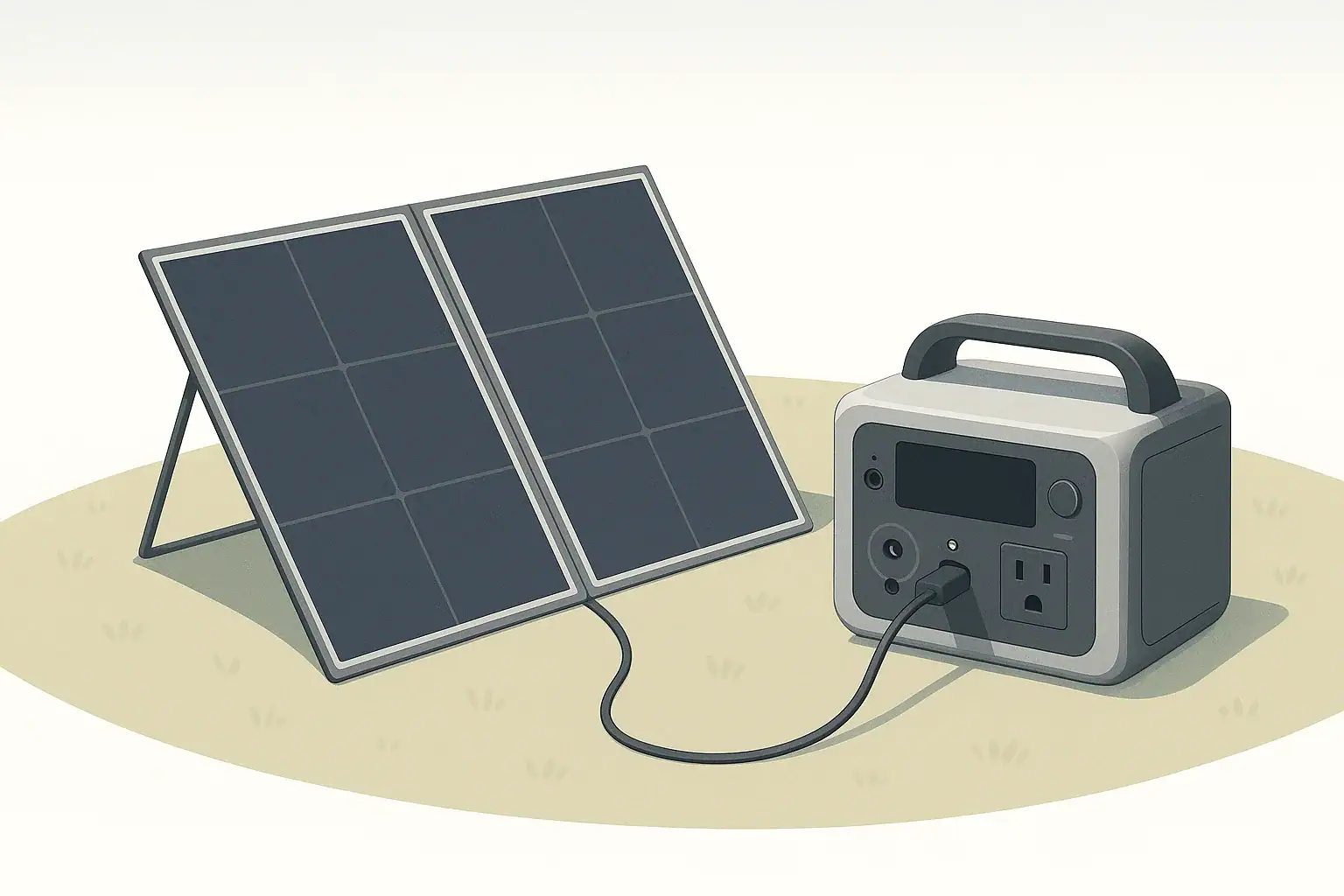
To fully recharge a portable power station in one day, you typically need solar watts equal to your battery capacity (Wh) divided by peak sun hours and then divided by about 0.75 for losses. In plain English, a 1,000 Wh power station in a 4-peak-sun-hour location usually needs around 330–400 W of solar.
This article explains how many solar watts you really need to recharge in a single day, not just in theory but in real outdoor conditions. You will see the core calculation, typical solar panel sizes for common battery capacities, and how weather, efficiency, and input limits change the result.
Whether you are planning off-grid camping, RV boondocking, or home emergency backup, the goal is the same: match your solar panel array to your power station so that daily solar charging keeps up with your daily energy use.
What “Full Recharge in One Day” Really Means and Why It Matters
When people ask how many solar watts they need to recharge in one day, they usually mean this: starting from a low state of charge in the morning and ending the day close to full, using only solar panels. In practice, that depends on both your battery size and your location.
Getting this sizing roughly right matters because it affects:
- How many solar panels you buy and carry
- Whether your battery recovers after a heavy-use day
- How many cloudy days you can ride out before running low
- How often you must fall back to vehicle or wall charging
For many users, the target is not perfection but reliability. If your solar array is too small, your state of charge slowly drifts downward over several days. If it is oversized, you spend more money and deal with bulkier gear than you really need.
Thinking in terms of watt-hours, solar charging watts, and realistic sun hours gives you a clear, repeatable way to answer the question for any portable power station size.
Key Concepts and the Core Solar Sizing Formula
Before doing the math, it helps to separate three ideas that often get mixed up: power, energy, and solar input limits.
Power vs. energy
- Watts (W) measure power, or how fast energy is used or produced at a moment in time. A 100 W panel can deliver up to 100 W in ideal sun.
- Watt-hours (Wh) measure energy, or how much work can be done over time. A 500 Wh battery can theoretically run a 50 W device for 10 hours (50 W × 10 h = 500 Wh).
Portable power station batteries are usually rated in watt-hours. Solar panels are rated in watts.
Peak sun hours (H)
Peak sun hours are not the same as daylight hours. They compress an entire day of changing sunlight into an equivalent number of hours at full sun strength. Typical ranges:
- Cloudy regions or winter: about 2–3 peak sun hours
- Moderate climates: about 3–5 peak sun hours
- Sunny regions or summer: about 5–6+ peak sun hours
Using a realistic, slightly conservative number for your season and location is key to avoiding undersized solar.
System efficiency (η)
Not all solar power reaches the battery. Losses come from panel temperature, non-ideal angle, shading, wiring, and the charge controller. A practical overall efficiency for a portable setup is usually around 70–80%.
We represent this with an efficiency factor η (eta), typically 0.7–0.8.
Solar input limit
Every portable power station has a maximum solar input rating. Even if you connect more panel watts than this rating, the internal electronics will usually cap charging power at that limit.
Two numbers matter:
- Maximum solar input power (W)
- Allowed input voltage and current range
Your calculated “ideal” solar watts must still fit under this maximum input power to be realistically usable.
The core equation
The basic formula to estimate how many solar watts you need to fully recharge in one day is:
Required solar watts ≈ Battery capacity (Wh) ÷ [Peak sun hours (H) × Efficiency (η)]
In symbols:
Required solar watts ≈ C ÷ (H × η)
- C = battery capacity in Wh
- H = peak sun hours per day
- η = system efficiency (0.7–0.8 typical)
Quick sizing table for common capacities
The table below uses a common scenario: 4 peak sun hours and 75% efficiency (η = 0.75). This gives a realistic starting point for many temperate locations in decent weather.
| Battery capacity (Wh) | Typical use case | Approx. solar watts needed* | Typical panel configuration |
|---|---|---|---|
| 300 Wh | Small camping setup, lights, phones | 100 W | One 100 W panel |
| 600 Wh | Light laptop use, fans, lights | 200 W | Two 100 W panels or one 200 W panel |
| 1,000 Wh | Heavier laptop use, small appliances | 330–400 W | Three to four 100 W panels |
| 1,500 Wh | RV or vanlife daily use | 500–600 W | Five to six 100 W panels |
| 2,000 Wh | Extended off-grid or backup power | 650–700 W | Six to seven 100 W panels |
These numbers are starting points. In cloudier climates or winter, you may need to move toward the upper end or beyond these ranges.
Real-World Examples: From Formula to Practical Solar Arrays
Working through a few scenarios makes the calculation easier to apply to your own setup.
Example 1: 300 Wh power station, moderate climate
- Battery capacity C = 300 Wh
- Peak sun hours H = 4
- Efficiency η = 0.75
Required solar watts:
300 ÷ (4 × 0.75) = 300 ÷ 3 = 100 W
In this case, a single 100 W panel is enough to refill the battery from empty in one good-sun day, assuming you are not drawing heavy loads at the same time. If you expect partial shade or occasional clouds, moving to 120–160 W gives a more comfortable margin.
Example 2: 600 Wh power station for weekend camping
- Battery capacity C = 600 Wh
- Peak sun hours H = 4
- Efficiency η = 0.75
Required solar watts:
600 ÷ (4 × 0.75) = 600 ÷ 3 = 200 W
Two 100 W panels or one 200 W panel is a common match. If your daily use is closer to 300–400 Wh instead of the full 600 Wh, you will often end the day at or near 100% charge.
Example 3: 1,000 Wh (1 kWh) power station in a sunny region
- Battery capacity C = 1,000 Wh
- Peak sun hours H = 5 (bright, sunny location)
- Efficiency η = 0.75
Required solar watts:
1,000 ÷ (5 × 0.75) = 1,000 ÷ 3.75 ≈ 270 W
In a very sunny region, a 250–300 W array can be enough for a 1 kWh station to recover fully in one day. If you want more reliability during shoulder seasons, 300–400 W is a more robust choice.
Example 4: 2,000 Wh power station in a cloudy or winter scenario
- Battery capacity C = 2,000 Wh
- Peak sun hours H = 3 (cloudier or winter conditions)
- Efficiency η = 0.7 (more conservative)
Required solar watts:
2,000 ÷ (3 × 0.7) = 2,000 ÷ 2.1 ≈ 950 W
Nearly 1,000 W of solar is required to reliably refill 2,000 Wh in one short, hazy winter day. Many portable power stations cap solar input at much lower levels (for example, 400–800 W), so a true empty-to-full recharge in one day may not be realistic in this scenario. Instead, you might plan to use only 800–1,200 Wh per day and accept a slower, multi-day recovery.
Balancing daily usage and daily solar input
A more practical way to size your system is to match your daily energy use with your daily solar production rather than assuming you always start from empty.
- Daily energy use (Wh) ≈ sum of device watts × hours used
- Daily solar production (Wh) ≈ Panel watts × H × η
For example, if your daily loads total 400 Wh and your solar setup can produce about 600 Wh per day, your battery will generally end each day more charged than it started, except during stretches of poor weather.
Common Mistakes and How to Troubleshoot Slow Solar Charging
Even with the right number of solar watts on paper, real-world charging can be disappointingly slow. Many issues come down to a few repeatable mistakes.
Typical sizing and setup mistakes
- Confusing watts with watt-hours. Buying a 500 W panel for a 500 Wh battery does not guarantee a one-hour recharge; you still need enough sun hours and must account for efficiency.
- Ignoring peak sun hours. Using 6 hours of sun in the math when your location only gets 3–4 peak sun hours leads to chronic undersizing.
- Overlooking the solar input limit. Connecting 600 W of panels to a power station that only accepts 300 W does not double your charging speed in full sun.
- Poor panel placement. Flat panels on the ground, panels in partial shade, or panels pointed away from the sun can cut output dramatically.
- Running heavy loads while charging. If your station is powering a 200 W appliance while solar is only providing 250 W, very little energy is left to refill the battery.
Troubleshooting slow solar charging
Use the station’s input wattage display (if available) to diagnose problems. Compare the number you see to the rated wattage of your panels.
| Observed issue | Likely cause | Practical fix |
|---|---|---|
| Input watts are less than 50% of panel rating at midday | Panel shaded, wrong angle, or heavy cloud cover | Move panels to full sun, tilt toward sun, avoid obstructions |
| Input watts never exceed the station’s listed solar max | Solar array is hitting the built-in input limit | Accept the cap; adding more panels will only help in low light |
| Input watts drop sharply as battery nears full | Charge controller is tapering current at high state of charge | Normal behavior; estimate charge time from 10–80% instead of 0–100% |
| Battery still drains over several days despite panels | Daily loads exceed average daily solar production | Reduce usage, add panel watts within input limit, or add backup charging |
| Panels feel very hot and output is lower than expected | High cell temperature reducing panel efficiency | Allow airflow under panels, avoid placing directly on hot surfaces |
When to increase solar vs. when to change behavior
If your observed input power is close to what the math predicts but you still run short on energy, the issue is usually daily consumption, not panel performance. In that case, either:
- Add more solar watts (within the input rating), or
- Reduce or reschedule heavy loads to align with peak solar hours
If your observed input power is far below expectations, focus first on placement, shading, wiring, and connector issues before buying more panels.
Solar and Battery Safety Basics
Solar charging a portable power station is generally safe, but higher power levels and outdoor conditions introduce risks that are easy to overlook.
Respect voltage and current limits
- Always keep the combined panel voltage and current within the power station’s stated limits.
- When wiring multiple panels, remember that series connections raise voltage and parallel connections raise current.
- Do not assume that “more is better”; exceeding limits can trigger protection circuits or, in extreme cases, damage equipment.
Use appropriate cables and connectors
- Select cables rated for the expected current and length to avoid overheating and excessive voltage drop.
- Keep connectors clean, dry, and fully seated. Loose or corroded connections can heat up under load.
- Avoid improvised or mismatched adapters that may not lock securely.
Protect equipment from weather and heat
- Most portable power stations are not designed to sit in direct rain or heavy condensation. Keep them sheltered while allowing ventilation.
- Do not leave the power station in enclosed, hot spaces (such as a closed vehicle in full sun) while charging.
- Panels can be used outdoors, but inspect them regularly for cracked glass, damaged frames, or compromised junction boxes.
Safe handling and placement
- Secure panels against wind gusts so they do not fall or become projectiles.
- Route cables to avoid tripping hazards and damage from doors, hatches, or sharp edges.
- Disconnect panels from the station before working on wiring changes.
Following these basics helps your solar setup operate safely and consistently, especially at higher wattages where currents and temperatures are higher.
Long-Term Use: Efficiency, Storage, and Seasonal Adjustments
Solar performance and battery behavior change over time. Planning for long-term use helps keep your “full recharge in one day” goal realistic across seasons and years.
Panel aging and cleanliness
- Solar panels slowly lose output over many years, but dirt, dust, and pollen can cause much larger short-term losses.
- Wipe panel surfaces gently with a soft cloth and clean water when you notice visible buildup.
- Avoid abrasive cleaners or rough scrubbing that could scratch the surface.
Battery aging and capacity loss
- Portable power station batteries gradually lose capacity after many charge cycles.
- As usable capacity shrinks, the same solar array will refill the battery faster, but you will have less total energy to work with.
- Plan for some capacity loss over the life of the system when sizing for critical loads.
Seasonal solar strategy
- In summer, you may be able to rely on a “balanced” solar setup that roughly matches your daily usage.
- In winter or at higher latitudes, you may shift to a “heavy” solar approach (more watts than the calculation suggests) or add backup charging.
- Adjust panel tilt seasonally if you have a semi-permanent setup: steeper in winter, flatter in summer.
Storage and transport
- Store the power station in a cool, dry place when not in use, ideally at a partial state of charge rather than completely full or empty.
- Protect foldable panels from sharp bends, creases, or heavy loads during transport.
- Periodically test your full setup (panels + station + cables) before long trips or storm seasons so you are not troubleshooting under pressure.
Putting It All Together: Practical Takeaways and Specs to Look For
By this point, you can estimate the solar watts needed to recharge your portable power station in one day and understand why real-world results may differ from simple math.
- Use the core formula C ÷ (H × η) to get a realistic wattage target.
- Compare that target to your station’s maximum solar input rating.
- Decide whether you want minimal, balanced, or heavy solar coverage based on how critical your loads are and how variable your weather is.
As a quick guideline if your station’s input limit allows it:
- Minimal solar (occasional top-ups): around 25–50% of the calculated watts
- Balanced solar (typical full-day recovery): around 70–120% of the calculated watts
- Heavy solar (high reliability or poor weather): 150% or more of the calculated watts
Specs to look for when choosing a power station and solar panels
When you are comparing options, these specifications directly affect how many solar watts you can use and how quickly you can recharge:
- Battery capacity (Wh): The starting point for the solar sizing formula. Match this to your daily energy needs plus some margin.
- Maximum solar input power (W): Sets the ceiling on how many panel watts you can effectively use in full sun.
- Supported input voltage range (V): Determines how you can wire panels (series, parallel) and what panel types are compatible.
- Maximum input current (A): Important when wiring panels in parallel; total current must stay below this limit.
- Built-in charge controller type: A good MPPT controller can improve real-world efficiency compared with simpler designs, especially in variable conditions.
- Display of input/output watts: Makes it much easier to troubleshoot solar performance and adjust panel placement.
- Supported connector types: Check that the station and panels can connect cleanly without excessive adapters.
- Operating temperature range: Important for both the battery and the charge controller if you plan to use the system in hot or cold environments.
Focusing on these specs, combined with the sizing method in this guide, will help you choose a portable power station and solar panel setup that can realistically recharge in one day under the conditions you actually expect to see.
Frequently asked questions
Which power station and solar panel specifications most affect whether you can recharge fully in one day?
Battery capacity (Wh), the number of peak sun hours at your location, overall system efficiency (losses from wiring, angle, temperature, and controller), and the power station’s maximum solar input rating are the primary factors. Together these determine the required panel wattage and whether the station can accept that power in full sun.
What is a common setup mistake that causes slow or incomplete recharging?
A frequent error is confusing panel watts with battery watt-hours and/or using optimistic peak sun hours in the math. Other common mistakes include poor panel placement, partial shading, and exceeding or overlooking the power station’s solar input limits.
What basic safety steps should I take when charging a power station with solar panels?
Respect the station’s voltage and current limits, use appropriately rated cables and connectors, and keep the station sheltered from direct rain while allowing ventilation. Secure panels against wind and avoid loose or corroded connections to reduce fire and damage risks.
How do peak sun hours change the amount of solar watts I need?
Peak sun hours appear in the denominator of the sizing equation, so fewer peak sun hours mean you need proportionally more panel watts to deliver the same energy. Use conservative peak sun hour estimates for winter or cloudy climates to avoid undersizing.
Can I simply add more panels if my power station charges slowly?
Only up to the station’s maximum solar input—adding panels beyond that will not increase the charge rate in full sun, though it can help maintain output in low-light conditions. If you need faster charging, check the input limits and consider a station with a higher accepted input or change usage patterns.
How can I quickly diagnose why observed input watts are much lower than panel ratings?
Check for shading, incorrect tilt or orientation, hot panel temperatures, loose or undersized cables, and whether the station is hitting its built-in solar input cap. Use the station’s input wattage display (if available) to compare expected vs. actual and isolate the issue.
Related guides
Browse this topic →
- Beginner-friendly sizing, runtime & specs
- Solar & charging (MPPT, fast charging, cables)
- Batteries (LiFePO4, cycles, care & storage)
- Safety, cold-weather performance, real-world tips
More in Solar
See all →- How to Clean Portable Solar Panels Without Damage
- Solar Charging on Cloudy Days: What Output Can a Portable Power Station Expect?
- How Many Portable Solar Panels Do You Need for a 1,000Wh Power Station?
- Solar Adapter Polarity Mistakes: How to Avoid Reverse-Polarity Charging Problems
- Portable Solar Panel Waterproof Ratings: What Rain, Dew, and Splash Resistance Mean
Keep reading
About this site
Portable Energy Lab publishes practical, independent guides about portable power—clear sizing, safe use, and real-world expectations.
Affiliate disclosure
Some links on this site may be affiliate links. If you buy through these links, we may earn a small commission at no extra cost to you. This helps support our content. Read our affiliate disclosure.