
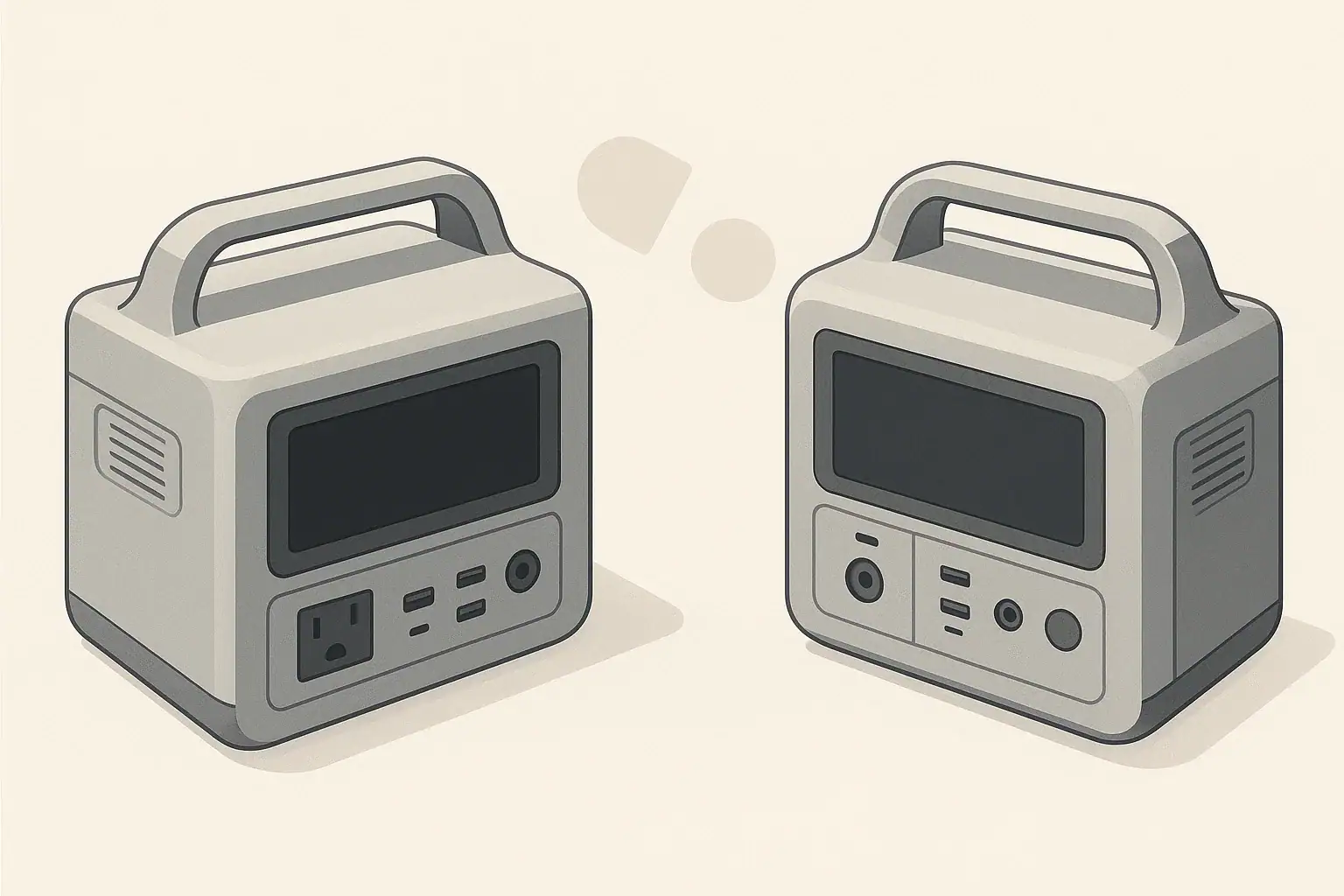
MPPT solar charging usually gives a portable power station noticeably faster and more consistent charging than PWM from the same solar panels. In real life that means shorter charge times, better performance in weak sun, and more flexibility in how you wire and place your panels.
This guide explains what MPPT and PWM actually do inside a portable power station, how much difference they make in watt-hours and hours of charging time, and when a simpler PWM input is still good enough. You will see plain-language examples, simple calculations, and typical use cases like camping, RV setups, and emergency backup power.
By the end, you will know how to read solar input specs, avoid common mistakes that slow charging, and decide whether it is worth paying more for MPPT in your next portable power station or solar generator.
What MPPT and PWM Mean and Why They Matter
A portable power station that accepts solar needs a built-in solar charge controller. That controller is almost always one of two types: PWM (pulse width modulation) or MPPT (maximum power point tracking). Both protect the battery and manage charging, but they do it in different ways that directly affect how much energy you actually store each day.
In simple terms:
- PWM is simpler and cheaper but wastes more of the panel’s potential power, especially when panel voltage is much higher than the battery voltage.
- MPPT is more advanced and usually harvests about 15–30% more energy from the same panels, especially in cold weather, weak sun, or partial shade.
Why this matters in real life:
- Charging speed: MPPT can turn a “barely keeps up” solar setup into one that reliably refills the battery in a day of sun.
- Panel flexibility: MPPT lets you use higher-voltage panels or series wiring to reduce cable losses.
- Reliability of power: If you depend on solar for fridges, communication gear, or medical devices, the extra harvest from MPPT can be the difference between full and flat by morning.
If you only use solar occasionally, PWM can still be acceptable. But if solar is your main charging method, understanding MPPT vs PWM helps you choose a portable power station that matches your expectations.
Key Concepts: How MPPT and PWM Work With Solar Panels
To understand why MPPT usually wins, it helps to look at what the controller does with voltage and current between the solar panels and the battery inside your portable power station.
What the Solar Charge Controller Actually Does
Inside the power station, the solar charge controller:
- Limits voltage and current to protect the battery from overcharging.
- Manages charging stages for battery health (fast charge, then slower topping, then maintaining).
- Tries to use the available solar power as effectively as its design allows.
The difference is how PWM and MPPT “use” the panel’s voltage and current.
PWM: Simple Voltage Matching
A PWM controller connects the panel to the battery and rapidly switches the connection on and off to control average current. It effectively drags the panel voltage down close to the battery voltage.
- If the panel’s best operating voltage (Vmp) is much higher than the battery voltage, the extra voltage is mostly lost.
- The panel is forced to run away from its most efficient point on the voltage–current curve.
- Electronics are simple and inexpensive, which is why PWM often appears in smaller or budget power stations.
MPPT: Actively Finding Maximum Power
An MPPT controller continuously measures panel voltage and current and adjusts the operating point to stay near the panel’s maximum power point.
- It runs the panel at or near Vmp, where voltage and current multiply to the highest wattage.
- A DC–DC converter inside steps the higher panel voltage down to the battery voltage while increasing current.
- As sunlight changes (clouds, angle, temperature), it retunes the operating point to keep power output close to the maximum available.
Energy Harvest in Numbers
Under many real-world conditions, MPPT can harvest roughly 15–30% more energy than PWM from the same panels. The exact gain depends on:
- How much higher the panel voltage is than the battery voltage.
- Temperature (panels run at higher voltage when cold).
- Cloud cover, shade patterns, and time of day.
- Cable length and wire thickness (voltage drop).
In cold, clear conditions with higher-voltage panels, the gain can be on the higher end. In very hot conditions with low panel voltage and short cables, the gain can be smaller but usually still present.
Real-World Examples and Typical Use Cases
Numbers are easier to understand with concrete examples. The following scenarios use rounded values to show how MPPT vs PWM changes daily energy harvest and charging time.
Example 1: Single 100 W Panel and a Mid-Size Power Station
Assume:
- Solar panel: 100 W, Vmp 18 V, Imp 5.5 A.
- Battery charging voltage inside the power station: about 13 V.
- Good sun: 5 hours of strong midday-equivalent sunlight.
Approximate power into the battery:
- PWM: Panel is pulled to about 13 V. Power ≈ 13 V × 5.5 A ≈ 71.5 W.
- MPPT: Panel runs near 18 V. Power ≈ 18 V × 5.5 A ≈ 99 W, minus some conversion loss.
Over 5 sun hours:
- PWM: about 70 W × 5 h ≈ 350 Wh into the battery.
- MPPT: about 90–95 W × 5 h ≈ 450–475 Wh into the battery.
On a 500 Wh power station, that can mean the difference between almost full in one day (MPPT) versus needing part of a second day (PWM).
| Setup | Controller Type | Effective Panel Power (W) | Daily Energy (Wh, 5 sun hours) | Approx. Time to Charge 500 Wh |
|---|---|---|---|---|
| 100 W panel | PWM | ~70 W | ~350 Wh | About 1.4 days of good sun |
| 100 W panel | MPPT | ~90–95 W | ~450–475 Wh | About 1 day of good sun |
| 200 W panels | PWM | ~140 W | ~700 Wh | About 0.8 day of good sun |
| 200 W panels | MPPT | ~180–190 W | ~900–950 Wh | About 0.6 day of good sun |
Example 2: Long Cable Run to a Sunny Spot
Imagine your power station sits inside a van or tent, but your panels are 10–15 meters away in full sun.
- PWM setup: Panels wired for low voltage (close to battery voltage). Current is relatively high, so voltage drop in the long cable eats into your power. You may lose 10% or more unless you use thick, heavy cable.
- MPPT setup: Panels wired in series for a higher voltage (within the power station’s limit). Current is lower, so the same cable has less voltage drop and you deliver more power to the controller.
In practice, this can be the difference between the station finishing its charge before sunset versus still being short by evening.
Example 3: Cloudy or Partially Shaded Days
On days with moving clouds or partial shade:
- PWM: Panel voltage and current both sag, and the controller simply follows the battery voltage. Output can drop sharply and stay low until conditions improve.
- MPPT: The controller re-scans the panel’s voltage–current curve and finds a new point that still delivers as much power as conditions allow. You may not get full rated power, but you typically get more than with PWM.
If you are relying on solar to run a fridge or communication gear in poor weather, this extra harvest can be very noticeable over a multi-day trip.
Common Mistakes and Troubleshooting Slow Solar Charging
Many “my solar is not working” problems turn out to be configuration issues rather than defective hardware. MPPT and PWM each have their own common pitfalls.
Frequent Mistakes With PWM Inputs
- Using very high-voltage panels: A PWM controller will drag the panel voltage down to near battery voltage and throw away the extra. The result: you paid for panel wattage you can never use.
- Long, thin cables: Because current is relatively high at low voltage, thin or very long cables cause large voltage drops and wasted power.
- Overestimating charge speed: People often size panels based on the printed wattage, then discover the PWM controller only delivers 60–75% of that into the battery.
Frequent Mistakes With MPPT Inputs
- Exceeding input voltage: Wiring too many panels in series can push the solar input above the controller’s maximum voltage rating, risking shutdown or damage.
- Ignoring shading patterns: One panel in deep shade in a series string can pull the whole string down. MPPT cannot create power that the panels are not producing.
- Expecting miracles in very poor sun: MPPT is more efficient, but it still needs a minimum amount of light. In heavy overcast, both PWM and MPPT will produce limited power.
Simple Troubleshooting Cues
If your portable power station charges slowly from solar, work through these checks:
- Panel orientation: Is the panel broadly facing the sun, not lying flat or shaded?
- Cables and connectors: Are all plugs fully seated, with no bent pins or damaged insulation?
- Input limits: Is the total panel wattage and voltage within the power station’s stated solar input range?
- Battery state: Charging always slows down as the battery nears full. Compare speed at 20–50% charge versus 90–100%.
- Controller type vs expectation: If your unit uses PWM, mentally reduce the panel’s rated watts by around 25–35% when estimating charge times.
| Symptom | Likely Cause | Quick Check or Fix |
|---|---|---|
| Solar input shows much lower watts than panel rating | PWM controller or poor sun angle | Confirm controller type; re-aim panel toward sun and compare midday readings |
| Solar input drops to zero intermittently | Loose connector or panel cable strain | Inspect and reseat all connectors; reduce cable tension |
| Unit will not accept solar at all | Panel voltage outside allowed range | Measure open-circuit panel voltage; compare with solar input spec |
| Panels far away, charging slower than expected | Voltage drop in long, thin cables | Use thicker cable or higher-voltage array with MPPT (within limits) |
| Good sun but sudden large power dips | Moving shade from trees, poles, or people | Watch panel surface for shadows; reposition if needed |
Safety Basics for Solar Charging and Controllers
Whether your portable power station uses MPPT or PWM, safe solar charging comes down to staying within the unit’s limits and handling DC power carefully.
Respect Voltage and Power Limits
- Do not exceed maximum solar input voltage: Going above the rated input voltage can instantly damage the controller. This is especially important when wiring panels in series for an MPPT input.
- Stay within maximum solar wattage: Oversizing the array far beyond the rated wattage can cause the unit to run hot or shut down. A modest amount of oversizing is often tolerated, but check the specs.
- Match connectors and polarity: Reversed polarity on DC connectors can damage internal electronics. Always double-check markings before plugging in.
Manage Heat and Ventilation
- Keep the power station ventilated: Both MPPT and PWM controllers generate heat while converting power. Do not cover the unit or block vents while charging at high solar input.
- Avoid direct hot sun on the unit: It is fine for panels to be in full sun, but the power station itself will run cooler and last longer if shaded and ventilated.
Safe Handling of Panels and Cables
- Secure panels in wind: A loose panel can flip, damage connectors, or injure someone.
- Protect cables from pinch points: Avoid running cables through doors or windows that can crush insulation.
- Disconnect safely: If you need to unplug panels under load, grip connectors firmly and avoid pulling on the cable itself.
These practices apply regardless of controller type. MPPT does not inherently require more safety precautions than PWM, but higher-voltage arrays for MPPT deserve extra attention to correct wiring and insulation.
Long-Term Use, Maintenance, and Seasonal Considerations
Good habits around storage, cleaning, and seasonal use help both MPPT and PWM systems perform closer to their potential over time.
Panel Care and Cleaning
- Keep panel surfaces clean: Dust, pollen, and bird droppings reduce output. A soft cloth and clean water usually suffice.
- Inspect for micro-cracks: After drops or impacts, check panels for broken glass or delamination, which can lower performance or create hot spots.
Battery and Controller Health Over Time
- Avoid constant 0–100% cycles: Deep cycling every day can age the battery faster. If possible, operate between roughly 20–80% state of charge for daily use.
- Store partially charged: For long-term storage, many manufacturers recommend storing around 40–60% charge and topping up every few months.
- Monitor for unusual heat: During high solar input, the unit should be warm but not excessively hot. Persistent overheating suggests you are pushing limits or blocking ventilation.
Seasonal Adjustments
- Winter: Short days and low sun angles reduce total energy, but cold panels run at higher voltage. MPPT benefits tend to be larger in these conditions.
- Summer: Longer days but hotter panels mean slightly lower voltage. Expect both MPPT and PWM to run closer to their rated power at midday, with MPPT still ahead.
- Travel and storage: When transporting, protect panel faces and avoid sharp bends in cables to prevent long-term damage that silently reduces output.
Practical Takeaways and Specs to Look For
Choosing between MPPT and PWM in a portable power station comes down to how much you rely on solar and how constrained your environment is.
- Heavy or primary solar use: MPPT is usually worth it for campers, RV users, off-grid cabins, and anyone running fridges or critical loads from solar.
- Occasional or backup solar use: PWM can be acceptable if you mostly charge from AC or vehicle power and just want solar as a slow top-up.
- Space-limited setups: If you cannot add more panel area, MPPT’s extra 15–30% harvest is effectively “free panel upgrade” from the same footprint.
Specs to Look For on the Data Sheet
When comparing portable power stations, scan the solar section of the spec sheet for these details:
- Controller type: Look for explicit wording like “MPPT solar charge controller.” If nothing is mentioned, assume PWM or confirm in the manual.
- Maximum solar input power (W): This tells you the largest practical array size. More watts usually means faster charging if you can supply them.
- Solar input voltage range (V): A wider range and a higher maximum voltage make it easier to wire panels in series and reduce cable losses, especially with MPPT.
- Maximum solar input current (A): Important when using low-voltage, high-current arrays or PWM inputs where current is naturally higher.
- Connector type and rating: Ensure the physical connector and adapter cables can safely handle the expected current.
- Published solar charging times: Compare claimed charge times from a stated panel wattage. If they seem optimistic, remember that PWM will deliver less than the panel’s printed wattage.
Align these specs with how you plan to use the power station: how often you see full sun, how much panel area you can deploy, how far panels sit from the unit, and how critical it is that the battery reaches full each day. With that information, the choice between MPPT and PWM becomes a practical decision instead of a confusing acronym.
Frequently asked questions
Which solar input specifications should I check when choosing a portable power station?
Check the controller type (MPPT or PWM), the maximum solar input power (watts), the supported input voltage range, and the maximum input current. Also confirm connector types and any published solar charging times so you can match the station to your panel array and expected conditions.
Why is my solar charging much slower than the panel’s rated wattage?
Slower charging is often due to mismatches between panel Vmp and the controller (especially with PWM), cable voltage drop, shading, or the battery already being near full. Verify wiring, orientation, and controller type, and measure input watts at midday to isolate the cause.
Are there safety risks when wiring panels for MPPT or using higher-voltage arrays?
Yes—wiring panels in series can raise open-circuit voltage above the controller’s maximum and risk damage or failure. Always stay within the power station’s voltage and wattage limits, use proper insulation and connectors, and avoid exposing the unit to blocked ventilation or extreme heat while charging.
How much faster will MPPT charge compared with PWM in real use?
MPPT typically harvests about 15–30% more energy than PWM under many real-world conditions, which translates to noticeably faster charge times. The exact gain depends on panel voltage relative to battery voltage, temperature, shade, and cable losses.
Can I mix different solar panels or combine series and parallel wiring with a portable power station?
Mixing panels with different voltages or currents can cause mismatches that reduce output; it’s best to use panels with similar Vmp and current ratings. Series wiring increases array voltage (watch the controller’s max voltage) while parallel wiring increases current (watch max input current), so plan wiring to stay within limits.
How important are cable length and wire gauge for solar charging efficiency?
Very important—long or thin cables cause voltage drop and reduce power at the controller, especially with low-voltage (PWM-style) setups. Use thicker cable or run panels at higher voltage (within the controller’s allowed range) to reduce losses and improve delivered power.
Related guides
Browse this topic →
- Beginner-friendly sizing, runtime & specs
- Solar & charging (MPPT, fast charging, cables)
- Batteries (LiFePO4, cycles, care & storage)
- Safety, cold-weather performance, real-world tips
More in Comparison
See all →Keep reading
About this site
Portable Energy Lab publishes practical, independent guides about portable power—clear sizing, safe use, and real-world expectations.
Affiliate disclosure
Some links on this site may be affiliate links. If you buy through these links, we may earn a small commission at no extra cost to you. This helps support our content. Read our affiliate disclosure.