
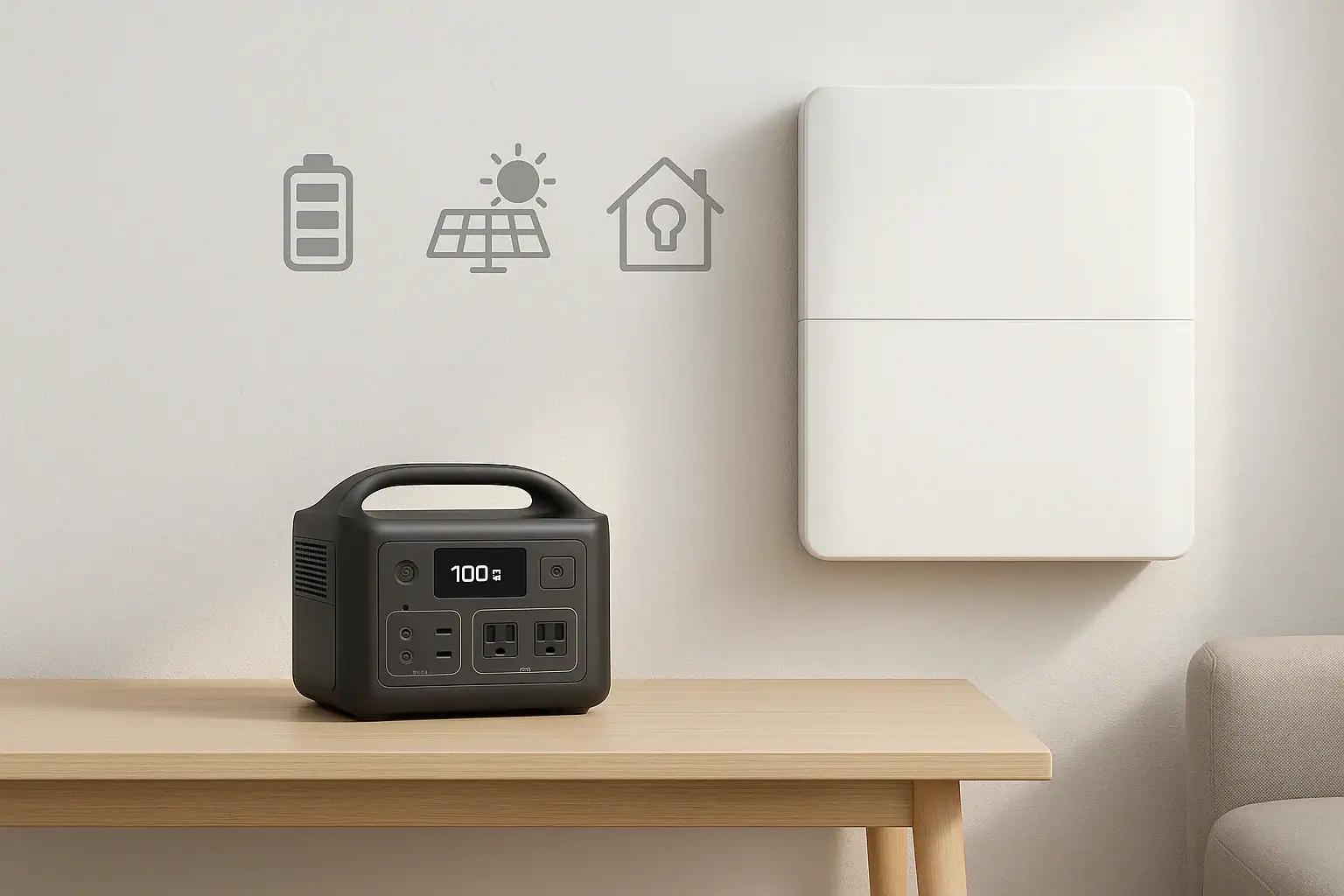
Choosing between a portable power station and a home battery mainly comes down to how much power you need, how long you need it, and whether portability or whole-home backup matters more. Both store energy in batteries, but they differ in capacity, output watts, runtime, surge handling, and how they connect to your home.
People compare these options when planning for outages, off-grid cabins, RVs, camping, and solar storage. Search terms like “backup power”, “surge watts”, “runtime”, “solar charging”, and “inverter size” all point to the same question: which system better fits your real-world loads? This guide breaks down how each works, what they are best at, and which technical specs matter most so you can match the right solution to your devices, budget, and safety needs.
Portable Power Station vs Home Battery: What They Are and Why It Matters
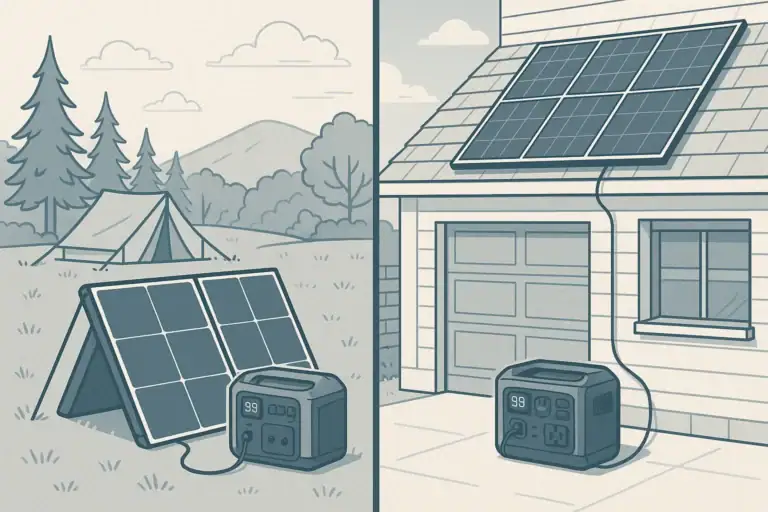
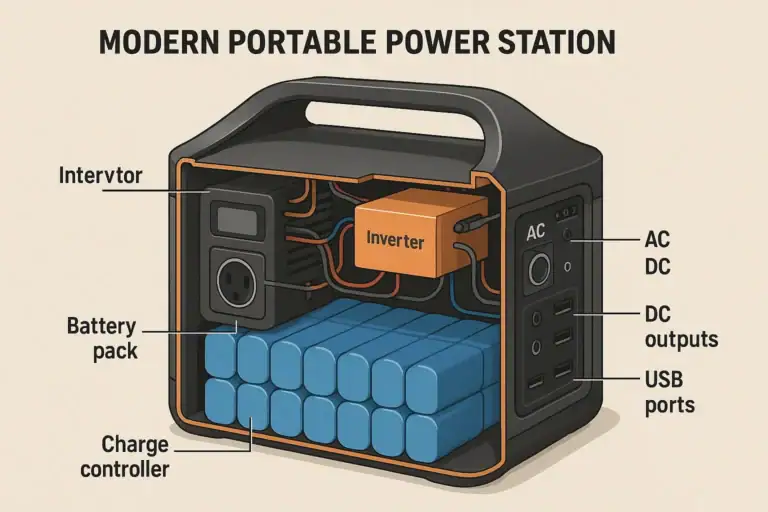
A portable power station is a self-contained, plug-and-play battery unit with built-in inverter, charge controller, and multiple output ports (AC, DC, USB). It is designed to be carried or moved, powering individual devices like laptops, fridges, CPAP machines, power tools, and small appliances during outages, travel, or outdoor use.
A home battery, by contrast, is typically a larger, often wall-mounted or floor-mounted system designed to work with a building’s electrical system. It is usually installed in a fixed location, often paired with solar panels, and sized to support critical circuits or, in some cases, almost the entire home for a set number of hours.
This distinction matters because:
- Use case: Portable power stations shine for flexible, device-level backup and mobility; home batteries are better for integrated, automatic backup of home circuits.
- Scale: Portable units typically offer hundreds to a few thousand watt-hours, whereas home batteries often start around several kilowatt-hours and scale up from there.
- Connection: Portable units plug into devices directly; home batteries are usually wired into a subpanel or backup system by an electrician.
- Cost and complexity: Portable power is relatively simple and modular; home batteries involve higher upfront cost, permitting in some areas, and professional installation.
Understanding these core differences helps you decide whether you need a flexible power “appliance” you can move around, or a permanent energy storage system that quietly protects your home in the background.
How Portable Power Stations and Home Batteries Work
Both portable power stations and home batteries use rechargeable battery cells, but they are packaged and managed differently.
Portable power station basics
- Battery chemistry: Often lithium-ion or lithium iron phosphate (LiFePO4), chosen for energy density, weight, and cycle life.
- Inverter: Converts DC battery power into AC power, usually pure sine wave, with a rated continuous watt output and a higher surge watt rating for startup loads.
- Battery management system (BMS): Protects against overcharge, over-discharge, overcurrent, and overtemperature.
- Charging inputs: Commonly AC wall charging, car DC input, and solar input via an integrated or external charge controller.
- Outputs: AC outlets, DC barrel ports, 12 V car socket, and USB/USB-C (including high-wattage PD profiles).
Runtime is roughly calculated as battery capacity (watt-hours) divided by load (watts), adjusted for inverter and system losses. For example, a 1,000 Wh unit running a 100 W load might deliver several hours of runtime in practice.
Home battery basics
- Higher capacity: Typically several thousand watt-hours (kWh scale), often stackable for more storage.
- Hybrid inverter or separate inverter: Manages both solar input (if present) and AC output to home circuits.
- Integration with home electrical system: Usually connected to a backup or critical loads panel via a transfer mechanism designed and installed by an electrician.
- Energy management: Some systems manage time-of-use shifting, charging from solar or the grid when rates are lower and discharging when rates are higher or during outages.
In both systems, the basic flow is: charge the battery from a source (grid, solar, generator, or vehicle), store the energy, then convert it to a usable voltage and waveform for your devices or home circuits when needed.
| Feature | Portable Power Station | Home Battery System |
|---|---|---|
| Typical Capacity | 300–3,000 Wh | 5–20 kWh (5,000–20,000 Wh) |
| Continuous Output | 200–2,000 W | 3–10 kW |
| Portability | Carriable, sometimes with handles/wheels | Fixed, wall or floor mounted |
| Installation | Plug-and-play, DIY-friendly | Professional installation recommended |
| Use Case | Camping, RV, small outage backup | Whole-home or critical loads backup |
Real-World Scenarios: When Each Option Makes More Sense
Looking at concrete scenarios makes the portable power station vs home battery decision much clearer.
Short outages and apartment living
If you live in an apartment or rental where you cannot modify electrical panels, a portable power station is usually more practical. It can power essentials like a Wi-Fi router, laptops, phones, lights, and a small fan or compact fridge during a brief grid failure. You simply plug devices directly into the unit and recharge it later from the wall or portable solar.
A home battery would typically require landlord approval, building rules compliance, and professional installation, which is often not feasible in multi-unit buildings.
Single-room or critical device backup
For medical equipment like a CPAP machine, small sump pump, or work-critical electronics, a mid-sized portable power station can be dedicated to that device or a small cluster of loads. You can move it between rooms, vehicles, or even take it on trips, maintaining flexibility and redundancy.
A home battery can also support these devices, but it does so indirectly through wired circuits. If you only need a few hundred watts for a few hours, a full home battery may be more than you need.
Whole-home resilience and longer outages
In areas with frequent or multi-day outages, a home battery paired with solar can keep critical circuits running for much longer than most portable units. It can automatically power refrigerators, well pumps, select outlets, and lighting circuits without needing to move cords around the house.
A large portable power station can still help, especially when combined with solar panels or a generator, but you may need to prioritize loads more aggressively and manually manage which devices are plugged in.
Off-grid cabins, RVs, and mobile setups
For RVs, vans, and small off-grid cabins, both options are viable, but the balance changes:
- Portable power station: Great for RVs and vans where plug-and-play simplicity and mobility matter. You can charge from the alternator, solar, or shore power, and bring the unit outside for tools or outdoor cooking.
- Home battery style system: Makes sense for a fixed cabin or tiny home where you want a more permanent installation with higher capacity and possibly integration with a small AC distribution panel.
Time-of-use and bill management
If your primary goal is to reduce electricity bills by storing cheap energy and using it when rates are high, a home battery tied into your electrical system is generally more effective. It can automatically charge and discharge based on schedules or smart controls. Portable power stations can be used for this in a manual way, but they are not optimized for whole-home energy arbitrage.
Common Mistakes When Choosing or Using Each System
Many issues with both portable power stations and home batteries come from mismatched expectations or misreading specs.
Underestimating power and energy needs
- Confusing watts and watt-hours: Watts relate to how much power a device needs at a moment; watt-hours describe how long a battery can supply that power. Users often buy based on watt output alone and then are disappointed by runtime.
- Ignoring surge watts: Devices with motors or compressors (fridges, pumps, some power tools) can draw 2–3 times their running watts at startup. If the inverter’s surge rating is too low, the device may fail to start or trip protections.
Overloading outlets and circuits
On portable power stations, plugging too many devices into the AC outlets can exceed the continuous output rating, triggering overload shutdowns. On home batteries, trying to back up too many circuits at once can exceed the inverter capacity, especially if several high-watt loads run simultaneously.
Assuming whole-home coverage from a small system
A frequent mistake is assuming that any battery system, once installed, will run an entire house as if the grid were still available. In reality, even large home batteries are usually configured to support critical loads, not every high-draw appliance at once. Portable power stations, meanwhile, are best treated as targeted backup for specific devices, not full household replacements.
Charging and input misunderstandings
- Overestimating solar input: Nameplate solar panel wattage is rarely achieved in real conditions. Users may expect a portable power station or home battery to recharge much faster than is realistic.
- Ignoring input limits: Both systems have maximum charge input limits. Exceeding these (for example, by oversizing solar arrays without proper configuration) can lead to throttling or protective shutdowns.
Troubleshooting cues to watch for
- Frequent overload shutdowns: Indicates loads are too high for the inverter size; consider reducing devices or upsizing the system.
- Rapid battery drain: Suggests that total load watts are higher than expected or capacity is too small for the intended runtime.
- Slow charging: May reflect limited input wattage, poor sunlight, long cable runs, or conservative charge profiles designed to protect battery life.
- Unusual heat or fan noise: Often a sign the system is working near its limits; reduce loads and ensure adequate ventilation.
Safety Basics for Portable Power Stations and Home Batteries
Both portable power stations and home batteries are engineered with multiple safety layers, but they still store significant energy and should be treated with respect.
General battery safety
- Follow manufacturer ratings: Do not exceed specified watt or current limits, and use only recommended charging methods.
- Avoid extreme temperatures: High heat accelerates battery degradation and can trigger thermal protections; very low temperatures can reduce performance and, in some cases, limit charging.
- Keep units dry: Most consumer systems are not designed for heavy moisture or direct rain. Use them in dry, ventilated locations and protect from condensation.
Ventilation and placement
Both types of systems contain electronics and inverters that generate heat. Place them where airflow is not blocked, away from flammable materials. For home batteries, installers typically follow clearance guidelines to maintain safe operation.
Electrical integration and backfeed risks
Home batteries that connect to a home’s wiring must be installed with proper transfer mechanisms to avoid backfeeding the grid during outages. Backfeed can endanger utility workers and damage equipment. Any connection to a home panel or critical loads subpanel should be designed and installed by a qualified electrician, following local codes and permitting requirements.
Portable power stations should not be connected to wall outlets or home circuits in improvised ways. Instead, plug devices directly into the unit’s outlets or use appropriately rated extension cords to individual devices.
Handling and physical safety
- Avoid dropping or crushing: Mechanical damage can compromise enclosures and internal protections.
- Do not open the enclosure: Internal components can store energy even when the system appears off; repairs and modifications should be left to professionals.
- Child and pet safety: Place units where cords will not be tripped over and where children cannot tamper with buttons or ports.
Maintenance and Storage Differences
Maintenance needs are generally low for both portable power stations and home batteries, but good practices can extend lifespan and reliability.
Portable power station maintenance
- Regular cycling: Use and recharge the unit periodically rather than leaving it idle for years. This helps keep the battery management system active and healthy.
- State of charge during storage: Many lithium-based systems prefer being stored partially charged (for example, around 40–60%) for long-term storage, though you should follow the specific guidance for your unit.
- Dust and debris: Keep vents and fans clear. Wipe down the case with a dry or slightly damp cloth; avoid harsh chemicals.
- Firmware and monitoring: If the unit supports firmware updates or app monitoring, periodically check for updates that may improve performance or safety.
Home battery maintenance
- Professional inspections: Periodic checks by a qualified technician or installer can verify that wiring, mounting hardware, and protective devices remain in good condition.
- Environmental control: Home batteries are often installed in garages, utility rooms, or dedicated enclosures. Keeping these areas within recommended temperature and humidity ranges helps maintain capacity and cycle life.
- System monitoring: Many home batteries include monitoring portals or apps. Watching state of charge, charge/discharge cycles, and any error codes helps catch issues early.
- Cleaning and clearance: Maintain clear space around the unit and keep it free from dust buildup or stored items that could block airflow.
Long-term storage considerations
For seasonal use, such as a cabin or backup-only system:
- Store portable power stations in a cool, dry place, partially charged, and check them a few times per year.
- Leave home batteries in their normal operating state unless the manufacturer specifies a special storage or standby mode.
- Avoid fully discharging and then storing any lithium-based battery for long periods, as this can lead to deep discharge conditions that some systems cannot recover from.
| Aspect | Portable Power Station | Home Battery System |
|---|---|---|
| Maintenance Level | User-level, light | Low, with periodic professional checks |
| Storage SOC | Often ~40–60% for long-term | Typically managed automatically |
| Environment | Cool, dry indoor spaces | Garage/utility room within spec range |
| Monitoring | On-device display or simple app | Integrated monitoring and alerts |
| Expected Role | Occasional, portable backup | Daily cycling or standby backup |
Related guides: Portable Power Station Buying Guide • Can a Portable Power Station Replace a UPS? • Portable Power Stations for Apartments • Surge Watts vs Running Watts: How to Size a Portable Power Station
Practical Takeaways and Buying Checklist
The choice between a portable power station and a home battery hinges on scale, permanence, and how you plan to use stored energy day to day.
- Choose a portable power station if you need flexible, moveable backup for specific devices, travel, or small spaces where electrical work is not practical.
- Choose a home battery if you want integrated, automatic backup for critical home circuits, or if you plan to pair storage with solar and manage energy bills.
- In some cases, a combination of both works best: a home battery for whole-home resilience and a portable unit for on-the-go or room-specific needs.
Specs to look for
- Battery capacity (Wh or kWh): Estimate your daily or outage energy use and choose capacity that can cover your key loads for the desired hours; for example, 1,000–2,000 Wh for light device backup or 5–15 kWh for critical home circuits.
- Inverter continuous watts: Add up the running watts of devices you plan to power simultaneously and select an inverter rating with at least 20–30% headroom; for example, 600–2,000 W for portable units or 3–10 kW for home systems.
- Surge watt rating: Look for surge capacity at least 2–3 times higher than the largest motor load startup (like a fridge or pump) to avoid nuisance shutdowns during inrush currents.
- Battery chemistry and cycle life: Compare cycle life ratings (for example, 2,000–6,000 cycles to 70–80% capacity) and temperature tolerance; LiFePO4 often offers longer cycle life, while other lithium chemistries may be lighter for the same capacity.
- Charging input power and options: Check maximum AC, DC, and solar input watts; higher input (for example, 400–1,500 W) allows faster recharging between outages or during limited sunlight windows.
- Output ports and voltage: Ensure enough AC outlets, DC ports, and USB/USB-C outputs at the voltages and power levels you need, such as high-wattage USB-C PD profiles for modern laptops.
- Integration and installation requirements: For home batteries, confirm compatibility with your electrical system, need for a critical loads panel, and local code requirements so an electrician can install it safely.
- Operating temperature range: Compare specified operating and charging temperature ranges to your climate; systems with wider ranges will perform more reliably in garages or unconditioned spaces.
- Display, monitoring, and controls: Look for clear state-of-charge information, estimated runtime, and app or web monitoring if you want remote visibility and basic energy management.
- Physical size and weight: Check dimensions and weight to ensure you can move a portable unit safely or mount a home battery where space and structural support are adequate.
By matching these specs to your actual devices, outage patterns, and living situation, you can choose between a portable power station, a home battery, or a combination that delivers reliable, right-sized backup power without overspending or compromising safety.
Frequently asked questions
What specs and features should I prioritize when choosing between a portable power station and a home battery?
Prioritize battery capacity (Wh or kWh) for the runtime you need, inverter continuous and surge watt ratings for the loads you plan to run, and maximum charge input power for recharge speed. Also consider battery chemistry and cycle life, available output ports, and whether the system integrates with home wiring or solar. These factors determine real-world performance more than marketing names or superficial specs.
How do I estimate the right size (capacity and watts) for my backup needs?
Add up the running watts of the devices you want to power simultaneously to determine required continuous inverter watts, then multiply total watts by desired hours of operation to get watt-hours. Include headroom (typically 20–30%) and check surge ratings for motor-starting loads. This calculation helps avoid buying a system with insufficient runtime or startup capability.
What is a common mistake people make when buying a backup battery system?
A common mistake is confusing watts (instantaneous power) with watt-hours (energy capacity) and thus underestimating runtime or ignoring surge/startup requirements. Buyers may select an inverter with adequate continuous watts but insufficient surge capacity, causing failure to start motor-driven appliances. Always match both energy and power needs to your expected loads.
Can I safely connect a portable power station to my home electrical panel to power multiple outlets?
Directly connecting a portable power station to a home panel is generally not recommended without a proper transfer switch or interlock and professional installation. Improvised connections can cause backfeed to the grid and endanger utility workers or damage equipment. For multi-circuit home backup, use systems designed for panel integration and follow local code with an electrician.
What safety precautions should I follow when installing or operating these battery systems?
Follow manufacturer instructions, avoid extreme temperatures and moisture, provide adequate ventilation, and do not modify enclosures or internal wiring. For home batteries, use a qualified installer and ensure correct transfer equipment to prevent backfeed; for portable units, plug devices directly into the unit and avoid unsafe DIY panel connections. Regularly monitor for unusual heat, odors, or error codes and address problems promptly.
How should I store and maintain these systems to maximize lifespan during long-term storage?
Store units in a cool, dry place and maintain a partial state of charge (often around 40–60%) for long-term storage, checking them periodically and performing occasional charge/discharge cycles. Keep vents clean and follow any firmware or monitoring guidance the manufacturer provides. For installed home batteries, rely on built-in management and annual professional checks as recommended.
Related guides
Browse this topic →
- Beginner-friendly sizing, runtime & specs
- Solar & charging (MPPT, fast charging, cables)
- Batteries (LiFePO4, cycles, care & storage)
- Safety, cold-weather performance, real-world tips
More in Comparison
See all →- Modular vs All-in-One Portable Power Stations: Pros, Cons, and Best Use Cases
- Portable Power Station vs Inverter Generator
- Portable Power Station vs Gas Generator Noise Levels
- Can You Use Two Portable Power Stations Together? Parallel Use Explained
- Portable Power Station vs Power Bank vs UPS: What You Actually Need
Keep reading
About this site
Portable Energy Lab publishes practical, independent guides about portable power—clear sizing, safe use, and real-world expectations.
Affiliate disclosure
Some links on this site may be affiliate links. If you buy through these links, we may earn a small commission at no extra cost to you. This helps support our content. Read our affiliate disclosure.