
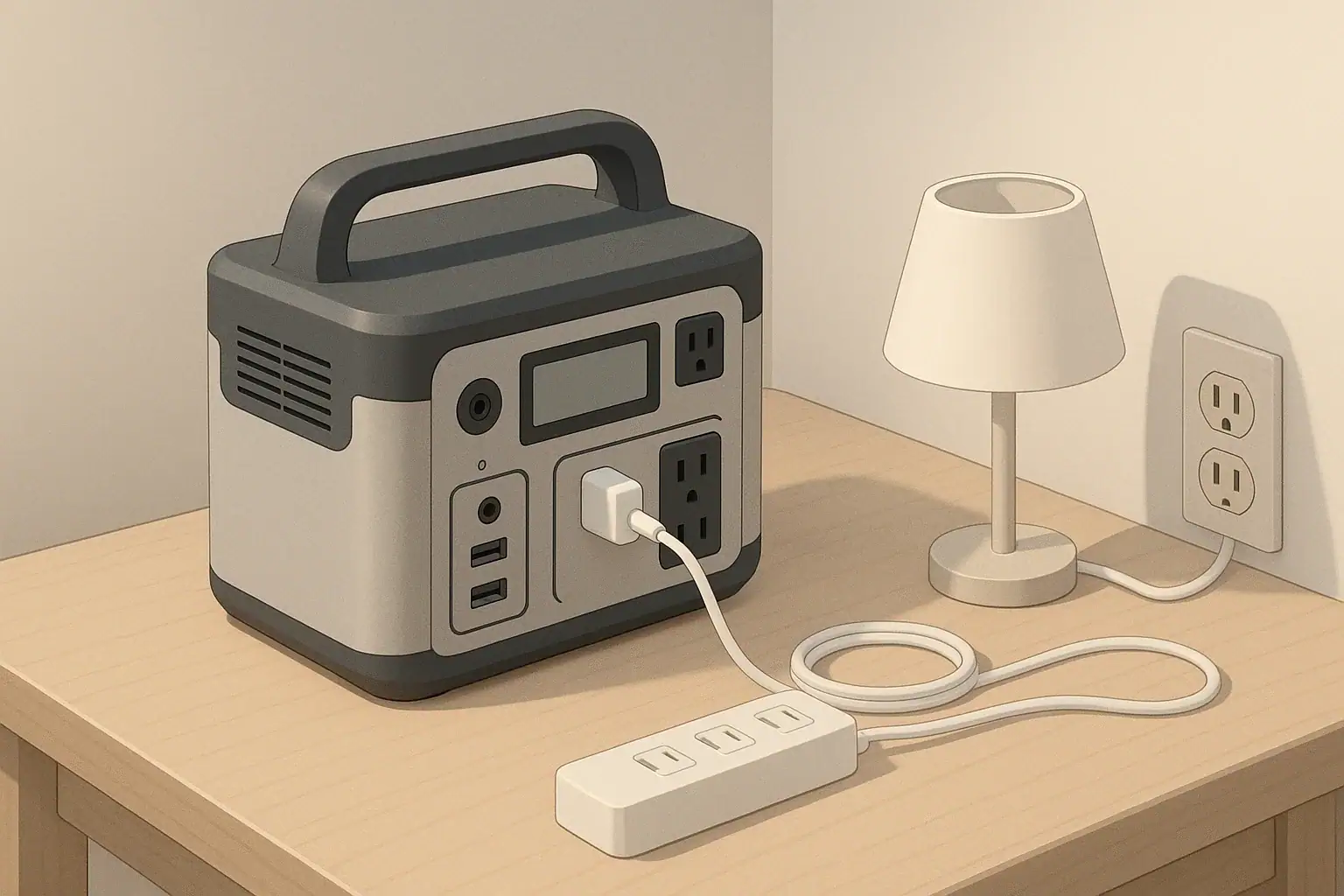
Portable power stations often sit in one place while the devices you power are spread around a room, campsite, or vehicle. Extension cords and power strips make that possible, but they also introduce extra heat, resistance, and potential overload points. Using them incorrectly can cause tripped protection, damaged equipment, or in the worst case, fire risk.
This guide explains how to choose and use extension cords and power strips safely with portable power stations. It focuses on typical home, office, and light camping scenarios, not industrial or permanent wiring. It also assumes you are plugging devices into the power station’s built-in outlets, not modifying the power station or your home wiring in any way.
Before adding cords and power strips, it helps to understand the limits of your portable power station and what you plan to run from it.
Why Extension Cords and Power Strips Matter With Portable Power Stations
Portable power stations often sit in one place while the devices you power are spread around a room, campsite, or vehicle. Extension cords and power strips make that possible, but they also introduce extra heat, resistance, and potential overload points. Using them incorrectly can cause tripped protection, damaged equipment, or in the worst case, fire risk.
This guide explains how to choose and use extension cords and power strips safely with portable power stations. It focuses on typical home, office, and light camping scenarios, not industrial or permanent wiring. It also assumes you are plugging devices into the power station’s built-in outlets, not modifying the power station or your home wiring in any way.
Key Safety Basics Before You Plug Anything In
Know Your Power Station’s Limits
Every portable power station has several important ratings:
- Battery capacity (Wh): Tells you how much total energy is stored. This affects how long you can run devices, not how many you can plug in at once.
- Inverter continuous power (W): The maximum steady AC output. Adding a power strip does not increase this limit.
- Inverter surge power (W): A short-term higher output for starting motors or compressors. Multiple devices starting at once can exceed this.
- Number and type of outlets: AC, DC, USB, and any built-in protection (such as overload and over-temperature shutoff).
Add up the running watts of what you want to power at the same time. Stay below the continuous watt rating of the power station, with extra margin if anything has a motor (fans, small pumps, some fridges).
Understand Extension Cords vs. Power Strips
Extension cords and power strips are not the same thing:
- Extension cord: A flexible cable with a plug on one end and one or more outlets on the other. Its main job is to extend reach.
- Power strip: A device with multiple outlets, often with a short cord. It may include surge protection and an on/off switch.
You can plug a power strip into an extension cord, or directly into a power station, but every added connection is another potential weak point. Using fewer, higher-quality components is generally safer than chaining many cheap ones.
Respect Amp, Watt, and Gauge Ratings
Each component has its own limits:
- Power station outlet rating: Often 10–15 A per outlet (example values), but always check the printed rating near the outlet.
- Power strip rating: Commonly listed as a maximum amp and watt value. Do not exceed whichever limit is reached first.
- Extension cord wire gauge: Lower gauge number means thicker wire and higher capacity (for example, 12 AWG is thicker than 16 AWG).
Heat is a sign something is overloaded or poorly connected. Cords, plugs, and power strips should never become uncomfortably hot in normal use.
Example values for illustration.
| What to Check | Why It Matters | Notes |
|---|---|---|
| Power strip amp/watt rating | Prevents overload and tripping | Keep device total below strip rating and below station rating |
| Extension cord gauge (AWG) | Controls voltage drop and heating | Thicker wire (smaller AWG number) for higher loads or longer runs |
| Indoor vs. outdoor rating | Protects insulation from environment | Use outdoor-rated cords only in damp or exterior locations |
| Grounding (3-prong) | Supports grounded appliances | Avoid adapters that defeat the grounding pin |
| Condition of plugs and jacket | Reduces risk of shorts and shock | Do not use cords with cracks, cuts, or bent blades |
| Built-in overload protection | Adds another safety layer | Some strips include resettable breakers for added protection |
| Cord length | Longer cords increase resistance | Use the shortest practical length for the load |
Choosing the Right Extension Cord for a Portable Power Station
The right extension cord depends on how far you need to reach and what you plan to plug in. Using an undersized or inappropriate cord is one of the most common mistakes with portable power stations.
Gauge and Length: Balancing Convenience and Safety
Two factors go together: wire thickness (gauge) and length.
- Short, light loads: For low-power devices (phone chargers, LED lamps) over short distances, a typical household extension cord is usually adequate.
- Higher loads or longer runs: For heavier appliances (space heaters, kettles, small microwaves) or runs over a few yards, use a thicker cord designed for higher amps.
- Avoid unnecessary length: Longer cords increase resistance and heating. Use the shortest cord that comfortably reaches.
Extension cord packages typically list their maximum amp rating and recommended use. Treat these as practical limits and leave extra margin rather than pushing to the maximum.
Grounded vs. Ungrounded Cords
Many portable power stations provide three-prong (grounded) AC outlets. When using grounded devices, use cords and power strips that maintain that ground connection:
- Use three-prong cords: These support devices that rely on a ground for safety, such as some computer equipment and metal-bodied appliances.
- Avoid ground adapters: “Cheater” adapters that defeat the ground pin remove a safety feature and are not recommended with portable power stations.
Indoor vs. Outdoor Rated Cords
If your portable power station is used outdoors, or indoors near damp areas like patios or garages, cord type matters:
- Outdoor-rated cords: Have insulation designed to withstand moisture, abrasion, and temperature swings.
- Indoor-only cords: Should stay dry and off the ground. Do not run them through doors or windows where they may be pinched.
Even with a robust portable power station, the weakest component in the chain sets the safety limit.
Using Power Strips With Portable Power Stations
Power strips let you plug several devices into one AC outlet on the power station. This is convenient for desks, media centers, and remote work setups, but it also makes it easy to silently overload the system if you are not paying attention.
Power Strip Ratings and Load Planning
Treat the power strip as its own device with limits:
- Check the strip rating: It should list a maximum amps and/or watts. Never exceed this, even if the power station could theoretically supply more.
- Count total load: Sum the typical wattage of all devices you plan to plug into that strip. Include chargers, which may draw more than expected when devices charge from low battery.
- Add margin: Aim to stay below both the strip rating and the power station’s continuous output by a comfortable margin, especially for longer runtimes.
Remember that some devices draw an initial surge. If multiple devices with motors start at once from the same power strip, you may see the power station briefly trip or shut down to protect itself.
Avoid Daisy-Chaining Strips and Cords
Daisy-chaining means plugging a power strip into another power strip, or building long chains of cords. This is widely discouraged for safety reasons:
- Uneven loading: One strip in the chain may carry more current than its design assumes.
- Extra resistance: Each plug and connection adds points of potential heating.
- Harder to inspect: Long chains get tucked behind furniture or under gear, where problems can go unnoticed.
A safer approach is to use a single, appropriately rated power strip connected directly to the portable power station, and then use individual cords only as needed for distance.
Surge Protectors With Portable Power Stations
Many power strips add surge protection. With portable power stations, surge protection can still be useful, particularly for sensitive electronics, but keep a few points in mind:
- Redundant protection: Many power stations have built-in inverter protections. A surge-protecting strip adds another layer but does not replace careful load planning.
- Indicator lights: Surge strips often have lights to show if protection is active. If the light is off when the strip is energized, its surge components may be spent.
- End-of-life: Surge protection can degrade over time after voltage spikes. Replace old or suspect units rather than relying on them indefinitely.
Placement, Routing, and Ventilation
Where you place your portable power station and how you route cords affect both safety and usability. Good cable management prevents trips, strain on outlets, and accidental damage.
Keep the Power Station Stable and Ventilated
Portable power stations contain batteries and inverters that generate heat under load.
- Stable surface: Place the unit on a flat, solid surface where it cannot tip or slide.
- Vent clearance: Keep vents and fans unblocked. Leave a few inches of open space around air inlets and outlets.
- Dry, cool location: Avoid direct sunlight, heaters, and damp or puddled areas.
Do not coil extension cords tightly near the power station. Coils trap heat and can cause the cord to run much warmer than if it were loosely laid out.
Safe Routing of Cords and Strips
Once everything is plugged in, check how your cords lie in the real space you are using:
- Avoid trip hazards: Do not stretch cords across walkways without protection. Use cord covers or route along walls where practical.
- Protect from pinch and crush: Do not run cords under rugs, through door gaps, or under heavy furniture. Pressure can damage insulation and cause hidden hot spots.
- Strain relief: Avoid putting tension on the power station’s outlets. If a cord is pulled tight, reposition the station or use a slightly longer cord.
Indoor vs. Camping and RV Use
In homes and offices, cords are usually protected from the elements. In camping and RV scenarios, conditions are harsher:
- Outdoor placement: If the power station is near a tent or under an awning, keep it off bare ground and protected from rain and splashes.
- Vehicle doors and windows: Avoid sharply pinching cords in door seals or windows. Repeated closing can cut through insulation.
- Temporary only: Resist the urge to build semi-permanent cord runs through walls or cabinetry. Permanent wiring modifications should be planned and installed by a qualified professional, not improvised with extension cords.
What Not to Plug In: High-Draw Devices and Risky Loads
Portable power stations are great for lights, communications gear, and many household essentials. However, some devices draw enough power to overwhelm both the power station and the cords you use.
High-Wattage Appliances
Be especially cautious with devices that convert electricity into heat:
- Space heaters
- Hair dryers
- Toasters and toaster ovens
- Electric kettles and some coffee makers
- Hot plates
These can easily draw hundreds to over a thousand watts, sometimes more than a smaller portable power station can safely deliver. Even if the power station can handle the load, your extension cord and power strip also need to be appropriately rated.
Motor Loads and Starting Surges
Devices with motors or compressors have two power numbers: a lower running wattage and a higher starting surge. Examples include:
- Refrigerators and freezers
- Small air conditioners
- Well pumps
- Some power tools
If several motor loads start at once on the same power strip or cord, the combined surge can exceed what the power station and cords can handle, at least briefly. This may cause nuisance shutdowns or stress on components.
Resist Using Portable Stations as Whole-Home Backups
It can be tempting to use a portable power station like a whole-house generator. However, safely powering multiple circuits or your main panel requires equipment and methods that go beyond extension cords and power strips.
- Do not backfeed: Plugging a power station into a wall outlet to energize house wiring is unsafe and may be illegal in many places.
- No DIY panel wiring: Any connection to a home electrical system, including transfer switches or dedicated inlets, should be assessed and installed by a qualified electrician.
For short outages, it is usually safer to run specific extension cords from the portable power station directly to the devices you need, rather than trying to energize entire circuits.
Example values for illustration.
| Device Type | Typical Watt Range (Example) | Planning Notes |
|---|---|---|
| LED lamp | 5–15 W | Low load; multiple lamps can share one strip comfortably |
| Laptop and monitor | 60–150 W | Good candidate for a single power strip at a desk |
| Phone and tablet chargers | 10–40 W total | Prefer direct USB outputs when available to free AC capacity |
| Mini fridge | 50–100 W running | Allow for higher starting surge; avoid sharing strip with other motor loads |
| Fan | 30–80 W | Generally fine on a shared strip; start fan before other high loads |
| Space heater | 1000–1500 W | Use extreme caution; often too much for small stations or light-duty cords |
Practical Checklists for Everyday Use
Before each use, it helps to run through a quick mental or written checklist. This keeps cords, power strips, and your portable power station working safely together.
Before You Turn On the Power Station
- Confirm that total expected watts are within the power station’s continuous rating.
- Check that each power strip and extension cord is rated for at least the portion of the load it will carry.
- Inspect cords and plugs for damage, discoloration, or loose blades.
- Place the power station where vents are clear and the surface is stable.
- Lay cords where they will not be walked on, pinched, or driven over.
While in Use
- Periodically feel cords and power strips with the back of your hand; they should be warm at most, not hot.
- Listen for unusual sounds from the power station, such as fans running excessively hard, which may indicate heavy load or poor ventilation.
- Watch the power station’s output indicators, if available, to avoid sustained operation near maximum capacity.
- Shut down and unplug if you detect burning odors, visible arcing, or melted plastic, and replace faulty components.
After You Are Done
- Turn off or unplug high-draw devices before switching off the power station.
- Coil cords loosely, not tightly, to avoid kinks and internal damage.
- Store cords and power strips in a dry area away from direct sunlight and sharp objects.
- Recharge the portable power station according to the manufacturer’s recommendations so it is ready for the next use.
Thoughtful planning and simple inspections go a long way toward safe, reliable use of extension cords and power strips with portable power stations in homes, offices, vehicles, and campsites.
Frequently asked questions
Can I use any extension cord with a portable power station?
No. Use an extension cord rated for the current and wattage you expect to draw, with a suitable wire gauge and length for the load. Prefer three-prong grounded cords for grounded appliances and choose outdoor-rated jackets if the cord will be exposed to moisture or abrasion.
How do I choose the right gauge and length for an extension cord?
Match the cord’s amp rating to the device(s) you plan to power and use a thicker (lower AWG number) cord for higher loads or longer runs to reduce voltage drop and heat. When in doubt, pick a heavier-duty cord and keep the run as short as practical.
Is it safe to plug a power strip into an extension cord or vice versa?
Daisy-chaining is discouraged because each connection adds resistance and potential heating; it also makes overloads harder to spot. If you must extend reach, use a single, appropriately rated heavy-duty cord connected directly to the power station and then attach one properly rated power strip, avoiding chains.
Should I use a surge protector with a portable power station?
Surge-protecting strips can add protection for sensitive electronics, but they don’t replace proper load planning or the power station’s internal protections. Check the protector’s indicator light and replace the strip if the protection has been expended or if the unit shows signs of wear.
What are warning signs that a cord or power strip is overloaded or failing?
Warning signs include cords or plugs that feel hot to the touch, discoloration, melting, burning smells, frequent tripping of protection, or visible damage to insulation or blades. If you observe any of these, unplug the device immediately and replace the faulty component before reuse.
Related guides
Browse this topic →
- Beginner-friendly sizing, runtime & specs
- Solar & charging (MPPT, fast charging, cables)
- Batteries (LiFePO4, cycles, care & storage)
- Safety, cold-weather performance, real-world tips
More in Safety
See all →Keep reading
About this site
Portable Energy Lab publishes practical, independent guides about portable power—clear sizing, safe use, and real-world expectations.
Affiliate disclosure
Some links on this site may be affiliate links. If you buy through these links, we may earn a small commission at no extra cost to you. This helps support our content. Learn more.