
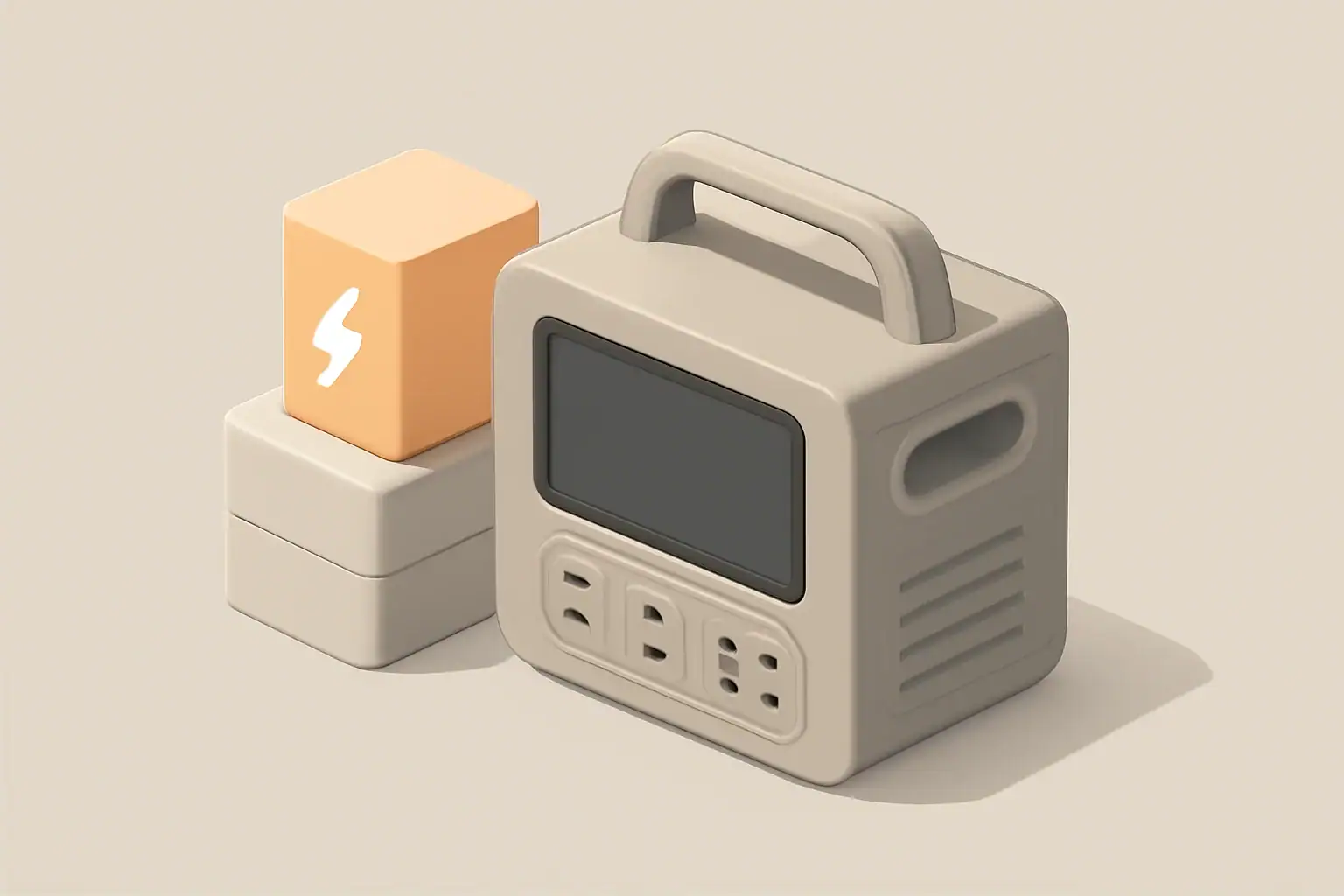
When you calculate how long a portable power station should run, the math often looks simple: divide the battery capacity in watt-hours by the appliance wattage. In practice, actual runtime is usually shorter. A major reason is inverter efficiency. The inverter converts stored DC battery power into AC power for most household devices, and that conversion is not perfectly efficient.
An inverter is the component that changes direct current (DC) from the battery into alternating current (AC) that most appliances use. It also adapts voltage and frequency to match household standards. This conversion consumes energy, so not all of the battery’s stored watt-hours reach your load.
Inverter efficiency is typically expressed as a percentage representing the ratio of AC power output to DC power input under specified conditions. An inverter rated at 90% efficiency outputs 90 watts of AC for every 100 watts drawn from the battery; the remaining 10 watts are lost, mostly as heat.
Why runtime is often shorter than expected
What an inverter does and why it matters
Types of losses during conversion
- Conversion losses: Energy wasted as heat when the inverter changes DC to AC.
- Standby or idle draw: Small continuous power used when the inverter is on but not heavily loaded.
- Losses due to waveform and load type: Nonlinear or reactive loads can increase losses.
- Inrush and surge inefficiencies: Motors and compressors draw high initial current that raises losses.
Understanding inverter efficiency numbers
Manufacturers often quote peak efficiency at a specific load (for example, 50% to 75% of rated power). Efficiency varies with load level, temperature, and age.
Typical efficiency behavior by load
- Very low loads: Efficiency tends to be poor because standby losses and control circuitry consume a larger share of the total.
- Moderate loads: Efficiency usually peaks in a middle range where the inverter operates optimally.
- Near-rated or overload conditions: Efficiency can fall and protective limits may reduce output or shut the unit down.
Factors that reduce runtime beyond basic efficiency
Inverter efficiency is one factor among several that shorten runtime from theoretical values. Key factors include:
1. Idle consumption and system overhead
Most inverters have a small constant draw even when the load is low. Power management features, cooling fans, and control electronics add to consumption. Over a long period, this idle draw can reduce usable capacity significantly.
2. Power factor and reactive loads
Many appliances, especially motors and some electronics, have a low power factor. That means they draw apparent power that does not translate directly to useful work, increasing current and losses in the inverter and wiring.
3. Surge currents
Devices with motors, pumps, or compressors need a higher initial current to start. The inverter must supply this surge, which increases instantaneous losses and can trigger protective limits that affect performance.
4. Temperature and environment
Higher ambient temperatures reduce inverter efficiency and can trigger cooling fans, which themselves consume power. Colder temperatures can affect battery output, indirectly changing how long the system can supply power.
5. Battery state and age
Batteries do not always deliver their nominal capacity. Age, depth of discharge, temperature, and discharge rate all affect usable watt-hours available to the inverter.
How to measure or estimate real-world inverter losses
Estimating real runtime requires accounting for conversion losses and the other factors above. There are three practical approaches:
- Manufacturer efficiency curves: If available, use the inverter’s efficiency versus load chart to find expected efficiency at your typical load.
- Direct measurement: Use a power meter on the AC output and a DC clamp meter on the battery input to measure input and output simultaneously under representative loads.
- Rule-of-thumb adjustments: Apply a conservative efficiency factor (for example 85% instead of 95%) and add a small allowance for idle draw.
Typical conservative efficiency assumptions
- Light loads (<10% rated): 60–80% effective due to idle losses.
- Moderate loads (25–75% rated): 85–95% effective depending on inverter design.
- Heavy loads (near rated): 80–90% effective and possibly limited by thermal management.
How to estimate runtime with inverter losses
Use a simple step-by-step method to estimate runtime more realistically.
Step formula
Estimated runtime (hours) = (Battery usable watt-hours × inverter efficiency) ÷ appliance AC watts
Example
Suppose a battery has 1,000 Wh usable capacity. You run a 200 W appliance. If the inverter’s real-world efficiency at that load is about 90%, the calculation is:
- Available AC power = 1,000 Wh × 0.90 = 900 Wh
- Estimated runtime = 900 Wh ÷ 200 W = 4.5 hours
Ignoring inverter losses would give 5 hours, which overestimates runtime by about 11% in this example.
Factor in standby and other draws
If the inverter has a 10 W idle draw, subtract that from available AC power before dividing. For the same example:
- Effective load = 200 W appliance + 10 W idle = 210 W
- Runtime = 900 Wh ÷ 210 W ≈ 4.29 hours
Practical ways to maximize runtime
Reducing conversion losses and overall consumption will extend runtime. Consider these steps:
- Run devices that accept DC directly from the battery when possible to avoid inversion losses.
- Choose appliances with higher efficiency and better power factor.
- Match inverter size to typical loads; oversized inverters can be inefficient at low loads.
- Avoid frequent high-surge starts by staggering startup times for motors and compressors.
- Keep the system cool and ventilated to limit thermal losses and reduce fan use.
- Monitor real-world usage with meters to build an accurate picture of consumption and efficiency.
Common misconceptions about inverter efficiency
- “All inverters have the same efficiency” — Efficiency varies by design, topology, and load.
- “Quoted efficiency applies at all loads” — Ratings are usually under specific test conditions; real-world efficiency changes with load.
- “Bigger inverter means longer runtime” — A larger inverter may have higher idle losses and lower efficiency at the loads you actually use.
Quick checklist to improve your runtime estimates
- Identify the typical load and check inverter efficiency at that load level.
- Subtract standby draw from usable capacity when calculating runtime.
- Account for surge currents and power factor for motor-driven appliances.
- Measure actual system draw when possible instead of relying solely on theoretical values.
- Factor in battery health, temperature, and depth of discharge limits.
Applying these points to your calculations will give more realistic runtime expectations and help you plan loads and usage for a portable power station more effectively.
Frequently asked questions
How much does inverter efficiency typically reduce a power station’s runtime?
Typical inverter losses reduce runtime by roughly 5–20% compared with an ideal DC-only calculation, depending on load and unit design. At moderate loads many inverters operate around 85–95% efficiency, while light loads or extreme conditions can push effective efficiency lower.
How can I measure my inverter’s real-world efficiency?
Measure AC output with a wattmeter and the DC input with a DC clamp meter or DC power meter under the same representative load, then divide AC out by DC in to get efficiency. If direct measurement isn’t possible, use the manufacturer’s efficiency vs. load curve or apply a conservative estimate and include idle draw.
Does inverter efficiency change with load and temperature?
Yes. Efficiency typically peaks at moderate loads (often 25–75% of rated power) and falls at very low or near-rated loads; higher ambient temperatures also reduce efficiency and can increase fan or thermal losses. Battery temperature and health further affect the overall usable energy available to the inverter.
Should I size an inverter larger than my typical load to improve efficiency?
No — oversizing an inverter can lower overall efficiency at your typical lower loads because idle and control losses become a larger fraction of consumption. It’s better to match the inverter rating to the usual load or choose a model optimized for good low-load efficiency.
Can I avoid inverter losses by running devices directly from the battery?
Yes, using DC-native devices or DC-compatible chargers avoids DC-to-AC conversion losses and can extend runtime, but this requires devices that accept the battery voltage or suitable DC-DC regulation. Many household appliances require AC, so direct-DC operation is only practical for compatible equipment.
Recommended next:
Related guides
Browse this topic →

- Beginner-friendly sizing, runtime & specs
- Solar & charging (MPPT, fast charging, cables)
- Batteries (LiFePO4, cycles, care & storage)
- Safety, cold-weather performance, real-world tips
More in Capacity
See all →- Battery Calibration Explained: When (and How) to Do a Full Discharge Without Damaging the Pack
- Inverter Idle Consumption Explained: How Much Power You Lose Just Having AC On
- VA vs Watts Explained for Portable Power Stations: Computers, Power Supplies, and UPS Confusion
- Why a 1000Wh Power Station Doesn’t Give 1000Wh: Usable Capacity Explained (Efficiency + Cutoffs)
- How to Calculate Watt-Hours From Amp-Hours (and Avoid Common Mistakes)
Keep reading
About this site
Portable Energy Lab publishes practical, independent guides about portable power—clear sizing, safe use, and real-world expectations.
Affiliate disclosure
Some links on this site may be affiliate links. If you buy through these links, we may earn a small commission at no extra cost to you. This helps support our content. Learn more.