
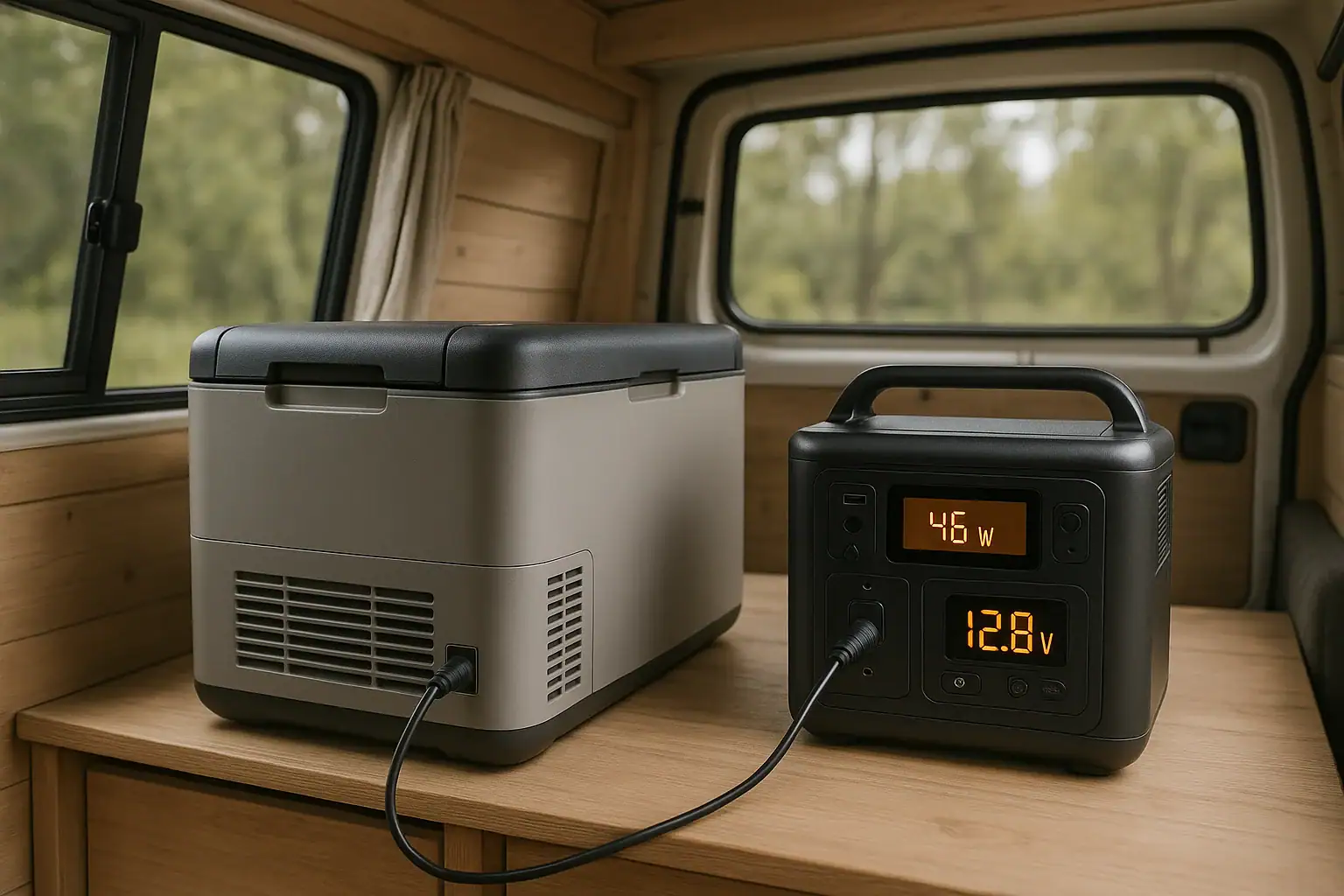
To power a 12V fridge efficiently, run it from a DC source sized to its average watt draw and daily amp-hour needs, and avoid unnecessary AC inverter losses. Matching your fridge’s power consumption with the right battery capacity, DC output, and cable setup is the key to longer runtime and reliable cooling.
Whether you call it a 12V cooler, compressor fridge, camping fridge, or portable refrigerator, the core questions are the same: how many watts does it use, how many amp hours will it drain, and what runtime can you expect from a portable power station or battery? Understanding DC vs AC efficiency, surge watts, duty cycle, and voltage drop helps you plan trips without warm food or dead batteries.
This guide explains how 12V fridges work on DC power, how to size your portable power station, and what settings and habits improve efficiency. It also highlights common mistakes, basic safety, and the exact specs to look for when choosing DC power options for a 12V refrigerator.
Understanding 12V Fridge Power Needs and Why Efficiency Matters
A 12V fridge is designed to run directly from low-voltage DC power, typically the same 12V system used in vehicles, RVs, boats, and many portable power stations. Unlike traditional household refrigerators that expect 120V AC, a 12V fridge can connect directly to a DC outlet, making it ideal for off-grid and mobile use.
Efficiency matters because your available energy is limited by battery capacity. Every watt your fridge wastes shortens runtime and may force you to ration power or shut it off. Using DC power directly, minimizing inverter losses, and understanding your fridge’s real power draw can significantly extend how long it runs between charges.
Most 12V fridges use a compressor that cycles on and off to maintain temperature. Instead of running continuously at a high wattage, they draw more power while the compressor is on and very little while it is off. This on/off pattern is called the duty cycle, and it is critical when estimating daily energy consumption and runtime from a portable power station or battery bank.
In practice, knowing the difference between peak watts (when the compressor starts), running watts (while it is cooling), and average daily watt-hours helps you choose the right DC power source. An efficient setup lets you keep food safe, reduce generator use, and rely more confidently on solar or stored battery energy.
How DC Powering of a 12V Fridge Works
When you power a 12V fridge from DC, the fridge’s compressor and control electronics are supplied directly from a low-voltage source, such as a vehicle socket, a dedicated 12V battery, or the DC output of a portable power station. This avoids converting DC to AC and back again, which typically wastes energy as heat in an inverter.
Most 12V fridges specify their consumption in amps at 12V (for example, 4A at 12V) or in watts (for example, 48W). To understand energy use over time, you convert between these units:
- Watts (W) = Volts (V) × Amps (A)
- Amp-hours (Ah) = Amps (A) × Hours (h)
- Watt-hours (Wh) = Watts (W) × Hours (h)
Because the compressor cycles, the fridge’s average current draw is lower than its running current. For example, a fridge that pulls 5A while running might only average 1.5–2.5A over 24 hours, depending on ambient temperature, set temperature, and how often you open the lid.
Portable power stations typically publish their capacity in watt-hours (Wh). To estimate runtime, you divide usable watt-hours by the fridge’s daily or hourly watt-hour consumption. You also consider efficiency losses in the DC circuitry and any voltage drop in long or thin cables, which can cause the fridge to see lower voltage than the power source provides.
Many 12V fridges include a low-voltage cut-off feature to protect the battery from over-discharge. When the battery drops below a set voltage, the fridge shuts off. This is helpful for battery health but can surprise users who expect longer runtime; understanding this interaction is part of designing an efficient DC power setup.
| Parameter | Typical 12V Fridge Value | What It Means |
|---|---|---|
| Running power | 35–60 W | Power draw while compressor is actively cooling. |
| Average daily use | 200–600 Wh/day | Depends on size, insulation, ambient heat, and set temperature. |
| Current draw | 3–5 A at 12 V | Instantaneous draw when the compressor is on. |
| Duty cycle | 20–50% | Percentage of time the compressor runs during normal use. |
| Low-voltage cut-off | 10.4–11.4 V | Voltage where fridge shuts off to protect the battery. |
Real-World Examples of Powering a 12V Fridge from DC Sources
Translating specs into real-world runtime helps you plan trips and choose a portable power solution that fits your needs. The following examples show how different capacities and fridge loads interact in typical scenarios.
Example 1: Weekend Trip with a Compact 12V Fridge
Imagine a small 12V fridge with an average consumption of 30W over time (including compressor cycling). Over 24 hours, it uses about 720Wh (30W × 24h). If you pair this with a portable power station rated at 1000Wh, you might expect about 1.3 days of runtime (1000Wh ÷ 720Wh/day).
However, you need to account for real-world factors: the power station might only deliver 85–90% of its rated capacity due to conversion and internal losses, and you may also be charging phones or lights. In practice, you might see closer to 0.9–1.1 days of fridge runtime alone, or a single weekend if you supplement with some solar charging or run the fridge at a moderate temperature setting.
Example 2: Larger Fridge with a Mid-Size Power Station
Consider a larger dual-zone 12V fridge that averages 45W. Over 24 hours, that is about 1080Wh. If your portable power station has a usable capacity of 1500Wh, and you primarily run the fridge, a rough runtime estimate would be 1500Wh ÷ 1080Wh/day ≈ 1.4 days.
In cooler weather, with a higher set temperature or less frequent opening, the duty cycle may drop, reducing average consumption to 30–35W. In that case, your 1500Wh power station could potentially power the fridge for 2 days or slightly more, especially if you avoid unnecessary AC loads and rely solely on the DC output.
Example 3: Vehicle DC Outlet vs Dedicated DC Output
Some users run a 12V fridge from a vehicle cigarette lighter while driving, then switch to a portable power station when parked. If the vehicle’s outlet is only powered with the ignition on, the fridge will lose power whenever the engine is off. In contrast, a portable power station with a regulated 12V DC output can supply stable power regardless of engine status.
In this mixed setup, the fridge draws from the alternator during driving and from stored battery energy when parked. This can significantly extend total runtime without large batteries, provided you manage temperature settings and minimize door openings during hot conditions.
Common Mistakes and Troubleshooting When Running a 12V Fridge on DC
Many issues with 12V fridges powered from portable power stations or batteries stem from mismatched expectations or small configuration errors rather than equipment failure. Recognizing common pitfalls helps you troubleshoot quickly and avoid wasting energy.
Relying on AC Instead of DC
One of the biggest efficiency losses occurs when users plug a 12V fridge into the AC outlet of a portable power station using an AC adapter. This forces the power station to invert DC to AC, while the fridge’s adapter then converts AC back to DC. Each conversion step wastes power as heat. Whenever possible, use the dedicated 12V DC output and a suitable DC cable instead of the AC inverter.
Underestimating Average Power Use
Another frequent mistake is assuming the fridge’s rated running watts reflect its average consumption. If the compressor draws 50W while running but only runs 25% of the time, the average is closer to 12–15W. Conversely, in hot conditions or when set to very low temperatures, the duty cycle can climb, pushing average use much higher than expected. If your power station seems to drain faster than your calculations, check ambient temperature, ventilation, and thermostat settings.
Voltage Drop and Thin Cables
Long or undersized DC cables can cause noticeable voltage drop, especially at higher currents. The fridge might see 10.8–11V even when the power station outputs 12.5V. This can trigger low-voltage cut-out earlier than expected, shortening runtime. Using shorter, heavier-gauge DC cables and avoiding unnecessary extensions helps maintain stable voltage at the fridge.
Misinterpreting Low-Voltage Shut-Off
When a fridge shuts down on low-voltage protection, users sometimes think the fridge or power station is defective. In reality, the fridge is protecting the battery from deep discharge. If this happens often, it may indicate that your battery capacity is too small, the fridge settings are too aggressive, or other loads are drawing power at the same time.
Ignoring Standby and Background Loads
Leaving the inverter on, charging multiple devices, or running fans and lights from the same power station can significantly reduce the energy available for the fridge. Even if each load is small, they add up over 24 hours. When runtime is critical, prioritize the fridge and turn off nonessential AC outputs and idle devices.
Safety Basics for DC Powering of 12V Fridges
Running a 12V fridge from a portable power station or battery is generally safe when you follow basic electrical and thermal guidelines. Although the voltages are relatively low, poor practices can still lead to overheating, damaged wiring, or battery stress.
First, ensure that the DC output you use is rated for the fridge’s current draw with some margin. If a fridge can draw up to 6A at startup, a 10A-rated DC socket or port is a safer choice than one rated just at 6A. Overloading a socket or cable can cause excess heat at connectors, especially in confined spaces.
Second, keep ventilation in mind. Both the fridge and the portable power station generate some heat while operating. Crowding them into tight compartments without airflow can raise internal temperatures, reducing efficiency and potentially triggering thermal protection. Leave space around vents and avoid covering cooling fans.
Third, use cables with appropriate insulation and gauge for the current and length. Avoid damaged or improvised connectors. If you are unsure about cable sizing for longer runs in a vehicle or RV, consult a qualified electrician or technician familiar with low-voltage DC systems.
Finally, treat batteries with respect. Do not bypass built-in protections, defeat low-voltage cut-offs, or modify internal wiring of power stations or batteries. If your setup requires more complex wiring, such as multiple batteries or distribution panels, seek professional advice to ensure proper fusing and safe installation.
Maintaining Your 12V Fridge and Power Source for Long-Term Efficiency
Efficiency is not just about initial setup; it also depends on how well you maintain both the fridge and the power source over time. Simple habits can preserve capacity, reduce energy use, and extend the service life of your gear.
For the fridge itself, keep the condenser and ventilation areas clear of dust and obstructions. Blocked airflow forces the compressor to work harder and run longer, increasing power draw. Periodically clean seals around the lid or door to ensure they close tightly, preventing cold air leaks that drive up energy consumption.
Packing strategy also matters. A well-organized fridge with minimal empty air space tends to hold temperature more consistently. Pre-chilling food and drinks before loading reduces the initial cooling load. Avoid frequent or prolonged door openings, especially in hot environments, as each opening lets in warm air that the compressor must remove later.
For portable power stations and batteries, follow recommended storage practices. Store them in a cool, dry place when not in use, and avoid leaving them fully discharged for long periods. Many battery chemistries prefer being stored partially charged rather than at 0% or 100% for months. Check charge levels periodically and top up as needed to keep them within a healthy range.
When charging from solar, match panel size and expected sunlight to your daily fridge consumption. A panel or array that can replace a large portion of the fridge’s daily watt-hours helps maintain battery state of charge and supports longer off-grid stays. Keep solar panels clean and positioned for good exposure to maximize output.
| Component | Maintenance Habit | Efficiency Impact |
|---|---|---|
| Fridge interior | Defrost and wipe down periodically. | Improves cooling performance and reduces compressor runtime. |
| Door/lid seals | Inspect and clean to ensure tight closure. | Prevents cold air leaks and unnecessary cycling. |
| Ventilation grills | Keep free of dust and obstructions. | Maintains airflow and avoids overheating. |
| Battery or power station | Store partially charged in a cool, dry place. | Helps preserve usable capacity over time. |
| Solar panels | Clean surfaces and orient toward sun. | Maximizes daily energy harvest for the fridge. |
Related guides: AC vs DC Power: How to Maximize Efficiency and Runtime • Surge Watts vs Running Watts: How to Size a Portable Power Station • How to Estimate Runtime for Any Device: A Simple Wh Formula + 5 Worked Examples • Portable Power Station Basics: Outputs, Inputs, and What the Numbers Mean
Practical Takeaways and Key Specs to Look For When Powering a 12V Fridge
Efficiently powering a 12V fridge with DC sources comes down to three main ideas: know your fridge’s real energy use, size your portable power station or battery accordingly, and avoid unnecessary conversion losses and poor cabling. When you align these factors, you can keep food cold for days with predictable runtime and less stress about power.
Use DC outputs wherever possible, and reserve AC for devices that truly need it. Pay attention to ambient temperature, ventilation, and thermostat settings, as they strongly influence duty cycle and daily watt-hour consumption. Combine good packing habits and minimal door openings with sensible maintenance to keep energy use stable over time.
Specs to look for
- Fridge average consumption (Wh/day) – Look for realistic daily use figures (for example, 200–600Wh/day); this drives how large your battery or power station must be.
- Running power and surge watts – Check running watts (typically 35–60W) and any startup surge; ensures your DC port or power station output can handle peak draw.
- Battery or power station capacity (Wh) – Aim for at least 1.5–3 times your expected daily fridge use; provides a buffer for hot weather and other small loads.
- DC output rating (volts and amps) – Confirm a regulated 12–13V output with sufficient current (for example, 10A or higher); supports stable compressor operation without nuisance shut-offs.
- Efficiency of DC vs AC outputs – Prefer direct 12V DC ports over AC inverters; reduces conversion losses and extends runtime from the same stored energy.
- Low-voltage protection settings – Look for adjustable or clearly specified cut-off levels; helps balance battery protection with maximum usable runtime.
- Cable gauge and length – Choose thicker, shorter DC cables rated for at least 1.5–2× expected current; minimizes voltage drop and unwanted low-voltage trips.
- Solar input capability – Check supported input watts and voltage ranges (for example, 100–400W solar); determines how quickly you can replenish energy used by the fridge.
- Operating temperature range – Ensure the fridge can run efficiently in the temperatures you expect; wide operating ranges support reliable cooling in hot or cold environments.
By focusing on these specs and best practices, you can design a DC-powered 12V fridge setup that is both efficient and predictable, whether you are camping for a weekend or living off-grid for extended periods.
Frequently asked questions
Which specs and features should I prioritize when selecting a DC power source for a 12V fridge?
Prioritize realistic average consumption (Wh/day), running and surge watts, battery capacity in Wh, and a regulated 12V DC output rated for the fridge’s peak current. Also consider low-voltage cut-off settings, cable gauge/length, and any solar input capability to replenish used energy.
Why is running a 12V fridge through an AC inverter often a bad idea?
Using an AC inverter forces DC→AC conversion and then the fridge converts AC back to DC, which wastes energy in two conversion steps and shortens runtime. Whenever possible, use a dedicated 12V DC output to avoid inverter losses and extend battery life.
How can I estimate how long my 12V fridge will run on a portable power station?
Estimate runtime by dividing the power station’s usable watt-hours by the fridge’s average watt-hour consumption (or Wh/day). Account for conversion losses, additional loads, ambient temperature, and potential low-voltage cut-off to get a realistic runtime.
What basic safety practices should I follow when powering a 12V fridge from batteries or power stations?
Use properly rated cables and connectors with correct fusing, ensure the DC output can handle startup and running current, provide ventilation for both fridge and power source, and do not bypass built-in battery protections. For complex installations, seek professional advice to ensure safe wiring and component selection.
How much does cable gauge and length affect performance?
Thin or long cables increase voltage drop, which can reduce voltage at the fridge and trigger low-voltage shut-offs earlier than expected. Use shorter, heavier-gauge cables rated above your expected current to minimize drop and maintain stable operation.
What routine maintenance helps keep a 12V fridge operating efficiently?
Keep vents and condenser areas clean, inspect and clean door/lid seals, pre-chill items before loading, and avoid frequent door openings to reduce compressor workload. For batteries and power stations, store at recommended charge levels and keep solar panels clean and well-oriented.
Recommended next:
- Portable Power Stations for Apartments
- Portable Power Stations for RV and Motorhomes
- Can a Portable Power Station Run a Microwave? What to Check Before You Try
- Can a Portable Power Station Run a Space Heater? Realistic Limits
- Can a Portable Power Station Run an Air Conditioner? Sizing and Expectations
- Powering a Coffee Maker, Kettle, or Induction Cooktop: What Works and Why
- More in Home / Appliances →
Related guides
Browse this topic →
- Beginner-friendly sizing, runtime & specs
- Solar & charging (MPPT, fast charging, cables)
- Batteries (LiFePO4, cycles, care & storage)
- Safety, cold-weather performance, real-world tips
More in Beginners
See all →- Camping Power Planning: A Simple Energy Budget for a Weekend
- Remote Work Power Kit: Keeping Laptop, Monitor, and Internet Running
- Portable Power Stations for Photography and Drone Charging: A Field Guide
- Portable Power Stations for CPAP and Medical Devices: What to Look For
- What’s in the Box? Essential Cables and Adapters You May Need
Keep reading
About this site
Portable Energy Lab publishes practical, independent guides about portable power—clear sizing, safe use, and real-world expectations.
Affiliate disclosure
Some links on this site may be affiliate links. If you buy through these links, we may earn a small commission at no extra cost to you. This helps support our content. Learn more.