
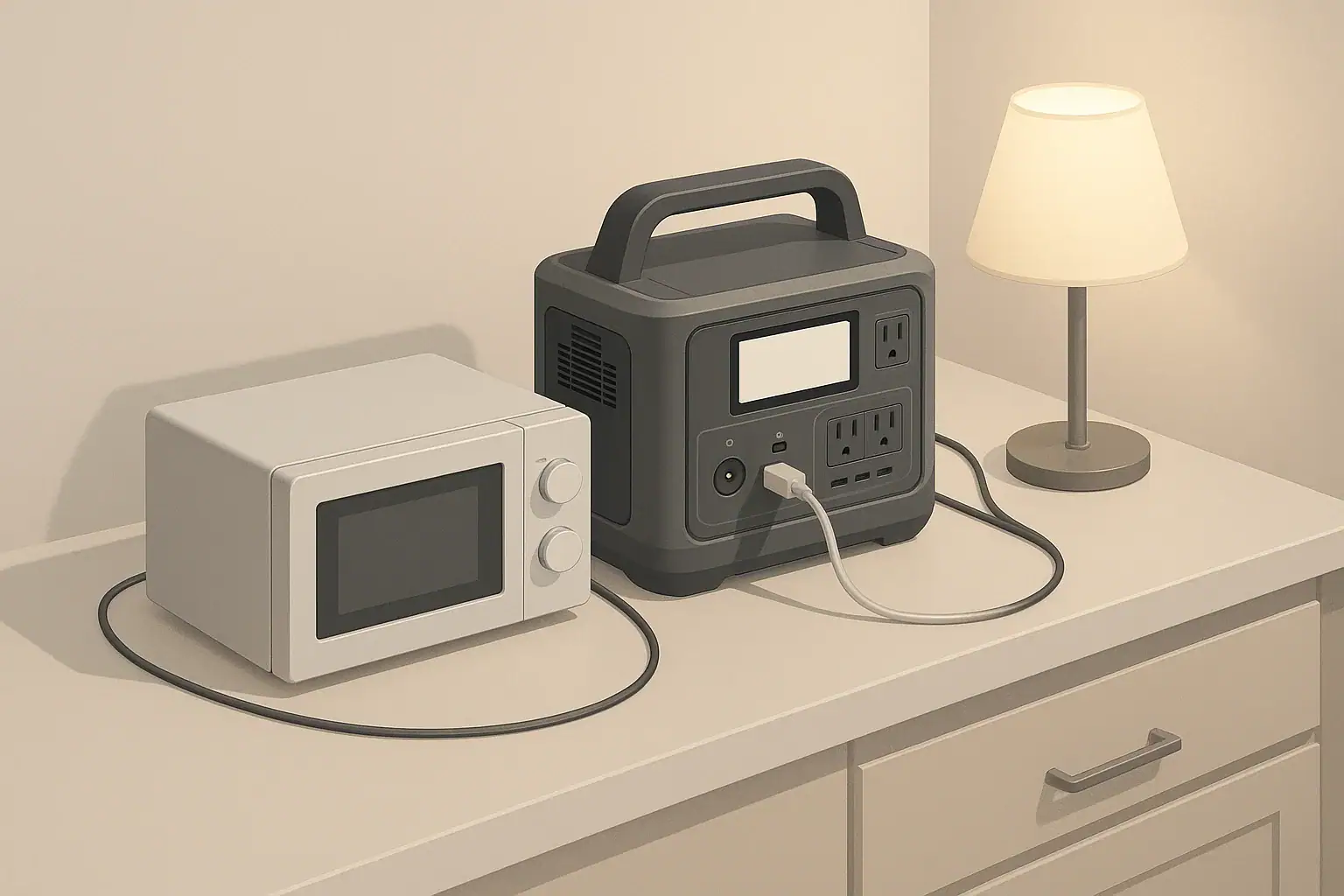
Yes, a portable power station can run a microwave, but only if the inverter output and battery capacity are big enough for the microwave’s real power draw. Many compact power stations are designed for phones and laptops, not high‑wattage cooking, so you need to match the microwave to the power station carefully.
This guide walks through how to check watts, surge power, and watt‑hours so you can tell, before you plug in, whether your setup is realistic. You will see how long a portable power station can run a microwave, what usually goes wrong, and how to avoid damaging your gear or draining your battery too quickly.
If you are planning for power outages, camping, vanlife, or RV use, understanding how a microwave behaves on battery power helps you decide whether it is worth the energy cost or if another cooking option makes more sense.
Can a Portable Power Station Really Run a Microwave?
Running a microwave from a portable power station is possible, but it is not as simple as “plug it in and see what happens.” Microwaves are one of the highest‑draw appliances people try to power from batteries, and they put stress on both the inverter and the battery pack.
Whether your portable power station can handle a microwave comes down to three checks:
- Inverter continuous watts: Must be higher than the microwave’s electrical input watts.
- Inverter surge (peak) watts: Must tolerate the short startup spike when the magnetron turns on.
- Battery capacity (Wh): Must be large enough to support the cooking time you actually need.
Because microwaves usually run for only a few minutes at a time, they are more about power (watts) than long runtimes. A portable power station that is just big enough on paper may still shut down if the microwave’s surge is high or if other devices are sharing the same inverter.
Understanding these basics helps you decide if using a microwave on portable power is a good use of your limited energy budget, or if you should reserve that capacity for refrigeration, communications, or medical equipment instead.
Key Power Concepts: Microwaves, Inverters, and Battery Capacity
To size a portable power station for microwave use, you need to translate the labels on both devices into a simple power budget. Three concepts matter most: input watts, surge power, and watt‑hours.
Microwave cooking watts vs. input watts
Microwave boxes often advertise “700 W” or “1,000 W,” but that number usually refers to cooking power (output), not the electrical input. The input watts are what the portable power station must actually supply.
Typical examples you might see on a label or in a manual:
- Cooking power: 700 W, Input: 1,050 W
- Cooking power: 1,000 W, Input: 1,500 W
When planning, always use the input watts. If you cannot find them, assume the input is noticeably higher than the cooking watts and give yourself extra inverter headroom.
Startup surge and cycling behavior
When a microwave starts, the magnetron and transformer (or inverter electronics) draw a short surge above the normal running watts. Some microwaves also cycle fully on and off at lower power settings, causing repeated mini‑surges.
This matters because a portable power station has two ratings:
- Continuous watts: What it can supply steadily.
- Surge or peak watts: What it can supply briefly during startup spikes.
If your microwave’s startup surge is too close to the inverter’s surge rating, the power station may shut down as soon as you press Start, or partway through a cooking cycle when the power cycles back on.
Battery capacity and runtime (watt‑hours)
Battery size is usually listed in watt‑hours (Wh). This tells you how much total energy you have to work with. A simple way to estimate runtime for one appliance is:
Runtime (hours) ≈ Battery Wh ÷ Appliance watts × 0.8
The 0.8 factor accounts for inverter losses and other inefficiencies. It is a planning number, not a guarantee.
Because microwaves draw so much power, even short cooking times can use a noticeable chunk of your battery. A few three‑minute runs can add up quickly on a small power station.
| Item | Example rating | What you need from the power station |
|---|---|---|
| Small microwave | Cooking 700 W, Input 1,050 W | >1,050 W continuous AC, higher surge rating |
| Mid‑size microwave | Cooking 900 W, Input 1,350 W | >1,350 W continuous AC, strong surge margin |
| Large microwave | Cooking 1,100 W, Input 1,600 W | >1,600 W continuous AC, large surge capacity |
| Compact power station | 500 W continuous, 800 W surge, 500 Wh | Generally unsuitable for most microwaves |
| Mid‑size power station | 1,200 W continuous, 2,000 W surge, 1,000 Wh | Can support many small to mid microwaves briefly |
| Large power station | 2,000 W continuous, 3,000 W surge, 2,000 Wh | Better for frequent microwave use and other loads |
Real‑World Examples: Can This Power Station Run That Microwave?
Putting the numbers together is easier with a few concrete, real‑world style scenarios. These examples use rounded values to show how to think about your own setup.
Example 1: Small microwave on a mid‑size power station
Assume:
- Microwave input: 1,050 W
- Power station: 1,200 W continuous, 2,000 W surge, 1,000 Wh battery
Inverter match: The microwave’s 1,050 W input is below the 1,200 W continuous rating, so running watts are acceptable. The 2,000 W surge rating gives a healthy buffer for startup.
Estimated runtime:
- Runtime ≈ 1,000 Wh ÷ 1,050 W × 0.8 ≈ 0.76 hours (about 45 minutes total cooking time).
- A single 3‑minute run uses roughly 1,050 W × 0.05 h ≈ 52.5 Wh, before losses.
This setup is realistic for occasional reheating during a short outage or on a camping trip, as long as you are not also powering other large appliances at the same time.
Example 2: Mid‑size microwave on a borderline inverter
Assume:
- Microwave input: 1,350 W
- Power station: 1,500 W continuous, 2,000 W surge, 1,500 Wh battery
Inverter match: On paper, 1,350 W is under 1,500 W continuous, but there is little headroom. If the microwave has a strong startup surge or if you plug in another device (like a coffee maker), the inverter may overload and shut down.
Estimated runtime:
- Runtime ≈ 1,500 Wh ÷ 1,350 W × 0.8 ≈ 0.89 hours (about 53 minutes).
- Each 5‑minute run uses roughly 1,350 W × 0.083 h ≈ 112 Wh, before losses.
This combination can work, but you should avoid running other heavy loads at the same time and watch the power station’s display for high‑load warnings or overheating.
Example 3: Trying a microwave on a small power station
Assume:
- Microwave input: 900 W
- Power station: 500 W continuous, 1,000 W surge, 600 Wh battery
Inverter match: The microwave’s 900 W input is far above the 500 W continuous rating. Even though the surge rating is 1,000 W, the inverter is not designed to hold 900 W for more than a brief moment. It will likely shut down immediately or within seconds.
Estimated runtime (if it could run): 600 Wh ÷ 900 W × 0.8 ≈ 0.53 hours (about 32 minutes), but in practice the inverter limit makes this combination impractical.
This scenario shows why you cannot rely on surge ratings alone. For microwaves, the continuous rating is usually the hard limit.
| Battery size | Microwave input | Approx. total runtime (0.8 factor) | Rough number of 3‑minute heats |
|---|---|---|---|
| 500 Wh | 800 W | ≈ 0.5 h (30 min) | About 10 cycles |
| 1,000 Wh | 1,000 W | ≈ 0.8 h (48 min) | About 16 cycles |
| 1,500 Wh | 1,200 W | ≈ 1.0 h (60 min) | About 20 cycles |
| 2,000 Wh | 1,200 W | ≈ 1.3 h (80 min) | About 26 cycles |
Use‑case perspective: outages, camping, and remote work
Short power outages at home: A mid‑size power station can comfortably support a compact microwave for quick meals, but every few minutes of cooking can use a noticeable percentage of your stored energy. You may decide to limit microwave use to preserve charge for refrigeration and communications.
Camping, vanlife, and RV use: A microwave is convenient but energy‑hungry. If you rely mostly on solar or limited vehicle charging, you might only use the microwave for occasional reheats and rely on other cooking methods for daily meals.
Remote work and light backup: If your main goal is to run laptops, monitors, and networking gear, adding microwave use might push you into a much larger and more expensive power station than you otherwise need. In that case, it can be more practical to cook with fuel or other low‑electric options.
Common Mistakes and Troubleshooting When Running a Microwave
Even when the numbers look good on paper, real‑world use can reveal weak spots. Recognizing common mistakes and symptoms helps you troubleshoot quickly and avoid damaging your equipment.
Typical mistakes people make
- Using cooking watts instead of input watts: This leads to under‑sizing the inverter and unexpected shutdowns.
- Ignoring other loads: Running a microwave plus a coffee maker, toaster, or space heater can easily exceed the inverter’s continuous rating.
- Relying on surge watts for steady running: Surge ratings are for seconds, not for holding a high load like a microwave.
- Using long, undersized extension cords: Thin or very long cords can overheat and cause extra voltage drop, making overloads more likely.
- Over‑discharging the battery: Running the battery to empty repeatedly with high‑wattage loads can shorten its lifespan.
What common symptoms usually mean
If something does not feel right when you start the microwave, the behavior often points to a specific issue.
| Symptom | Likely cause | Practical next steps |
|---|---|---|
| Power station shuts off as soon as you press Start | Startup surge exceeds inverter surge rating | Try a lower‑watt microwave, unplug other loads, or use a larger inverter |
| Microwave runs a few seconds, then stops | Continuous draw is near or over inverter limit; thermal or overload protection trips | Reduce microwave power setting if available, or upgrade to a higher‑watt power station |
| Microwave light dims, cooking seems weak | Inverter struggling, voltage sag, or modified wave output | Use a lower‑power setting, shorten cook times, or use a power station with more headroom |
| Power station fan runs loudly and case feels hot | High sustained load pushing inverter and battery hard | Allow cool‑down between runs, improve ventilation, avoid running other heavy loads |
| Battery percentage drops faster than expected | Microwave input watts higher than assumed; inverter losses; other loads active | Re‑check label watts, monitor live watt draw, and adjust cooking habits |
Simple troubleshooting sequence
- Check the labels: Confirm the microwave’s input watts and the power station’s continuous and surge ratings.
- Run the microwave alone: Unplug all other AC loads and try again.
- Shorten cook time: Test with 10–20 seconds instead of several minutes to see if startup alone is the problem.
- Lower power level: If the microwave allows lower power settings, try those to reduce average draw.
- Feel for heat: After a short test, carefully check for excessive warmth around vents or cords and allow time to cool.
If the power station still trips or overheats after these steps, the combination is likely too demanding for that inverter or battery size.
Safety Basics for Running a Microwave on a Portable Power Station
High‑wattage appliances deserve extra caution, especially when powered from a battery‑based system that may be used indoors, in vehicles, or in small spaces.
Placement and ventilation
- Place the power station on a firm, level, dry surface with its vents unobstructed.
- Do not stack items on top of the power station or press it against walls or soft materials.
- Give the microwave the same clearances you would on a kitchen counter so its vents can move hot air away.
- Avoid operating both devices in tightly enclosed cabinets or storage compartments.
Cords, outlets, and load limits
- Plug the microwave directly into the power station when possible.
- If you must use an extension cord, choose a short, heavy‑duty cord rated for the current draw of the microwave.
- Avoid daisy‑chaining power strips, splitters, or multiple adapters for a high‑wattage appliance.
- Do not exceed the power station’s rated AC output by running too many large appliances at once.
Environment and weather
- Keep both the power station and microwave away from rain, splashes, and condensation.
- Avoid placing the power station directly on wet ground or in standing water.
- Follow recommended operating temperature ranges. Extreme heat increases the risk of overheating; extreme cold can reduce available battery capacity.
Respecting built‑in protections
- Most portable power stations include protections for overload, short circuit, and temperature. If the unit shuts down, treat this as a warning, not an inconvenience.
- Allow the power station to cool before restarting after a heavy microwave session.
- Do not attempt to bypass fuses, modify the battery pack, or open the enclosure. Internal servicing should be left to qualified technicians.
Managing Battery Health and Long‑Term Use
Microwave use is one of the harsher tasks you can ask of a portable power station. With a few habits, you can still preserve battery health and keep performance predictable over time.
Limiting deep discharges
High‑wattage loads can pull the battery from a high state of charge down to low percentages quickly. Repeatedly running the battery to empty can shorten its lifespan.
- Plan microwave use so you do not routinely drain the battery to 0%.
- During outages, consider reserving a minimum “floor” (for example, 20–30%) for essentials.
Charging strategy after microwave use
After several microwave runs, it is common to see a large drop in state of charge. How you refill that energy matters, especially off‑grid.
- Wall charging: When grid power is available, it is usually the fastest way to recover from heavy microwave use.
- Vehicle charging: Often best for slow top‑ups during travel days, not for quickly recovering large amounts of energy.
- Solar charging: Works well over a full day, but a few microwave sessions can easily consume a large share of what your panels collect.
Storage and periodic maintenance
- Store the power station in a cool, dry place away from direct sunlight and moisture.
- If the manufacturer recommends storing at a partial charge, follow that guidance and top up periodically.
- Run a test session every so often: power the microwave for a short time and confirm that the inverter, display, and protections behave as expected.
Monitoring over time
As batteries age, available capacity slowly decreases. You may notice that the same microwave routine uses a larger percentage of the battery than it did when the power station was new.
- Watch for signs like faster‑than‑expected percentage drops or more frequent overload warnings.
- Adjust your cooking habits or consider a larger battery if microwave use is a regular part of your energy plan.
Practical Takeaways and Specs to Look For
When you put all of this together, running a microwave on a portable power station can be practical in short bursts, as long as the inverter and battery are sized with enough margin. The key is to treat the microwave as a high‑priority, high‑impact load instead of “just another appliance.”
In many setups, the most efficient strategy is to use the microwave sparingly for quick reheats, while relying on lower‑wattage or fuel‑based cooking methods for everyday meals. This keeps your battery available for refrigeration, communications, and other essentials during outages or off‑grid trips.
Specs to look for when pairing a portable power station with a microwave
- Microwave input watts: Find the electrical input rating on the label or in the manual. Use this number, not just the advertised cooking watts.
- Inverter continuous watts: Choose a power station with a continuous AC rating comfortably above the microwave’s input watts, especially if you plan to run other loads at the same time.
- Inverter surge watts: Look for a surge rating significantly higher than the microwave’s running draw to handle startup spikes.
- Battery capacity (Wh): Estimate how many minutes per day you will run the microwave and use the runtime formula (Wh ÷ watts × 0.8) to size the battery.
- Inverter waveform: A pure or true sine wave output is preferable for high‑wattage kitchen appliances and can reduce noise and waste heat.
- Number and type of AC outlets: Ensure there is at least one outlet dedicated to the microwave, with room to spare for other devices if needed.
- Cooling and ventilation design: Fans, vents, and thermal protections should be robust enough for sustained high‑load operation.
- Charging options: Consider how quickly you can recharge after heavy microwave use using wall, vehicle, or solar inputs.
If you match these specs carefully and monitor how your system behaves under real loads, you can use a microwave on a portable power station confidently, without guesswork or repeated overloads.
Frequently asked questions
What specs and features matter when choosing a portable power station for running a microwave?
Focus on the inverter’s continuous watt rating, its surge (peak) capacity, and the battery size in watt‑hours (Wh). A true sine wave output, adequate AC outlets, strong cooling, and practical recharge options (wall, vehicle, or solar) are also important.
What is a common mistake that causes unexpected shutdowns when using a microwave with a power station?
Relying on the microwave’s advertised cooking watts instead of its higher electrical input watts commonly leads to undersized inverters and shutdowns. Another frequent error is running other heavy loads simultaneously or depending on surge ratings for sustained operation.
What high‑level safety precautions should I follow when operating a microwave on a portable power station?
Ensure both devices have clear ventilation, avoid wet or confined spaces, and plug the microwave directly into the station or use a heavy‑duty short extension cord. Treat any shutdown, overheating, or unusual noises as a warning and allow cooling before retrying.
How long can a typical portable power station run a microwave?
Runtime depends on the battery Wh and the microwave’s input watts; estimate it with Wh ÷ watts × 0.8 to include losses. For example, a 1,000 Wh battery powering a 1,000 W microwave would run roughly 0.8 hours (about 48 minutes) under ideal conditions.
Can I run other appliances at the same time as the microwave?
Running other large appliances simultaneously can quickly exceed the inverter’s continuous rating and cause overloads, so it’s safest to run the microwave alone or ensure your station has significant headroom. Monitor the station’s live draw and avoid daisy‑chaining multiple high‑watt devices.
Related guides
Browse this topic →
- Beginner-friendly sizing, runtime & specs
- Solar & charging (MPPT, fast charging, cables)
- Batteries (LiFePO4, cycles, care & storage)
- Safety, cold-weather performance, real-world tips
More in Home / Appliances
See all →Keep reading
About this site
Portable Energy Lab publishes practical, independent guides about portable power—clear sizing, safe use, and real-world expectations.
Affiliate disclosure
Some links on this site may be affiliate links. If you buy through these links, we may earn a small commission at no extra cost to you. This helps support our content. Read our affiliate disclosure.