
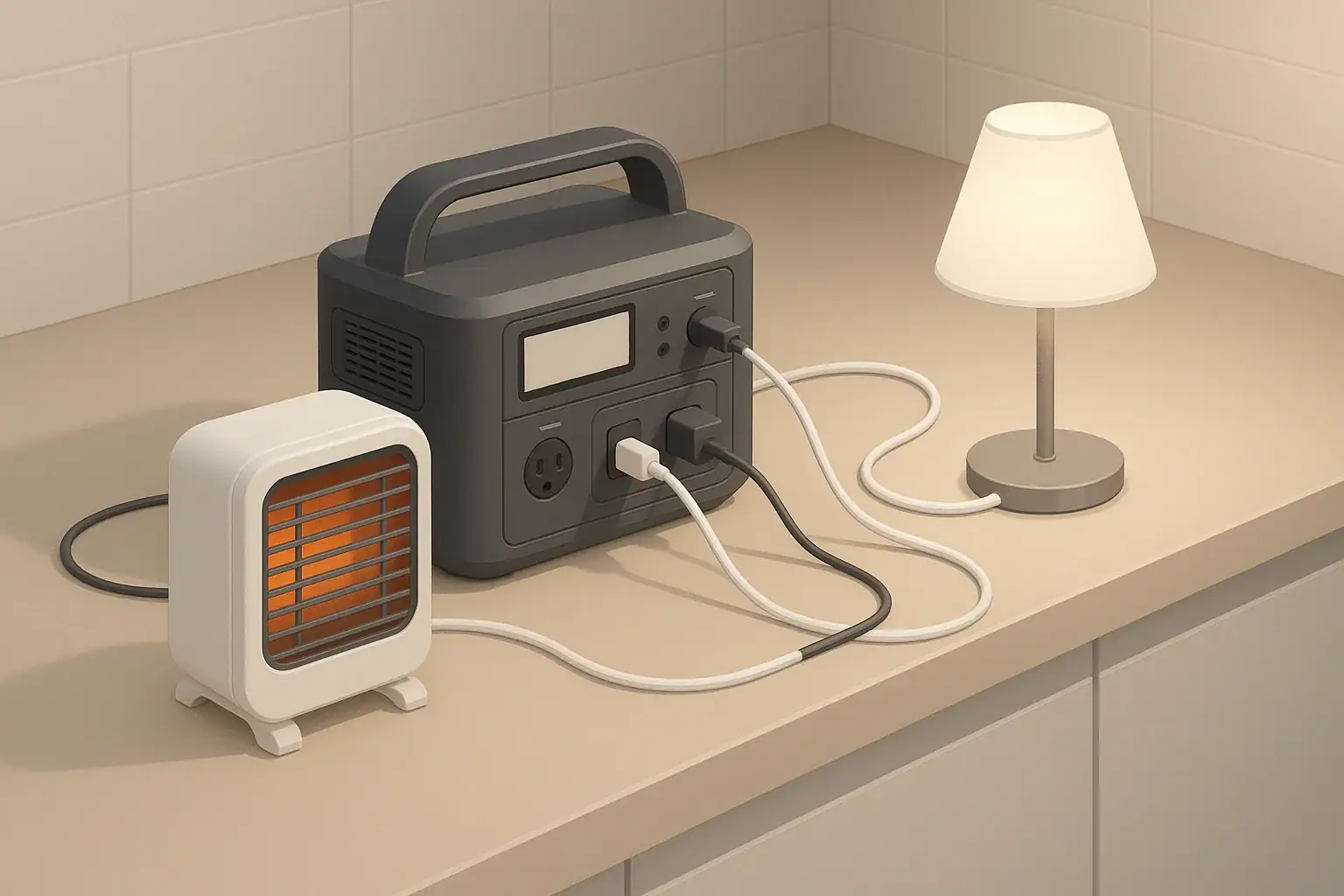
Yes, a portable power station can run a space heater, but usually only on lower settings and for a short time before the battery is drained. Electric heaters are one of the most power-hungry loads you can plug into a battery power source, so realistic expectations are essential.
If you are planning backup heat for power outages, RV or van life, or cold-weather camping, it is important to know how long a battery power station can actually run a space heater. The same unit that powers lights, phones, and a small fridge all evening may only run a 1500 watt heater for well under an hour.
This guide walks through how portable power stations and space heaters interact, how to estimate runtime, and how to avoid common overload and shutdown problems. You will see concrete examples, simple rules of thumb, and a practical checklist so you can decide when electric space heating from a battery makes sense and when to focus on other ways to stay warm.
What this question really means and why it matters
When you ask whether a portable power station can run a space heater, you are really asking whether the heater’s power demand fits within the station’s inverter limits and battery capacity. Space heaters convert electrical energy directly into heat using resistance elements, which means nearly all of the power they draw is turned into heat. That also means they draw far more watts than typical electronics.
In many homes, a plug-in portable heater is rated for 750–1500 watts on 120 volts. By comparison, a laptop might use 60 watts, a phone charger 10 watts, and an efficient LED bulb 10 watts or less. A heater can easily draw 10–100 times more power than these devices, which is why it can drain a battery pack so quickly.
This matters because portable power stations are often marketed using their watt-hour capacity and maximum watt output, but those numbers can be misleading if you do not connect them to real-world loads. Someone might see a “1000 Wh” label and assume it will keep a room warm all night. In practice, that same unit might only support an hour of continuous heating on a medium setting.
Understanding the limits helps you choose a realistic strategy: perhaps using the heater briefly for spot warmth, keeping the power station for critical loads like communications and medical devices, and relying on insulation, clothing, and other non-electric heat sources for long-duration comfort.
Key power concepts and sizing logic for running a heater
To decide if your portable power station can run a specific space heater, you need three basic numbers: the heater’s watt rating, the power station’s continuous AC watt rating, and the battery’s watt-hour capacity. With those, you can quickly estimate whether the combination is safe and how long it might run.
1. Heater watts: Check the label or manual on your heater. Common settings include around 500 watts (low), 750–1000 watts (medium), and 1500 watts (high). Use the actual number printed on the device whenever possible. If it lists amperes (A) instead of watts, you can approximate watts as volts × amps (for example, 120 V × 12.5 A ≈ 1500 W).
2. Power station AC output: Look for the continuous (running) watt rating of the AC inverter. Ignore the higher surge or peak number for this purpose. The heater’s watt draw should be comfortably below the continuous rating for reliable operation. Running right at the limit often leads to nuisance shutdowns or overheating.
3. Battery capacity in watt-hours (Wh): This tells you how much total energy the battery can store. A simple theoretical runtime is:
Runtime (hours) ≈ Battery Wh ÷ Heater watts
However, this calculation assumes 100% efficiency. In reality, you lose some energy in the inverter and battery management system, especially at high loads. A common planning rule is to assume about 80–85% of the rated watt-hours are usable for a large AC load like a heater.
For a quick mental estimate, you can multiply the theoretical runtime by 0.8. For example, if the math says 2 hours, expect more like 1.5–1.7 hours of continuous operation in practice.
| Heater setting (approx.) | Minimum inverter continuous rating to start | Recommended inverter rating for reliability | Typical outcome on a matching battery |
|---|---|---|---|
| 500 W (small / eco) | ≥ 500 W | 600–800 W | Usually starts and runs; drains a 500 Wh battery in under an hour. |
| 750 W (low) | ≥ 750 W | 900–1200 W | Works on many mid-size units; 1000 Wh battery lasts around 1 hour. |
| 1000 W (medium) | ≥ 1000 W | 1200–1500 W | High draw; 1000 Wh battery drains in well under 1.5 hours. |
| 1500 W (high) | ≥ 1500 W | 1800 W or more | Requires a large inverter and battery; short runtimes unless capacity is several kWh. |
| Any of the above | Rating equal to or below heater watts | Not recommended | Likely overload warnings, shutdowns, or failure to start the heater. |
Beyond raw numbers, consider how you will use the heater. Continuous high-power heating is much harder on both the battery and inverter than short bursts on a lower setting. Directing heat at people (for example, under a desk or near a sitting area) is usually more efficient than trying to raise the temperature of an entire room.
Real-world runtime examples for heaters on portable power
Putting the math into concrete scenarios makes it easier to set expectations. The following examples assume about 80% usable capacity for high-wattage AC loads and continuous operation without thermostat cycling.
Example 1: Small power station with a 500 W personal heater
- Power station: 500 Wh battery, 600 W continuous inverter
- Heater: 500 W setting
- Theoretical runtime: 500 Wh ÷ 500 W = 1.0 hour
- Realistic runtime (80% efficiency): 0.8 hours, or about 45–50 minutes
This setup is often adequate for short bursts of heat at a work desk or in a small tent, but it will not keep a room warm for an evening.
Example 2: Mid-size power station with a 750 W heater setting
- Power station: 1000 Wh battery, 1200 W continuous inverter
- Heater: 750 W setting
- Theoretical runtime: 1000 Wh ÷ 750 W ≈ 1.33 hours
- Realistic runtime: about 1.0–1.1 hours of continuous heating
If the heater’s thermostat cycles on and off in a well-insulated room, the total elapsed time before the battery is empty might be 2–3 hours, but the heater will not be running the whole time.
Example 3: Large heater on a high setting
- Power station: 2000 Wh battery, 2000 W continuous inverter
- Heater: 1500 W setting
- Theoretical runtime: 2000 Wh ÷ 1500 W ≈ 1.33 hours
- Realistic runtime: roughly 1.0–1.1 hours
To run the same 1500 W heater for 4 hours continuously, you would need around 6000 Wh of usable capacity. That is more than many portable units can provide and typically means a much heavier, more expensive system.
Example 4: Choosing between heat and other essentials
- Power station: 1000 Wh battery
- Option A: 750 W heater on low, about 1 hour of runtime
- Option B: 10 W LED light for 8 hours, 60 W laptop for 4 hours, 10 W router for 8 hours, plus several phone charges
Both options use a similar amount of energy, but Option B keeps communications, work, and lighting running for an evening. This comparison highlights why many users treat electric heating as a short-term comfort measure rather than a primary use for a battery power station.
| Battery capacity | Heater setting | Theoretical runtime (Wh ÷ W) | Realistic continuous runtime (80% of rated Wh) |
|---|---|---|---|
| 500 Wh | 500 W | 1.0 hours | 0.8 hours (about 45–50 minutes) |
| 1000 Wh | 750 W | 1.33 hours | ≈ 1.0–1.1 hours |
| 1500 Wh | 1000 W | 1.5 hours | ≈ 1.1–1.2 hours |
| 2000 Wh | 1500 W | 1.33 hours | ≈ 1.0–1.1 hours |
| 3000 Wh | 1500 W | 2.0 hours | ≈ 1.5–1.7 hours |
These examples show that even relatively large-capacity power stations provide limited runtime for full-size heaters. Planning around lower heater settings, shorter usage windows, and supplemental non-electric insulation is usually more effective than trying to replicate central heating from a battery.
Common mistakes and troubleshooting cues
Many problems people encounter when trying to run a space heater from a portable power station come down to a few predictable mistakes. Recognizing them makes troubleshooting much easier.
Mistake 1: Ignoring the heater’s watt rating
Assuming that “if it plugs in, it will work” is a common error. If your heater draws 1500 watts and your power station’s inverter is rated for 1000 watts continuous, the station will likely shut down immediately, flash an overload warning, or refuse to start the heater at all.
What you might see: The heater clicks on briefly, the power station beeps, and the AC output turns off. Some units display an overload icon or error code.
Mistake 2: Overestimating runtime from watt-hours
Simply dividing watt-hours by heater watts and assuming that number is guaranteed leads to disappointment. Heavy AC loads are where inverter losses and battery protection limits are most noticeable.
What you might see: The battery percentage drops much faster than your calculation suggested, even though the heater seems to be working normally. This does not usually indicate damage; it just reflects real-world efficiency.
Mistake 3: Running the inverter at its limit continuously
Running a heater that is very close to the inverter’s maximum continuous rating stresses the electronics and generates more internal heat. Over time, this can lead to more frequent thermal shutdowns or reduced performance.
What you might see: The power station’s cooling fans run at full speed, the case feels warm, and the unit shuts down after a period of heavy use even though the battery is not empty.
Mistake 4: Placing the power station in the heater’s airflow
Positioning the heater so that hot air blows directly on the power station can quickly raise its internal temperature, triggering protective shutdowns or shortening lifespan.
What you might see: The heater stops, and the power station shows a temperature warning or refuses to turn the AC output back on until it cools down.
Mistake 5: Misunderstanding pass-through use
Some users expect that plugging the power station into a wall outlet or another charger while running a heater will keep the battery at 100%. If the heater draws more power than the charger supplies, the battery will still discharge.
What you might see: The display shows that the unit is charging, but the overall state of charge slowly decreases or barely increases while the heater is on.
Quick troubleshooting checks
- Compare heater watts to inverter continuous watts; reduce heater setting if they are close.
- Check for overload or temperature icons on the display if the unit shuts down.
- Move the power station away from heat sources and improve airflow around its vents.
- Test the AC output with a smaller load (such as a lamp) to confirm the inverter still works.
- If problems persist even with small loads, stop using the unit and contact a professional service provider.
Safety basics when using a heater with a power station
Space heaters carry fire and burn risks regardless of how they are powered. Adding a portable power station introduces high current draw and concentrated energy storage, so safety deserves extra attention.
Placement and clearance
- Place the heater on a stable, flat, non-flammable surface.
- Keep clear space around the heater, especially in front of the hot air outlet.
- Keep bedding, curtains, paper, clothing, and furniture well away from the heater.
Supervision and duration
- Avoid running a space heater unattended or while sleeping, especially on battery power.
- Use shorter, supervised heating sessions to warm up a space or specific area, then turn the heater off.
Power station ventilation
- Ensure the power station has adequate airflow around its cooling vents.
- Do not cover the unit with blankets or clothing to “keep it warm”; this can trap heat.
- Keep the power station out of direct heater airflow and away from other heat sources.
Cords and connections
- Plug the heater directly into the power station when possible rather than using power strips.
- If an extension cord is necessary, use one rated for at least the heater’s wattage and intended for indoor use.
- Inspect cords for damage, and avoid running them under rugs or through tight doorways where they can overheat or be pinched.
Environment and moisture
- Avoid using electric space heaters powered by a portable unit in wet or very humid areas.
- Keep both the heater and power station away from sinks, tubs, and other water sources.
Following these basics reduces the risk of fire, overheating, and electrical hazards while still allowing you to use a heater briefly when it is genuinely needed.
Maintenance and storage for reliable cold-weather use
Because heaters are often used during winter storms and cold-weather trips, the way you maintain and store your portable power station has a direct impact on whether it will perform when you need it.
Temperature and battery performance
Lithium-based batteries do not like extreme temperatures. Very cold conditions can temporarily reduce available capacity and discharge rates, while high heat accelerates long-term aging. Whenever possible, store and operate the unit within the temperature range specified in its documentation.
In practice, this means avoiding long-term storage in freezing vehicles, unheated sheds, or hot attics. During winter, try to keep the power station indoors and bring it into a moderate environment for a while before charging or using it heavily.
State of charge during storage
Most portable power stations are happiest when stored partially charged rather than at 0% or 100% for long periods. A common approach is to store the battery around 40–60% state of charge if it will sit unused for months, then top it up before storm season or a trip.
Periodic checks and test runs
Even when turned off, many units slowly self-discharge. Checking the battery every 1–3 months and recharging as needed helps ensure that the battery is not unexpectedly empty when a winter outage hits. Running a small AC load for a short time is also a good way to confirm that the inverter and outlets are still working properly.
Visual inspections and cleaning
High-draw loads like heaters put extra stress on internal components. Regular visual inspections can catch problems early.
- Look for cracks in the housing, swelling, or deformation.
- Inspect AC outlets and DC ports for looseness or discoloration.
- Keep cooling vents free of dust and debris.
If you notice anything unusual beyond minor dust, avoid opening the unit or attempting internal repairs yourself. Instead, stop using the power station and seek professional service.
| Maintenance item | Suggested practice | Benefit for heater use |
|---|---|---|
| Storage charge level | Store around 40–60% if unused for several months. | Preserves battery health so peak power is available for high-draw heaters. |
| Recharge interval | Check and top up every 1–3 months. | Reduces chance of finding a dead battery during a winter outage. |
| Storage location | Keep in a cool, dry indoor area away from extremes. | Limits capacity loss from heat and performance loss from deep cold. |
| Pre-season test | Run a small AC load for 10–20 minutes. | Confirms inverter operation before connecting a high-watt heater. |
| Vent and fan cleaning | Periodically remove dust from vents. | Improves cooling so the unit can handle sustained heater loads. |
| Usage tracking | Note how often you fully discharge the battery. | Helps avoid frequent deep cycles that can shorten lifespan. |
Practical takeaways and specs to look for
Portable power stations can run space heaters, but only within clear limits. Matching heater wattage to inverter capacity, and heater runtime expectations to battery watt-hours, is essential if you want predictable performance instead of surprise shutdowns.
For most people, the most effective approach is to treat electric space heating as a short, targeted comfort measure and reserve most of the battery for lights, communications, and critical small appliances. Lower heater settings, shorter sessions, and good insulation usually deliver more comfort per watt-hour than trying to heat an entire room continuously from a battery.
When you are comparing portable power stations for occasional heater use, it helps to focus on a few key specifications and design details.
Specs to look for when planning to run a space heater
- AC inverter continuous watt rating: Choose a unit with a continuous rating comfortably above your intended heater setting (for example, at least 20–30% higher). Avoid operating continuously at the inverter’s absolute limit.
- Battery capacity (Wh): Estimate runtime using battery Wh ÷ heater watts, then multiply by about 0.8 for a realistic figure. Decide if that runtime is acceptable for your use case.
- Thermal management: Look for designs with clear ventilation paths and active cooling, which are better suited to sustained high-wattage loads.
- Display and monitoring: A clear readout of input, output, and remaining capacity helps you see how fast the heater is draining the battery and adjust your usage.
- AC outlet count and rating: Ensure there are enough outlets and that they share the inverter capacity appropriately if you plan to run a heater plus other devices.
- Supported operating temperature range: Check that the specified range fits your expected winter conditions, especially if you plan to use the unit in unheated spaces.
- Charging options and speed: Faster charging from wall power, vehicle power, or solar can partially offset the rapid drain from heater use during multi-day outages.
- Battery chemistry and cycle life: Higher cycle life can be useful if you regularly draw large amounts of energy for heat, as this places more wear on the battery.
By combining realistic runtime estimates with these spec checks, you can quickly determine whether a given power station and heater pairing fits your needs. In many situations, the best comfort comes from using the heater briefly and intelligently while letting the power station focus on the essential loads that truly require electricity.
Primary reference: The CPSC’s portable-heater safety guidance recommends clearance from combustible materials, avoiding extension cords and power strips, and turning heaters off while sleeping. Always follow the heater and power-station manuals.
Frequently asked questions
Which power station specifications should I prioritize to run a space heater?
Prioritize the inverter’s continuous AC watt rating to ensure it comfortably exceeds the heater’s running watts, and the battery capacity in watt-hours to estimate runtime. Also consider thermal management (venting and fans) and clear monitoring of input/output so you can track drain and avoid overheating.
Why won’t my space heater start when plugged into a portable power station?
Most commonly the heater’s starting or running watts exceed the inverter’s continuous or surge capability, causing an immediate overload or shutdown. Check the heater’s watt rating against the station’s continuous output and try a lower heater setting or a larger inverter-rated unit.
Is it safe to run a space heater from a portable power station overnight?
Running a heater unattended overnight from battery power is generally not recommended due to fire and overheating risks and the potential for inverter thermal shutdown. Use short, supervised heating sessions and follow placement, ventilation, and cord-safety guidance to reduce hazards.
How can I maximize runtime when using a heater on battery power?
Use lower heater settings, target heat to people rather than whole-room heating, improve insulation, and rely on thermostat cycling rather than continuous operation. Combining these steps with supplemental non-electric measures (blankets, clothing) gives more effective comfort per watt-hour.
Will charging the power station while running a heater prevent the battery from draining?
Only if the charger’s input power equals or exceeds the heater’s draw; otherwise the battery will still discharge slowly. Many chargers cannot supply enough continuous power to fully offset a high-wattage heater, so check input vs. output ratings before relying on pass-through charging.
What common mistakes shorten power station or heater performance?
Frequent mistakes include running the inverter at or above its continuous limit, placing the power station in the heater’s hot airflow, and storing batteries in extreme temperatures. These practices increase thermal stress, trigger protective shutdowns, and accelerate battery aging.
Related guides
Browse this topic →
- Beginner-friendly sizing, runtime & specs
- Solar & charging (MPPT, fast charging, cables)
- Batteries (LiFePO4, cycles, care & storage)
- Safety, cold-weather performance, real-world tips
More in Home / Appliances
See all →Keep reading
About this site
Portable Energy Lab publishes practical, independent guides about portable power—clear sizing, safe use, and real-world expectations.
Affiliate disclosure
Some links on this site may be affiliate links. If you buy through these links, we may earn a small commission at no extra cost to you. This helps support our content. Read our affiliate disclosure.