
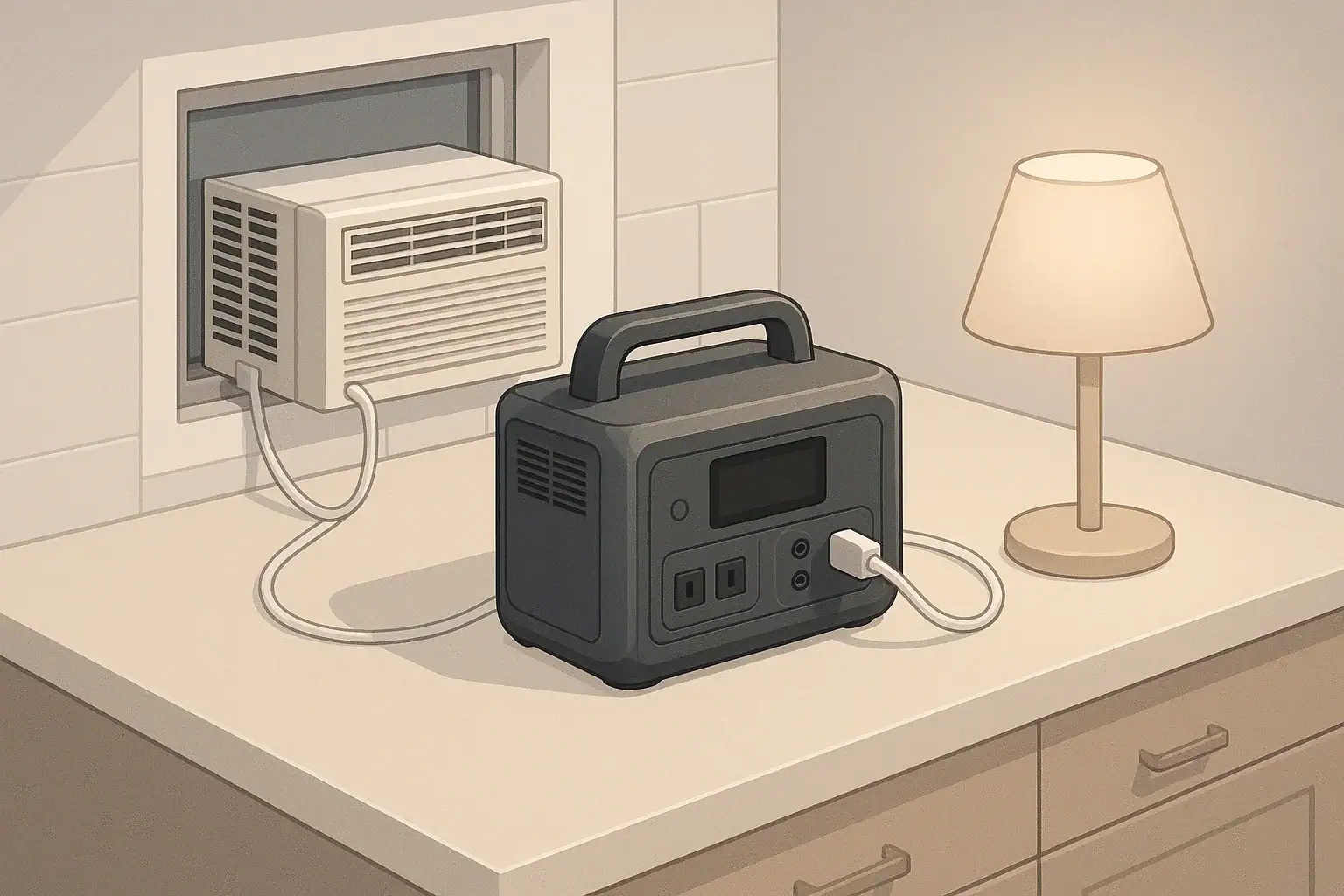
Yes, a portable power station can run an air conditioner if its inverter can handle the air conditioner’s running watts and startup surge, and if the battery has enough watt-hours for the runtime you expect.
The practical answer is more limited than the simple answer. A small efficient window AC, compact portable AC, or low-draw RV air conditioner may run from a large portable battery system for a useful period. A full-size room unit, older compressor AC, or central air system usually needs far more power than most portable power stations can provide.
Think of this as a sizing problem, not a guessing game. You need to compare watts, surge watts, battery capacity, heat load, and charging limits. A battery generator or solar generator can provide short cooling windows, but it is rarely a whole-home air conditioning replacement.
What it means and why it matters
When people ask whether a portable power station can run an air conditioner, they are really asking two separate questions. First, can the unit start the compressor without tripping an overload? Second, can it keep the air conditioner running long enough to matter?
Air conditioners are difficult loads for battery systems because they use a compressor motor. The compressor may need a brief burst of power at startup that is much higher than the power used after it is running. If the power station cannot supply that surge, the AC may click, beep, flash an error, or shut the power station down immediately.
This matters during outages, hot-weather emergencies, camping, RV use, van setups, and small-room cooling. In those situations, even one to four hours of focused cooling can be useful. It may help cool a bedroom before sleep, protect a pet in a small insulated space, or reduce heat stress during the hottest part of the day.
The key expectation is targeted cooling. A portable power station is best used with a small, efficient air conditioner in a limited area. Cooling an open floor plan, garage, large RV, sun-exposed room, or poorly insulated space will drain the battery quickly and force the compressor to run more often.
Key concepts and how the sizing works
Start with the air conditioner’s running watts. This is the power the AC uses after the compressor is operating. Some labels list watts directly. Others list amps. For a typical 120-volt appliance in the United States, estimated watts are amps multiplied by 120. For example, an AC rated at 6 amps uses roughly 720 watts while running.
Next, check startup surge. Many compressor-based air conditioners briefly draw two to five times their running power. Some newer inverter-style air conditioners ramp up more gently, while some older models surge harder. The power station’s surge rating must be higher than the AC’s startup demand, not just equal to the running watts.
Then calculate energy use. Battery capacity is measured in watt-hours. A 1,000 Wh power station does not usually deliver the full 1,000 Wh to an AC outlet because the inverter and electronics use some energy. A practical planning estimate is to use about 80 to 90 percent of the listed capacity for AC loads.
The basic runtime estimate is usable watt-hours divided by average watts. If a power station has 1,000 Wh and you assume 850 Wh usable, a 500-watt continuous load would run for about 1.7 hours. If the air conditioner cycles off half the time after the room cools down, the total clock time can be longer. If the compressor runs constantly because the room is hot, runtime will be shorter.
| Item to check | What it tells you | Practical sizing cue |
|---|---|---|
| AC running watts | Normal power draw after startup | Keep it below about 70 to 80 percent of inverter continuous output when possible |
| AC startup surge | Brief compressor starting demand | Must be below the power station surge rating with some margin |
| Battery watt-hours | Total stored energy | Use 80 to 90 percent of rated Wh for rough AC-outlet runtime planning |
| Average AC draw | Real energy use over time | Lower if the compressor cycles off; higher in extreme heat |
| Other connected loads | Total demand on the inverter | Avoid running kettles, microwaves, heaters, or tools at the same time |
| Charging input | How fast the battery can be refilled | If input watts are lower than AC draw, the battery still drains while charging |
Real-world examples and realistic runtime
A small 5,000 to 6,000 BTU window air conditioner might use about 400 to 600 running watts. With a 1,000 Wh power station and roughly 850 Wh usable through the inverter, continuous runtime may be around 1.4 to 2.1 hours. If the room is shaded, insulated, and already partly cooled, cycling may stretch the clock time to several hours.
A larger portable room air conditioner may use 800 to 1,200 running watts. This is a much heavier load. Even if the inverter can handle it, a 1,000 Wh class battery may provide less than an hour of compressor-heavy runtime. A larger 2,000 to 3,000 Wh unit would be more realistic, but heat load and surge still matter.
An RV rooftop air conditioner can be especially challenging. Many draw around 1,200 to 1,800 watts while running and may require a high startup surge unless equipped with a soft-start device or inverter compressor design. This kind of load usually calls for a high-output power station, a large battery reserve, and careful testing before relying on it in hot weather.
A compact AC used for spot cooling in a van, small office, or bedroom is more realistic. For example, a 500-watt average load on a 2,000 Wh power station with 1,700 usable Wh could run for about 3.4 hours of continuous draw. If the compressor averages 50 percent duty cycle after cooling the space, the total use window may be longer. If the sun is heating the space and the compressor runs constantly, use the shorter number.
Solar charging can help, but it does not erase the energy math. A panel array producing 300 watts in real conditions cannot indefinitely support a 700-watt AC load. It can slow the battery drain, extend runtime, or recharge after use. For daytime cooling, the most dependable plan is to pre-cool the space, reduce heat gain, and use solar as supplemental input rather than assuming it will fully carry the load.
Common mistakes and troubleshooting cues
The most common mistake is looking only at battery size. A large watt-hour number does not guarantee an air conditioner will start. The inverter must supply both the continuous running watts and the compressor surge. If the AC shuts off the power station the instant cooling begins, startup surge is the first thing to suspect.
Another mistake is using the air conditioner’s lowest advertised number instead of actual use. Some units list minimum, cooling mode, or seasonal efficiency information that does not match the draw you will see on a hot day. A plug-in power meter can help measure actual watts, but the power station display can also give useful clues once the AC is running.
A third mistake is assuming runtime calculations are exact. Battery displays are estimates, and air conditioners cycle differently depending on room temperature, humidity, insulation, thermostat setting, and airflow. A setup that runs three hours at night may run only one hour on a hot afternoon in direct sun.
| Symptom | Likely cause | Practical response |
|---|---|---|
| Power station shuts off as compressor starts | Startup surge exceeds inverter capability | Try a smaller AC, use fan-only mode, or choose a system with higher surge capacity |
| AC runs briefly, then overloads | Running watts plus other loads are too high | Disconnect other devices and confirm the AC draw on the display |
| Battery percentage drops very quickly | High continuous load or low starting charge | Start from full charge and recalculate runtime from actual watts |
| Runtime is shorter on hot days | Compressor duty cycle is higher | Shade windows, close doors, pre-cool early, and raise the thermostat a few degrees |
| Charging while running still drains battery | Input watts are below AC load | Compare real input watts with output watts; do not rely on pass-through use alone |
| Extension cord feels warm | Cord undersized, too long, or damaged | Stop use and switch to a shorter, heavier-gauge cord rated for the load |
Safety basics for running an AC from a power station
Place the portable power station on a dry, stable surface with open space around its vents. Air conditioners and inverters both produce heat, and blocked airflow can cause thermal shutdown or shorten equipment life. Do not cover the unit with blankets, clothing, curtains, or stored gear.
Use extension cords carefully. Air conditioners are high-draw appliances, so thin or very long cords can waste energy and overheat. Use a cord rated for the amperage and keep it uncoiled during operation so heat can dissipate. Avoid daisy-chaining power strips, adapters, and multiple cords between the station and the AC.
Keep the setup away from water. This includes rain, puddles, wet floors, dripping window units, and damp outdoor areas. If a protective outlet trips, do not keep resetting it without finding the cause. Check for moisture, damaged cords, loose plugs, or signs of overheating.
Do not backfeed a home panel, garage circuit, RV circuit, or wall outlet unless the system is specifically designed and installed for that purpose. Plugging a power station into building wiring incorrectly can create shock and fire hazards. For transfer equipment, dedicated circuits, or permanent wiring, use a qualified electrician.
Finally, respect thermal limits. High outdoor temperatures can reduce inverter performance and make battery cooling fans run harder. If the power station shows an over-temperature warning, reduce the load, improve ventilation, and allow it to cool before restarting the air conditioner.
Maintenance, storage, and long-term reliability
A power station that is expected to run an air conditioner during an outage should not sit forgotten for a year. Check the state of charge every few months, especially before storm season or summer heat waves. Batteries self-discharge slowly, and some units also consume a small amount of energy for standby electronics.
For long-term storage, many rechargeable battery systems prefer a partial charge rather than being stored completely full or completely empty. A common practical range is around 40 to 60 percent for storage, followed by charging to 100 percent before expected heavy use. Always follow the manual for the specific battery chemistry and model.
Temperature matters. Store the unit in a cool, dry location away from direct sun, hot vehicles, freezing sheds, and damp basements. Heat speeds battery aging, while cold can temporarily reduce available capacity and may limit charging. If the unit has been stored in very cold conditions, let it return to a moderate temperature before charging or applying a heavy AC load.
Inspect the system before relying on it. Look for dust-blocked vents, cracked cords, loose plugs, unusual fan noise, swollen casing, or error messages. Test the setup with the actual air conditioner before an emergency. A ten-minute test can reveal startup problems, overload warnings, and unrealistic runtime expectations before comfort or safety depends on it.
Long-term use also benefits from reducing the cooling load. Clean the air conditioner filter, seal window gaps, close blinds, use reflective shades, cool only one room, and set the thermostat a few degrees higher. These small steps can reduce compressor runtime and may add meaningful minutes or hours to a battery-powered cooling plan.
Practical takeaways and specs to look for
A portable power station can run an air conditioner when the system is sized correctly, but the best use case is short-term, focused cooling. The smaller and more efficient the AC, the easier it is to power. The larger, older, or harder-starting the compressor, the more likely you are to run into surge limits and short runtime.
For planning, treat the air conditioner as the main load. Do not assume you can also power cooking appliances, space heaters, power tools, or multiple high-draw devices at the same time. When cooling is the priority, every extra watt reduces runtime.
Specs to look for checklist
- Continuous AC output: Choose an inverter rating comfortably above the air conditioner’s running watts.
- Surge output: Confirm the surge rating can handle compressor startup with margin.
- Battery capacity: Estimate usable watt-hours, then divide by expected average watts.
- AC outlet rating: Make sure the outlet and total inverter output support the load you plan to use.
- Charging input: Compare wall, vehicle, or solar input watts against the AC load and recharge goals.
- Pass-through limitations: Verify whether the unit supports charging and discharging at the same time, and under what limits.
- Operating temperature range: Check whether the power station can handle hot-weather use without derating or shutdown.
- Display information: A clear watts-in, watts-out, and estimated-runtime display makes troubleshooting easier.
- Weight and placement: Larger batteries are heavier, so plan where the unit will safely sit near the AC.
The practical sizing process is straightforward: measure or estimate the AC running watts, allow for startup surge, calculate runtime from usable watt-hours, and test the setup before you need it. If any one of those steps fails, choose a smaller cooling load, a larger power station, better insulation, or a different backup cooling strategy.
Frequently asked questions
How do I know if my portable power station is big enough for my air conditioner?
Check two numbers: the air conditioner’s running watts and its startup surge. The power station must support both, and the battery capacity must be large enough for the runtime you want. If the AC is a compressor-based unit, surge capacity is often the limiting factor.
What specs matter most when choosing a power station for an air conditioner?
The most important specs are continuous inverter output, surge output, and usable watt-hours. After that, look at charging input, pass-through limits, and operating temperature range. A clear display showing watts in and watts out also helps you verify real-world performance.
What is the most common mistake people make when trying to run an AC from a battery?
The most common mistake is focusing only on battery size and ignoring startup surge. A large battery still will not start an air conditioner if the inverter cannot handle the compressor’s brief power spike. Another frequent error is assuming advertised runtime will match hot-weather conditions.
Can a portable power station run an air conditioner overnight?
Usually only a very efficient small AC with a large battery system and favorable conditions. Overnight runtime depends on room insulation, outdoor temperature, thermostat setting, and how often the compressor cycles. For most setups, several hours is more realistic than a full night.
Is it safe to use an air conditioner with a portable power station indoors?
Yes, if the equipment is used according to the manufacturer’s instructions and kept dry, ventilated, and properly wired. Use a correctly rated cord, keep vents clear, and avoid overloading the inverter. Do not connect the power station to household wiring unless the system is designed for that purpose.
Will solar panels keep an air conditioner running all day?
Usually not by themselves, unless the AC load is very small and the solar array is large with strong sun. Solar can extend runtime or recharge the battery, but real-world output is often much lower than the panel’s rated maximum. For dependable cooling, treat solar as support rather than the only power source.
Related guides
Browse this topic →
- Beginner-friendly sizing, runtime & specs
- Solar & charging (MPPT, fast charging, cables)
- Batteries (LiFePO4, cycles, care & storage)
- Safety, cold-weather performance, real-world tips
More in Home / Appliances
See all →Keep reading
About this site
Portable Energy Lab publishes practical, independent guides about portable power—clear sizing, safe use, and real-world expectations.
Affiliate disclosure
Some links on this site may be affiliate links. If you buy through these links, we may earn a small commission at no extra cost to you. This helps support our content. Read our affiliate disclosure.