
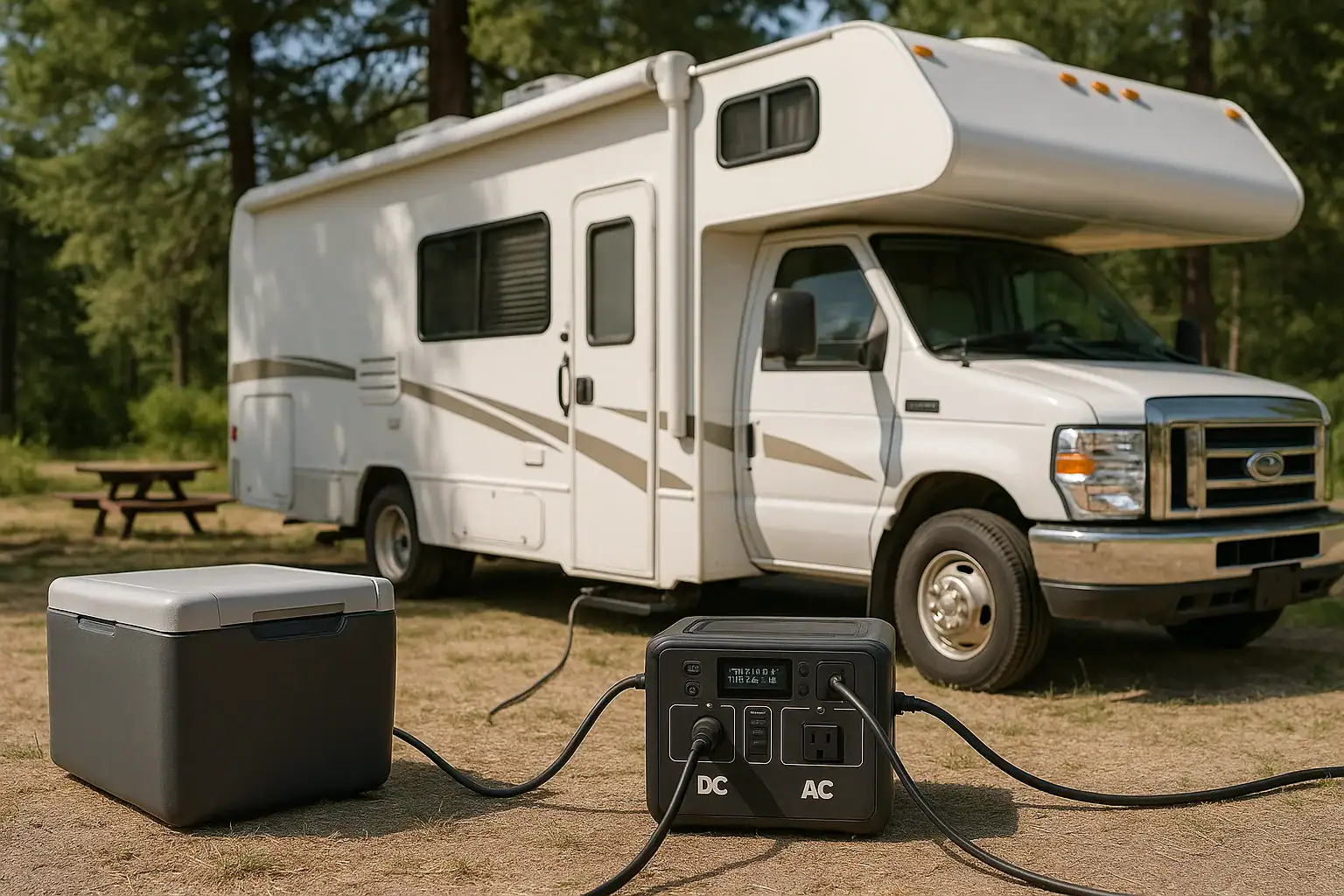
Using a portable power station for RV 12V loads and light “house power” is usually straightforward, but runtime, inverter limits, and 12V output ratings decide what actually works. Once you understand watt-hours, surge watts, DC vs AC efficiency, and input limits, you can match your RV gear to what a power station can safely supply.
This guide explains how to run 12V lights, fans, fridges, and basic outlets from a power station without killing the battery early or tripping protections. You will see how 12V ports differ from the AC inverter, how to estimate runtime, why some RV appliances overload the system, and which specs really matter for camping, boondocking, or backup use. The goal is to help you plan a simple, reliable setup that keeps your RV comfortable without guesswork.
Understanding RV Power Stations, 12V Loads, and House Power
A portable power station is a self-contained battery system with built-in inverter, DC outputs, and charging electronics. For RV use, it can act as a compact “house battery” that powers both 12V loads (direct DC) and basic “house power” through its AC outlets or RV shore-power cord.
In a typical RV, there are two sides of the electrical system:
- 12V DC system: Lights, fans, water pump, vent fans, USB chargers, some fridges, and control boards.
- 120V AC system: Wall outlets, microwave, air conditioner, electric water heater element, and some residential fridges.
A power station can supply both, but not in the same way. The 12V ports power DC loads directly, while the built-in inverter creates 120V AC for outlets or the RV shore-power inlet. This matters because:
- Inverter output is limited by continuous watts and surge watts.
- 12V ports have their own amp limits and sometimes lower total power than the inverter.
- Every watt-hour (Wh) drawn from the battery is reduced by conversion losses, especially when going from DC to AC.
Understanding these limits is the foundation for deciding which RV loads to run and for how long.
How a Portable Power Station Powers 12V Loads and RV House Circuits
Inside a portable power station, the battery stores energy in watt-hours (Wh). The system then converts that stored DC energy into usable outputs:
- 12V DC outputs: Often a cigarette-lighter style port and sometimes 5.5 mm barrel or Anderson-style ports. These supply DC power directly from the battery through a DC-DC converter.
- USB/USB-C ports: Provide 5V (and sometimes higher PD profiles) for phones, tablets, and laptops.
- AC inverter outputs: Convert DC battery power to 120V AC for standard plugs or an RV shore-power cord.
For RV use, there are two main ways to connect:
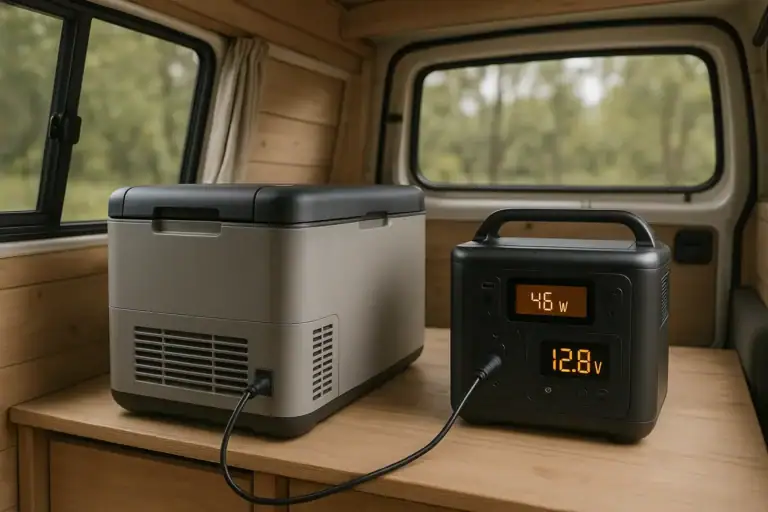
- Direct 12V connection: Plug 12V appliances (fans, compressor fridge, lights) into the power station’s DC ports. This is usually more efficient than running the same loads through the inverter.
- AC “house power” connection: Plug the RV’s shore-power cord into the power station’s AC outlet via a suitable adapter, then turn off or manage large loads (A/C, electric water heater, big microwave) so you don’t overload the inverter.
Key concepts that control what you can run:
- Battery capacity (Wh): How much energy you have. Runtime ≈ Wh ÷ load watts ÷ efficiency factor.
- Inverter continuous watts: Maximum sustained AC power. Your simultaneous AC loads must stay under this.
- Inverter surge watts: Short bursts for motor starts (fridge compressor, pump). Loads that exceed surge can trip the inverter.
- 12V output current limit (amps): Total amps allowed across all DC ports. Exceeding this trips DC output protections.
- Charging input limit (watts): How fast you can recharge from shore power, generator, or solar.
When you plug the RV’s shore cord into the power station, the RV’s internal 120V panel sees it like a small pedestal. The difference is that the “pedestal” now has strict watt limits and a finite battery behind it.
| Aspect | 12V DC Loads | 120V AC House Loads |
|---|---|---|
| Typical use | Lights, fans, fridge, pump | Outlets, TV, small microwave |
| Conversion losses | Lower (DC-DC) | Higher (DC-AC inverter) |
| Power limit type | Amp limit on 12V ports | Inverter continuous & surge watts |
| Efficiency at low loads | Usually better | Often worse at very small loads |
| Best for | Long runtimes on essentials | Short-term higher-power use |
Practical RV Scenarios: 12V Loads and Light House Power
Seeing real-world RV examples makes it easier to plan your setup and avoid overloading the power station.
Running 12V RV Essentials Directly
Many RVers use the power station purely as a 12V battery bank:
- 12V compressor fridge: A small DC fridge may average 30–50W over time, even if it peaks higher when the compressor starts.
- LED lights: A few interior LED fixtures might total 10–25W.
- Vent fans or small 12V fans: Often 5–30W each depending on speed.
- Water pump: Often 60–100W, but only runs in short bursts.
For a 600Wh power station, a 40W average 12V fridge plus 20W of lights and fans (60W total) might give a rough runtime of:
Runtime ≈ 600Wh ÷ 60W ÷ 0.9 ≈ 11 hours (assuming ~90% DC efficiency).
Using a Power Station as a Mini Shore Power Source
Another common approach is to plug the RV’s shore-power cord into the power station’s AC outlet. In this mode, the power station feeds the RV’s 120V panel, and the RV’s converter may try to charge the RV house battery.
Typical light “house power” loads include:
- TV and streaming device (40–120W)
- Laptop chargers (30–90W each)
- Small microwave (600–1000W while running)
- Coffee maker (600–900W while brewing)
- Low-power electric kettle (600–900W)
On a 1000W continuous inverter, you might run:
- TV (80W) + a laptop (60W) + some lights (40W) = ~180W comfortably.
- A small microwave at 800W alone, but not with other big loads at the same time.
Large loads like rooftop air conditioners (often 1200–1800W running with higher startup) or electric water heaters can easily exceed the inverter’s continuous or surge rating and drain the battery very quickly.
Hybrid Use: DC for Efficiency, AC for Convenience
Many RV owners combine both methods:
- Run critical, long-duration loads (12V fridge, fans, lights) directly from DC ports for better efficiency and longer runtime.
- Use the AC inverter sparingly for short, high-power tasks (microwave, coffee, induction cooktop) when needed.
This hybrid approach reduces wasted energy in the inverter, stretches runtime, and keeps you under the power station’s output and surge limits.
Common Mistakes and Troubleshooting When Powering an RV
Most issues with using a power station for RV 12V and house power come down to overloads, hidden parasitic loads, or misunderstandings about how the RV’s own systems behave.
Overloading the Inverter
Symptom: AC output shuts off, beeps, or shows an overload warning.
Likely causes:
- Starting a high-surge load (A/C, large fridge compressor, big pump).
- Running multiple high-watt devices at once (microwave + coffee maker + outlets).
- Underrated continuous watt rating compared to total RV demand.
What to check:
- Add up the watts of everything plugged into AC, including what the RV converter is drawing.
- Disable or unplug large AC loads in the RV breaker panel (A/C, electric water heater) so they cannot start unexpectedly.
12V Ports Shutting Down
Symptom: 12V cigarette-lighter or DC ports turn off or show an error.
Likely causes:
- Total 12V current draw exceeds the port’s amp rating.
- Short circuit or faulty cable on a 12V appliance.
- Voltage sag from a nearly depleted battery causing a low-voltage cutoff.
What to check:
- Sum the amps of your 12V loads (amps = watts ÷ 12).
- Try each 12V load individually to find a problematic device.
- Confirm the power station’s DC output limit and stay below it with a safety margin.
RV Converter Wasting Power or Fighting the Power Station
Symptom: The power station drains faster than expected when the RV shore cord is plugged in, even with few visible loads.
Likely causes:
- The RV converter/charger is trying to charge the RV battery from the power station.
- Parasitic AC and DC loads inside the RV (detectors, control boards, standby devices).
What to check:
- Turn off the RV’s converter/charger circuit at the breaker panel if you are not intentionally charging the RV battery from the power station.
- Identify and switch off non-essential AC circuits while on battery power.
Unexpectedly Short Runtime
Symptom: Battery percentage drops faster than predicted, or the unit shuts down earlier than expected.
Likely causes:
- Using AC for loads that could be powered by DC, losing energy in conversion.
- Underestimating average watts (e.g., a cycling fridge or fan draws more than its “low” spec suggests).
- Cold temperatures reducing effective battery capacity.
What to check:
- Monitor real-time watt draw on the power station’s display.
- Shift long-running loads to DC ports where possible.
- Adjust expectations for runtime in very hot or cold conditions.
Charging Confusion: Solar, Vehicle, and Shore Power
Symptom: Power station charges slowly or not at all from solar, vehicle 12V, or campground power.
Likely causes:
- Solar panel voltage or connector not compatible with the power station’s input specs.
- Vehicle 12V outlet limited to low amps, especially when the engine is off.
- Input limit reached because the station is already charging from another source.
What to check:
- Confirm the allowable input voltage and wattage for the power station.
- Use appropriately sized solar panels and correct polarity.
- Do not exceed the maximum combined input rating when using multiple charging methods.
Safety Basics for Using Power Stations in RVs
Portable power stations simplify RV power, but they still store significant energy. Proper use protects you, your RV wiring, and the equipment itself.
Respect Output Limits and Breaker Ratings
Always treat the power station’s ratings as hard limits:
- Stay under the continuous watt rating for AC loads, leaving headroom for surges.
- Keep 12V loads under the stated amp limit for each port and for the total DC output.
- Use the RV’s own breakers to disable large loads that the power station cannot support.
Do not attempt to wire the power station directly into an RV’s main AC distribution in a way that bypasses breakers or safety devices. For any permanent or semi-permanent wiring changes, consult a qualified RV electrician.
Ventilation and Heat Management
Power stations and inverters generate heat under load and while charging:
- Place the unit where air can circulate around vents and fans.
- Avoid enclosed compartments without airflow, especially near flammable materials.
- Keep it out of direct, intense sun when possible, particularly in hot climates.
High internal temperatures can trigger thermal protection, reduce output, or shorten battery life over time.
Moisture, Dust, and Vibration
Most portable power stations are not designed for heavy moisture or dust exposure:
- Keep the unit dry; do not use it in standing water, heavy rain, or where it can be splashed.
- Avoid dusty or sandy environments that can clog cooling vents.
- Secure the power station during travel to minimize vibration and impacts.
If you must use it outdoors, provide basic shelter while maintaining airflow.
Cable and Connector Safety
Undersized or damaged cables can overheat and become a fire risk:
- Use appropriately rated extension cords and adapters for the inverter’s output.
- Inspect 12V cables for frayed insulation, loose plugs, or melted connectors.
- Avoid running cords under rugs or through pinched doorways where heat can build up.
Do not modify plugs, defeat ground pins, or use makeshift adapters. If you are unsure about a particular connection into the RV, seek guidance from a qualified professional.
Battery Chemistry Considerations
Many modern power stations use lithium-based chemistries. Follow the manufacturer’s guidance for:
- Safe operating temperature range.
- Charging practices and compatible chargers.
- Storage state of charge and conditions.
Never attempt to open the power station or modify its internal battery pack. Internal repairs and advanced diagnostics should be left to qualified service personnel.
Maintenance and Storage for RV Power Station Reliability
Basic care extends the life and reliability of a portable power station, especially when it is central to your RV’s 12V and house power setup.
Regular Use and Cycling
Power stations generally prefer periodic use over sitting completely idle:
- Cycle the battery occasionally by discharging and recharging within normal operating ranges.
- Avoid frequently running to 0% or leaving at 100% for long periods unless the manufacturer specifically recommends it.
Moderate cycling helps keep the battery management system active and calibrated.
State of Charge for Storage
For longer storage between trips:
- Store at a moderate state of charge (often around 40–60%) unless otherwise specified.
- Check and top up the charge every few months to prevent deep discharge.
Extremely low or high state of charge during long storage can reduce long-term capacity.
Temperature and Storage Environment
Where you store the power station matters:
- Keep it in a cool, dry place out of direct sunlight.
- Avoid leaving it in a closed RV or vehicle in extreme heat for long periods.
- Protect it from freezing temperatures when not in use.
Both high heat and deep cold can stress the battery and electronics if sustained.
Inspecting Ports, Cables, and Connectors
Before each trip, give the system a quick check:
- Inspect AC outlets and 12V ports for debris, corrosion, or looseness.
- Test key loads (fridge, fans, lights) to confirm they power up as expected.
- Check cables for signs of wear, cuts, or overheating.
Finding issues while parked at home is easier than troubleshooting at a remote campsite.
Charging Practices Between Trips
How you recharge between outings affects convenience and battery health:
- Use the recommended charger and avoid exceeding input limits with combined sources.
- If using solar in storage, ensure the charging profile and voltage remain within the power station’s specs.
- Do not leave the unit on a high-amperage charger indefinitely unless designed for that use.
| Practice | Suggested Approach | Why It Helps |
|---|---|---|
| Storage charge level | Around 40–60% charge | Reduces long-term battery stress |
| Check interval | Every 2–3 months | Catches slow self-discharge early |
| Storage temperature | Cool, dry, above freezing | Protects battery chemistry and electronics |
| Pre-trip test | Run key 12V and AC loads briefly | Confirms functionality before travel |
| Cable inspection | Look for damage or overheating marks | Prevents failures and hot spots |
Related guides: Portable Power Stations for RV and Motorhomes • AC vs DC Power: How to Maximize Efficiency and Runtime • Surge Watts vs Running Watts: How to Size a Portable Power Station
Key Takeaways and Specs to Look For in an RV Power Station
Using a portable power station for RV 12V loads and light house power works best when you design around its limits instead of treating it like an unlimited pedestal. Direct 12V connections are more efficient for long-running essentials, while the inverter is ideal for short bursts of higher-wattage AC loads. Managing which RV circuits are active, understanding your typical watt draw, and planning your charging strategy will determine how comfortable and independent you can be off-grid.
Before relying on a power station as your RV’s primary or backup source, estimate your daily energy use, consider seasonal temperature impacts, and test your setup in a low-risk environment (like your driveway) to confirm runtimes and behavior. Combined with sensible safety practices and basic maintenance, this approach gives you predictable power for boondocking, travel days, and campground outages.
Specs to look for
- Battery capacity (Wh): Look for enough watt-hours to cover at least your typical overnight use (for many RV setups, 500–1500Wh). More capacity means longer runtime for 12V fridges, fans, and lights.
- Inverter continuous and surge watts: Choose continuous watts above your expected simultaneous AC load (often 600–2000W for RV use) with a higher surge rating to handle motor starts from fridges or pumps.
- 12V DC output rating (amps and watts): Ensure the total 12V output (for example, 10–30A) can comfortably run your fridge, fans, and pump together without tripping protections.
- Number and type of DC ports: Multiple 12V and USB/USB-C ports reduce the need for splitters and adapters and let you power several RV devices efficiently at once.
- Charging input power (AC and solar): Higher input limits (for example, 200–800W combined) allow faster recharging from shore power, generator, or solar between uses.
- Inverter efficiency and idle draw: Lower standby consumption and good efficiency at moderate loads help stretch battery runtime, especially when running only a few AC devices.
- Display and monitoring: A clear screen or app that shows real-time watts in/out, state of charge, and estimated runtime makes it easier to manage loads in an RV.
- Operating temperature range: A wide, realistic range helps maintain performance in hot summer RV interiors and cool shoulder seasons without frequent shutdowns.
- Cycle life and warranty terms: Higher rated charge cycles at a given depth of discharge indicate better long-term value if you use the power station heavily for camping or full-time RVing.
Frequently asked questions
Which specs and features matter most when using a power station for RV 12V loads and house power?
Key specs are battery capacity (Wh) for runtime, inverter continuous and surge watts for AC loads and motor starts, and the 12V DC output amp rating for direct DC devices. Also check charging input limits, port types and counts, inverter efficiency/idle draw, operating temperature range, and cycle life for long-term reliability.
What common mistakes shorten a power station’s runtime or cause unexpected shutdowns in an RV?
Common mistakes include running AC loads that could be powered by DC (adding conversion losses), leaving the RV converter on so it draws charging power, and exceeding inverter or 12V port limits. Cold temperatures and underestimating cycling/heavy-start loads (like compressor surges) also reduce effective runtime or trigger shutdowns.
What safety precautions should I take when using a power station in my RV?
Respect the unit’s output limits, use proper cables and breakers, provide ventilation to avoid overheating, and keep the unit dry and secured during travel. Do not bypass RV safety devices or modify internal wiring; consult a qualified electrician for permanent installations.
Can I plug my RV shore-power cord into a portable power station to run the RV’s 120V panel?
Yes, you can feed the RV panel from a power station’s AC outlet, but treat it like a limited pedestal with finite wattage and surge capacity. Disable large circuits and the converter if necessary, and ensure the station’s continuous and surge ratings cover the loads you plan to run.
How can I maximize runtime for a fridge and lights while boondocking?
Run long-duration loads like the fridge and lights on the power station’s DC outputs when possible, minimize AC usage, and reduce fridge cycling by keeping it shaded and properly packed. Choosing a larger Wh capacity and adding solar charging between cycles will also extend time off-grid.
What’s the best way to charge a power station while on the road or at a campsite?
Use shore power or a generator up to the unit’s AC input limit, and supplement with solar panels sized and connected per the station’s input specs. Don’t exceed combined input wattage when mixing sources, and use correct connectors and cable ratings to avoid losses and safety issues.
Recommended next:
- Portable Power Stations for Apartments
- Portable Power Stations for RV and Motorhomes
- Can a Portable Power Station Run a Microwave? What to Check Before You Try
- Can a Portable Power Station Run a Space Heater? Realistic Limits
- Can a Portable Power Station Run an Air Conditioner? Sizing and Expectations
- Powering a Coffee Maker, Kettle, or Induction Cooktop: What Works and Why
- More in Home / Appliances →
Related guides
Browse this topic →
- Beginner-friendly sizing, runtime & specs
- Solar & charging (MPPT, fast charging, cables)
- Batteries (LiFePO4, cycles, care & storage)
- Safety, cold-weather performance, real-world tips
More in Beginners
See all →- Camping Power Planning: A Simple Energy Budget for a Weekend
- Remote Work Power Kit: Keeping Laptop, Monitor, and Internet Running
- Portable Power Stations for Photography and Drone Charging: A Field Guide
- Portable Power Stations for CPAP and Medical Devices: What to Look For
- What’s in the Box? Essential Cables and Adapters You May Need
Keep reading
About this site
Portable Energy Lab publishes practical, independent guides about portable power—clear sizing, safe use, and real-world expectations.
Affiliate disclosure
Some links on this site may be affiliate links. If you buy through these links, we may earn a small commission at no extra cost to you. This helps support our content. Learn more.