
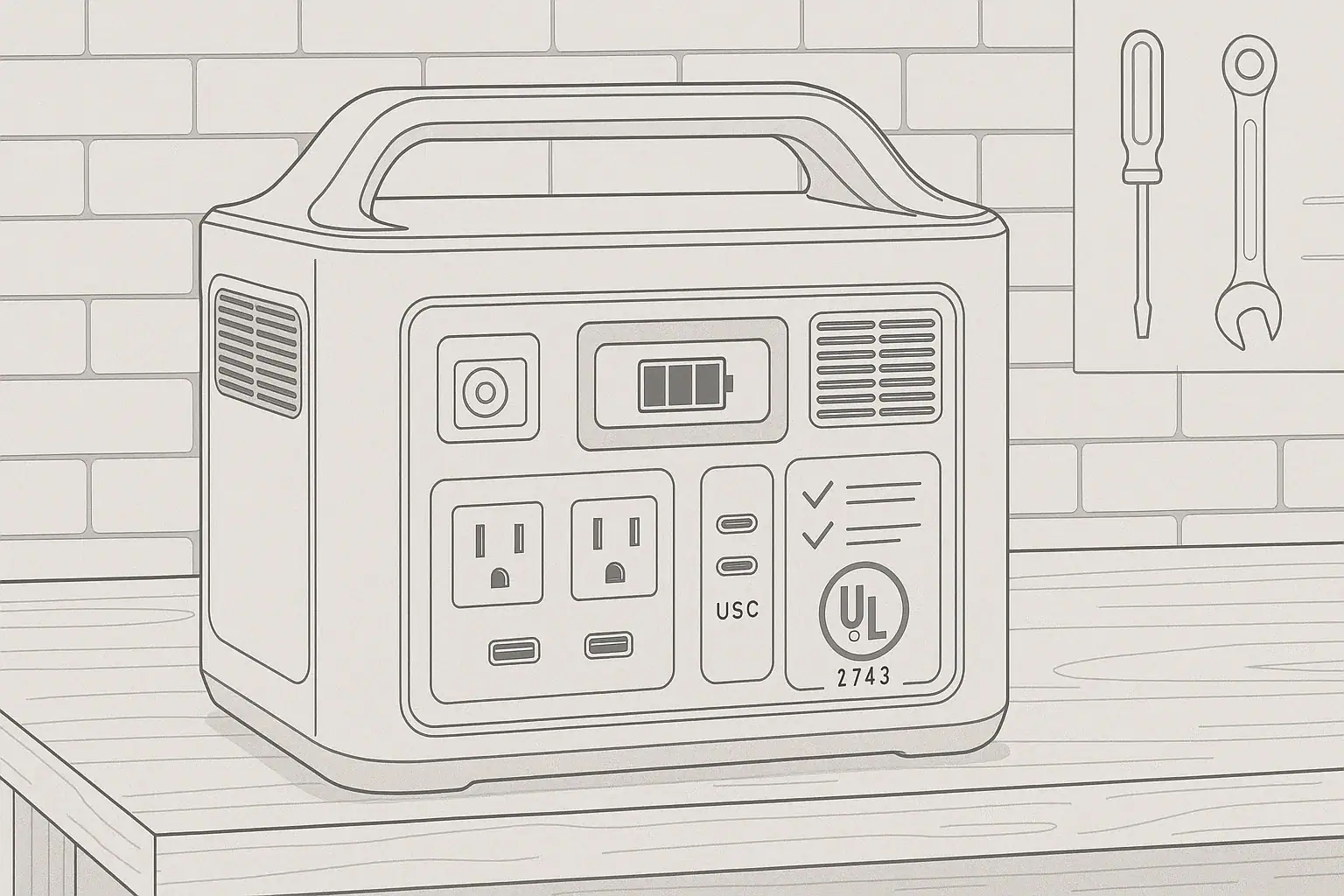
UL 2743 certification means a portable power station has been evaluated to a recognized safety standard for portable power packs, focusing on risks such as electric shock, overheating, fire, enclosure strength, abnormal operation, and safe charging behavior.
For shoppers, this certification is one of the clearest ways to separate a basic battery generator from a unit that has gone through structured third-party safety testing. It does not tell you the exact runtime, charging speed, surge watts, AC output quality, PD profile, or solar input limit by itself, but it helps confirm that the design has been reviewed for predictable hazards.
Portable power stations combine lithium batteries, inverters, chargers, DC outputs, firmware, cooling systems, and protective circuits in one enclosure. UL 2743 matters because a failure in any of those systems can affect the whole product, especially during high-wattage loads, pass-through charging, vehicle charging, or storage in hot conditions.
What UL 2743 certification means and why it matters
UL 2743 is a safety standard used for portable power packs, including many portable power stations designed to supply AC and DC power from an internal rechargeable battery. In plain terms, certification indicates that a representative product design has been tested and evaluated against defined safety requirements, and that ongoing production is subject to follow-up procedures by the certification body.
This is different from a manufacturer simply saying a product is “safe” or “built with protection.” A certified unit should have evidence of conformity to the standard, usually shown by a recognized certification mark on the product label, packaging, or documentation. The exact mark can vary depending on the certifying organization and market, but the key idea is independent evaluation rather than self-declaration alone.
For portable power stations, the safety challenge is that several high-energy systems are packed into a small case. The battery stores significant energy. The inverter turns DC battery power into household-style AC power. USB-C ports negotiate voltage and current. Solar and wall charging circuits manage incoming power. Cooling fans, fuses, relays, sensors, and firmware coordinate protection. UL 2743 looks at how these parts are built and how they respond when something goes wrong.
It is important to understand what the certification does not mean. It is not a promise that the unit will run a refrigerator for a specific number of hours. It is not a comparison of efficiency, noise, app features, charging speed, or battery cycle life. It also does not make unsafe use safe. Overloading outlets, blocking vents, using damaged cords, exposing the station to water, or connecting it improperly to home wiring can still create hazards.
How UL 2743 works for portable power stations
UL 2743 evaluation generally looks at the product as a complete system rather than only at the battery cells. That matters because the safest cell can still be part of an unsafe product if the charger, inverter, enclosure, wiring, connectors, or thermal controls are poorly designed. Conversely, a well-designed power station uses layers of protection so one fault is less likely to become a dangerous failure.
Testing and review may include construction analysis, electrical spacing, insulation, grounding or bonding where applicable, temperature rise during operation, abnormal charging or discharging conditions, output overload behavior, enclosure durability, labeling, instructions, and component suitability. Battery packs and cells may also need to meet related component standards or be evaluated as part of the whole product.
A useful way to think about certification is “tested safety behavior under expected and abnormal conditions.” The unit should operate within its ratings, limit outputs when overloaded, manage heat, prevent access to hazardous parts, and provide appropriate markings so users understand the limits. The standard is not a feature checklist for convenience; it is a framework for reducing foreseeable safety risks.
Certification also involves production consistency. A single test sample is not enough if later units are made with different components or weaker construction. Follow-up inspection programs are intended to verify that certified products continue to match the evaluated design. This is one reason the product label and documentation matter when comparing models.
| Area evaluated | What it means in practice | Why users should care |
|---|---|---|
| Battery system | Cells, pack design, protection circuits, charging limits, and thermal monitoring are reviewed as part of safety evaluation. | Battery failures can create heat, smoke, or fire risk if energy is not controlled properly. |
| AC inverter output | The inverter and outlets are checked for safe operation within rated power and under abnormal conditions. | High-wattage appliances and surge loads can stress internal components. |
| Charging circuits | Wall, vehicle, USB-C, or solar input circuits are assessed for controlled charging and fault protection. | Incorrect charging behavior can overheat components or damage the battery. |
| Enclosure and access | The case, openings, covers, and internal spacing are reviewed for mechanical and electrical safety. | Users should be protected from hazardous voltage and hot internal parts. |
| Markings and instructions | Ratings, warnings, and operating limits are required to be understandable and durable. | Clear labels help prevent overloads, misuse, and unsafe storage conditions. |
Real-world examples of where UL 2743 matters
Consider a family using a portable power station during an outage to run a refrigerator, a Wi-Fi router, phones, and a few lights. The refrigerator may use only moderate running watts, but its compressor can draw a higher surge when starting. A certified unit should have clearly rated continuous watts and surge watts, plus protection behavior if the load exceeds the inverter limit. Certification does not guarantee the refrigerator will start, but it supports confidence that overload handling was evaluated.
Another example is camping with a power station inside a vehicle or tent vestibule. Users may charge phones, run a fan, power a CPAP machine, or recharge camera batteries. The unit may operate for many hours at low to medium load. Good safety design matters here because blocked ventilation, warm weather, and overnight operation can increase thermal stress. A certified design should include thermal controls and instructions that define safe operating conditions.
Solar charging is another common use case. A portable power station may accept input from folding panels through an MPPT controller or other charge circuit. The solar input range, maximum wattage, and connector type must match the product’s specifications. UL 2743 certification does not mean every solar panel is compatible. It means the product’s charging system and safety behavior have been evaluated within the intended ratings.
Home backup use is where misunderstandings become more serious. A portable power station can safely power individual devices when connected directly with suitable cords and within rating. However, connecting any generator or power station to a home electrical panel requires appropriate equipment and professional installation. Users should not improvise panel connections, backfeed outlets, or bypass protective devices. A qualified electrician should handle any permanent or semi-permanent home backup arrangement.
Common mistakes and troubleshooting cues
One common mistake is treating UL 2743 as a performance ranking. A certified 500 watt-hour unit can still have shorter runtime than a non-certified 1,000 watt-hour unit because capacity and load determine runtime. Certification relates to safety evaluation, not energy storage size. When runtime matters, compare watt-hours, inverter efficiency, appliance wattage, and whether the load cycles on and off.
Another mistake is focusing only on peak output. Surge watts are useful for motor loads, but continuous watts are the rating that describes sustained operation. If a power station shuts off when a microwave, pump, heater, or compressor starts, the issue may be overload, surge demand, or power factor rather than a defect. The troubleshooting cue is to compare both the starting surge and running watts of the appliance with the station’s rated output.
Charging problems can also be misread. If solar charging is slow or fails to start, check whether the panel’s open-circuit voltage, wattage, and connector polarity match the station’s input specifications. If USB-C charging does not reach the expected speed, the cable, charger, or PD profile may not support the required voltage and current. Certification does not override input limits or communication requirements.
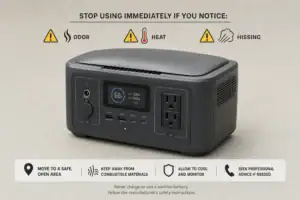
Heat is another cue. Warm operation is normal under high load or fast charging, but excessive heat, repeated shutdowns, burning smells, swelling, popping sounds, or visible damage are warning signs. Stop using the unit, disconnect loads and charging sources if it is safe to do so, move it away from combustibles, and follow the manufacturer’s support guidance. Do not open the enclosure or attempt to repair battery packs or internal electronics.
Finally, users sometimes assume any label with safety language is equivalent to certification. Look for a recognized certification mark and clear standard reference in documentation or labeling. Marketing phrases such as “safety tested,” “multi-protection,” or “meets standards” are not the same as a verifiable third-party certification.
Safety basics when using a certified power station
Use the power station within its published ratings. Add up the watts of connected devices, allow extra headroom for startup surges, and avoid running high-draw heating appliances unless the unit is specifically rated for them. Space heaters, kettles, hot plates, hair dryers, and large tools can drain the battery quickly and place heavy stress on the inverter.
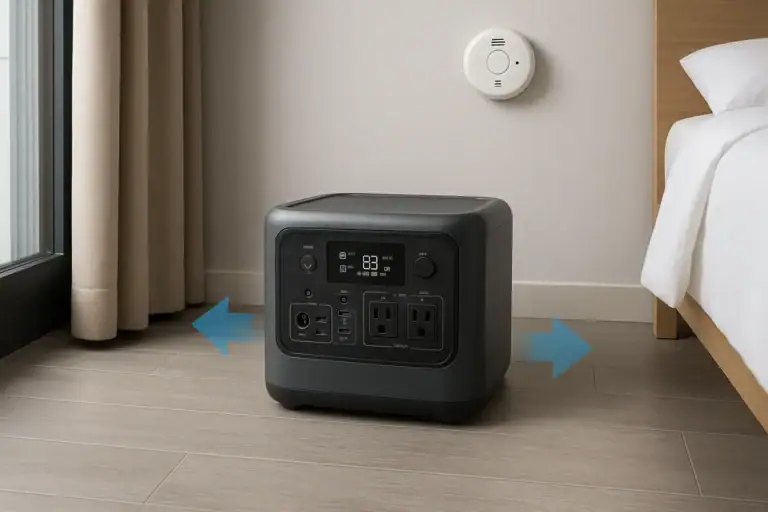
Keep ventilation openings clear. Portable power stations rely on airflow, heat sinks, and internal sensors to manage temperature. Do not cover the unit with blankets, place it in a sealed box while running, or push it against soft surfaces that block vents. Heat buildup can shorten battery life and increase shutdowns.
Use cords and accessories appropriate for the load. Extension cords should be in good condition and sized for the current they carry. Damaged cords, loose plugs, or overloaded power strips can create hazards that are outside the power station itself. For outdoor use, keep the unit dry and sheltered according to its rating. Many portable power stations are not waterproof, even if they are built for rugged use.
Do not use a portable power station as a substitute for code-compliant electrical work. If you want to power selected home circuits, consult a qualified electrician about suitable transfer equipment and local requirements. Avoid any setup that could energize utility lines or expose workers and occupants to unexpected voltage.
Maintenance and storage practices that support safety
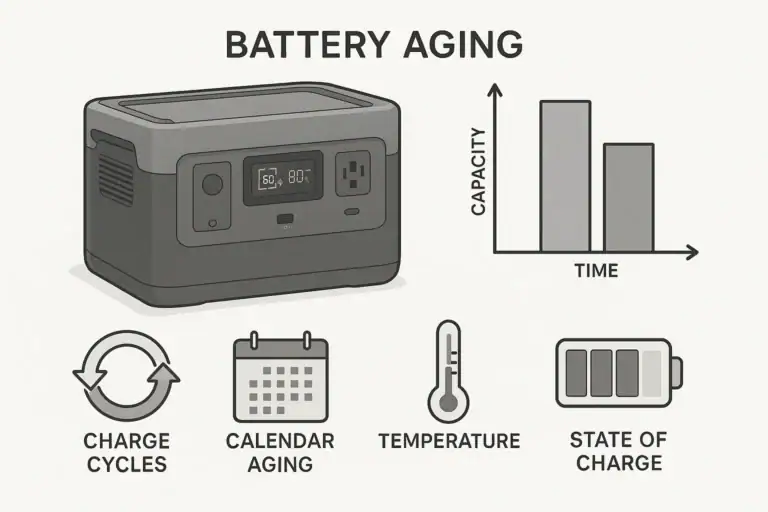
Good storage habits help preserve both safety and performance. Store the unit in a cool, dry location away from direct sun, heaters, freezing conditions, and moisture. Extreme temperatures can accelerate battery aging and may trigger protective shutdowns. A moderate indoor environment is usually better than a hot garage, vehicle trunk, or damp shed.
Check the battery charge periodically during long storage. Many lithium battery systems have low self-discharge, but the control electronics can still consume a small amount of power over time. Storing at a partial charge is commonly recommended for lithium batteries, while fully draining the pack and leaving it empty for months can reduce usable capacity or prevent normal startup.
Inspect the exterior before use. Look for cracked plastic, loose outlets, damaged ports, corrosion, swelling, unusual odors, or signs of liquid exposure. If the unit has been dropped hard, flooded, involved in a vehicle accident, or exposed to smoke or fire, treat it cautiously and follow the manufacturer’s service guidance. Do not open the case to inspect internal parts.
Keep firmware and settings in mind if the unit supports them, but do not rely on app features as the only safety layer. Hardware protections, clear ratings, and safe use habits matter more than convenience controls. If an app shows abnormal battery temperature, repeated faults, or charging errors, stop using the questionable function until the cause is understood.
| Storage or use condition | Better practice | Risk reduced |
|---|---|---|
| Long-term storage | Store around a partial charge and check periodically, such as every few months. | Deep discharge and battery degradation. |
| High-load operation | Leave open space around vents and reduce load if fans run constantly or faults appear. | Overheating and nuisance shutdowns. |
| Outdoor use | Keep the unit dry and elevated, and only use weather-appropriate cords and covers. | Moisture intrusion and shock hazards. |
| Transport | Protect ports, avoid crushing, and secure the unit so it cannot slide or fall. | Mechanical damage to cells, outlets, or enclosure. |
| Post-incident use | Stop using a unit with swelling, smoke exposure, burnt smell, or visible damage. | Escalation from hidden damage to fire or electrical fault. |
Practical takeaways for comparing certified portable power stations
UL 2743 certification is a strong safety signal, but it should be considered alongside capacity, output, charging options, operating temperature, outlet layout, and manufacturer documentation. The best match depends on what you plan to power, how long you need runtime, and where the unit will be used.
Related guides: Portable Power Station Basics: Outputs, Inputs, and What the Numbers Mean • Surge Watts vs Running Watts: How to Size a Portable Power Station • Battery Management System (BMS) Explained: Protections Inside a Power Station
Specs to look for
- Certification marking: Look for a recognized safety certification mark and documentation referencing UL 2743 or the applicable portable power pack standard; this helps distinguish third-party evaluation from marketing claims.
- Battery capacity: Compare watt-hours, such as 300 Wh for phones and lights or 1,000 Wh and above for longer outage support; capacity is the main driver of runtime.
- Continuous AC output: Match running watts to your devices, with practical examples such as 300–600 W for small electronics or 1,000–2,000 W for larger appliances; this prevents overload shutdowns.
- Surge watts: Check surge capability for compressors, pumps, and power tools, often expressed as a short peak above continuous output; this affects whether motor loads can start reliably.
- Input charging limits: Review wall, solar, vehicle, and USB-C input ratings, such as 200 W solar or 100 W USB-C; input limits determine recharge time and accessory compatibility.
- USB-C PD profiles: Look for listed voltages and wattage, such as 5 V, 9 V, 15 V, 20 V up to 60–100 W; this matters for laptops, tablets, and fast charging.
- Battery chemistry and cycle rating: Compare chemistry and cycle-life estimates, such as several hundred to several thousand cycles to reduced capacity; this affects long-term value and weight.
- Operating temperature range: Check realistic charging and discharging ranges, especially if using the unit in a vehicle, garage, campsite, or winter outage; batteries may limit charging in cold or hot conditions.
- Protection and status indicators: Look for overload, temperature, low-battery, input fault, and remaining-runtime information; clear alerts make troubleshooting safer and faster.
The practical bottom line is simple: UL 2743 helps answer “has this portable power station been evaluated for key safety risks?” It does not answer every performance question. For a well-rounded comparison, pair certification with the electrical ratings that match your intended loads and the storage habits that keep the unit in good condition over time.
Frequently asked questions
What does UL 2743 certification cover on a portable power station?
UL 2743 certification focuses on safety-related construction and behavior, including risks such as electric shock, overheating, fire, enclosure strength, and abnormal operation. It evaluates the product as a system, not just the battery cells. It does not rate runtime, noise, or charging speed.
What specs matter most when comparing certified portable power stations?
The most useful specs are watt-hours, continuous AC output, surge watts, input charging limits, USB-C power profiles, and operating temperature range. These determine what the unit can power, how long it can run, and how quickly it can recharge. Certification helps with safety, but these ratings determine performance fit.
Is UL 2743 certification the same as being safe to use anywhere?
No. Certification means the product has been evaluated against a safety standard, but it still must be used within its ratings and instructions. Heat, water exposure, overloads, damaged cords, and improper home wiring can still create hazards.
What is a common mistake people make when reading UL 2743 claims?
A common mistake is assuming certification tells you how powerful or long-lasting the unit is. UL 2743 is not a performance ranking and does not replace capacity or output comparisons. Another mistake is treating marketing phrases like “safety tested” as the same thing as a recognized certification mark.
Can a UL 2743 certified power station be used for home backup?
It can power individual devices directly if the load stays within the unit’s ratings. However, connecting it to home circuits or a panel requires proper transfer equipment and professional installation. Improvised backfeeding or panel connections should be avoided.
How can I tell whether a portable power station is actually certified?
Look for a recognized certification mark on the product, packaging, or documentation, along with a clear standard reference. A real certification should be tied to a specific evaluated model, not just broad safety language. If the claim is vague, it is worth verifying the label and paperwork carefully.
Related guides
Browse this topic →
- Beginner-friendly sizing, runtime & specs
- Solar & charging (MPPT, fast charging, cables)
- Batteries (LiFePO4, cycles, care & storage)
- Safety, cold-weather performance, real-world tips
More in Safety
See all →- Childproofing a Portable Power Station at Home: Cables, Heat, Buttons, and Pets
- Can You Take a Portable Power Station on a Plane? Battery Limits and Safer Travel Planning
- What to Do If a Portable Power Station Gets Wet
- Portable Power Station Fire Safety Checklist for Apartments
- Lithium Battery Safety Myths vs Reality: What Actually Causes Incidents
Keep reading
About this site
Portable Energy Lab publishes practical, independent guides about portable power—clear sizing, safe use, and real-world expectations.
Affiliate disclosure
Some links on this site may be affiliate links. If you buy through these links, we may earn a small commission at no extra cost to you. This helps support our content. Read our affiliate disclosure.