
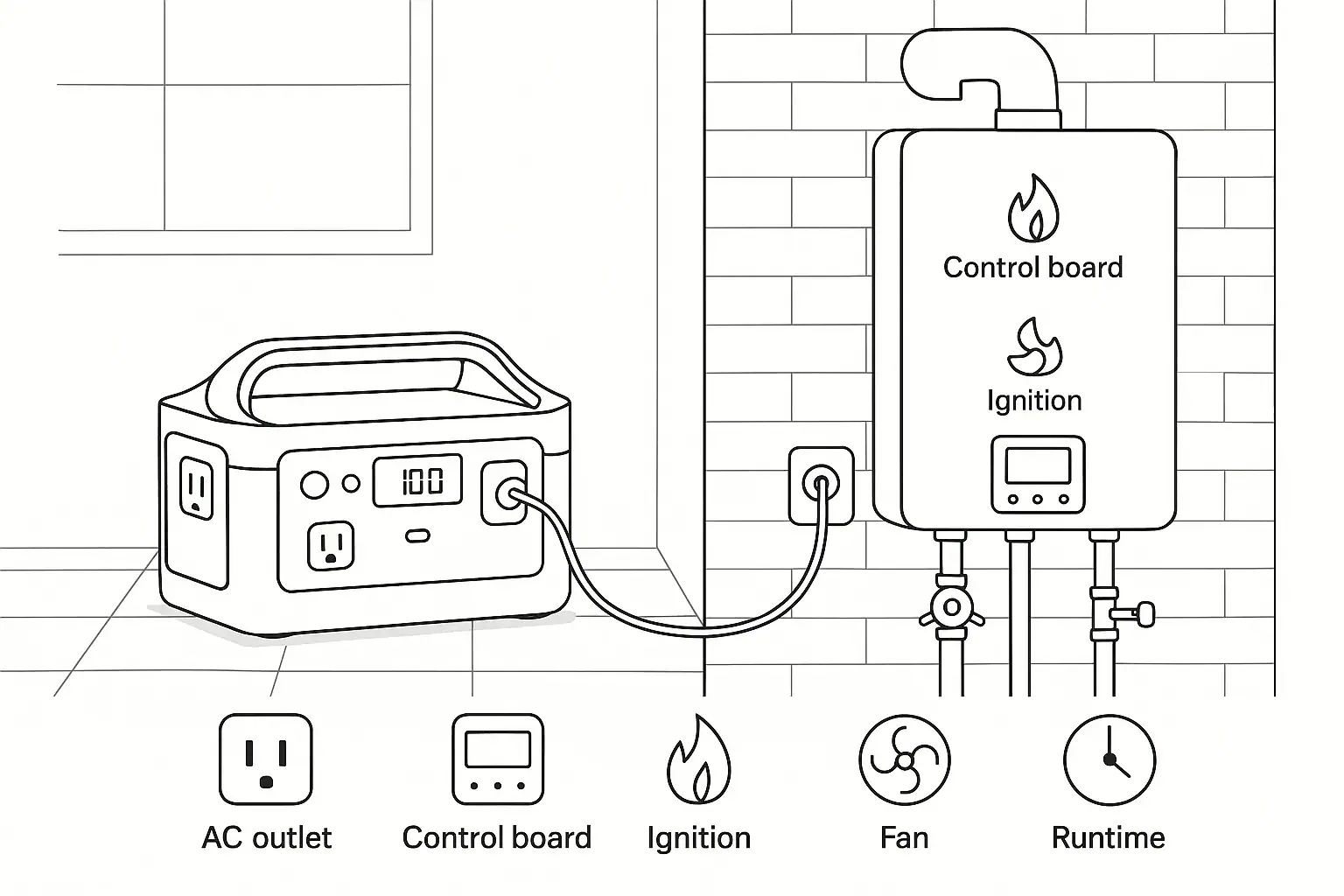
A portable power station can usually run a tankless gas water heater because the heater uses gas for heat and electricity mainly for ignition, controls, sensors, and sometimes a fan or freeze protection.
The key is not just battery size. You need the right AC output, enough running watts, enough surge watts, a compatible grounding behavior, and enough watt-hours for the runtime you expect. Many troubleshooting searches start when a heater lights on wall power but will not ignite, clicks repeatedly, shows an error code, or shuts down when connected to backup power.
This guide explains how the electrical side of a gas tankless unit works, what portable power station specs matter, and how to estimate runtime without assuming every heater is the same. It does not apply to electric tankless water heaters, which typically require far more power than a portable power station can provide.
What a portable power station does for a tankless gas water heater
A tankless gas water heater heats water with natural gas or propane, but it still needs electricity to operate. The portable power station acts like a temporary AC power source for those low-to-moderate electrical loads. In an outage, it may allow the unit to start, monitor water flow, open gas valves, run a combustion fan, power the control board, and keep safety sensors active.
This matters because hot water is often one of the most practical outage needs. A gas tankless unit may have plenty of fuel available, yet it will not operate if the electronic ignition and controls have no power. Unlike a storage tank with a standing pilot, many modern tankless units are fully dependent on electrical control.
The electrical demand is usually much lower than the heat output rating suggests. A heater described as producing large amounts of hot water may still use only a small amount of electricity while firing. However, some units have higher loads because of powered venting, recirculation settings, integrated freeze protection, or accessories such as condensate pumps.
The goal is to match the power station to the actual electrical requirements on the heater nameplate and manual. A power station that is too small may shut off, overload, or fail to support ignition. A power station with a poor AC waveform may cause nuisance faults or unreliable startup. A unit with an incompatible neutral-ground configuration may also create problems with certain flame-sensing or safety circuits.
How ignition, controls, fans, and sensors use electricity
A tankless gas water heater normally begins operation when a flow sensor detects water movement. The control board checks safety conditions, starts the combustion fan if equipped, activates the igniter, opens the gas valve, confirms flame, and then modulates gas and airflow to maintain the target outlet temperature. Electricity supports every part of that sequence.
The igniter is usually a short-duration load. It may draw more power for a brief moment during startup, but it does not run continuously. The control board and display use relatively little power, but they are sensitive to voltage quality. The combustion fan can be one of the larger continuous loads while the burner is operating, especially in sealed-combustion or forced-draft models.
Standby power matters for runtime when the heater stays plugged in all day waiting for use. A few watts of idle draw can consume noticeable energy over long outages. Freeze protection is another major variable. Some outdoor or garage-installed units use electric heaters to protect internal components in cold weather. Those loads can run intermittently and may be much higher than normal standby draw.
A portable power station converts stored DC battery energy into AC power through an inverter. For sensitive appliance controls, a pure sine wave vs modified sine wave inverter is generally preferred. Modified waveform output can cause hum, heat, false faults, or startup failures in some electronics and motors. The inverter also has an output watt rating and a surge rating. The output watt rating must cover the heater while running, and the surge rating must cover brief startup peaks.
| Electrical load | Typical range | Why it matters |
|---|---|---|
| Control board and display | 2 to 15 watts | Low draw, but sensitive to clean voltage and stable frequency |
| Igniter during startup | 20 to 80 watts briefly | Can cause clicking or failed ignition if voltage sags |
| Combustion fan | 30 to 150 watts while firing | Often the main running load during hot water use |
| Gas valve and sensors | Small continuous load | Must remain powered for safe burner operation |
| Freeze protection | 50 to 200 watts intermittently | Can dominate runtime in cold locations |
| Condensate or recirculation pump | 40 to 150 watts when active | Adds load and may increase surge demand |
Real-world runtime examples for outage planning
Runtime depends on battery capacity, inverter efficiency, and how often the heater actually fires. A power station rated at 1,000 watt-hours does not deliver every watt-hour to the appliance. After inverter losses and automatic shutoff reserves, usable AC energy is often lower. A reasonable planning estimate is to assume about 80 to 90 percent usable AC energy unless the product documentation says otherwise.
For a simple example, imagine a tankless gas water heater that draws 80 watts while firing and 5 watts in standby. If it fires for one total hour during a day and remains plugged in for the other 23 hours, the energy use is about 80 watt-hours plus 115 watt-hours, or 195 watt-hours before accounting for inverter losses. With losses, the power station may need roughly 220 to 245 watt-hours for that day of light use.
A larger or more complex setup can use more energy. If the heater draws 140 watts while firing, includes a small condensate pump, and sees several showers, dishwashing, and handwashing, total daily electrical use may rise substantially. If freeze protection runs during cold weather, it can add hundreds of watt-hours, especially if the unit is outdoors or in an unheated space.
Short hot-water events are usually easier on a power station than long continuous draws. A few handwashing cycles may barely dent the battery. Multiple back-to-back showers can use more energy because the combustion fan and controls stay active. The gas supply still provides the heat, but the electrical system must remain stable for the burner to stay lit.
To estimate runtime, multiply the heater wattage by the number of hours it operates, add standby wattage multiplied by standby hours, then divide the usable watt-hours of the power station by that daily demand. This gives a planning estimate, not a guarantee. Real output changes with water temperature, setpoint, flow rate, venting load, battery temperature, and accessory equipment.
Common mistakes and troubleshooting cues
One common mistake is sizing only by battery capacity while ignoring inverter output. A large battery with a small AC inverter may still overload if the heater, fan, pump, or startup surge exceeds the output limit. Look at both watt-hours and AC watts.
Another mistake is assuming a gas tankless unit needs no electricity. Most modern models need power for ignition and control. If the display is off, the unit is usually not ready to heat water. If the display turns on but the burner does not light, the cause may be voltage quality, grounding behavior, gas supply, venting, water flow, or an appliance fault.
Repeated clicking without ignition can indicate the igniter is trying but flame is not being established. On backup power, this may happen if the inverter voltage drops during startup, if the waveform is not suitable, or if the heater’s flame-sensing circuit does not like the power source. It can also happen for non-power reasons such as air in the gas line, closed gas valves, low gas pressure, or blocked venting.
An overload warning on the power station points to excessive connected load. Check whether other items are plugged into the same power station. Pumps, heat tape, refrigerators, and chargers can add enough load to push the inverter over its limit. If the heater works until a pump starts, the pump surge may be the issue.
Unexpected shutdowns can also come from the power station’s energy-saving mode. Some units turn off AC output when the load is very low for a period of time. A tankless heater in standby may draw so little power that the power station assumes nothing important is connected. For this use case, the ability to disable sleep mode or keep AC output active can be important.
Error codes should be read in the heater manual rather than guessed. Backup power can reveal marginal conditions, but it does not make normal safety checks optional. If the unit reports flame failure, fan failure, vent blockage, overheating, or combustion-related errors, treat them as appliance issues that may need qualified service.
Safety basics when using backup power for hot water
Use the portable power station as a temporary power source for the appliance plug or a manufacturer-approved connection method. Do not attempt to backfeed a home circuit, wire into a panel, bypass a breaker, or improvise a transfer setup. If the heater is hardwired or you want it connected through home wiring during outages, consult a qualified electrician.
Keep the power station dry, ventilated, and away from direct water spray. Utility rooms, garages, and outdoor installations can expose equipment to moisture. A power station is an electrical device and should not sit where a leaking pipe, pressure relief discharge, condensate line, or floor drain backup can wet it.
Do not use a power station to bypass heater safety systems. Flame sensors, limit switches, vent checks, and control-board shutdowns exist to prevent unsafe operation. If the heater will not run on a properly rated clean AC source, the right answer is diagnosis, not defeating protections.
Carbon monoxide safety still matters because the heater is burning gas. Backup electricity does not change venting requirements. Make sure combustion air and exhaust paths are unobstructed, and use carbon monoxide alarms according to local code and manufacturer instructions.
Extension cords should be treated carefully. If a cord is necessary, it should be rated for the load, as short as practical, and in good condition. Undersized or damaged cords can cause voltage drop, heat, and nuisance faults. Avoid running cords where they can be pinched, soaked, or tripped over.
Maintenance, storage, and readiness for outages
A portable power station is most useful for a tankless gas water heater when it is charged, accessible, and tested before an outage. Store it in a dry location within the temperature range recommended by the manufacturer. Extreme heat and freezing temperatures can reduce performance and shorten battery life.
Check the battery level periodically. Many lithium-based power stations hold a charge well, but they are not maintenance-free. If the unit sits unused for months, confirm that it still powers on, the AC outlet works, and the display or app reports a healthy state of charge. For long-term storage, follow the product guidance for storage charge level.
Do a practical test during normal conditions. Plug the heater into the power station only if the connection method is safe and appropriate for your installation, then run hot water long enough for the burner to ignite and stabilize. Watch for overload warnings, abnormal heater errors, or the power station turning AC output off during standby. This is a readiness test, not a repair procedure.
Keep appliance documentation available. The water heater nameplate, installation manual, and error-code chart are often more useful than general estimates. Note the heater’s rated electrical input, voltage, and any accessory loads. If the unit uses a condensate pump, recirculation pump, or freeze protection, include those loads in your planning.
Battery condition affects runtime. Older batteries may deliver less usable energy than their original rating. Cold batteries can also have reduced output. If you rely on hot water during winter outages, store the power station where it can remain within a reasonable operating temperature before use.
| Planning item | Example value | Practical note |
|---|---|---|
| Power station capacity | 500 to 1,500 watt-hours | Often enough for intermittent hot water, depending on standby and accessories |
| Usable AC energy | 80 to 90 percent of rated capacity | Accounts for inverter losses and reserve behavior |
| Heater running draw | 60 to 150 watts | Varies by fan, controls, and operating mode |
| Standby draw | 2 to 10 watts | Important during long outages with light hot-water use |
| Freeze protection draw | 50 to 200 watts intermittent | Can sharply reduce runtime in cold weather |
| Estimated light-use runtime | 1 to 3 days from a mid-size unit | Depends on actual hot-water use and idle draw |
Practical takeaways and specs to look for
Related guides: Pure Sine Wave vs Modified Sine Wave: Does It Matter for a Portable Power Station? • Surge Watts vs Running Watts: How to Size a Portable Power Station • Inverter Efficiency Explained: Why Your Runtime Is Shorter Than Expected
A portable power station can be a practical backup source for a tankless gas water heater when the heater is gas-fired, the electrical load is modest, and the source provides clean, stable AC power. The most important step is to confirm the heater’s actual electrical requirements and include every accessory that may run at the same time.
For most households, the main sizing question is not whether the power station can create heat. The gas does that. The question is whether the power station can keep ignition, controls, fan, sensors, and support equipment powered for the length of the outage. Runtime estimates should include both active hot-water use and standby time.
If the heater is hardwired, uses unusual grounding requirements, or shows flame-sensing errors on backup power, do not improvise wiring changes. Have the installation reviewed by a qualified electrician or a qualified water-heater technician. Safe operation depends on both the electrical source and the combustion appliance working as designed.
Specs to look for
- Pure sine wave AC output: Look for clean 120-volt AC power because control boards, igniters, and fan motors are more reliable on a utility-like waveform.
- Continuous AC watt rating: Look for at least several times the heater’s listed running watts, such as 300 to 600 watts for many gas tankless setups, to leave room for fans and small accessories.
- Surge watt rating: Look for enough short-term headroom, such as 2 times the expected running load, because igniters, fans, and pumps can draw more at startup.
- Battery capacity in watt-hours: Look for 500 to 1,500 watt-hours for intermittent use, or more if standby, freeze protection, or multiple daily showers are expected.
- Low-load AC behavior: Look for an option to keep AC output on or disable sleep mode because a heater in standby may draw only a few watts.
- Grounding and neutral behavior: Look for documentation on neutral-ground bonding compatibility because some heater flame-sensing systems may be sensitive to the power source configuration.
- Recharge options: Look for AC and solar or vehicle charging options because multi-day outages require a way to replace energy used by standby and hot-water cycles.
- Operating temperature range: Look for ratings suitable for garages, utility rooms, or winter storage because cold batteries can deliver less power and freeze protection can increase demand.
- Clear display or monitoring: Look for real-time watts and remaining battery estimates because they help you confirm actual heater draw and adjust hot-water use during an outage.
The best approach is to test the combination before you need it. If the heater starts cleanly, runs without error codes, and the power station shows a manageable watt draw, you can estimate runtime with much more confidence. If it fails during testing, use the error code, the heater manual, and qualified help rather than relying on trial-and-error changes.
Frequently asked questions
What size portable power station do I need for a tankless gas water heater?
Size it by the heater’s running watts, startup surge, and expected daily watt-hours, not just battery capacity. Many gas tankless units can work with a modest inverter, but the exact requirement depends on the fan, controls, pumps, and freeze protection. A unit with enough continuous AC output and a few hundred to over a thousand watt-hours of capacity is often the practical range for intermittent use.
What specs matter most when choosing a portable power station for a tankless gas water heater?
The most important specs are pure sine wave output, sufficient continuous watts, enough surge watts, and usable watt-hours for your expected runtime. Low-load AC behavior also matters because the heater may draw very little power in standby. If the heater is sensitive to grounding or neutral configuration, check that documentation before buying.
Why does my tankless gas water heater click but not ignite on backup power?
Clicking usually means the ignition sequence is starting but flame is not being established. On a portable power station, the cause can be voltage sag, an unsuitable waveform, or a compatibility issue with the heater’s sensing circuits. It can also be unrelated to power, such as low gas pressure, air in the line, or a venting problem.
What is the most common mistake people make when powering a gas tankless heater from a battery?
The most common mistake is focusing only on battery size and ignoring inverter output and surge capability. A large battery can still fail if the AC inverter cannot support the heater’s startup or fan load. Another frequent mistake is forgetting standby draw and accessory loads like pumps or freeze protection.
Is it safe to run a tankless gas water heater from a portable power station during an outage?
It can be safe when the power station is used as a temporary, properly rated AC source and the heater is connected the way the manufacturer allows. Do not backfeed a panel, bypass safety devices, or use damaged cords. The heater still needs normal venting, combustion air, and carbon monoxide precautions.
How long will a portable power station run a tankless gas water heater?
Runtime varies widely because the heater may draw only a few watts in standby and much more while firing or running freeze protection. A mid-size power station can sometimes support light intermittent hot-water use for one to several days, but heavy use or cold-weather protection can shorten that significantly. The best estimate comes from the heater’s actual watt draw and your expected daily usage.
Related guides
Browse this topic →
- Beginner-friendly sizing, runtime & specs
- Solar & charging (MPPT, fast charging, cables)
- Batteries (LiFePO4, cycles, care & storage)
- Safety, cold-weather performance, real-world tips
More in Home / Appliances
See all →Keep reading
About this site
Portable Energy Lab publishes practical, independent guides about portable power—clear sizing, safe use, and real-world expectations.
Affiliate disclosure
Some links on this site may be affiliate links. If you buy through these links, we may earn a small commission at no extra cost to you. This helps support our content. Read our affiliate disclosure.