
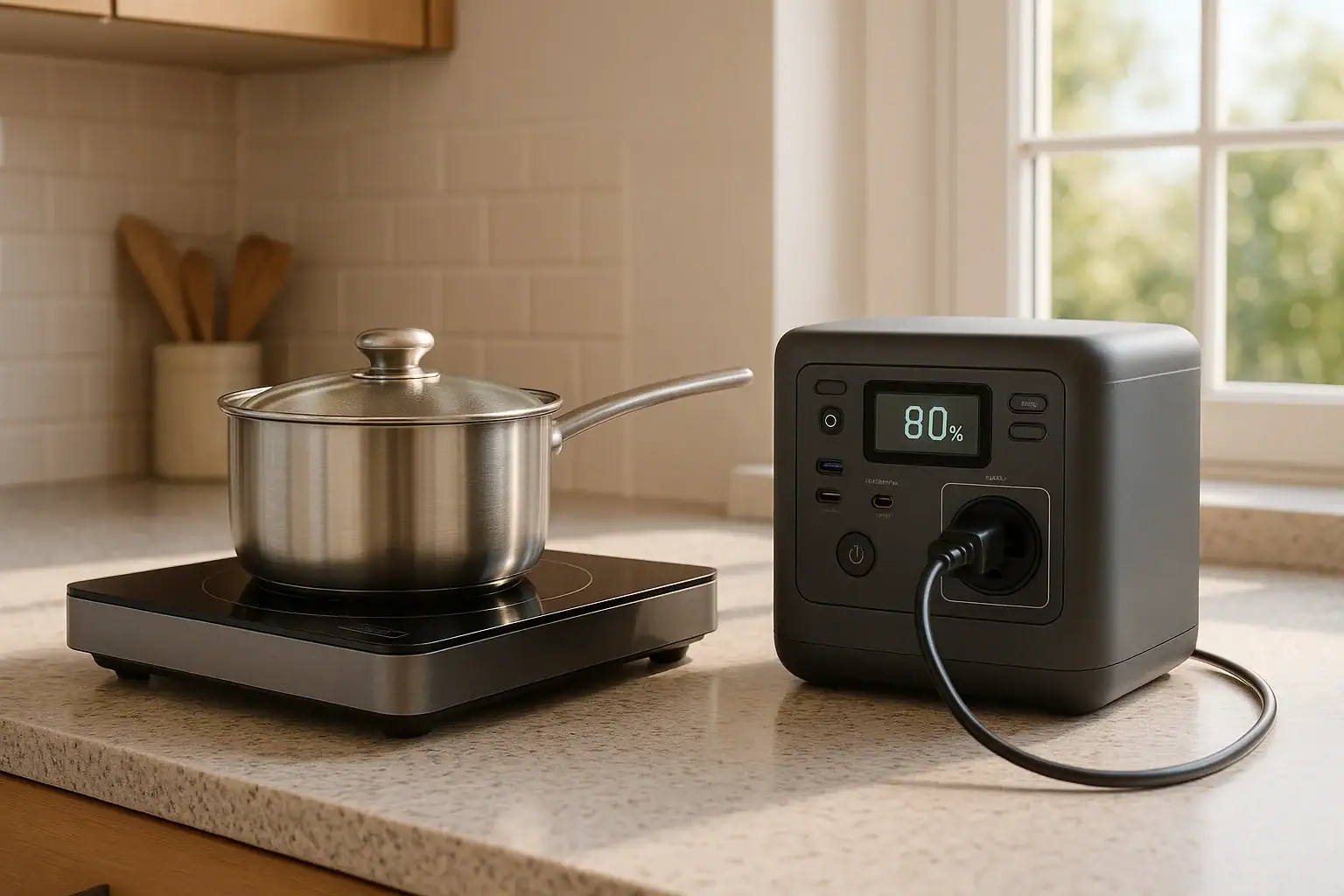
Yes, a portable power station can run an induction cooktop if its AC inverter wattage, outlet rating, and battery capacity are high enough for the cooktop’s load.
The important limits are continuous watts, peak watts, AC voltage, outlet amps, runtime, and heat management. A small power station may turn on a cooktop display but shut down when the burner starts drawing real power. A larger unit with a pure sine wave inverter and enough watt-hours can usually run a single portable induction burner for short cooking sessions.
The answer changes quickly with cooktop size. A compact 600-watt setting is very different from a full 1,800-watt countertop burner or a built-in 240-volt induction range. Understanding those wattage and safety limits helps prevent overload trips, short runtime, overheating, and unsafe extension-cord use.
What it means to run an induction cooktop from a portable power station
Running an induction cooktop from a portable power station means the station’s battery feeds an inverter, and that inverter supplies household-style AC power to the cooktop. The cooktop then creates a magnetic field that heats compatible cookware directly. This is different from powering a phone, router, light, or small fan because induction cooking is a high-wattage heating load.
The main question is not only whether the plug fits. The power station must be able to deliver the cooktop’s required watts continuously without exceeding the AC outlet rating or the inverter’s temperature limits. It also needs enough usable battery capacity to cook for the time you expect.
This matters because induction cooktops can pull a lot of power even at moderate settings. Many single-burner portable units advertise maximum power around 1,300 to 1,800 watts. Some can be set lower, but they may cycle power on and off, which can still create momentary high demand. If the power station is undersized, it may show an overload warning, shut off the AC output, or drain the battery much faster than expected.
For home backup, camping, apartments, emergency cooking, or off-grid meal prep, the most realistic use case is a single portable induction burner used at low to medium power. A full-size built-in induction cooktop or range usually requires higher voltage and dedicated electrical service, which is outside what most portable power stations are designed to provide.
Key wattage concepts: inverter output, battery capacity, and cooktop settings
The first specification to check is continuous AC output. This is the amount of power the station can provide steadily. If a cooktop can draw 1,500 watts, the power station should have a continuous AC rating above that level, with some headroom for heat, cycling, and measurement differences. A station rated at exactly the same wattage as the cooktop may still overload in real use.
Peak or surge watts are less important for induction than for motors, but they still matter. Some cooktops briefly draw near maximum power when heating starts or when changing settings. Surge capacity can help, but it should not be used as the main rating. A 1,800-watt cooktop should not be judged safe just because the station lists an 1,800-watt surge number if the continuous rating is much lower.
Battery capacity is measured in watt-hours. A simple estimate is usable watt-hours divided by cooktop watts. For example, a 1,000 watt-hour station running a 1,000-watt cooking load might not run for a full hour because inverter losses and internal protections reduce usable energy. Many real-world estimates use about 80 to 90 percent of rated capacity, depending on the station and conditions.
Outlet voltage and amperage are also important. In North America, many portable induction burners plug into a standard 120-volt outlet and may draw up to about 12 to 15 amps at high power. Larger built-in induction appliances are often 240-volt loads and should not be treated like a portable countertop burner.
| Cooktop use | Typical power draw | What it means for a power station |
|---|---|---|
| Keep warm or very low simmer | 300 to 600 watts | Potentially workable on many mid-size units, with longer runtime |
| Gentle cooking or simmering | 700 to 1,000 watts | Needs a solid continuous AC rating and enough battery capacity |
| Boiling water or searing | 1,200 to 1,800 watts | Requires a high-output inverter and shorter expected runtime |
| Built-in multi-burner cooktop | Often above portable station limits | Usually requires specialized high-voltage equipment and professional planning |
Real-world examples of runtime and cooking performance
Consider a portable induction burner set to 800 watts and connected to a power station with 1,000 watt-hours of rated capacity. If about 85 percent of that energy is usable after inverter losses, the practical energy available may be around 850 watt-hours. At 800 watts, that suggests roughly one hour of burner time. In real cooking, the burner may cycle, so simmering soup could last longer than a constant full-power boil.
Now consider the same station with a burner running near 1,500 watts. The estimated runtime drops to a little over half an hour under ideal conditions, and possibly less if the station heats up or the battery is not full. This may be enough to boil water, cook pasta, fry eggs, or prepare a simple one-pan meal, but it is not the same as running a kitchen range for an evening of heavy cooking.
A smaller 500 watt-hour station can be useful at low settings, but it is a poor match for high-power induction cooking. At 1,200 watts, the battery may be depleted quickly, and the inverter may be near its limit. Even if the cooktop starts, the station may shut down when the burner cycles up.
A larger 2,000 watt-hour power station with a 2,000-watt or higher continuous inverter is more realistic for induction cooking. It may handle a 1,500-watt portable burner with useful headroom and enough battery capacity for multiple short cooking tasks. However, the user still needs to watch ventilation, cord rating, outlet rating, and the power station’s stated operating temperature range.
Cooking technique also affects runtime. Keeping a lid on the pot, using flat magnetic cookware, matching pot size to the burner, and reducing power after reaching a boil can significantly cut energy use. Induction is efficient, but high heat is still high heat; battery capacity is finite.
Common mistakes and troubleshooting cues
One common mistake is comparing only battery capacity and ignoring inverter output. A large battery with a low AC output rating may store plenty of energy but still be unable to run a 1,500-watt cooktop. Capacity determines how long the station can run a load. Inverter wattage determines whether it can run the load at all.
Another mistake is relying on peak watts as if they were continuous watts. Peak output is temporary. If the cooktop needs high power for several minutes, the station must support that demand continuously. If it cannot, the AC output may cut off even though the display initially turns on.
If the cooktop powers on but stops heating, the likely causes are overload protection, incompatible cookware, a low battery state of charge, or a cooktop setting that is too high for the station. If the power station shuts down immediately, check whether the cooktop’s maximum draw exceeds the AC output rating. If it works at low power but fails at high power, the inverter or outlet amp limit is probably being exceeded.
If runtime is much shorter than expected, the cooktop may be drawing more watts than the selected temperature suggests. Some induction units use cycling behavior, briefly pulling high wattage and then pausing. Cold weather, battery age, high ambient temperature, and charging other devices at the same time can also reduce available runtime.
Extension cords are another troubleshooting point. A thin or very long cord can cause voltage drop and heat buildup under high loads. For high-wattage cooking, the safest approach is to plug directly into the power station when possible, or use only a heavy-duty cord appropriate for the load and environment.
Safety basics for induction cooking on battery power
Use the cooktop only within the power station’s AC output rating, battery operating range, and ventilation requirements. High-wattage loads create heat inside both the cooktop and the inverter. Keep the power station on a stable, dry, open surface with clear airflow around vents. Do not cover it, place it next to a hot pan, or operate it where steam or spills can enter the unit.
Use compatible cookware that sits flat on the induction surface. Poor contact or non-magnetic cookware can cause error codes, cycling, or inefficient heating. Keep the cooking area clear of flammable materials, and do not leave a powered cooktop unattended just because it is running from a battery.
Avoid daisy-chaining power strips, adapters, or light-duty cords. Induction cooktops are continuous high-load appliances, and accessory devices can become weak points. If the outlet, cord, or plug feels hot, stop using the setup and let everything cool before investigating.
Do not modify the power station, open the battery pack, bypass overload protections, or attempt to connect a portable power station into household wiring unless the system is specifically designed for that purpose and installed by a qualified electrician. Backfeeding a home circuit without proper equipment is dangerous. For home backup cooking, it is usually safer to treat the power station as a standalone source for a plug-in portable burner.
Also consider indoor air quality and fire safety. Induction does not create combustion fumes, which is one reason it is attractive for emergency indoor cooking. Still, cooking itself can produce smoke, grease vapor, and steam, so use normal kitchen ventilation and keep a suitable fire extinguisher accessible.
Maintenance, storage, and habits that support reliable performance
High-power cooking is demanding, so battery condition matters. Store the power station in a dry, moderate-temperature location and avoid leaving it fully depleted for long periods. Before relying on it for emergency cooking, charge it according to the manufacturer’s guidance and test the cooktop at realistic settings.
Keep ports, plugs, and vents clean. Dust can restrict cooling, and loose plugs can increase resistance and heat. Inspect cords for damage before using them with a high-wattage appliance. If the AC plug does not seat firmly, do not use that connection for cooking.
Plan meals around the battery. Foods that need a short boil, quick sauté, or reheating are better matches than recipes requiring long high-power simmering. If the station supports solar or wall charging, remember that input power may be far lower than cooktop output. A solar input of a few hundred watts cannot keep up with a burner drawing over 1,000 watts, though it can help recover energy over time.
Let the station cool after heavy use, especially in warm rooms or summer conditions. Thermal protection is a safety feature, not a defect. If the station repeatedly shuts down during cooking, reduce the cooktop setting, improve airflow, remove other loads, or use a power source with more continuous output headroom.
| Care habit | Why it helps | Practical cue |
|---|---|---|
| Store at moderate temperature | Protects battery health and output capability | Avoid hot cars, freezing storage, and damp spaces |
| Test before an outage | Confirms the cooktop and power station are compatible | Try the settings you would actually use for meals |
| Keep vents unobstructed | Reduces thermal shutdown risk | Leave open space around fan intakes and exhausts |
| Use efficient cookware | Shortens cooking time and saves watt-hours | Choose flat-bottom magnetic pans with fitted lids |
Related guides: Pure Sine Wave vs Modified Sine Wave: Does It Matter for a Portable Power Station? • Surge Watts vs Running Watts: How to Size a Portable Power Station • Inverter Efficiency Explained: Why Your Runtime Is Shorter Than Expected • Extension Cords and Power Strips: Safe Practices With Portable Power Stations
Practical takeaways and specs to look for
A portable power station can run a portable induction cooktop when the station has enough continuous AC output, the correct outlet voltage, sufficient battery capacity, and enough thermal headroom. For most households, the practical target is a single-burner 120-volt induction cooktop used at low to medium settings, not a built-in multi-burner range.
For occasional emergency cooking, prioritize controllable power settings and realistic runtime over headline battery size alone. A setup that can reliably simmer at 700 to 1,000 watts may be more useful than one that barely supports a maximum-power boil for a few minutes. Match the cooking task to the battery, and leave margin instead of operating every component at its limit.
Specs to look for
- Continuous AC output: Look for more than the cooktop’s maximum draw, such as 1,800 to 2,400 watts for many portable burners, because continuous rating determines whether the station can sustain cooking.
- Surge or peak output: Look for reasonable headroom above continuous output, such as 2,500 watts or more on larger units, because brief power spikes can trigger overload protection.
- Battery capacity: Look for capacity in watt-hours, such as 1,000 to 2,000 watt-hours for meaningful cooking time, because high-heat settings drain batteries quickly.
- Usable energy estimate: Look for efficiency expectations around 80 to 90 percent of rated capacity, because inverter losses reduce actual runtime.
- AC voltage and outlet amperage: Look for a 120-volt outlet with enough amp capacity for the burner, commonly around 12 to 15 amps for high settings, because the plug fitting does not guarantee safe output.
- Pure sine wave inverter: Look for pure sine wave AC output, because sensitive appliance electronics generally operate more reliably on cleaner power.
- Thermal design: Look for clear ventilation requirements, cooling fans, and high-load operating guidance, because induction cooking can keep the inverter under heavy load.
- Low-power cooktop control: Look for adjustable wattage settings such as 300, 600, 900, and 1,200 watts, because lower settings extend runtime and reduce overload risk.
- Recharge input: Look for wall, car, or solar input that fits your use case, such as several hundred watts of solar input for recovery, because recharging may take far longer than cooking consumes energy.
The safest rule is simple: check the cooktop’s wattage, compare it with the power station’s continuous AC rating, estimate runtime from watt-hours, and leave margin. If the load involves a built-in cooktop, a 240-volt appliance, or any connection to home wiring, consult a qualified electrician instead of improvising.
Frequently asked questions
What size portable power station do I need for an induction cooktop?
For a portable induction burner, a power station with at least 1,500 to 2,000 watts of continuous AC output is often a practical starting point, depending on the cooktop’s maximum draw. Battery capacity matters too, because higher wattage settings drain energy quickly. If you want longer cooking time, look for a larger watt-hour rating rather than only a higher surge number.
Can a small power station run an induction cooktop at low power?
Sometimes, yes, if the cooktop has a low setting and the station’s continuous AC output is still above that draw. A small unit may handle keep-warm or simmer settings, but runtime will be limited. If the cooktop cycles upward or the inverter is near its limit, the station may shut off.
What is the most common mistake people make with a portable power station induction cooktop setup?
The most common mistake is checking battery capacity but ignoring continuous inverter output. A large battery does not help if the AC inverter cannot supply the cooktop’s wattage. Another frequent error is assuming surge watts are the same as continuous watts.
Is it safe to use an extension cord with an induction cooktop and power station?
It can be safe only if the cord is heavy-duty, short enough for the load, and rated for the current involved. Thin or long cords can overheat or cause voltage drop under high wattage. For the safest setup, plug directly into the power station whenever possible.
What specs and features matter most when choosing a power station for induction cooking?
The most important specs are continuous AC output, battery capacity in watt-hours, outlet voltage and amperage, and a pure sine wave inverter. Thermal management also matters because induction cooking can keep the inverter under sustained load. Adjustable cooktop power levels are helpful because they reduce overload risk and extend runtime.
Can I use a built-in induction cooktop with a portable power station?
Usually not, because built-in induction cooktops often need higher voltage and more power than a portable station can safely provide. Many are designed for dedicated household circuits rather than standalone battery inverters. If the appliance is 240 volts or part of home wiring, it should be evaluated by a qualified electrician.
Related guides
Browse this topic →
- Beginner-friendly sizing, runtime & specs
- Solar & charging (MPPT, fast charging, cables)
- Batteries (LiFePO4, cycles, care & storage)
- Safety, cold-weather performance, real-world tips
More in Home / Appliances
See all →- Backup Power for a Smart Home Hub, Door Locks, and Security Sensors
- Powering a Heated Mattress Pad or Electric Throw: Runtime and Safety Notes
- Portable Power Station for Baby Monitor, Sound Machine, and Nursery Essentials
- What Size Portable Power Station for an Electric Recliner or Lift Chair?
- Portable Power Station for a Garage Workshop: Tools, Chargers, and Safe Setup
Keep reading
About this site
Portable Energy Lab publishes practical, independent guides about portable power—clear sizing, safe use, and real-world expectations.
Affiliate disclosure
Some links on this site may be affiliate links. If you buy through these links, we may earn a small commission at no extra cost to you. This helps support our content. Learn more.