
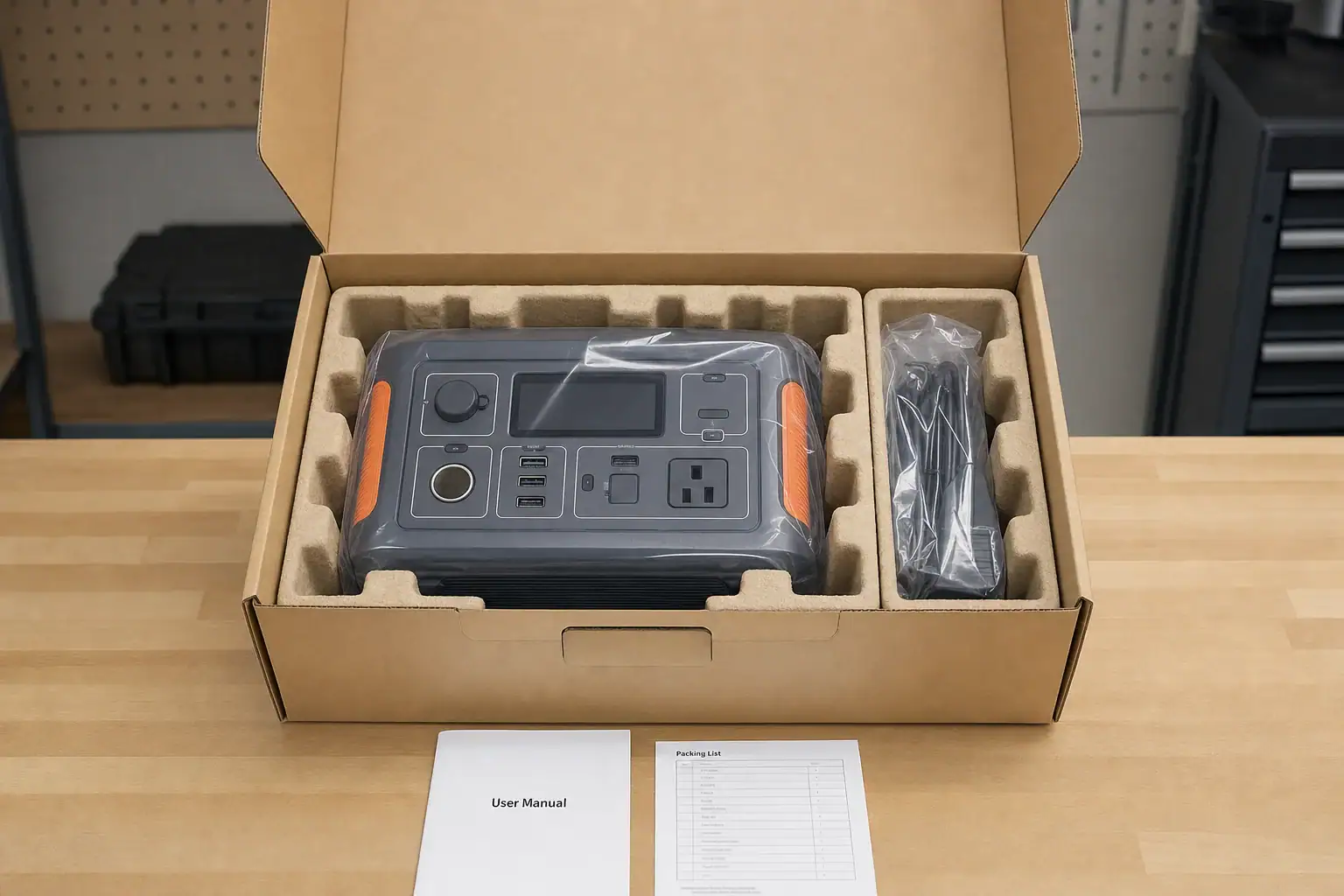
Shipping a portable power station usually requires approved carrier service, strong protective packaging, and accurate lithium battery documentation because most units contain batteries far larger than ordinary consumer shipping exceptions. Before mailing a unit or starting a warranty return, confirm its watt-hour rating, battery chemistry, physical condition, destination, and the carrier’s current acceptance rules.
Search terms such as lithium battery shipping, portable power station return, UN 38.3 test summary, watt-hour rating, and hazardous materials packaging describe different parts of the same issue. A prepaid return label does not automatically mean a package is correctly prepared or eligible for every transport method. Air, ground, domestic, and international shipments may follow different requirements.
The safest approach is to use the manufacturer’s return instructions and the carrier service named on the label. If the battery is swollen, leaking, unusually hot, punctured, recalled, or damaged in an accident, do not place it in ordinary parcel transportation. Contact the manufacturer, seller, carrier, or a qualified hazardous-materials shipping provider for case-specific direction.
1. What Lithium Battery Packaging Means and Why It Matters
A portable power station combines a rechargeable lithium battery, battery management electronics, charging hardware, and power outputs in one enclosure. Its stored energy is normally stated in watt-hours, or Wh. Even compact models may store several hundred watt-hours, while larger units can exceed 1,000 Wh. That capacity affects transportation classification, carrier acceptance, packaging, documentation, and whether air service is available.
Lithium batteries can release heat and flammable gases if crushed, short-circuited, overcharged, or internally damaged. Shipping rules are designed to reduce those risks and help transportation workers identify and handle regulated packages. Requirements may come from national transportation agencies, international air or maritime standards, and carrier-specific policies.
The shipping description is not determined by marketing terminology alone. Depending on its design and regulatory interpretation, a power station may be treated as a lithium-ion battery, a battery contained in equipment, or another regulated article. Many carriers apply stricter rules to power banks and power stations because supplying electrical energy is their main purpose. The shipper should use the classification provided in the manufacturer’s shipping documents rather than guessing from the enclosure.
2. Key Concepts Behind Classification, Packing, and Acceptance
Watt-hours: Battery energy is commonly calculated as nominal voltage multiplied by amp-hours. A label showing 25.6 volts and 40 amp-hours represents about 1,024 Wh. Use the rating printed on the product or technical documentation rather than calculating from AC output watts, which measure power rather than stored energy.
Battery test information: Lithium cells and batteries offered for transport generally need to be of a type that has passed applicable UN 38.3 design tests. A test summary identifies the tested battery type, manufacturer, laboratory, and test results. It does not prove that a damaged package is safe, and it is not a substitute for shipping papers when those are required.
State of charge: Some transport modes or classifications restrict battery state of charge. A manufacturer may instruct the owner to discharge a unit to a specified range before return, such as roughly 20% to 30%. Do not assume that one percentage applies to every shipment, and do not deliberately drain a malfunctioning battery that becomes hot or unstable.
Protection from movement and activation: The unit should be switched off, protected against accidental operation, and immobilized with nonconductive cushioning. Terminals, sockets, switches, and displays should not contact metal accessories or bear the weight of the package. Cables should be disconnected unless the approved return instructions state otherwise.
| Information | Example | Why it matters |
|---|---|---|
| Stored energy | 512 Wh | Helps determine the applicable battery category and available carrier services. |
| Battery chemistry | Lithium iron phosphate | Identifies the lithium battery type, although chemistry alone does not remove shipping controls. |
| Package weight | 35 lb | Affects box strength, handling, service eligibility, and shipment cost. |
| Return charge level | About 25% | May match a specific manufacturer or transport instruction. |
| Transport test record | UN 38.3 test summary available | Provides evidence that the battery design completed required transport testing. |
3. Illustrative Shipping and Return Scenarios
Routine return in the original packaging
A normally functioning 500 Wh unit is being returned because it does not meet the owner’s needs. The seller provides a ground-service label, packing instructions, and a required charge range. The owner uses the original fitted end caps, secures accessories in a separate compartment, and confirms that the power button cannot be pressed through the box. This is a lower-risk scenario because the battery has no signs of damage and the return channel was arranged in advance.
Warranty return without the original box
A 1,000 Wh station no longer charges, but it is cool, dry, and physically intact. A random single-wall carton with loose packing peanuts would not provide reliable restraint. The owner requests an approved replacement packaging kit or written packing specifications. A heavy-duty outer box, shaped nonconductive cushioning, protected controls, and adequate clearance around every side may be necessary. Whether one or two boxes are required depends on the authorized packaging design and package weight.
Damaged or swollen battery
A power station was dropped, and its case is distorted near the battery compartment. Even if the display still works, hidden cell damage may create a delayed fire risk. It should not be charged, discharged for shipping, or placed in a normal parcel box. The return provider must determine whether specialized damaged-battery transport, local collection, or another disposal route is appropriate.
International or air shipment
A traveler wants to send a high-capacity station overseas using an express air service. The unit’s capacity, classification, route, carrier approval, documentation, and destination-country rules may make ordinary consumer acceptance unavailable. Changing to a different label or declaring it as generic electronics does not solve the issue. A qualified dangerous-goods shipper may be required.
4. Common Packaging Mistakes and Troubleshooting Cues
- Using an unauthorized service: A label for standard ground transportation cannot automatically be substituted with air, postal, expedited, or international service. Confirm the exact service before sealing the box.
- Hiding the battery description: Describing the parcel only as a generator, camping accessory, or electronic device can produce an inaccurate declaration. Use the terminology supplied by the return provider.
- Assuming the retail carton is sufficient: A display carton may have been shipped inside another certified outer package. Check whether all original inserts, overpacks, and closures are required.
- Allowing movement: If the station shifts when the box is gently tilted, the cushioning is probably inadequate. Loose fill alone may settle around a dense product and leave it exposed to impacts.
- Leaving accessories connected: Plugged-in cables can damage ports or create unintended electrical paths. Disconnect and isolate accessories unless instructions specifically require them to remain installed.
- Covering warning signs: Odor, hissing, swelling, corrosion, fluid, a cracked case, abnormal heat, or repeated protection shutdowns are reasons to stop packing and seek specialized guidance.
- Creating labels from memory: Battery marks, hazard labels, orientation marks, and shipping papers have precise uses. Apply only the materials and wording specified for the shipment.
- Reusing a weakened box: Water damage, crushed corners, tears, old punctures, or softened cardboard reduce stacking and impact resistance. Dense power stations need packaging matched to their actual weight.
If a carrier counter refuses the parcel, do not remove battery markings or move the product to another carrier without checking eligibility. Ask the return provider to confirm the classification, service level, account authorization, and required documents in writing.
5. High-Level Safety Basics Before and During Packing
Inspect the station in a clear, dry area away from flames, heaters, combustible clutter, and direct sunlight. Do not open the enclosure, remove an internal battery, bypass the battery management system, tape over damaged casing, or attempt a repair to make the unit shippable. Internal work can expose high current, stored energy, and damaged cells.
Turn the unit off using its normal controls. Disconnect solar panels, AC chargers, vehicle cables, expansion batteries, and powered loads. Cover exposed external terminals with the protective caps designed for the product or follow the supplied nonconductive protection method. Never place loose screws, adapters, tools, or metal plugs where they can bridge terminals.
Use firm cushioning that does not conduct electricity and that resists compression under the unit’s weight. Protect corners, displays, handles, wheels, and control panels. Close the carton with the specified tape pattern and number of strips. Extremely heavy models may require team lifting, a pallet, or freight service rather than ordinary parcel handling.
If the station emits smoke, vapor, popping sounds, or rapidly increasing heat, move away and contact emergency services. Do not carry a venting battery through an occupied building or put water, ice, or improvised chemicals inside its enclosure. Emergency response should take priority over completing a return.
6. Storage and Maintenance While Waiting for Authorization
Keep a normal, undamaged power station in a cool, dry, ventilated location while waiting for a shipping label or packaging kit. Avoid freezing conditions, hot vehicles, damp basements, and prolonged direct sun. Maintain the charge level requested by the return provider; otherwise, use the manufacturer’s normal storage range rather than leaving the battery completely full or empty for weeks.
Do not repeatedly charge and discharge the unit merely to reach an assumed shipping percentage. Check the display occasionally for unexpected charge loss, error messages, temperature warnings, or activation. Leave ports dry and uncovered unless their original caps are intended for storage.
Retain the original carton, molded inserts, terminal covers, accessory bags, manuals, and any shipping overpack after purchase. Photograph the unit’s condition, serial label, battery specification label, packed cushioning, and sealed box before handoff. Keep the return authorization and carrier receipt until the return is accepted and resolved. These records can document that the correct unit and packaging were used.
| Storage or packing check | Illustrative target | Reason |
|---|---|---|
| Waiting temperature | About 50°F to 77°F | Moderate conditions reduce heat stress and condensation risk. |
| Storage charge | Roughly 30% to 60% | A middle range is often practical when no shipment-specific level has been assigned. |
| Clearance around product | About 2 to 4 inches | Allows room for fitted cushioning, subject to the approved package design. |
| Condition check | Before packing and before handoff | Helps identify swelling, heat, leakage, or new physical damage. |
| Documentation retained | Until the return closes | Supports tracking, condition verification, and warranty processing. |
Related guides: How to Calculate Watt-Hours From Amp-Hours (and Avoid Common Mistakes) • Lithium-Ion vs LiFePO4 Batteries Explained • Long-Term Storage Best Practices: Charge Level, Temperature, and Schedule • Portable Power Station Warranty Terms: What to Check Before Buying
7. Practical Takeaways and Specs to Check Before Purchase
Start every shipment by identifying the battery’s condition, watt-hour rating, chemistry, destination, and approved carrier service. Obtain return instructions before packing, especially for a unit above typical small-battery capacities. Use the provided classification and documents, immobilize the product, prevent accidental activation, and keep accessories from contacting terminals or controls.
Do not ship a recalled, swollen, leaking, punctured, overheated, or crash-damaged power station through an ordinary parcel network. These conditions require direction from the manufacturer, carrier, local waste authority, or a hazardous-materials professional. Rules can vary by transport mode and destination, so current shipment-specific instructions take precedence over a generic checklist.
Specs to look for
- Clearly marked watt-hour capacity: Look for a permanent label showing values such as 300 Wh, 700 Wh, or 1,200 Wh; this supports accurate classification and carrier screening.
- Battery chemistry disclosure: Look for a specific chemistry such as lithium iron phosphate or nickel manganese cobalt rather than only “lithium”; it improves identification and maintenance planning.
- UN 38.3 test summary availability: Look for documentation that can be obtained for the exact battery model; return providers or commercial shippers may need it.
- Manageable packed weight: Compare net weight with an estimated packed weight, such as 45 lb becoming 52 lb with cushioning; this affects box strength and service eligibility.
- Shipping-mode or low-charge feature: A controllable storage range around 20% to 50% can make it easier to follow return instructions without excessive cycling.
- Recessed or lockable controls: Look for switches that cannot be pressed easily through packaging; this reduces accidental activation during handling.
- Protected external terminals: Built-in covers or fitted caps for expansion ports and high-current connectors help prevent short circuits and contamination.
- Reusable fitted packaging: Molded end caps, a strong outer carton, and separated accessory storage simplify future warranty returns and limit movement.
- Documented return procedure: Look for clear instructions covering charge level, approved service, packaging, and damaged-unit escalation; this reduces uncertainty if service is needed.
Shipping convenience is rarely the main purchase criterion, but it becomes important when a 40- to 100-pound unit needs warranty service. Clear labeling, obtainable test documentation, durable controls, protected terminals, and reusable packaging can make a future return safer and easier to arrange.
Frequently asked questions
Can I ship a portable power station through a regular parcel service?
It depends on the unit’s watt-hour rating, condition, destination, transport method, and the carrier’s current rules. Use only the carrier service and shipping description authorized by the seller, manufacturer, or carrier for that specific shipment.
What information do I need before returning a portable power station?
Have the product’s watt-hour rating, battery chemistry, serial information, physical condition, destination, and return authorization available. The return provider may also specify the allowed charge level, packaging method, label placement, and required documents.
What specs and features matter when buying a power station that may need to be shipped later?
Look for a clearly marked watt-hour rating, stated battery chemistry, available UN 38.3 test documentation, protected terminals, and controls that resist accidental activation. Reusable fitted packaging and a documented return procedure can also make future warranty shipping easier to arrange.
What is a common mistake when packing a portable power station for return?
A common mistake is using a weak retail carton or loose fill that allows the heavy unit to shift during handling. Another is switching to a different shipping service than the one authorized on the return label, which can change the applicable acceptance requirements.
How can I safely prepare a portable power station for shipping?
For an undamaged unit, turn it off, disconnect external cables and accessories, protect exposed terminals as instructed, and use firm nonconductive cushioning that prevents movement. Follow the return provider’s directions for charge level, box type, closures, labels, and carrier handoff.
Can I ship a swollen, leaking, or damaged portable power station?
Do not place a swollen, leaking, punctured, overheated, recalled, or crash-damaged unit in ordinary parcel transportation. Contact the manufacturer, seller, carrier, local waste authority, or a qualified hazardous-materials provider for shipment, collection, or disposal guidance.
Related guides
Browse this topic →

- Beginner-friendly sizing, runtime & specs
- Solar & charging (MPPT, fast charging, cables)
- Batteries (LiFePO4, cycles, care & storage)
- Safety, cold-weather performance, real-world tips
More in Maintenance
See all →- How App Control and Smart Charging Affect Portable Power Station Battery Health
- How to Maintain a Portable Power Station
- How Long Do Portable Power Stations Last?
- Are Portable Power Stations Sustainable? Repairability, Recycling, and E-Waste
- When to Replace Cables and Adapters: Signs of Wear and Overheating
Keep reading

About this site
Portable Energy Lab publishes practical, independent guides about portable power—clear sizing, safe use, and real-world expectations.
Affiliate disclosure
Some links on this site may be affiliate links. If you buy through these links, we may earn a small commission at no extra cost to you. This helps support our content. Read our affiliate disclosure.