
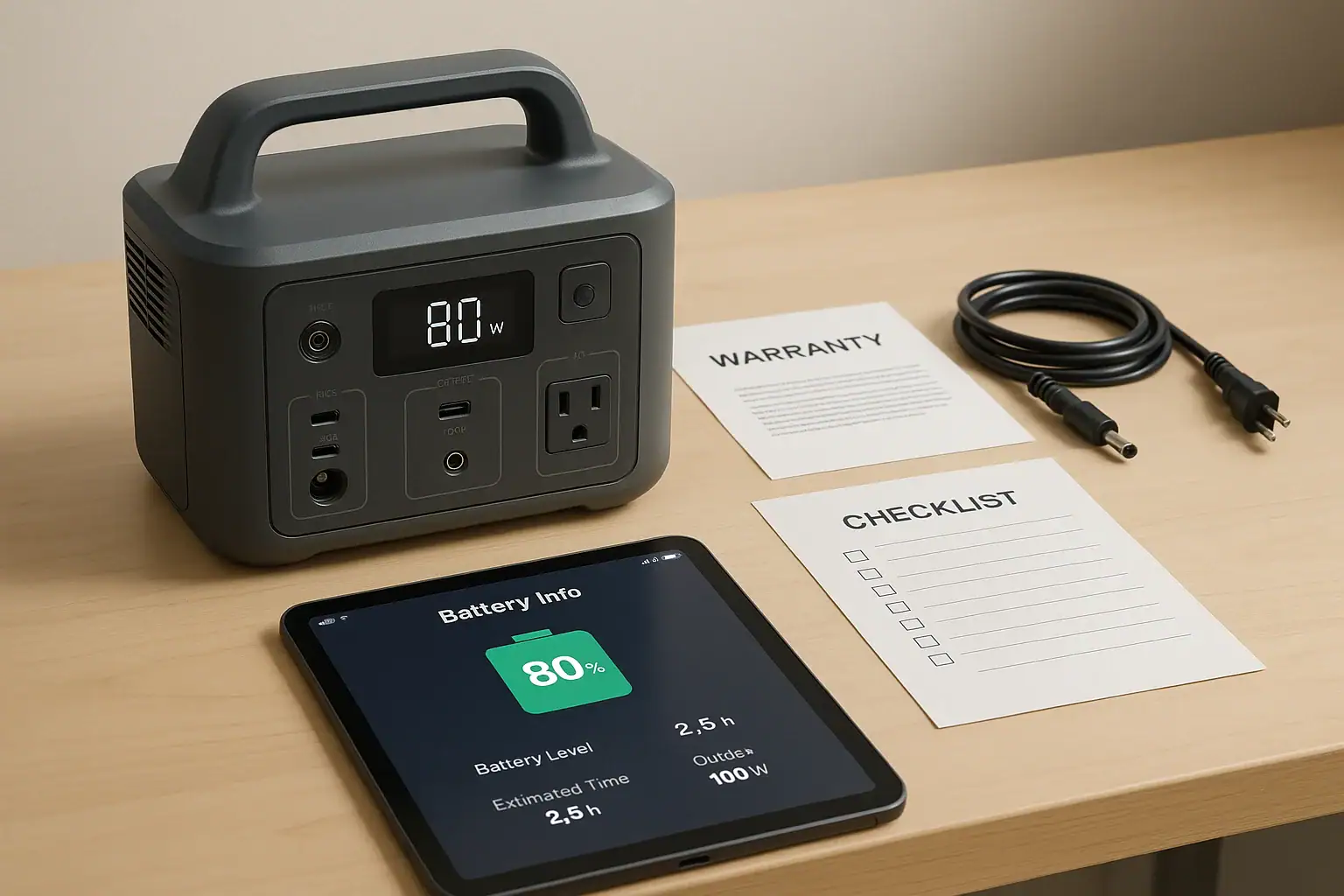
Portable power station warranty terms tell you what is covered, for how long, and what proof you need if the unit fails after purchase. Before buying, check the warranty length, battery coverage, cycle life language, exclusions, claim process, shipping responsibility, and whether accessories such as chargers and cables are included.
This matters because a portable power station combines a battery, inverter, charge controller, display, ports, and safety electronics in one device. A problem with AC output, USB-C PD profile, solar input limit, surge watts, runtime, or battery capacity may be treated differently depending on the written terms.
A good warranty is not just a long number of years. It should clearly explain what counts as a defect, what is considered normal wear, and what happens if the product needs repair, replacement, or refund support.
What portable power station warranty terms mean and why they matter
A warranty is a written promise that the maker or seller will address certain defects for a defined period. For portable power stations, the warranty usually focuses on failures in materials, workmanship, electronics, or battery performance under normal use. It is different from a return window, which is usually shorter and handled by the retailer.
The warranty matters because portable power stations are long-term products. Many buyers expect to use them for camping, backup power, jobsite charging, road trips, or emergency preparedness. If the unit stops charging, will not power devices, displays errors, or loses capacity unusually fast, the warranty terms determine what options are available.
Most warranties do not promise unlimited performance forever. They commonly exclude damage from misuse, water exposure, excessive heat, unauthorized modification, improper storage, physical impact, or using incompatible chargers and panels. Some also limit coverage for consumable components, including batteries that naturally age over time.
For beginners, the key is to read the warranty as a practical service agreement. Ask what is covered, what is not covered, who pays shipping, how long service may take, and what documentation is required. A clear warranty can reduce uncertainty; a vague warranty can make a future claim harder even if the product appears well specified.
How portable power station warranties usually work
Warranty coverage typically begins on the purchase date, not the first day you use the power station. That is why keeping a receipt or order confirmation is important. Some sellers may require product registration within a certain period, while others use the original proof of purchase alone.
Coverage length varies widely. Entry-level units may have shorter coverage, while larger battery systems may advertise multi-year coverage. However, the words around the term are as important as the number. Look for whether the term applies to the whole device, only the inverter and electronics, or includes the battery pack at the same level.
Battery wording deserves close attention. Lithium batteries lose capacity gradually with charge cycles, calendar age, temperature exposure, and depth of discharge. A warranty may cover sudden battery failure but not normal capacity loss. Some warranties mention a capacity retention threshold, such as retaining a certain percentage of original capacity during a stated period or cycle range. Others do not define battery health at all.
The claim process may include troubleshooting, photos, serial number verification, purchase proof, error codes, and testing instructions. The company may decide whether to repair the unit, replace it, provide a refurbished unit, send parts such as a charger, or issue another remedy. Read whether replacement units receive a new warranty or only the remaining time from the original purchase.
| Warranty term | What it usually means | Why to check it |
|---|---|---|
| Coverage period | The number of months or years the warranty applies | A longer term is only useful if the covered parts are clearly defined |
| Battery coverage | Whether failure or unusual capacity loss is included | The battery is one of the highest-value components |
| Exclusions | Conditions that void or limit coverage | Heat, moisture, impact, and misuse are common reasons claims are denied |
| Claim requirements | Proof, photos, serial numbers, and troubleshooting steps | Missing documentation can delay or prevent service |
| Shipping terms | Who pays for return shipping, inspection, or replacement delivery | Large power stations can be costly to ship |
Real-world examples of warranty terms in practice
Consider a small power station used occasionally for phones, lights, and a laptop. After several months, the USB-C PD profile stops delivering the expected PD profile, even though the AC outlets and DC socket still work. If the warranty covers electronic defects and ports under normal use, this may be a straightforward claim. The buyer would normally need proof of purchase, the serial number, a description of the problem, and sometimes photos or a short video.
Now consider a larger unit used for a refrigerator during outages. The refrigerator starts, then the power station shuts off when the compressor kicks on. This may not be a warranty issue if the appliance surge watts exceed the inverter’s surge rating. The product may be working as designed, even though it is not suitable for that load. This is why output ratings and warranty terms should be evaluated together before purchase.
A third example is a unit stored in a garage for a year without checking the battery. It no longer charges properly. The written warranty may exclude damage from improper storage, extended deep discharge, or storage outside the recommended temperature range. Even if the warranty period has not expired, the storage history could affect the claim.
Another common scenario involves solar charging. A buyer connects solar panels that exceed the station’s voltage input range. If the power station develops a charging fault, the warranty may not cover the damage because the input limit was exceeded. The solar input specification is a buying feature, but it is also a warranty risk if ignored.
Finally, imagine a display that shows inaccurate runtime while the unit still charges and powers devices normally. Some runtime estimates change based on load and battery conditions, so the manufacturer may first ask for calibration-like usage checks or repeated test results. A warranty claim is more likely to move smoothly when the buyer can describe the load, estimated watts, battery percentage, and error messages clearly.
Common mistakes and troubleshooting cues before making a claim
One common mistake is assuming every performance issue is a defect. Portable power stations have limits. If the AC load draws more running watts than the inverter can provide, the unit may shut down. If a motor, pump, kettle, microwave, or power tool briefly exceeds the surge rating, protection may trip. That behavior can be normal rather than a warranty failure.
Another mistake is overlooking compatibility. USB-C charging depends on the PD profile supported by both the power station and the device. Solar charging depends on voltage, current, connector type, and the station’s maximum input watts. Car charging can be slow by design because vehicle accessory sockets are limited. If the unit charges slowly, compare the actual input watts with the listed input limit before assuming something is defective.
Battery capacity complaints also require context. Advertised watt-hours are not the same as usable AC output. Inverter losses, standby draw, high loads, cold conditions, and battery protection reserve can reduce runtime. If a power station rated for a certain watt-hour capacity runs an AC appliance for less time than expected, the result may be normal once conversion loss and appliance cycling are considered.
Troubleshooting cues that may support a claim include a unit that will not charge from any approved source, repeated error messages under light loads, AC outlets failing while within wattage limits, unusual swelling or odor, a nonfunctional display, or a port that no longer works with multiple known-good cables and devices. Stop using any device that shows signs of heat damage, swelling, burning smell, liquid intrusion, or cracked housing.
Before contacting support, gather basic information: purchase date, order record, serial number, firmware version if visible, error codes, charging source, connected load, approximate watts, battery percentage, and environmental conditions. Clear details help separate a product fault from an overload, cable issue, incompatible charger, or normal protection event.
Safety basics that affect warranty and responsible use
Safety protections in portable power stations are designed to reduce risk from overcurrent, overheating, overvoltage, short circuits, and battery stress. Do not bypass these protections, open the housing, modify battery packs, alter wiring, or attempt internal repairs. These actions can create fire, shock, and chemical hazards, and they commonly void warranty coverage.
Use the power station within its rated limits. Match appliance running watts and surge watts to the inverter rating. Check the solar voltage range before connecting panels. Use chargers, cables, and adapters that fit the unit’s input and output specifications. A connector that physically fits is not automatically electrically compatible.
Keep the unit dry and ventilated. Portable power stations should not be used in standing water, heavy rain, enclosed hot spaces, or near flammable materials. Heat is especially important because high temperature can shorten battery life and trigger protective shutdowns. Cold conditions can also reduce available capacity and charging performance.
For home backup use, do not connect a portable power station directly to household wiring unless the setup uses appropriate listed equipment and is installed by a qualified electrician. Improper connections can endanger utility workers, damage equipment, and create shock or fire hazards. If you need power for hardwired circuits, get professional guidance rather than improvising.
Warranty terms usually expect normal, safe use. If a claim involves burned connectors, water intrusion, crushed casing, melted adapters, or evidence of unauthorized modification, coverage may be denied. Safe use is not only about protecting people and property; it also protects your ability to receive warranty service if a genuine defect occurs.
Maintenance and storage habits that preserve warranty value
Good maintenance is simple but important. Store the power station in a cool, dry place away from direct sun, heaters, freezing conditions, and high humidity. Avoid leaving it fully depleted for long periods. Many lithium battery products are best stored at a partial state of charge, with periodic checks every few months if the unit is not used.
Keep vents clear during operation and charging. Dust buildup, blankets, bags, or tight cabinets can restrict airflow and increase operating temperatures. Heat-related stress may reduce battery capacity over time and can contribute to shutdowns under load.
Inspect external parts occasionally. Look for damaged cords, loose connectors, cracked plastic, corrosion, debris in ports, or abnormal smells. Use a dry, soft cloth for routine cleaning. Do not use solvents, spray cleaners, or water near ports. If a cable becomes hot, frayed, or intermittent, stop using it and replace it with a compatible cable of suitable rating.
Keep purchase documentation in a safe place. Save the invoice, registration confirmation if applicable, serial number, photos of product labels, and any support conversations. For expensive units, it can help to record the first date of use and major accessories used for charging, such as solar panels or AC adapters.
Software or firmware updates, when offered through normal official channels, may improve behavior or fix display and charging issues. However, do not attempt unofficial modifications. If the unit shows repeated faults, contact support before continuing to cycle it heavily, especially if the issue involves charging, overheating, or unstable output.
| Storage factor | Better habit | Warranty relevance |
|---|---|---|
| State of charge | Store partially charged and check periodically | Helps avoid deep-discharge problems that may be excluded |
| Temperature | Use and store in moderate conditions | Extreme heat or cold can affect battery health and claim review |
| Moisture | Keep dry and away from condensation | Liquid damage is commonly excluded |
| Ventilation | Keep vents unobstructed during charging and use | Overheating evidence may complicate coverage |
| Documentation | Save receipts, serial numbers, and support records | Proof is often required before repair or replacement |
Practical takeaways before you buy
Related guides: Portable Power Station Buying Guide • Common Mistakes When Buying a Portable Power Station • Portable Power Station Terminology Explained
The best warranty for a portable power station is clear, specific, and realistic. It should tell you how long coverage lasts, which parts are included, how battery aging is handled, what use cases are excluded, and what the claim process requires. A long warranty with vague exclusions may be less useful than a shorter warranty with precise, transparent terms.
Before buying, compare the written warranty with how you plan to use the power station. Emergency home backup, camping, solar charging, jobsite use, refrigerator support, and device charging all create different stresses. Make sure the rated capacity, inverter output, surge rating, input limits, and environmental guidance match your intended use.
Specs to look for
- Warranty length: Look for a clearly stated term such as 2 to 5 years and whether registration is required, because coverage starts and claim eligibility depend on the written timing.
- Battery chemistry and cycle life: Look for chemistry type and cycle ratings such as hundreds to several thousand cycles to a stated capacity level, because battery aging affects long-term value.
- Usable capacity: Look beyond advertised watt-hours and expect usable AC energy to be lower due to conversion losses, because runtime estimates depend on real delivered power.
- Continuous and surge watts: Match running watts and startup surge to your appliances, such as a 600 W load with a higher startup spike, because overload shutdowns are usually not defects.
- Solar input range: Check input voltage, current, and maximum watts, such as a defined voltage window and 100 W to 800 W input class, because exceeding limits can damage equipment and void coverage.
- USB-C PD profiles: Look for supported outputs such as 45 W, 65 W, 100 W, or 140 W, because laptops and tablets may charge slowly or not at all without the right profile.
- Operating and storage temperature range: Look for practical temperature guidance for charging, discharging, and storage, because heat and cold influence battery performance and warranty review.
- Accessory coverage: Check whether AC adapters, car charging cables, solar cables, and expansion connectors are included, because accessory failure can stop normal use even when the main unit works.
- Shipping and service terms: Look for who pays shipping and whether repair, replacement, refurbished replacement, or refund is the remedy, because large batteries can be expensive and slow to service.
Keep the final decision practical: choose specifications that fit your loads, read the warranty before purchase, and save your documentation. A portable power station is easier to own when the performance limits and warranty limits are both clear from the start.
Frequently asked questions
What portable power station specs matter most when comparing warranty terms?
The most important specs are battery coverage, warranty length, cycle life language, inverter output, solar input limits, and whether accessories are included. These details help you tell the difference between normal wear and a covered defect. If the warranty is vague about the battery or exclusions, the product may be harder to service later.
What is a common mistake buyers make with portable power station warranties?
A common mistake is assuming a long warranty automatically means broad protection. In practice, claims are often denied because of misuse, overload, water damage, improper storage, or incompatible charging. Another mistake is not keeping the receipt or serial number, which can slow or block a claim.
Do portable power station warranties usually cover battery capacity loss?
Sometimes, but not always. Many warranties cover sudden battery failure while excluding normal capacity fade from age and charge cycles. If battery health matters to you, look for a stated retention threshold or clear wording about how capacity loss is handled.
Can using the wrong solar panel or charger void the warranty?
Yes, it can. If the input voltage, current, connector type, or charging profile exceeds the unit’s limits, damage may be excluded from coverage. Always match the charger or solar setup to the published input specifications before use.
How do I know if a power station problem is a defect or normal protection behavior?
Check whether the unit is operating within its rated running watts, surge watts, and input limits. Shutdowns, slow charging, or reduced runtime can be normal if the load is too high, the battery is cold, or the source is incompatible. Repeated failures under normal conditions are more likely to support a warranty claim.
What safety steps help protect both the user and the warranty?
Use the unit within its rated limits, keep it dry and ventilated, and avoid opening or modifying the battery pack. Do not bypass safety protections or use damaged cables and adapters. Safe use reduces the risk of injury and also helps prevent warranty denial.
Related guides
Browse this topic →
- Beginner-friendly sizing, runtime & specs
- Solar & charging (MPPT, fast charging, cables)
- Batteries (LiFePO4, cycles, care & storage)
- Safety, cold-weather performance, real-world tips
More in Beginners
See all →- Charging an Electric Wheelchair or Mobility Scooter From a Portable Power Station
- Portable Power Station for a Gaming PC: Runtime, Load Spikes, and UPS Considerations
- Portable Power Station for a Pop-Up Camper: Lights, Fans, Fridge, and Recharge Plan
- Portable Power Station for a Shed or Outbuilding: Lights, Chargers, and Security
- Portable Power Station for a Boat: 12V Loads, Salt Air, and Safer Storage
Keep reading
About this site
Portable Energy Lab publishes practical, independent guides about portable power—clear sizing, safe use, and real-world expectations.
Affiliate disclosure
Some links on this site may be affiliate links. If you buy through these links, we may earn a small commission at no extra cost to you. This helps support our content. Read our affiliate disclosure.