
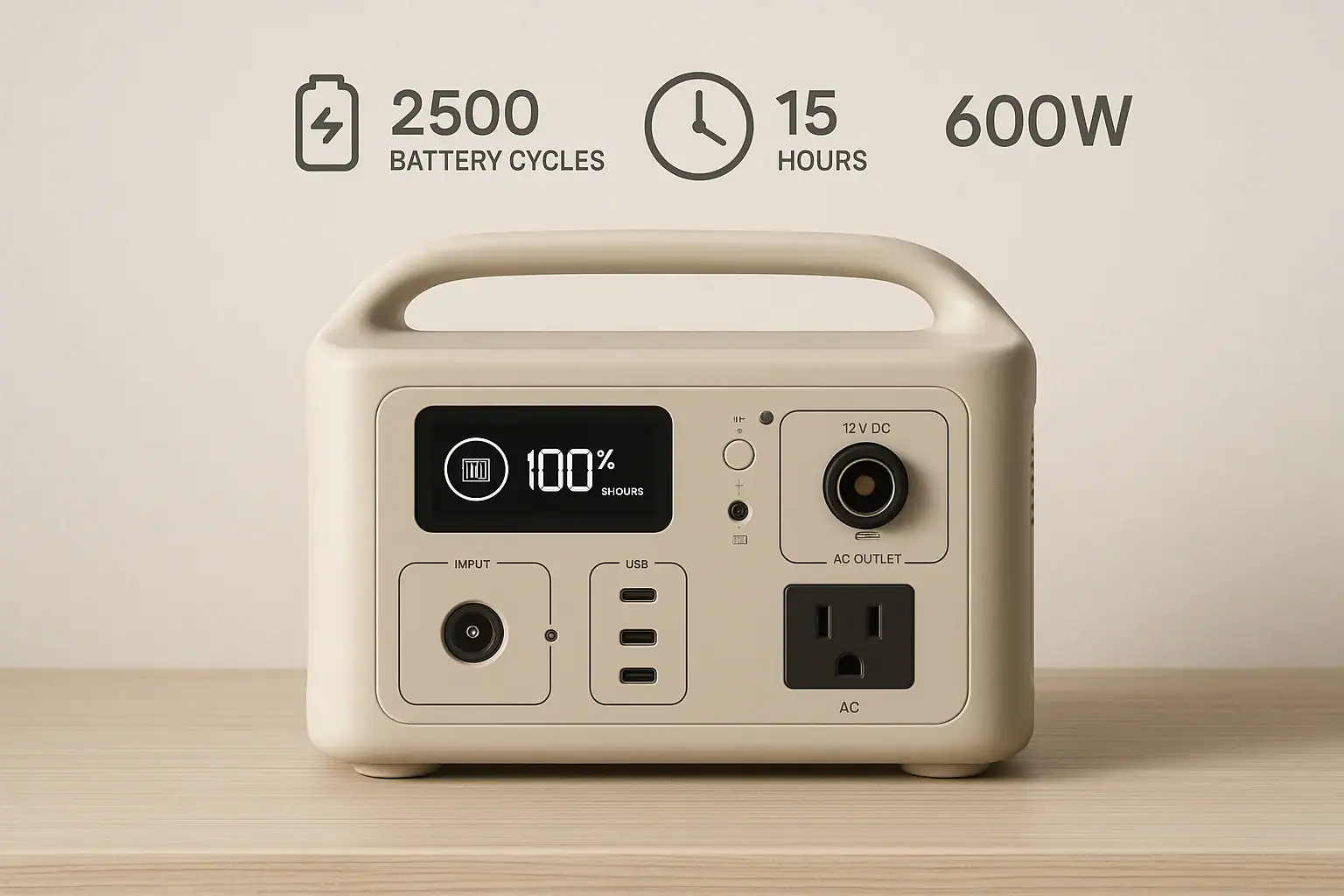
Most portable power stations last about 5–10 years and 500–3,000 charge cycles, and each charge can power devices from a few hours to a couple of days depending on capacity and load. Actual lifespan and runtime depend on battery chemistry, depth of discharge, charge rate, inverter efficiency, and how well the unit is maintained. When people ask how long a portable power station lasts, they may mean battery lifespan, runtime in hours, or shelf life in storage.
Understanding these differences helps you estimate runtime, compare watt-hours, and decide if a station can handle your typical watt draw, surge watts, and charging needs. With proper care—avoiding extreme temperatures, over-discharging, and constant max loads—portable power stations can remain a reliable backup power source for years. This guide breaks down what “lasting” really means, how the technology works, what shortens life, and how to keep your unit performing as long as possible.
1. What “How Long Do Portable Power Stations Last?” Really Means
When people search for how long portable power stations last, they are usually asking about three related but different timeframes:
- Battery lifespan in years – How many years until the battery noticeably degrades.
- Cycle life – How many full charge–discharge cycles it can handle before capacity drops significantly.
- Runtime per charge – How many hours it can power specific devices on a single full charge.
Each of these matters for different reasons:
- Battery lifespan affects long-term value. A unit that lasts 8–10 years under normal use typically offers better total cost of ownership than one that fades after 3–4 years.
- Cycle life is critical if you use the power station often—for camping, work sites, or as frequent backup power.
- Runtime determines whether it can cover your use case, such as overnight CPAP support, laptop workdays, small fridge backup, or power tools.
There is also shelf life—how long the unit can sit in storage and still hold a useful charge. For emergency backup, this is just as important as cycle life, because a high-capacity station is not helpful if it self-discharges too quickly while stored.
To evaluate how long a portable power station lasts, you need to look at all four dimensions: years, cycles, runtime, and shelf performance. The rest of this guide explains how these are determined and how you can influence them.
2. Key Factors That Determine Portable Power Station Lifespan
Portable power stations are essentially battery systems with built-in inverters, chargers, and protection electronics. How long they last is controlled by a mix of design choices and user behavior. The most important factors include:
Battery chemistry and quality
Most modern units use one of two lithium-based chemistries:
- Li-ion (NMC or similar) – Higher energy density (more watt-hours per pound), generally 500–1,000 cycles to about 80% capacity under moderate use.
- LFP (LiFePO4) – Lower energy density but higher cycle life, often 2,000–4,000 or more cycles to around 80% capacity under proper conditions.
Higher-quality cells and better battery management systems (BMS) usually translate into longer usable life, more stable performance, and better safety margins.
Depth of discharge (DoD)
Depth of discharge is how much of the battery’s capacity you use before recharging. Deeper discharges shorten battery life:
- Regularly using 80–100% DoD stresses the battery more.
- Staying closer to 20–70% DoD (partial cycles) can greatly extend cycle count.
Even if the manufacturer allows full discharge, avoiding frequent 0%–100% swings generally helps the battery last longer.
Charge and discharge rates
Fast charging and heavy loads generate heat and chemical stress:
- High input wattage (fast AC or DC charging) is convenient but may slightly reduce long-term cycle life if used constantly.
- Running near maximum output watts for long periods keeps the inverter and cells under sustained load, which can accelerate aging.
Using moderate charge rates when you have time and avoiding constant max output can help preserve lifespan.
Temperature and environment
Temperature is one of the biggest aging accelerators for lithium batteries:
- High heat (for example, a hot car in summer) can permanently reduce capacity.
- Charging below freezing can damage cells if not properly controlled by the BMS.
- Long-term storage is best in a cool, dry place, typically around 50–77°F (10–25°C).
Usage pattern and calendar aging
Even if you rarely use a portable power station, its battery slowly ages with time—a process called calendar aging. Frequent deep cycles, constant high loads, or leaving it at 0% or 100% charge for months can all accelerate this natural decline.
In typical mixed use, many portable power stations remain functional for 5–10 years, though they may hold less charge toward the end of that period.
| Aspect | Typical Range | Impact on How Long It Lasts |
|---|---|---|
| Battery chemistry | Li-ion vs. LFP | LFP usually offers more cycles; Li-ion is lighter |
| Cycle life | 500–4,000 cycles | Higher cycles = more years of regular use |
| Depth of discharge | 20–100% per use | Shallower discharges extend lifespan |
| Operating temperature | 32–95°F (0–35°C) | Extreme heat or cold shortens battery life |
| Average load | 25–80% of rated watts | Constant max load increases wear and heat |
| Storage habits | 40–60% charge, cool place | Good storage slows capacity loss |
3. Real-World Lifespan and Runtime Examples
To make lifespan and runtime easier to understand, it helps to look at concrete examples. These are simplified scenarios using round numbers to illustrate how capacity, load, and usage patterns interact.
Example 1: Small station for light electronics
Consider a compact portable power station with a 300 Wh battery and a 300 W inverter:
- Phone (10 Wh per full charge): roughly 20–25 charges.
- Laptop (60 Wh per charge): about 3–4 charges.
- LED light (10 W): around 20–24 hours of runtime.
Assuming moderate use—fully cycling it a few times per month—it might see 50–100 cycles per year. With a cycle life of 500–1,000 cycles, it could remain useful for 5–8 years, though capacity may decline to 70–80% toward the end.
Example 2: Mid-size station for overnight backup
Now take a mid-size unit with 1,000 Wh capacity and a 1,000 W inverter, used for:
- CPAP machine (40 W average): ~20–22 hours.
- Wi-Fi router (10 W): ~80–90 hours.
- Small fridge cycling (average 60 W): ~12–14 hours.
In practice, inverter losses and standby draw reduce these ideal runtimes by about 10–20%. If you use this station as backup power during occasional outages, you might only cycle it 20–40 times per year. With a multi-thousand-cycle battery, it could easily last a decade in this light-duty role, even as capacity slowly tapers.
Example 3: Large station for frequent off-grid use
Consider a larger unit with 2,000 Wh capacity, used heavily for camping and off-grid work:
- Average daily load of 400 W for 4–5 hours (about 1,600–2,000 Wh per day).
- Used 150 days per year.
This is close to 150 full cycles per year. If the battery supports 2,500 cycles to 80% capacity, you might see:
- About 15–17 years of use before reaching 80% capacity, in theory.
- In practice, heat, storage habits, and occasional deeper discharges may shorten this to around 8–12 years.
Example 4: Shelf life for emergency-only units
Some people keep a portable power station primarily for emergency use. In that case:
- The unit may only see a handful of full cycles per year.
- Calendar aging and self-discharge become more important than cycle count.
- Checking and topping up the charge every 3–6 months helps ensure it still works when needed.
Even with very light use, expect some capacity loss over 5–10 years. A station that started at 1,000 Wh might hold closer to 700–800 Wh after many years, but still be valuable for shorter outages.
4. Common Mistakes That Shorten Lifespan (and Signs of Trouble)
Several user habits can significantly reduce how long a portable power station lasts. Recognizing and avoiding these mistakes can add years of useful life.
Frequent full discharges and overloading
- Running to 0% regularly puts extra strain on the cells, especially if followed by fast charging.
- Consistently drawing near or above rated output (for example, pushing a 500 W inverter with 450–500 W loads for hours) generates more heat and stress.
- Ignoring surge ratings and plugging in devices with high startup watts (like some compressors or pumps) can cause repeated overload shutdowns and stress components.
Try to stay within a comfortable margin of the station’s continuous watt rating and avoid treating 0% as a normal stopping point.
Leaving it fully charged or fully empty for months
Keeping lithium batteries at extremes accelerates aging:
- Long-term storage at 100% charge can gradually reduce capacity.
- Leaving the unit at or near 0% for extended periods increases the risk of deep discharge damage.
For storage longer than a few weeks, aim for a mid-range state of charge instead of the extremes.
Heat and poor ventilation
- Operating in hot, enclosed spaces (like a closed car or tent in direct sun) elevates internal temperatures.
- Blocking cooling vents or fans can cause the inverter and battery to heat up under load.
High temperatures are one of the fastest ways to shorten battery life, even if you stay within rated loads.
Ignoring early warning signs
Pay attention to cues that the station is struggling or degrading:
- Noticeably reduced runtime at the same load compared to when it was new.
- Frequent thermal shutdowns or fan running at maximum most of the time.
- Inconsistent state-of-charge readings (jumping percentages, sudden drops).
- Unusual smells, swelling, or hot spots on the case.
If you see these, reduce load, improve ventilation, and avoid fast charging until you understand what is happening. For serious symptoms like swelling or burning smells, stop using the unit and contact a qualified professional for guidance.
5. Safety Basics While Extending Lifespan
Extending how long a portable power station lasts should never come at the expense of safety. Following basic safety practices protects both the device and the people using it.
Operate within rated limits
- Stay within the continuous watt rating for AC output and respect surge limits.
- Do not daisy-chain multiple high-draw devices on power strips if their combined load approaches or exceeds the station’s rating.
- Check that the input wattage for charging (AC adapters, car charging, or solar) stays within the manufacturer’s recommended range.
Use in safe environments
- Keep the unit on a stable, dry, and well-ventilated surface.
- Avoid placing it near flammable materials or in direct sunlight for long periods.
- Protect it from rain, snow, and condensation unless it is specifically designed for exposure.
Avoid unsafe modifications
- Do not open the case, bypass the BMS, or modify the battery pack.
- Avoid homemade wiring into home electrical panels or circuits. For any connection to household wiring, consult a qualified electrician and use appropriate, code-compliant equipment.
- Use only compatible charging sources and cables rated for the voltage and current involved.
Monitor during heavy use and charging
- During high-load operation or fast charging, periodically check for excessive heat or unusual noises.
- Ensure cooling fans are not obstructed and that air can circulate around the unit.
- Disconnect devices that cause repeated overloads or tripped protections until you confirm they are safe to use with the station.
Safe, moderate use not only protects people and property, it also helps the power station last longer by keeping thermal and electrical stress under control.
6. Maintenance and Storage to Maximize Lifespan
Good maintenance and storage habits can add years to the effective life of a portable power station. These practices are simple but often overlooked.
Regular charging and exercise
- Top up the battery every 3–6 months if the station is stored and not used regularly.
- Run a light to moderate load test occasionally to confirm it still performs as expected.
- Avoid letting the unit sit unused for years; occasional cycling helps keep the battery and electronics in working order.
Optimal storage state of charge
For storage longer than a few weeks:
- Aim for around 40–60% charge rather than 0% or 100%.
- If the unit has a display, note the percentage before storing and recheck every few months.
- Recharge to mid-level if it falls too low due to self-discharge.
Temperature and environment control
- Store in a cool, dry location, away from direct sunlight and heat sources.
- Avoid freezing conditions for extended storage, especially if the battery is low.
- Keep dust and debris away from cooling vents and ports.
Cleaning and physical care
- Wipe the exterior with a dry or slightly damp cloth; avoid harsh chemicals.
- Inspect ports and plugs for dirt, corrosion, or damage and clean gently if needed.
- Protect the unit from drops, impacts, and crushing loads during transport.
Monitoring capacity over time
- Periodically note how long it runs a known load (for example, a 50 W light) to track capacity changes.
- If runtime declines significantly, adjust expectations and plan for shorter backup duration.
- Consider using the older unit for lighter tasks if you later obtain a newer one for critical loads.
| Maintenance Area | Recommended Practice | Effect on Longevity |
|---|---|---|
| Charging interval in storage | Every 3–6 months | Prevents deep discharge damage |
| Storage charge level | About 40–60% | Reduces long-term stress on cells |
| Storage temperature | Cool, dry, out of sun | Slows chemical aging |
| Usage frequency | Occasional light cycling | Keeps battery and BMS active |
| Ventilation | Unblocked vents, open space | Prevents overheating during use |
| Physical handling | Avoid drops and impacts | Protects internal components |
Related guides: Portable Power Station Buying Guide • Can a Portable Power Station Replace a UPS? • How to Estimate Runtime for Any Device: A Simple Wh Formula + 5 Worked Examples
7. Practical Takeaways and Key Specs to Watch
How long a portable power station lasts depends on both design and behavior. In normal conditions, many units provide reliable service for 5–10 years, with cycle life ranging from a few hundred to several thousand full charges. Runtime per charge is determined by watt-hour capacity, inverter efficiency, and the actual watt draw of your devices.
To get the most from any portable power station:
- Match its capacity and output to your real-world loads instead of running at the limit.
- Avoid repeated full discharges and extreme temperatures.
- Store it partially charged and test it periodically, especially if used for emergency backup.
- Respect safety limits and use it in well-ventilated, dry environments.
Specs to look for
- Battery capacity (Wh) – Look for a capacity that comfortably covers your typical daily watt-hour usage with a margin (for example, 500–2,000 Wh). This determines runtime per charge.
- Battery chemistry – Compare Li-ion versus LFP options. LFP often offers higher cycle counts and longer lifespan, while Li-ion is lighter and more compact.
- Rated cycle life – Seek clear cycle life numbers (for example, 500–1,000+ cycles for Li-ion, 2,000–4,000+ for LFP) to estimate how many years of regular use you can expect.
- Continuous and surge output (W) – Ensure continuous watts exceed your combined device load by at least 20–30%, and that surge watts can handle startup spikes from motors or compressors.
- Inverter efficiency – Higher efficiency (often 85–90% or more) means less energy lost as heat and longer runtimes from the same watt-hour capacity.
- Charging input options and limits – Check maximum AC, car, and solar input wattage so you know how quickly you can recharge in different situations.
- Operating and storage temperature ranges – Favor units with clearly stated safe temperature ranges, especially if you plan to use or store them in hot or cold environments.
- BMS protections and safety features – Look for protections against overcharge, over-discharge, overcurrent, short circuit, and over-temperature to help prevent damage and extend lifespan.
- Self-discharge and standby draw – Lower self-discharge and efficient standby operation help preserve charge during storage and improve shelf life for emergency use.
- Port selection and output types – Multiple AC outlets, regulated DC ports, and USB-C PD outputs make it easier to run devices efficiently without adapters that can add extra losses.
By understanding these specs and following good usage and maintenance habits, you can maximize how long your portable power station lasts and get more reliable power from every charge.
Long-term care starts on day one; follow a battery-friendly first setup before settling into a normal charging and storage routine.
Frequently asked questions
Which specifications and features most affect runtime and long-term lifespan?
Battery capacity (Wh) determines runtime, while battery chemistry (LFP vs. Li-ion), rated cycle life, and inverter efficiency influence long-term lifespan. Also consider continuous and surge watt ratings, input charging limits, and the quality of the battery management system for safety and durability.
What’s the most common user mistake that shortens a power station’s lifespan?
Regularly running the battery to 0% and repeatedly drawing near the unit’s maximum output are common mistakes that increase heat and chemical stress on cells. Combined with frequent fast charging and poor ventilation, these habits accelerate capacity loss.
What basic safety precautions should I take when using a portable power station?
Operate within the rated continuous and surge limits, keep the unit on a stable, dry, and well-ventilated surface, and avoid opening or modifying the internals. If you notice swelling, burning smells, or severe overheating, stop use and seek professional guidance.
How often should I check and recharge a power station kept in long-term storage?
Check and top up stored units every 3–6 months and aim to store them at about 40–60% charge to reduce stress on the battery. Recharging before the state of charge drops too low helps prevent deep-discharge damage.
How can I estimate how long a power station will run a particular device?
Divide the station’s watt-hour capacity by the device’s average watt draw, then adjust for inverter and system losses (typically 10–20%). For example, a 1,000 Wh battery powering a 50 W load will run about 16–18 hours after accounting for losses.
What signs indicate a portable power station is reaching the end of its useful life?
Watch for noticeably reduced runtime at familiar loads, frequent thermal shutdowns, inconsistent state-of-charge readings, or physical signs like swelling and unusual smells. If you see severe symptoms, stop using the unit and get professional advice.
Related guides
Browse this topic →
- Beginner-friendly sizing, runtime & specs
- Solar & charging (MPPT, fast charging, cables)
- Batteries (LiFePO4, cycles, care & storage)
- Safety, cold-weather performance, real-world tips
More in Maintenance
See all →- Where to Store a Portable Power Station at Home: Heat, Humidity, and Access
- How App Control and Smart Charging Affect Portable Power Station Battery Health
- How to Maintain a Portable Power Station
- Are Portable Power Stations Sustainable? Repairability, Recycling, and E-Waste
- When to Replace Cables and Adapters: Signs of Wear and Overheating
Keep reading
About this site
Portable Energy Lab publishes practical, independent guides about portable power—clear sizing, safe use, and real-world expectations.
Affiliate disclosure
Some links on this site may be affiliate links. If you buy through these links, we may earn a small commission at no extra cost to you. This helps support our content. Read our affiliate disclosure.