
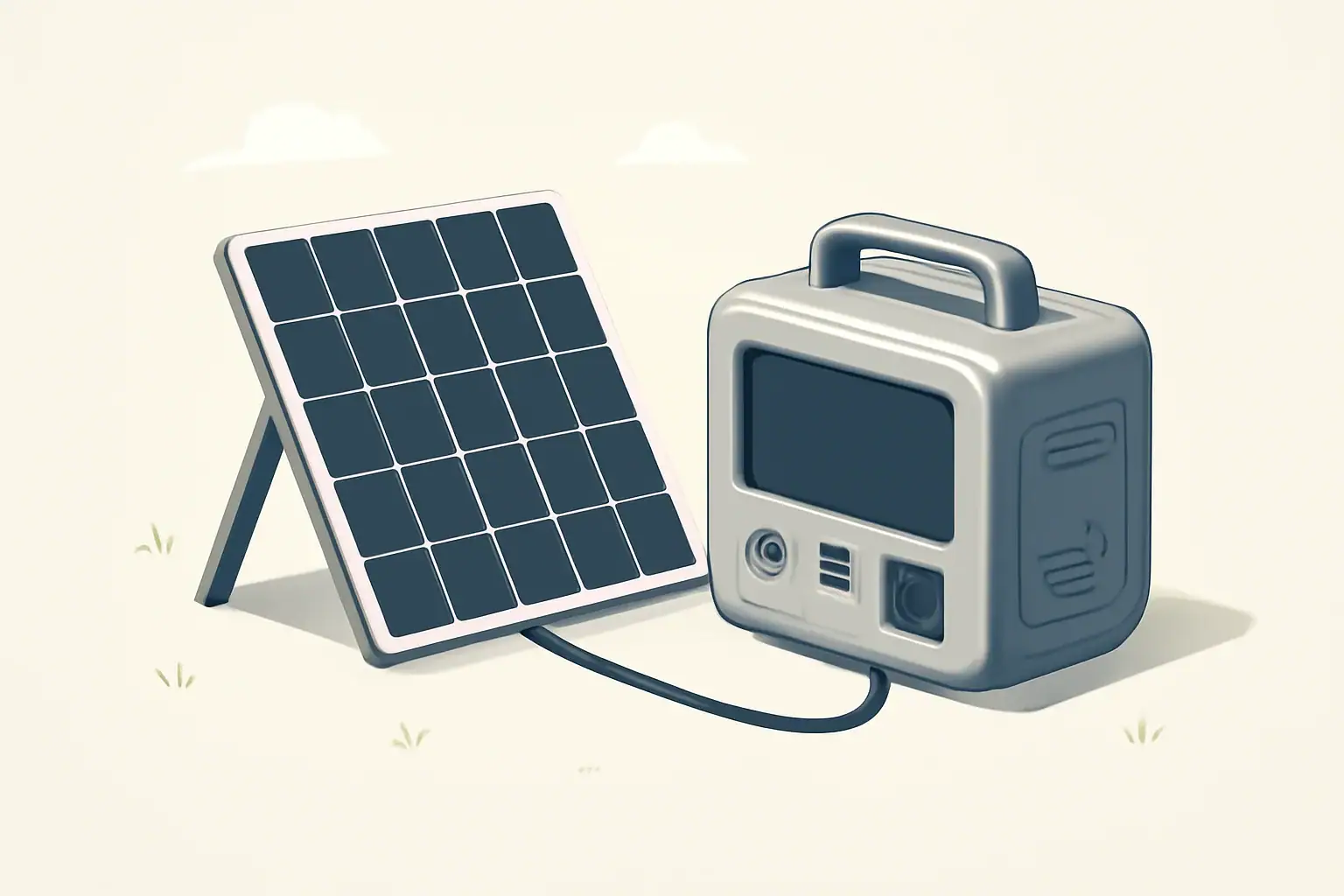
Portable power stations work well with renewable energy when the battery size, inverter, and charging inputs are correctly matched to your solar, wind, or vehicle setup. Used this way, they can provide reliable off‑grid power for camping, emergency backup, and remote work without depending on fuel or a wired grid.
This guide explains how portable power stations integrate with renewable sources, how to size a system for real-world use, and what to watch for so you do not damage batteries or overload components. You will see concrete examples, simple calculations, and checklists you can copy into your own planning notes.
Whether you are building a small solar generator for weekend trips or adding a portable station to a home backup system, the goal is the same: convert intermittent renewable energy into stable, usable electricity for your devices and appliances.
What a Portable Power Station Is and Why It Matters for Renewable Energy
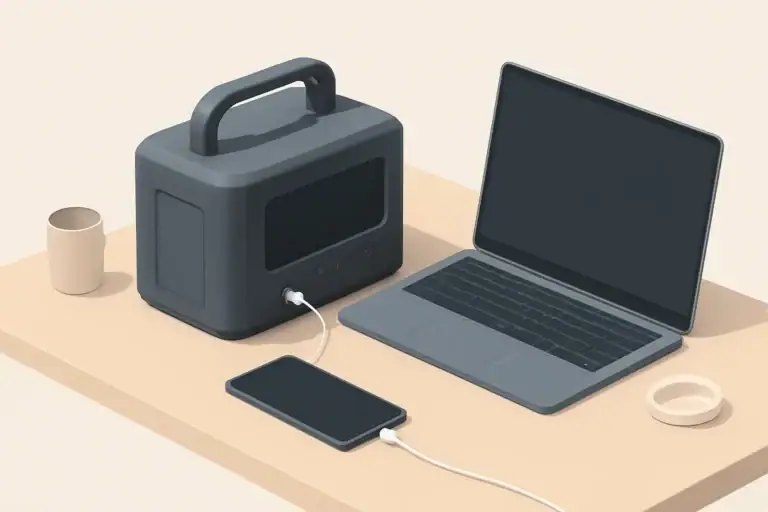
A portable power station is a self-contained battery system with built-in electronics that stores energy and delivers it through AC outlets, DC ports, and USB outputs. When paired with renewable inputs like solar panels or small wind turbines, it becomes a compact off-grid power system.
Compared with loose batteries and separate inverters or charge controllers, portable stations offer:
- Simpler setup: One box handles storage, conversion, and protection.
- Predictable capacity: Battery size is clearly labeled in watt-hours (Wh).
- Multiple charging options: Wall AC, vehicle DC, and renewable inputs on a single unit.
- Built-in safety: A battery management system (BMS) limits overcharge, deep discharge, and overheating.
For renewable energy, this matters because solar and wind are variable. A portable power station acts as a buffer: it absorbs energy whenever the sun or wind is available and releases it later at a steady voltage and frequency your devices can use. This makes renewable power practical for everyday tasks like running a laptop, a small fridge, or communications gear. For a broader view, see how small renewable systems and portable storage fit into the grid.
Key Concepts: How Portable Power Stations Work with Renewable Sources
When you connect a renewable source to a portable power station, you are creating a small energy system with three main parts: generation, storage, and loads. Understanding how these pieces interact helps you size and operate the system correctly.
Core components inside a portable power station
- Battery pack: Stores energy, usually rated in watt-hours (Wh). This determines how long you can power your devices.
- Battery management system (BMS): Monitors cell voltage, current, and temperature to prevent damage.
- Inverter: Converts DC battery power into AC power for household-style outlets.
- DC-DC converters: Provide regulated DC outputs (for 12 V sockets and USB ports).
- Charge controller: Manages solar or other DC input to safely and efficiently charge the battery.
Energy flow: from panel or turbine to your devices
A typical renewable setup follows this path:
- Solar panel or small turbine produces variable DC power depending on sun or wind.
- The charge controller inside (or connected to) the power station adjusts voltage and current to match the battery’s needs.
- The battery stores energy until you plug in a device.
- The inverter and DC outputs deliver stable AC or DC power to your loads.
Battery chemistry and renewable integration
- Lithium-ion (NMC and similar): High energy density and relatively light. Well suited for portable use, but more sensitive to high temperatures and repeated deep discharges.
- LiFePO4 (lithium iron phosphate): Lower energy density and slightly heavier for the same Wh, but very long cycle life and good tolerance for frequent charge/discharge cycles common with solar.
- Lead-acid (AGM, gel): Heavier and lower usable capacity per rated Wh because deep discharges shorten life. More common in older or budget systems.
For renewable-heavy use (daily solar charging, frequent cycling), LiFePO4 is often preferred for its longevity, while lighter lithium-ion can be attractive when weight and compact size matter more than maximum cycle life.
Matching solar input to the station
Every portable power station specifies a maximum solar input in watts, voltage, and current. Staying within these limits is critical:
- Voltage (V): Exceeding the maximum PV voltage can damage the charge controller.
- Current (A): Exceeding the input current limit can trigger protection or reduce efficiency.
- Power (W): The station will only use up to its rated solar wattage, even if your panel array is larger.
Basic sizing method
To size a portable power station for renewable use, you need to balance three numbers: daily energy consumption, usable battery capacity, and renewable generation potential. The table below shows a simple planning process.
| Step | What to calculate | Example value |
|---|---|---|
| 1. List devices | Note each device’s power (W) and hours of use per day. | Laptop 60 W × 4 h, fridge 80 W (duty cycle), lights 10 W × 5 h |
| 2. Daily energy (Wh) | Multiply watts × hours and add everything. | Laptop 240 Wh + fridge 400 Wh + lights 50 Wh ≈ 690 Wh |
| 3. Add losses | Multiply by 1.2–1.4 for inverter and system losses. | 690 Wh × 1.3 ≈ 900 Wh |
| 4. Choose battery size | Pick a station with usable capacity ≥ step 3. | 1,000 Wh station gives margin above 900 Wh need |
| 5. Size solar | Daily Wh ÷ peak sun hours ÷ efficiency. | 900 Wh ÷ 5 h ÷ 0.8 ≈ 225 W of panels |
Real-World Examples of Portable Power Stations with Renewable Energy
Abstract numbers are easier to understand when tied to real scenarios. Below are three common setups and how a portable power station and renewables work together in each case.
Example 1: Weekend camping with solar
Use case: A small group on a two-night camping trip wants to power phones, a tablet, LED lights, and a small 12 V cooler.
- Loads: 4 phones (charging 10 W each for 2 h), 1 tablet (20 W for 3 h), LED strip lights (10 W for 5 h), 12 V cooler averaging 40 W for 8 h/day.
- Daily energy: Phones 80 Wh + tablet 60 Wh + lights 50 Wh + cooler 320 Wh ≈ 510 Wh.
- Battery size: With a 1.3 factor, 510 Wh × 1.3 ≈ 660 Wh. A station around 700–1,000 Wh gives comfortable margin.
- Solar input: In an area with roughly 5 peak sun hours, 660 Wh ÷ 5 ÷ 0.8 ≈ 165 W. A 160–200 W folding solar panel is practical.
Result: The group can run the cooler, charge devices, and fully recharge the station each day in good sun. If a cloudy day occurs, they still have enough stored energy for one night.
Example 2: Home outage backup with rooftop solar
Use case: A household wants to keep essential loads running during short grid outages, using an existing small solar array and a portable station as a flexible battery.
- Loads: Wi-Fi router (10 W), laptop (60 W for 4 h), LED room lights (30 W for 4 h), small fridge averaging 80 W for 8 h.
- Daily energy: Router 240 Wh + laptop 240 Wh + lights 120 Wh + fridge 640 Wh ≈ 1,240 Wh.
- Battery size: 1,240 Wh × 1.3 ≈ 1,612 Wh. A 1,600–2,000 Wh station is appropriate.
- Solar input: With 4 peak sun hours and 80% efficiency, 1,612 Wh ÷ 4 ÷ 0.8 ≈ 504 W. A 500 W solar input (from rooftop or portable panels) can refill the station daily.
Result: During a daytime outage, solar keeps the station topped up. Overnight, stored energy runs essentials. For longer outages, careful load management (shorter laptop use, fewer lights) extends runtime.
Example 3: Remote work site with mixed charging
Use case: A small field crew runs measurement instruments, a laptop, and battery chargers at a site without grid power for several days.
- Loads: Laptop 60 W for 6 h, instruments 50 W for 8 h, battery charger 40 W for 2 h, LED work light 20 W for 6 h.
- Daily energy: Laptop 360 Wh + instruments 400 Wh + charger 80 Wh + light 120 Wh ≈ 960 Wh.
- Battery size: 960 Wh × 1.3 ≈ 1,248 Wh. A 1,200–1,500 Wh station works.
- Charging: 200–300 W of solar for daytime, plus vehicle DC charging while driving between sites.
Result: Even if clouds reduce solar output, vehicle charging can top up the station during transit, keeping equipment powered without a fuel generator.
Common Mistakes and Troubleshooting When Using Renewables
Many problems with portable power stations and renewable energy come from a few predictable mistakes. Recognizing them early helps you troubleshoot quickly and avoid permanent damage.
Frequent mistakes to avoid
| Mistake | Typical symptom | What to check or change |
|---|---|---|
| Overestimating solar output | Battery never reaches full charge; devices shut off at night. | Use realistic sun hours (often 3–5), and consider panel orientation and shading. Increase panel wattage or reduce loads. |
| Exceeding PV voltage limit | Station refuses to accept solar input or shows error codes. | Re-wire panels from series to parallel or reduce panel count so open-circuit voltage stays within the station’s PV limit. |
| Ignoring inverter surge ratings | Station shuts down when starting a fridge, pump, or power tool. | Check appliance startup (surge) watts; choose a station with sufficient surge capacity or avoid that load. |
| Running batteries to 0% regularly | Noticeably reduced runtime after a few months of heavy use. | Aim to keep discharge above 10–20% when possible, especially for non-LiFePO4 chemistries. |
| Using thin or long DC cables | Panels show good sun but charging is slow; cables feel warm. | Use appropriately sized cables for current and distance to reduce voltage drop and heating. |
Troubleshooting slow or no solar charging
- Check panel orientation: Point panels directly at the sun and tilt them according to your latitude and season.
- Inspect for shading: Even small shadows from branches or roof rails can drastically cut output.
- Verify connections: Confirm all connectors are fully seated and polarity is correct.
- Measure open-circuit voltage: If you have a meter, compare panel voltage in sun to its rated value; a large difference may indicate damage.
- Confirm input settings: Some stations have multiple DC inputs or modes. Ensure the correct input is selected and enabled.
Troubleshooting fast battery drain
- Identify hidden loads: Check for devices left plugged in (routers, chargers, small heaters) that run continuously.
- Monitor inverter use: AC inverters are less efficient at low loads. If possible, power small devices from DC or USB instead of AC.
- Watch for cold temperatures: Cold batteries deliver less usable capacity. Expect reduced runtime in freezing conditions.
- Compare actual vs. planned use: Log your daily Wh usage for a day or two to see if it matches your earlier estimates.
When to reduce load vs. increase generation
If you frequently hit low battery before the end of the day, you can either reduce consumption or add more solar (or other charging). Often, a mix works best: switch some devices to DC, shorten run times on high-power loads, and increase panel wattage if your station can accept it.
Safety Basics with Batteries, Solar, and Inverters
Portable power stations are designed to be user friendly, but they still store and move substantial energy. Following basic safety practices protects both your equipment and the people around it.
Electrical and thermal safety
- Avoid overloading outputs: Stay within the continuous and surge watt ratings of the inverter and DC outputs.
- Provide ventilation: Do not cover vents or operate the station in tightly enclosed spaces where heat cannot escape.
- Keep away from flammable materials: Place the station on a stable, nonflammable surface, especially under high loads or while fast charging.
- Use appropriate extension cords: For AC loads, use cords rated for the current and length required to minimize heating.
Safe use with external generators and vehicles
- Never run fuel generators indoors: Only use them outside and away from windows and doors to avoid carbon monoxide buildup.
- Protect against backfeed: Do not connect a portable station directly into household wiring unless a proper transfer mechanism and qualified installation are in place.
- Vehicle charging: Ensure cables are routed to avoid pinch points, sharp edges, and hot engine components.
Environmental and handling considerations
- Moisture protection: Keep the station and connections dry. If you must operate in damp conditions, protect the unit under a shelter with adequate ventilation.
- Transport: Handle the station carefully, avoid dropping it, and follow any transport restrictions for large lithium batteries, especially for air travel.
- End-of-life: When the battery reaches the end of its useful life, use appropriate recycling or disposal channels according to local regulations.
Maintenance and Long-Term Use with Renewable Charging
Regular maintenance extends the life of both your portable power station and your renewable charging equipment. Most tasks are simple and can be done with basic tools.
Battery care over time
- Avoid extreme states of charge: For frequent cycling, operating mostly between about 20% and 80% can reduce wear, especially on non-LiFePO4 chemistries.
- Limit heat exposure: Do not leave the station in hot vehicles or in direct sun for long periods.
- Exercise the battery: If stored for months, run a partial discharge and recharge cycle a few times per year to keep cells balanced.
Solar panel and wiring upkeep
- Clean panel surfaces: Dust, pollen, and bird droppings can noticeably reduce output. Clean gently with water and a soft cloth when cool.
- Inspect connectors: Look for corrosion, bent pins, or loose locking mechanisms.
- Check cable strain relief: Ensure cables are not hanging by their connectors or under constant tension.
Storage best practices
- State of charge for storage: Many lithium-based stations prefer storage around 30–60% charge rather than full or empty.
- Temperature: Store in a cool, dry place away from direct sunlight and freezing conditions.
- Periodic checks: Every few months, verify charge level and top up if it has dropped significantly due to self-discharge.
Simple maintenance schedule
- Before each trip or season: Test the station with typical loads, confirm solar input works, and inspect cables.
- Every 3–6 months: Clean panels, check for firmware updates if available, and run a controlled discharge/recharge cycle.
- Annually: Review your energy needs; if your usage has grown, consider whether your current station and solar setup still match your requirements.
Practical Takeaways and Specs to Look For
Bringing everything together, a good portable power and renewable setup starts with realistic expectations about energy use and solar or wind availability, then matches equipment to those needs.
Key takeaways
- Size your station by daily watt-hours, not just by peak watts or marketing labels.
- Plan for real-world solar output using conservative sun-hour estimates and some margin.
- Respect input voltage and current limits to protect the built-in charge controller.
- Use DC outputs where possible to minimize conversion losses from the inverter.
- Prioritize battery chemistries and capacities that fit how often and how deeply you will cycle the system.
Specs to look for when choosing a portable power station for renewables
- Battery capacity (Wh): Compare to your calculated daily energy needs with at least 20–30% headroom.
- Battery chemistry: LiFePO4 for frequent cycling and longevity; other lithium chemistries when weight and compact size are more important.
- AC inverter rating: Continuous watts at least equal to your largest expected load, with surge capacity for motors and compressors.
- Solar input rating: Maximum watts, voltage, and current that match the panels you plan to use.
- Charge controller type: MPPT generally harvests more energy from solar than simpler control methods, especially in variable conditions.
- DC output options: 12 V sockets, regulated DC outputs, and multiple USB ports for efficient low-voltage use.
- Display and monitoring: Clear readouts for input watts, output watts, and state of charge to help manage energy use.
- Cycle life rating: Number of cycles to a given remaining capacity (for example, 80%) to estimate long-term durability.
- Operating temperature range: Suitability for your climate, especially if you plan to use the station in hot vehicles or cold environments.
- Physical form factor: Weight, handle design, and overall size, particularly if you will move the station frequently.
By focusing on these specifications and applying the simple sizing and troubleshooting steps in this guide, you can build a portable renewable power system that is reliable, efficient, and well matched to how you actually use electricity off the grid.
Source, buffer, and load-shifting roles
In a small renewable setup, portable storage can serve three different roles: a direct source for selected devices, a buffer between intermittent generation and the load, or a way to move limited energy from one time of day to another. The useful role depends on battery capacity, inverter output, charging rate, and the amount of renewable energy actually available.
A portable station remains a plug-in appliance unless the manufacturer documents another approved configuration. Do not backfeed a household outlet or improvise a grid connection. Systems intended to interact with household wiring require compatible transfer equipment and qualified installation.
Frequently asked questions
What specs and features matter most when selecting a portable power station for renewable charging?
Prioritize usable battery capacity (Wh), inverter continuous and surge ratings, and the station’s maximum solar input (watts, voltage, current). Also consider charge controller type (MPPT vs. PWM), battery chemistry and cycle life, available DC outputs, and monitoring features to manage real-world energy flows.
How can I avoid overestimating the solar output for daily charging?
Use conservative peak-sun-hour estimates for your location, account for panel orientation, seasonal variation, and shading, and include system losses in your calculations. Plan a margin of extra panel capacity or reduce loads to avoid shortfalls on cloudy days.
Are portable power stations safe to use indoors or in enclosed spaces?
Portable battery stations are generally safer indoors than fuel generators because they do not emit exhaust, but they still produce heat and must be ventilated. Avoid covering vents, keep units away from flammable materials, and follow manufacturer guidance on operating temperature and placement.
How do I size a portable power station for my daily energy needs with solar panels?
Estimate your total daily watt-hours for all loads, multiply by a factor for inverter and system losses (typically 1.2–1.4), and choose a station with usable capacity at or above that number. Size solar wattage by dividing required daily Wh by peak sun hours and panel-to-battery efficiency to determine needed panel power.
Can I charge a portable power station from solar panels and a vehicle at the same time?
Some stations support multiple simultaneous inputs, but you must check the combined input limits and the BMS behavior. Using both sources can speed charging if the total does not exceed the station’s rated voltage, current, or overall power input limits.
What routine maintenance helps extend the life of a power station used with renewables?
Store the battery at a moderate state of charge (often 30–60%), avoid exposing it to extreme temperatures, clean and inspect solar panels and connectors regularly, and perform occasional controlled discharge/recharge cycles. Also check for firmware updates and address any connector corrosion or cable strain issues promptly.
Related guides
Browse this topic →
- Beginner-friendly sizing, runtime & specs
- Solar & charging (MPPT, fast charging, cables)
- Batteries (LiFePO4, cycles, care & storage)
- Safety, cold-weather performance, real-world tips
More in Solar
See all →- How to Clean Portable Solar Panels Without Damage
- Solar Charging on Cloudy Days: What Output Can a Portable Power Station Expect?
- How Many Portable Solar Panels Do You Need for a 1,000Wh Power Station?
- Solar Adapter Polarity Mistakes: How to Avoid Reverse-Polarity Charging Problems
- Portable Solar Panel Waterproof Ratings: What Rain, Dew, and Splash Resistance Mean
Keep reading
About this site
Portable Energy Lab publishes practical, independent guides about portable power—clear sizing, safe use, and real-world expectations.
Affiliate disclosure
Some links on this site may be affiliate links. If you buy through these links, we may earn a small commission at no extra cost to you. This helps support our content. Read our affiliate disclosure.