
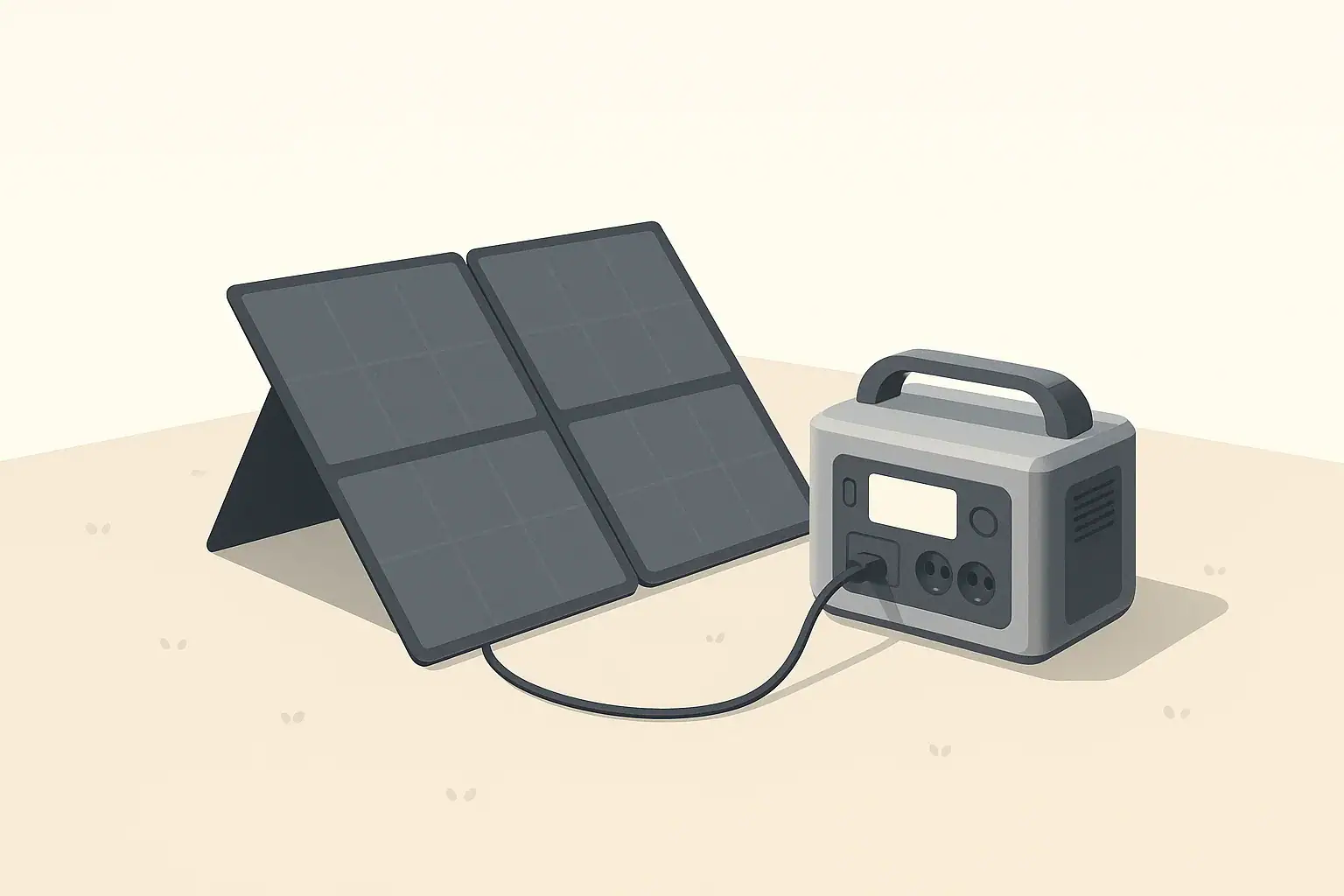
You can often connect more solar panel watts than your portable power station’s solar input rating, as long as you stay under its maximum voltage and current limits. In that case, the charge controller usually just caps charging at its rated watts and ignores the extra potential power. The risk comes when voltage or current go beyond what the input electronics and connectors are designed to handle.
This practice is called overpaneling or oversizing a solar array. It is common in rooftop solar and can also make sense with portable power stations, solar generators, and off-grid setups. Done carefully, it can improve charging speed in real-world conditions with clouds, shade, and short winter days.
This guide explains how overpaneling works, how to read solar input and panel specs, where people get into trouble, and how to stay within safe limits. You will see practical examples, simple calculations, and checklists you can use before buying or rewiring panels.
What Overpaneling Means and Why It Matters
Overpaneling means connecting solar panels whose combined rated wattage is higher than the portable power station’s published maximum solar input in watts. For example, using 450 watts of panels on an input rated for 300 watts.
Three key points define whether that is acceptable:
- Voltage (V) from the panels must stay at or below the station’s maximum input voltage.
- Current (A) must stay within the input and connector amp ratings.
- Power (W) above the limit is usually clipped by the charge controller if voltage and current are safe.
In practice, overpaneling matters because real solar output is almost always below the nameplate rating. Clouds, high temperatures, imperfect tilt, and partial shade can easily cut panel output by 30–60%. Modestly oversizing the array can help you still reach the power station’s maximum charge rate for more hours each day.
However, portable power stations have fixed internal wiring, connectors, and charge controllers. Unlike a custom-built solar system, you cannot upgrade those components. Understanding the limits is the difference between a faster-charging setup and a damaged input port.
Key Concepts: How Solar Input Limits and Overpaneling Work
Solar inputs on portable power stations are usually defined by three related ratings: maximum voltage, maximum current, and maximum solar power.
Voltage limits (V)
The voltage limit is the most critical number. It is often printed as something like “12–30 V DC” or “10–50 V max.” If the panels’ open-circuit voltage (Voc) ever exceeds this maximum, the input electronics can be permanently damaged.
- Panels in series add voltage; current stays roughly the same.
- Panels in parallel keep the same voltage; current adds.
- Cold weather can increase Voc above the label value, sometimes by 10–20%.
Because of that cold-weather bump, you should design series strings so the coldest-expected Voc stays comfortably below the input’s maximum voltage.
Current limits (A)
The current limit may be specified directly (for example, “max 10 A”) or implied by the connector type. If the array can deliver more current than the controller or connector can handle, a good MPPT controller will usually limit current internally—but the external connectors and cables may still be stressed.
- Parallel wiring adds current; high current can overheat small connectors.
- Long cable runs with thin wire increase voltage drop and heat.
- Fuses or breakers should be sized for the array’s short-circuit current (Isc).
Power limits (W)
The watt limit is what most product pages highlight: “max 100 W solar input,” “max 300 W,” and so on. Power is calculated as:
Power (W) = Voltage (V) × Current (A)
Modern MPPT charge controllers generally handle extra potential wattage by clipping the output at their rated maximum. As long as voltage and current are within safe limits, connecting somewhat more panel watts usually just means the station charges at full speed more often.
| Input spec to check | What it controls | How it affects overpaneling | Practical design tip |
|---|---|---|---|
| Max input voltage (Vmax) | Highest safe panel voltage | Hard limit; exceeding can damage electronics | Sum Voc of series panels and keep at least 10–20% below Vmax in cold climates |
| Recommended voltage range | MPPT/PWM operating window | Too low or too high reduces efficiency | Aim for total Vmp inside this range for best charging |
| Max input current (Amax) | Connector and controller current | Parallel strings can exceed this even if watts look modest | Add panel Imp values in parallel and stay under Amax with a safety margin |
| Max solar input power (Wmax) | Highest charge rate in watts | Extra watts above this are clipped | Overpaneling 20–50% above Wmax is usually enough in real-world conditions |
| Controller type (MPPT vs PWM) | How power is harvested | MPPT benefits more from modest overpaneling | For PWM, match panel voltage closely to battery; oversizing watts gives smaller gains |
| Connector rating | Safe current and voltage at plug | Can be lower than controller ratings | Use cables and adapters with equal or higher ratings than the station’s connector |
MPPT vs PWM behavior when overpaneled
MPPT controllers track the panel’s maximum power point and convert excess voltage into current. When overpaneled within V and A limits, they simply stop increasing current once Wmax is reached. This makes them well suited to modest overpaneling.
PWM controllers act more like a switch. They work best when panel voltage is close to battery voltage. Extra panel watts above the input rating often provide little benefit, because the controller cannot efficiently convert higher voltage into more current.
Real-World Overpaneling Examples and Use Cases
Numbers become much clearer with concrete scenarios. The following examples are simplified but show how to think through panel configurations against solar input limits.
Example 1: Modest overpaneling that stays within limits
Assume a portable power station with:
- Solar input: 12–40 V
- Max current: 10 A
- Max power: 300 W
You have two 200 W panels, each rated approximately:
- Voc: 22 V
- Vmp: 18 V
- Imp: 11.1 A
Two panels in series give Voc about 44 V, which already exceeds the 40 V limit in mild weather and even more in the cold. That series configuration is unsafe for this input.
Two panels in parallel keep Voc at 22 V but double Imp to about 22.2 A, far above the 10 A limit and likely above connector ratings. That is also not acceptable.
In this case, a single 200 W panel is within all limits and slightly over the watt rating would not be possible without changing panel size or using a different power station. The “overpaneling” idea is limited by both voltage and current constraints.
Example 2: Slight oversize on watts only
Now consider a station with:
- Solar input: 12–60 V
- Max current: 15 A
- Max power: 400 W
You have three 160 W panels:
- Voc: 21 V
- Vmp: 18 V
- Imp: 8.9 A
Two panels in series: Voc ≈ 42 V (safe below 60 V), Vmp ≈ 36 V, Imp ≈ 8.9 A. That string is about 320 W at STC, which is within both voltage and current limits and below Wmax.
Adding a second identical series string in parallel (four panels total) would be about 640 W of panels, Voc ≈ 42 V, Imp ≈ 17.8 A. That exceeds the 15 A limit, so it is not acceptable.
However, using three panels in a 2S+1 configuration is sometimes possible with careful design, for example:
- One string of two panels in series (about 320 W)
- One separate single panel used only when connected alone
In practice, many users in this situation choose two panels in series (320 W), which is a modest 20% oversize on a 400 W max input. Under real conditions, that pair may only produce 250–320 W, allowing the station to charge near its maximum on good days without stressing limits.
Example 3: Using overpaneling to reach daily energy targets
Suppose you want around 1.2 kWh of solar energy per day for remote work and a small fridge. You typically get about 4 hours of effective sun. Ignoring losses for a moment:
- 300 W of panels × 4 hours ≈ 1.2 kWh
- Because of clouds, angle, and heat, you might only get 60–70% of that.
To compensate, you might size the array at 400 W on an input limited to 300 W, assuming voltage and current remain in spec. On clear days, the power station will clip at 300 W, but on hazy or partly cloudy days, that extra panel capacity helps you still reach close to your daily energy goal.
| Total panel watts | Effective sun hours | Approx. daily energy (kWh) after 30% losses | Typical use case fit |
|---|---|---|---|
| 200 W | 4 h | 0.6 kWh | Phones, tablets, light laptop use, LED lights |
| 300 W | 4 h | 0.84 kWh | Single laptop plus router and small fan |
| 400 W (on 300 W input) | 4 h | 1.12 kWh | Modest overpaneling to support laptop + compact fridge |
| 500 W (on 300–400 W input) | 3–4 h | 1.05–1.4 kWh | More margin in cloudy or winter conditions |
Common Overpaneling Mistakes and Troubleshooting Cues
Most overpaneling problems come from misunderstanding one of the limits or from wiring choices. Recognizing early warning signs can prevent damage.
Typical mistakes people make
- Exceeding maximum voltage with series strings. Adding “one more panel” in series without recalculating total Voc, especially in cold climates.
- Ignoring connector current ratings. Running high-current parallel arrays through small barrel or proprietary connectors not designed for that load.
- Mixing very different panels. Combining panels with different voltages or currents, which can drag the whole array down and create unpredictable behavior.
- Using long, thin extension cables. Causing large voltage drops so the station never reaches its rated input power, even with many panels.
- Expecting STC watts in real conditions. Assuming that a 400 W array will always deliver 400 W and oversizing far beyond what is useful.
Troubleshooting: symptoms to watch for
- Station will not accept solar input. Could be reversed polarity, open-circuit voltage above the maximum, or incompatible connector wiring.
- Solar watts stuck far below expected. May indicate shading, poor angle, high cable losses, or that the controller is clipping due to hitting its watt limit.
- Connectors or cables feel hot to the touch. Suggests excessive current, undersized wire, or poor-quality connections.
- Intermittent charging or shutdowns. Can be caused by overcurrent protection, loose plugs, or thermal protection inside the power station.
| Observed issue | Likely cause | Quick checks | Practical fix |
|---|---|---|---|
| No solar charging | Voltage out of range or polarity reversed | Measure Voc at the connector; confirm positive/negative orientation | Rewire series/parallel to fit voltage window; correct polarity |
| Charging stops on cold mornings | Series Voc exceeds max input when cold | Compare measured cold Voc to input Vmax | Reduce panels in series or switch to parallel strings |
| Cables or plugs are hot | Too much current for connector or wire gauge | Check panel Imp × number of parallel strings | Use thicker cable, fewer parallel strings, or a different connector path |
| Power lower than expected | Voltage drop, shade, or controller clipping | Compare panel-side voltage to input voltage at the station | Shorten cable runs, improve panel angle, or accept clipping if at Wmax |
| Inconsistent readings | Loose or corroded connections | Inspect and gently wiggle connectors while monitoring watts | Clean contacts, replace damaged adapters, secure strain relief |
High-Level Safety Basics When Overpaneling
Overpaneling is only worth doing if it remains safe. The following principles apply whether you are using a small camping power station or a larger unit for RV or backup power.
Electrical and fire safety
- Treat maximum input voltage as an absolute ceiling. Design your array with a margin for cold-weather Voc increase.
- Respect continuous current ratings. Do not size arrays so that expected current is right at the connector’s maximum; allow headroom.
- Use appropriate wire gauge. Higher current and longer runs require thicker cable to limit voltage drop and heat buildup.
- Keep cables uncoiled under load. Coiled cable can trap heat and act like an inductor; lay it out straight when charging.
Protection and disconnects
- Use fuses or breakers sized for the array. These should be chosen based on short-circuit current (Isc) and cable ratings.
- Have a clear way to disconnect panels. A simple inline connector or switch makes it easy to safely disconnect during storms or when moving equipment.
- Keep connections weather aware. Use junctions and adapters intended for outdoor use to reduce the chance of moisture-related faults.
Battery and device protection
- Rely on the built-in battery management system. Within specified limits, it will regulate charge rate to protect the cells.
- Avoid blocking cooling vents. Overpaneling can keep the device at higher charge rates longer; ensure airflow is not obstructed.
- Monitor behavior after changes. When you change panel configuration, check the display, temperature, and connectors during the first few charge cycles.
Long-Term Use, Maintenance, and Storage With Overpaneled Systems
Once your array and wiring are set up correctly, most of the work is simple maintenance and good operating habits. Overpaneling does not usually require extra steps beyond what a well-designed solar setup needs, but it can keep the system operating near its limits more often.
Panel care and placement
- Keep panel surfaces clean. Dust, pollen, and bird droppings can significantly reduce output. Gently clean with water and a soft cloth when needed.
- Check for shading throughout the day. A small amount of shade on one panel in a series string can cut power dramatically.
- Secure portable panels against wind. Overpaneling often means more surface area; use straps or weights so gusts do not flip panels.
Cable and connector inspections
- Inspect connectors regularly. Look for discoloration, melted plastic, or loose pins—all signs of overheating.
- Check strain relief. Heavy cables should not hang directly from small connectors; support them to prevent stress and fatigue.
- Test voltage and polarity after rewiring. Any time you change series/parallel layout, verify Voc and polarity before plugging into the station.
Storage practices
- Store the power station partially charged. Many lithium-based systems prefer storage around 30–60% charge if they will sit for months.
- Keep panels and cables dry when stored. Moisture trapped in connectors can corrode contacts over time.
- Label panel strings. Simple tags indicating “String 1: 2 in series” and so on make future troubleshooting and reconfiguration easier.
Practical Takeaways and Specs to Look For
Overpaneling can be a useful tool to get more reliable solar charging from a portable power station, especially in less-than-ideal sun. The key is to oversize wattage only within the hard limits of voltage, current, and connector ratings.
Quick practical rules
- Never exceed the station’s maximum input voltage; design series wiring with a cold-weather safety margin.
- Keep total array current within both the controller’s amp rating and the connector’s rating.
- For MPPT-equipped units, consider modest overpaneling in the 20–50% range above the watt limit if allowed by the manufacturer.
- Prioritize simple, robust wiring over squeezing in every possible watt.
- Monitor new setups during the first few uses for temperature, stability, and consistent charging behavior.
Specs to look for when planning overpaneling
- On the portable power station:
- Solar input voltage range (minimum and maximum)
- Maximum solar input power in watts
- Maximum input current in amps
- Type of solar charge controller (MPPT or PWM)
- Connector type and its rated current and voltage
- On each solar panel:
- Rated power (Pmax)
- Open-circuit voltage (Voc)
- Voltage at max power (Vmp)
- Current at max power (Imp)
- Short-circuit current (Isc)
- For the overall array:
- Total Voc for each series string (including cold-weather margin)
- Total Imp for all parallel strings
- Estimated total panel watts versus the station’s Wmax
- Wire gauge and length for each cable run
- Fuse or breaker ratings relative to Isc and cable limits
If you walk through those specs before buying or rewiring panels, you can decide whether overpaneling makes sense for your setup, avoid the most common pitfalls, and get the most from your portable solar input limits.
Frequently asked questions
Which specifications and features matter most when planning to overpanel a portable power station?
Focus first on the station’s maximum input voltage, maximum input current, and maximum solar input power. Also check the controller type (MPPT vs PWM), connector ratings, and planned cable gauge and length because they determine safe current flow and voltage drop.
What common wiring mistake should I avoid when oversizing a solar array?
A frequent error is adding panels in series or parallel without recalculating total Voc or total Imp, which can push voltage or current beyond limits—especially in cold weather for Voc. Always measure or calculate combined Voc and Imp and include safety margins for temperature and cable losses.
Is overpaneling safe for my portable power station?
Overpaneling can be safe if the array stays within the station’s maximum voltage and current ratings and uses properly rated connectors and cables; the controller will usually clip excess watts. Exceeding the maximum input voltage is the primary safety risk and can permanently damage input electronics, so design with a margin for cold Voc.
How much can I reasonably oversize panel watts above the station’s watt limit?
For MPPT-equipped stations, modest oversizing of roughly 20–50% above the rated watt limit is commonly used to improve real-world charging, provided voltage and current remain within limits. The exact safe amount depends on Voc, Imp, connector ratings, and whether the controller and wiring can safely handle the increased potential.
Can mixing different panel models cause problems when overpaneling?
Yes; combining panels with different Vmp, Voc, or Imp can reduce overall output and create mismatch losses, and may produce unpredictable currents when strings are paralleled. To avoid issues, match panels electrically or use separate MPPT inputs or properly configured strings with blocking diodes where appropriate.
What are early warning signs that my overpaneled system might be unsafe?
Watch for hot connectors or cables, thermal shutdowns, no solar charging despite sun, or unusual smells or discoloration at junctions. These symptoms suggest excessive current, poor connections, or voltage out-of-range conditions and should prompt immediate inspection and corrective action.
Related guides
Browse this topic →
- Beginner-friendly sizing, runtime & specs
- Solar & charging (MPPT, fast charging, cables)
- Batteries (LiFePO4, cycles, care & storage)
- Safety, cold-weather performance, real-world tips
More in Solar
See all →- How to Clean Portable Solar Panels Without Damage
- Solar Charging on Cloudy Days: What Output Can a Portable Power Station Expect?
- How Many Portable Solar Panels Do You Need for a 1,000Wh Power Station?
- Solar Adapter Polarity Mistakes: How to Avoid Reverse-Polarity Charging Problems
- Portable Solar Panel Waterproof Ratings: What Rain, Dew, and Splash Resistance Mean
Keep reading
About this site
Portable Energy Lab publishes practical, independent guides about portable power—clear sizing, safe use, and real-world expectations.
Affiliate disclosure
Some links on this site may be affiliate links. If you buy through these links, we may earn a small commission at no extra cost to you. This helps support our content. Read our affiliate disclosure.