
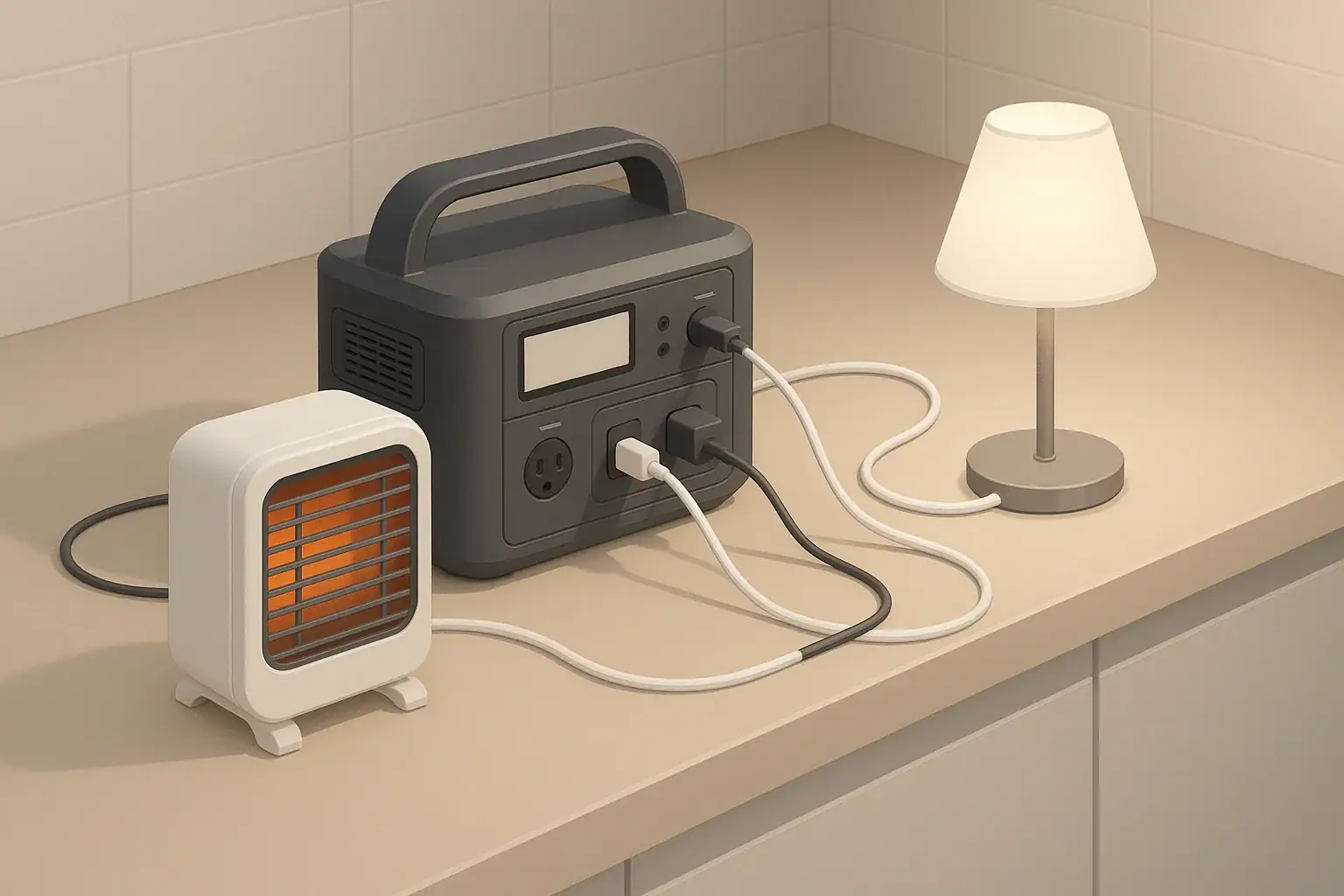
Asking whether a portable power station can run a space heater is really a question about how much power heat requires and what these battery-powered units are designed to do. Space heaters use electric resistance to create heat, and that process demands a lot of watts compared with most electronics and small appliances.
Portable power stations excel at running lower-power devices such as lights, laptops, phones, small fans, or a compact fridge for short periods. A typical plug-in space heater, by contrast, is one of the hungriest loads you can connect. Matching the heater’s needs to the power station’s limits is essential if you want to avoid instant shutdowns, tripped protection circuits, or draining the battery in minutes.
This matters for backup heat during outages, RV or vanlife planning, and winter camping. Many people assume that a large-looking battery pack can keep a room warm all night, only to discover that realistic runtimes are much shorter. Understanding the numbers helps you decide whether to rely on electric space heat at all, or whether to focus on other ways to stay warm while using your power station for essentials.
By breaking down power (watts), energy (watt-hours), and real-world efficiency losses, you can estimate how long a power station might safely run a heater on different settings. From there, you can make practical choices about when it is feasible and when it is better to reserve battery power for lighting, communications, or medical and food-related needs.
What the topic means and why it matters
To understand whether a portable power station can run a space heater, start with two core numbers on the heater’s label: watts and voltage. In the United States, most portable heaters are designed for around 120 volts AC and draw between about 500 watts on low and up to 1500 watts on high. The watt rating tells you how much power the heater needs while it is operating.
Next, look at the power station’s AC output rating in watts. This is often split into continuous (running) watts and a higher surge or peak watts number. Continuous watts is what the unit can supply steadily. Surge watts is what it can briefly provide when a device first turns on. A space heater is mostly a resistive load and usually does not need a large surge, but the continuous rating still must be higher than the heater’s setting or the power station will shut off or refuse to start the heater.
Energy capacity is measured in watt-hours (Wh). This indicates how much total energy the battery can store. A simple estimate of runtime is battery Wh divided by the heater’s watts. For example, 1000 Wh divided by 1000 watts equals 1 hour. However, this is an idealized number. In reality, AC inverter losses, battery management limits, and not discharging fully to 0% reduce usable energy. A rough planning rule is to assume maybe 80–85% of the rated watt-hours are available for high-power AC loads.
Efficiency losses increase as power draw approaches the inverter’s maximum output. Running a heater near the top of the power station’s rating not only shortens runtime but can also generate more heat inside the power station itself. This stresses the electronics and may trigger protective shutdowns sooner. For realistic estimates, use the heater’s lower settings when possible and factor in that the effective runtime will usually be shorter than the theoretical calculation suggests.
| If your heater setting is… | And your power station AC rating is… | Then the basic outcome is… |
|---|---|---|
| 1500 W (high) | < 1000 W continuous | Power station will likely shut off or refuse to start the heater. |
| 1500 W (high) | 1500–1800 W continuous | May run, but battery drains very fast and inverter runs near its limit. |
| 1000 W (medium) | 1000–1200 W continuous | Generally compatible; expect short runtimes and noticeable fan noise. |
| 750 W (low) | 800–1000 W continuous | More comfortable margin; better efficiency and lower stress on components. |
| 500 W (eco or small heater) | 500–700 W continuous | Often workable; still high draw but more manageable for mid-size units. |
| Any of the above | Output rating equal to or just under heater watts | Expect nuisance shutdowns, overload warnings, or failure to start the heater. |
| Any of the above | Significantly higher than heater watts | Power station can supply the load; runtime will depend on battery Wh. |
Real-world examples of heater runtimes on portable power
Consider a power station with about 500 watt-hours of capacity and an AC inverter rated around 500–600 watts continuous. Pair that with a small 500-watt personal heater. In theory, 500 Wh divided by 500 W gives one hour of runtime. After accounting for inverter losses and not draining the battery fully, a more realistic expectation might be 35–45 minutes of continuous heating before the battery is low.
Scale that up to a 1000 Wh power station and a heater set to 750 watts. The simple math gives around 1.3 hours. With real-world efficiency, that may translate to around 1 to 1.1 hours of continuous use. If the heater has a thermostat and cycles on and off in a well-insulated space, the actual elapsed time before the battery is drained could be longer, but the heater will not be on the whole time.
At the high end, consider a 1500-watt space heater on its maximum setting. To run that heater for two full hours, you would need over 3000 Wh of usable energy, which generally means an even larger rated capacity once you factor in efficiency losses and reserve. Many consumer-grade portable power stations do not offer that combination of very high AC output and large battery capacity, and those that do are heavy and slower to recharge.
These examples illustrate why portable power is rarely the best primary heat source. A modest power station might operate a heater for only part of an evening, while the same battery could instead run LED lights, charge phones, power a router, and keep a laptop running for many hours. For many users, the most practical approach is to use the heater briefly for targeted warmth and rely on non-electric insulation and clothing for staying comfortable.
Common mistakes and troubleshooting cues
One frequent mistake is ignoring the heater’s watt rating and assuming that if the plug fits, the power station can handle it. If the heater’s draw exceeds the inverter’s continuous watt rating, you may see instant overload warnings, the AC output shutting off, or the heater never starting. In some cases, the power station will beep or flash an overload indicator to signal that the load is too high.
Another issue is misreading runtime estimates. Many people divide the power station’s watt-hours by the heater’s watts and treat the result as guaranteed. In reality, losses in the inverter and internal wiring, plus safety margins in the battery management system, can reduce usable energy significantly. If you see the battery percentage dropping faster than expected, that is usually not a sign of damage; it simply means the heater is drawing a lot of power and the theoretical math was optimistic.
Charging behavior can also be confusing. Running a high-wattage heater while charging the power station, often called pass-through use, may cause the state of charge to rise very slowly or even fall if the heater’s draw is close to or above the input charging power. Users sometimes think the unit is “not charging” when, in fact, the heater is consuming power faster than it can be replenished.
Finally, some power stations enforce temperature limits to protect the battery. If you run a heater in a warm room or place the power station too close to the heater’s hot air stream, internal temperatures may climb. The unit may respond by reducing output, speeding up internal fans, or shutting down until it cools. If your heater suddenly turns off and the power station feels warm or shows a temperature warning, overheating is a likely cause.
Safety basics when using a heater with a power station
Space heaters carry inherent fire risk, whether powered from a wall outlet or a portable power station. Always place the heater on a stable, flat, non-flammable surface with clear space around it. Keep it away from bedding, curtains, furniture, and any materials that could ignite or melt. Do not leave a heater running unattended or while sleeping, especially when it is fed from a battery that can quietly discharge over time.
Ventilation and placement of the power station itself are also important. The unit contains internal electronics and cooling fans that need airflow. Do not cover it with blankets or clothing, and do not place it directly in the heater’s hot airflow. Keep it on a dry, level surface where cords cannot create a tripping hazard. For indoor use, position the power station where it is unlikely to be knocked over or exposed to spilled liquids.
Use appropriate cords and connections. Plug the heater directly into the power station’s AC outlet whenever possible rather than daisy-chaining multiple power strips. If you must use an extension cord, select one rated for the heater’s wattage and intended for indoor use. Inspect cords for damage and avoid running them under rugs or through doorways where they can overheat or be pinched.
Some heaters designed for use in bathrooms or damp areas include ground-fault protection. Portable power stations may or may not offer similar protection on their AC outlets. As a general rule, avoid operating space heaters in wet or highly humid environments when powered from a portable unit. If you have questions about safe use around water or special circuits like GFCI outlets, consult product documentation or a qualified electrician for guidance.
Maintenance and storage for reliable cold-weather use
Because heating is often needed during cold weather, the condition and storage of your power station directly affect how well it can support a space heater. Lithium-based batteries perform best within moderate temperature ranges. Extreme cold can temporarily reduce available capacity and discharge rates, while high heat accelerates aging. Try to store and operate the power station within the temperature limits in its manual, and avoid leaving it in freezing vehicles or hot attics for long periods.
State of charge during storage also matters. Keeping a power station at 0% or 100% for months can stress the battery. A common practice is to store it around 40–60% charge if you will not use it for a while, then top it up before storm season or planned trips. Many units slowly self-discharge over time, even when turned off, due to internal monitoring circuits.
To stay ready for occasional heater use, check the charge every one to three months and recharge as needed. This helps ensure that when you do need backup power, the battery is not unexpectedly empty. Periodically running the AC output with a smaller load, such as a lamp or fan, can also help you confirm that the inverter and outlets are working correctly before you rely on them for a high-demand heater.
Routine visual inspections are simple but useful. Look for damaged cords, cracked housings, or signs of swelling or deformation. If the power station has cooling vents, keep them free of dust and debris. Do not open the unit or attempt internal repairs; if something seems wrong beyond basic cleaning or charging, contact the manufacturer or a professional service provider rather than bypassing safety features.
| Item | Suggested practice | Why it matters for heater use |
|---|---|---|
| Long-term state of charge | Store around 40–60% if unused for several months. | Helps preserve battery health for high-draw loads like heaters. |
| Top-up schedule | Check and recharge every 1–3 months. | Reduces risk of finding an empty battery during a winter outage. |
| Storage temperature | Keep in a cool, dry indoor space. | Extreme heat or cold can reduce capacity or shorten life. |
| Pre-season test | Run a small AC load for 10–20 minutes. | Confirms inverter outputs work before relying on the unit for heat. |
| Visual inspection | Look for cracks, swelling, or damaged ports. | Catches physical issues that could worsen under heavy current. |
| Vent cleaning | Gently remove dust from cooling vents. | Improves airflow to handle the stress of high-wattage loads. |
| Usage log | Note roughly how often deep discharges occur. | Frequent full drains can shorten lifespan, impacting heater capability. |
Practical takeaways and planning checklist
Portable power stations can run space heaters, but usually only for short periods and under specific conditions. The heater’s watt rating must be comfortably below the inverter’s continuous AC rating, and the battery’s watt-hour capacity must be large enough to provide meaningful runtime. Even then, high current draw, inverter losses, and temperature limits all work together to shorten real-world heating time.
For many users, the most practical strategy is to treat electric space heating as a supplemental or emergency-only use of battery power, not the primary way to keep a room warm. Prioritize running essentials such as lights, communications, and small appliances, and rely on insulation, clothing, and non-electric heat sources that are safe and appropriate for indoor use according to their own instructions. Use lower heater settings, direct heat toward people instead of entire rooms, and monitor battery status closely.
When planning for outages, camping, or RV use, think in terms of realistic runtimes and recharge opportunities rather than all-night heating. Match your expectations to the numbers, and you can use your portable power station more effectively without overloading it or draining it unexpectedly fast.
- Confirm the heater’s wattage and choose a setting safely below the inverter’s continuous rating.
- Estimate runtime using battery Wh, then reduce that estimate to account for efficiency losses.
- Avoid leaving heaters unattended or running while asleep, especially on battery power.
- Keep both the heater and power station on stable, clear surfaces with good airflow.
- Store the power station partly charged, indoors, and check it periodically before winter.
- Reserve battery capacity for critical loads if your energy supply or recharging options are limited.
By approaching space heater use with these limits in mind, you can decide when it is worth drawing heavily on your portable power station and when other heating strategies are a better fit.
Frequently asked questions
Can a typical portable power station run a 1500 W space heater?
Most consumer portable power stations cannot run a 1500 W heater reliably unless the inverter is rated for at least 1500 W continuous and the battery capacity is several kilowatt-hours. Even when the inverter rating is sufficient, the battery will usually drain very quickly, so this setup is generally impractical for extended heating.
How long will a 1000 Wh power station run a 750 W heater?
The theoretical runtime is about 1.33 hours (1000 Wh ÷ 750 W), but real-world runtime is shorter due to inverter losses and reserve limits; expect roughly 1 to 1.1 hours of continuous operation. If the heater cycles with a thermostat in a well-insulated space, the elapsed time before the battery is depleted can be longer because the heater is not on continuously.
Is it safe to run a space heater from a portable power station overnight?
Running a heater overnight on battery power is not recommended because of fire risk, unattended operation, and rapid battery depletion. If you must use a heater, keep it short-term, monitored, placed on a non-flammable surface, and positioned so the power station stays cool and well-ventilated.
Can I charge a power station while running a heater (pass-through use)?
Some units support pass-through charging, but whether the station’s input power can keep up with a heater’s draw depends on the relative wattages. If the heater uses more power than the charger supplies, the battery state of charge will still fall or only creep up slowly; check the manufacturer’s guidance and avoid assuming the unit will maintain charge under heavy load.
What practical steps maximize heater runtime from a limited battery?
Use the heater on lower settings, direct heat toward people rather than whole rooms, improve insulation and close doors, and let the heater cycle with a thermostat instead of running continuously. Also prioritize other loads, avoid running the inverter at its maximum rating, and arrange for recharge options (solar, generator, or shore power) if extended heat is required.
Recommended next:
Related guides
Browse this topic →
- Beginner-friendly sizing, runtime & specs
- Solar & charging (MPPT, fast charging, cables)
- Batteries (LiFePO4, cycles, care & storage)
- Safety, cold-weather performance, real-world tips
More in Home / Appliances
See all →- Portable Power Station for a Garage Door Opener and Gate: What Actually Matters
- Backup Power for Security Cameras and Wi-Fi: Sizing a 24/7 Setup
- Running a Pellet Stove During a Power Outage: Starting Surge, Runtime, and Safe Setup
- What Size Portable Power Station for a Chest Freezer? Runtime Planning for Outages
- Portable Power Station for Starlink: Power Draw, Runtime, and What Specs Matter
Keep reading
About this site
Portable Energy Lab publishes practical, independent guides about portable power—clear sizing, safe use, and real-world expectations.
Affiliate disclosure
Some links on this site may be affiliate links. If you buy through these links, we may earn a small commission at no extra cost to you. This helps support our content. Learn more.