
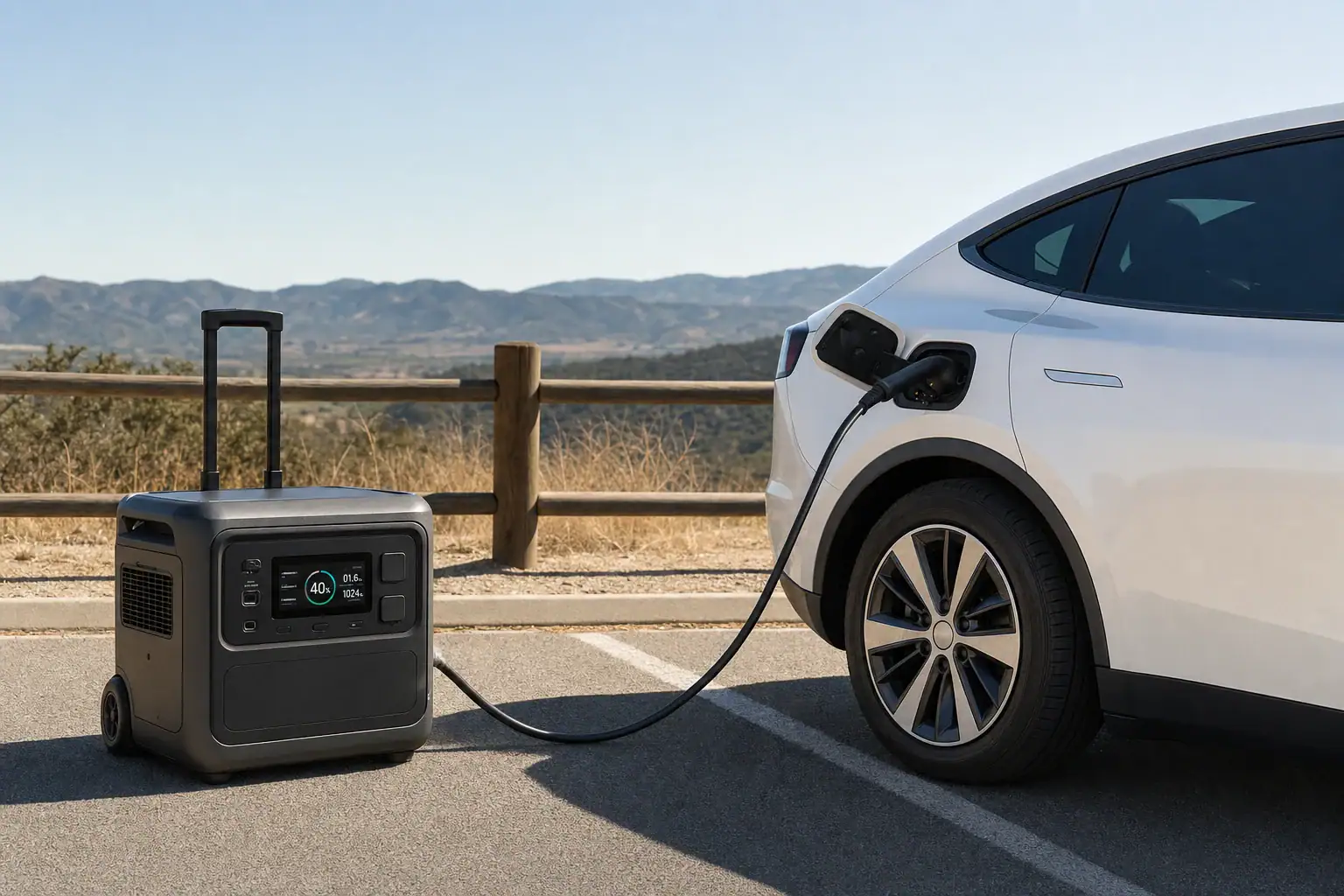
Yes, a portable power station can charge some electric cars, but the result is usually a few miles of emergency range rather than a full battery. Success depends on the station’s battery capacity, continuous inverter wattage, AC output, the vehicle’s Level 1 charging requirements, and electrical grounding compatibility.
A typical portable setup sends AC power through the car’s portable charging cable, also called an EV charging cord or EVSE. Energy is lost in the power station inverter, cable, onboard charger, and vehicle systems, so the advertised watt-hours do not all reach the traction battery. A large unit may provide enough runtime to reach a nearby outlet or charging location, while a small unit may fail to start charging at all.
The practical questions are whether the charging equipment will accept the power source, whether the station can sustain the required load, and how much usable range remains after charging efficiency losses.
1. What Charging an Electric Car From a Portable Power Station Means
A portable power station stores direct-current energy in an internal battery and uses an inverter to supply household-style alternating current. To charge an electric car, the vehicle’s portable Level 1 EVSE is normally plugged into that AC outlet. The EVSE communicates with the car and authorizes its onboard charger to draw power.
This arrangement is different from directly connecting an external battery to the vehicle’s high-voltage traction pack. A consumer power station generally cannot provide DC fast charging, and it should never be connected directly to an electric vehicle battery. The vehicle’s normal charge port and compatible charging equipment must remain in the power path.
The distinction matters because power stations are limited by both energy and power. Energy capacity, measured in watt-hours or kilowatt-hours, determines how long charging can continue. Inverter power, measured in watts, determines whether the station can operate the charging load in the first place. A unit can have substantial battery capacity but still be unable to supply the continuous wattage requested by the car.
Portable charging is therefore best viewed as a limited backup option. It may add enough range to move the car to a conventional charger, but it is generally less practical than roadside charging assistance, towing, or charging from a properly installed circuit.
2. How Power, Capacity, and Charging Losses Determine Range
Continuous power must support the charging load
Basic 120-volt Level 1 charging often draws about 8 to 12 amps, depending on the vehicle and charging equipment. At 120 volts, that represents approximately 960 to 1,440 watts. The power station should have a continuous AC rating above the actual draw, not merely a short-duration surge rating. A charging session can last for hours, making continuous thermal performance more important than momentary surge capacity.
Some vehicles let the driver select a lower charging current. Reducing the current may allow charging from a lower-powered station, although it also increases charging time and the proportion of energy consumed by vehicle electronics. Current should only be changed through normal vehicle or charging-equipment controls.
Usable energy is lower than advertised capacity
A station rated at 2,000 watt-hours does not normally deliver the full 2,000 watt-hours through its AC outlets. Battery reserve settings, inverter conversion, heat, and low-voltage shutdown reduce usable AC energy. The vehicle’s onboard charger and battery conditioning systems create further losses.
A reasonable planning estimate is that roughly 70% to 80% of the station’s advertised capacity may ultimately reach the vehicle battery under favorable conditions. Cold temperatures, battery heating, cabin systems, low charging power, or an inefficient inverter can reduce that percentage.
Estimating miles gained
Multiply the power station’s rated kilowatt-hours by the expected net efficiency, then divide by the vehicle’s energy use in kilowatt-hours per mile. For example, a 2-kilowatt-hour station at 75% net efficiency could add about 1.5 kilowatt-hours to the car. If the vehicle consumes 0.28 kilowatt-hours per mile, the theoretical gain is approximately 5.4 miles.
| Rated station capacity | Energy reaching car at 75% | Range at 250 Wh per mile | Range at 330 Wh per mile |
|---|---|---|---|
| 1 kWh | 0.75 kWh | 3.0 miles | 2.3 miles |
| 2 kWh | 1.50 kWh | 6.0 miles | 4.5 miles |
| 3 kWh | 2.25 kWh | 9.0 miles | 6.8 miles |
| 5 kWh | 3.75 kWh | 15.0 miles | 11.4 miles |
3. Real-World Electric Car Charging Examples
Small power station with a standard charging cord
Consider a 1-kilowatt-hour station with a 1,000-watt continuous inverter. If the car’s charging cord requests 1,440 watts, the inverter will probably overload and shut off. Even if the car can be set to an 8-amp draw of about 960 watts, the load leaves almost no operating margin. Heat, voltage drop, or brief fluctuations could still trigger shutdown.
If charging does operate, the station may run for less than an hour and add approximately two to three miles under favorable conditions. Vehicle battery heating or other overhead could make the gain smaller.
Medium station with reduced-current charging
A 2-kilowatt-hour station with an inverter comfortably above the charging load is more workable. At a 960-watt draw, it might operate for roughly 1.5 to 1.8 hours after accounting for inverter losses and reserve capacity. The vehicle could gain around four to six miles, depending on efficiency and driving conditions.
This can be meaningful when a public charger or safe parking location is nearby. It is less useful when the nearest charging option is many miles away or requires highway driving, where energy consumption is often higher.
Large expandable system
A system with 4 to 5 kilowatt-hours of storage could potentially add about 9 to 16 miles. However, systems of this size are heavy, expensive, and time-consuming to recharge. Carrying one routinely may also reduce vehicle efficiency because of the added weight and cargo space used.
Displayed range should not be treated as guaranteed distance. Speed, hills, wind, temperature, tire pressure, climate control, and traffic affect how far the added energy will take the car. Retaining a safety margin is more prudent than planning to arrive with the battery at zero.
4. Common Reasons Charging Fails and What the Symptoms Mean
The power station shuts off immediately
An immediate shutdown often indicates inverter overload, a protective fault, or an unsupported grounding arrangement. Compare the charging load with the station’s continuous AC output rather than its peak or surge figure. Also confirm that other AC devices are not sharing the inverter capacity.
The EVSE shows a fault light
Electric vehicle charging equipment performs safety checks before allowing current to flow. Some portable power stations use a floating-neutral AC design that may not satisfy the EVSE’s grounding test. The EVSE may display a fault even though the station operates ordinary appliances normally.
Do not defeat the ground check or use improvised bonding devices. Compatibility should be confirmed through the instructions for the power station, vehicle, and EVSE. If the grounding requirements are unclear, consult the equipment manufacturers or a qualified electrician.
Charging starts and then stops
Intermittent shutdowns can result from overheating, depleted capacity, voltage instability, an overly high current setting, or automatic power-saving behavior. Check the station’s display for overload, temperature, low-battery, or output warnings. Place the unit where its vents remain unobstructed and where the operating temperature stays within its specified range.
The vehicle gains less range than expected
Low apparent gains are often caused by conversion losses or energy used for battery temperature control. The car may also round its displayed state of charge or recalculate projected range based on recent driving. Compare energy added in kilowatt-hours when that information is available rather than relying only on the estimated-mile display.
The outlet or plug becomes warm
A slightly warm plug can occur under a sustained load, but increasing heat, discoloration, odor, crackling, or a loose connection indicates a problem. Stop charging and have damaged or questionable equipment inspected. Extension cords add resistance and should be avoided unless the charging-equipment instructions explicitly permit a properly rated cord.
5. Safety Basics for Portable EV Charging
Use only intact, listed charging equipment that is compatible with the vehicle. The portable power station must remain dry, stable, and adequately ventilated. Keep connectors out of standing water and protect the equipment from rain, snow, direct spray, traffic, and trip hazards. Weather resistance does not make an open AC connection safe to submerge or expose carelessly.
Inspect the AC outlet, EVSE plug, cable, and vehicle connector before use. Stop if there are bent contacts, damaged insulation, loose connections, unusual heat, smoke, odor, repeated fault messages, or visible battery swelling. Do not open the power station, modify its battery, bypass protection circuits, or attempt to connect it directly to the vehicle’s high-voltage system.
Charging is a sustained high-power load. Avoid covering the station or placing it in a sealed compartment where heat can accumulate. Follow the operating-temperature limits for both the power station and the vehicle. Very cold conditions may cause the car to spend much of the supplied energy warming its battery, while high temperatures can cause either device to reduce power or stop.
Portable power stations must not be connected to building wiring through improvised cords or unapproved inlet arrangements. Any connection involving a home electrical panel, transfer equipment, or permanent EV charging circuit should be designed and installed by a qualified electrician under applicable electrical requirements.
6. Storage and Maintenance for an Emergency Charging Setup
A backup power station is only useful if it is charged and functioning when needed. Check its state of charge periodically and recharge it according to its battery chemistry and manufacturer guidance. For long-term storage, many units favor a partial charge rather than remaining at 0% or 100% for months, but the specified storage level takes priority.
Store the station in a dry, temperature-controlled location away from direct sunlight and combustible clutter. Extreme heat accelerates battery aging, while deep cold can temporarily reduce capacity and charging performance. Avoid leaving a large battery system in a hot parked vehicle for extended periods.
Periodically inspect the EVSE, adapters supplied for normal use, and power cables. A short functional test with a safe, supported load can reveal a depleted battery or failed outlet before an emergency. If testing with the car, monitor the first part of the session for faults and verify that the expected charging wattage remains below the continuous inverter rating.
Battery aging gradually reduces usable capacity. Cycle count, calendar age, high temperatures, and frequent deep discharge all influence that decline. Range calculations made when the station was new may therefore become optimistic after years of use.
| Maintenance item | Practical interval | Reason |
|---|---|---|
| Check state of charge | Every 1 to 3 months | Limits unexpected self-discharge |
| Inspect outlets and cables | Before each use | Identifies heat, wear, or physical damage |
| Run a functional test | Every 3 to 6 months | Confirms AC output and battery operation |
| Review stored capacity | Annually | Accounts for battery aging in range estimates |
Related guides: Portable Power Station Buying Guide • Extension Cords and Power Strips: Safe Practices With Portable Power Stations • Long-Term Storage Best Practices: Charge Level, Temperature, and Schedule • How Does a Portable Power Station Work?
7. Practical Takeaways and Specs to Look For
A portable power station can charge an electric car when its AC output, grounding design, and available energy are compatible with the vehicle’s charging equipment. The practical gain is commonly only a few miles per kilowatt-hour of rated station capacity. For planning, assume that approximately 70% to 80% of rated energy may reach the traction battery, then allow an additional driving reserve.
This approach is most reasonable for slow emergency charging in a safe location. It is not a substitute for routine home charging or public charging, and it may not work with every EVSE. Before relying on it, verify compatibility under controlled conditions and learn what the station’s fault indicators mean.
Specs to look for
- Rated battery capacity: Look for capacity stated in watt-hours or kilowatt-hours, such as 2,000 to 5,000 Wh; higher capacity provides more potential miles before losses.
- Usable AC capacity: Look for documented AC discharge efficiency or usable-energy information around 80% to 90%; this supports a more realistic range estimate.
- Continuous AC output: Look for at least 1,500 to 2,000 watts when supporting a typical 120-volt charging load; adequate margin helps prevent overload shutdowns.
- Output voltage and frequency: Look for stable 120-volt, 60-hertz output for charging equipment designed for North American household power; incorrect output may cause faults or prevent charging.
- Pure sine wave inverter: Look for clearly specified pure sine wave AC; clean output is generally better suited to sensitive charging electronics.
- Grounding configuration: Look for explicit information about EVSE compatibility, neutral-ground behavior, and protective grounding; this matters because charging equipment performs electrical safety checks.
- Adjustable vehicle charging current: Look for normal vehicle or EVSE settings such as 8, 10, or 12 amps; a lower supported current can reduce the load on the inverter.
- Thermal and overload protection: Look for temperature monitoring, overload shutdown, short-circuit protection, and visible fault messages; EV charging places a long-duration load on the station.
- Weight and recharge time: Compare systems that may weigh tens to more than 100 pounds and require several hours to recharge; portability and recovery time affect emergency usefulness.
Use calculated range only as a planning estimate. Weather, vehicle efficiency, battery temperature, terrain, and the condition of the power station can materially change the final result.
Frequently asked questions
Can a portable power station charge an electric car in an emergency?
Yes, if the station’s AC output and grounding arrangement are compatible with the vehicle’s portable charging equipment. In most cases, it provides only limited emergency range, often a few miles rather than a substantial recharge. It is most useful for reaching a nearby charging location or safer stopping point.
How many miles can a portable power station add to an EV?
The answer depends on the station’s usable energy, charging losses, and the vehicle’s energy consumption. As a rough estimate, a 1 kWh station may provide roughly 2 to 3 miles for a less-efficient vehicle or about 3 to 4 miles for an efficient vehicle under favorable conditions. Cold weather, hills, high speeds, and battery conditioning can reduce the usable range.
What specs matter most when choosing a portable power station for EV charging?
Key specifications include battery capacity in watt-hours or kilowatt-hours, continuous AC inverter output, stable output voltage and frequency, and documented compatibility with EV charging equipment. A pure sine wave inverter, thermal protection, and enough continuous wattage margin are also important. Verify grounding or neutral configuration compatibility before depending on the setup.
Can an EV charge from a 1,000-watt portable power station?
It may work only if the vehicle or EVSE can be set to a sufficiently low charging current, such as about 8 amps at 120 volts. That load is approximately 960 watts, which leaves very little margin on a 1,000-watt inverter. Some stations may still shut down because of heat, voltage drop, or protective limits.
Is it safe to use an extension cord to charge an EV from a power station?
Using an extension cord is a common mistake because it can add resistance, heat, and connection points during a sustained high-power load. Avoid one unless the EVSE instructions specifically allow it and the cord is properly rated for the application. Never use damaged, undersized, coiled, or loosely connected cords.
Is charging an electric car from a portable power station safe?
It can be safe when compatible, listed equipment is used according to the manufacturer instructions in a dry, ventilated location. Do not bypass grounding checks, modify connectors, connect the station directly to the vehicle battery, or use damaged equipment. Stop the session if plugs become increasingly hot or if either device reports a fault.
Related guides
Browse this topic →

- Beginner-friendly sizing, runtime & specs
- Solar & charging (MPPT, fast charging, cables)
- Batteries (LiFePO4, cycles, care & storage)
- Safety, cold-weather performance, real-world tips
More in FAQ
See all →Keep reading

About this site
Portable Energy Lab publishes practical, independent guides about portable power—clear sizing, safe use, and real-world expectations.
Affiliate disclosure
Some links on this site may be affiliate links. If you buy through these links, we may earn a small commission at no extra cost to you. This helps support our content. Read our affiliate disclosure.