
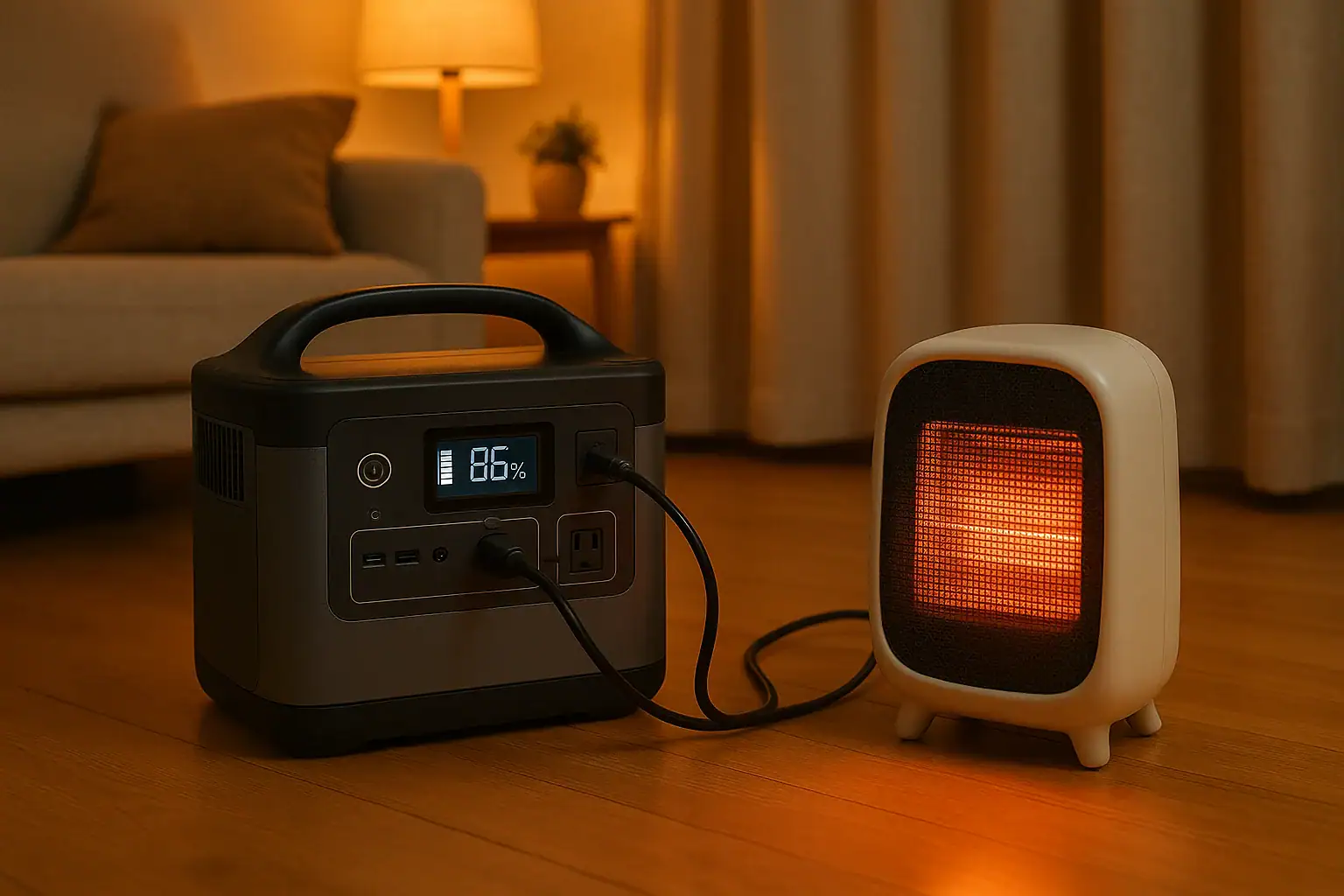
Yes, a portable power station can run a space heater, but usually only for a short time. The limiting factors are the heater wattage, the power station battery capacity, the AC output rating, the inverter efficiency, and the expected runtime.
Space heaters are high-wattage resistive loads, which means nearly all of the electricity becomes heat. That works well for warming a small area, but it drains batteries much faster than phones, lights, fans, routers, or even many refrigerators. A typical 1,500-watt heater can empty a mid-size portable power station in well under an hour.
The key is not whether a battery generator can technically turn the heater on. The better question is whether the power station can handle the continuous watts safely and whether the remaining runtime is useful for your situation.
What It Means to Run a Space Heater From a Portable Power Station
Running a space heater from a portable power station means using the unit’s battery, inverter, and AC outlet to supply household-style power to an electric heater. Most plug-in space heaters use standard AC power and have heat settings such as low, medium, high, eco, or thermostat-controlled cycling.
The reason this matters is simple: heat is one of the most demanding things you can ask a battery to make. A laptop charger might draw 45 to 100 watts. An LED lamp might draw 5 to 15 watts. A compact fan might draw 20 to 60 watts. A space heater commonly draws 750 to 1,500 watts whenever the heating element is on.
Portable power stations are best understood as stored electricity, not as a fuel source. A large battery may look capable because it has multiple outlets and a high advertised capacity, but heating quickly reveals the practical limits. Even when the inverter can supply the load, the battery energy is consumed rapidly.
This is why a portable power station is usually better for emergency essentials than for whole-room heating. It can help power communications, lighting, medical devices within their rated limits, fans, small appliances, and short bursts of heating. It is rarely an efficient way to provide hours of electric warmth unless the power station is very large and the heater is run at a low setting.
How Space Heater Loads Drain Batteries So Quickly
A space heater is a resistive load. That means it uses electrical resistance to produce heat, and its power draw is relatively steady while the heating element is active. Unlike a refrigerator or power tool, a basic space heater usually does not have a large startup surge, but it can demand a high continuous wattage for a long time.
Battery capacity is usually listed in watt-hours, abbreviated Wh. A 1,000Wh power station theoretically stores enough energy to supply 1,000 watts for one hour. In real use, the actual AC runtime is lower because the inverter efficiency consumes some energy while converting battery power to AC power. Losses vary, but planning around 80% to 90% usable energy for AC loads is more realistic than assuming perfect conversion.
The basic runtime estimate is usable watt-hours divided by heater watts. For example, if a power station has 1,000Wh of capacity and you estimate 85% usable AC energy, you have about 850Wh available. A 1,500-watt heater would run for about 0.57 hours, or roughly 34 minutes, if it stayed on continuously.
Thermostats and eco modes can improve runtime if the heater cycles on and off. However, in a cold room, garage, drafty cabin, or outage situation, the heater may run almost continuously. The colder the space and the poorer the insulation, the less benefit you get from cycling.
| Heater setting | Typical draw | Approximate runtime from 500Wh usable | Approximate runtime from 1,000Wh usable |
|---|---|---|---|
| Low personal heater | 250 watts | About 2 hours | About 4 hours |
| Low heat setting | 500 watts | About 1 hour | About 2 hours |
| Medium heat setting | 750 watts | About 40 minutes | About 1 hour 20 minutes |
| High heat setting | 1,500 watts | About 20 minutes | About 40 minutes |
Real-World Runtime Examples for Home Heating
Consider a small 300-watt personal heater used under a desk. If it is paired with a power station that can deliver the continuous AC wattage and has around 700Wh of usable AC energy, runtime might be a little over two hours if the heater stays on. That can be useful for warming hands and feet in a small occupied area, but it will not heat an entire room for long.
Now compare that with a common 750-watt heater setting. With the same 700Wh usable energy estimate, runtime drops to less than one hour. If the heater cycles at 50% duty because the room is already fairly warm, practical runtime may stretch longer. If the room is cold and the heater stays on continuously, it will drain the battery quickly.
A 1,500-watt space heater is the toughest common scenario. Many portable power stations cannot supply 1,500 watts continuously, and those that can may still run it only briefly. A 2,000Wh station with about 1,700Wh usable through AC might power a 1,500-watt heater for a little over an hour in continuous use.
These examples also assume the heater is the only load. If you add a refrigerator, internet equipment, lights, chargers, or a medical device, total power draw increases and runtime falls. Portable power planning should use total watts, not just the wattage of the heater.
Room conditions also matter. A heater in a small insulated bedroom may cycle more often than the same heater in a garage or open living space. Closing doors, reducing drafts, using warm clothing, and heating only the occupied zone can make a major difference in how often the heating element runs.
Common Mistakes and Troubleshooting Cues
The most common mistake is looking only at battery capacity and ignoring the inverter output rating. A power station with a large watt-hour number still cannot run a heater if its AC inverter is rated below the heater’s continuous watt draw. For example, a 1,500-watt heater should not be treated as compatible with a 600-watt AC outlet simply because the battery capacity is high.
Another mistake is assuming an advertised peak or surge watt rating is the same as continuous output. Surge watts describe short bursts for loads that need extra startup power. A space heater needs sustained power. The continuous AC output rating is the number that matters most.
If the power station shuts off immediately, beeps, flashes an overload warning, or disables the AC outlet, the heater likely exceeds the inverter rating. If it runs for a short period and then stops, the battery may be depleted, the unit may be too hot, or the heater may be cycling in a way that triggers the power station’s protections.
If runtime is much shorter than expected, check the heater setting first. Many units marked as energy-saving can still draw 1,500 watts on high. A thermostat dial does not always reduce wattage; it may simply turn the full heating element on and off. A power meter can help identify actual draw, but the heater label is the starting point.
Also consider ambient temperature. Batteries generally perform less efficiently in cold conditions, and a power station stored in a cold garage may deliver less useful energy than expected. Bringing the unit to a safe room-temperature environment before use can help, as long as the manufacturer’s temperature guidance is followed.
Safety Basics for Using a Space Heater on Battery Power
Only use a space heater if the portable power station’s AC output is rated for the heater’s continuous wattage. Do not rely on extension cords, outlet splitters, or adapters to make an undersized power station work. If the unit overloads, treat that as a safety signal, not an inconvenience to bypass.
Place the heater on a stable, level, nonflammable surface with open space around it. Keep bedding, curtains, paper, furniture, clothing, and rugs away from the hot surfaces and air outlet. A battery-powered heater setup should still follow the same basic fire precautions as wall-outlet use.
Use the heater in an occupied area where it can be monitored. Do not leave portable heaters running unattended or while sleeping unless the heater is specifically designed and rated for that use and all safety guidance is followed. Tip-over protection and overheat shutoff are important features, but they are not substitutes for supervision.
Do not open the power station, modify battery packs, bypass fuses, defeat overload protection, or attempt makeshift wiring. If you need to power household circuits during an outage, consult a qualified electrician. Portable power stations should not be connected to home electrical panels except through properly designed and installed equipment appropriate for that purpose.
Ventilation is also worth understanding. Electric space heaters do not produce combustion exhaust, but they still create fire risk and can overheat if airflow is blocked. Keep the power station itself well ventilated too, because the inverter can generate heat while supplying a heavy AC load.
Maintenance and Storage Considerations for Heat Loads
Heavy heater loads create more stress than light electronics because they pull high current from the battery and inverter. Occasional short use within the power station’s rating is generally different from repeated deep discharges at maximum output. For long-term battery health, avoid treating a portable power station as a primary space-heating system.
Store the unit in a dry, moderate-temperature location. Extreme heat can accelerate battery aging, while cold storage can reduce available output until the battery warms to an acceptable operating range. If the power station has been sitting unused for months, check its state of charge before winter storms or outage season.
Keep vents clean and unobstructed. A heater load can cause cooling fans inside the power station to run frequently. Dust buildup, blocked vents, or placing the unit against fabric can make heat management harder. The power station should have open airflow and should not be placed directly in the hot air stream from the heater.
Recharge planning matters as well. If you drain a battery with a heater, recovery time depends on the charging input limit and available power source. Some units recharge quickly from an AC wall outlet, while solar recharging may take much longer in winter due to shorter days, low sun angle, clouds, and panel placement.
For emergency preparedness, test realistic loads before you need them. A brief test with the heater at the intended setting can show whether the power station overloads and how fast the battery percentage drops. Use that information to decide whether the heater should be reserved for short warming sessions rather than continuous heating.
| Care factor | What to watch | Why it matters |
|---|---|---|
| State of charge | Store with a practical reserve and recharge periodically | Helps ensure usable energy is available during outages |
| Temperature | Avoid extreme heat or cold during storage and use | Supports battery performance and long-term health |
| Ventilation | Keep power station vents clear during heater use | Heavy AC loads generate inverter heat |
| Load testing | Test the exact heater setting before relying on it | Reveals overloads and realistic runtime |
Practical Takeaways and Specs That Matter
Related guides:
Portable Power Station Watt-Hours Explained •
Inverter Efficiency Explained: Why Your Runtime Is Shorter Than Expected •
Surge Watts vs Running Watts: How to Size a Portable Power Station
A portable power station can operate a space heater, but heat is one of the least battery-friendly uses. Match the heater watts to the continuous AC output, estimate runtime with usable watt-hours, and reserve battery heating for short, targeted use when other heating options are unavailable or impractical.
If your goal is outage comfort, think in layers. Use the power station for essentials first, reduce heat loss, warm only the occupied area, and choose the lowest heater setting that is actually useful. A smaller personal heater may provide more practical comfort per watt than a full-size 1,500-watt unit, especially when battery capacity is limited.
Specs to look for
- Continuous AC output: Look for a rating above the heater’s steady draw, such as 800 watts for a 750-watt setting or 1,800 to 2,000 watts for a 1,500-watt heater, because this determines whether the inverter can safely carry the load.
- Battery capacity in watt-hours: Look for higher capacity if heat is a priority, such as 1,000Wh to 2,000Wh or more, because heater runtime is directly tied to stored energy.
- Usable AC energy: Estimate about 80% to 90% of listed capacity for AC loads, because inverter losses reduce the energy available to the heater.
- Low-watt heater compatibility: Look for support for 250-watt, 400-watt, 500-watt, or 750-watt heater settings, because lower draw can stretch runtime much more than high heat.
- Surge or peak rating: Treat this as secondary for space heaters, but look for a reasonable margin above continuous output because it helps with mixed loads and brief power fluctuations.
- AC recharge rate: Look for a recharge input that can refill the battery in a useful timeframe, such as several hundred watts to over 1,000 watts, because heavy heat use can empty the battery quickly.
- Solar input limit: Look for enough solar input for your climate and panels, such as 400 watts to 1,200 watts on larger systems, because winter solar recovery can be slow.
- Operating temperature range: Look for clear cold and heat operating guidance, because battery performance and charging may be limited in freezing or very hot conditions.
- Safety protections: Look for overload, over-temperature, short-circuit, and low-voltage protection, because high-wattage AC loads put more demand on the system.
The bottom line: a portable power station can operate a space heater, but heat is one of the least battery-friendly uses. Match the heater watts to the continuous AC output, estimate runtime with usable watt-hours, and reserve battery heating for short, targeted use when other heating options are unavailable or impractical.
Frequently asked questions
How long can a portable power station run a space heater?
Runtime depends on the heater wattage and the power station’s usable watt-hours. A 1,500-watt heater can drain a mid-size unit in well under an hour, while a lower-watt personal heater may run for a few hours. Thermostat cycling can extend runtime if the heater does not stay on continuously.
What specs matter most when choosing a power station for a heater?
The most important specs are continuous AC output and battery capacity in watt-hours. The inverter must be able to handle the heater’s steady draw, and the battery must store enough energy to make the runtime useful. Usable AC energy is also important because conversion losses reduce what is available.
What is the most common mistake people make with heater loads?
The most common mistake is confusing surge wattage with continuous output. A space heater needs sustained power, so the continuous AC rating is the number that matters. Another frequent error is assuming a large battery alone can compensate for an undersized inverter.
Is it safe to use a space heater with a portable power station?
It can be safe if the heater stays within the power station’s continuous output rating and the setup follows normal heater precautions. Keep the heater on a stable, nonflammable surface, maintain clear space around it, and do not leave it unattended. If the power station overloads, stop using that load.
Can a small personal heater be a better choice than a full-size space heater?
Yes. Lower-watt personal heaters often provide more practical comfort per watt because they heat a smaller area and can stretch battery runtime much farther. They are often a better fit when the goal is to warm one occupied zone rather than an entire room.
Why does my power station shut off when I plug in the heater?
That usually means the heater exceeds the inverter’s continuous output rating or triggers a protection feature. It can also happen if the battery is too low or the unit is overheating. Check the heater’s wattage against the power station’s AC output before trying again.
Related guides
Browse this topic →
- Beginner-friendly sizing, runtime & specs
- Solar & charging (MPPT, fast charging, cables)
- Batteries (LiFePO4, cycles, care & storage)
- Safety, cold-weather performance, real-world tips
More in Home / Appliances
See all →- Can a Portable Power Station Run an Induction Cooktop? Wattage and Safety Limits
- Portable Power Station for a Tankless Gas Water Heater: Ignition, Controls, and Runtime
- Portable Power Station for a Portable Fan During a Heat Wave: Runtime Planning Guide
- Backup Power for a Smart Home Hub, Door Locks, and Security Sensors
- Powering a Heated Mattress Pad or Electric Throw: Runtime and Safety Notes
Keep reading
About this site
Portable Energy Lab publishes practical, independent guides about portable power—clear sizing, safe use, and real-world expectations.
Affiliate disclosure
Some links on this site may be affiliate links. If you buy through these links, we may earn a small commission at no extra cost to you. This helps support our content. Learn more.