
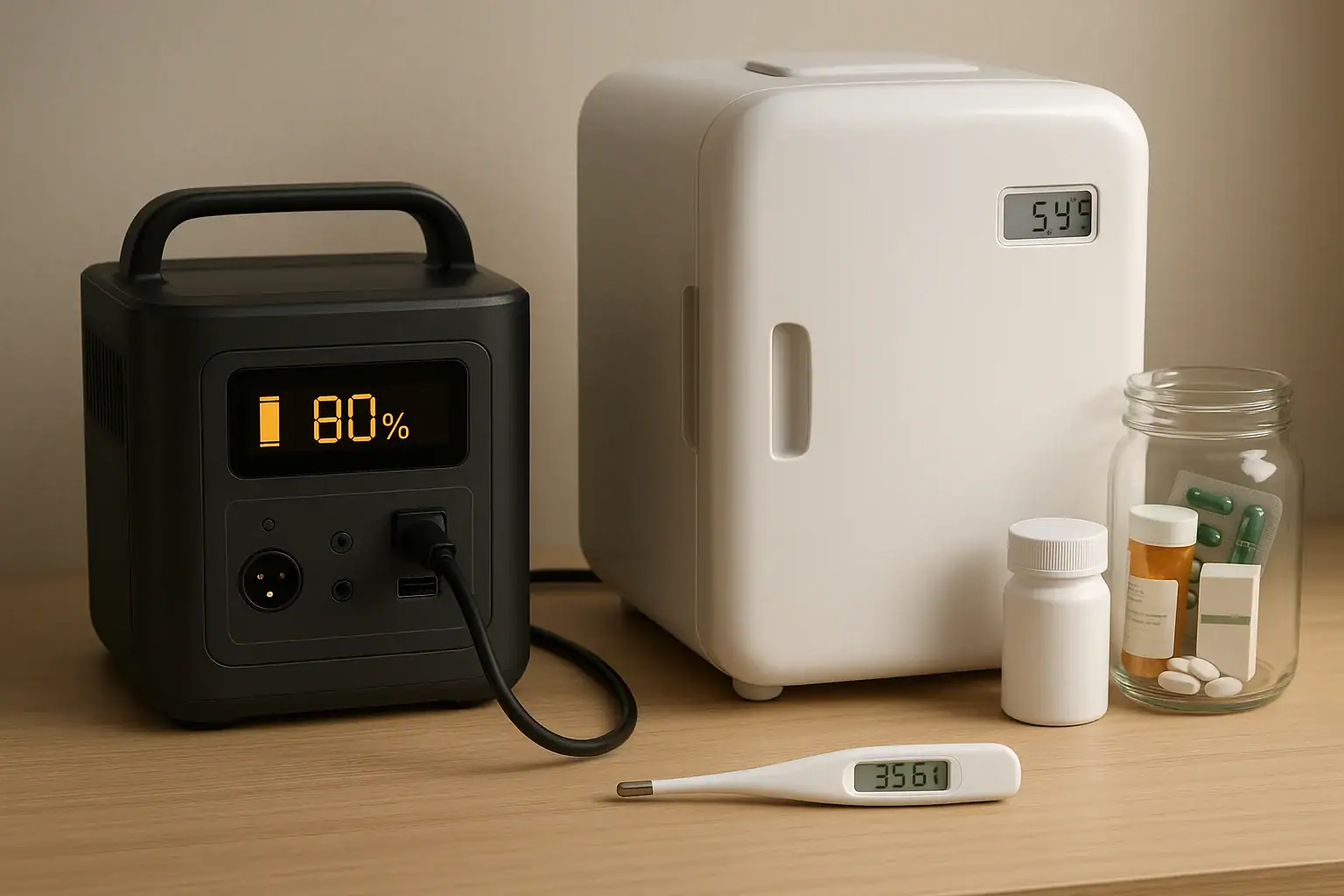
A portable power station can run a medical mini fridge if its usable watt-hours, inverter output, and recharge plan cover the fridge’s running watts, compressor surge watts, and outage length. The key is not just battery size; it is matching capacity, AC inverter rating, input limit, runtime needs, and temperature safety.
Medical refrigeration at home may involve insulin, biologics, eye drops, fertility medications, injections, or temperature-sensitive supplies. A compact refrigerator may look easy to power, but compressor cycling, room temperature, door openings, and thermostat settings can change energy use substantially.
This guide explains how to estimate mini fridge runtime, what specs matter in a portable power station, and how to build a practical backup plan without modifying home wiring or relying on guesswork during an outage.
What a portable power station does for medical refrigeration
A portable power station is a rechargeable battery system with outputs such as AC outlets, DC ports, and USB ports. For a medical mini fridge, the usual connection is the fridge’s standard AC plug into the power station’s AC inverter. The station converts stored battery energy into household-style AC power so the refrigerator can keep cycling during an outage.
This matters because refrigerator temperature is not the same as battery percentage. A medication fridge may remain cold for a while after power loss, then warm faster if the room is hot, the door is opened, or the unit has poor insulation. A backup power source helps keep the compressor operating instead of relying only on retained cold air.
The goal is to preserve the temperature range required by the medication label or pharmacy instructions. Many temperature-sensitive medications have strict storage requirements, and a power station is only one part of the plan. You also need a thermometer, a way to recharge the station, and a decision point for when to move the medication to another safe location.
For emergency planning, think in layers: keep the mini fridge powered when possible, reduce heat gain, monitor temperature, and have a backup destination if the outage lasts longer than the battery and recharge plan can support.
How mini fridge runtime works with watt-hours and compressor cycling
Runtime starts with watt-hours. If a power station has 1,000 watt-hours listed, that is the stored battery energy under ideal test conditions. The usable energy is usually lower after inverter losses, battery reserve, temperature effects, and the power required to run the station itself. A practical estimate is often based on 80% to 90% of rated capacity for AC loads.
A mini fridge does not draw one constant number of watts all day. It may pull a higher surge for a moment when the compressor starts, then run at a lower wattage while cooling, then use very little power between cycles. The average wattage over time is what determines runtime, but the inverter must still handle the short compressor surge.
A basic runtime estimate is: usable watt-hours divided by average watts. For example, if a station has 800 usable watt-hours and the medical mini fridge averages 40 watts over time, estimated runtime is about 20 hours. If the average rises to 70 watts in a hot room, runtime falls to about 11 hours.
Average wattage is best measured with an energy meter over at least a day in normal conditions. If you cannot measure it, use conservative assumptions and plan extra battery capacity. Medical refrigeration is a risk-sensitive load, so it is better to size for the worst reasonable case rather than the best-case number on a product label.
| Planning variable | Example value | Why it matters |
|---|---|---|
| Rated power station capacity | 768 to 1,024 watt-hours | Shows total stored energy before practical losses. |
| Usable AC energy | About 80% to 90% of rating | Accounts for inverter conversion and operating overhead. |
| Mini fridge average draw | 30 to 80 watts | Determines how quickly the battery is consumed. |
| Compressor startup surge | 2 to 4 times running watts | Must be below the inverter’s short surge capability. |
| Estimated runtime | Usable watt-hours divided by average watts | Provides a planning estimate, not a guarantee. |
Mini fridge runtime examples for home medical backup
Consider a compact medical fridge that averages 35 watts in a cool indoor room. A 500 watt-hour station with about 425 usable AC watt-hours could run it for roughly 12 hours. A 1,000 watt-hour station with about 850 usable AC watt-hours could run it for about 24 hours. A 2,000 watt-hour station could potentially cover two days or more if conditions stay favorable.
Now consider the same fridge in a warm room during a summer outage. If the average draw rises to 65 watts, the 500 watt-hour station may last about 6 to 7 hours, while the 1,000 watt-hour station may last about 13 hours. This difference is why emergency runtime estimates should include room temperature and door-opening behavior.
A second example is a small refrigerator with a running draw of 70 watts and a starting surge near 250 watts. A power station with a 300-watt continuous inverter might run it once started, but could fail at compressor startup if surge capability is too low. In this case, a larger inverter rating matters even if the average electricity use is modest.
Some users want to recharge the power station with solar panels or a vehicle power socket during an extended outage. Recharge time depends on the station’s input limit and real-world charging conditions. A station that accepts 200 watts of solar input will recharge much more slowly than one that accepts 600 watts, even if both have the same battery capacity. Solar output also drops with clouds, shade, poor panel angle, and short winter daylight.
For medical refrigeration, a good backup plan usually combines enough battery capacity for overnight use with a replenishment method for daytime or longer outages. That may mean wall charging before storms, solar charging when practical, or relocating medication to a facility with reliable power if the outage exceeds the plan.
Common mistakes and troubleshooting cues
One common mistake is sizing from the refrigerator’s maximum wattage label alone. The label may show a rating that does not reflect average energy use, or it may omit the real compressor startup surge. Runtime planning needs average watts, while compatibility needs both continuous and surge watts.
Another mistake is assuming the entire advertised capacity is available to the fridge. AC inverter losses are normal. If a station is rated at 1,000 watt-hours, it may not deliver a full 1,000 watt-hours through the AC outlet. Temperature, age, state of charge, and low-power cutoffs can reduce usable runtime.
A frequent troubleshooting cue is that the fridge runs for a while, then the power station shuts off when the compressor restarts. This can indicate a surge overload, not a lack of battery capacity. Look for overload warnings, beeping, error codes, or sudden AC output shutoff shortly after a compressor click.
If runtime is much shorter than expected, check whether the fridge is cycling constantly. Causes can include a hot room, poor ventilation around the fridge, a thermostat set colder than necessary for the medication range, damaged door gasket, frequent door openings, or placing warm items inside. A mini fridge packed too tightly may also cool unevenly.
Pass-through charging can also be misunderstood. Some power stations can power a load while recharging, but the behavior, efficiency, and switching time vary. For medical refrigeration, do not assume it functions as a certified medical uninterruptible power supply. Test the setup in advance and monitor temperatures during any real outage.
Finally, avoid using estimated runtime as the only decision tool. The actual medication temperature is what matters. Keep a refrigerator thermometer or data logger inside the fridge, and know in advance who to contact if medication storage temperature becomes uncertain.
Safety basics for powering a medical mini fridge
Use the portable power station in a dry, ventilated indoor area away from sinks, standing water, heaters, and direct sun. Keep air vents unobstructed, and do not cover the station with blankets or place it inside a sealed cabinet while it is powering a refrigerator.
Plug the mini fridge directly into the power station when possible. Avoid daisy-chaining power strips, adapters, or undersized extension cords. If an extension cord is unavoidable, use one rated for the load and keep it as short as practical. Damaged cords, loose plugs, or warm connectors are warning signs to stop using that setup.
Do not open the power station, modify battery packs, bypass protections, or attempt to wire the station into a home electrical panel. Whole-home connections, transfer equipment, and any permanent wiring should be handled by a qualified electrician and installed according to applicable code.
Separate medical decisions from electrical decisions. If medicine has been outside its labeled storage range, ask a pharmacist, clinician, or the medication manufacturer’s support channel for guidance. Do not assume it is safe because the fridge feels cool or because power returned later.
Carbon monoxide safety is also important if generators are part of a broader backup plan. Fuel-burning generators must never run indoors, in garages, or near openings to living spaces. A battery power station can be used indoors, but any charging source connected to fuel equipment needs proper outdoor placement and safe routing.
Maintenance, storage, and readiness before an outage
A portable power station is most useful for medical refrigeration when it is charged, tested, and easy to access. Store it where household members can find it quickly. Keep the required charging cables with the unit, and label the medical fridge plug if several cords are near the outlet.
Check the state of charge on a regular schedule. Many lithium-based power stations hold charge well, but they still self-discharge over time. For standby use, follow the owner’s manual for storage charge level and top-off intervals. If the unit will be needed during storm season, charge it fully before forecasted outages.
Test the full setup before relying on it. Run the mini fridge from the station long enough to confirm that the compressor starts, cycles, and restarts without overload. Record approximate runtime under normal indoor conditions. If possible, repeat the test in warmer weather, because cooling demand can increase significantly.
Maintain the mini fridge too. Clean dust from exterior vents if accessible without disassembly, keep space around the unit for airflow, verify the door seals, and avoid overloading the interior. Use a thermometer and record typical operating temperatures so you can spot changes before an emergency.
For longer outages, keep a written plan. Include the estimated battery runtime, recharge options, contact numbers, and the location of a backup storage site such as a clinic, pharmacy, hospital, or trusted location with reliable refrigeration. The plan should be simple enough to follow under stress.
Practical takeaways and specs to look for
| Readiness task | Suggested target | Reason |
|---|---|---|
| Pre-outage charge | Charge before expected severe weather | Maximizes starting runtime. |
| Temperature monitoring | Use a fridge thermometer or logger | Confirms medication storage conditions. |
| Runtime test | Test for several compressor cycles | Checks surge handling and realistic draw. |
| Recharge plan | Identify wall, solar, vehicle, or alternate site options | Extends usefulness beyond the first battery cycle. |
| Relocation trigger | Decide before the outage when to move medication | Reduces last-minute risk. |
Related guides: Portable Power Stations for CPAP and Medical Devices • Can a Portable Power Station Run a Refrigerator? • Surge Watts vs Running Watts: How to Size a Portable Power Station • Portable Power Station Watt-Hours Explained
The best portable power station for medical refrigeration is the one that can start the fridge reliably, run it for the needed outage window, recharge at a useful rate, and remain simple to operate during stress. Start with the medication’s storage requirement, then size the power system around confirmed or conservative refrigerator energy use.
Specs to look for
- Battery capacity: Look for enough rated watt-hours to cover the outage window after losses, such as 500 to 2,000 watt-hours for many mini fridge plans; this is the main driver of runtime.
- Usable AC output estimate: Plan around roughly 80% to 90% of rated capacity for AC loads; this prevents overly optimistic runtime calculations.
- Continuous inverter rating: Look for an AC output comfortably above the fridge’s running watts, such as 300 to 1,000 watts depending on the appliance; this keeps the inverter from operating at its limit.
- Surge watt capability: Look for short-duration surge support several times higher than running watts; compressor startup can trip undersized inverters.
- Recharge input limit: Look for AC and solar input levels that match your recovery plan, such as 200 to 800 watts or more; higher input can restore battery capacity faster during extended outages.
- Pass-through charging behavior: Look for clear support for powering loads while charging, plus test it in advance; this can help during rolling outages but should not be assumed to be medical-grade backup.
- Battery chemistry and cycle life: Look for a chemistry and cycle rating suitable for standby and repeated emergency use; longer cycle life supports multi-year readiness.
- Low-temperature and high-temperature operating range: Look for practical indoor operating limits and storage guidance; extreme temperatures can reduce performance or prevent charging.
- Display and alerts: Look for readable state of charge, input watts, output watts, and overload warnings; these help diagnose runtime and surge issues quickly.
- Port layout and physical size: Look for a stable AC outlet arrangement and manageable weight; a backup device that is easy to move and connect is more likely to be used correctly.
For a simple planning method, measure or estimate the fridge’s average watts, multiply the desired backup hours by that wattage, then add a safety margin for inverter losses and hot weather. Confirm that the inverter can handle startup surge, and test the setup before the first emergency.
Medical refrigeration backup should always include temperature monitoring and a decision point for relocation. A power station can buy valuable time, but safe medication storage depends on verified temperature, not battery specifications alone.
Frequently asked questions
How do I choose the right portable power station size for a medical mini fridge?
Start with the fridge’s average watt draw, then multiply it by the number of hours you want to cover and add a margin for inverter losses and warmer conditions. Also check that the inverter can handle the compressor’s startup surge, not just the running watts. For medical refrigeration, it is usually safer to size conservatively than to rely on the minimum advertised capacity.
What features matter most in a portable power station for medical refrigeration?
The most important features are usable watt-hours, continuous AC output, surge capability, and a recharge plan that fits your outage scenario. A clear display for battery level, input watts, output watts, and overload alerts is also useful. If you expect longer outages, fast AC or solar input can make a major difference.
What is a common mistake people make when backing up a mini fridge?
A common mistake is estimating runtime from the fridge’s label or the power station’s advertised capacity without accounting for compressor cycling and inverter losses. Another frequent error is overlooking startup surge, which can shut the inverter off even when battery capacity is still available. Testing the setup in advance helps avoid both problems.
Is it safe to run a medical mini fridge from a portable power station indoors?
Yes, a portable power station is generally designed for indoor use, provided it is kept dry, ventilated, and used according to the manufacturer’s instructions. Do not block vents, overload outlets, or use damaged cords. If any medication may have gone out of range, follow pharmacist or manufacturer guidance rather than guessing based on the fridge’s feel.
How long can a portable power station keep insulin or other medications cold?
It depends on the fridge’s average power use, the station’s usable capacity, room temperature, and how often the door is opened. A small fridge in a cool room may run much longer than the same fridge in hot weather. Because medication storage is temperature-sensitive, use a thermometer or logger to confirm conditions rather than relying on a time estimate alone.
Can I recharge the power station while the mini fridge is running?
Sometimes, but the result depends on the station’s pass-through charging behavior and input limits. Even when supported, charging and powering a load at the same time can reduce efficiency and may not switch seamlessly during every outage. Test the exact setup beforehand if you plan to rely on it.
Related guides
Browse this topic →
- Beginner-friendly sizing, runtime & specs
- Solar & charging (MPPT, fast charging, cables)
- Batteries (LiFePO4, cycles, care & storage)
- Safety, cold-weather performance, real-world tips
More in Home / Appliances
See all →Keep reading
About this site
Portable Energy Lab publishes practical, independent guides about portable power—clear sizing, safe use, and real-world expectations.
Affiliate disclosure
Some links on this site may be affiliate links. If you buy through these links, we may earn a small commission at no extra cost to you. This helps support our content. Read our affiliate disclosure.