
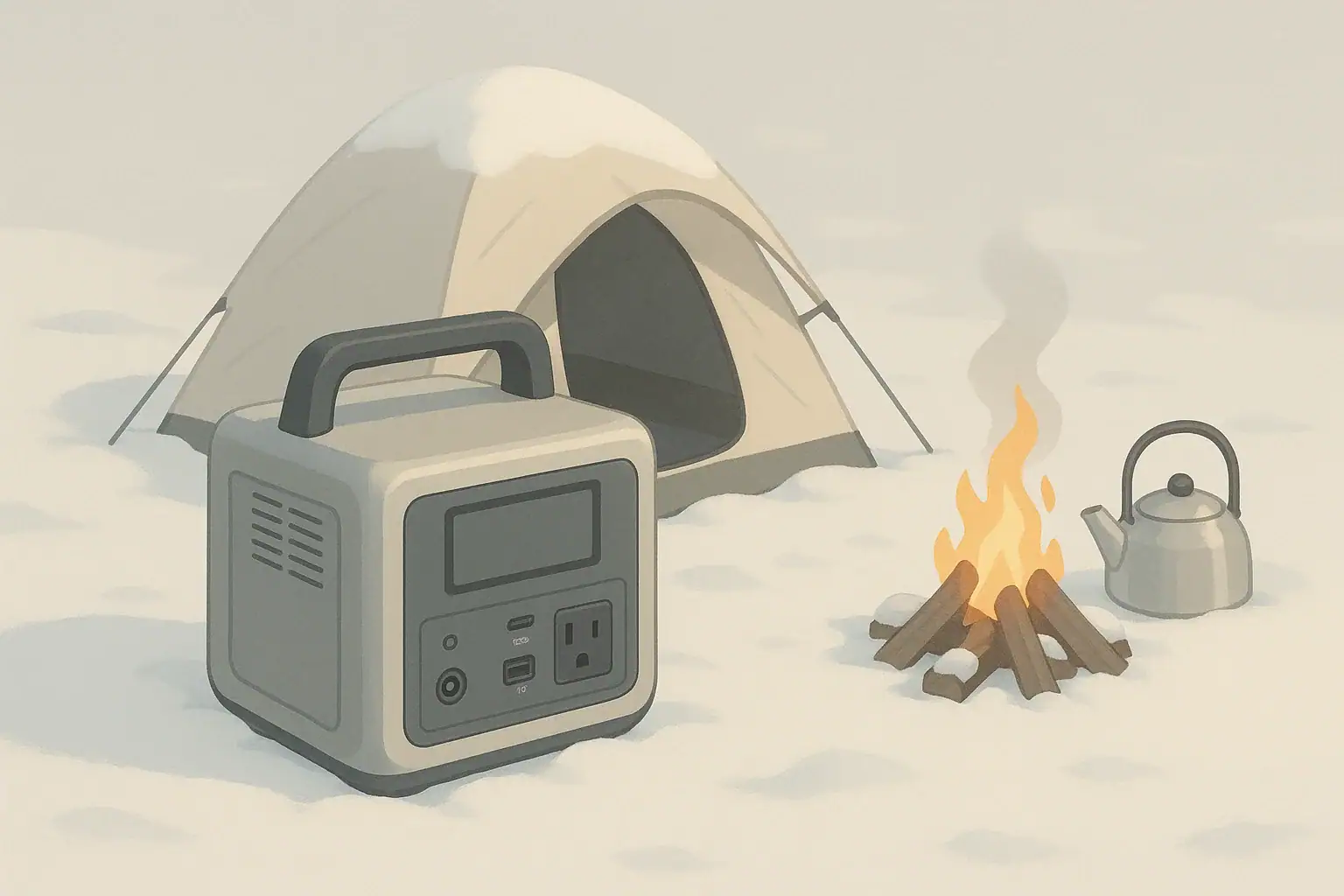
Charging a portable power station in freezing temperatures can permanently damage the battery, so you should warm the unit above its minimum charging temperature before plugging it in. Cold weather use is usually fine, but cold weather charging is where most of the risk lives.
When lithium batteries are charged below about 32°F (0°C), internal chemical reactions slow down and can cause lithium plating, capacity loss, and shorter battery life. You may still be able to discharge and run devices in the cold, but you need a different strategy for when and how you recharge.
This guide explains what happens inside a lithium battery in the cold, how much runtime you can realistically expect in winter, common cold‑weather mistakes, and practical steps to keep your portable power station safe, reliable, and ready for emergencies.
What “Charging in Freezing Temperatures” Really Means and Why It Matters
For portable power stations, “freezing” usually means around 32°F (0°C) and below, but the exact limits depend on the battery design. Many lithium batteries can discharge at temperatures well below freezing, yet their safe charging range is much narrower.
Manufacturers typically publish three separate temperature ranges:
- Charging temperature – often something like 32–104°F (0–40°C).
- Discharging temperature – often wider, for example 14–104°F (−10–40°C) or more.
- Storage temperature – sometimes broader but still not intended for deep freeze long‑term.
Charging below the minimum charging temperature is where damage can occur. The pack may still “accept” charge if protections are weak or bypassed, but repeated cold charging can silently reduce capacity and increase internal resistance. Over time, that means shorter runtimes, more voltage sag, and a power station that feels much smaller than its original rating.
Understanding where these limits come from helps you plan winter camping trips, RV use, job‑site work, and home backup so that you charge warm, use cold, and keep the battery healthy for years.
How Cold Affects Lithium Batteries and Charging Behavior
Inside a lithium battery, energy moves as lithium ions travel through an electrolyte between the anode and cathode. Temperature changes the speed and efficiency of that movement.
In cold conditions:
- Chemical reactions slow down – ions move more slowly, so the battery cannot accept or deliver current as easily.
- Electrolyte becomes more viscous – the internal “liquid highway” gets thicker, raising internal resistance.
- Voltage behavior changes – the same current causes more internal stress, and voltage drops faster under load.
These effects show up differently when you are discharging versus charging the battery.
Discharging in the Cold: Less Runtime, More Voltage Sag
When you run devices from a cold portable power station, you may notice:
- Shorter runtimes than you get at room temperature.
- Unexpected shutdowns under heavy loads, even when the display still shows remaining charge.
- More frequent low‑battery or overload warnings.
This happens because the cold battery cannot deliver energy as efficiently. The inverter sees the battery voltage sagging and shuts down to protect the pack, even though some energy remains locked away until the cells warm back up.
Charging in the Cold: Lithium Plating and Permanent Damage
Charging in freezing conditions is more serious than simply losing runtime. At low temperatures, the anode cannot absorb lithium ions as quickly as the charger is trying to push them in. Instead of entering the anode structure, some lithium can deposit as metallic lithium on the surface. This is called lithium plating.
Over time, lithium plating can lead to:
- Permanent capacity loss – part of the battery’s active material is no longer available for storing energy.
- Higher internal resistance – the pack runs warmer under load and feels “weaker.”
- Shortened lifespan – the battery reaches end of life sooner, even if it still appears to work.
Most modern power stations include a battery management system (BMS) that monitors temperature and will reduce or block charging when the pack is too cold. However, not all systems react the same way, and relying on protections alone is not a substitute for good habits.
| Use case | Common temperature range | What this means in practice |
|---|---|---|
| Charging | 32–104°F (0–40°C) | Aim to be comfortably above freezing before plugging in any charger. |
| Discharging (running devices) | 14–104°F (−10–40°C) | You can usually use the unit in light subfreezing conditions but expect less runtime. |
| Short‑term storage | 14–95°F (−10–35°C) | Okay for seasonal storage if you avoid deep freeze and high heat extremes. |
| Long‑term storage | 41–77°F (5–25°C) | Best range for long battery life when stored partially charged. |
Because exact limits vary, treat your own product’s minimum charging temperature as a hard line and give yourself a safety margin above it.
Cold-Weather Examples: Camping, RV, Job Sites, and Home Backup
Understanding theory is helpful, but cold‑weather charging decisions are made in real situations: a tent at dawn, a frozen driveway, or a chilly workshop. These examples show how to apply the same principles in different scenarios.
Winter Camping and Vanlife
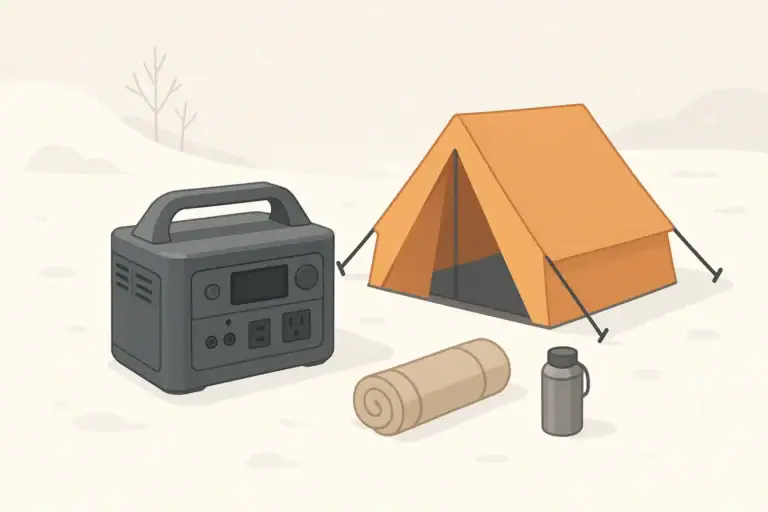
Imagine a weekend trip where overnight temperatures drop to 15°F (−9°C). Your power station spends the night in the tent vestibule powering a small fan and lights. In the morning you want to recharge from a folding solar panel.
- The battery pack inside the unit is likely close to the outside air temperature.
- The display may still show 40–50% remaining, but the internal cells are cold and sluggish.
- Connecting solar right away may cause the BMS to refuse charging or accept only a trickle.
A better approach is to move the power station into the warmest part of the tent or vehicle, let it warm gradually while you make breakfast, and start charging once the interior has climbed above freezing.
RV and Remote Work Setups
In an RV or mobile office, the power station might live in a storage bay that drops below freezing overnight while you drive or park. The next morning you plug into shore power or start a generator and expect everything to charge as usual.
What actually happens:
- The BMS may limit charge current until the pack warms, making “fast charging” much slower.
- If sensors are not accurate or protections are minimal, the pack may accept high current while still too cold, increasing long‑term wear.
- Voltage sag is more noticeable when running power tools or a coffee maker from a cold battery.
Planning to store the power station in the conditioned interior when hard freezes are expected, and opening cabinet doors around it while charging, can keep temperatures closer to the recommended range.
Cold Weather Home Backup and Short Outages
During a winter outage, you might grab a power station from an unheated garage where it has sat at 20°F (−6°C) for weeks. You bring it into the living room and immediately plug it into a small gasoline generator or wall outlet once power returns.
Safer practice looks like this:
- Set the unit on a dry, stable surface away from heaters and stoves.
- Allow it to slowly reach room temperature; wipe off any visible condensation.
- Only then connect chargers and critical loads like lights, phones, or a modem.
Because cold reduces effective capacity, prioritize low‑wattage essentials instead of trying to run electric heaters or large appliances directly from the power station.
Outdoor Job Sites and Workshops
On a winter job site, it is common to leave a power station in the back of a truck overnight, then use it to run tools and charge batteries during the day. If you fast‑charge it from AC in an unheated workshop that is just above freezing, the cells are still cold even though the air feels “not that bad.”
In that situation, using a slower charging method or moving the unit into a slightly warmer space before fast charging can significantly reduce stress on the battery, especially if this pattern repeats all winter.
Common Cold-Weather Mistakes and Troubleshooting Cues
Most cold‑related battery problems come from a few repeatable mistakes. Recognizing them early can help you avoid permanent damage and troubleshoot odd behavior before it becomes serious.
Frequent Mistakes with Charging in Freezing Temperatures
- Charging as soon as you come indoors – the outside of the case feels warmer than the internal cells, which may still be below freezing.
- Leaving the unit on snow or concrete – it stays colder longer than you expect, especially in light wind.
- Using the fastest charger in marginal temperatures – high current at just‑above‑freezing conditions increases stress on the cells.
- Assuming the display temperature equals cell temperature – some sensors read air or case temperature, not the battery core.
- Ignoring repeated charge throttling or error codes – the BMS may be warning you that the pack is too cold.
Symptoms That Point to Cold-Related Battery Stress
Cold exposure and improper charging do not always cause immediate failure. Look for patterns over time:
- Noticeably shorter runtimes than when the unit was new, even at moderate temperatures.
- More frequent low‑battery shutdowns under loads that used to be fine.
- Longer charging times for the same input power.
- Intermittent or new error messages when charging after cold storage.
These issues can have other causes, but if they show up after a season of winter use, cold charging is a likely contributor.
| Observed issue | Likely cause | Immediate action | Longer‑term step |
|---|---|---|---|
| Unit will not start charging after a night in the car | BMS blocking charge due to low temperature | Bring indoors, let it warm to room temperature, then retry. | Store above freezing when hard freezes are expected. |
| Fast shutdown when running a space heater in the cold | Voltage sag and inverter overload | Turn off the heater and switch to low‑wattage loads. | Avoid running high‑draw heaters from small power stations. |
| Runtime much shorter than in summer | Reduced effective capacity at low temperature | Move the unit to a less exposed, insulated spot. | Plan extra capacity for winter trips and outages. |
| Condensation on case after bringing it indoors | Moisture from warm air hitting cold surfaces | Let it dry fully before charging or heavy use. | Use bags or covers to reduce moisture swings. |
| New clicking sounds or unusual smell while charging | Possible internal fault or damage | Stop charging immediately and power down. | Contact the manufacturer or a qualified service provider. |
When to Stop and Seek Help
If you notice swelling of the case, a sweet or chemical odor, visible damage, or repeated error codes that do not clear after warming and restarting the unit, stop using it. Do not attempt to open the enclosure or bypass safety systems. Contact the manufacturer or a qualified technician for guidance on inspection, repair, or recycling.
Cold-Weather Safety Basics for Portable Power Stations
Cold temperatures add extra stress to the battery, but most safety issues arise when cold is combined with moisture, poor ventilation, or improvised electrical connections. A few high‑level rules go a long way.
Temperature and Placement Safety
- Avoid extreme swings – do not move the unit directly from deep freeze to high heat, such as next to a heater or stove.
- Keep vents clear – even in winter, the inverter and BMS need airflow to shed heat while charging or under heavy load.
- Elevate off snow and standing water – use a board, crate, or dry mat to reduce moisture exposure and shock risk.
Electrical and Load Safety
- Use appropriate cords – cold makes many cables stiff and more prone to cracking; inspect insulation before use.
- Avoid overloading – cold batteries sag more under load, so devices that were “borderline” in summer may now trip overload protection.
- Do not backfeed building wiring – never connect a portable power station to household circuits without proper transfer equipment installed by a professional.
Ventilation and Indoor Use
- Ensure adequate airflow – do not bury the unit under blankets or clothing to “keep it warm.”
- Respect other heat sources – maintain clearance from gas heaters, fireplaces, and cooking appliances.
- Follow device instructions – some connected loads, such as medical equipment, have their own temperature and ventilation requirements.
Most modern portable power stations include multiple layers of protection, but those systems are designed to work within published limits. Using the unit within its specified temperature range and avoiding improvised electrical setups is the foundation of safe cold‑weather operation.
Long-Term Cold-Weather Care, Storage, and Battery Health
How you store and maintain a portable power station between trips or seasons matters just as much as how you use it on any given winter day. Good habits can preserve capacity and reduce unpleasant surprises when you need backup power most.
Off-Season Storage in Cold Climates
- Choose a moderate location – a closet, interior room, or conditioned basement is better than an unheated shed or vehicle.
- Avoid full charge or full empty – many lithium batteries age best when stored around 30–60% state of charge.
- Top up periodically – check and recharge every few months to prevent deep discharge from self‑drain.
If your only option is a space that occasionally dips below freezing, keep the unit off bare concrete and away from exterior walls. An insulated shelf or cabinet can reduce temperature swings and moisture exposure.
Post-Winter Inspection
After a season of cold use, a quick inspection can catch issues before they become failures:
- Look for cracks in the housing, loose handles, or damaged feet from impacts in cold weather.
- Inspect AC outlets and DC ports for corrosion, dirt, or moisture staining.
- Check cords and adapters for stiff spots, nicks, or cracked insulation.
If any damage is found, retire the affected cords or accessories and follow the manufacturer’s guidance for the power station itself.
Planning Capacity for Winter Use
Because cold reduces effective capacity, it is reasonable to assume that real‑world winter runtimes may be noticeably lower than the nameplate watt‑hour rating suggests. Many users plan with a margin, such as treating a 1,000 Wh unit as if it were only 700–800 Wh in freezing conditions, depending on load type and exposure time.
That extra buffer can be the difference between running only essentials through a long winter night versus unexpectedly running out of power before morning.
Practical Takeaways and Specs to Look For
Cold weather does not mean you cannot rely on a portable power station. It does mean you need to think about when you charge, where you store the unit, and which specifications matter most for winter use.
Key Takeaways for Charging in Freezing Temperatures
- Use your power station in the cold if needed, but avoid charging below the stated minimum temperature.
- Warm the unit gradually to above freezing before plugging in any charger, whether AC, solar, or vehicle.
- Expect shorter runtimes and more voltage sag in winter; plan extra capacity or reduce loads.
- Store the unit in a cool, dry place that generally stays above freezing and avoid leaving it fully charged or fully empty for long periods.
- Watch for warning signs like new error codes, unusual smells, or rapid capacity loss after cold exposure.
Specs to Look For When You Expect Cold-Weather Use
When comparing portable power stations for use in freezing climates, the spec sheet can tell you a lot about how they will behave in winter. Pay particular attention to:
- Minimum charging temperature – the lower this value (within reason), the more flexible the unit is for cold‑weather charging.
- Discharge temperature range – a wider range supports more reliable operation on cold nights.
- Storage temperature range – important if the unit will live in a garage, RV, or cabin.
- Battery chemistry – different lithium chemistries (for example, LiFePO4 versus other lithium‑ion types) have different cold‑weather behavior and cycle life characteristics.
- BMS protections – look for explicit mention of low‑temperature charge protection, thermal sensors, and automatic charge throttling.
- Available charge inputs – multiple input options (AC, DC, solar) let you choose slower or gentler charging methods in marginal conditions.
- Usable capacity at low temperature (if stated) – some manufacturers provide performance graphs showing capacity versus temperature.
Matching these specifications to your climate and use case helps ensure that your power station remains dependable in winter, without relying on risky cold‑weather charging habits that shorten battery life.
Frequently asked questions
Which specifications and features most affect a power station’s performance when charging in freezing temperatures?
Minimum charging temperature, discharge and storage temperature ranges, and battery chemistry are the most important specs. Also look for explicit BMS low‑temperature protections, thermal sensors, and information about usable capacity at low temperatures. Multiple input options (AC, DC, solar) let you choose gentler charging methods in marginal conditions.
Can I charge a power station immediately after bringing it inside from the cold?
No — you should let the unit warm gradually above the minimum charging temperature before charging. Charging while the internal cells are still cold risks lithium plating and long‑term capacity loss, and the BMS may refuse to charge until the pack warms.
What immediate safety steps should I take if I suspect cold-related battery damage?
Stop charging and disconnect any loads, then move the unit to a well‑ventilated, moderate‑temperature area and avoid rapid heating. Do not open the enclosure or attempt repairs; contact the manufacturer or a qualified technician for inspection and disposal guidance if you see swelling, strong odors, or persistent error codes.
How much runtime loss is typical when using a power station in very cold conditions?
Runtime reduction varies with temperature, load, and exposure time, but many users see noticeably lower effective capacity — often on the order of 20–30% or more under severe cold. Plan additional capacity or reduce loads for winter use to avoid unexpected outages.
Are there safer ways to charge with solar or vehicle charging when temperatures are near freezing?
Yes — use lower charge currents or slower charge modes and, when possible, move the station into a warmer space before charging. Insulating the unit from wind and placing it in a sheltered, dry enclosure can help, but the best practice is to ensure internal cell temperature is above the manufacturer’s minimum before applying significant charge current.
How can I reduce condensation risk when bringing a cold power station indoors?
Bring the unit into a cool, dry room and let it warm gradually in a sealed bag or case to limit moisture contact, then open and dry any visible condensation before charging. Avoid placing it directly next to heaters or humid environments to prevent rapid temperature swings that create condensation.
Related guides
Browse this topic →
- Beginner-friendly sizing, runtime & specs
- Solar & charging (MPPT, fast charging, cables)
- Batteries (LiFePO4, cycles, care & storage)
- Safety, cold-weather performance, real-world tips
More in Cold Weather
See all →Keep reading
About this site
Portable Energy Lab publishes practical, independent guides about portable power—clear sizing, safe use, and real-world expectations.
Affiliate disclosure
Some links on this site may be affiliate links. If you buy through these links, we may earn a small commission at no extra cost to you. This helps support our content. Read our affiliate disclosure.