Do Portable Power Stations Work in Cold Weather?

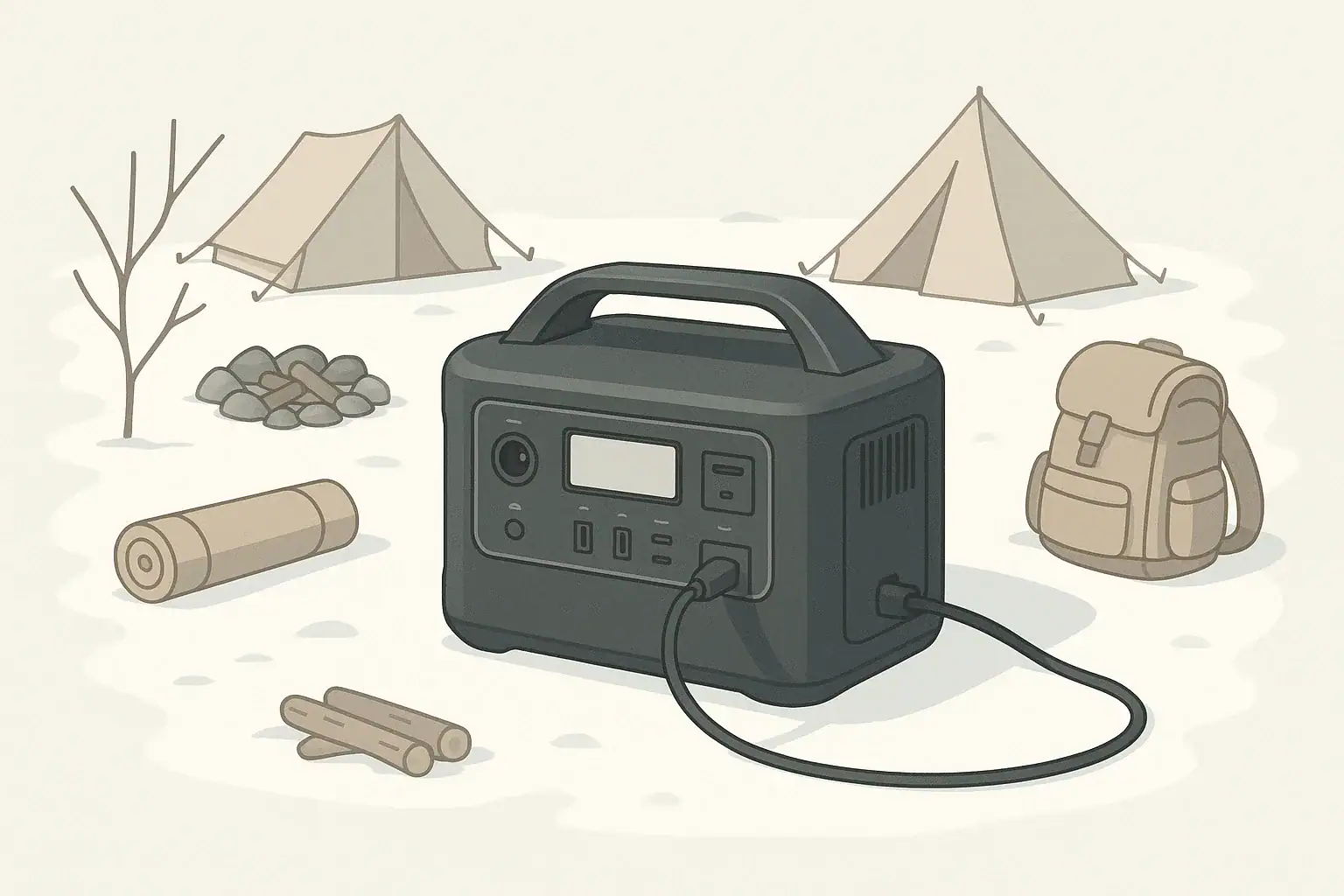
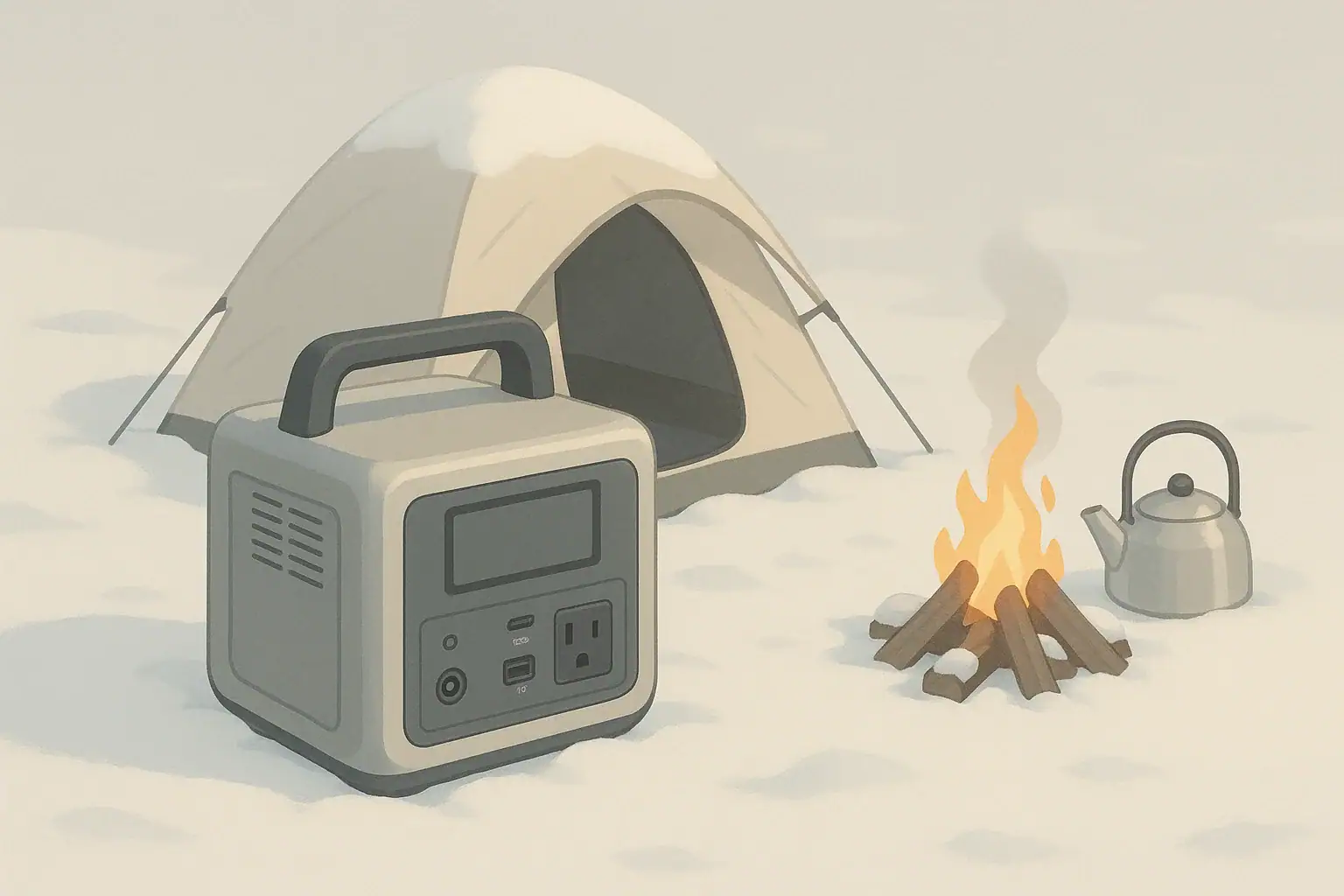
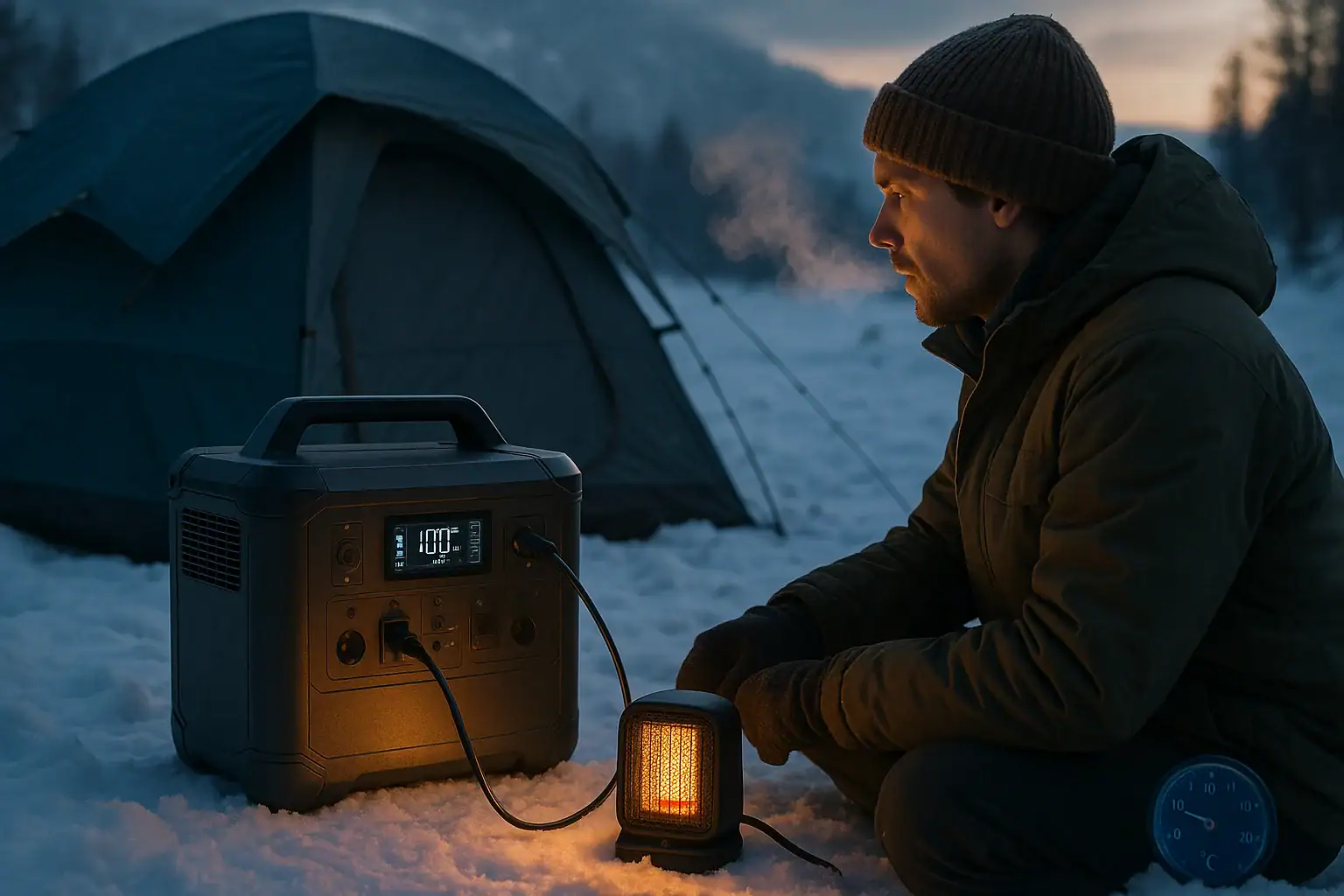
Portable power station operating in cold weather at a snowy campsite

Portable power stations do work in cold weather, but their battery capacity, runtime, and charging performance usually drop as temperatures fall. In freezing conditions you may see slower charging, reduced watt-hours, and limits on output power or surge watts, especially during startup loads. Understanding how temperature affects lithium batteries helps you avoid surprises and extend usable runtime when it is cold.

People search terms like “portable power station in winter,” “cold weather performance,” “battery degradation,” and “low temperature cutoff” because they want reliable backup power for camping, RVs, tailgating, or emergencies. The key is knowing how cold impacts battery chemistry, inverter efficiency, and the built-in battery management system (BMS), then planning your usage and storage around those limits.

This guide explains what really happens to portable power stations in cold weather, how to troubleshoot weak performance, and which cold-weather specs and features matter most when you are deciding what to buy or how to use the unit you already own.

Cold Weather Performance of Portable Power Stations: What It Means and Why It Matters

Cold weather performance describes how well a portable power station can charge, discharge, and deliver its rated watt-hours when temperatures drop, especially around freezing and below. While datasheets often list an operating temperature range, real-world behavior in winter can be very different from room-temperature lab numbers.

Most portable power stations use either lithium-ion or lithium iron phosphate (LiFePO4) cells. Both types are affected by temperature because ion movement inside the battery slows down when it is cold. That leads to:

  • Higher internal resistance: The battery has a harder time delivering current, which can trigger voltage sag under load.
  • Reduced apparent capacity: Less of the rated watt-hours are available before the voltage hits the BMS cutoff.
  • Charging risk at low temps: Charging below freezing can cause lithium plating and long-term capacity loss.

Manufacturers typically define a recommended charge and discharge temperature range. Discharge limits are usually broader than charge limits, meaning you can often draw power at colder temperatures than you can safely recharge.

Inverter and DC output in the cold

The inverter converts DC battery power to AC power for household devices. In cold weather:

  • Efficiency can drop slightly, meaning more energy is lost as heat inside the unit.
  • Peak surge handling may be lower, especially if the battery voltage sags quickly under heavy startup loads.
  • Idle consumption stays constant, which can be a bigger percentage of total capacity when the battery is already limited by cold.

DC outputs (like USB, USB-C PD, and 12V sockets) depend directly on battery voltage and BMS limits. You might see:

  • USB-C PD profiles stepping down to lower wattage.
  • 12V ports shutting off earlier than expected when the battery appears “empty” in the cold.

The role of the battery management system (BMS)

The BMS is the protective brain inside the power station. In cold weather it may:

  • Prevent charging below a certain temperature.
  • Limit discharge current to protect the cells.
  • Shut down the unit if internal temperature sensors report conditions outside the safe range.

Some models include internal heaters or preheating modes that gently warm the battery before charging or heavy discharge. Others rely on ambient warmth from the environment or from light loads over time.

Because of these protective behaviors, a portable power station might refuse to charge, stop output, or show reduced available capacity even though nothing is “broken” in the traditional sense. It is simply enforcing cold-weather safety limits.

ConditionTypical Effect in Cold WeatherWhat You May Notice
Battery at or below freezingCharging restricted or blockedUnit will not accept charge from wall, solar, or car
Heavy load at low temperatureVoltage sag and BMS cutoffDevice shuts off earlier, shorter runtime
Moderate load in mild coldReduced effective capacityBattery percentage drops faster than in warm weather
Unit stored in very cold vehicleSlow warm-up needed before normal useDelayed charging, limited output until it warms
Cold temperature effects on portable power station behavior. Example values for illustration.

Real-World Cold Weather Scenarios and What to Expect

Cold weather behavior becomes much clearer when you look at common use cases. These scenarios illustrate how portable power stations often perform in winter conditions, and what you can realistically expect in terms of runtime and reliability.

Winter camping and overlanding

For winter camping or overlanding, people often power LED lights, phone chargers, small fans, and occasionally a low-wattage electric blanket or heater. In below-freezing temperatures:

  • Light loads (phones, headlamps, radios) usually work fine, but the displayed battery percentage may drop faster than in summer.
  • Electric blankets or small heaters draw high continuous watts. The BMS may shut down earlier than expected if the battery voltage sags in the cold.
  • Solar charging can be limited if the unit’s internal temperature is too low, even when panels are producing power.

A practical approach is to keep the power station inside a tent, vehicle, or insulated box so it stays closer to room temperature. Even a small temperature increase can noticeably improve performance and runtime.

Cold-weather RV and van life

In vans or RVs, portable power stations often support fridges, fans, routers, and laptops. Refrigerators and 12V coolers are especially sensitive to cold-weather performance because they cycle on and off over many hours.

  • Compressor fridges may run less often in cold weather, which helps offset the reduced battery capacity.
  • Inverter idle draw becomes more important. If the inverter is left on continuously, the combination of idle draw and reduced cold capacity can shorten overnight runtime.
  • Vehicle charging through a 12V socket may be limited or disabled until the battery inside the power station warms up.

Mounting or storing the power station inside the living space, rather than in an uninsulated compartment, helps keep the battery within a more comfortable temperature range.

Emergency backup during winter storms

During winter power outages, portable power stations are often used for:

  • Phones, radios, and internet equipment.
  • LED lamps and emergency lighting.
  • Medical devices with modest power draw.
  • Occasional use of small space heaters or kettles.

In these situations, the biggest cold-weather issues are:

  • Overestimating runtime based on nameplate watt-hours instead of cold-adjusted capacity.
  • Attempting to recharge a frozen unit directly from a generator or wall source.
  • Running high-wattage resistive loads (heaters, toasters, kettles) that quickly drain the battery in the cold.

For emergency use, it is wise to treat the rated capacity as optimistic in winter. Plan for a noticeable reduction and prioritize low-watt, high-importance loads over comfort appliances.

Common Cold Weather Problems and Troubleshooting Clues

Many cold-weather complaints about portable power stations come down to a few recurring issues. Recognizing the symptoms helps you decide whether you are seeing normal low-temperature behavior or a real fault that needs support or repair.

Problem: Power station will not charge in the cold

What you see: You plug into wall, car, or solar, but the power station refuses to charge or charges at a very low rate.

Likely cause: The BMS is blocking or throttling charging because the internal battery temperature is too low.

What to do (high-level):

  • Bring the unit indoors or into a warmer space.
  • Allow it to sit unplugged until the internal temperature rises.
  • Try charging again once the casing feels closer to room temperature.

If the unit still will not charge at normal temperatures, that may indicate a different issue unrelated to cold weather, and you should follow the manufacturer’s support process.

Problem: Capacity and runtime seem much lower than rated

What you see: Battery percentage drops quickly, and devices shut off sooner than expected compared to warm-weather use.

Likely causes:

  • Reduced effective capacity due to cold battery chemistry.
  • Voltage sag under load causing early BMS cutoff.
  • Higher relative impact of inverter idle draw and conversion losses.

What to do (high-level):

  • Warm the unit slightly by moving it indoors, into a tent, or into an insulated container (without blocking vents).
  • Reduce peak loads by staggering device usage instead of running everything at once.
  • Turn off the AC inverter when not needed; use DC outputs where possible.

Problem: Unit shuts down under heavy load in the cold

What you see: A space heater, kettle, or power tool causes the power station to shut off or trip protection, especially shortly after startup.

Likely causes:

  • High inrush or surge watts exceeding what the inverter can handle at low temperature.
  • Battery voltage drop triggering low-voltage cutoff.

What to do (high-level):

  • Avoid running high-wattage resistive loads for long periods in deep cold.
  • Use lower power settings if available on the device.
  • Let the unit warm up before attempting heavy loads.

Problem: Battery gauge behaves oddly in cold weather

What you see: The percentage display jumps up or down, or the unit shows low battery but later appears to “gain” capacity when warmed.

Likely cause: Battery state-of-charge estimation is less accurate in the cold due to changing voltage behavior and internal resistance.

What to do (high-level):

  • Use the percentage display as a rough guide, not a precise meter, in very cold conditions.
  • Pay attention to actual runtime and device behavior rather than the exact number.
  • Whenever possible, recharge and calibrate the unit at moderate temperatures.

Cold Weather Safety Basics for Portable Power Stations

Cold weather introduces specific safety considerations for portable power stations. While these devices include built-in protections, safe handling and placement are still important, especially around snow, moisture, and enclosed spaces.

Avoid charging frozen batteries

Charging lithium batteries below freezing can cause internal damage that may not be immediately visible but will reduce long-term capacity and can, in extreme cases, create safety risks. Many power stations prevent cold charging automatically, but you should still avoid forcing a charge on a unit that feels very cold to the touch.

Allow the device to warm gradually in a dry, ventilated area before connecting to wall power, solar, or a vehicle socket.

Keep units dry and off snow or ice

Moisture is a bigger safety concern than cold itself. Snow, slush, or condensation can create short circuits or corrosion over time.

  • Place the power station on a dry, stable surface, not directly on snow or ice.
  • Protect it from blowing snow and sleet, while keeping ventilation openings clear.
  • Avoid sealing the unit inside airtight plastic bags that can trap condensation.

Ventilation and heat buildup

Even in cold weather, the inverter and internal components can generate heat under heavy load. If you insulate the unit to keep it warm, be careful not to block vents or cooling fans.

  • Use breathable covers or insulated boxes that allow airflow.
  • Do not stack blankets or clothing directly over vents.
  • Monitor the unit for any unusual smells, noises, or error messages.

Safe use of heaters and high-watt devices

Portable power stations can technically run some small heaters, but this is where cold-weather and safety concerns overlap:

  • Heaters draw high continuous watts and can quickly deplete the battery.
  • Improper placement of heaters in tents, vehicles, or small rooms can create fire or carbon monoxide risks (for fuel-burning heaters).
  • Extension cords should be rated for outdoor or cold-weather use if used outside.

Use electric heaters cautiously, follow the heater’s safety instructions, and never leave high-wattage devices unattended.

When to involve a professional

If you plan to integrate a portable power station with a home electrical system for winter backup, consult a qualified electrician. Do not attempt to wire a power station directly into a breaker panel or modify transfer equipment yourself. Properly installed transfer devices and circuits help prevent backfeed and other hazards.

Cold Weather Storage and Maintenance for Portable Power Stations

How you store and maintain a portable power station in cold climates has a big impact on battery health and long-term performance. Good habits can reduce capacity loss and help the unit perform more predictably in winter.

Off-season storage in cold climates

For long-term storage during colder months:

  • Avoid deep cold when possible: Store the unit indoors or in a temperature-moderated space instead of an unheated shed or trunk that regularly drops well below freezing.
  • Store at partial charge: Many lithium batteries fare best when stored around 30–60% state of charge rather than completely full or empty.
  • Top up periodically: Every few months, bring the unit to room temperature and recharge to the recommended storage level.

These practices help slow battery degradation and preserve capacity over years of use.

Before a winter trip or storm

Prior to winter camping or an expected storm:

  • Charge the power station at room temperature so it starts from full capacity.
  • Test key devices (lights, communication gear, critical electronics) to confirm they work as expected.
  • Check that all fans and displays function normally and that there are no error codes.

Doing this indoors gives you a baseline for comparison once you are in the cold.

During use in cold weather

While using the power station in the cold:

  • Keep it insulated but ventilated: For example, inside a tent, vehicle, or insulated box with open vents.
  • Avoid repeated freeze-thaw cycles: Rapid temperature swings can increase condensation inside and outside the unit.
  • Let it warm before recharging: If it has been sitting in sub-freezing conditions, allow time for the internal temperature to rise before connecting chargers.

After cold exposure

When you bring a very cold power station into a warm, humid room, condensation can form on surfaces. To reduce risk:

  • Let the unit sit unplugged until it reaches room temperature and visible moisture evaporates.
  • Avoid charging or running heavy loads while the casing is still damp or fogged.
  • Inspect ports for moisture before plugging in cables.
SituationRecommended ActionReason
Storing over winterKeep at 30–60% charge in a cool, dry roomHelps preserve long-term battery health
Using in sub-freezing tempsKeep unit insulated but ventilatedReduces capacity loss while avoiding overheating
Recharging after cold useWarm to room temperature before chargingPrevents damage from charging frozen cells
Bringing indoors from snowLet condensation evaporate before useMinimizes moisture-related electrical issues
Cold weather storage and handling guidelines. Example values for illustration.

Related guides: Cold-Weather Capacity Loss: How Much Power You Really LoseTemperature Limits Explained: Safe Charging/Discharging Ranges and What Happens Outside ThemWinter Use: Why Charging Slows in Cold Weather and How to Plan Around It

Key Takeaways and Cold-Weather Specs to Look For

Portable power stations can absolutely work in cold weather, but you should expect reduced capacity, slower charging, and stricter protection behavior as temperatures drop. The closer you keep the unit to moderate temperatures, the more it will behave like it does in mild weather. Planning for lower effective watt-hours and prioritizing efficient, low-watt loads will help you get the most from your system in winter.

When comparing or using portable power stations for cold-weather scenarios, focus on realistic expectations and the right features rather than just headline capacity numbers. The following checklist highlights the most relevant specs and design details for reliable winter performance.

Specs to look for

  • Operating temperature range: Look for clearly stated charge and discharge temperature ranges (for example, charging above 32°F and discharging down to around 14°F or lower). This tells you how the unit is designed to behave in real cold.
  • Battery chemistry: Note whether the unit uses standard lithium-ion or lithium iron phosphate (LiFePO4). LiFePO4 can offer longer cycle life and stable performance, but both chemistries lose capacity in the cold, so compare expectations accordingly.
  • Usable capacity vs. rated capacity: A higher watt-hour rating (such as 800–1,500 Wh) provides more buffer against cold-related capacity loss. Assume a meaningful reduction in freezing conditions when planning runtimes.
  • Continuous and surge output: Check continuous watts and surge watts, especially if you plan to run devices with high startup loads. Choosing a unit with comfortable headroom above your typical load helps avoid cold-related shutdowns.
  • Low-temperature charging protection: Look for mention of low-temp charge cutoff or smart BMS protection. This helps prevent accidental charging when the battery is too cold, protecting long-term health.
  • Built-in preheating or thermal management: Some designs include internal heaters or thermal control to bring batteries into a safe range before charging or heavy discharge. This can significantly improve winter usability.
  • Inverter efficiency and idle draw: Higher efficiency and lower idle consumption (for example, under 20–30 W when AC is on with no load) are important when capacity is already reduced by cold weather.
  • DC output options: Multiple DC outputs (12V ports and USB-C PD with higher wattage profiles like 60–100 W) let you power devices more efficiently than through AC, stretching runtime in cold conditions.
  • Clear display and error indicators: A screen that shows temperature warnings, input/output watts, and error codes helps you understand when cold is limiting performance versus when something else is wrong.
  • Physical design for winter use: Consider weight, handle design, and casing layout so it is easy to move with gloves, keep off snow, and position in sheltered but ventilated spots.

By paying attention to these cold-weather factors and specs, you can choose and use portable power stations that remain dependable in winter, whether you are camping in the snow, living off-grid in a van, or riding out a winter storm at home.

Frequently asked questions

Which specifications and features matter most for reliable cold-weather performance?

Key specs include separate charge and discharge temperature ranges, usable watt‑hours versus rated capacity, continuous and surge output ratings, and low‑temperature charge cutoff implemented by the BMS. Built‑in thermal management or preheating, inverter efficiency and idle draw, and available DC outputs (like high‑watt USB‑C or 12V ports) are also important for winter reliability.

What is the most common mistake people make when using portable power stations in cold weather?

The most common mistake is assuming the nameplate watt‑hours and warm‑weather runtime will be the same in freezing conditions. That often leads to undersized capacity or attempting to run high‑watt devices that cause early voltage sag or BMS shutdowns.

Is it safe to charge a portable power station outdoors during freezing temperatures?

Charging in below‑freezing conditions can damage lithium batteries, so many units will block charging automatically. Best practice is to move the unit to a warmer, dry location and allow it to reach a safe temperature before charging to avoid long‑term harm.

How much runtime loss should I expect when using a power station in below‑freezing conditions?

Runtime loss varies with temperature, battery chemistry, and load, but it is common to see noticeably reduced usable capacity—often on the order of tens of percent at deep cold. Light, efficient loads will be less affected than heavy continuous draws like heaters.

How can I keep a portable power station functioning better overnight in a cold tent or vehicle?

Keep the unit insulated but ventilated by placing it inside the tent or vehicle living area or an insulated box with open vents, avoid blocking cooling passages, turn off the AC inverter when not needed, and use DC outputs for efficiency. Warming the unit slightly can significantly reduce voltage sag and improve runtime.

Can I use high‑wattage heaters or kettles with a portable power station in winter?

Technically some stations will run small resistive heaters briefly, but high‑wattage devices rapidly deplete capacity and increase the chance of shutdowns, especially in the cold. Prioritize low‑watt essential loads and avoid relying on portable power stations as the primary source for continuous high‑power heating.

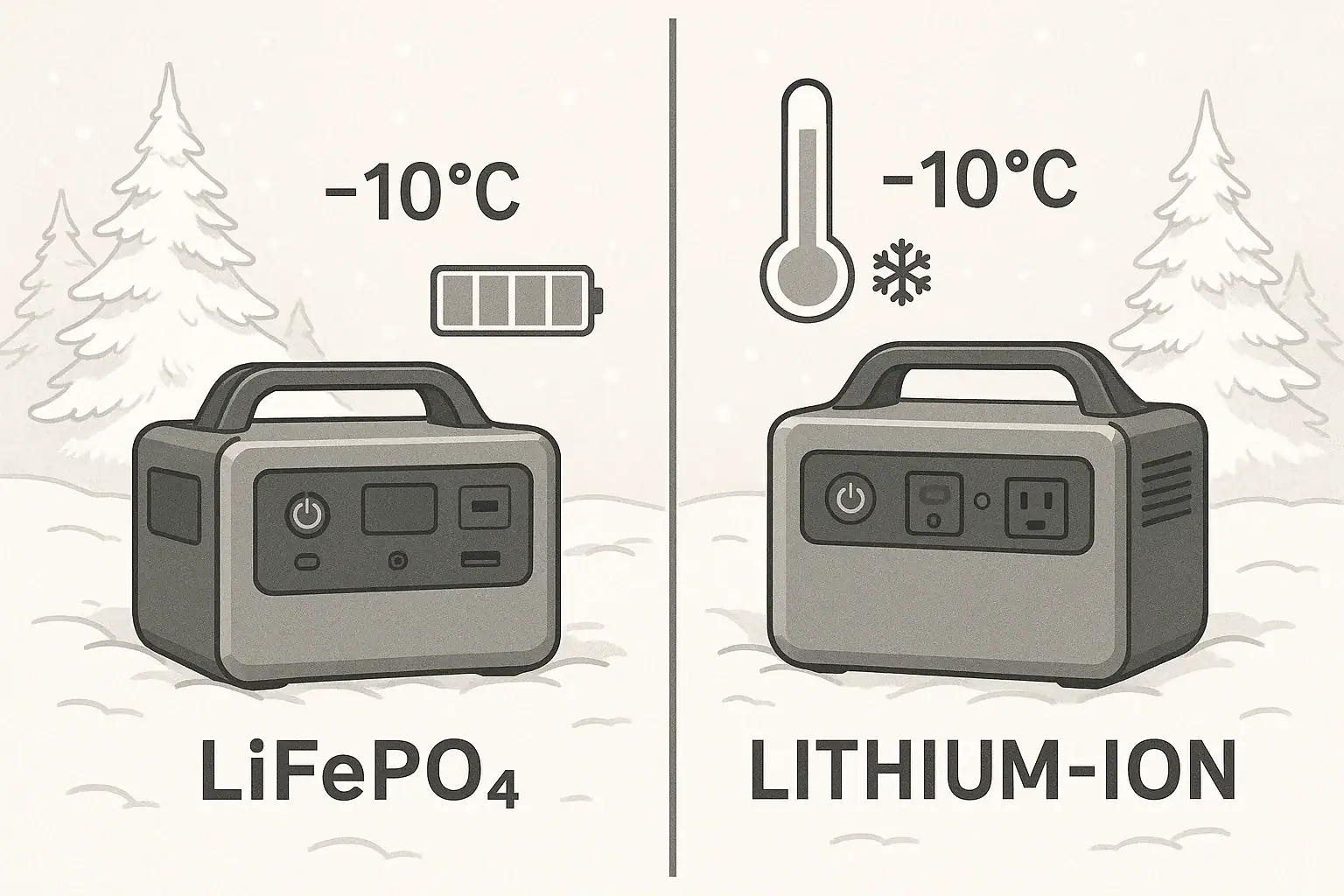
LiFePO4 vs Lithium-Ion in Cold Weather: Which Holds Up Better?

Portable power stations with LiFePO4 and lithium-ion batteries operating in cold weather snow.

In cold weather, LiFePO4 batteries usually hold voltage more steadily but lose usable capacity faster, while other lithium-ion chemistries can deliver more power at very low temperatures but degrade quicker over time. For portable power stations, this affects runtime, charging speed, and whether your unit will even start in freezing conditions. People search for answers using terms like battery runtime, low temperature limit, cold crank behavior, depth of discharge, and cycle life.

Understanding how LiFePO4 vs lithium-ion react to the cold helps you avoid dead power stations, failed starts, and permanent battery damage. The right chemistry and settings can mean the difference between a reliable winter backup and a brick when you most need it. This guide explains what happens inside the cells, how it shows up in real-world use, and which specs matter most when you compare portable power stations for winter camping, off-grid cabins, or emergency backup.

LiFePO4 vs lithium-ion: what they are and why cold weather matters

Both LiFePO4 and lithium-ion are rechargeable lithium-based batteries, but they use different cathode materials and behave differently in cold weather. “Lithium-ion” is a broad term that usually refers to chemistries like NMC (nickel manganese cobalt) or NCA (nickel cobalt aluminum), while LiFePO4 uses lithium iron phosphate.

For portable power stations, the chemistry you choose affects three core cold-weather outcomes: whether the battery will accept a charge, how much runtime you get, and how long the battery will last over years of use. Temperature directly changes internal resistance, voltage sag, and how quickly the cells age.

In moderate cold (around 32°F / 0°C), LiFePO4 typically offers excellent cycle life and stable voltage but reduced usable capacity. In deeper cold (well below freezing), many lithium-ion chemistries may still deliver bursts of power but can suffer faster long-term degradation and higher risk if charged outside their safe limits.

Because portable power stations are often used for backup power, winter camping, tailgating, or in unheated garages, understanding the differences between LiFePO4 and lithium-ion in the cold helps you pick a system that will actually work when temperatures drop.

How cold affects LiFePO4 and lithium-ion batteries inside a portable power station

Cold weather changes how ions move inside the battery. As temperature drops, the electrolyte becomes less conductive, and the chemical reactions that move lithium ions between anode and cathode slow down. This affects LiFePO4 and other lithium-ion chemistries in slightly different ways.

Internal resistance and voltage sag

At low temperatures, internal resistance increases. That means:

  • More voltage sag under load (the voltage drops more when you turn on a device).
  • Reduced peak power output (inverter may shut down earlier on high-watt loads).
  • Lower apparent capacity (the battery reaches its cutoff voltage sooner).

LiFePO4 already has relatively high internal resistance compared to some lithium-ion chemistries at room temperature, and this difference becomes more noticeable in the cold. The result is that a LiFePO4 pack might hit its low-voltage cutoff earlier under the same load, even if the actual stored energy is similar.

Charge acceptance and low-temperature charging limits

Charging is more sensitive to cold than discharging. Both LiFePO4 and other lithium-ion batteries can be damaged if charged too quickly when cold, especially below freezing. Lithium plating can occur on the anode, leading to permanent capacity loss and safety risks.

Typical behavior in a portable power station:

  • Above about 32°F (0°C): Most systems allow normal charge current, though with slightly reduced efficiency.
  • Between roughly 14°F and 32°F (-10°C to 0°C): Many battery management systems (BMS) will reduce charge current or switch to a slow charge profile.
  • Below about 14°F (-10°C): Many BMS designs will block charging entirely to prevent damage.

LiFePO4 is particularly sensitive to charging below freezing, so well-designed systems rely heavily on BMS protections or internal heaters to manage cold charging. Other lithium-ion chemistries may tolerate slightly lower charge temperatures, but repeated cold charging still accelerates wear.

Capacity loss and runtime in the cold

All lithium-based batteries show apparent capacity loss in cold weather because the reactions slow down and internal resistance rises. A pack rated for 100% capacity at 77°F (25°C) might only deliver 60–80% at 14°F (-10°C), depending on chemistry and discharge rate.

LiFePO4 tends to show more noticeable capacity loss at low temperatures compared with some NMC/NCA lithium-ion cells, especially at higher discharge rates. However, LiFePO4 also tends to recover more of its capacity when warmed back up, and its long-term cycle life remains strong if it has been protected from cold charging.

BMS behavior and cold-weather protections

The battery management system is the gatekeeper. In modern portable power stations, the BMS monitors cell temperature, voltage, and current, and it may:

  • Block charging below a set temperature.
  • Limit discharge current when cells are cold.
  • Shut the system down if temperature falls outside safe bounds.
  • Coordinate with internal heaters to raise battery temperature before charging.

Some LiFePO4-based systems include active self-heating, allowing the pack to warm itself using a portion of the incoming charge, then resume full charging once safe. Many basic lithium-ion systems rely solely on passive temperature limits and may simply refuse to charge in deep cold.

Cold-weather behavior differences between LiFePO4 and common lithium-ion chemistries in portable power stations. Example values for illustration.
ParameterLiFePO4Typical lithium-ion (NMC/NCA)
Nominal cell voltage~3.2 V~3.6–3.7 V
Relative capacity at 32°F (0°C)~75–85%~80–90%
Relative capacity at 14°F (-10°C)~55–75%~60–80%
Cold charge toleranceMore sensitive; strict BMS limits commonSlightly more tolerant but still limited
Cycle life (moderate temps)Often higherOften lower
Voltage stability under loadVery stable until cutoffMore gradual sag

Real-world cold-weather scenarios for LiFePO4 and lithium-ion power stations

Understanding lab behavior is useful, but what matters is how your portable power station performs at a campsite, in a vehicle, or during a winter outage. Here are common scenarios that highlight the differences between LiFePO4 and other lithium-ion chemistries in the cold.

Winter camping at freezing temperatures

Imagine an overnight trip where temperatures drop to around 32°F (0°C). You use a portable power station to run LED lights, charge phones, and power a small DC fridge.

  • LiFePO4 unit: You may see a noticeable drop in displayed remaining capacity overnight, and the fridge might trigger low-voltage cutoffs sooner when the compressor starts. However, the battery voltage remains relatively flat until near the end, making runtime somewhat predictable.
  • Lithium-ion unit: You may get slightly longer runtime at the same temperature and loads, with a bit more tolerance to short compressor surges. The trade-off is that repeated deep discharges and cold use can shorten long-term cycle life more than with LiFePO4.

Vehicle-based power in sub-freezing weather

Consider a power station left in a car overnight at 14°F (-10°C), then used to power a tire inflator and charge a laptop in the morning.

  • Start-up behavior: Some LiFePO4-based units may initially refuse to charge from the vehicle outlet until the internal pack warms up. Discharge may still be allowed but at reduced current.
  • Load handling: A high-draw device like a tire inflator can cause voltage sag. A LiFePO4 pack might hit low-voltage cutoff faster under that surge compared with certain lithium-ion packs, even if its rated capacity is similar.
  • Recovery: Once the cabin warms or the unit is brought indoors, both chemistries recover much of their apparent capacity, but the LiFePO4 may show less long-term wear if it has not been charged while still very cold.

Unheated garage or shed backup power

For backup use in an unheated garage, the power station might sit idle for weeks in temperatures hovering around or below freezing, then be expected to run tools or a sump pump during an outage.

  • LiFePO4 advantages: Very low self-discharge, long cycle life, and good calendar life mean it is more likely to retain its rated capacity over years of standby.
  • LiFePO4 limitations: If an outage occurs while the pack is very cold, initial peak power and usable capacity may be lower than expected, especially for heavy loads.
  • Lithium-ion behavior: It may deliver higher peak power in the cold but could lose capacity faster over years of storage and use, especially if regularly charged to 100% and stored hot in summer months.

Emergency indoor heating or electronics during a winter outage

During a multi-day winter outage, you might use a power station to run a low-wattage space heater (within inverter limits), communication devices, or a router.

  • Temperature moderation: Indoors, the temperature is usually less extreme, so both chemistries perform closer to their rated specs.
  • LiFePO4 benefit: The strong cycle life shines when you perform multiple deep discharges in a short period. You are less likely to notice permanent capacity loss after the event.
  • Lithium-ion consideration: The unit may work well during the event but can lose usable capacity more quickly over multiple seasons of similar use, particularly if often charged to 100% and stored at high state of charge.

Common cold-weather mistakes and troubleshooting signs

Many cold-weather battery problems come from using or charging portable power stations outside their recommended temperature range. Recognizing the symptoms can help you avoid permanent damage.

Trying to fast charge below freezing

One of the biggest mistakes is forcing a fast charge when the battery is below 32°F (0°C), especially for LiFePO4. Symptoms include:

  • Charging suddenly stops or never starts, even though AC or solar input is present.
  • Charge rate is much lower than usual (for example, only a fraction of the normal wattage).
  • Error icons or temperature warnings on the display.

These are often protective actions by the BMS. If you bypass them using external chargers or workarounds, you risk lithium plating and permanent capacity loss. The correct response is to bring the unit into a warmer environment and allow it to reach a safe temperature before charging.

Expecting summer runtime in winter conditions

Another common issue is assuming the same runtime in winter as in summer. Signs of cold-related capacity loss include:

  • Battery percentage dropping faster than expected under familiar loads.
  • Inverter shutting off early when starting a compressor, pump, or heater fan.
  • DC outputs cutting out while the display still shows significant charge remaining.

This is usually not a defect but a combination of increased internal resistance and low-temperature voltage behavior. LiFePO4 in particular may hit its low-voltage cutoff quickly under high loads in the cold, even when the state of charge is not truly near zero.

Leaving the unit fully depleted in the cold

Storing a power station at very low state of charge in cold conditions can cause issues for both LiFePO4 and lithium-ion chemistries. Warning signs include:

  • Unit will not turn on after long storage.
  • Battery percentage reads 0% and does not rise even when plugged in immediately.
  • Display flickers or resets when you try to start a load.

Some BMS designs enter a deep sleep mode to protect the cells when voltage is very low. Recovery may still be possible by leaving the unit on charge for an extended period in a warm environment, but repeated deep storage depletion shortens lifespan for any lithium-based battery.

Ignoring BMS temperature warnings

If the display shows a temperature or battery warning, do not keep trying to restart or override it. Repeated resets can stress the cells and internal electronics. Instead:

  • Move the power station to a moderate-temperature area.
  • Let it sit unplugged for a while so internal temperature equalizes.
  • Try a low-power load or a gentle charge source first to confirm stable operation.

If warnings persist at normal room temperature, contact the manufacturer or a qualified technician, as the issue may be more than just cold-weather behavior.

Cold-weather safety basics for LiFePO4 and lithium-ion power stations

Safety in cold weather is mostly about preventing charging damage and avoiding unsafe workarounds. While both LiFePO4 and other lithium-ion chemistries can be very safe when managed correctly, cold conditions increase the risk of misuse.

Respect the operating temperature range

Each portable power station has a specified operating temperature range for charging and discharging. Typical ranges might be:

  • Charging: around 32°F to 104°F (0°C to 40°C), sometimes with narrower limits for LiFePO4.
  • Discharging: around 14°F to 104°F (-10°C to 40°C), with some variation.

Do not assume the discharge range equals the charge range. Charging is usually more restricted. If your environment is below the minimum charge temperature, let the unit warm up before connecting AC or solar input.

Avoid DIY heating methods

It is tempting to warm a cold battery with external heat, but many methods are unsafe. Avoid:

  • Placing the power station directly against heaters or stoves.
  • Using heating pads or blankets not designed for electronics.
  • Covering air vents or blocking cooling paths to “trap” heat.

Instead, bring the unit into a temperature-controlled space and allow it to warm gradually. Some systems have built-in heaters managed by the BMS; rely on those rather than improvised external heat.

Do not bypass the BMS or open the case

Never attempt to open the power station to warm or charge the cells directly, bypass temperature sensors, or modify the battery pack. This can:

  • Defeat over-temperature and low-temperature protections.
  • Increase the risk of internal short circuits.
  • Void warranties and create fire hazards.

If the unit repeatedly refuses to charge or operate within its stated temperature range, seek professional support instead of attempting internal repairs.

Use appropriate extension cords and placement

In cold-weather setups, you may place the power station indoors and run extension cords outdoors to loads. To stay safe:

  • Use cords rated for outdoor use and appropriate current.
  • Avoid running cords through door gaps where they can be pinched.
  • Keep the power station on a dry, stable surface away from snow, ice, and condensation.

For any connection to home circuits, consult a qualified electrician and use approved transfer equipment. Do not attempt to wire a portable power station directly into a panel or backfeed outlets.

Cold-weather safety and storage considerations for LiFePO4 and lithium-ion portable power stations. Example values for illustration.
AspectLiFePO4Typical lithium-ion (NMC/NCA)
Typical safe charge temp~32–113°F (0–45°C)~32–113°F (0–45°C)
Typical safe discharge temp~14–140°F (-10–60°C)~-4–140°F (-20–60°C)
Cold charging riskHigh; plating risk below 32°FHigh; plating risk below 32°F
Built-in heatersCommon in newer designsPresent in some models
Self-discharge in storageVery lowLow to moderate

Related guides: Winter Use: Why Charging Slows in Cold Weather and How to Plan Around ItWinter Storage Checklist: Keeping Batteries Healthy in the ColdLiFePO4 vs NMC Batteries: Weight, Cold Performance, Safety, and Real Cycle Life Differences

Practical takeaways and cold-weather specs to compare

For cold climates, the choice between LiFePO4 and other lithium-ion chemistries comes down to priorities. LiFePO4 usually offers superior cycle life, stable voltage, and excellent long-term value, but feels the cold more in terms of immediate capacity and charge acceptance. Other lithium-ion chemistries can perform slightly better at very low temperatures in the short term but often wear out faster over years of use.

In real-world portable power station use:

  • If you value long-term durability, frequent cycling, and predictable performance in moderate cold (around freezing), LiFePO4 is often attractive.
  • If you need high surge output and are operating in more extreme cold, a well-managed lithium-ion system with robust BMS protections can deliver strong short-term performance, as long as you respect its charge limits.

In both cases, system design matters as much as chemistry. Battery heaters, conservative charge profiles, and accurate temperature sensing can dramatically improve cold-weather reliability.

Specs to look for

  • Operating temperature range (charge/discharge) – Look for clearly stated charge and discharge ranges, for example, charging from 32–104°F (0–40°C). Wider, well-documented ranges indicate better cold-weather engineering.
  • Low-temperature charge protection – Check for automatic charge cutoff or reduced current below freezing. This protects LiFePO4 and lithium-ion cells from plating damage in cold conditions.
  • Integrated battery heating – Some units include self-heating that activates before charging in the cold. This feature can make winter solar or vehicle charging far more reliable.
  • Rated cycle life at 80% capacity – Look for realistic cycle life numbers (for example, 2,000–4,000+ cycles) at standard depth of discharge. Higher values suggest the chemistry and BMS are optimized for longevity, especially important for LiFePO4.
  • Usable capacity vs. rated capacity – Pay attention to whether the system allows deep discharge (for example, 80–90% usable) and how that holds up at low temperatures. Some systems reduce usable capacity aggressively in the cold.
  • Continuous and surge output at low temps – If specified, compare continuous watts and surge watts at lower temperatures. This helps predict whether cold will cause early inverter shutdowns when starting motors or compressors.
  • State-of-charge and temperature monitoring – A clear display showing battery percentage, estimated runtime, and internal temperature helps you adjust usage in cold weather before protections kick in.
  • Self-discharge and standby drain – Look for low self-discharge rates and minimal idle consumption. This matters when leaving a power station in a cold garage or vehicle for weeks between uses.
  • Recommended storage state of charge – Guidance such as storing at 40–60% charge at moderate temperatures indicates the manufacturer has considered long-term battery health, especially relevant for seasonal cold-weather users.

By focusing on these specs instead of just chemistry labels, you can choose a portable power station that stays dependable when temperatures drop, whether it uses LiFePO4 or another lithium-ion formulation.

Frequently asked questions

What specs and features should I prioritize for reliable cold-weather performance?

Look for a clearly stated operating temperature range for both charging and discharging, low-temperature charge protection, and whether the unit has integrated self-heating. Also compare usable capacity at low temperatures, continuous/surge output specs at cold temps, and clear state-of-charge and temperature monitoring on the display.

Is it OK to try charging a portable power station when it’s below freezing?

Generally no—charging below freezing can cause lithium plating on the anode and permanent capacity loss. Most modern BMSs will reduce charge current or block charging below safe thresholds; the safest approach is to warm the unit to the recommended charge temperature or use a system with managed heaters.

How can I manage battery temperature safely during winter use?

Keep the power station in a temperature-controlled space when possible, run loads or extension cords outdoors rather than moving the unit into cold conditions, and rely on built-in BMS heaters instead of improvised external heat sources. Follow the manufacturer’s guidance and avoid covering vents or placing the unit against high-heat surfaces.

Why does my power station show reduced runtime in cold weather even when the percentage seems high?

Cold increases internal resistance and causes greater voltage sag under load, so the pack can hit its low-voltage cutoff sooner even though the state-of-charge indicator still shows capacity. Warming the battery typically restores much of the apparent capacity.

What’s a common user mistake that shortens battery life in cold climates?

Forcing charges or bypassing BMS protections when the pack is cold is a common mistake that accelerates wear and can cause permanent damage. Long-term habits like regularly storing at 100% state of charge or repeatedly deep-discharging in cold conditions also reduce lifespan.

Winter Use: Why Charging Slows in Cold Weather and How to Plan Around It

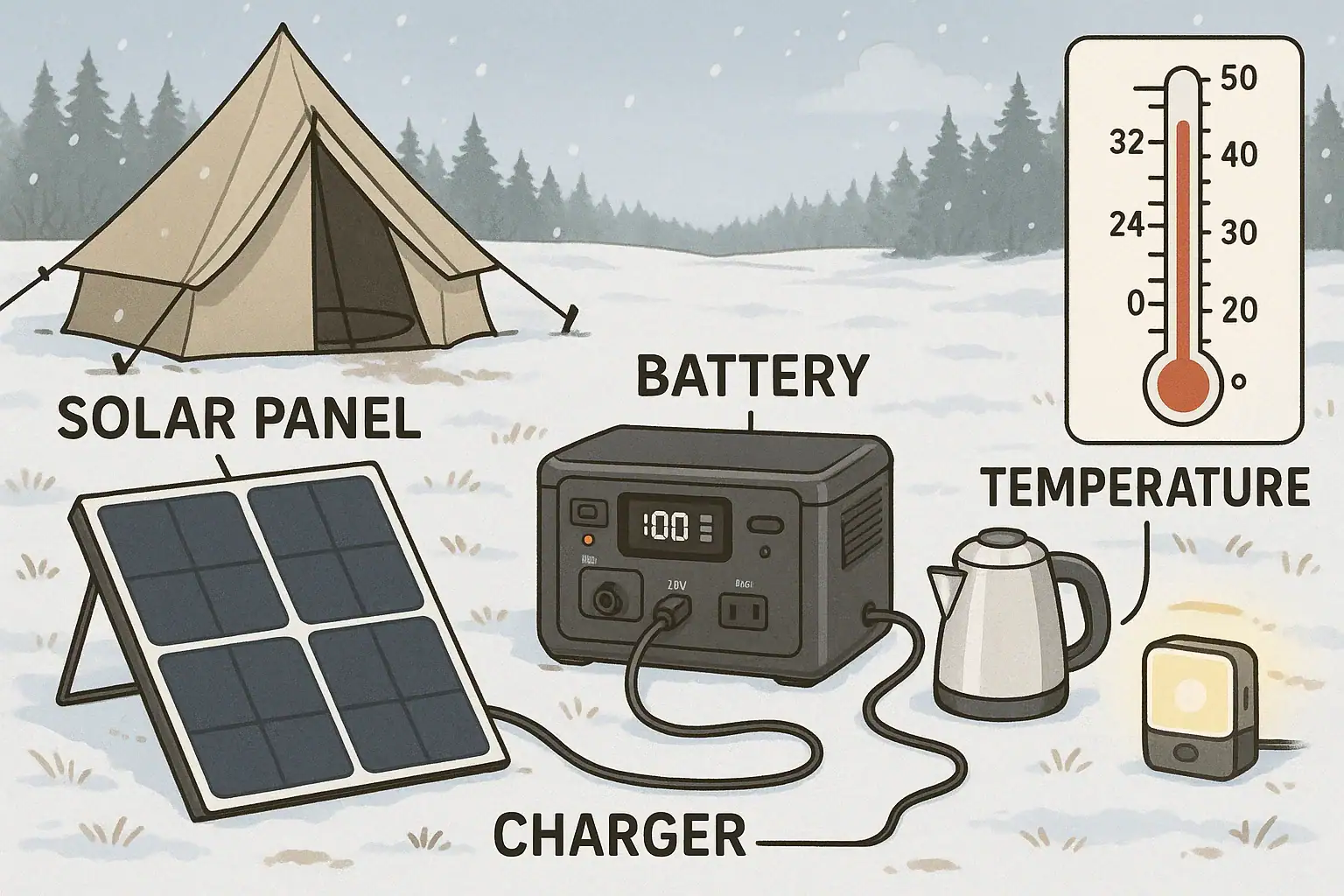
Portable power station charging slowly in cold winter weather at a campsite

Charging slows in cold weather because low temperatures reduce battery chemistry activity and trigger built‑in protection limits that cut charging current and input watts. Portable power stations automatically restrict charge rate, adjust voltage, or pause charging to avoid damage when the battery pack is too cold. That is why you see lower input watts, longer charge time, and sometimes “temperature” or “low temp” warnings on the display during winter use.

If you rely on a portable power station for winter camping, backup power, off‑grid cabins, or van life, cold‑weather charging behavior matters. Understanding how temperature affects charge rate, runtime, state of charge (SoC) accuracy, and solar input lets you plan around slower charging instead of being surprised by it. With a few simple strategies—insulating the unit, pre‑warming, adjusting your charge schedule, and choosing the right specs—you can keep winter performance predictable and safe.

This guide explains what is happening inside the battery, why your charge time estimate changes, how different chemistries behave in the cold, and what to look for when comparing portable power stations for cold‑weather use.

Cold-Weather Charging: What It Means and Why It Matters

Cold‑weather charging is any situation where you charge a portable power station while its battery is below normal room temperature, especially near or below freezing. In this range, the charger and battery management system (BMS) automatically change how fast the battery can accept energy.

For users, this shows up as reduced input watts, longer charge time, and sometimes a charge that stops before reaching 100% until the battery warms up. You might also see the estimated runtime jump around because the state of charge reading becomes less accurate when the cells are cold.

This matters because many people depend on portable power stations for critical winter tasks: running a CPAP overnight, powering communication devices, keeping a small heater fan or furnace blower running, or supporting tools on a job site. If you expect a two‑hour recharge from wall power or solar and it actually takes four hours in low temperatures, your entire power plan can fail.

Understanding cold‑weather charging helps you:

  • Estimate realistic charge time in winter conditions.
  • Avoid forcing the battery to charge when it is too cold, which can shorten its lifespan.
  • Decide where to place the power station (indoors vs. outdoors, insulated vs. exposed).
  • Choose models and specs that handle low temperatures better.

Instead of treating slow winter charging as a defect, it is more accurate to see it as a built‑in safety feature. Once you know how it works, you can plan around it.

How Temperature Affects Battery Charging Inside a Portable Power Station

Portable power stations rely on lithium‑based batteries, usually either lithium iron phosphate (LiFePO4) or lithium‑ion variants such as NMC. Both chemistries are sensitive to temperature, and their safe charging window is narrower than their safe discharging window.

At the cell level, low temperatures slow down the chemical reactions that move lithium ions between electrodes. When you try to push the same charging current into a cold cell, ions can plate onto the surface of the anode instead of inserting into it. This lithium plating is permanent damage that reduces capacity and can increase internal resistance and safety risk. To prevent this, the BMS and charger reduce current or stop charging when the battery is too cold.

Most portable power stations monitor:

  • Cell temperature: Internal sensors track how warm or cold the pack is.
  • Input current and power: The BMS caps the charge amps or watts based on temperature.
  • Voltage: The charger adjusts its profile (constant current/constant voltage) to stay within safe limits.

As the battery gets colder, several things happen:

  • Charge current limit drops: The system may cut maximum input from, for example, 400 W at room temperature down to 100–200 W or less in the cold.
  • Internal resistance rises: More energy is lost as heat, and the pack cannot accept high power efficiently.
  • Usable capacity shrinks temporarily: You might only see 60–80% of the usual watt‑hours available until the battery warms up.
  • SoC estimation becomes less accurate: Voltage‑based fuel gauges can misread charge level when the battery is cold, especially under load.

Some portable power stations include built‑in battery heaters or “low‑temperature charging” features. These systems divert part of the input power to warming the pack before allowing a higher charge rate. Others simply refuse to charge below a certain temperature, displaying a temperature warning instead of accepting power.

Solar charging in cold weather adds another layer. Solar panels often produce higher voltage in low temperatures, which can help reach the minimum MPPT input voltage. But the battery’s cold‑limited charge current still caps how much of that solar power can actually flow into the pack, so you might see the solar input fluctuate or sit below the panel’s rated watts.

Cold weather effects on portable power station charging and runtime. Example values for illustration.
Battery Temperature Typical Charge Power Limit Approx. Usable Capacity Common BMS Behavior
68°F (20°C) 80–100% of rated input (e.g., 400–600 W) 90–100% Normal charging, accurate SoC
41°F (5°C) 50–80% of rated input 80–95% Moderate current limit, slightly slower charging
32°F (0°C) 25–60% of rated input 70–90% Noticeable slowdown, possible warnings
14°F (-10°C) 0–30% of rated input 50–80% Severely limited or disabled charging

Real-World Winter Scenarios: What Slow Charging Looks Like

In practice, cold‑weather charging issues show up differently depending on how and where you use your portable power station. Seeing specific scenarios helps you recognize normal behavior versus real problems.

Winter Camping and Overlanding

Imagine winter camping with overnight lows around 20°F (−6°C). You leave your portable power station in the unheated tent vestibule, running LED lights and a small 12 V fridge. By morning, the battery is cold and at 40% SoC. When you connect a 400 W AC charger from a nearby cabin outlet, the display only shows 120–150 W of input and estimates 4–5 hours to full instead of the usual 2 hours.

This is typical behavior: the BMS is limiting current to protect the cold battery. If you move the unit inside the cabin for 30–60 minutes and then plug it in again, you may see the input rise to 300–400 W as the battery warms.

Van Life and RV Use in Freezing Conditions

For van dwellers, the power station might sit on the floor near a door, where temperatures overnight drop close to freezing. In the morning, you start driving and expect the alternator or DC‑DC charger to push 300 W into the station. Instead, you see 80–150 W for the first hour, slowly increasing as the van interior warms.

Solar input behaves similarly. On a clear, cold morning, your panels may be capable of 500 W, but the power station only accepts 200–250 W until the pack temperature rises. If you do not account for this delayed ramp‑up, you might assume something is wrong with your solar setup.

Emergency Backup During Winter Outages

During a winter power outage, you may keep the portable power station in an unheated garage to run a sump pump or charge phones. After several hours of use, you bring it inside to charge from a small generator. Because the pack is cold and partially depleted, the BMS may limit charge current, so your generator runs for longer than expected to refill the battery.

If you are powering sensitive loads like medical devices, the combination of reduced usable capacity and longer recharge time can be critical. Planning extra runtime margin and bringing the unit into a warmer space before charging becomes essential.

Job Sites and Outdoor Work

On winter job sites, portable power stations often sit on concrete or in the back of a truck. At 15–25°F (−9 to −4°C), tools may still run, but charging between tasks is slow. Even if you plug into a high‑power AC circuit, the unit might only accept a fraction of its rated input. Workers sometimes misinterpret this as a faulty charger when it is simply temperature‑limited charging.

Common Cold-Weather Mistakes and Troubleshooting Clues

Many winter charging problems are avoidable once you recognize how temperature interacts with charge rate and runtime. Here are typical mistakes and what to look for when troubleshooting.

Mistake 1: Leaving the Power Station Fully Exposed to the Cold

Storing the unit in the open bed of a truck, on frozen ground, or in an uninsulated shed leads to a very cold battery pack. Even if the display shows an acceptable ambient temperature, the cells themselves can be much colder, especially after sitting overnight. The result is slow or refused charging when you finally plug in.

Troubleshooting cue: If charge power is low and you see a temperature icon, snowflake symbol, or “low temp” message, move the unit into a warmer space and wait 30–60 minutes before trying again.

Mistake 2: Assuming Rated Input Watts Apply in All Conditions

Manufacturers list maximum AC and solar input at ideal temperatures. Users often plan charge time using these values without accounting for cold‑weather derating. In freezing conditions, actual input may be half—or less—of the rated figure.

Troubleshooting cue: Compare your observed input watts at room temperature to what you see in the cold. If the charger delivers full power indoors but not outdoors, temperature limits are the likely cause, not a defective adapter.

Mistake 3: Fast Charging a Very Cold Battery

Trying to force fast charging immediately after the unit has been in sub‑freezing conditions can stress the battery, even if the BMS allows some current. Repeatedly doing this can shorten long‑term capacity and increase internal resistance.

Troubleshooting cue: If the case feels very cold to the touch and you notice the fan running hard or the unit making more noise than usual during charging, pause and let it warm up before continuing.

Mistake 4: Misreading Winter Runtime as Permanent Capacity Loss

Usable capacity temporarily reduces in the cold, so your power station might appear to “shrink” in winter. Users sometimes assume the battery is worn out when it simply needs to warm up.

Troubleshooting cue: Run the same load test at room temperature and at near‑freezing temperatures. If capacity is normal indoors but lower outdoors, the battery is probably healthy and just cold‑limited.

Mistake 5: Blocking Ventilation While Trying to Insulate

Wrapping the power station tightly in blankets or foam to keep it warm can block air vents. During charging, this may cause overheating or force the BMS to throttle power for the opposite reason—too much heat.

Troubleshooting cue: If input watts drop after a few minutes of charging and the fan runs continuously, check that vents are clear and the unit can breathe while still being protected from the cold floor or direct drafts.

Cold-Weather Charging Safety Basics

Winter conditions add both cold‑related and general electrical safety concerns. Following a few high‑level rules helps protect you, your devices, and the battery pack.

  • Respect the specified temperature range: Never attempt to charge a portable power station below its stated minimum charging temperature. If the unit blocks charging, do not try to bypass protections.
  • Avoid DIY heating tricks: Do not use open flames, heating pads, or improvised heaters directly on the power station. Instead, bring it into a moderately warm space and let it equilibrate naturally.
  • Keep the unit dry: Snow, condensation, and slush can introduce moisture into ports and vents. Use weather‑resistant placement and keep the unit off wet ground.
  • Use rated cords and adapters: In cold weather, cables become stiff and more prone to cracking. Use properly rated, undamaged cords and avoid tight bends that could damage insulation.
  • Do not overload the inverter: Cold temperatures already stress the battery. Avoid running surge‑heavy loads near the inverter’s maximum continuous watt rating, especially when the battery is low and cold.
  • Monitor the unit while charging: In winter, check the display periodically for temperature warnings, unexpected shutdowns, or rapid swings in input power.
  • For home backup integration, use a professional: If you intend to connect a portable power station to home circuits, consult a qualified electrician and use proper transfer equipment rather than improvised wiring.

Winter Storage, Transport, and Long-Term Care

How you store and transport a portable power station in cold seasons has a major impact on both immediate performance and long‑term battery health.

Storing in Cold Climates

If you store the unit in a garage, shed, or RV over winter, aim for a location that stays above freezing when possible. Extreme cold does not usually cause immediate failure, but repeated deep cold cycles can accelerate aging.

  • Store at partial charge: Keeping the battery around 30–60% SoC for long storage reduces stress compared to 0% or 100%.
  • Avoid full discharge in the cold: Letting the battery sit empty in low temperatures can increase the risk of it falling into a deep‑discharge state that the charger may not recover.
  • Check periodically: Every 2–3 months, bring the unit into a warmer space, check SoC, and top up slightly if it has dropped significantly.

Transporting in Winter

When transporting a portable power station in a vehicle during winter:

  • Keep it inside the cabin rather than in an open bed if possible.
  • Use a padded case or insulated box to moderate rapid temperature swings.
  • Avoid leaving it for long periods in a locked, unheated car at sub‑freezing temperatures.

Pre-Warming Before Charging

Before connecting to AC, DC, or solar input after the unit has been in the cold:

  • Bring it into a space around 50–70°F (10–21°C) for at least 30 minutes.
  • Let internal condensation evaporate if it has moved from very cold to humid conditions.
  • Start with a moderate charge rate if adjustable, then increase once the battery has warmed.

Balancing Winter Use and Battery Lifespan

Occasional cold‑weather use is expected and supported by modern portable power stations, but repeated fast charging in very low temperatures can shorten lifespan. To balance performance and longevity:

  • Use the fastest charging modes mainly at moderate temperatures.
  • In harsh winter conditions, accept slower charging as a trade‑off for longer battery life.
  • Whenever possible, schedule heavy charging sessions for warmer parts of the day or indoors.
Winter storage and use guidelines for portable power stations. Example values for illustration.
Situation Recommended SoC Temperature Goal Charging Advice
Long-term winter storage 30–60% Above 32°F (0°C) if possible Top up briefly every 2–3 months
Daily winter use 20–80% Keep unit insulated from extreme cold Charge indoors or during warmer hours
Emergency outage 40–100% Indoor placement preferred Expect slower charging, plan extra time
Vehicle transport 30–80% Interior cabin instead of open bed Pre‑warm before high‑power charging

Related guides: Charging in Freezing Temperatures: Why It’s Risky and How to Avoid DamageWinter Storage Checklist: Keeping Batteries Healthy in the ColdTemperature Limits Explained: Safe Charging/Discharging Ranges and What Happens Outside Them

Planning Around Slow Winter Charging: Practical Steps and Key Specs

Planning for cold‑weather performance turns slow winter charging from an unpleasant surprise into a manageable constraint. Focus on three areas: how you use the unit, where you place it, and which specs you prioritize when choosing a portable power station.

Usage and Placement Strategies

  • Charge earlier and longer: In winter, assume your charge time might double compared to room‑temperature conditions. Start charging as soon as you have AC, DC, or solar available instead of waiting until the battery is low.
  • Keep the battery as warm as safely possible: Place the unit in a tent, cabin, or vehicle interior rather than fully outdoors. Use a box or soft insulation under and around it while keeping vents clear.
  • Prioritize critical loads: When capacity is reduced by cold, power essentials first (medical devices, communication, heating controls) and delay non‑essential loads until the battery is warmer and better charged.
  • Align solar with warmer hours: If you rely on solar input, angle panels for low winter sun and expect the best charging between late morning and mid‑afternoon when both irradiance and temperatures are higher.

Choosing Cold-Weather-Friendly Features

When evaluating portable power stations for use in cold climates, certain specifications and design features are especially important.

Specs to look for

  • Charging temperature range: Look for clearly stated minimum charging temperatures (for example, around 32–41°F / 0–5°C). A wider supported range means more flexibility in winter without manual pre‑warming.
  • Battery chemistry: Compare LiFePO4 versus other lithium‑ion chemistries. LiFePO4 often offers longer cycle life, while some NMC‑type packs may have slightly better cold‑temperature performance. Choose based on how often you expect sub‑freezing use.
  • Maximum AC and DC input watts: Higher rated input (e.g., 400–1,000 W) gives more headroom. Even when cold derating cuts this in half, you still get practical charge power for shorter winter top‑ups.
  • Solar input voltage and watt limits: A flexible MPPT range and higher solar watt capacity (for example, 300–800 W) help compensate for shorter winter days and lower sun angles.
  • Low-temperature charging protection: Look for explicit mention of low‑temp charging protection, including automatic current reduction or charge cutoff, to prevent lithium plating and extend battery life.
  • Built-in battery heating or pre-heat modes: Some systems can warm the battery using grid or solar input before full‑power charging. This feature can dramatically improve usability in consistently cold environments.
  • Display and app temperature readouts: A screen or app that shows pack temperature and clear temperature warnings helps you understand when slow charging is normal and when you should move or warm the unit.
  • Usable capacity at low temperatures: If available, compare stated or tested capacity at 32°F (0°C) versus 68°F (20°C). Smaller percentage drop means more reliable winter runtime.
  • Enclosure and port design: Recessed ports, protective covers, and robust cases help keep moisture and snow away from electrical contacts during outdoor winter use.
  • Cycle life and warranty: Higher cycle ratings and solid warranty coverage provide a buffer if you expect frequent cold‑weather charging, which is more demanding on the battery over time.

By combining realistic expectations about winter charge time with thoughtful placement and the right feature set, you can rely on a portable power station year‑round, even when temperatures drop well below freezing.

Frequently asked questions

What specifications and features matter most when buying a portable power station for cold weather?

Look for a clearly stated minimum charging temperature, a chemistry suited to your use (LiFePO4 or other lithium variants), and higher maximum AC/DC and solar input watts so derating still provides useful charge power. Built‑in preheat or battery‑heating modes, an MPPT with a wide input voltage range, and temperature readouts on the display or app are also valuable for winter reliability.

How does placing a power station on cold ground or leaving it in an unheated vehicle affect charging?

Cold placement lowers cell temperature, which increases internal resistance and triggers the BMS to reduce or stop charging to avoid lithium plating. That results in lower input watts and much longer charge times until the pack warms, so keeping the unit off frozen surfaces or inside a warmer space improves charging speed.

Is it safe to use external heaters or DIY heating methods to warm a battery before charging?

Using open flames, direct‑contact heating pads, or improvised heaters is unsafe and not recommended. The safer approach is to move the unit into a moderately warm environment or use manufacturer‑approved preheat modes; avoid methods that can overheat components or introduce moisture.

Why does solar seem to produce less charge power on cold mornings even when panels are sunny?

Cold air can improve panel output voltage and even efficiency, but the battery pack’s cold‑limited charge current still caps how much solar energy the BMS will accept. The MPPT may show higher panel power while the power station only accepts a lower wattage until the battery warms up.

How much longer should I expect charging to take at freezing temperatures?

Charge time can easily double or more near freezing compared with room temperature, depending on the unit and conditions. Expect significantly reduced input watts and plan for slower ramps; pre‑warming the pack or scheduling charging during warmer daylight hours shortens overall time.

Will frequent charging in cold weather permanently damage the battery?

Repeated fast charging while the pack is very cold increases the risk of lithium plating, which reduces capacity and raises internal resistance over time. Occasional cold‑weather use is generally supported, but regularly charging without proper preheating or BMS protection can accelerate degradation.

Leaving a Power Station in a Hot Car: Heat Risks and Safe Habits

portable power station at a snowy campsite scene

What the topic means and why heat in cars matters

Leaving a power station in a hot car means storing or transporting a portable power unit inside a vehicle that is parked in direct sun or warm weather. Interior car temperatures can climb far above the outdoor air temperature, especially on sunny days with closed windows. This creates a harsh environment for any battery-powered device, including portable power stations.

Portable power stations typically use lithium-based batteries, which are sensitive to temperature. Excessive heat accelerates chemical reactions inside the cells, which can speed up aging and raise the risk of failure. While devices include built-in protections, they are not designed to live in extreme temperatures for long periods.

This topic matters because many people use power stations for camping, road trips, and remote work, where leaving the unit in the vehicle seems convenient. Understanding how heat interacts with watt-hours, output loads, and charging efficiency helps you avoid performance loss and safety issues. With a few informed habits, you can reduce risk without giving up the flexibility that makes portable power stations useful.

Thinking about heat is part of a broader view of capacity, sizing, and safe use. The same concepts that guide you when matching wattage to appliances also apply when deciding how and where to store the unit. Heat is simply another load on the system, one that quietly affects lifespan, runtime, and reliability.

Key concepts and sizing logic under heat stress

Two capacity numbers matter when thinking about a hot car: watts and watt-hours (Wh). Watts describe how much power your devices draw at a moment in time, while watt-hours describe how much energy the battery can store. Heat does not change these ratings on the label, but it can reduce the usable capacity and efficiency you actually see, especially at the high and low ends of the temperature range.

Most appliances list watts as their running power, but they may also require surge power to start. A portable power station’s inverter needs to handle both the steady running watts and the short surge. In hot conditions, the inverter and internal electronics may reach thermal limits more quickly, forcing the unit to reduce output or shut down to protect itself. This means a setup that works fine in a cool room might struggle inside a hot vehicle.

Efficiency losses also increase with heat. Internal resistance rises as components get hotter, which means more energy is lost as heat instead of going to your devices. When left in a hot car, the battery may charge more slowly, stop charging altogether, or refuse to deliver full power until it cools down. These behaviors are usually built-in safeguards rather than failures.

State of charge (SOC) interacts with temperature as well. Keeping a battery at 100% and in high heat for extended periods can accelerate aging. From a sizing perspective, planning some extra capacity helps you avoid operating at extremes. Instead of sizing your system to be just enough under ideal conditions, consider a margin that accounts for heat-related losses and the reality that runtime in a hot environment can be shorter.

Heat-aware sizing and use checklist – Example values for illustration.
What to checkWhy it matters in heatNotes
Label watt-hours (Wh)Indicates stored energy; actual usable Wh can drop in very hot conditions.Plan with a margin instead of assuming full label capacity.
Continuous watts ratingHigh loads generate more internal heat, stressing components faster.Running near the limit in a hot car increases shutoff risk.
Surge watts capacityStarting appliances in heat can trigger protections sooner.Consider soft-start or lower-surge devices when possible.
Typical ambient temperatureCar interiors can exceed moderate ratings by a wide margin.Use shade, ventilation, or remove the unit when practical.
Expected runtimeHeat and inverter losses shorten practical runtime.Derate rough estimates instead of counting on ideal numbers.
Charging source (wall, car, solar)Charging adds heat on top of a hot environment.Allow time for cooling if the unit feels hot to the touch.
Duty cycle of your loadsIntermittent loads create less sustained heat inside the unit.Continuous heavy loads are more likely to cause thermal throttling.

Real-world examples of hot car impacts

Consider a mid-sized portable power station that might normally run a small 60 W fan for about 10 hours in a room at a comfortable temperature. In a hot car, with the internal temperature substantially higher, the same unit may run for noticeably fewer hours. Some of the stored energy is lost as heat within the battery and inverter rather than delivered to the fan, and the unit may shut down earlier to avoid overheating.

Now imagine using that same power station to charge a laptop and several phones during a road trip. While the car is moving with air conditioning on, the cabin stays relatively cool, and the unit operates near its rated efficiency. If the car is parked for a midday stop, and the power station is left charging in direct sunlight through the windows, its internal temperature can climb quickly. As it heats up, the car outlet charging rate may slow or stop, even though the devices plugged into it still appear connected.

A more demanding scenario would be running a compact portable refrigerator or cooler from a power station left in the back of a vehicle. The fridge cycles on and off, drawing more power in warmer conditions. Inside a hot car, the fridge runs more frequently, while the power station also runs hotter. The combined effect is shorter runtime than you would see at a campground table in the shade, even with the same starting battery level.

People using power stations for emergency backup see similar patterns. A unit that comfortably powers a few lights and a router for several hours indoors may behave differently if it is stored and used in a garage or trunk that gets very hot. Runtime can shrink, and the station might shut down unexpectedly if it does not have space to dissipate heat. Planning for these differences helps you avoid relying on best-case runtimes in worst-case conditions.

Common mistakes and troubleshooting cues in hot conditions

One common mistake is assuming that because a power station is rated for outdoor use, it is also fine to live in a closed, sunlit car. Outdoor ratings usually refer to splash resistance or dust protection, not the ability to sit for hours at temperatures far beyond typical room conditions. Leaving the unit fully charged in a hot trunk day after day can quietly shorten its lifespan.

Another frequent mistake is loading the power station near its maximum wattage while it is already hot from being in the vehicle. High load plus high ambient temperature pushes the internal components close to their thermal limits. The most common symptom is the inverter shutting off unexpectedly or the unit displaying an overload or temperature warning. Users sometimes interpret this as a defect, when it is usually a safety protection doing its job.

Charging behavior can also confuse people in hot cars. You might plug the station into a car outlet or solar panel and assume it is charging, but in reality the unit has reduced its charging current or stopped charging because it is too hot. Signs include a slower-than-expected increase in battery level, a charging indicator that turns off, or a fan that runs hard but the state of charge barely rises.

Finally, some users ignore ventilation needs. Placing the power station under a seat, stacked with bags, or wrapped in a blanket to hide it from view restricts airflow around the vents. In a hot vehicle, this can lead to aggressive fan noise, early thermal shutdowns, or warm plastic housing. When these cues appear, the safest response is to power down nonessential loads, move the unit to a cooler, shaded, and better-ventilated spot, and allow time for it to cool before resuming use.

Safety basics: placement, ventilation, cords, and heat

Proper placement is central to safe use, especially when vehicles and high temperatures are involved. A portable power station should sit on a stable, flat surface, with its vents unobstructed and away from soft materials that can insulate heat. Leaving it in a hot car under direct sun or pressed against upholstery makes it harder for internal fans to move air, increasing temperatures inside the unit.

Ventilation is important both while operating and while charging. If you must use a power station in a vehicle, it is safer to do so when the car interior is reasonably cool and there is some airflow. Avoid enclosing the device in tight compartments or stacking gear around it. Remember that inverters and chargers generate heat even at moderate loads; giving that heat somewhere to go lowers stress on the battery and electronics.

Cord management also plays a role. Power cords and extension cords should be rated for the loads you are running and routed to avoid pinching in doors, seats, or trunk lids. In a hot car, coiled cords can warm up more quickly, so try not to leave long cables tightly coiled under direct sun or near heat sources. For outdoor or damp environments, using cords with appropriate insulation and, where applicable, plugging into outlets protected by ground-fault circuit interrupters (GFCI) adds another layer of safety.

High-level electrical safety principles still apply: treat the power station’s AC outlets like any household outlet, avoid overloading circuits, and keep liquids away from both the unit and its cords. If you are considering any connection that goes beyond plugging individual devices into the power station, such as integrating it with home wiring, consult a qualified electrician rather than attempting do-it-yourself solutions. Built-in safety features will help, but thoughtful placement and attention to heat are what keep the system within its design limits.

Maintenance and storage in hot and cold conditions

Maintenance and storage practices greatly affect how well a portable power station tolerates occasional time in a vehicle. Batteries age more slowly when kept at moderate temperatures and moderate states of charge. Leaving a fully charged unit in a hot trunk all summer or in a freezing car all winter is harder on the cells than storing it indoors and only bringing it to the vehicle when needed.

Most lithium-based power stations self-discharge slowly over time, even when turned off. In a hot environment, self-discharge can be slightly faster, and the internal battery management system may periodically wake to perform checks, using a small amount of energy. Checking the state of charge every few months and topping up as needed helps keep the battery from sitting empty, which can be harmful if prolonged.

Temperature ranges matter for both storage and operation. While specific limits vary by model, a general pattern is that extreme cold can temporarily reduce available capacity, and extreme heat can permanently accelerate aging and increase risk. A car parked in direct summer sun can easily exceed common recommended storage temperatures. When possible, store the power station indoors and treat vehicle storage as temporary, not permanent.

Routine checks should include inspecting the housing, vents, and cords for damage, and listening for unusual fan noises under load. If the unit often feels very hot to the touch after being in the car, consider adjusting your habits: reduce the time it spends in parked vehicles, keep it out of direct sun, and avoid charging or running heavy loads until it cools to a more typical temperature. These small steps support both safety and long-term performance.

Storage and maintenance planner – Example values for illustration.
TaskSuggested intervalHeat-related notes
Check state of charge (SOC)Every 1–3 monthsAvoid leaving at 0% or 100% in a hot car for long periods.
Top up chargeWhen SOC falls near 20–40%Charge indoors in a cool, dry place when possible.
Visual inspectionEvery 3–6 monthsLook for discoloration, warping, or damage that could indicate heat stress.
Vent cleaningEvery 3–6 monthsGently remove dust so fans can move air efficiently in warm conditions.
Functional test under loadBefore trips or storm seasonTest in a moderate-temperature space, not inside a hot vehicle.
Vehicle storage reviewEach seasonReconsider leaving the unit in the car during peak summer heat waves.
Long-term storage planFor breaks over 6 monthsStore partially charged, in a cool room, and avoid garages that overheat.

Example values for illustration.

Practical takeaways and safer habits for hot cars

Managing heat risk with a portable power station is about habits rather than complex technical steps. Treat the unit like you would other sensitive electronics: avoid leaving it in parked cars during extreme heat if you can, and give it shade and airflow when you cannot. Even modest changes, like placing it on the cabin floor instead of the dashboard and cracking windows when safe to do so, can reduce temperature peaks.

When planning capacity and runtime for trips that involve vehicles, build in a buffer to account for heat-related losses. Assume that best-case runtimes will be shorter in a hot car, especially with continuous or high-power loads. Use the power station more heavily when the vehicle is occupied and cooler, and scale back expectations when it will sit parked in the sun.

  • Avoid routine long-term storage in vehicles; bring the unit indoors between uses.
  • Keep vents clear and avoid wrapping or burying the power station under gear.
  • Let a hot unit cool before charging or running heavy loads.
  • Watch for signs of thermal protection: fans running hard, reduced charging rate, or unexpected shutdowns.
  • Maintain a moderate state of charge for storage, and check levels regularly.
  • Use appropriately rated cords and avoid overloading outlets or circuits.

By understanding how watts, watt-hours, and temperature interact, you can make more realistic plans and use your power station with confidence. Respecting heat is simply part of using battery technology responsibly, whether your goal is camping convenience, road-trip comfort, or basic backup power at home.

Frequently asked questions

Is it safe to leave a power station in a hot car all day?

No — prolonged exposure to high interior car temperatures accelerates battery aging and can trigger thermal protections that reduce charging or shut the unit down. For safety and lifespan, avoid leaving the unit in parked vehicles during extreme heat and store it indoors when possible.

What temperature range is considered safe for operating or storing a portable power station in a vehicle?

Temperature limits vary by model, so check the manufacturer’s specifications for exact operating and storage ranges. As a rule of thumb, many lithium-based stations are designed for typical indoor ranges (often around 0–40°C for operation) and can degrade faster above those levels, so keep units shaded and ventilated in cars.

What signs indicate my power station is overheating while in a car?

Common signs include unusually hot housing to the touch, fans running loudly or continuously, reduced charging rates, temperature or overload warnings on the display, and unexpected shutdowns. If you see these cues, power down nonessential loads and move the unit to a cooler, ventilated area.

How should I position and ventilate a power station if I must leave it in a parked vehicle for a short time?

Place the unit on a stable, low surface out of direct sunlight—such as the cabin floor rather than the dashboard or rear window—and avoid covering vents or stacking gear around it. If safe, crack windows for airflow, and avoid charging or running heavy loads while the vehicle is parked in direct sun.

Can leaving a power station in a hot car cause a fire or explosion?

Severe thermal events like fire or thermal runaway are uncommon in modern units because of built-in battery management and thermal protections, but extreme heat and damaged or aging batteries increase risk. Avoid prolonged exposure to high temperatures and have units inspected if you notice warping, discoloration, or persistent overheating.

Winter Storage Checklist: Keeping Batteries Healthy in the Cold

Portable power station at a snowy campsite in winter

Winter can be hard on batteries and portable power stations in ways that are easy to overlook until you need them. This article gathers practical checks and seasonal maintenance steps so you can store, monitor, and use battery systems through cold months with confidence. It covers how temperature and state of charge affect capacity and charging behavior, what to inspect before and during storage, and how to size and operate gear to avoid unexpected shutoffs or damage. Use this checklist-driven guide to reduce the risk of deep discharge, condensation issues, cracked cases, or brittle cables, and to ensure your system will perform more predictably for outages, camping, or remote work in cold weather.

What winter storage means and why it matters for batteries

Winter storage is the period when your portable power station or standalone battery spends most of its time sitting unused in cold conditions, such as in a garage, RV, cabin, or vehicle. Even when you are not actively powering devices, the battery chemistry is still reacting to temperature and state of charge, which affects its long-term health.

Cold temperatures slow down the internal reactions in a battery, temporarily reducing available capacity and power output. Extremely low or high temperatures can also cause permanent damage, shortening the battery’s useful life. For portable power stations used for camping, remote work, or backup power, that loss of performance can leave you with less runtime than expected when you need it most.

Proper winter storage is about controlling three main factors: how full the battery is, how cold or hot its environment becomes, and how long it sits without being checked. A simple winter storage checklist can help you avoid deep discharge, swelling, cracked cases, or reduced capacity. Taken together, these practices extend the life of your system and make its behavior more predictable when you pull it back out in the spring.

Because winter often coincides with power outage season in many parts of the United States, keeping batteries healthy is not just about convenience. It is a reliability and safety issue, ensuring that your power station can start up, deliver power smoothly, and recharge at a normal speed when the weather is harsh.

Key concepts and sizing logic in cold conditions

To plan winter storage and winter use, it helps to understand a few key electrical concepts. Capacity is usually measured in watt-hours (Wh), which tells you how much energy the battery can store. Power output is measured in watts (W), which tells you how fast that energy can be delivered to your devices. A higher Wh rating means longer runtime; a higher W rating means the power station can run larger or more demanding devices at once.

Most appliances have two different power levels to consider: surge (or starting) watts and running (continuous) watts. Devices with motors or compressors, such as refrigerators or some power tools, draw a brief burst of higher power when they start. Your portable power station’s inverter must handle that surge without shutting down. This is especially important in the cold, where the battery may already have temporarily reduced capability.

Efficiency losses also matter more in winter. Every time energy is converted—from battery DC to 120 V AC, or through voltage converters for USB—some of it is lost as heat. Batteries themselves are less efficient at low temperatures, so you may see shorter runtimes and slower charging than the same setup delivers in mild weather. Planning with a safety margin becomes essential: a power station that runs a certain load for six hours in the summer might only manage four to five hours in freezing temperatures.

Finally, self-discharge is the slow loss of charge that happens even when the battery is turned off and unplugged. Rates vary by chemistry and design, but cold storage can affect this behavior. Some chemistries lose charge more slowly in cool environments, but the risk of damage from very low temperatures goes up. Good winter storage practice balances these factors by choosing moderate temperatures and checking state of charge periodically.

Winter battery health checklist table – Example values for illustration.
Key winter storage checks for portable power stations
What to checkWhy it mattersExample notes
State of charge before storagePrevents deep discharge during long idle periodsStore around half to three-quarters full, not at 0% or 100%
Storage temperature rangeReduces risk of permanent capacity loss or damageCool indoor area is often better than an unheated shed
Visible damage to case and portsCracks and warping can signal stress from temperature swingsDiscontinue use and contact the manufacturer if severe
Battery level every 1–3 monthsCatches slow self-discharge before the battery reaches emptyTop up with a short charge if the level drops noticeably
Moisture and condensation around unitMoisture can lead to corrosion or short circuitsAllow to dry thoroughly before charging or use
Ventilation space around ventsPrevents overheating during any winter charging sessionsKeep several inches clear on all sides of vents
Cable condition and flexibilityCold can make some cable jackets brittleInspect for cracks and replace damaged cords

Example values for illustration.

Real-world examples of winter performance and sizing

Imagine a portable power station rated for a few hundred watt-hours running indoor essentials during a winter power outage. In mild temperatures, it might power a 10 W LED lamp and a 60 W laptop for several hours. In a cold room or unheated cabin, you could still run the same devices, but the effective capacity may feel lower. You might see an hour or more of runtime difference compared to a warmer scenario, depending on the exact temperature and battery chemistry.

For camping or vanlife in cold climates, a similar unit might be used mainly for lighting, charging phones, and operating a small fan or device charger. When nighttime temperatures drop below freezing, the power station may display a lower remaining percentage or shut off earlier than you are used to. Planning ahead by reducing unneeded loads and starting with a higher state of charge can help offset that temporary capacity loss.

In an RV or off-grid cabin, households might rely on a larger capacity power station for a small refrigerator, router, and LED lights. Here, surge power becomes critical: refrigerators may draw several times their running watts for a second or two at start-up, and that starting behavior can be more demanding when the compressor oil is cold. A unit sized just barely to the running load might trip off on overload in winter, even if it seemed fine when tested in summer.

For remote work in a cold garage or workshop, a mid-sized power station can run a broadband modem, laptop, and a small space heater on low. However, resistive heaters draw a lot of wattage and can quickly drain the battery, especially in freezing weather. These examples show why winter storage and winter use planning go together: keeping the battery healthy in the cold makes runtime estimates more consistent when you depend on your power station most.

Common mistakes and troubleshooting cues in winter

One common winter mistake is leaving a portable power station fully charged or fully discharged for months. Storing at 100% can stress some battery chemistries, and storing at or near 0% can lead to deep discharge once self-discharge is added in. Both scenarios can reduce total cycle life. A moderate level, checked periodically, is usually a better choice.

Another frequent issue is trying to fast charge a very cold battery. Many systems include built-in protection that reduces charge rate or blocks charging altogether at low temperatures. If you plug in a cold unit and notice that charging seems unusually slow, or the charger cycles on and off, the device may be protecting itself. Allowing the power station to warm gradually to a more moderate temperature before charging can normalize behavior.

Unexpected shutoffs are also common in the cold. If your power station turns off when a device starts up, the inverter may be hitting its surge limit or a built-in low-temperature or low-voltage protection. If it shuts down after several hours at light load, the effective capacity may simply be reduced by the cold, or the battery management system may be keeping a reserve to prevent damage. These cues suggest you may need to reduce loads, provide a slightly warmer operating environment, or recharge earlier than usual.

Finally, storing a unit in a place with large temperature swings—such as an uninsulated attic or vehicle trunk—can lead to condensation when it is brought into a warm, humid room. Moisture on ports or vents can cause corrosion or shorts. If you see fogging, water droplets, or frost melting off the unit, let it rest in a dry, moderate environment until it reaches room temperature and surfaces are completely dry before charging or using it.

Safety basics for winter placement and operation

Safe use of portable power stations in winter starts with placement. Keep the unit on a stable, dry, and non-flammable surface. Avoid placing it directly on snow, ice, or wet concrete, where moisture can enter vents or cause the case to chill rapidly. Indoors, give it enough space around the sides and back for ventilation, especially if it will be charging or powering high-wattage loads.

Ventilation is important even in cold environments. While the surrounding air may be cool, the inverter and internal electronics can still produce heat under heavy load. Blocked vents can cause the unit to overheat and shut down or reduce output. Leave several inches of clearance and avoid draping blankets, clothing, or other insulating items over the power station, even if you are trying to shield it from cold drafts.

Use cords and extension cables rated for outdoor or cold-weather use if they will be exposed to low temperatures. Some cable jackets stiffen and crack in the cold, increasing the risk of exposed conductors or intermittent connections. Inspect cords for cuts, kinks, crushed sections, or discolored plugs. Do not run cords under rugs or through tightly closed doors or windows, where they can be pinched.

When plugging into household circuits, it is generally safer to connect appliances directly to the power station than to try to backfeed a home electrical system. If you need a more integrated backup solution, consult a qualified electrician about appropriate equipment such as transfer switches or interlocks. For outdoor or damp-area use, plugging sensitive devices into a power strip with built-in protection and using outlets with ground-fault protection can add a layer of safety, but this does not replace manufacturer instructions or local codes.

Maintenance and storage for healthy batteries through winter

Routine maintenance is the backbone of keeping batteries healthy through winter. Before storing a portable power station for the season, clean off dust and debris, inspect the case for cracks, and check that all ports are free of corrosion or bent contacts. Store the unit with a moderate state of charge, often around the middle of its capacity range, unless the manufacturer recommends otherwise. Avoid leaving it plugged in continuously for months unless the manual specifically permits that practice.

Storage temperature is just as important. Many units specify safe storage ranges that are wider than their charging and operating ranges. In general, a cool, dry indoor environment is better than a location that sees hard freezes or extreme heat. Avoid spots with wide daily temperature swings, such as attics or uninsulated sheds. If your only option is a cold area like a garage, consider placing the power station inside an insulated but ventilated container or cabinet to blunt temperature extremes, while still following all manufacturer ventilation guidance.

Self-discharge continues even when the power station is switched off. Plan a schedule to check the battery level every one to three months during the winter. If the level has dropped significantly, bring the unit to a moderate temperature and recharge it to your target storage level. This prevents it from slowly drifting to a deep-discharge state that can stress the cells and may trigger protective shutdowns that require special recovery procedures.

When taking a unit out of storage, let it acclimate to room temperature before charging or applying heavy loads, especially if it has been in a very cold space. Check for condensation, odors, unusual sounds from internal fans, or error indicators on the display. If anything seems off, stop using the device and contact the manufacturer or a qualified service provider rather than opening the unit yourself.

Winter battery storage maintenance plan – Example values for illustration.
Sample winter maintenance schedule for portable power stations
Time frameActionExample notes
Before first freezeClean, inspect, and set storage charge levelWipe with a dry cloth and avoid harsh cleaners
Monthly checkVerify charge level and environmentLook for signs of moisture, dust buildup, or rodent activity
Every 2–3 monthsTop up charge if neededCharge in a moderate indoor temperature, not a freezing garage
Mid-winterTest basic operation with a light loadPower a small lamp or device briefly to confirm normal behavior
After major cold snapInspect case and cords for crackingDo not use damaged cables; replace them promptly
End of winterBring to room temperature and fully check functionsConfirm outlets, USB ports, and display work as expected
Before heavy seasonal useCharge to desired operating levelPlan for higher consumption in cold-weather outings or outages

Example values for illustration.

Practical winter storage checklist and takeaways

Keeping batteries healthy in the cold comes down to a consistent routine. You do not need specialized tools or complex calculations for basic winter care, just some awareness of how temperature, charge level, and time interact. Building a seasonal checklist makes it easier to remember the small tasks that add up to longer battery life and more reliable performance.

Use the following checklist as a starting point and adapt it to your climate, storage locations, and how you actually use your portable power station. Always match these general guidelines with the specific instructions in your device’s manual, especially regarding recommended storage ranges and charging behavior in low temperatures.

  • Store the power station in a cool, dry, and stable environment, away from direct heat sources and out of freezing temperatures when possible.
  • Set the battery to a moderate state of charge before long-term storage and avoid leaving it at 0% or 100% for extended periods.
  • Check the battery level every one to three months and recharge to your target storage level if it has dropped noticeably.
  • Inspect the case, vents, and ports for cracks, dust buildup, or signs of moisture or corrosion; keep vents clear.
  • Use cold-rated or outdoor-rated extension cords in winter, and replace any cables that feel brittle or show damage.
  • Allow a cold-stored unit to warm to room temperature and dry completely before charging or putting it under significant load.
  • Assume reduced runtime in cold conditions and plan a margin in your sizing for winter power outages, camping, or remote work.
  • Do not attempt to open the battery or modify internal wiring; if you encounter persistent errors or abnormal behavior, contact the manufacturer or a qualified technician.

By combining these practical steps with a basic understanding of watts, watt-hours, and how cold affects battery performance, you can enter each winter season confident that your portable power station will be ready when you need it.

Frequently asked questions

What is the ideal state of charge for storing a portable power station over winter?

Aim for a moderate state of charge—typically around 40–70%—unless the device manufacturer gives a different recommendation. This avoids stress from being stored at 100% and reduces the risk of deep discharge that can occur if left near 0% for extended periods.

How often should I check and top up a battery kept in cold storage?

Check the battery level every one to three months and top up as needed to return to your target storage charge. When charging, bring the unit into a moderate, dry temperature first and perform a controlled charge rather than leaving it plugged in continuously.

Can I charge a battery immediately after bringing it inside from the cold?

It is best to let a cold battery warm to room temperature before charging because many systems reduce charge rate or block charging below safe temperatures. Charging while the unit is still cold can trigger protection circuits or result in slower or incomplete charging.

How do I prevent condensation when moving a cold-stored unit into a warm area?

Move the unit into a dry, moderate-temperature space and allow it to warm gradually, ideally while sealed or covered to minimize moisture settling on internal components. If you observe visible moisture or frost melting, let the surfaces dry completely before charging or using the unit.

Is it safe to store portable power stations in a garage or unheated shed during winter?

A garage or unheated shed can be acceptable if temperatures remain within the unit’s specified storage range and you avoid wide daily temperature swings. If extreme cold is likely, place the unit in an insulated but ventilated enclosure and monitor charge level more frequently to reduce risk of damage.

Why Battery Capacity Drops in Cold and Heat (and How to Get Better Runtime)

Portable power station with abstract battery cells in isometric view

Battery capacity drops in cold and heat because temperature changes how efficiently the battery’s chemistry can move ions and deliver power. In cold weather, reactions slow down and internal resistance rises, so you cannot access all the stored energy; in high heat, the battery may deliver power but ages faster and may throttle output to protect itself.

For portable power stations, that means the “rated” watt-hours on the label are a best-case number measured at moderate temperature, not a guarantee in real-life weather. A 1,000 Wh unit might behave like 600–800 Wh on a freezing morning or after years of hot storage in a vehicle. Understanding this gap between rated and usable capacity is essential for planning runtimes for fridges, CPAP machines, laptops, lights, and other off-grid loads.

This guide explains why capacity changes with temperature, what you can realistically expect in winter and summer, and how to adjust your setup to get more reliable runtime. You will see simple rules of thumb, real-world examples, and a checklist of specs to pay attention to when comparing portable power stations.

What capacity drop means and why it matters

When people say a portable power station “loses capacity” in the cold or “drains faster” in hot weather, they are talking about usable capacity: how many watt-hours you can actually draw before the unit shuts off. The total chemical energy inside the battery has not disappeared; the battery management system is limiting how much of it can be safely used under those conditions.

Manufacturers rate batteries at a specific temperature (often around room temperature) and a specific discharge rate. Out in the real world, your battery faces cold mornings, hot cars, and fluctuating loads from devices that cycle on and off. Each of these factors changes how much of the rated watt-hours you can access during that discharge.

This matters because runtime planning depends on capacity. If you assume a 1,000 Wh power station will always deliver 1,000 Wh, you may undersize your system for winter camping, emergency backup, or RV travel. In practice, you need to plan for conversion losses, temperature effects, and battery aging so that critical loads—like medical devices or refrigeration—keep running even when conditions are not ideal.

Thinking in terms of a capacity range instead of a single number is the key shift. The same power station might give you 850 Wh on a mild day, 650 Wh on a freezing night, and 750 Wh after years of hot storage. Building that variability into your expectations and sizing decisions is the most practical way to avoid surprises.

Key concepts: power vs energy, chemistry, and temperature effects

To understand why battery capacity in cold and heat changes, it helps to separate a few basic ideas: power vs energy, how battery chemistry works, and how temperature affects internal resistance.

Power vs energy

  • Power (W) is how fast energy is used at any moment. A 100 W light uses power twice as fast as a 50 W light.
  • Energy (Wh) is how much total work the battery can do. A 1,000 Wh battery could, in theory, power a 100 W device for 10 hours (1,000 ÷ 100).

Your portable power station’s capacity rating is in watt-hours, but the outlets have watt limits. High power draws (near the inverter’s maximum watts) stress the battery more and make temperature effects more obvious.

Battery chemistry in brief

  • Inside the battery, ions move through an electrolyte between the positive and negative electrodes.
  • When you draw power, ions move in one direction and electrons flow through your devices.
  • Temperature changes how easily ions move and how much resistance they encounter.

How cold affects capacity

  • Cold temperatures slow ion movement and increase internal resistance.
  • Voltage drops more quickly under load, so the battery “looks” empty to the management system even though some energy remains.
  • The battery management system may reduce maximum output power or shut down earlier to protect the cells.

Result: in cold weather, you can often only access 60–80% of the energy you would get at room temperature, especially with high-wattage loads.

How heat affects capacity

  • Warm batteries can deliver current more easily in the short term, so they may appear to perform well.
  • However, high temperatures accelerate chemical side reactions that permanently reduce capacity over time.
  • The battery management system may slow charging or reduce output to avoid overheating.

Result: in heat, you may see normal runtime today but faster long-term capacity loss over months and years.

Other real-world losses

  • Conversion losses: Turning DC battery power into AC for household outlets wastes energy as heat in the inverter.
  • Standby and electronics: Displays, fans, and the control electronics consume power even with light loads.
  • Safety buffer: Many systems keep a small reserve at the top and bottom of the state-of-charge range to protect the cells, so “0%” and “100%” on the display do not represent the full chemical capacity.
Planning for real-world usable capacity from a portable power station. Example values for illustration.
Rated battery size Conditions and load Typical planning usable capacity Notes
1,000 Wh Room temperature, mostly DC loads, light to moderate power draw 800–900 Wh Assumes 10–20% lost to conversion and safety buffers
1,000 Wh Below freezing, moderate AC load 600–750 Wh Cold plus inverter losses significantly reduce runtime
1,000 Wh Room temperature, near-maximum inverter load 650–800 Wh High current increases internal losses and heat
1,000 Wh (aged) After many cycles and hot storage, room temperature 650–800 Wh Permanent capacity loss from long-term heat and cycling

Using a planning range instead of the label number makes your runtime estimates more realistic, especially in cold or hot environments.

Real-world examples of capacity drop in cold and heat

Numbers feel abstract until you see how they affect actual devices. The examples below use a 1,000 Wh portable power station to illustrate what happens in different temperatures and with different loads.

Example 1: Laptop and small electronics

Assume a combined load of 60 W (laptop, router, and phone charging).

  • Room temperature (around 70°F): Plan on about 850 Wh usable. Runtime ≈ 850 Wh ÷ 60 W ≈ 14 hours.
  • Cold garage (20°F): Plan on about 650 Wh usable. Runtime ≈ 650 Wh ÷ 60 W ≈ 10–11 hours.
  • Hot interior (100°F) with a newer battery: Usable capacity might still be around 800 Wh, but repeated use in this heat will slowly lower that number over time.

From the user’s perspective, the same setup that easily runs through a workday in spring may fall short in winter unless you warm the unit or add extra capacity.

Example 2: Small refrigerator or cooler

Assume a fridge that averages 80 W over time (cycling on and off).

  • Room temperature: 850 Wh usable → about 10–11 hours of average runtime.
  • Cold conditions: 650 Wh usable → about 8 hours of average runtime.
  • After years of hot storage: even at room temperature, you might only get 700 Wh, or about 8.5–9 hours.

For food safety or medication storage, that difference can decide whether you need a bigger battery, a second unit, or a plan to recharge during longer outages.

Example 3: High-wattage space heater

Assume a 1,000 Wh power station running a 600 W electric heater.

  • Simple math: 1,000 Wh ÷ 600 W ≈ 1.7 hours. This is the theoretical maximum.
  • More realistic at room temperature: 750 Wh usable at high discharge → 750 ÷ 600 ≈ 1.2–1.3 hours.
  • Cold environment: 600–650 Wh usable at high discharge → roughly 1.0–1.1 hours.

High loads exaggerate temperature effects because they pull current quickly, increasing voltage sag and triggering protective shutdown sooner.

Example 4: CPAP machine overnight

Assume a CPAP drawing 40 W on average, used for 8 hours.

  • Energy needed: 40 W × 8 h = 320 Wh.
  • Room temperature: Even a 500 Wh unit with 400 Wh usable should handle this.
  • Cold cabin: If usable capacity drops to 60–70% (300–350 Wh), a 500 Wh unit is now borderline, especially if other loads share the battery.

This is why people relying on medical devices often choose larger capacity than the math suggests, or keep the power station in a warmer part of the room.

Common mistakes and troubleshooting cues

Many “bad battery” complaints are actually normal behavior under cold or hot conditions. Recognizing the patterns can save time and worry.

Mistake 1: Assuming the label watt-hours are always available

Planning runtimes using the rated capacity without accounting for temperature, inverter losses, or aging leads to disappointment. If you design your setup so that you need nearly 100% of the label capacity just to get through the night, cold weather or an older battery will quickly expose that margin as too thin.

Mistake 2: Ignoring temperature limits for charging

Most batteries should not be charged when very cold or very hot. If you notice charging slowing or stopping at partial charge on a freezing morning or in a hot vehicle, the system is likely protecting itself. For troubleshooting, move the unit to a moderate environment, wait for it to warm or cool, and try again.

Mistake 3: Misreading the state-of-charge display

Percentage readings are estimates based on voltage and past behavior. In cold weather, voltage drops faster under load, so the percentage can fall quickly and the unit may shut down even though it still shows a non-zero value. After warming up, the percentage may jump or behave more normally. This is not necessarily a calibration failure; it is the chemistry reacting to temperature.

Mistake 4: Overloading the inverter in cold weather

Running close to the inverter’s continuous rating is more likely to cause shutdowns when it is cold because internal resistance is higher. If the power station clicks off when a large appliance starts, try:

  • Reducing the total load (unplug non-essential devices).
  • Starting high-surge devices one at a time.
  • Warming the unit closer to room temperature before heavy use.

Mistake 5: Storing the unit fully charged in heat

Leaving a portable power station at 100% charge in a hot environment—such as a trunk or shed in summer—accelerates permanent capacity loss. Months later, users notice shorter runtimes and blame a “defective” battery when the main issue was storage conditions.

Common symptoms, likely causes, and simple checks. Example values for illustration.
Symptom Likely cause Quick checks
Unit shuts off early in cold weather High internal resistance and voltage sag triggering protection Warm the unit, reduce load, and test again at room temperature
Charging pauses at partial state of charge Battery temperature outside recommended charging range Move to a moderate environment and resume charging later
Runtime much shorter than last season Capacity fade from age and/or hot storage Compare runtime at similar temperature with lighter loads
Fans running constantly in warm room Inverter and battery working near thermal limits Improve ventilation, reduce load, or move to a cooler spot
Display percentage drops quickly under load Cold-induced voltage drop or heavy current draw Test with a smaller load and/or at a warmer temperature

Working through these checks helps distinguish normal temperature-related behavior from true faults that may require professional service.

Safety basics around temperature, placement, and loads

Temperature that reduces capacity can also affect safety. While modern portable power stations include multiple protections, basic habits make them safer and more reliable.

Placement and ventilation

  • Place the unit on a stable, dry, non-flammable surface.
  • Keep vents clear on all sides so cooling air can flow freely.
  • Avoid direct sun, heaters, stoves, or other strong heat sources.
  • In cold conditions, avoid setting the unit directly on ice, metal, or concrete; a thin insulating pad can reduce temperature swings at the battery pack.

Managing heat during use

  • Do not cover the power station with blankets, bags, or clothing while it is charging or discharging.
  • If the case feels very hot or the fan runs continuously, reduce the load and allow the unit to cool.
  • Avoid operating at maximum rated power for long periods in hot rooms or vehicles; this combination is hard on the battery and electronics.

Cords, extension leads, and connected devices

  • Use cords rated for the current your devices will draw; undersized or damaged cords can overheat.
  • Inspect cords for cuts, frays, or crushed insulation before use.
  • Avoid tightly coiling extension cords under heavy load, as this can trap heat.
  • Spread high-wattage devices across outlets rather than stacking them on a single adapter or strip.

High-level electrical protection

  • Use outlets with ground-fault protection when operating near damp areas.
  • Do not attempt to modify the internal wiring or bypass safety features.
  • If you intend to connect a portable power source to building wiring, consult a qualified electrician and follow local codes.

Paying attention to temperature, ventilation, and load limits not only preserves capacity but also reduces the risk of overheating or equipment damage.

Maintenance and storage for better long-term capacity

How you store and maintain a portable power station has a large influence on how much capacity it will still have after a few years, especially if it regularly sees cold winters or hot summers.

State of charge for storage

  • Avoid storing the battery long-term at 0% or 100%.
  • For multi-month storage, a mid-range state of charge (for example, around half to three-quarters full) is often a good compromise.
  • Check the charge level every few months and top up if it has dropped significantly.

Temperature during storage

  • Store in a cool, dry place away from direct sun and heat sources.
  • Avoid long-term storage in vehicles, attics, or sheds that can reach very high temperatures.
  • Very cold storage is usually less harmful than hot storage, but always warm the unit toward room temperature before charging or heavy use.

Periodic testing and inspection

  • Every few months, plug in a small, known load (such as a light or fan) and confirm the unit powers it normally.
  • Listen for unusual noises from fans and feel for hot spots during operation.
  • Check that vents are free of dust and debris.
  • Look for any swelling, cracks, or damage to the case; if you see these, stop using the unit and seek professional guidance.

These habits help keep runtime predictions closer to reality and reduce the chance of a surprise failure during an outage or trip.

Practical takeaways and specs to look for

Temperature will always affect battery capacity, but you can plan around it. Think of your portable power station as having a usable capacity range that shrinks in the cold, slowly declines with age, and is affected by how hard you push the inverter. Build margin into your system so that critical loads still run when conditions are worst, not just when they are ideal.

In practice, that means assuming less than the rated watt-hours in winter, avoiding long-term storage in high heat, and choosing models with features that handle temperature extremes more gracefully.

Quick rules of thumb for everyday use

  • At room temperature, assume you can use roughly 80–90% of the rated watt-hours with moderate loads.
  • Below freezing, plan on losing roughly 20–40% of usable capacity unless you keep the unit warm.
  • Expect shorter runtime when running near the inverter’s maximum wattage.
  • Keep the unit out of closed, sun-heated spaces whenever possible.
  • Let a cold battery warm toward room temperature before fast charging or heavy discharging.

Specs to look for when comparing portable power stations

To handle capacity drop in cold and heat more effectively, pay attention to these specifications and design details:

  • Battery capacity (Wh) vs your loads: Calculate your daily energy needs and add margin for temperature losses and aging.
  • Continuous and surge inverter ratings (W): Ensure both are comfortably above the starting and running watts of your largest devices, especially in cold climates.
  • Recommended operating temperature range: Check that the discharge and charge ranges match your intended environment (for example, winter camping or hot garages).
  • Low-temperature charging protections: Look for systems that prevent charging when the battery is too cold and resume automatically when safe.
  • High-temperature protections and cooling: Fans, vents, and thermal limits help prevent overheating in summer or under heavy loads.
  • Efficiency and DC output options: Using DC ports for compatible devices reduces conversion losses and stretches runtime, especially when capacity is already reduced by cold.
  • Cycle life and expected capacity retention: Specifications that indicate how much capacity remains after a certain number of cycles give you a sense of long-term performance.
  • Accurate, stable state-of-charge display: A clear percentage readout and remaining-time estimate, while not perfect, make it easier to adjust for temperature and load changes.

Combining realistic expectations about battery chemistry with careful attention to these specs will help you choose and use portable power stations that perform more predictably in both cold and hot conditions.

Frequently asked questions

What specs and features most affect a portable power station’s performance in cold and heat?

Key specs include the recommended operating temperature range, low-temperature charging protection, and thermal management (fans, vents, and thermal cutoffs). Inverter continuous and surge ratings matter too because high discharge rates increase internal losses; DC output options and overall efficiency also help reduce conversion losses in extreme temperatures.

How much capacity loss should I expect in freezing or very hot conditions?

In cold conditions you can commonly lose 20–40% of usable capacity depending on discharge rate and temperature; heavy loads make the loss worse. High ambient heat may not reduce short-term runtime as much, but it accelerates permanent capacity fade over months or years if the unit is stored hot.

Can I safely charge or use a power station in freezing temperatures?

Most power stations restrict charging below their recommended minimum temperature to protect the cells, so charging may pause or not start in freezing conditions. Discharging is generally possible but with reduced usable capacity; warming the unit to a moderate temperature before charging is the safest approach.

Is storing a power station fully charged in a hot car harmful?

Yes. Keeping a battery at high state-of-charge in a hot environment speeds up chemical degradation and reduces long-term capacity. For multi-week or -month storage, keep the unit partially charged (around 40–70%) and in a cool, shaded location if possible.

What common mistakes lead people to think their battery is failing?

Typical mistakes include assuming the label watt-hours are always available, charging in temperatures outside the recommended range, and misreading state-of-charge under load. Storage at high temperature and frequent operation near the inverter’s limits also cause capacity loss that can be mistaken for sudden failure.

How should I manage safety when using portable batteries in extreme temperatures?

Keep the unit well ventilated, avoid direct sunlight or proximity to heat sources, and do not cover the case while charging or discharging. Follow the manufacturer’s operating-temperature guidelines, reduce heavy loads if the unit feels hot or fans run continually, and store the battery in a cool, dry place when not in use.

Temperature Limits for Portable Power Stations: Safe Charging, Discharging, and What Happens Outside Them

isometric portable power station beside abstract battery module

Portable power stations are generally safe to use and charge between about freezing and a warm room, but both charging and discharging have specific temperature limits that you should respect. Staying within those limits protects the lithium battery, keeps runtimes predictable, and reduces the chance of sudden shutdowns or long‑term damage.

In practice, that means charging near typical indoor temperatures and avoiding fast charging when the unit is very cold or very hot. Discharging is usually allowed over a wider range, but extreme heat or cold will still cut usable capacity and may trigger protective shutdowns. Understanding how temperature limits work lets you plan for hot vehicles, winter camping, and long‑term storage without guessing.

This guide explains what “safe temperature range” really means, how it affects charging, discharging, and runtime, and what to do when your power station slows down or refuses to work because it is too hot or too cold.

What temperature limits mean and why they matter

Portable power stations use lithium‑based batteries that are sensitive to temperature. Every model has defined temperature limits for three basic states:

  • Charging range – the battery temperature window where it can safely accept charge.
  • Discharging range – the window where it can safely deliver power to your devices.
  • Storage range – the conditions that minimize long‑term wear when the unit is not in use.

Charging is the most restrictive. When you push energy into a lithium battery, chemical reactions are more stressed and more heat is generated. That is why most power stations allow discharging at lower and higher temperatures than they allow charging.

Staying inside the recommended temperature limits matters for three main reasons:

  • Safety – protections reduce the risk of overheating, venting, or internal damage.
  • Performance – heat and cold both reduce usable watt‑hours and can limit inverter output.
  • Battery life – repeated use or storage at extreme temperatures permanently shortens capacity over time.

Modern power stations include temperature sensors and control circuits that will slow charging, reduce output, or shut down entirely when temperatures are out of bounds. Those are last‑resort protections. Good temperature planning keeps you well away from those hard limits, so your unit feels predictable instead of “finicky.”

Key temperature concepts: charging, discharging, and runtime

Temperature limits interact with the basic sizing math of a portable power station: power (watts), energy (watt‑hours), and efficiency losses. Understanding this helps you translate a spec sheet into realistic runtimes in hot or cold conditions.

Charging vs. discharging temperature ranges

While exact numbers vary by model, many portable power stations use ranges similar to these:

  • Typical charging window: roughly around 32–95°F (0–35°C).
  • Typical discharging window: roughly around 14–104°F (−10–40°C) or wider.

Charging limits are tighter for two reasons:

  • Cold charging risks – below freezing, charging can cause internal plating on battery electrodes, which permanently reduces capacity.
  • Hot charging risks – at high temperatures, chemical reactions speed up and pressure can build, raising safety concerns.

Discharging is more tolerant because you are taking energy out, not pushing it in. The battery still heats internally, but the chemical stress is lower than during fast charging.

How temperature changes usable watt‑hours

Even when you stay within the allowed range, temperature changes how much of the rated capacity you can actually use. Three effects stack together:

  • Battery efficiency – cold increases internal resistance, so voltage drops sooner and the system shuts down earlier.
  • Inverter and electronics losses – heat makes internal components less efficient, wasting more energy as heat.
  • Thermal throttling – the battery management system may limit charging or output power to keep temperatures safe.

That is why a 500 Wh portable power station might feel like a 350–400 Wh unit in mild indoor conditions, a 250–300 Wh unit on a freezing night, and a 300–350 Wh unit in a very hot van with fans running constantly.

Planning runtimes with temperature in mind

When you estimate runtime, you can treat the printed watt‑hours as a best‑case starting point, then adjust for temperature and normal conversion losses. The table below shows a simple way to do that using rough percentages.

Estimated usable capacity vs. temperature – Example values for illustration.
Environment Approx. battery temp Planning factor vs. rated Wh Example: 500 Wh unit usable Wh
Cool indoor room 60–75°F (15–24°C) 70–80% 350–400 Wh
Hot shaded area 85–95°F (29–35°C) 60–70% 300–350 Wh
Very hot vehicle interior 100–120°F (38–49°C) 50–65% (plus risk of shutdown) 250–325 Wh
Cool outdoor evening 40–55°F (4–13°C) 65–75% 325–375 Wh
Near freezing campsite 25–35°F (−4–2°C) 50–60% 250–300 Wh
Below typical discharge limit Below about 14°F (−10°C) Unreliable; possible shutdown May not operate

These are not specifications; they are planning numbers that help you avoid surprises when temperatures are far from ideal.

Real-world temperature scenarios and what to expect

To make the abstract ranges more concrete, it helps to walk through common situations where people use portable power stations: parked cars, winter camping, garages, and backup power during heat waves.

Hot vehicle or tent in summer

Scenario: A mid‑sized power station is left in a parked car at a trailhead on a sunny day. Outside air is 90°F (32°C), but inside the car it quickly climbs above 120°F (49°C).

  • The battery and inverter heat up well beyond their ideal range.
  • Fans may run constantly and the unit may refuse to fast charge from a car outlet.
  • AC output could shut off under moderate loads, even though the state of charge still shows plenty of capacity.

When you return, the unit may display an over‑temperature warning and block charging until it cools down. In repeated use, this kind of heat exposure noticeably accelerates long‑term capacity loss.

Cold campsite or unheated cabin

Scenario: The same unit is used at a campsite where night temperatures drop to around 25°F (−4°C). It was stored in the trunk overnight and feels very cold to the touch in the morning.

  • The power station may still power small DC loads or low‑draw AC devices, but runtime is shorter.
  • Attempting to recharge from a vehicle or solar may result in very slow charging or no charging at all until the internal battery warms.
  • Voltage sag under load can cause an early shutdown, even though the battery indicator did not reach zero.

Placing the unit inside a tent or cabin for an hour, or running a small load to let it gently warm, often restores more normal behavior.

Garage backup during a heat wave

Scenario: A power station lives in a garage and is used to run fans and a small refrigerator during summer outages. The garage reaches 95°F (35°C) in the afternoon.

  • Charging from wall power may slow down or pause periodically as the internal charger manages heat.
  • Running near the inverter’s continuous rating for hours can push internal temperatures near shutdown thresholds.
  • Over several seasons, the combination of high storage and operating temperatures can noticeably reduce capacity.

Moving the unit to a cooler room during outages and storing it away from hot walls or windows can significantly improve both runtime and long‑term health.

Winter power outage in a cold house

Scenario: A power station is stored in a closet and brought out during a winter outage. Indoor temperature is around 45°F (7°C) because the heating system is off.

  • The unit generally works, but devices that normally run for 8 hours may only run 5–6 hours.
  • If the battery was stored at a low state of charge, the combination of cold and low voltage can trigger an earlier low‑battery cutoff.
  • Charging from a generator or wall outlet (when power returns) may be slower until the unit warms up.

Planning for reduced runtime in these conditions helps you prioritize which devices are truly essential.

Common mistakes and troubleshooting temperature problems

Many “mystery failures” with portable power stations are actually temperature protections doing exactly what they were designed to do. Recognizing the patterns can save you from unnecessary support calls or returns.

Typical symptoms of temperature issues

  • Unit will not charge even though the charger is connected and working elsewhere.
  • AC output shuts off while DC ports keep working.
  • Charging slows dramatically partway through, especially above 80% state of charge on a hot day.
  • Runtime feels much shorter than usual in either very hot or very cold weather.
  • Fans run loudly and often, even with modest loads.

These are usually the battery management system and inverter protecting themselves, not signs of immediate failure.

  • Leaving the unit in a closed car or direct sun for hours, then expecting full‑speed charging and full output right away.
  • Trying to fast charge a frozen battery that has been in an unheated vehicle or shed overnight in winter.
  • Blocking vents and fans with bags, blankets, or tight shelving, which traps heat.
  • Running near maximum inverter load for long periods in a hot room without ventilation.
  • Assuming a fault instead of checking temperature when the unit suddenly shuts off under load.

The table below links these mistakes to practical troubleshooting steps.

Temperature issues and quick troubleshooting steps – Example values for illustration.
Symptom Likely temperature cause Immediate actions Prevention next time
Refuses to charge after hot car storage Battery and electronics above safe charge temp Move to shade, let cool 30–60 minutes, then retry Avoid closed vehicles; store in cooler spot when parked
Refuses to charge after freezing night Battery below safe charge temp Bring indoors, let reach room temp before charging Store indoors or insulated; avoid leaving at very low temps
AC shuts off but DC still works Inverter overheated under load Turn off loads, improve airflow, wait for cool‑down Use lower power mode or spread loads across time
Runtime far shorter than usual in cold Higher internal resistance, early low‑voltage cutoff Warm unit slightly, then restart with priority loads Keep unit off cold floors; store at moderate temperature
Charging slows dramatically at high state of charge Charger or battery reaching thermal limits Accept slower charge or move to cooler area Allow more time for full charges in hot weather

Simple diagnostic checklist

If your portable power station behaves oddly, run through this quick mental checklist before assuming a defect:

  • Has it been in direct sun, a hot car, or near a heater?
  • Has it been stored in a very cold place for several hours?
  • Are vents or fans blocked by objects or dust buildup?
  • Are you running close to the maximum rated watts for a long time?
  • Does the case feel hot or very cold to the touch?

Addressing those points first resolves a large share of real‑world complaints.

Safety basics: placement, ventilation, and cords

Good temperature management is also a safety issue. While portable power stations are designed with multiple layers of protection, simple habits reduce risk further and help those protections work as intended.

Placement and ventilation

  • Use stable, dry, nonflammable surfaces such as floors or sturdy tables, not soft bedding or piles of clothing that trap heat.
  • Keep vents and fans clear on all sides. A few inches of space around the unit is usually enough for airflow.
  • Avoid enclosed spaces like sealed cabinets, tightly packed gear bins, or under blankets while operating or charging.
  • Protect from direct radiant heat sources such as space heaters, stoves, or south‑facing windows.

Cords, adapters, and heat

  • Use appropriately rated extension cords for AC loads. Undersized or very long cords can overheat and drop voltage.
  • Do not operate with tightly coiled cords; coils act like a heater under load.
  • Inspect insulation and plugs for discoloration, melting, or a burnt smell, which can indicate overheating.
  • Avoid pinching or sharply bending DC and USB cables, especially near connectors where heat can concentrate.

Moisture and shock considerations

Temperature and moisture often go together, especially outdoors. When powering devices near sinks, showers, or wet ground, extra care is warranted. Using outlets, adapters, or power strips with ground‑fault protection can add a layer of safety by shutting off power if a fault is detected. For any setup that interacts with building wiring or permanent installations, consulting a qualified electrician is safer than improvising.

Maintenance and storage for long-term battery health

How and where you store a portable power station between trips or outages has a major impact on how the battery ages. Temperature is one of the biggest levers you can control.

Best storage temperatures

Lithium batteries generally age slowest when stored cool and dry, away from direct sun. Long‑term exposure to high heat is one of the fastest ways to lose capacity, even if you rarely use the unit.

  • Aim for room‑temperature storage whenever possible, roughly 50–77°F (10–25°C).
  • Avoid attics, hot garages, and car trunks that can exceed 100°F (38°C) for hours.
  • Cold storage is less harmful than hot, but extremely low temperatures can still cause temporary performance loss and condensation risk.

State of charge during storage

Most lithium batteries prefer not to sit at 0% or 100% for months. A moderate state of charge reduces stress on the cells.

  • For general storage, many users aim for roughly 40–60% charge.
  • For seasonal backup (storms, fire season), slightly higher, like 60–80%, can be practical.
  • Check and top up every few months to account for self‑discharge and idle drain.

Routine temperature-aware checks

Periodic checks help catch temperature‑related issues before you rely on the unit in an emergency or on a trip.

  • Every few months, power it on, run a small load, and confirm fans operate as expected.
  • Start a charge cycle and watch for unusual error indicators or very early thermal throttling.
  • Inspect vents for dust or pet hair that could block airflow.
  • Look for signs of moisture exposure or corrosion around ports.

Aligning these checks with seasonal changes (before summer heat and before winter cold) ensures the power station is ready for the conditions where you are most likely to use it.

Practical takeaways and specs to look for

Temperature limits are not just fine print; they shape how your portable power station behaves in the real world. By assuming reduced capacity in heat and cold, avoiding fast charging when the battery is very hot or very cold, and storing at moderate temperatures and partial charge, you can keep your system safer and more predictable for years.

When comparing or setting up portable power stations, it helps to know which temperature‑related specifications and features to look for. These details can make the difference between a unit that only works in perfect conditions and one that stays useful in real‑world weather.

Specs to look for on datasheets and manuals

  • Charging temperature range – Look for a clearly stated minimum and maximum battery temperature for charging. A wider, realistic range (with protections) gives more flexibility.
  • Discharging temperature range – Check both the low‑temperature and high‑temperature limits, especially if you plan winter camping or hot‑climate use.
  • Storage temperature range – Note both short‑term and long‑term storage recommendations to avoid leaving the unit in damaging conditions.
  • Low‑temperature charging protection – Confirm that the system automatically blocks or limits charging when the battery is too cold.
  • Over‑temperature protection – Look for protections on both the battery and inverter, including automatic shutdown or throttling.
  • Cooling design – Fans, vents, and internal heat management matter if you plan to run high loads or fast charging in warm environments.
  • Efficiency or usable capacity notes – Some documentation includes typical usable watt‑hours or efficiency percentages, which you can adjust further for hot or cold conditions.
  • Recommended storage state of charge – A clear guideline (for example, mid‑range storage) makes it easier to maintain the battery between trips.

By reading these specs through a temperature lens and adjusting your expectations accordingly, you can choose and use portable power stations that remain reliable across seasons instead of only on mild spring days.

Frequently asked questions

What temperature-related specifications and features matter most when choosing a portable power station?

Prioritize clearly stated charging, discharging, and storage temperature ranges along with protections for low-temperature charging and over-temperature shutdowns. Also consider cooling design (fans and vents) and any documented usable capacity or efficiency notes to understand real-world performance in heat or cold.

Why won’t my power station charge after being left in a hot car?

Many units automatically block or throttle charging when internal sensors detect battery temperatures above the safe charging range to prevent damage and safety risks. Allow the unit to cool in shade or a cooler environment before attempting to charge again.

Is it dangerous to operate a portable power station outside its recommended temperature limits?

Operating outside the recommended limits raises the risk of reduced performance, accelerated battery aging, or protective shutdowns; extreme cases can stress internal components. Built-in safety systems reduce immediate hazards, but avoiding temperature extremes is the safer long-term strategy.

How can I avoid common temperature-related mistakes when using a power station outdoors?

Avoid leaving the unit in closed vehicles or direct sun, keep ventilation clear, and don’t attempt fast charging when the battery is very cold or hot. Planning placement, using insulation or shade, and allowing gradual warm-up or cool-down can prevent many common failures.

How should I store a portable power station to minimize temperature-related aging?

Store at moderate temperatures (roughly 50–77°F / 10–25°C) and a partial state of charge (about 40–60%), checking and topping up every few months. Avoid prolonged storage in attics, hot garages, or car trunks where temperatures can exceed safe limits.

What first steps should I take if my unit shuts down due to temperature?

Turn off loads, move the unit to a cooler or warmer location as appropriate, and allow it to reach a normal operating temperature before restarting or charging. Inspect vents and cables and only resume use once sensors no longer report faults.

Charging in Freezing Temperatures: Risks, Safe Limits, and How to Protect Your Power Station

Portable power station at a snowy campsite in winter

Charging a portable power station in freezing temperatures can permanently damage the battery, so you should warm the unit above its minimum charging temperature before plugging it in. Cold weather use is usually fine, but cold weather charging is where most of the risk lives.

When lithium batteries are charged below about 32°F (0°C), internal chemical reactions slow down and can cause lithium plating, capacity loss, and shorter battery life. You may still be able to discharge and run devices in the cold, but you need a different strategy for when and how you recharge.

This guide explains what happens inside a lithium battery in the cold, how much runtime you can realistically expect in winter, common cold‑weather mistakes, and practical steps to keep your portable power station safe, reliable, and ready for emergencies.

What “Charging in Freezing Temperatures” Really Means and Why It Matters

For portable power stations, “freezing” usually means around 32°F (0°C) and below, but the exact limits depend on the battery design. Many lithium batteries can discharge at temperatures well below freezing, yet their safe charging range is much narrower.

Manufacturers typically publish three separate temperature ranges:

  • Charging temperature – often something like 32–104°F (0–40°C).
  • Discharging temperature – often wider, for example 14–104°F (−10–40°C) or more.
  • Storage temperature – sometimes broader but still not intended for deep freeze long‑term.

Charging below the minimum charging temperature is where damage can occur. The pack may still “accept” charge if protections are weak or bypassed, but repeated cold charging can silently reduce capacity and increase internal resistance. Over time, that means shorter runtimes, more voltage sag, and a power station that feels much smaller than its original rating.

Understanding where these limits come from helps you plan winter camping trips, RV use, job‑site work, and home backup so that you charge warm, use cold, and keep the battery healthy for years.

How Cold Affects Lithium Batteries and Charging Behavior

Inside a lithium battery, energy moves as lithium ions travel through an electrolyte between the anode and cathode. Temperature changes the speed and efficiency of that movement.

In cold conditions:

  • Chemical reactions slow down – ions move more slowly, so the battery cannot accept or deliver current as easily.
  • Electrolyte becomes more viscous – the internal “liquid highway” gets thicker, raising internal resistance.
  • Voltage behavior changes – the same current causes more internal stress, and voltage drops faster under load.

These effects show up differently when you are discharging versus charging the battery.

Discharging in the Cold: Less Runtime, More Voltage Sag

When you run devices from a cold portable power station, you may notice:

  • Shorter runtimes than you get at room temperature.
  • Unexpected shutdowns under heavy loads, even when the display still shows remaining charge.
  • More frequent low‑battery or overload warnings.

This happens because the cold battery cannot deliver energy as efficiently. The inverter sees the battery voltage sagging and shuts down to protect the pack, even though some energy remains locked away until the cells warm back up.

Charging in the Cold: Lithium Plating and Permanent Damage

Charging in freezing conditions is more serious than simply losing runtime. At low temperatures, the anode cannot absorb lithium ions as quickly as the charger is trying to push them in. Instead of entering the anode structure, some lithium can deposit as metallic lithium on the surface. This is called lithium plating.

Over time, lithium plating can lead to:

  • Permanent capacity loss – part of the battery’s active material is no longer available for storing energy.
  • Higher internal resistance – the pack runs warmer under load and feels “weaker.”
  • Shortened lifespan – the battery reaches end of life sooner, even if it still appears to work.

Most modern power stations include a battery management system (BMS) that monitors temperature and will reduce or block charging when the pack is too cold. However, not all systems react the same way, and relying on protections alone is not a substitute for good habits.

Typical Temperature Ranges for Lithium Power Stations – Example values for illustration.
Use case Common temperature range What this means in practice
Charging 32–104°F (0–40°C) Aim to be comfortably above freezing before plugging in any charger.
Discharging (running devices) 14–104°F (−10–40°C) You can usually use the unit in light subfreezing conditions but expect less runtime.
Short‑term storage 14–95°F (−10–35°C) Okay for seasonal storage if you avoid deep freeze and high heat extremes.
Long‑term storage 41–77°F (5–25°C) Best range for long battery life when stored partially charged.

Because exact limits vary, treat your own product’s minimum charging temperature as a hard line and give yourself a safety margin above it.

Cold-Weather Examples: Camping, RV, Job Sites, and Home Backup

Understanding theory is helpful, but cold‑weather charging decisions are made in real situations: a tent at dawn, a frozen driveway, or a chilly workshop. These examples show how to apply the same principles in different scenarios.

Winter Camping and Vanlife

Imagine a weekend trip where overnight temperatures drop to 15°F (−9°C). Your power station spends the night in the tent vestibule powering a small fan and lights. In the morning you want to recharge from a folding solar panel.

  • The battery pack inside the unit is likely close to the outside air temperature.
  • The display may still show 40–50% remaining, but the internal cells are cold and sluggish.
  • Connecting solar right away may cause the BMS to refuse charging or accept only a trickle.

A better approach is to move the power station into the warmest part of the tent or vehicle, let it warm gradually while you make breakfast, and start charging once the interior has climbed above freezing.

RV and Remote Work Setups

In an RV or mobile office, the power station might live in a storage bay that drops below freezing overnight while you drive or park. The next morning you plug into shore power or start a generator and expect everything to charge as usual.

What actually happens:

  • The BMS may limit charge current until the pack warms, making “fast charging” much slower.
  • If sensors are not accurate or protections are minimal, the pack may accept high current while still too cold, increasing long‑term wear.
  • Voltage sag is more noticeable when running power tools or a coffee maker from a cold battery.

Planning to store the power station in the conditioned interior when hard freezes are expected, and opening cabinet doors around it while charging, can keep temperatures closer to the recommended range.

Cold Weather Home Backup and Short Outages

During a winter outage, you might grab a power station from an unheated garage where it has sat at 20°F (−6°C) for weeks. You bring it into the living room and immediately plug it into a small gasoline generator or wall outlet once power returns.

Safer practice looks like this:

  • Set the unit on a dry, stable surface away from heaters and stoves.
  • Allow it to slowly reach room temperature; wipe off any visible condensation.
  • Only then connect chargers and critical loads like lights, phones, or a modem.

Because cold reduces effective capacity, prioritize low‑wattage essentials instead of trying to run electric heaters or large appliances directly from the power station.

Outdoor Job Sites and Workshops

On a winter job site, it is common to leave a power station in the back of a truck overnight, then use it to run tools and charge batteries during the day. If you fast‑charge it from AC in an unheated workshop that is just above freezing, the cells are still cold even though the air feels “not that bad.”

In that situation, using a slower charging method or moving the unit into a slightly warmer space before fast charging can significantly reduce stress on the battery, especially if this pattern repeats all winter.

Common Cold-Weather Mistakes and Troubleshooting Cues

Most cold‑related battery problems come from a few repeatable mistakes. Recognizing them early can help you avoid permanent damage and troubleshoot odd behavior before it becomes serious.

Frequent Mistakes with Charging in Freezing Temperatures

  • Charging as soon as you come indoors – the outside of the case feels warmer than the internal cells, which may still be below freezing.
  • Leaving the unit on snow or concrete – it stays colder longer than you expect, especially in light wind.
  • Using the fastest charger in marginal temperatures – high current at just‑above‑freezing conditions increases stress on the cells.
  • Assuming the display temperature equals cell temperature – some sensors read air or case temperature, not the battery core.
  • Ignoring repeated charge throttling or error codes – the BMS may be warning you that the pack is too cold.

Cold exposure and improper charging do not always cause immediate failure. Look for patterns over time:

  • Noticeably shorter runtimes than when the unit was new, even at moderate temperatures.
  • More frequent low‑battery shutdowns under loads that used to be fine.
  • Longer charging times for the same input power.
  • Intermittent or new error messages when charging after cold storage.

These issues can have other causes, but if they show up after a season of winter use, cold charging is a likely contributor.

Cold-Weather Issues and What to Do Next – Example values for illustration.
Observed issue Likely cause Immediate action Longer‑term step
Unit will not start charging after a night in the car BMS blocking charge due to low temperature Bring indoors, let it warm to room temperature, then retry. Store above freezing when hard freezes are expected.
Fast shutdown when running a space heater in the cold Voltage sag and inverter overload Turn off the heater and switch to low‑wattage loads. Avoid running high‑draw heaters from small power stations.
Runtime much shorter than in summer Reduced effective capacity at low temperature Move the unit to a less exposed, insulated spot. Plan extra capacity for winter trips and outages.
Condensation on case after bringing it indoors Moisture from warm air hitting cold surfaces Let it dry fully before charging or heavy use. Use bags or covers to reduce moisture swings.
New clicking sounds or unusual smell while charging Possible internal fault or damage Stop charging immediately and power down. Contact the manufacturer or a qualified service provider.

When to Stop and Seek Help

If you notice swelling of the case, a sweet or chemical odor, visible damage, or repeated error codes that do not clear after warming and restarting the unit, stop using it. Do not attempt to open the enclosure or bypass safety systems. Contact the manufacturer or a qualified technician for guidance on inspection, repair, or recycling.

Cold-Weather Safety Basics for Portable Power Stations

Cold temperatures add extra stress to the battery, but most safety issues arise when cold is combined with moisture, poor ventilation, or improvised electrical connections. A few high‑level rules go a long way.

Temperature and Placement Safety

  • Avoid extreme swings – do not move the unit directly from deep freeze to high heat, such as next to a heater or stove.
  • Keep vents clear – even in winter, the inverter and BMS need airflow to shed heat while charging or under heavy load.
  • Elevate off snow and standing water – use a board, crate, or dry mat to reduce moisture exposure and shock risk.

Electrical and Load Safety

  • Use appropriate cords – cold makes many cables stiff and more prone to cracking; inspect insulation before use.
  • Avoid overloading – cold batteries sag more under load, so devices that were “borderline” in summer may now trip overload protection.
  • Do not backfeed building wiring – never connect a portable power station to household circuits without proper transfer equipment installed by a professional.

Ventilation and Indoor Use

  • Ensure adequate airflow – do not bury the unit under blankets or clothing to “keep it warm.”
  • Respect other heat sources – maintain clearance from gas heaters, fireplaces, and cooking appliances.
  • Follow device instructions – some connected loads, such as medical equipment, have their own temperature and ventilation requirements.

Most modern portable power stations include multiple layers of protection, but those systems are designed to work within published limits. Using the unit within its specified temperature range and avoiding improvised electrical setups is the foundation of safe cold‑weather operation.

Long-Term Cold-Weather Care, Storage, and Battery Health

How you store and maintain a portable power station between trips or seasons matters just as much as how you use it on any given winter day. Good habits can preserve capacity and reduce unpleasant surprises when you need backup power most.

Off-Season Storage in Cold Climates

  • Choose a moderate location – a closet, interior room, or conditioned basement is better than an unheated shed or vehicle.
  • Avoid full charge or full empty – many lithium batteries age best when stored around 30–60% state of charge.
  • Top up periodically – check and recharge every few months to prevent deep discharge from self‑drain.

If your only option is a space that occasionally dips below freezing, keep the unit off bare concrete and away from exterior walls. An insulated shelf or cabinet can reduce temperature swings and moisture exposure.

Post-Winter Inspection

After a season of cold use, a quick inspection can catch issues before they become failures:

  • Look for cracks in the housing, loose handles, or damaged feet from impacts in cold weather.
  • Inspect AC outlets and DC ports for corrosion, dirt, or moisture staining.
  • Check cords and adapters for stiff spots, nicks, or cracked insulation.

If any damage is found, retire the affected cords or accessories and follow the manufacturer’s guidance for the power station itself.

Planning Capacity for Winter Use

Because cold reduces effective capacity, it is reasonable to assume that real‑world winter runtimes may be noticeably lower than the nameplate watt‑hour rating suggests. Many users plan with a margin, such as treating a 1,000 Wh unit as if it were only 700–800 Wh in freezing conditions, depending on load type and exposure time.

That extra buffer can be the difference between running only essentials through a long winter night versus unexpectedly running out of power before morning.

Practical Takeaways and Specs to Look For

Cold weather does not mean you cannot rely on a portable power station. It does mean you need to think about when you charge, where you store the unit, and which specifications matter most for winter use.

Key Takeaways for Charging in Freezing Temperatures

  • Use your power station in the cold if needed, but avoid charging below the stated minimum temperature.
  • Warm the unit gradually to above freezing before plugging in any charger, whether AC, solar, or vehicle.
  • Expect shorter runtimes and more voltage sag in winter; plan extra capacity or reduce loads.
  • Store the unit in a cool, dry place that generally stays above freezing and avoid leaving it fully charged or fully empty for long periods.
  • Watch for warning signs like new error codes, unusual smells, or rapid capacity loss after cold exposure.

Specs to Look For When You Expect Cold-Weather Use

When comparing portable power stations for use in freezing climates, the spec sheet can tell you a lot about how they will behave in winter. Pay particular attention to:

  • Minimum charging temperature – the lower this value (within reason), the more flexible the unit is for cold‑weather charging.
  • Discharge temperature range – a wider range supports more reliable operation on cold nights.
  • Storage temperature range – important if the unit will live in a garage, RV, or cabin.
  • Battery chemistry – different lithium chemistries (for example, LiFePO4 versus other lithium‑ion types) have different cold‑weather behavior and cycle life characteristics.
  • BMS protections – look for explicit mention of low‑temperature charge protection, thermal sensors, and automatic charge throttling.
  • Available charge inputs – multiple input options (AC, DC, solar) let you choose slower or gentler charging methods in marginal conditions.
  • Usable capacity at low temperature (if stated) – some manufacturers provide performance graphs showing capacity versus temperature.

Matching these specifications to your climate and use case helps ensure that your power station remains dependable in winter, without relying on risky cold‑weather charging habits that shorten battery life.

Frequently asked questions

Which specifications and features most affect a power station’s performance when charging in freezing temperatures?

Minimum charging temperature, discharge and storage temperature ranges, and battery chemistry are the most important specs. Also look for explicit BMS low‑temperature protections, thermal sensors, and information about usable capacity at low temperatures. Multiple input options (AC, DC, solar) let you choose gentler charging methods in marginal conditions.

Can I charge a power station immediately after bringing it inside from the cold?

No — you should let the unit warm gradually above the minimum charging temperature before charging. Charging while the internal cells are still cold risks lithium plating and long‑term capacity loss, and the BMS may refuse to charge until the pack warms.

What immediate safety steps should I take if I suspect cold-related battery damage?

Stop charging and disconnect any loads, then move the unit to a well‑ventilated, moderate‑temperature area and avoid rapid heating. Do not open the enclosure or attempt repairs; contact the manufacturer or a qualified technician for inspection and disposal guidance if you see swelling, strong odors, or persistent error codes.

How much runtime loss is typical when using a power station in very cold conditions?

Runtime reduction varies with temperature, load, and exposure time, but many users see noticeably lower effective capacity — often on the order of 20–30% or more under severe cold. Plan additional capacity or reduce loads for winter use to avoid unexpected outages.

Are there safer ways to charge with solar or vehicle charging when temperatures are near freezing?

Yes — use lower charge currents or slower charge modes and, when possible, move the station into a warmer space before charging. Insulating the unit from wind and placing it in a sheltered, dry enclosure can help, but the best practice is to ensure internal cell temperature is above the manufacturer’s minimum before applying significant charge current.

How can I reduce condensation risk when bringing a cold power station indoors?

Bring the unit into a cool, dry room and let it warm gradually in a sealed bag or case to limit moisture contact, then open and dry any visible condensation before charging. Avoid placing it directly next to heaters or humid environments to prevent rapid temperature swings that create condensation.

Cold-Weather Capacity Loss: How Much Power You Really Lose

portable power station in a snowy campsite winter scene

Portable power stations typically lose about 10–30% of their usable capacity around freezing and up to 40–50% in very cold weather, even when fully charged. This cold weather capacity loss is normal behavior for lithium batteries, not usually a defect, but it can dramatically shorten the runtime you get for winter power outages, camping, or vanlife.

Understanding how low temperatures affect battery performance helps you plan realistic runtimes, avoid sudden shutdowns, and protect your investment. Instead of relying only on the rated watt-hours printed on the label, you can adjust for cold, load, and age to get a much closer estimate of what your portable power station will actually deliver.

This guide explains why batteries lose capacity in the cold, shows real-world examples, walks through common mistakes and troubleshooting cues, and finishes with safety basics, storage tips, and a practical specs checklist to use before your next winter trip or storm.

What Cold-Weather Capacity Loss Means and Why It Matters

Cold-weather capacity loss is the drop in usable energy you get from a portable power station when the battery is cold compared with its rated capacity at room temperature. The label might say 1,000 Wh, but in freezing temperatures you may only be able to use 600–800 Wh before the unit shuts down.

This matters because most people size their portable power station based on ideal conditions. In winter, that same setup can fall short for critical loads such as communication devices, medical equipment, or heating accessories. Knowing how much capacity you really lose lets you plan a margin of safety instead of being surprised by early cutoff.

Cold capacity loss is usually temporary and mostly reversible: when the battery warms back up, much of the apparent “missing” energy becomes usable again. However, repeatedly operating or charging at extreme low temperatures can contribute to long-term wear and permanent capacity loss over the life of the pack.

In practical terms, cold weather capacity loss affects:

  • How long your lights, router, or fridge will run during a winter outage
  • Whether your laptop and hotspot last through a remote workday in a cold cabin
  • How much backup you need for overnight camping when temperatures drop below freezing

How Cold Affects Battery Chemistry and Performance

Portable power stations typically use lithium-based batteries. These cells are designed and rated around room temperature, often about 68–77°F (20–25°C). As temperature drops, the internal chemistry slows and resistance increases, which changes how the battery behaves under load and during charging.

Slower Chemical Reactions and Higher Internal Resistance

Inside each cell, lithium ions move between electrodes through an electrolyte. Cold temperatures slow this movement and increase internal resistance. The result is:

  • Lower effective capacity under load: the pack cannot deliver as much energy before voltage drops to cutoff.
  • Reduced peak power capability: the battery struggles more with sudden or heavy loads.
  • More heat from internal losses: some energy is lost as heat instead of going to your devices.

Manufacturers rate capacity at a specific temperature and discharge rate. When you move away from those conditions—especially toward freezing or below—the real-world watt-hours you can draw decrease.

Voltage Sag and Early Shutoff

battery management system inside a power station constantly monitors voltage and temperature to keep operation within safe limits. In the cold, voltage under load sags more quickly. If voltage dips below a preset threshold, the system shuts output off to protect the cells, even if there is still some energy remaining.

This is why you might see a state-of-charge display that still shows 15–25%, but the unit suddenly turns off when you plug in a heavier device, especially in cold conditions. The cold exaggerates this effect, and high loads make it worse.

Cold Charging Limitations

Charging lithium batteries when they are very cold can cause internal damage, such as metallic lithium plating on the anode. To prevent this, most power stations:

  • Reduce charge current at low temperatures
  • Block charging entirely below a defined cutoff
  • Display warnings or error codes when the pack is too cold

These behaviors are protective features, not faults. If your unit will not charge after being in a cold car or shed, it usually needs time to warm up internally before normal charging resumes.

Typical Capacity Loss by Temperature

The exact numbers vary by battery chemistry, pack design, and load, but many users see patterns like these under light-to-moderate loads:

  • Around 50°F (10°C): small, often barely noticeable loss
  • Around 32°F (0°C): roughly 10–30% less usable capacity
  • Well below freezing: 30–50% or more loss, especially under higher loads

These effects stack on top of normal inefficiencies such as inverter losses, so the difference between the rated watt-hours and what you get in real winter use can be large.

Approximate cold-weather capacity vs. temperature – how much usable energy you may see compared with the rated watt-hours at room temperature. Example values for illustration.
Battery temperature Approx. usable capacity vs. rating What you might notice in use
77°F (25°C) 90–100% Performance close to spec sheet; minor losses only.
50°F (10°C) 85–95% Most users see little difference for light loads.
32°F (0°C) 70–90% Noticeable runtime reduction, especially with laptops or fridges.
14°F (-10°C) 50–70% Shorter runtimes; more early shutdowns with high-wattage devices.
-4°F (-20°C) 40–60% Hard to power heavy loads; frequent low-voltage cutoff.

Real-World Cold-Weather Runtime Examples

To make cold weather capacity loss more concrete, it helps to walk through specific scenarios. These examples assume a 1,000 Wh portable power station rated at room temperature and used after it has cooled to around freezing.

Example 1: Winter Power Outage With Home Essentials

Imagine a 1,000 Wh unit powering:

  • Wi-Fi router and modem: 20 W total
  • LED lamp: 10 W
  • Phone charging: 10 W average over time

Total load is about 40 W. At room temperature and assuming 85% overall efficiency, you might expect roughly:

  • 1,000 Wh × 0.85 ÷ 40 W ≈ 21 hours of runtime

At freezing, if usable capacity drops to about 80% of rated, the effective energy is closer to 800 Wh × 0.85 ≈ 680 Wh. That gives:

  • 680 Wh ÷ 40 W ≈ 17 hours of runtime

The difference—about 4 hours—can matter if you are planning for an overnight outage.

Example 2: Cold-Weather Camping With a Laptop and 12 V Fridge

Consider the same 1,000 Wh station used in a camper at 28°F (-2°C) to power:

  • Laptop for remote work: 60 W while in use
  • 12 V compressor fridge: 45 W while running, 30% duty cycle
  • Interior LED lights: 10 W

The average load is roughly:

  • Laptop: 60 W for 8 hours ≈ 480 Wh
  • Fridge: 45 W × 0.3 ≈ 14 W average over 24 hours
  • Lights: 10 W for 6 hours ≈ 60 Wh

With cold-related loss to around 70–80% usable capacity and normal inefficiencies, you might only have about 650–750 Wh realistically available. That means a full 24-hour day of work, cooling, and lighting may nearly drain the battery, whereas the same setup in mild weather would have more margin.

Example 3: High-Wattage Loads in the Cold

High loads exaggerate cold weather capacity loss. If you try to run a 500 W space heater from a 1,000 Wh station at 20°F (-7°C), the unit may:

  • Shut down early due to voltage sag
  • Deliver far less than the expected 1–2 hours of runtime
  • Run its fans hard while still not keeping up with the heating need

Even if the battery technically has enough watt-hours, the combination of cold, high current, and inverter losses can make the heater impractical. In most winter scenarios, prioritizing lower-wattage loads (insulation, sleeping bags, efficient clothing, and small electronics) is far more efficient than trying to heat air with battery power.

Cold-weather runtime planning examples – typical device loads and how cold capacity loss changes expectations. Example values for illustration.
Use case Approx. load (W) Room-temp runtime on 1,000 Wh Freezing runtime on 1,000 Wh
Router + lamp + phones 40 W ~20–22 hours ~15–18 hours
Laptop + lights 80 W ~10–11 hours ~7–9 hours
12 V fridge (average) 30–40 W ~22–28 hours ~16–22 hours
Small power tool use (intermittent) 150–300 W bursts Several hours of mixed use Noticeably fewer cuts/drills per charge
Compact space heater 400–600 W ~1–2 hours Often under 1 hour before cutoff

Common Cold-Weather Mistakes and Troubleshooting Cues

Most winter problems with portable power stations come from a few predictable mistakes. Recognizing the signs helps you decide whether you are seeing normal cold weather behavior or a true fault.

Mistake 1: Assuming Rated Capacity in Any Weather

Many users plan runtimes by dividing rated watt-hours by load watts without adjusting for temperature or inverter losses. In cold weather this leads to:

  • Unexpectedly short runtimes
  • Critical devices shutting off overnight
  • Misjudging how many days of power a setup can provide

Troubleshooting cue: If your math says you should get 10 hours but you only see 6–7 in freezing conditions, that gap is often normal cold weather capacity loss plus efficiency overhead, not necessarily a defective battery.

Mistake 2: Leaving the Unit Cold-Soaked Before Use

Storing the power station in an unheated garage, vehicle trunk, or shed and then using it immediately in a cold environment means the internal cells start the day cold. The pack may warm slightly under load, but initial capacity and power delivery will be reduced.

Troubleshooting cue: If you move the unit into a warmer space for a few hours and runtimes improve, the issue was temperature, not a failing pack.

Mistake 3: Charging When the Battery Is Very Cold

Trying to fast-charge a cold battery is one of the easiest ways to shorten its life. Some units will refuse to charge or limit input power; others may charge but at the cost of long-term capacity.

Troubleshooting cue: If charging is very slow or blocked and the display shows a low-temperature warning, bring the station indoors, let it sit unplugged until the case feels close to room temperature, then try again.

Mistake 4: Running High-Wattage Devices Continuously

Space heaters, hair dryers, kettles, and large power tools draw a lot of current. In the cold, this triggers stronger voltage sag and earlier protective shutdown.

Troubleshooting cue: If the station shuts off quickly with a heavy appliance but runs fine with lighter loads, the behavior is usually normal. Reduce load, use lower power settings, or run heavy devices for shorter bursts.

Mistake 5: Blocking Vents With Insulation

Insulating the unit to keep it warm is helpful, but covering vents or fans can cause overheating or derating, especially when the inverter is working hard.

Troubleshooting cue: If the unit runs hot, throttles output, or shows over-temperature warnings even in cold air, check that vents are completely unobstructed and that there is some airflow around the case.

Cold-Weather Safety Basics for Portable Power Stations

Cold weather does not remove electrical or battery risks. It simply changes which issues are most likely. A few high-level safety habits go a long way.

Temperature and Placement

  • Operate the power station within the manufacturer’s recommended temperature range whenever possible.
  • Avoid leaving the unit for long periods in locations that regularly drop well below freezing.
  • Keep the station on a dry, stable surface away from snow, ice melt, and standing water.

Ventilation and Enclosures

  • Do not fully enclose the power station in blankets, boxes, or bags that block fans or vents.
  • If you use an insulated cover, ensure there are clear openings for air intake and exhaust.
  • Leave space around the unit so warm air from the inverter and charger can escape.

Extension Cords and Loads

  • Use cords and power strips rated for the wattage you plan to draw.
  • Route cables to avoid trip hazards on snow or ice, and keep connectors off wet ground.
  • Avoid daisy-chaining multiple strips or adapters, especially with high-wattage devices.

Home Backup Considerations

  • Do not attempt to backfeed a home electrical panel with improvised connections.
  • Use dedicated, clearly labeled outlets on the power station to run individual appliances.
  • If you plan to integrate with home circuits via a transfer switch, consult a qualified electrician.

Maintenance and Storage for Winter and Long-Term Use

maintenance and storage habits reduce both temporary cold weather capacity loss and permanent long-term degradation.

Short-Term Winter Handling

  • Before a storm or trip, charge the station indoors to the recommended level.
  • Keep the unit in a heated area until shortly before use, then move it to the colder environment.
  • When possible, operate the station in a tent vestibule, vehicle cabin, or insulated compartment rather than fully exposed to the cold.

Off-Season and Between-Trip Storage

  • Store the power station in a cool, dry place—not in direct sun, not next to heaters, and not in damp basements.
  • Avoid long-term storage at 0% or 100% state of charge; a moderate charge level is often best for longevity.
  • In very cold climates, avoid leaving the unit in unheated sheds or vehicles for months at a time.

Periodic Checks and Top-Ups

  • Check the state of charge every few months during storage and top up if it has dropped significantly.
  • Exercise the battery occasionally by running a moderate load and then recharging within the recommended temperature range.
  • Inspect cables, ports, and the case for damage before winter season use.

Signs of Long-Term Degradation vs. Normal Cold Behavior

It is important to distinguish between normal cold weather performance and signs that the battery itself is aging or damaged.

  • Likely normal cold behavior: runtimes improve noticeably when used in warmer conditions; charging resumes after warming up; shutdowns mainly occur with high loads in the cold.
  • Possible long-term degradation: significantly reduced runtime even at room temperature; rapid drop from high to low state-of-charge; noticeable swelling, unusual noises, or persistent error codes.

If you observe symptoms that persist in mild temperatures, the issue is more likely wear, damage, or another fault rather than simple cold weather capacity loss.

Practical Takeaways and Specs to Look For

Cold weather does not have to make your portable power station unreliable. With realistic expectations, a bit of planning, and the right specs, you can get predictable winter runtimes and preserve long-term battery health.

Key Planning Takeaways

  • Expect 10–30% capacity loss around freezing and more at very low temperatures.
  • Use conservative runtime estimates that include both cold effects and inverter losses.
  • Prioritize low- and moderate-wattage devices over continuous high-wattage loads.
  • Keep the battery as close to room temperature as practical before and during use.
  • Avoid charging when the pack is very cold; let it warm up first.

Specs to Look For on a Cold-Weather-Friendly Power Station

When comparing portable power stations with winter use in mind, pay attention to more than just watt-hours and peak watts. The following specs and features help determine how well a unit will handle cold weather capacity loss:

  • Operating temperature range: especially minimum discharge and charge temperatures.
  • Battery chemistry: some chemistries handle cold better than others, though all lithium types lose capacity in low temperatures.
  • Battery management system protections: clear low-temperature charging and discharging safeguards.
  • Display and monitoring: temperature indicators, error codes, and accurate state-of-charge readings.
  • Inverter efficiency: higher efficiency means less wasted energy, which matters more when cold already reduces capacity.
  • Continuous vs. surge power ratings: realistic continuous output for the devices you plan to run in winter.
  • Pass-through charging behavior: how the unit behaves when powering devices while being charged in cold conditions.
  • Physical design: handles, size, and shape that make it easy to keep indoors or in insulated compartments.

By combining these specs with the planning ideas in this guide, you can better match a portable power station to your winter use cases and avoid being caught off guard by cold weather capacity loss when you need reliable backup the most.

Frequently asked questions

Which battery specs should I prioritize for winter use?

Look for a documented operating temperature range (minimum discharge and charge temps), a robust battery management system with low-temperature protections, and a high inverter efficiency rating. Also consider the unit’s continuous output rating and any thermal management features that help the pack retain or shed heat safely.

Is charging a cold battery safe, and what should I do instead?

Charging a very cold lithium battery can cause internal damage such as lithium plating, so many units will limit or block charging until they warm. If your station won’t accept full charge, move it to a warmer location or let it warm up naturally before charging to protect long-term capacity.

What safety precautions should I take when using a portable power station in cold weather?

Operate the unit within the manufacturer’s temperature and ventilation guidelines, keep it dry and elevated off wet ground, and use properly rated cords and outlets. Avoid improvised connections to home panels and ensure vents aren’t blocked by insulation or snow.

How much runtime reduction should I expect at freezing temperatures?

Many users see roughly 10–30% less usable capacity around 32°F (0°C), with larger losses below freezing—often 30–50% under heavier loads. Exact reduction depends on battery chemistry, load size, age of the pack, and the unit’s thermal design.

Can insulating the unit improve cold performance?

Insulation can help the pack retain heat and reduce short-term capacity loss, but it must not block vents or fans. Use an insulated enclosure that allows airflow and monitor the unit during high loads to avoid overheating or inverter derating.

How can I minimize long-term capacity loss from winter use?

Avoid charging when the battery is very cold, store the unit at a moderate state of charge in a temperate location, and limit repeated deep cycling at extreme temperatures. Warming the pack before charging and doing occasional exercise cycles in recommended temperature ranges also helps preserve capacity.