
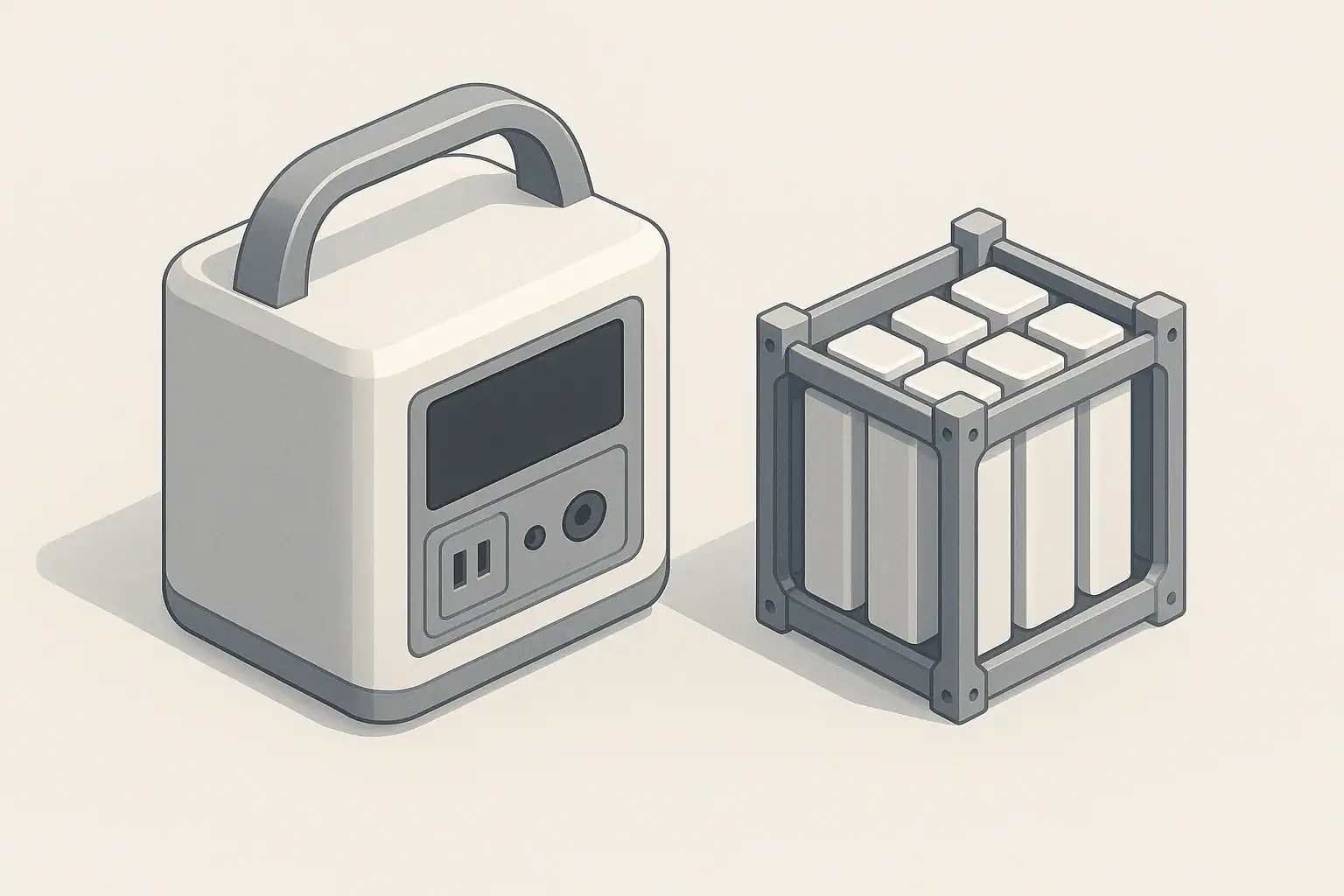
Depth of discharge (DoD) tells you what percentage of a battery’s usable energy has been drained, and keeping DoD moderate is one of the simplest ways to extend battery life. In plain terms, the less deeply you run a battery down each cycle, the more total cycles you usually get, especially with portable power stations using LiFePO4 or NMC cells.
If you regularly discharge to 90–100% DoD, you get more runtime per charge but shorten the overall lifespan. If you stay closer to 30–70% DoD, you trade a bit of runtime today for many more cycles over the years. Understanding DoD, state of charge (SOC), and how they interact with watt-hours, watts, and temperature helps you size a unit correctly and avoid surprises like early shutdowns.
This guide explains what depth of discharge really means, how it affects LiFePO4 versus NMC batteries, and how to apply it in real-world situations such as camping, outages, RV use, and remote work so your portable power station remains reliable for as long as possible.
What Depth of Discharge Means and Why It Matters
Depth of discharge is the percentage of a battery’s usable capacity that has been consumed. A cycle from 100% down to the minimum safe level is 100% DoD. A cycle from 80% down to 30% is a 50% DoD cycle. Because portable power stations have built-in protection, you usually cannot damage the pack by accidentally going below its safe limit, but how far you go down each time still matters.
DoD and SOC are two sides of the same coin. If the battery is at 70% SOC, it is at 30% DoD for that cycle. Manufacturers often rate battery life in cycles until capacity falls to a certain percentage of the original value. Deeper average DoD means fewer total cycles before you notice reduced capacity; shallower average DoD means more cycles.
This tradeoff is different for LiFePO4 and NMC. LiFePO4 chemistry generally tolerates deeper, more frequent discharges with less wear, making it attractive for heavy daily cycling. NMC can offer higher energy density in a smaller package but is more sensitive to high DoD, high temperature, and very high discharge rates. In both cases, managing DoD is one of the most practical levers you have to balance runtime needs, weight, and long-term cost of ownership.
Key Concepts: How DoD, Capacity, and Power Work Together
To use depth of discharge in a practical way, you need to connect three ideas: energy capacity, power draw, and efficiency.
Capacity (Wh) describes how much energy a battery can store. A 1,000 Wh portable power station can theoretically deliver 1,000 watts for 1 hour, or 100 watts for 10 hours, before losses and protections are considered.
Power (W) describes how fast you are using that energy. High-wattage devices drain the battery faster and can reduce usable capacity at the same time, especially at low temperatures or near the inverter’s limit.
If you divide watt-hours by watts, you get an approximate runtime in hours. Real runtimes are usually 10–20% lower because of inverter losses, voltage conversion, and the battery management system protecting the cells.
DoD describes how much of that capacity you actually use per cycle. If you have a 1,000 Wh unit and typically consume about 500 Wh before recharging, your average DoD is around 50%. If you regularly pull 900 Wh or more, your average DoD is closer to 90%.
LiFePO4 packs typically maintain a more stable voltage across a wide SOC range and can handle many cycles even at higher DoD. NMC packs often show more voltage sag near the bottom of the charge, which can trigger low-voltage cutoffs earlier under heavy load. In both chemistries, very deep cycles at high load and high temperature create more stress than moderate cycles at modest loads.
| Use case | Typical load (W) | Daily energy use (Wh) | Target DoD range | Suggested minimum battery size (Wh) |
|---|---|---|---|---|
| Home internet + lights during short outages | 60–120 | 200–400 | 40–70% | 600–800 |
| Remote work (laptop, monitor, router) | 70–120 | 400–700 | 30–60% | 800–1,200 |
| Weekend camping (phones, lights, small fridge) | 50–200 (variable) | 500–900 | 50–80% | 1,000–1,500 |
| RV fridge, fans, and small electronics | 150–300 | 800–1,200 | 50–80% | 1,500–2,000 |
| Jobsite tools (intermittent high draw) | 300–800 (peaks higher) | 600–1,500 | 40–70% | 1,500–2,400 |
In practice, you start with your expected daily watt-hour use, decide how aggressive you are willing to be with DoD, and then size the battery so your typical day falls within that target range. This is often more reliable than buying solely based on peak wattage ratings.
Real-World Examples: DoD, LiFePO4 vs NMC, and Runtimes
Seeing depth of discharge in real numbers makes it easier to apply when you choose or use a portable power station.
Example 1: 1,000 Wh unit powering small devices
Suppose you have a 1,000 Wh power station and you run a 100 W load (for example, a router, a light, and a laptop combined). On paper, 1,000 Wh ÷ 100 W = 10 hours. After 15% efficiency losses, you might get about 8.5 hours. If you let the unit shut down from full, you are using close to 100% DoD.
If you instead recharge after 5 hours, you have used around 500–600 Wh, roughly a 50–60% DoD cycle. Over many months of use, those shallower cycles generally lead to significantly more total cycles before capacity noticeably fades, especially on NMC-based systems.
Example 2: 500 Wh unit for remote work
Imagine a 500 Wh unit running a 50 W laptop and a 30 W monitor for 6 hours. That is 80 W × 6 hours = 480 Wh on paper. With losses and protective cutoffs, you might see 380–430 Wh delivered before shutdown, or roughly 75–85% of the label. That is effectively a deep cycle every workday.
If you want to keep DoD closer to 50–60% for longer battery life, you could either reduce runtime (for example, 4 hours per day instead of 6) or choose a larger unit, perhaps 800–1,000 Wh, so that the same workload becomes a moderate cycle instead of a deep one.
Example 3: Refrigerator with surge load
A compact refrigerator might average 60–80 W while running but demand 3–5 times that briefly at startup. A LiFePO4 pack usually maintains voltage better at higher DoD, which can help the inverter handle the startup surge even when the battery is at 20–30% SOC. An NMC pack at the same apparent SOC may show more voltage sag, causing the inverter to trip on low-voltage or overload protection earlier, especially if the overall DoD is already high for that cycle.
Example 4: Continuous daily cycling
Consider a user cycling a LiFePO4 power station every day between 80% and 20% SOC (60% DoD). Many LiFePO4 systems are designed for thousands of such cycles before capacity drops to around 80% of original. If the same user instead cycles between 100% and the cutoff every day (near 100% DoD), the total cycle count before noticeable capacity loss is often much lower, even with LiFePO4. For an NMC system under similar conditions, the difference between moderate and deep daily DoD is usually even more pronounced.
Common Mistakes and Troubleshooting Cues
Misunderstanding depth of discharge often shows up as frustration with runtime, unexpected shutdowns, or the impression that a unit is “wearing out too fast.” Recognizing common patterns can help you separate normal protective behavior from actual problems.
Mistake 1: Focusing on watts, ignoring watt-hours
Many buyers choose a power station because the inverter watt rating looks high enough for their appliances, but they overlook the energy capacity in watt-hours. A unit that can briefly power a microwave may still only run it for a short time before hitting a deep DoD and shutting down. The result is high stress on the battery and disappointing runtime.
Mistake 2: Expecting the full labeled capacity in every situation
Fast discharges, cold temperatures, and operation near maximum inverter output all reduce usable capacity. This is especially noticeable with NMC at high discharge rates. Users may assume the battery is defective when they see only 70–80% of the label in a demanding scenario, but this is often a normal combination of losses and protections.
Mistake 3: Misreading protective shutdowns
Sudden power loss under load is often the battery management system protecting the pack from over-discharge, overcurrent, or over-temperature. High DoD combined with a heavy load increases the chances of hitting these limits. If the unit restarts and behaves normally at lighter loads or after cooling, it is usually doing its job rather than failing.
Mistake 4: Leaving the battery at 0% or 100% for long periods
Storing a portable power station completely full or completely empty for months is harder on both LiFePO4 and NMC cells than storing at a mid-range SOC. Over time, this can reduce capacity even if cycle counts are low.
| Symptom | Likely DoD-related cause | Quick checks |
|---|---|---|
| Unit shuts off earlier than expected | High DoD at heavy load; efficiency losses; low temperature | Reduce load, warm the unit to room temperature, compare runtime at lighter loads |
| Cannot start fridge or pump at low battery | Voltage sag during surge at high DoD | Recharge to higher SOC, try starting again, avoid running surge loads near empty |
| Runtime varies a lot day to day | Different DoD and load patterns, changing temperatures | Log approximate watts used and ambient temperature to see patterns |
| Battery seems to charge “too fast” at first, then slows | Deep DoD followed by normal tapering near higher SOC | Note that fast initial charging and slower top-off is expected BMS behavior |
| Capacity feels reduced after months of use | Frequent deep cycles, high temperature, or both | Review typical DoD, reduce deep discharges, store cooler when possible |
When troubleshooting, start by estimating how many watt-hours you are using, how deep you are cycling the battery, and what the ambient temperature is. Often, small changes in load or operating conditions can bring behavior back in line with expectations.
Safety Basics: Placement, Heat, and Electrical Protection
Whether a portable power station uses LiFePO4 or NMC, safe operation follows the same core principles: avoid excess heat, allow ventilation, and respect electrical limits.
Placement and airflow
Place the unit on a stable, dry surface with space around it for air to move. Do not cover vents or stack items on top. High DoD combined with heavy loads generates more heat inside the unit, so good airflow helps keep temperatures within safe limits and reduces thermal stress on the cells and electronics.
Temperature awareness
In very cold conditions, many systems limit charging until the cells warm up, especially when the battery is already at a low SOC.
Cords and connections
Use extension cords and power strips that are appropriately rated for the loads you plan to run. Undersized or very long cords can overheat and cause voltage drop, which increases current draw and makes protective shutdowns more likely at high DoD. For outdoor use, keep connections off the ground and away from standing water.
Integration with household wiring
Do not attempt to backfeed a home’s electrical system through standard outlets or improvised adapters. Any permanent or semi-permanent connection to household circuits should be handled by a qualified electrician using appropriate transfer equipment. This is important for safety and for ensuring that the power station is not exposed to currents or voltages outside its design.
Maintenance and Storage for Longer Battery Life
Good maintenance habits can extend the practical life of both LiFePO4 and NMC batteries, regardless of how often you use them. Depth of discharge is part of this, but temperature and storage practices are just as important.
Storage state of charge
For storage longer than a few weeks, it is usually best to leave the battery at a moderate SOC rather than full or empty. A mid-range level reduces chemical stress on the cells over time. Many systems are comfortable around 30–60% SOC for storage, with a top-up to higher levels shortly before you expect to use the unit heavily.
Periodic checks
All batteries self-discharge slowly, and the internal electronics of a power station draw a small amount of power even when off. If you store the unit for months without checking it, it can drift into very low SOC. That is harder on the cells and may put the system into a deep-sleep mode that takes longer to recover from. Checking the charge level every couple of months and briefly recharging when needed keeps DoD during storage modest.
Visual and temperature checks
During normal use and charging, the case should feel warm at most, not excessively hot. There should be no strong odors or visible swelling. Vents should remain free of dust buildup. If anything looks or feels abnormal, stop using the unit and have it inspected by the manufacturer or a qualified service provider rather than opening the case yourself.
Adapting to climate
If you live in a hot climate, prioritize cool storage and avoid leaving the unit fully charged in high heat for long periods. If you live in a cold climate, allow the battery to warm toward room temperature before charging, particularly after a deep discharge. In both chemistries, repeated deep cycles at extreme temperatures are more damaging than the same DoD at moderate temperatures.
Practical Takeaways and Specs to Look For
Depth of discharge is one of the most useful concepts for predicting how a portable power station will behave in real life. Thinking in watt-hours instead of just watts, estimating your typical DoD, and understanding how LiFePO4 and NMC respond to deep cycles can help you choose the right unit and use it in a way that preserves capacity.
For frequent, daily cycling, aim to keep most cycles in a moderate range, such as 30–70% DoD, whenever your use case allows. Use deeper cycles when you need maximum runtime but treat them as occasional rather than routine. Combine this with moderate temperatures, correct cabling, and sensible storage practices to get the most out of the battery over many years.
When comparing portable power stations on paper, you can use a short checklist of specifications and behaviors to see how well a model will match your DoD and runtime expectations.
Specs to Look For When Evaluating DoD and Battery Life
- Battery capacity (Wh): Check watt-hours first, not just inverter watts. Estimate your daily energy use and choose a size that keeps your typical DoD in a moderate range.
- Battery chemistry: Note whether the pack is LiFePO4 or NMC. Expect LiFePO4 to handle deeper regular cycles better, and NMC to benefit more from conservative DoD and careful temperature management.
- Cycle life rating: Look for the number of cycles to a specified remaining capacity (often 70–80%) and the DoD used for that rating. A cycle life specified at 80% DoD is not directly comparable to one specified at 50% DoD.
- Continuous and surge power ratings: Confirm that continuous watts cover your typical loads and that surge watts are sufficient for motor-driven appliances. Remember that high surge loads near empty are more likely to trip protections, especially on NMC packs.
- Operating temperature ranges: Check recommended charging and discharging temperature windows. If you plan to use the unit in a vehicle, RV, or unconditioned space, this has a direct impact on usable capacity and safe DoD.
- Efficiency or usable capacity notes: Some manufacturers list expected usable Wh at typical loads or provide efficiency figures. Use these to adjust your runtime estimates instead of assuming 100% of the label.
- Battery management features: Look for protections against over-charge, over-discharge, over-current, and over-temperature. These systems are what enforce safe DoD in practice and prevent accidental damage.
- Display and monitoring: A clear SOC display (percentage and, ideally, estimated remaining time or watts in/out) makes it easier to track DoD in real time and adjust your usage before hitting hard cutoffs.
- Charging options and rates: Faster charging can help you avoid deep cycles by topping up more often, but very high charge rates at high temperatures can increase wear. Balance speed with long-term battery health.
- Manufacturer guidance on storage: Check recommended storage SOC and intervals for top-ups. Following these guidelines keeps DoD during storage modest and supports long-term capacity retention.
Using depth of discharge as a planning tool, rather than just a number on a spec sheet, allows you to size your system realistically, interpret its behavior correctly, and make choices that extend the usable life of both LiFePO4 and NMC portable power stations.
Frequently asked questions
Which battery specifications and features most affect usable capacity and DoD?
Usable capacity and practical DoD depend most on the battery’s watt-hours (Wh), chemistry (LiFePO4 vs NMC), and the cycle-life rating with its stated DoD. Continuous and surge power ratings, operating temperature range, and the battery management system (BMS) and efficiency notes also strongly affect how much energy you can safely draw in real conditions.
How can I estimate real runtime from depth of discharge and my device load?
Divide the usable Wh by your load in watts to get a baseline runtime, then reduce that estimate by typical system losses (commonly 10–20%) for inverter and BMS overhead. Also account for voltage sag under high discharge rates and colder temperatures, which both reduce usable capacity and shorten runtime.
Why does my power station sometimes shut off earlier than the labeled capacity?
Early shutdowns are commonly caused by heavy loads, efficiency losses, voltage sag, protective cutoffs, or low ambient temperatures that reduce usable capacity. Before assuming a defect, check actual watt-hour use, try lighter loads or warmer conditions, and confirm whether surge demands are triggering protections.
Are deep discharges safe, and what safety measures should I follow?
Deep discharges are generally safe when the BMS enforces cutoffs, but frequent 100% DoD accelerates capacity loss and raises the chance of protective shutdowns during surge events. Maintain good ventilation, avoid extreme temperatures, use properly rated cables, and have any permanent home wiring work done by a qualified electrician.
How should I store a power station to minimize DoD-related degradation?
For storage longer than a few weeks, keep the battery at a moderate SOC—typically around 30–60%—and check/top it up every couple of months. Avoid storing fully charged or empty in hot or very cold environments, since both extremes increase chemical stress and long-term capacity loss.
How do partial cycles extend battery life in practice?
Partial (shallow) cycles reduce stress per cycle, so most chemistries deliver many more total cycles at moderate DoD (for example, 30–70%) than at repeated 100% DoD. If you cycle daily, sizing the battery so typical days are shallower or topping up more often will extend the pack’s usable life.
Related guides
Browse this topic →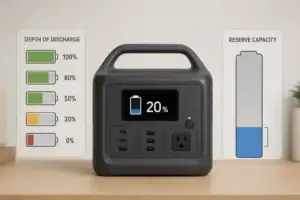
- Beginner-friendly sizing, runtime & specs
- Solar & charging (MPPT, fast charging, cables)
- Batteries (LiFePO4, cycles, care & storage)
- Safety, cold-weather performance, real-world tips
More in Battery
See all →- Low-Temperature Charging Protection in LiFePO4 Power Stations Explained
- Portable Power Station Expansion Batteries: When Extra Capacity Makes Sense
- Lithium-Ion vs LiFePO4 Batteries Explained
- LiFePO4 vs Lithium-Ion in Cold Weather: Which Holds Up Better?
- Best Storage Charge Percentage: 40% vs 60% vs 80% for Different Battery Chemistries
Keep reading
About this site
Portable Energy Lab publishes practical, independent guides about portable power—clear sizing, safe use, and real-world expectations.
Affiliate disclosure
Some links on this site may be affiliate links. If you buy through these links, we may earn a small commission at no extra cost to you. This helps support our content. Read our affiliate disclosure.