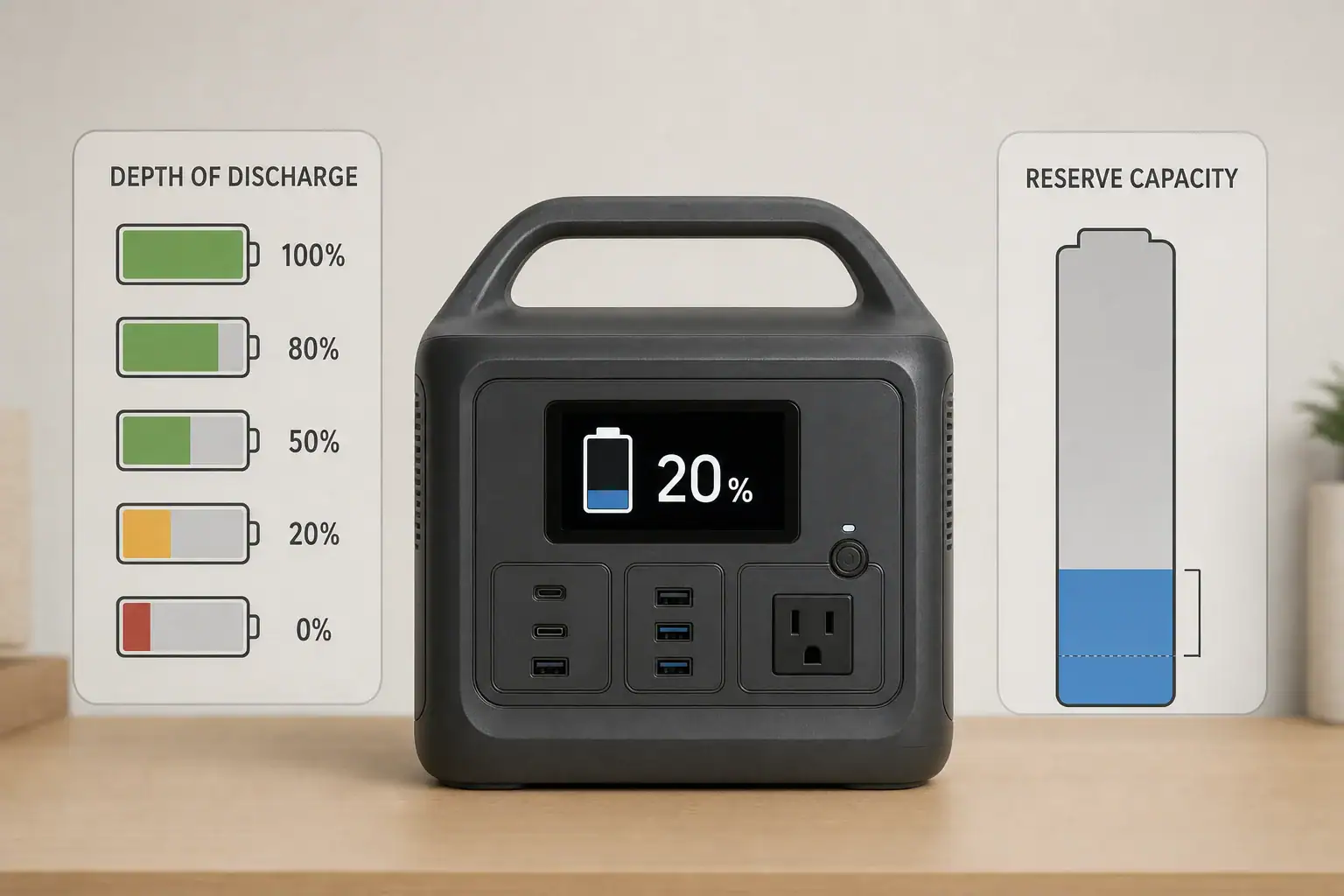
Lithium-Ion vs LiFePO4 Batteries Explained

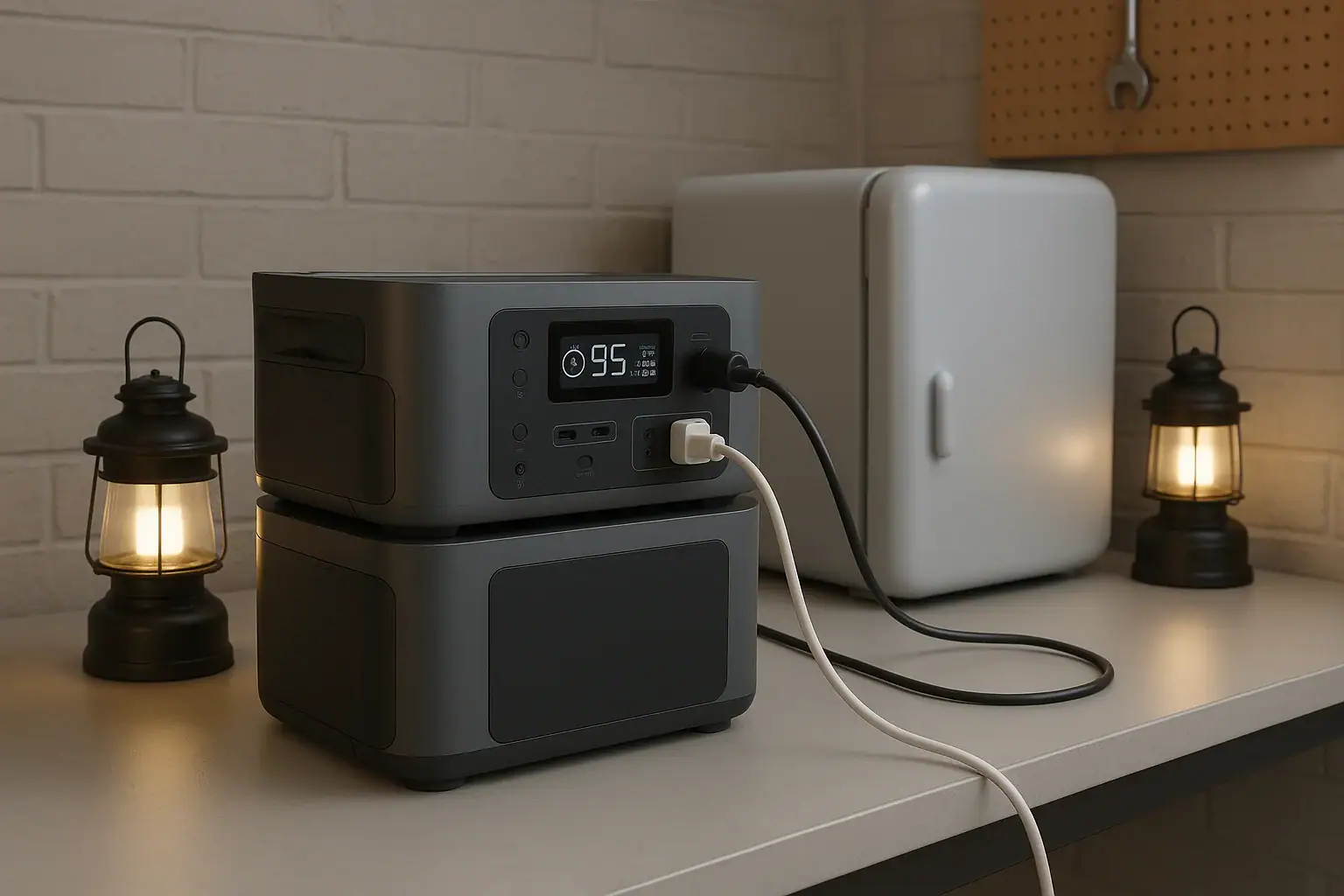
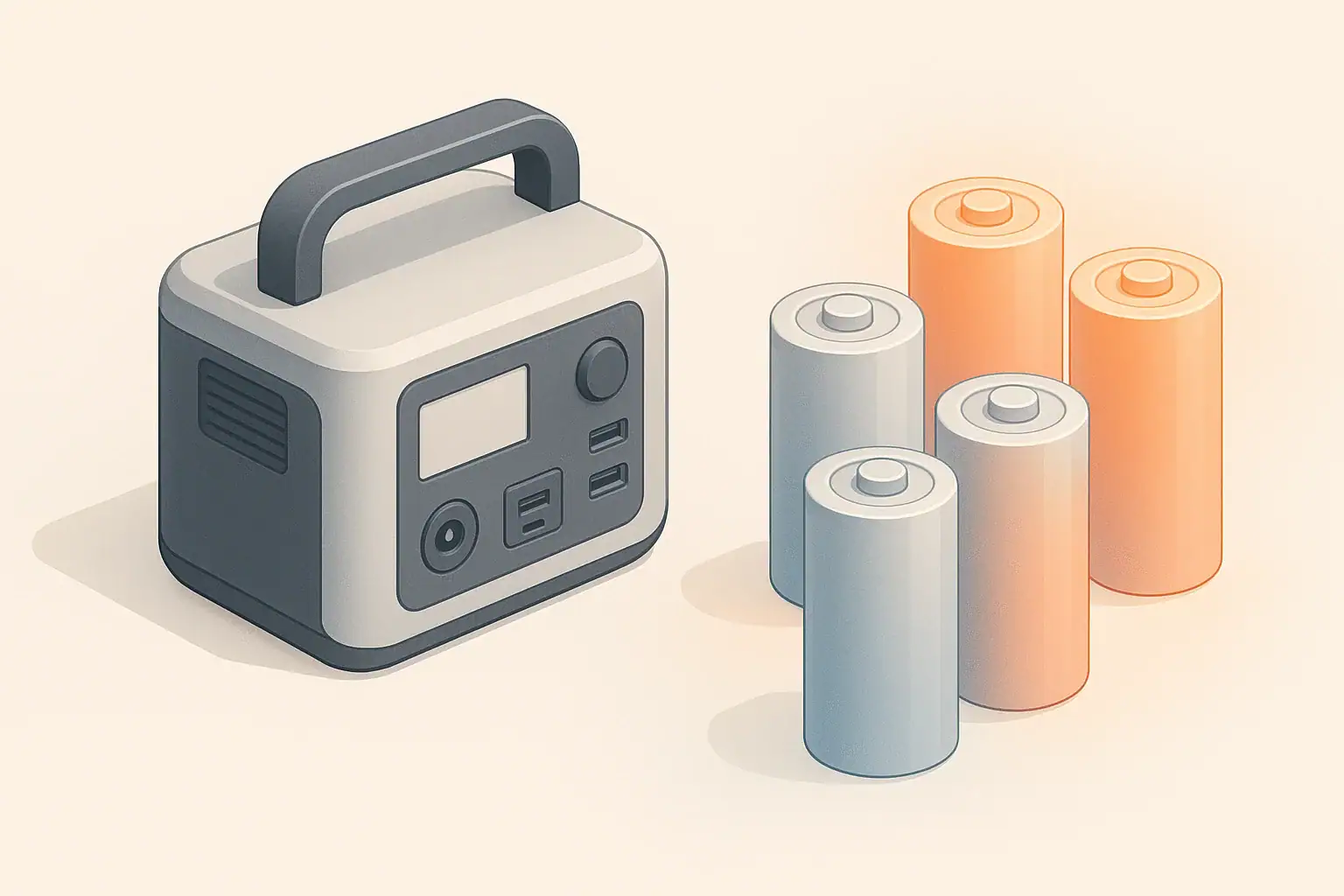
Comparison of lithium-ion and LiFePO4 batteries for portable power stations

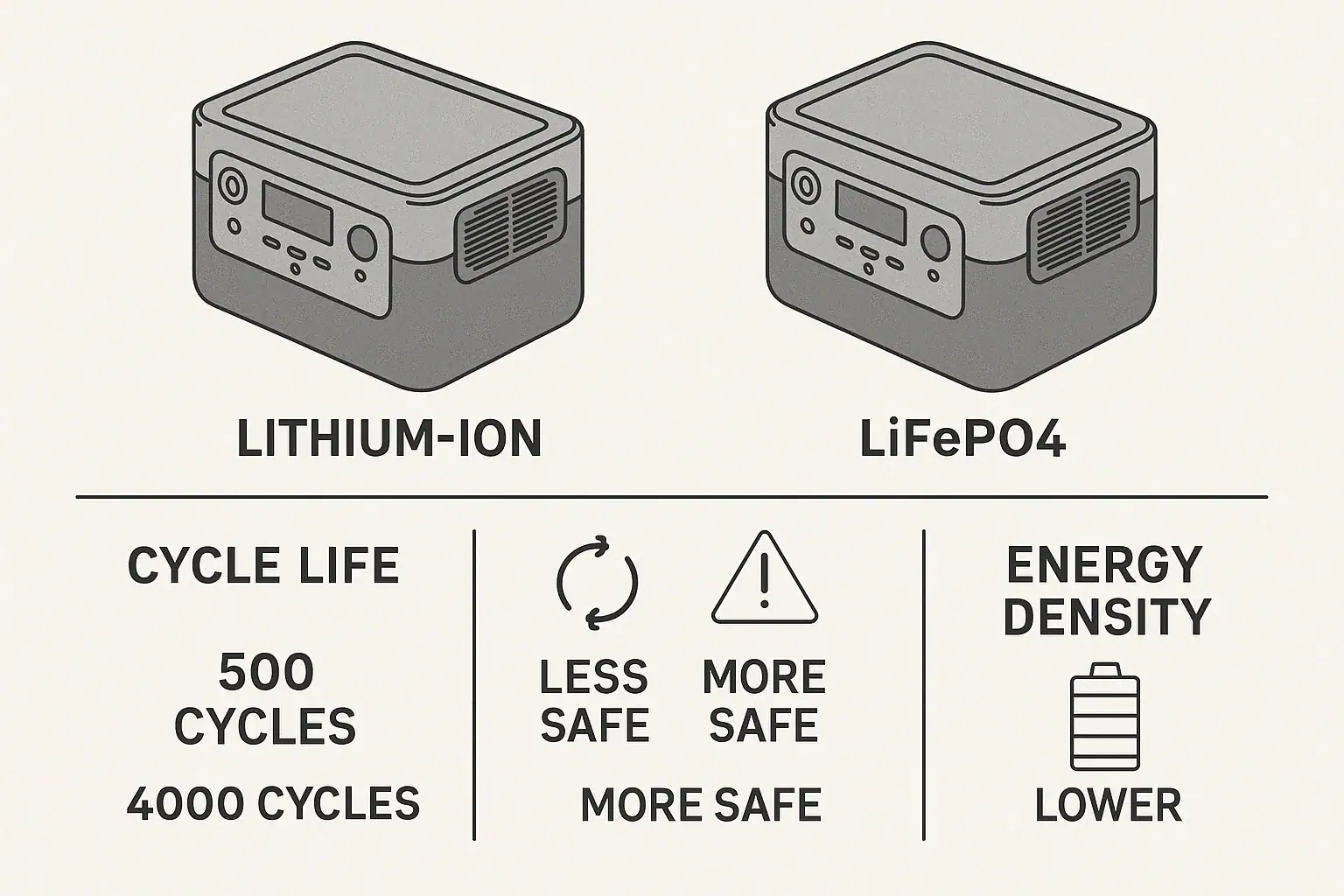
Lithium-ion and LiFePO4 batteries mainly differ in safety, cycle life, weight, and usable capacity, which directly affect runtime, recharge time, and long-term cost in portable power stations. Understanding these differences helps you choose the right battery chemistry for backup power, camping, off-grid use, and everyday charging.

When people compare lithium-ion vs LiFePO4, they are usually asking which lasts longer, which is safer, how many cycles they can expect, and whether the higher price is worth it. These factors influence watt-hour capacity, depth of discharge, charge rate, and how the battery behaves under heavy loads or surge watts from appliances.

This guide breaks down how each chemistry works, what it means for real-world runtime and performance, and which specs matter most so you can match a portable power station to your actual use instead of just buying by advertised watt-hours.

What Lithium-Ion and LiFePO4 Batteries Are and Why They Matter

Both lithium-ion and LiFePO4 are rechargeable lithium-based batteries used in portable power stations, but they use different cathode materials and have different strengths and trade-offs. In this context, “lithium-ion” usually refers to higher energy density chemistries such as nickel-manganese-cobalt or similar blends, while LiFePO4 stands for lithium iron phosphate.

For portable power stations, battery chemistry matters because it affects:

  • Cycle life: How many charge/discharge cycles before noticeable capacity loss.
  • Safety margin: How the battery handles abuse, high temperatures, and overcharge conditions.
  • Energy density: How much energy (Wh) fits into a given size and weight.
  • Voltage behavior: How stable the output voltage is as the battery discharges, which affects inverter performance and runtime.
  • Cost per cycle: Total usable energy over the battery’s life relative to price.

Choosing between lithium-ion and LiFePO4 is less about which is “best” and more about which is better matched to your priorities: maximum capacity in a compact package, or long life and stability for frequent deep discharges.

How Lithium-Ion and LiFePO4 Batteries Work in Portable Power Stations

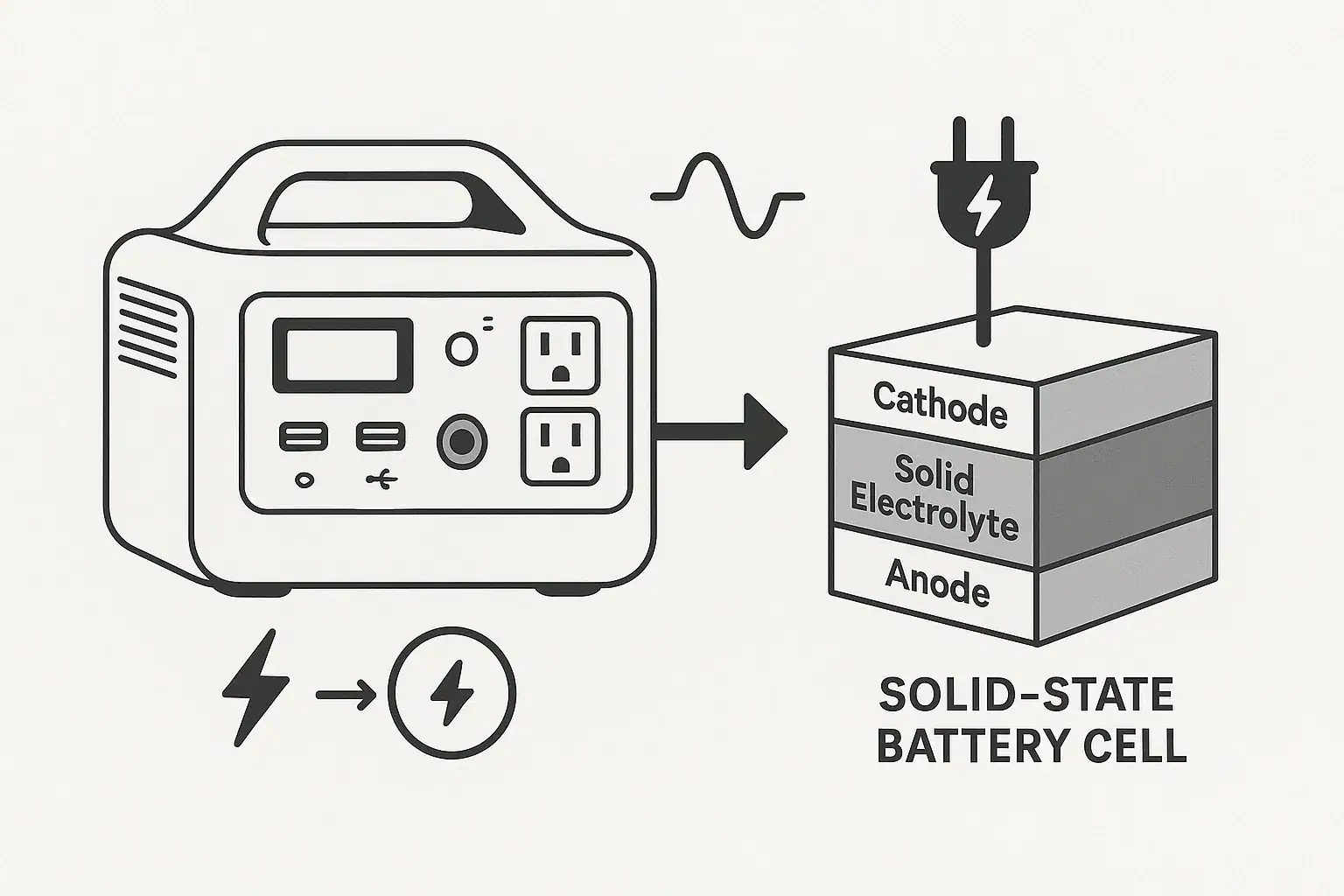
Both lithium-ion and LiFePO4 batteries operate by moving lithium ions between a positive electrode (cathode) and a negative electrode (anode) through an electrolyte. During charging, ions move into the anode; during discharging, they move back to the cathode, releasing electrical energy.

In mainstream lithium-ion chemistries, the cathode typically includes nickel, manganese, cobalt, or similar metals, which provide high energy density. LiFePO4 uses an iron-phosphate cathode, which is more thermally stable and less prone to runaway but stores slightly less energy per unit of weight and volume.

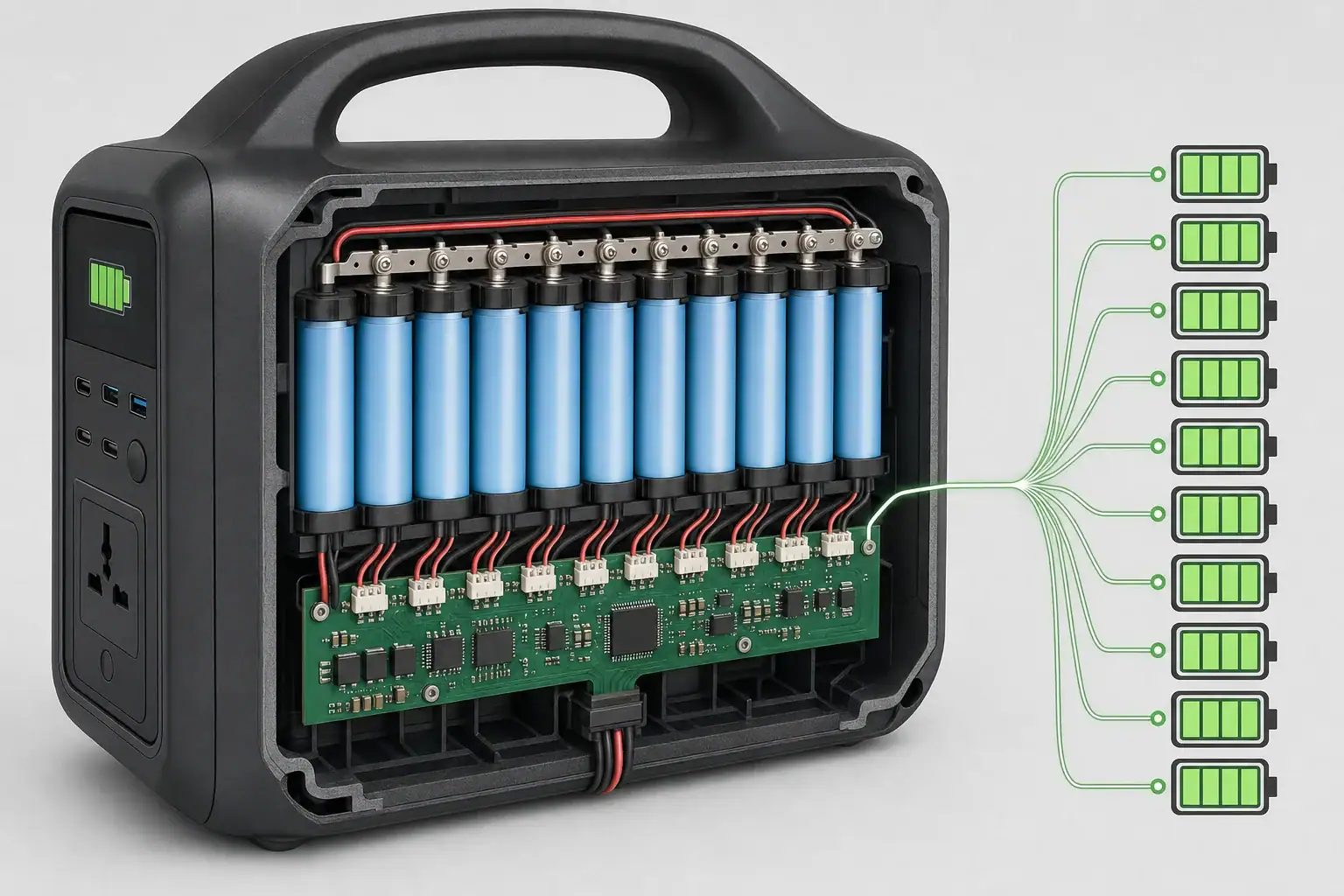
Inside a portable power station, individual cells are connected in series and parallel to create a battery pack with a suitable voltage and capacity. A battery management system (BMS) monitors cell voltages, temperatures, and currents. It controls charging profiles, protects against overcharge and over-discharge, and limits input and output current to safe levels.

Key operational differences include:

  • Voltage curve: LiFePO4 has a flatter discharge curve, holding near its nominal voltage for most of the cycle, which can keep inverters operating efficiently longer. Many lithium-ion chemistries show a more gradual voltage drop.
  • Cycle life behavior: LiFePO4 typically tolerates more deep cycles (e.g., 2,000–4,000+ at moderate depth of discharge) compared with many lithium-ion packs that may be rated in the hundreds to low thousands of cycles under similar conditions.
  • Temperature sensitivity: Lithium-ion chemistries generally perform better in cold conditions but can be more sensitive to high temperatures; LiFePO4 is more stable at high temperatures but can see reduced charge acceptance at low temperatures.
  • Charge rate: Both can support relatively fast charging when designed correctly, but the BMS will enforce limits based on cell chemistry, pack design, and long-term durability targets.
Comparison of typical characteristics for lithium-ion vs LiFePO4 in portable power stations. Example values for illustration.
CharacteristicLithium-IonLiFePO4
Typical cycle life range~500–2,000 cycles~2,000–6,000 cycles
Energy density (relative)Higher (more Wh per lb)Lower (fewer Wh per lb)
Thermal stabilityGood, but more sensitive to abuseVery high, more tolerant of abuse
Weight for same WhLighterHeavier
Cost per Wh (upfront)Often lowerOften higher
Cost per Wh (lifetime)ModerateOften lower due to long life

Real-World Examples: Which Battery Chemistry Fits Which Use Case

In practice, the choice between lithium-ion and LiFePO4 in a portable power station comes down to how you use it and how often.

Occasional Backup Power and Travel

If you mainly use a portable power station for occasional power outages, light camping, or as a travel charger, a lithium-ion based unit can make sense. The higher energy density means more watt-hours in a smaller, lighter package, which is easier to carry and store. For example:

  • A compact 300–500 Wh lithium-ion unit can be light enough for carry-on luggage yet still power small devices, laptops, and low-wattage appliances for short periods.
  • Because you are only cycling the battery a few dozen times per year, the shorter cycle life is less of an issue.

Frequent Cycling, Off-Grid, and RV Use

For daily or near-daily use—such as in RVs, van life, off-grid cabins, or as part of a small solar setup—LiFePO4 often provides better long-term value. The higher cycle life and stable voltage are beneficial when you regularly run the battery down and recharge it:

  • A 1,000–2,000 Wh LiFePO4 power station used and recharged most days can remain serviceable for many years, even with deep discharges.
  • The flatter voltage curve helps maintain consistent inverter output, so devices see less voltage sag as the battery empties.

High-Power Loads and Surge Demands

When powering tools, small air conditioners, or appliances with high surge watts, both chemistries can work well if the pack and inverter are correctly sized. However, LiFePO4’s ability to handle high discharge rates with less stress can be an advantage for repeated heavy use. In contrast, a lithium-ion pack might be more optimized for short bursts and lighter average loads.

Weight-Sensitive vs Longevity-Sensitive Scenarios

If you prioritize minimum weight—such as carrying the unit long distances—lithium-ion’s higher energy density is appealing. If you prioritize longevity and total cost of ownership over many years, LiFePO4’s extended cycle life can outweigh the extra weight and initial cost.

Common Misconceptions, Mistakes, and Troubleshooting Clues

Users often run into performance issues not because of the chemistry itself, but because of misunderstandings about how lithium-ion and LiFePO4 behave in real use.

Mistake 1: Assuming All Watt-Hours Are Equal

Two power stations can have the same rated watt-hours but deliver different usable runtime. Differences in depth of discharge limits, inverter efficiency, and BMS settings mean that a LiFePO4 unit might allow more frequent deep discharges without noticeable degradation, while a lithium-ion unit may be tuned for shallower cycles to protect cycle life.

Troubleshooting cue: If runtime seems shorter than expected, check the rated usable capacity, depth of discharge limits, and whether high loads are triggering early shutoff.

Mistake 2: Ignoring Temperature Effects

Both chemistries are sensitive to temperature, but in different ways. Charging at very low temperatures can be restricted or blocked by the BMS, especially with LiFePO4, to prevent damage. High temperatures can accelerate aging for lithium-ion packs.

Troubleshooting cue: If charging slows down, stops, or the unit displays an error icon in cold or hot environments, let the battery return to a moderate temperature and try again. Many systems intentionally limit input current when cells are outside the optimal temperature range.

Mistake 3: Overestimating Fast-Charge Benefits

Fast charging is limited by both the charger and the battery chemistry. Pushing a lithium-ion pack at its maximum input limit repeatedly can increase heat and long-term wear. LiFePO4 can often handle higher charge rates relative to capacity, but the BMS may still cap input to protect longevity.

Troubleshooting cue: If the unit does not reach the advertised input watts, check whether the state of charge is already high, the temperature is elevated, or the BMS is throttling current to preserve the battery.

Mistake 4: Treating Cycle Life Ratings as Absolute

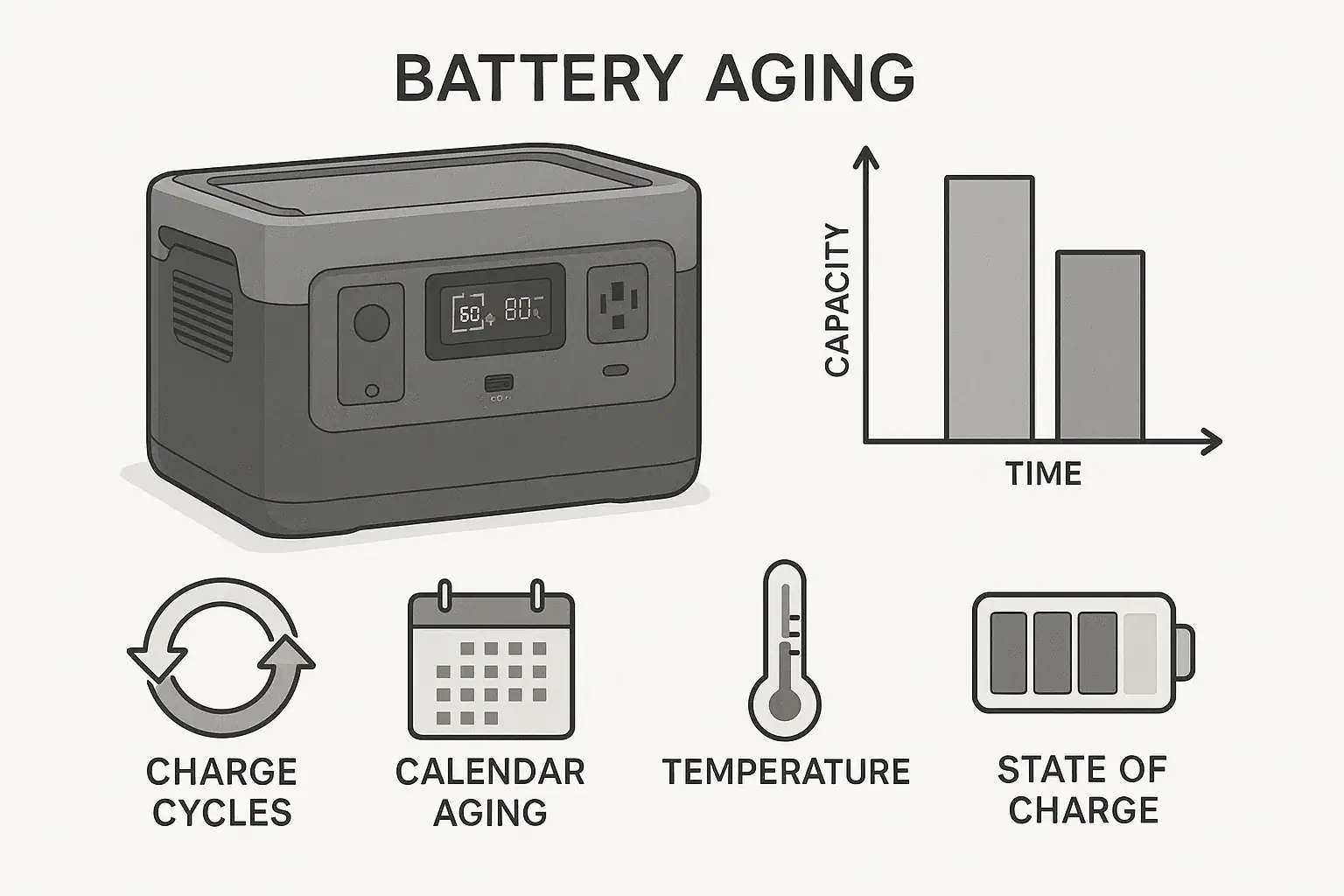
Cycle life ratings (for example, 500 cycles to 80% capacity, or 3,000 cycles to 80%) are estimates under specific test conditions. Real-world factors such as depth of discharge, average temperature, and charging habits can increase or decrease actual lifespan.

Troubleshooting cue: If capacity appears to drop faster than expected, review how deeply you are discharging the battery, how often you are fast charging, and whether the unit is frequently stored fully charged in high heat.

Safety Basics for Lithium-Ion and LiFePO4 Batteries

Both lithium-ion and LiFePO4 batteries used in portable power stations are designed with integrated safety systems. The BMS monitors voltage, current, and temperature to reduce the risk of overcharge, over-discharge, and overheating. Nonetheless, safe operation and storage are essential.

LiFePO4 chemistry is generally considered more thermally stable and less prone to thermal runaway than many lithium-ion chemistries. This does not mean it is immune to damage or misuse, but it provides a wider safety margin when properly designed and managed.

Key safety principles include:

  • Use only approved chargers and inputs: Follow the manufacturer’s guidance for AC adapters, car charging, and solar input limits. Mismatched voltage or current can stress the pack and BMS.
  • Avoid extreme temperatures: Do not operate or store portable power stations in direct sun inside vehicles or in freezing conditions without protection. Both chemistries age faster under heat, and charging in sub-freezing temperatures can damage cells.
  • Keep ventilation clear: Ensure vents and cooling fans are unobstructed so the unit can dissipate heat under heavy load or during fast charging.
  • Do not open or modify packs: Battery packs are not user-serviceable. Opening, rewiring, or bypassing protections can create fire and shock hazards.
  • Monitor for unusual behavior: Swelling, strong odors, excessive heat, or repeated error codes can indicate a problem. In such cases, discontinue use and contact qualified service support.

For integrating a portable power station with home circuits, consult a qualified electrician. Avoid makeshift connections to breaker panels or household wiring, regardless of battery chemistry.

Basic safety-related differences between lithium-ion and LiFePO4 batteries in portable power applications. Example values for illustration.
Safety AspectLithium-IonLiFePO4
Thermal runaway tendencyHigher if abused or damagedLower due to stable chemistry
BMS relianceCritical for safe operationCritical, but chemistry is more forgiving
High-temperature toleranceModerate, aging can accelerateGenerally better, but still limited
Abuse toleranceLess tolerant of overcharge/shortsMore tolerant, yet not immune
Typical use guidanceCareful with heat and fast chargeSimilar guidance, more margin

Related guides: LiFePO4 Charging Profile Explained (in Plain English)Depth of Discharge (DoD) ExplainedLiFePO4 vs NMC Batteries: Weight, Cold Performance, Safety, and Real Cycle Life Differences

Maintenance and Storage for Long Battery Life

Good maintenance practices extend the life of both lithium-ion and LiFePO4 batteries and help you get closer to their rated cycle life.

Depth of Discharge and Everyday Use

Both chemistries benefit from avoiding constant 0%–100% swings. While LiFePO4 tolerates deep cycles better, shallower discharges generally slow aging for any lithium-based battery. Keeping typical cycles in a moderate range—such as 20%–80% or 10%–90%—can improve long-term capacity retention.

Storage State of Charge

For long-term storage (weeks to months), storing at partial charge is usually better than leaving the battery full or completely empty. Many users aim for around 30%–60% state of charge when putting a portable power station away for a season. Check the battery level every few months and top up if it drops significantly.

Temperature Management

Store and use the power station in a cool, dry place away from direct sunlight and heat sources. High ambient temperatures accelerate capacity loss for both lithium-ion and LiFePO4, even when not in use. Extremely cold conditions can restrict charging and temporarily reduce available capacity.

Charging Habits

Using moderate charge rates when time allows can reduce heat buildup and stress. Fast charging is convenient, but relying on maximum input power for every cycle may shorten lifespan over many years. If the unit supports adjustable input limits, selecting a lower setting for everyday use can be beneficial.

Periodic Use and Self-Discharge

Lithium-based batteries have relatively low self-discharge, but they are not zero-loss systems. Cycling the power station periodically—rather than leaving it unused for very long periods—can help keep the BMS calibrated and the cells healthy. Avoid letting the battery sit at 0% for extended time, as very deep, prolonged discharge can trigger protective shutdowns that require specialized recovery.

Practical Takeaways and Specs to Look For

When comparing lithium-ion vs LiFePO4 portable power stations, start with how often you will cycle the battery, how much weight you can carry, and how critical safety margins and lifespan are for your use. Lithium-ion units often win on compactness and lower upfront cost, making sense for occasional or light-duty use. LiFePO4 units typically win on cycle life, thermal stability, and long-term value, especially for frequent deep discharges or semi-permanent off-grid setups.

Beyond the marketing labels, focus on measurable specs and how they align with your real-world needs—backup power duration, device wattage, surge watts, input charging time, and expected service life.

Specs to look for

  • Battery chemistry (Lithium-ion vs LiFePO4): Choose lithium-ion for lighter weight and compact size; choose LiFePO4 for higher cycle life and added thermal stability, especially for frequent daily use.
  • Usable capacity (Wh): Look for clear watt-hour ratings and, if available, usable capacity after BMS limits (for example, 90%–95% of nominal). More Wh means longer runtime for the same load.
  • Cycle life rating: Compare ratings such as 500+ vs 2,000+ cycles to 80% capacity at a stated depth of discharge. Higher cycle counts suggest better long-term value when used regularly.
  • Continuous and surge output (W): Ensure continuous watts comfortably exceed your typical load, and surge watts exceed startup demands of devices like fridges or power tools.
  • Charge input power and options: Check maximum AC, car, and solar input (for example, 200–800 W total). Higher input allows faster recharge, but moderate rates can be gentler on the battery.
  • Operating temperature range: Look for realistic charge and discharge temperature ranges. Wider ranges and built-in low-temperature charging protection are helpful in variable climates.
  • BMS protections listed: Confirm protections for over-voltage, under-voltage, over-current, short circuit, and temperature. These are critical regardless of chemistry.
  • Weight vs capacity ratio: Compare pounds per 100 Wh. Lithium-ion typically offers a lower weight per Wh; LiFePO4 will be heavier for the same capacity but may last more cycles.
  • Recommended depth of discharge: Some manufacturers specify an ideal discharge range. A design that supports deeper discharge (for example, down to 10–20%) without severe cycle life penalties can be beneficial.
  • Warranty duration and cycle terms: While not a performance spec, a longer warranty aligned with higher cycle life claims can provide added confidence in the stated ratings.

By aligning these specs with how often you plan to cycle the battery, the loads you need to power, and your tolerance for weight and cost, you can make an informed choice between lithium-ion and LiFePO4 portable power stations that fits your long-term needs.

Frequently asked questions

Which specs and features should I compare when choosing between lithium-ion and LiFePO4 batteries?

Compare usable watt-hours (not just nominal capacity), cycle life at a stated depth of discharge, continuous and surge output (W), charge input limits, operating temperature range, and listed BMS protections. These factors determine real runtime, how often the pack can be used over its life, and how it handles heavy loads and temperatures.

How can I avoid common mistakes when estimating real-world runtime?

Account for usable capacity after BMS limits, inverter efficiency, depth of discharge, and the impact of high loads or surge events rather than relying on nominal watt-hours alone. Also check whether advertised charge times assume ideal conditions—temperature and input power can change real performance.

Are LiFePO4 batteries safer than other lithium-ion chemistries?

LiFePO4 is generally more thermally stable and less prone to thermal runaway than many higher-energy-density lithium-ion chemistries, providing a wider safety margin. However, safe operation still depends on a properly designed BMS and correct charging, storage, and handling practices.

Is the higher upfront cost of LiFePO4 usually justified compared to lithium-ion?

LiFePO4 often costs more up front but can deliver lower cost per usable Wh over many years because of higher cycle life and better durability under deep discharges. Whether it’s justified depends on how frequently you’ll cycle the battery and whether longevity and safety margins are priorities.

Do extreme temperatures affect charging and performance for these batteries?

Yes. Charging can be limited or blocked at low temperatures (especially for LiFePO4) and high ambient heat accelerates aging for both chemistries. Look for realistic operating and charging temperature ranges and allow the unit to return to moderate temperatures if the BMS throttles input.

Which chemistry is generally better for frequent heavy loads and high-discharge use?

For repeated heavy loads and frequent deep discharging, LiFePO4 typically performs better due to higher cycle life and better tolerance for high discharge rates. Well-designed lithium-ion packs can handle high power too, but they may show faster capacity decline under the same demanding usage.

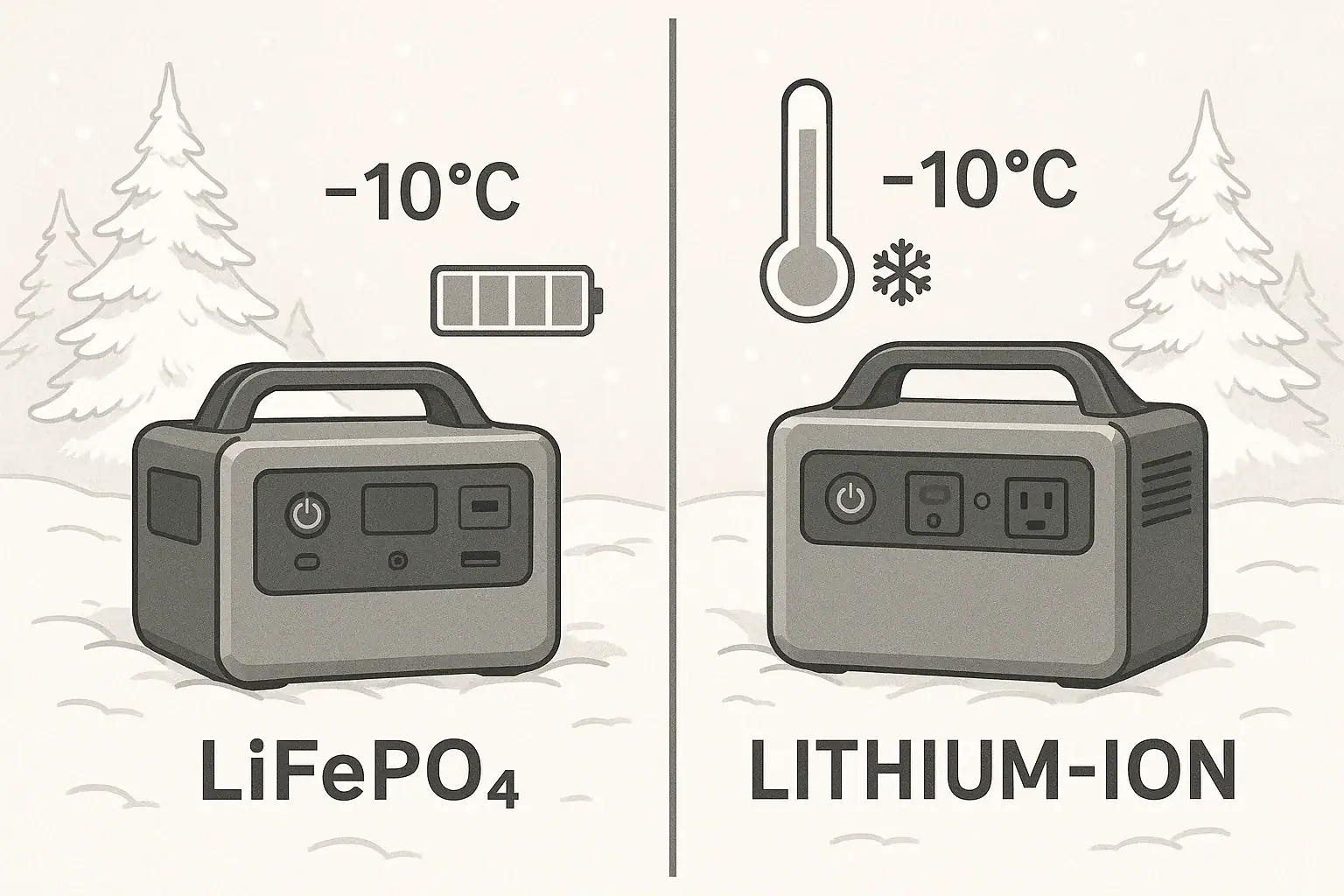
LiFePO4 vs Lithium-Ion in Cold Weather: Which Holds Up Better?

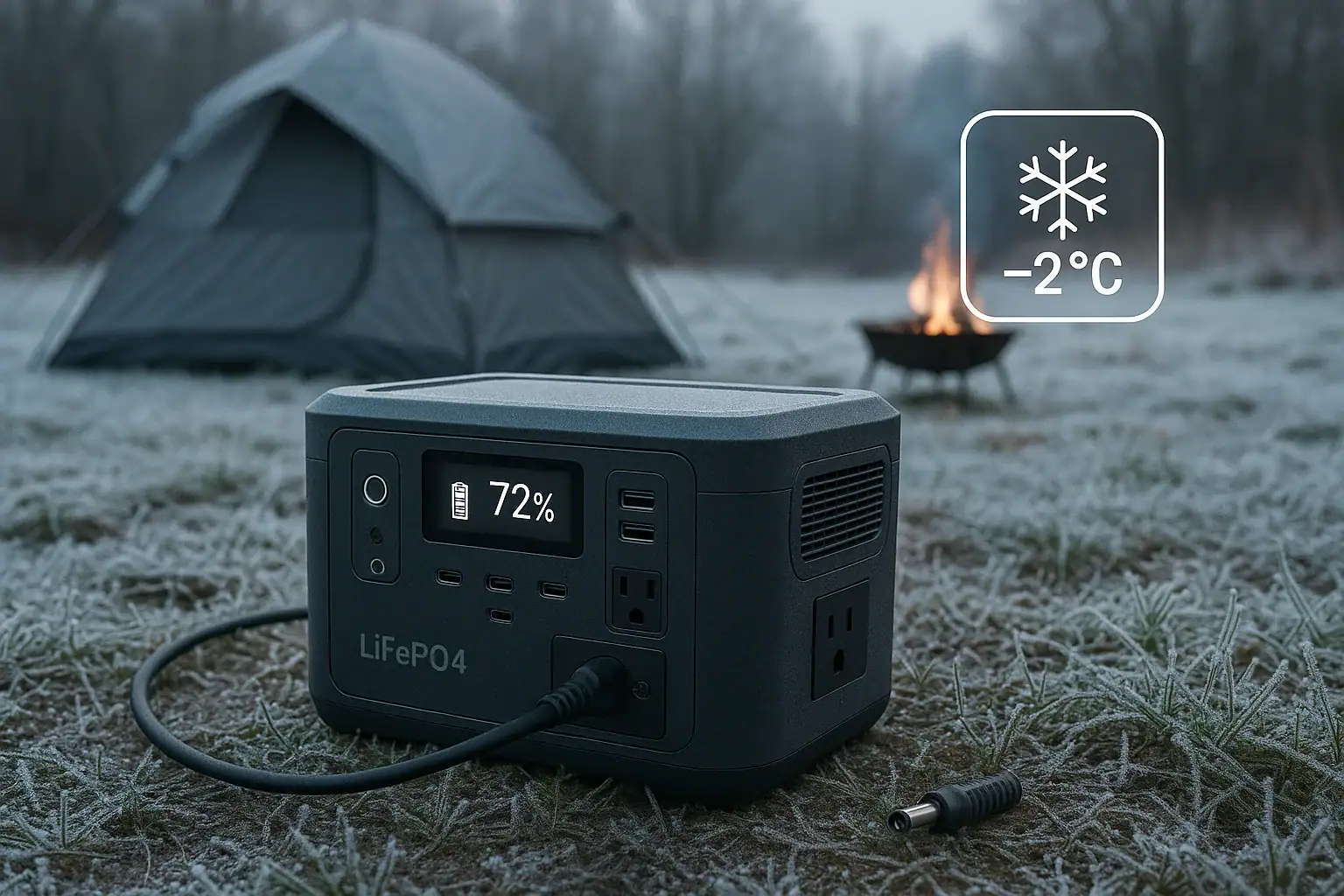
Portable power stations with LiFePO4 and lithium-ion batteries operating in cold weather snow.

In cold weather, LiFePO4 batteries usually hold voltage more steadily but lose usable capacity faster, while other lithium-ion chemistries can deliver more power at very low temperatures but degrade quicker over time. For portable power stations, this affects runtime, charging speed, and whether your unit will even start in freezing conditions. People search for answers using terms like battery runtime, low temperature limit, cold crank behavior, depth of discharge, and cycle life.

Understanding how LiFePO4 vs lithium-ion react to the cold helps you avoid dead power stations, failed starts, and permanent battery damage. The right chemistry and settings can mean the difference between a reliable winter backup and a brick when you most need it. This guide explains what happens inside the cells, how it shows up in real-world use, and which specs matter most when you compare portable power stations for winter camping, off-grid cabins, or emergency backup.

LiFePO4 vs lithium-ion: what they are and why cold weather matters

Both LiFePO4 and lithium-ion are rechargeable lithium-based batteries, but they use different cathode materials and behave differently in cold weather. “Lithium-ion” is a broad term that usually refers to chemistries like NMC (nickel manganese cobalt) or NCA (nickel cobalt aluminum), while LiFePO4 uses lithium iron phosphate.

For portable power stations, the chemistry you choose affects three core cold-weather outcomes: whether the battery will accept a charge, how much runtime you get, and how long the battery will last over years of use. Temperature directly changes internal resistance, voltage sag, and how quickly the cells age.

In moderate cold (around 32°F / 0°C), LiFePO4 typically offers excellent cycle life and stable voltage but reduced usable capacity. In deeper cold (well below freezing), many lithium-ion chemistries may still deliver bursts of power but can suffer faster long-term degradation and higher risk if charged outside their safe limits.

Because portable power stations are often used for backup power, winter camping, tailgating, or in unheated garages, understanding the differences between LiFePO4 and lithium-ion in the cold helps you pick a system that will actually work when temperatures drop.

How cold affects LiFePO4 and lithium-ion batteries inside a portable power station

Cold weather changes how ions move inside the battery. As temperature drops, the electrolyte becomes less conductive, and the chemical reactions that move lithium ions between anode and cathode slow down. This affects LiFePO4 and other lithium-ion chemistries in slightly different ways.

Internal resistance and voltage sag

At low temperatures, internal resistance increases. That means:

  • More voltage sag under load (the voltage drops more when you turn on a device).
  • Reduced peak power output (inverter may shut down earlier on high-watt loads).
  • Lower apparent capacity (the battery reaches its cutoff voltage sooner).

LiFePO4 already has relatively high internal resistance compared to some lithium-ion chemistries at room temperature, and this difference becomes more noticeable in the cold. The result is that a LiFePO4 pack might hit its low-voltage cutoff earlier under the same load, even if the actual stored energy is similar.

Charge acceptance and low-temperature charging limits

Charging is more sensitive to cold than discharging. Both LiFePO4 and other lithium-ion batteries can be damaged if charged too quickly when cold, especially below freezing. Lithium plating can occur on the anode, leading to permanent capacity loss and safety risks.

Typical behavior in a portable power station:

  • Above about 32°F (0°C): Most systems allow normal charge current, though with slightly reduced efficiency.
  • Between roughly 14°F and 32°F (-10°C to 0°C): Many battery management systems (BMS) will reduce charge current or switch to a slow charge profile.
  • Below about 14°F (-10°C): Many BMS designs will block charging entirely to prevent damage.

LiFePO4 is particularly sensitive to charging below freezing, so well-designed systems rely heavily on BMS protections or internal heaters to manage cold charging. Other lithium-ion chemistries may tolerate slightly lower charge temperatures, but repeated cold charging still accelerates wear.

Capacity loss and runtime in the cold

All lithium-based batteries show apparent capacity loss in cold weather because the reactions slow down and internal resistance rises. A pack rated for 100% capacity at 77°F (25°C) might only deliver 60–80% at 14°F (-10°C), depending on chemistry and discharge rate.

LiFePO4 tends to show more noticeable capacity loss at low temperatures compared with some NMC/NCA lithium-ion cells, especially at higher discharge rates. However, LiFePO4 also tends to recover more of its capacity when warmed back up, and its long-term cycle life remains strong if it has been protected from cold charging.

BMS behavior and cold-weather protections

The battery management system is the gatekeeper. In modern portable power stations, the BMS monitors cell temperature, voltage, and current, and it may:

  • Block charging below a set temperature.
  • Limit discharge current when cells are cold.
  • Shut the system down if temperature falls outside safe bounds.
  • Coordinate with internal heaters to raise battery temperature before charging.

Some LiFePO4-based systems include active self-heating, allowing the pack to warm itself using a portion of the incoming charge, then resume full charging once safe. Many basic lithium-ion systems rely solely on passive temperature limits and may simply refuse to charge in deep cold.

Cold-weather behavior differences between LiFePO4 and common lithium-ion chemistries in portable power stations. Example values for illustration.
ParameterLiFePO4Typical lithium-ion (NMC/NCA)
Nominal cell voltage~3.2 V~3.6–3.7 V
Relative capacity at 32°F (0°C)~75–85%~80–90%
Relative capacity at 14°F (-10°C)~55–75%~60–80%
Cold charge toleranceMore sensitive; strict BMS limits commonSlightly more tolerant but still limited
Cycle life (moderate temps)Often higherOften lower
Voltage stability under loadVery stable until cutoffMore gradual sag

Real-world cold-weather scenarios for LiFePO4 and lithium-ion power stations

Understanding lab behavior is useful, but what matters is how your portable power station performs at a campsite, in a vehicle, or during a winter outage. Here are common scenarios that highlight the differences between LiFePO4 and other lithium-ion chemistries in the cold.

Winter camping at freezing temperatures

Imagine an overnight trip where temperatures drop to around 32°F (0°C). You use a portable power station to run LED lights, charge phones, and power a small DC fridge.

  • LiFePO4 unit: You may see a noticeable drop in displayed remaining capacity overnight, and the fridge might trigger low-voltage cutoffs sooner when the compressor starts. However, the battery voltage remains relatively flat until near the end, making runtime somewhat predictable.
  • Lithium-ion unit: You may get slightly longer runtime at the same temperature and loads, with a bit more tolerance to short compressor surges. The trade-off is that repeated deep discharges and cold use can shorten long-term cycle life more than with LiFePO4.

Vehicle-based power in sub-freezing weather

Consider a power station left in a car overnight at 14°F (-10°C), then used to power a tire inflator and charge a laptop in the morning.

  • Start-up behavior: Some LiFePO4-based units may initially refuse to charge from the vehicle outlet until the internal pack warms up. Discharge may still be allowed but at reduced current.
  • Load handling: A high-draw device like a tire inflator can cause voltage sag. A LiFePO4 pack might hit low-voltage cutoff faster under that surge compared with certain lithium-ion packs, even if its rated capacity is similar.
  • Recovery: Once the cabin warms or the unit is brought indoors, both chemistries recover much of their apparent capacity, but the LiFePO4 may show less long-term wear if it has not been charged while still very cold.

Unheated garage or shed backup power

For backup use in an unheated garage, the power station might sit idle for weeks in temperatures hovering around or below freezing, then be expected to run tools or a sump pump during an outage.

  • LiFePO4 advantages: Very low self-discharge, long cycle life, and good calendar life mean it is more likely to retain its rated capacity over years of standby.
  • LiFePO4 limitations: If an outage occurs while the pack is very cold, initial peak power and usable capacity may be lower than expected, especially for heavy loads.
  • Lithium-ion behavior: It may deliver higher peak power in the cold but could lose capacity faster over years of storage and use, especially if regularly charged to 100% and stored hot in summer months.

Emergency indoor heating or electronics during a winter outage

During a multi-day winter outage, you might use a power station to run a low-wattage space heater (within inverter limits), communication devices, or a router.

  • Temperature moderation: Indoors, the temperature is usually less extreme, so both chemistries perform closer to their rated specs.
  • LiFePO4 benefit: The strong cycle life shines when you perform multiple deep discharges in a short period. You are less likely to notice permanent capacity loss after the event.
  • Lithium-ion consideration: The unit may work well during the event but can lose usable capacity more quickly over multiple seasons of similar use, particularly if often charged to 100% and stored at high state of charge.

Common cold-weather mistakes and troubleshooting signs

Many cold-weather battery problems come from using or charging portable power stations outside their recommended temperature range. Recognizing the symptoms can help you avoid permanent damage.

Trying to fast charge below freezing

One of the biggest mistakes is forcing a fast charge when the battery is below 32°F (0°C), especially for LiFePO4. Symptoms include:

  • Charging suddenly stops or never starts, even though AC or solar input is present.
  • Charge rate is much lower than usual (for example, only a fraction of the normal wattage).
  • Error icons or temperature warnings on the display.

These are often protective actions by the BMS. If you bypass them using external chargers or workarounds, you risk lithium plating and permanent capacity loss. The correct response is to bring the unit into a warmer environment and allow it to reach a safe temperature before charging.

Expecting summer runtime in winter conditions

Another common issue is assuming the same runtime in winter as in summer. Signs of cold-related capacity loss include:

  • Battery percentage dropping faster than expected under familiar loads.
  • Inverter shutting off early when starting a compressor, pump, or heater fan.
  • DC outputs cutting out while the display still shows significant charge remaining.

This is usually not a defect but a combination of increased internal resistance and low-temperature voltage behavior. LiFePO4 in particular may hit its low-voltage cutoff quickly under high loads in the cold, even when the state of charge is not truly near zero.

Leaving the unit fully depleted in the cold

Storing a power station at very low state of charge in cold conditions can cause issues for both LiFePO4 and lithium-ion chemistries. Warning signs include:

  • Unit will not turn on after long storage.
  • Battery percentage reads 0% and does not rise even when plugged in immediately.
  • Display flickers or resets when you try to start a load.

Some BMS designs enter a deep sleep mode to protect the cells when voltage is very low. Recovery may still be possible by leaving the unit on charge for an extended period in a warm environment, but repeated deep storage depletion shortens lifespan for any lithium-based battery.

Ignoring BMS temperature warnings

If the display shows a temperature or battery warning, do not keep trying to restart or override it. Repeated resets can stress the cells and internal electronics. Instead:

  • Move the power station to a moderate-temperature area.
  • Let it sit unplugged for a while so internal temperature equalizes.
  • Try a low-power load or a gentle charge source first to confirm stable operation.

If warnings persist at normal room temperature, contact the manufacturer or a qualified technician, as the issue may be more than just cold-weather behavior.

Cold-weather safety basics for LiFePO4 and lithium-ion power stations

Safety in cold weather is mostly about preventing charging damage and avoiding unsafe workarounds. While both LiFePO4 and other lithium-ion chemistries can be very safe when managed correctly, cold conditions increase the risk of misuse.

Respect the operating temperature range

Each portable power station has a specified operating temperature range for charging and discharging. Typical ranges might be:

  • Charging: around 32°F to 104°F (0°C to 40°C), sometimes with narrower limits for LiFePO4.
  • Discharging: around 14°F to 104°F (-10°C to 40°C), with some variation.

Do not assume the discharge range equals the charge range. Charging is usually more restricted. If your environment is below the minimum charge temperature, let the unit warm up before connecting AC or solar input.

Avoid DIY heating methods

It is tempting to warm a cold battery with external heat, but many methods are unsafe. Avoid:

  • Placing the power station directly against heaters or stoves.
  • Using heating pads or blankets not designed for electronics.
  • Covering air vents or blocking cooling paths to “trap” heat.

Instead, bring the unit into a temperature-controlled space and allow it to warm gradually. Some systems have built-in heaters managed by the BMS; rely on those rather than improvised external heat.

Do not bypass the BMS or open the case

Never attempt to open the power station to warm or charge the cells directly, bypass temperature sensors, or modify the battery pack. This can:

  • Defeat over-temperature and low-temperature protections.
  • Increase the risk of internal short circuits.
  • Void warranties and create fire hazards.

If the unit repeatedly refuses to charge or operate within its stated temperature range, seek professional support instead of attempting internal repairs.

Use appropriate extension cords and placement

In cold-weather setups, you may place the power station indoors and run extension cords outdoors to loads. To stay safe:

  • Use cords rated for outdoor use and appropriate current.
  • Avoid running cords through door gaps where they can be pinched.
  • Keep the power station on a dry, stable surface away from snow, ice, and condensation.

For any connection to home circuits, consult a qualified electrician and use approved transfer equipment. Do not attempt to wire a portable power station directly into a panel or backfeed outlets.

Cold-weather safety and storage considerations for LiFePO4 and lithium-ion portable power stations. Example values for illustration.
AspectLiFePO4Typical lithium-ion (NMC/NCA)
Typical safe charge temp~32–113°F (0–45°C)~32–113°F (0–45°C)
Typical safe discharge temp~14–140°F (-10–60°C)~-4–140°F (-20–60°C)
Cold charging riskHigh; plating risk below 32°FHigh; plating risk below 32°F
Built-in heatersCommon in newer designsPresent in some models
Self-discharge in storageVery lowLow to moderate

Related guides: Winter Use: Why Charging Slows in Cold Weather and How to Plan Around ItWinter Storage Checklist: Keeping Batteries Healthy in the ColdLiFePO4 vs NMC Batteries: Weight, Cold Performance, Safety, and Real Cycle Life Differences

Practical takeaways and cold-weather specs to compare

For cold climates, the choice between LiFePO4 and other lithium-ion chemistries comes down to priorities. LiFePO4 usually offers superior cycle life, stable voltage, and excellent long-term value, but feels the cold more in terms of immediate capacity and charge acceptance. Other lithium-ion chemistries can perform slightly better at very low temperatures in the short term but often wear out faster over years of use.

In real-world portable power station use:

  • If you value long-term durability, frequent cycling, and predictable performance in moderate cold (around freezing), LiFePO4 is often attractive.
  • If you need high surge output and are operating in more extreme cold, a well-managed lithium-ion system with robust BMS protections can deliver strong short-term performance, as long as you respect its charge limits.

In both cases, system design matters as much as chemistry. Battery heaters, conservative charge profiles, and accurate temperature sensing can dramatically improve cold-weather reliability.

Specs to look for

  • Operating temperature range (charge/discharge) – Look for clearly stated charge and discharge ranges, for example, charging from 32–104°F (0–40°C). Wider, well-documented ranges indicate better cold-weather engineering.
  • Low-temperature charge protection – Check for automatic charge cutoff or reduced current below freezing. This protects LiFePO4 and lithium-ion cells from plating damage in cold conditions.
  • Integrated battery heating – Some units include self-heating that activates before charging in the cold. This feature can make winter solar or vehicle charging far more reliable.
  • Rated cycle life at 80% capacity – Look for realistic cycle life numbers (for example, 2,000–4,000+ cycles) at standard depth of discharge. Higher values suggest the chemistry and BMS are optimized for longevity, especially important for LiFePO4.
  • Usable capacity vs. rated capacity – Pay attention to whether the system allows deep discharge (for example, 80–90% usable) and how that holds up at low temperatures. Some systems reduce usable capacity aggressively in the cold.
  • Continuous and surge output at low temps – If specified, compare continuous watts and surge watts at lower temperatures. This helps predict whether cold will cause early inverter shutdowns when starting motors or compressors.
  • State-of-charge and temperature monitoring – A clear display showing battery percentage, estimated runtime, and internal temperature helps you adjust usage in cold weather before protections kick in.
  • Self-discharge and standby drain – Look for low self-discharge rates and minimal idle consumption. This matters when leaving a power station in a cold garage or vehicle for weeks between uses.
  • Recommended storage state of charge – Guidance such as storing at 40–60% charge at moderate temperatures indicates the manufacturer has considered long-term battery health, especially relevant for seasonal cold-weather users.

By focusing on these specs instead of just chemistry labels, you can choose a portable power station that stays dependable when temperatures drop, whether it uses LiFePO4 or another lithium-ion formulation.

Frequently asked questions

What specs and features should I prioritize for reliable cold-weather performance?

Look for a clearly stated operating temperature range for both charging and discharging, low-temperature charge protection, and whether the unit has integrated self-heating. Also compare usable capacity at low temperatures, continuous/surge output specs at cold temps, and clear state-of-charge and temperature monitoring on the display.

Is it OK to try charging a portable power station when it’s below freezing?

Generally no—charging below freezing can cause lithium plating on the anode and permanent capacity loss. Most modern BMSs will reduce charge current or block charging below safe thresholds; the safest approach is to warm the unit to the recommended charge temperature or use a system with managed heaters.

How can I manage battery temperature safely during winter use?

Keep the power station in a temperature-controlled space when possible, run loads or extension cords outdoors rather than moving the unit into cold conditions, and rely on built-in BMS heaters instead of improvised external heat sources. Follow the manufacturer’s guidance and avoid covering vents or placing the unit against high-heat surfaces.

Why does my power station show reduced runtime in cold weather even when the percentage seems high?

Cold increases internal resistance and causes greater voltage sag under load, so the pack can hit its low-voltage cutoff sooner even though the state-of-charge indicator still shows capacity. Warming the battery typically restores much of the apparent capacity.

What’s a common user mistake that shortens battery life in cold climates?

Forcing charges or bypassing BMS protections when the pack is cold is a common mistake that accelerates wear and can cause permanent damage. Long-term habits like regularly storing at 100% state of charge or repeatedly deep-discharging in cold conditions also reduce lifespan.

LiFePO4 vs NMC Batteries: Weight, Cold Weather, Safety, and Cycle Life

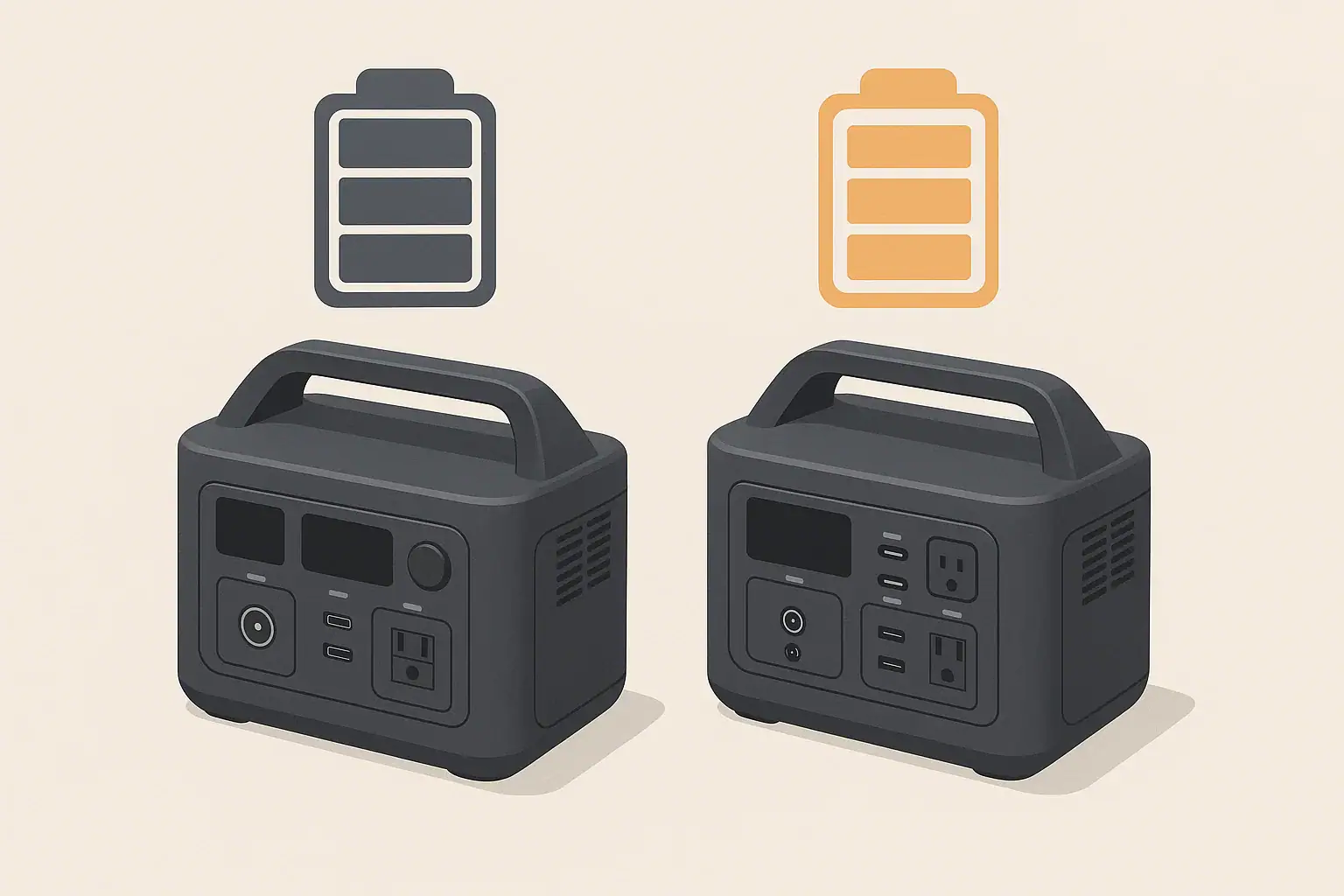
Two portable power stations compared side by side illustration

LiFePO4 batteries are usually the better choice for long-lasting portable power stations, while NMC batteries are usually better when low weight and compact size matter most.

Both are lithium-ion battery chemistries, but they are not interchangeable in real-world use. LiFePO4, short for lithium iron phosphate, tends to offer longer cycle life, stronger thermal stability, and more predictable aging. NMC, short for lithium nickel manganese cobalt oxide, usually stores more energy in less weight and space, which can make a portable power station easier to carry.

The right choice depends on how you use the unit. A weekend camper may care more about pounds and handle comfort. A homeowner, RV user, or remote worker who cycles a power station often may care more about long-term battery health, cold charging limits, and safety margin.

What LiFePO4 and NMC Mean and Why It Matters

LiFePO4 and NMC describe the battery cell chemistry inside the power station. The chemistry affects energy density, voltage behavior, charging limits, heat tolerance, and how quickly the pack loses capacity over time. The inverter, battery management system, charger, enclosure, and cooling design still matter, but chemistry sets important boundaries.

LiFePO4 cells have lower energy density than many NMC cells. That means a LiFePO4 power station often needs a larger and heavier battery pack to reach the same watt-hour rating. In exchange, LiFePO4 usually handles frequent cycling better. Many LiFePO4 packs are marketed for thousands of cycles before reaching a specified remaining capacity, often around 80 percent under controlled test conditions.

NMC cells generally have higher energy density, so they can support lighter and smaller designs. That is why NMC has been common in compact electronics and some portable power stations where portability is the main selling point. The tradeoff is that NMC is typically more sensitive to high heat, long storage at full charge, and repeated deep discharges.

For buyers, this matters because watt-hours alone do not tell the whole story. Two power stations can both claim 1000 Wh, but one may be easier to carry while the other may tolerate years of frequent use with less capacity loss. The better battery is the one that matches your actual pattern of use.

Key Performance Differences and How They Work

The biggest difference between LiFePO4 vs NMC batteries is not whether they can power your devices. Both can run lights, laptops, routers, refrigerators, tools, and small appliances when paired with the right inverter. The difference is how much weight it takes to store that energy, how the pack behaves at temperature extremes, and how long it is likely to remain useful under repeated cycling.

Energy density is the main advantage for NMC. If you need to carry a unit up stairs, lift it into a vehicle, or move it often between rooms, the lighter chemistry can be a real benefit. This is especially noticeable as capacity increases. A few pounds may not matter for a 300 Wh unit, but it can matter a lot for a 1500 Wh or 2000 Wh station.

Cycle life is the main advantage for LiFePO4. A cycle is usually counted as one full equivalent discharge and recharge, even if it happens across partial uses. For example, using 50 percent of the battery one day and 50 percent the next roughly equals one full cycle. If you use a power station daily for tool charging, refrigerator backup, or off-grid work, the chemistry with higher cycle life can provide better long-term value.

Cold performance is more nuanced. NMC often retains usable discharge performance better in moderately cold conditions, though capacity still drops as temperature falls. LiFePO4 can also discharge in the cold, but it is commonly more restricted when charging near or below freezing. Many modern power stations block charging when the cell temperature is too low because charging cold lithium cells can cause permanent damage.

LiFePO4 vs NMC decision factors. Example values for illustration.
Factor LiFePO4 tendency NMC tendency What it means for portable power stations
Weight for same Wh Heavier and often larger Lighter and more compact NMC is easier to carry when capacity is high
Cycle life Usually much higher Usually lower LiFePO4 is better for daily or frequent deep use
Thermal stability Strong inherent stability More heat sensitive LiFePO4 provides more safety margin, though design still matters
Cold charging Often restricted near freezing May be less restrictive, but still limited Check operating temperature specs before winter use
Voltage behavior Flatter discharge curve More gradual voltage decline State-of-charge displays may behave differently
Best fit Frequent cycling, backup, RV, workshop use Travel, lighter camping kits, occasional backup Choose based on use pattern, not chemistry labels alone

Real-World Examples

For a short home outage, either chemistry can work well if the watt-hour capacity and inverter rating are adequate. Suppose you run a 12 W router, a 60 W laptop, and 20 W of LED lighting. That is about 92 W before inverter losses. On a 500 Wh power station, a realistic AC runtime may be around four to four and a half hours after efficiency losses. At this modest load, the chemistry is less important than the unit size, inverter efficiency, and state of charge when the outage begins.

For regular refrigerator backup, LiFePO4 starts to look more attractive. A refrigerator does not draw its rated surge power continuously, but it cycles throughout the day. If the power station is used every storm season or as part of a routine backup plan, cycle life and heat tolerance become more important than saving a few pounds. The inverter still must handle compressor startup surge, so chemistry alone will not solve an undersized output rating.

For tent camping or car camping, NMC can be appealing when the power station is moved frequently. A lighter unit is easier to load, unload, and reposition around camp. If you only use it a few weekends per year for phones, cameras, a fan, and lights, you may never come close to wearing out an NMC pack. In that case, portability may matter more than maximum cycle count.

For RV, van, and remote work use, LiFePO4 often makes more sense. These users may discharge and recharge the station many times, sometimes from solar during the day and AC loads at night. A heavier battery is less of a problem if the station stays in one place. The longer cycle life can become meaningful after hundreds of partial cycles.

For cold-weather use, think about where the power station will sit. A unit stored overnight in a freezing vehicle may refuse to charge from solar in the morning until the cells warm up. This is especially common with LiFePO4 units that protect against low-temperature charging. If winter charging is important, look for clear low-temperature charging specifications and any built-in warming features.

Common Mistakes and Troubleshooting Cues

The most common mistake is choosing by battery capacity alone. Watt-hours tell you how much energy the battery can store, but they do not tell you whether the inverter can start your appliance. A small power station may have enough stored energy to run a device for a while, yet still shut down instantly if the startup surge is too high.

Another mistake is assuming cold-weather slowdowns mean the battery is defective. Lithium batteries lose performance in the cold, and protective electronics may block charging outside the safe temperature range. If the display shows input power dropping to zero on a freezing morning, the battery management system may be doing exactly what it should.

Users also misread cycle life claims. A rated cycle life is usually based on controlled testing at specified temperature, discharge rate, and depth of discharge. Real use may include heat, high loads, full-charge storage, or deep discharge, all of which can shorten practical life. LiFePO4 usually has the advantage, but it is not immune to aging.

Troubleshooting cues for LiFePO4 and NMC power stations. Example values for illustration.
Symptom Likely cause What to check first Practical response
Unit shuts off when appliance starts Surge exceeds inverter rating Startup watts and overload message Use a lower-surge load or a larger inverter rating
Charging stops in freezing weather Low-temperature charging protection Battery temperature range in specs Warm the unit before charging
Runtime is shorter than expected Inverter losses or high actual load Device watt draw and AC versus DC use Measure load and plan for efficiency losses
Display drops quickly from full Load calibration, age, or voltage curve Runtime under a steady known load Run a controlled test after fully charging
Charging slows near 100 percent Normal charge tapering Input watts at different charge levels Expect slower final charging
Fans run often under load Heat from inverter or charger Vent clearance and ambient temperature Improve airflow and reduce load if needed

Safety Basics

LiFePO4 has an inherent safety advantage because it is more thermally and chemically stable than NMC. That does not make any portable power station risk-free. Safety depends on the cells, battery management system, charger design, inverter design, enclosure, cooling, and how the owner uses the unit.

Keep any power station on a stable, dry surface with ventilation space around the intake and exhaust areas. Do not cover it with bedding, pack it tightly under gear while operating, or place it next to heaters. Heat is bad for both chemistries, and it is especially hard on NMC over time.

Treat the AC outlets like household power. Do not exceed the continuous watt rating, do not daisy-chain overloaded power strips, and use appropriately rated cords. High-watt devices such as space heaters, kettles, microwaves, hair dryers, and induction cooktops can drain a battery quickly and may exceed inverter limits.

Moisture is a separate safety issue from battery chemistry. Keep the station away from rain, puddles, snowmelt, and wet floors unless the product is specifically rated for that exposure. If the unit gets wet, is dropped hard, smells unusual, swells, or shows repeated overheat warnings, stop using it and follow the manufacturer’s service guidance.

Do not open the battery enclosure or attempt cell-level repair. A short circuit inside a lithium pack can create extreme heat very quickly. Battery chemistry affects risk level, but it does not make internal repair appropriate for typical users.

Maintenance, Storage, and Long-Term Use

Good storage habits can extend the useful life of both LiFePO4 and NMC power stations. For long-term storage, a moderate state of charge is usually better than storing completely full or nearly empty. Many owners aim for roughly 40 to 60 percent when the unit will sit unused for weeks or months.

NMC is more sensitive to being stored at full charge, especially in heat. If an NMC power station is kept at 100 percent in a hot garage or vehicle for long periods, capacity loss can accelerate. LiFePO4 is more tolerant, but it still benefits from cool, dry storage and periodic checks.

Avoid letting any lithium battery sit fully depleted. Even though the display may show zero percent, the battery management system usually reserves some energy to protect the cells. Over long storage, self-discharge and standby electronics can continue to draw the pack lower. If the unit will be stored for months, check it occasionally and top it up before it gets too low.

For seasonal use, run a simple readiness check before you need the power station. Charge it to the level you plan to use, plug in a small known load, confirm AC and DC outputs work, and listen for abnormal fan noise. Check cords for damage and make sure vents are clear of dust. A ten-minute test before storm season or a trip is better than discovering a problem during an outage.

If the station has been in a freezing vehicle or unheated shed, let it warm gradually before charging. This is especially important for LiFePO4. If the unit supports a storage mode, charge limit, or battery care setting, use it when it matches your use pattern.

Practical Takeaways and Specs to Look For

LiFePO4 vs NMC batteries is not a simple good-versus-bad comparison. LiFePO4 usually wins for frequent cycling, long service life, thermal stability, and stationary backup use. NMC usually wins when you need the lightest practical unit for a given capacity. Both can be reliable when the power station is correctly sized and used within its limits.

If you use a power station every day, discharge it deeply, run it in an RV, or keep it ready for repeated outages, LiFePO4 is often the more practical chemistry. If you only need occasional backup or you carry the unit often, an NMC design may be easier to live with. Cold-weather users should pay special attention to charging temperature, not just discharge temperature.

Specs to look for

  • Battery chemistry: Confirm whether the pack is LiFePO4 or NMC instead of relying on vague lithium wording.
  • Usable watt-hours: Compare capacity, but remember that AC inverter losses reduce real runtime.
  • Continuous output rating: Make sure the inverter can run your largest device without overload.
  • Surge output rating: Check startup requirements for refrigerators, pumps, compressors, and tools.
  • Cycle life rating: Note the remaining-capacity condition, such as cycles to 80 percent capacity.
  • Charging temperature range: Look closely if you expect solar or vehicle charging in winter.
  • Weight and dimensions: Compare actual carry weight, not just capacity.
  • Storage guidance: Prefer clear instructions for state of charge, temperature, and periodic top-ups.
  • Battery management protections: Look for overcurrent, overtemperature, low-temperature charge protection, and short-circuit protection.

The practical rule is straightforward: choose LiFePO4 when longevity and safety margin matter most, and choose NMC when compact energy storage and lighter carrying weight matter more. Then verify inverter output, temperature limits, and charging options before assuming the chemistry alone will meet your needs.

Frequently asked questions

Which is better for a portable power station, LiFePO4 or NMC?

Neither chemistry is universally better. LiFePO4 is usually better for frequent use, longer cycle life, and higher thermal stability, while NMC is usually better when lower weight and smaller size matter most. The best choice depends on how often you plan to charge and discharge the unit and how portable it needs to be.

What specs should I compare when choosing between LiFePO4 vs NMC batteries?

Compare battery chemistry, usable watt-hours, continuous output, surge output, cycle life rating, charging temperature range, and total weight. It also helps to check storage guidance and battery management protections. These specs matter more than chemistry alone because they affect real-world runtime, portability, and reliability.

Is LiFePO4 safer than NMC?

LiFePO4 is generally considered more thermally stable and less prone to overheating than NMC. That said, both are lithium-ion chemistries and still need proper charging, ventilation, and protection circuitry. Safe use depends on the full system design and how the power station is operated.

Can I charge a LiFePO4 power station in cold weather?

Sometimes, but many LiFePO4 systems restrict charging near or below freezing to protect the cells. Discharge may still work in cold conditions, but charging is the bigger concern. Always check the manufacturer’s charging temperature range before using solar or vehicle charging in winter.

What is a common mistake people make when buying these batteries?

A common mistake is choosing only by watt-hour capacity and ignoring inverter limits, weight, and temperature specs. A power station can have enough stored energy but still fail to start an appliance with a high surge. Buyers should match the battery, inverter, and operating conditions to the actual use case.

Which battery chemistry lasts longer with frequent cycling?

LiFePO4 usually lasts longer when the battery is cycled often. It is commonly rated for more charge and discharge cycles before reaching a lower remaining capacity. NMC can still be durable, but it typically has a shorter cycle-life advantage in demanding daily-use scenarios.

Why Battery Capacity Drops in Cold and Heat (and How to Get Better Runtime)

Portable power station with abstract battery cells in isometric view

Battery capacity drops in cold and heat because temperature changes how efficiently the battery’s chemistry can move ions and deliver power. In cold weather, reactions slow down and internal resistance rises, so you cannot access all the stored energy; in high heat, the battery may deliver power but ages faster and may throttle output to protect itself.

For portable power stations, that means the “rated” watt-hours on the label are a best-case number measured at moderate temperature, not a guarantee in real-life weather. A 1,000 Wh unit might behave like 600–800 Wh on a freezing morning or after years of hot storage in a vehicle. Understanding this gap between rated and usable capacity is essential for planning runtimes for fridges, CPAP machines, laptops, lights, and other off-grid loads.

This guide explains why capacity changes with temperature, what you can realistically expect in winter and summer, and how to adjust your setup to get more reliable runtime. You will see simple rules of thumb, real-world examples, and a checklist of specs to pay attention to when comparing portable power stations.

What capacity drop means and why it matters

When people say a portable power station “loses capacity” in the cold or “drains faster” in hot weather, they are talking about usable capacity: how many watt-hours you can actually draw before the unit shuts off. The total chemical energy inside the battery has not disappeared; the battery management system is limiting how much of it can be safely used under those conditions.

Manufacturers rate batteries at a specific temperature (often around room temperature) and a specific discharge rate. Out in the real world, your battery faces cold mornings, hot cars, and fluctuating loads from devices that cycle on and off. Each of these factors changes how much of the rated watt-hours you can access during that discharge.

This matters because runtime planning depends on capacity. If you assume a 1,000 Wh power station will always deliver 1,000 Wh, you may undersize your system for winter camping, emergency backup, or RV travel. In practice, you need to plan for conversion losses, temperature effects, and battery aging so that critical loads—like medical devices or refrigeration—keep running even when conditions are not ideal.

Thinking in terms of a capacity range instead of a single number is the key shift. The same power station might give you 850 Wh on a mild day, 650 Wh on a freezing night, and 750 Wh after years of hot storage. Building that variability into your expectations and sizing decisions is the most practical way to avoid surprises.

Key concepts: power vs energy, chemistry, and temperature effects

To understand why battery capacity in cold and heat changes, it helps to separate a few basic ideas: power vs energy, how battery chemistry works, and how temperature affects internal resistance.

Power vs energy

  • Power (W) is how fast energy is used at any moment. A 100 W light uses power twice as fast as a 50 W light.
  • Energy (Wh) is how much total work the battery can do. A 1,000 Wh battery could, in theory, power a 100 W device for 10 hours (1,000 ÷ 100).

Your portable power station’s capacity rating is in watt-hours, but the outlets have watt limits. High power draws (near the inverter’s maximum watts) stress the battery more and make temperature effects more obvious.

Battery chemistry in brief

  • Inside the battery, ions move through an electrolyte between the positive and negative electrodes.
  • When you draw power, ions move in one direction and electrons flow through your devices.
  • Temperature changes how easily ions move and how much resistance they encounter.

How cold affects capacity

  • Cold temperatures slow ion movement and increase internal resistance.
  • Voltage drops more quickly under load, so the battery “looks” empty to the management system even though some energy remains.
  • The battery management system may reduce maximum output power or shut down earlier to protect the cells.

Result: in cold weather, you can often only access 60–80% of the energy you would get at room temperature, especially with high-wattage loads.

How heat affects capacity

  • Warm batteries can deliver current more easily in the short term, so they may appear to perform well.
  • However, high temperatures accelerate chemical side reactions that permanently reduce capacity over time.
  • The battery management system may slow charging or reduce output to avoid overheating.

Result: in heat, you may see normal runtime today but faster long-term capacity loss over months and years.

Other real-world losses

  • Conversion losses: Turning DC battery power into AC for household outlets wastes energy as heat in the inverter.
  • Standby and electronics: Displays, fans, and the control electronics consume power even with light loads.
  • Safety buffer: Many systems keep a small reserve at the top and bottom of the state-of-charge range to protect the cells, so “0%” and “100%” on the display do not represent the full chemical capacity.
Planning for real-world usable capacity from a portable power station. Example values for illustration.
Rated battery size Conditions and load Typical planning usable capacity Notes
1,000 Wh Room temperature, mostly DC loads, light to moderate power draw 800–900 Wh Assumes 10–20% lost to conversion and safety buffers
1,000 Wh Below freezing, moderate AC load 600–750 Wh Cold plus inverter losses significantly reduce runtime
1,000 Wh Room temperature, near-maximum inverter load 650–800 Wh High current increases internal losses and heat
1,000 Wh (aged) After many cycles and hot storage, room temperature 650–800 Wh Permanent capacity loss from long-term heat and cycling

Using a planning range instead of the label number makes your runtime estimates more realistic, especially in cold or hot environments.

Real-world examples of capacity drop in cold and heat

Numbers feel abstract until you see how they affect actual devices. The examples below use a 1,000 Wh portable power station to illustrate what happens in different temperatures and with different loads.

Example 1: Laptop and small electronics

Assume a combined load of 60 W (laptop, router, and phone charging).

  • Room temperature (around 70°F): Plan on about 850 Wh usable. Runtime ≈ 850 Wh ÷ 60 W ≈ 14 hours.
  • Cold garage (20°F): Plan on about 650 Wh usable. Runtime ≈ 650 Wh ÷ 60 W ≈ 10–11 hours.
  • Hot interior (100°F) with a newer battery: Usable capacity might still be around 800 Wh, but repeated use in this heat will slowly lower that number over time.

From the user’s perspective, the same setup that easily runs through a workday in spring may fall short in winter unless you warm the unit or add extra capacity.

Example 2: Small refrigerator or cooler

Assume a fridge that averages 80 W over time (cycling on and off).

  • Room temperature: 850 Wh usable → about 10–11 hours of average runtime.
  • Cold conditions: 650 Wh usable → about 8 hours of average runtime.
  • After years of hot storage: even at room temperature, you might only get 700 Wh, or about 8.5–9 hours.

For food safety or medication storage, that difference can decide whether you need a bigger battery, a second unit, or a plan to recharge during longer outages.

Example 3: High-wattage space heater

Assume a 1,000 Wh power station running a 600 W electric heater.

  • Simple math: 1,000 Wh ÷ 600 W ≈ 1.7 hours. This is the theoretical maximum.
  • More realistic at room temperature: 750 Wh usable at high discharge → 750 ÷ 600 ≈ 1.2–1.3 hours.
  • Cold environment: 600–650 Wh usable at high discharge → roughly 1.0–1.1 hours.

High loads exaggerate temperature effects because they pull current quickly, increasing voltage sag and triggering protective shutdown sooner.

Example 4: CPAP machine overnight

Assume a CPAP drawing 40 W on average, used for 8 hours.

  • Energy needed: 40 W × 8 h = 320 Wh.
  • Room temperature: Even a 500 Wh unit with 400 Wh usable should handle this.
  • Cold cabin: If usable capacity drops to 60–70% (300–350 Wh), a 500 Wh unit is now borderline, especially if other loads share the battery.

This is why people relying on medical devices often choose larger capacity than the math suggests, or keep the power station in a warmer part of the room.

Common mistakes and troubleshooting cues

Many “bad battery” complaints are actually normal behavior under cold or hot conditions. Recognizing the patterns can save time and worry.

Mistake 1: Assuming the label watt-hours are always available

Planning runtimes using the rated capacity without accounting for temperature, inverter losses, or aging leads to disappointment. If you design your setup so that you need nearly 100% of the label capacity just to get through the night, cold weather or an older battery will quickly expose that margin as too thin.

Mistake 2: Ignoring temperature limits for charging

Most batteries should not be charged when very cold or very hot. If you notice charging slowing or stopping at partial charge on a freezing morning or in a hot vehicle, the system is likely protecting itself. For troubleshooting, move the unit to a moderate environment, wait for it to warm or cool, and try again.

Mistake 3: Misreading the state-of-charge display

Percentage readings are estimates based on voltage and past behavior. In cold weather, voltage drops faster under load, so the percentage can fall quickly and the unit may shut down even though it still shows a non-zero value. After warming up, the percentage may jump or behave more normally. This is not necessarily a calibration failure; it is the chemistry reacting to temperature.

Mistake 4: Overloading the inverter in cold weather

Running close to the inverter’s continuous rating is more likely to cause shutdowns when it is cold because internal resistance is higher. If the power station clicks off when a large appliance starts, try:

  • Reducing the total load (unplug non-essential devices).
  • Starting high-surge devices one at a time.
  • Warming the unit closer to room temperature before heavy use.

Mistake 5: Storing the unit fully charged in heat

Leaving a portable power station at 100% charge in a hot environment—such as a trunk or shed in summer—accelerates permanent capacity loss. Months later, users notice shorter runtimes and blame a “defective” battery when the main issue was storage conditions.

Common symptoms, likely causes, and simple checks. Example values for illustration.
Symptom Likely cause Quick checks
Unit shuts off early in cold weather High internal resistance and voltage sag triggering protection Warm the unit, reduce load, and test again at room temperature
Charging pauses at partial state of charge Battery temperature outside recommended charging range Move to a moderate environment and resume charging later
Runtime much shorter than last season Capacity fade from age and/or hot storage Compare runtime at similar temperature with lighter loads
Fans running constantly in warm room Inverter and battery working near thermal limits Improve ventilation, reduce load, or move to a cooler spot
Display percentage drops quickly under load Cold-induced voltage drop or heavy current draw Test with a smaller load and/or at a warmer temperature

Working through these checks helps distinguish normal temperature-related behavior from true faults that may require professional service.

Safety basics around temperature, placement, and loads

Temperature that reduces capacity can also affect safety. While modern portable power stations include multiple protections, basic habits make them safer and more reliable.

Placement and ventilation

  • Place the unit on a stable, dry, non-flammable surface.
  • Keep vents clear on all sides so cooling air can flow freely.
  • Avoid direct sun, heaters, stoves, or other strong heat sources.
  • In cold conditions, avoid setting the unit directly on ice, metal, or concrete; a thin insulating pad can reduce temperature swings at the battery pack.

Managing heat during use

  • Do not cover the power station with blankets, bags, or clothing while it is charging or discharging.
  • If the case feels very hot or the fan runs continuously, reduce the load and allow the unit to cool.
  • Avoid operating at maximum rated power for long periods in hot rooms or vehicles; this combination is hard on the battery and electronics.

Cords, extension leads, and connected devices

  • Use cords rated for the current your devices will draw; undersized or damaged cords can overheat.
  • Inspect cords for cuts, frays, or crushed insulation before use.
  • Avoid tightly coiling extension cords under heavy load, as this can trap heat.
  • Spread high-wattage devices across outlets rather than stacking them on a single adapter or strip.

High-level electrical protection

  • Use outlets with ground-fault protection when operating near damp areas.
  • Do not attempt to modify the internal wiring or bypass safety features.
  • If you intend to connect a portable power source to building wiring, consult a qualified electrician and follow local codes.

Paying attention to temperature, ventilation, and load limits not only preserves capacity but also reduces the risk of overheating or equipment damage.

Maintenance and storage for better long-term capacity

How you store and maintain a portable power station has a large influence on how much capacity it will still have after a few years, especially if it regularly sees cold winters or hot summers.

State of charge for storage

  • Avoid storing the battery long-term at 0% or 100%.
  • For multi-month storage, a mid-range state of charge (for example, around half to three-quarters full) is often a good compromise.
  • Check the charge level every few months and top up if it has dropped significantly.

Temperature during storage

  • Store in a cool, dry place away from direct sun and heat sources.
  • Avoid long-term storage in vehicles, attics, or sheds that can reach very high temperatures.
  • Very cold storage is usually less harmful than hot storage, but always warm the unit toward room temperature before charging or heavy use.

Periodic testing and inspection

  • Every few months, plug in a small, known load (such as a light or fan) and confirm the unit powers it normally.
  • Listen for unusual noises from fans and feel for hot spots during operation.
  • Check that vents are free of dust and debris.
  • Look for any swelling, cracks, or damage to the case; if you see these, stop using the unit and seek professional guidance.

These habits help keep runtime predictions closer to reality and reduce the chance of a surprise failure during an outage or trip.

Practical takeaways and specs to look for

Temperature will always affect battery capacity, but you can plan around it. Think of your portable power station as having a usable capacity range that shrinks in the cold, slowly declines with age, and is affected by how hard you push the inverter. Build margin into your system so that critical loads still run when conditions are worst, not just when they are ideal.

In practice, that means assuming less than the rated watt-hours in winter, avoiding long-term storage in high heat, and choosing models with features that handle temperature extremes more gracefully.

Quick rules of thumb for everyday use

  • At room temperature, assume you can use roughly 80–90% of the rated watt-hours with moderate loads.
  • Below freezing, plan on losing roughly 20–40% of usable capacity unless you keep the unit warm.
  • Expect shorter runtime when running near the inverter’s maximum wattage.
  • Keep the unit out of closed, sun-heated spaces whenever possible.
  • Let a cold battery warm toward room temperature before fast charging or heavy discharging.

Specs to look for when comparing portable power stations

To handle capacity drop in cold and heat more effectively, pay attention to these specifications and design details:

  • Battery capacity (Wh) vs your loads: Calculate your daily energy needs and add margin for temperature losses and aging.
  • Continuous and surge inverter ratings (W): Ensure both are comfortably above the starting and running watts of your largest devices, especially in cold climates.
  • Recommended operating temperature range: Check that the discharge and charge ranges match your intended environment (for example, winter camping or hot garages).
  • Low-temperature charging protections: Look for systems that prevent charging when the battery is too cold and resume automatically when safe.
  • High-temperature protections and cooling: Fans, vents, and thermal limits help prevent overheating in summer or under heavy loads.
  • Efficiency and DC output options: Using DC ports for compatible devices reduces conversion losses and stretches runtime, especially when capacity is already reduced by cold.
  • Cycle life and expected capacity retention: Specifications that indicate how much capacity remains after a certain number of cycles give you a sense of long-term performance.
  • Accurate, stable state-of-charge display: A clear percentage readout and remaining-time estimate, while not perfect, make it easier to adjust for temperature and load changes.

Combining realistic expectations about battery chemistry with careful attention to these specs will help you choose and use portable power stations that perform more predictably in both cold and hot conditions.

Frequently asked questions

What specs and features most affect a portable power station’s performance in cold and heat?

Key specs include the recommended operating temperature range, low-temperature charging protection, and thermal management (fans, vents, and thermal cutoffs). Inverter continuous and surge ratings matter too because high discharge rates increase internal losses; DC output options and overall efficiency also help reduce conversion losses in extreme temperatures.

How much capacity loss should I expect in freezing or very hot conditions?

In cold conditions you can commonly lose 20–40% of usable capacity depending on discharge rate and temperature; heavy loads make the loss worse. High ambient heat may not reduce short-term runtime as much, but it accelerates permanent capacity fade over months or years if the unit is stored hot.

Can I safely charge or use a power station in freezing temperatures?

Most power stations restrict charging below their recommended minimum temperature to protect the cells, so charging may pause or not start in freezing conditions. Discharging is generally possible but with reduced usable capacity; warming the unit to a moderate temperature before charging is the safest approach.

Is storing a power station fully charged in a hot car harmful?

Yes. Keeping a battery at high state-of-charge in a hot environment speeds up chemical degradation and reduces long-term capacity. For multi-week or -month storage, keep the unit partially charged (around 40–70%) and in a cool, shaded location if possible.

What common mistakes lead people to think their battery is failing?

Typical mistakes include assuming the label watt-hours are always available, charging in temperatures outside the recommended range, and misreading state-of-charge under load. Storage at high temperature and frequent operation near the inverter’s limits also cause capacity loss that can be mistaken for sudden failure.

How should I manage safety when using portable batteries in extreme temperatures?

Keep the unit well ventilated, avoid direct sunlight or proximity to heat sources, and do not cover the case while charging or discharging. Follow the manufacturer’s operating-temperature guidelines, reduce heavy loads if the unit feels hot or fans run continually, and store the battery in a cool, dry place when not in use.

Depth of Discharge (DoD) Explained: How Partial Cycles Extend LiFePO4 and NMC Battery Life

portable power station beside abstract battery modules isometric

Depth of discharge (DoD) tells you what percentage of a battery’s usable energy has been drained, and keeping DoD moderate is one of the simplest ways to extend battery life. In plain terms, the less deeply you run a battery down each cycle, the more total cycles you usually get, especially with portable power stations using LiFePO4 or NMC cells.

If you regularly discharge to 90–100% DoD, you get more runtime per charge but shorten the overall lifespan. If you stay closer to 30–70% DoD, you trade a bit of runtime today for many more cycles over the years. Understanding DoD, state of charge (SOC), and how they interact with watt-hours, watts, and temperature helps you size a unit correctly and avoid surprises like early shutdowns.

This guide explains what depth of discharge really means, how it affects LiFePO4 versus NMC batteries, and how to apply it in real-world situations such as camping, outages, RV use, and remote work so your portable power station remains reliable for as long as possible.

What Depth of Discharge Means and Why It Matters

Depth of discharge is the percentage of a battery’s usable capacity that has been consumed. A cycle from 100% down to the minimum safe level is 100% DoD. A cycle from 80% down to 30% is a 50% DoD cycle. Because portable power stations have built-in protection, you usually cannot damage the pack by accidentally going below its safe limit, but how far you go down each time still matters.

DoD and SOC are two sides of the same coin. If the battery is at 70% SOC, it is at 30% DoD for that cycle. Manufacturers often rate battery life in cycles until capacity falls to a certain percentage of the original value. Deeper average DoD means fewer total cycles before you notice reduced capacity; shallower average DoD means more cycles.

This tradeoff is different for LiFePO4 and NMC. LiFePO4 chemistry generally tolerates deeper, more frequent discharges with less wear, making it attractive for heavy daily cycling. NMC can offer higher energy density in a smaller package but is more sensitive to high DoD, high temperature, and very high discharge rates. In both cases, managing DoD is one of the most practical levers you have to balance runtime needs, weight, and long-term cost of ownership.

Key Concepts: How DoD, Capacity, and Power Work Together

To use depth of discharge in a practical way, you need to connect three ideas: energy capacity, power draw, and efficiency.

Capacity (Wh) describes how much energy a battery can store. A 1,000 Wh portable power station can theoretically deliver 1,000 watts for 1 hour, or 100 watts for 10 hours, before losses and protections are considered.

Power (W) describes how fast you are using that energy. High-wattage devices drain the battery faster and can reduce usable capacity at the same time, especially at low temperatures or near the inverter’s limit.

If you divide watt-hours by watts, you get an approximate runtime in hours. Real runtimes are usually 10–20% lower because of inverter losses, voltage conversion, and the battery management system protecting the cells.

DoD describes how much of that capacity you actually use per cycle. If you have a 1,000 Wh unit and typically consume about 500 Wh before recharging, your average DoD is around 50%. If you regularly pull 900 Wh or more, your average DoD is closer to 90%.

LiFePO4 packs typically maintain a more stable voltage across a wide SOC range and can handle many cycles even at higher DoD. NMC packs often show more voltage sag near the bottom of the charge, which can trigger low-voltage cutoffs earlier under heavy load. In both chemistries, very deep cycles at high load and high temperature create more stress than moderate cycles at modest loads.

Planning battery size using DoD, capacity, and power draw. Example values for illustration.
Use case Typical load (W) Daily energy use (Wh) Target DoD range Suggested minimum battery size (Wh)
Home internet + lights during short outages 60–120 200–400 40–70% 600–800
Remote work (laptop, monitor, router) 70–120 400–700 30–60% 800–1,200
Weekend camping (phones, lights, small fridge) 50–200 (variable) 500–900 50–80% 1,000–1,500
RV fridge, fans, and small electronics 150–300 800–1,200 50–80% 1,500–2,000
Jobsite tools (intermittent high draw) 300–800 (peaks higher) 600–1,500 40–70% 1,500–2,400

In practice, you start with your expected daily watt-hour use, decide how aggressive you are willing to be with DoD, and then size the battery so your typical day falls within that target range. This is often more reliable than buying solely based on peak wattage ratings.

Real-World Examples: DoD, LiFePO4 vs NMC, and Runtimes

Seeing depth of discharge in real numbers makes it easier to apply when you choose or use a portable power station.

Example 1: 1,000 Wh unit powering small devices
Suppose you have a 1,000 Wh power station and you run a 100 W load (for example, a router, a light, and a laptop combined). On paper, 1,000 Wh ÷ 100 W = 10 hours. After 15% efficiency losses, you might get about 8.5 hours. If you let the unit shut down from full, you are using close to 100% DoD.

If you instead recharge after 5 hours, you have used around 500–600 Wh, roughly a 50–60% DoD cycle. Over many months of use, those shallower cycles generally lead to significantly more total cycles before capacity noticeably fades, especially on NMC-based systems.

Example 2: 500 Wh unit for remote work
Imagine a 500 Wh unit running a 50 W laptop and a 30 W monitor for 6 hours. That is 80 W × 6 hours = 480 Wh on paper. With losses and protective cutoffs, you might see 380–430 Wh delivered before shutdown, or roughly 75–85% of the label. That is effectively a deep cycle every workday.

If you want to keep DoD closer to 50–60% for longer battery life, you could either reduce runtime (for example, 4 hours per day instead of 6) or choose a larger unit, perhaps 800–1,000 Wh, so that the same workload becomes a moderate cycle instead of a deep one.

Example 3: Refrigerator with surge load
A compact refrigerator might average 60–80 W while running but demand 3–5 times that briefly at startup. A LiFePO4 pack usually maintains voltage better at higher DoD, which can help the inverter handle the startup surge even when the battery is at 20–30% SOC. An NMC pack at the same apparent SOC may show more voltage sag, causing the inverter to trip on low-voltage or overload protection earlier, especially if the overall DoD is already high for that cycle.

Example 4: Continuous daily cycling
Consider a user cycling a LiFePO4 power station every day between 80% and 20% SOC (60% DoD). Many LiFePO4 systems are designed for thousands of such cycles before capacity drops to around 80% of original. If the same user instead cycles between 100% and the cutoff every day (near 100% DoD), the total cycle count before noticeable capacity loss is often much lower, even with LiFePO4. For an NMC system under similar conditions, the difference between moderate and deep daily DoD is usually even more pronounced.

Common Mistakes and Troubleshooting Cues

Misunderstanding depth of discharge often shows up as frustration with runtime, unexpected shutdowns, or the impression that a unit is “wearing out too fast.” Recognizing common patterns can help you separate normal protective behavior from actual problems.

Mistake 1: Focusing on watts, ignoring watt-hours
Many buyers choose a power station because the inverter watt rating looks high enough for their appliances, but they overlook the energy capacity in watt-hours. A unit that can briefly power a microwave may still only run it for a short time before hitting a deep DoD and shutting down. The result is high stress on the battery and disappointing runtime.

Mistake 2: Expecting the full labeled capacity in every situation
Fast discharges, cold temperatures, and operation near maximum inverter output all reduce usable capacity. This is especially noticeable with NMC at high discharge rates. Users may assume the battery is defective when they see only 70–80% of the label in a demanding scenario, but this is often a normal combination of losses and protections.

Mistake 3: Misreading protective shutdowns
Sudden power loss under load is often the battery management system protecting the pack from over-discharge, overcurrent, or over-temperature. High DoD combined with a heavy load increases the chances of hitting these limits. If the unit restarts and behaves normally at lighter loads or after cooling, it is usually doing its job rather than failing.

Mistake 4: Leaving the battery at 0% or 100% for long periods
Storing a portable power station completely full or completely empty for months is harder on both LiFePO4 and NMC cells than storing at a mid-range SOC. Over time, this can reduce capacity even if cycle counts are low.

Typical symptoms linked to DoD-related issues and simple checks. Example values for illustration.
Symptom Likely DoD-related cause Quick checks
Unit shuts off earlier than expected High DoD at heavy load; efficiency losses; low temperature Reduce load, warm the unit to room temperature, compare runtime at lighter loads
Cannot start fridge or pump at low battery Voltage sag during surge at high DoD Recharge to higher SOC, try starting again, avoid running surge loads near empty
Runtime varies a lot day to day Different DoD and load patterns, changing temperatures Log approximate watts used and ambient temperature to see patterns
Battery seems to charge “too fast” at first, then slows Deep DoD followed by normal tapering near higher SOC Note that fast initial charging and slower top-off is expected BMS behavior
Capacity feels reduced after months of use Frequent deep cycles, high temperature, or both Review typical DoD, reduce deep discharges, store cooler when possible

When troubleshooting, start by estimating how many watt-hours you are using, how deep you are cycling the battery, and what the ambient temperature is. Often, small changes in load or operating conditions can bring behavior back in line with expectations.

Safety Basics: Placement, Heat, and Electrical Protection

Whether a portable power station uses LiFePO4 or NMC, safe operation follows the same core principles: avoid excess heat, allow ventilation, and respect electrical limits.

Placement and airflow
Place the unit on a stable, dry surface with space around it for air to move. Do not cover vents or stack items on top. High DoD combined with heavy loads generates more heat inside the unit, so good airflow helps keep temperatures within safe limits and reduces thermal stress on the cells and electronics.

Temperature awareness
In very cold conditions, many systems limit charging until the cells warm up, especially when the battery is already at a low SOC.

Cords and connections
Use extension cords and power strips that are appropriately rated for the loads you plan to run. Undersized or very long cords can overheat and cause voltage drop, which increases current draw and makes protective shutdowns more likely at high DoD. For outdoor use, keep connections off the ground and away from standing water.

Integration with household wiring
Do not attempt to backfeed a home’s electrical system through standard outlets or improvised adapters. Any permanent or semi-permanent connection to household circuits should be handled by a qualified electrician using appropriate transfer equipment. This is important for safety and for ensuring that the power station is not exposed to currents or voltages outside its design.

Maintenance and Storage for Longer Battery Life

Good maintenance habits can extend the practical life of both LiFePO4 and NMC batteries, regardless of how often you use them. Depth of discharge is part of this, but temperature and storage practices are just as important.

Storage state of charge
For storage longer than a few weeks, it is usually best to leave the battery at a moderate SOC rather than full or empty. A mid-range level reduces chemical stress on the cells over time. Many systems are comfortable around 30–60% SOC for storage, with a top-up to higher levels shortly before you expect to use the unit heavily.

Periodic checks
All batteries self-discharge slowly, and the internal electronics of a power station draw a small amount of power even when off. If you store the unit for months without checking it, it can drift into very low SOC. That is harder on the cells and may put the system into a deep-sleep mode that takes longer to recover from. Checking the charge level every couple of months and briefly recharging when needed keeps DoD during storage modest.

Visual and temperature checks
During normal use and charging, the case should feel warm at most, not excessively hot. There should be no strong odors or visible swelling. Vents should remain free of dust buildup. If anything looks or feels abnormal, stop using the unit and have it inspected by the manufacturer or a qualified service provider rather than opening the case yourself.

Adapting to climate
If you live in a hot climate, prioritize cool storage and avoid leaving the unit fully charged in high heat for long periods. If you live in a cold climate, allow the battery to warm toward room temperature before charging, particularly after a deep discharge. In both chemistries, repeated deep cycles at extreme temperatures are more damaging than the same DoD at moderate temperatures.

Practical Takeaways and Specs to Look For

Depth of discharge is one of the most useful concepts for predicting how a portable power station will behave in real life. Thinking in watt-hours instead of just watts, estimating your typical DoD, and understanding how LiFePO4 and NMC respond to deep cycles can help you choose the right unit and use it in a way that preserves capacity.

For frequent, daily cycling, aim to keep most cycles in a moderate range, such as 30–70% DoD, whenever your use case allows. Use deeper cycles when you need maximum runtime but treat them as occasional rather than routine. Combine this with moderate temperatures, correct cabling, and sensible storage practices to get the most out of the battery over many years.

When comparing portable power stations on paper, you can use a short checklist of specifications and behaviors to see how well a model will match your DoD and runtime expectations.

Specs to Look For When Evaluating DoD and Battery Life

  • Battery capacity (Wh): Check watt-hours first, not just inverter watts. Estimate your daily energy use and choose a size that keeps your typical DoD in a moderate range.
  • Battery chemistry: Note whether the pack is LiFePO4 or NMC. Expect LiFePO4 to handle deeper regular cycles better, and NMC to benefit more from conservative DoD and careful temperature management.
  • Cycle life rating: Look for the number of cycles to a specified remaining capacity (often 70–80%) and the DoD used for that rating. A cycle life specified at 80% DoD is not directly comparable to one specified at 50% DoD.
  • Continuous and surge power ratings: Confirm that continuous watts cover your typical loads and that surge watts are sufficient for motor-driven appliances. Remember that high surge loads near empty are more likely to trip protections, especially on NMC packs.
  • Operating temperature ranges: Check recommended charging and discharging temperature windows. If you plan to use the unit in a vehicle, RV, or unconditioned space, this has a direct impact on usable capacity and safe DoD.
  • Efficiency or usable capacity notes: Some manufacturers list expected usable Wh at typical loads or provide efficiency figures. Use these to adjust your runtime estimates instead of assuming 100% of the label.
  • Battery management features: Look for protections against over-charge, over-discharge, over-current, and over-temperature. These systems are what enforce safe DoD in practice and prevent accidental damage.
  • Display and monitoring: A clear SOC display (percentage and, ideally, estimated remaining time or watts in/out) makes it easier to track DoD in real time and adjust your usage before hitting hard cutoffs.
  • Charging options and rates: Faster charging can help you avoid deep cycles by topping up more often, but very high charge rates at high temperatures can increase wear. Balance speed with long-term battery health.
  • Manufacturer guidance on storage: Check recommended storage SOC and intervals for top-ups. Following these guidelines keeps DoD during storage modest and supports long-term capacity retention.

Using depth of discharge as a planning tool, rather than just a number on a spec sheet, allows you to size your system realistically, interpret its behavior correctly, and make choices that extend the usable life of both LiFePO4 and NMC portable power stations.

Frequently asked questions

Which battery specifications and features most affect usable capacity and DoD?

Usable capacity and practical DoD depend most on the battery’s watt-hours (Wh), chemistry (LiFePO4 vs NMC), and the cycle-life rating with its stated DoD. Continuous and surge power ratings, operating temperature range, and the battery management system (BMS) and efficiency notes also strongly affect how much energy you can safely draw in real conditions.

How can I estimate real runtime from depth of discharge and my device load?

Divide the usable Wh by your load in watts to get a baseline runtime, then reduce that estimate by typical system losses (commonly 10–20%) for inverter and BMS overhead. Also account for voltage sag under high discharge rates and colder temperatures, which both reduce usable capacity and shorten runtime.

Why does my power station sometimes shut off earlier than the labeled capacity?

Early shutdowns are commonly caused by heavy loads, efficiency losses, voltage sag, protective cutoffs, or low ambient temperatures that reduce usable capacity. Before assuming a defect, check actual watt-hour use, try lighter loads or warmer conditions, and confirm whether surge demands are triggering protections.

Are deep discharges safe, and what safety measures should I follow?

Deep discharges are generally safe when the BMS enforces cutoffs, but frequent 100% DoD accelerates capacity loss and raises the chance of protective shutdowns during surge events. Maintain good ventilation, avoid extreme temperatures, use properly rated cables, and have any permanent home wiring work done by a qualified electrician.

How should I store a power station to minimize DoD-related degradation?

For storage longer than a few weeks, keep the battery at a moderate SOC—typically around 30–60%—and check/top it up every couple of months. Avoid storing fully charged or empty in hot or very cold environments, since both extremes increase chemical stress and long-term capacity loss.

How do partial cycles extend battery life in practice?

Partial (shallow) cycles reduce stress per cycle, so most chemistries deliver many more total cycles at moderate DoD (for example, 30–70%) than at repeated 100% DoD. If you cycle daily, sizing the battery so typical days are shallower or topping up more often will extend the pack’s usable life.

BMS Explained: What a Battery Management System Does Inside a Portable Power Station

Isometric illustration of portable power station and battery module

A battery management system in a portable power station is the electronic control unit that monitors the battery cells and decides when to allow, limit, or cut off charging and discharging. In everyday use, the BMS is what makes lithium batteries safe, predictable, and long‑lasting inside a compact power box.

It constantly watches voltage, current, temperature, and state of charge, then compares those readings to safe limits. When something starts to drift out of range, the BMS quietly adjusts power flow or shuts outputs down. That is why a power station may stop earlier than the math suggests, slow its charging, or refuse to start a demanding appliance.

Understanding what the BMS actually does helps you size a portable power station realistically, interpret odd behaviors, and avoid thinking a unit is “bad” when it is simply protecting itself. The sections below walk through how it works, what you will see in real-world use, and how to work with the BMS instead of fighting it.

What a Battery Management System Means and Why It Matters

In simple terms, the battery management system is the battery’s supervisor. It sits between the battery cells and the rest of the portable power station, making rapid decisions about when to deliver power, when to accept charge, and when to say “no” for safety or longevity.

Without a BMS, high-capacity lithium batteries would be at risk of overcharging, deep discharging, overheating, and cell imbalance. Any of those issues can permanently damage the pack or, in extreme cases, create safety hazards. The BMS enforces limits so that the cells stay within a safe operating window.

This matters directly to how you use a portable power station:

  • Runtime: The BMS decides how much of the rated watt-hours are actually usable before it shuts the pack down.
  • Power output: It can limit or cut AC or DC outputs if current is too high or voltage sags under heavy load.
  • Charging behavior: It controls charge rate, especially when the battery is nearly full, very empty, or too hot or cold.
  • Battery lifespan: It avoids the extremes that wear out lithium cells, extending the useful life of the power station.

When you see unexpected shutdowns, slow charging, or reduced performance in extreme temperatures, you are usually seeing the BMS doing its job, not a random glitch.

Key Concepts, Sizing Logic, and How the BMS Fits In

To understand how a battery management system shapes real performance, it helps to separate a few basic electrical terms and then layer the BMS on top of them.

Energy (watt-hours, Wh) describes how much energy is stored. A 500 Wh battery can, in theory, deliver 500 watts for 1 hour, 250 watts for 2 hours, and so on.

Power (watts, W) describes how fast you use that energy. High-wattage appliances drain the battery faster and stress it more.

Voltage (V) is the electrical “pressure” of the battery. As the battery discharges, its voltage drops. Under heavy load, voltage can sag temporarily.

Current (amps, A) is the flow of electricity. High current creates more heat in the cells and internal wiring.

The BMS monitors all of these and enforces several key limits:

  • Overcharge and over-discharge protection: It stops charging before the cells reach a damaging voltage and stops discharging before they are too empty.
  • Overcurrent protection: It limits how many amps can flow in or out at once, often shutting down outputs if a device draws too much.
  • Temperature protection: It slows or blocks charging and discharging if the pack is too hot or too cold.
  • Cell balancing: It keeps individual cells at similar voltages so that no single cell is over-stressed.

These protections mean that the full printed capacity is rarely accessible, especially at high loads or in harsh temperatures. The BMS will also reserve a buffer at the top and bottom of the state-of-charge range, even when the display shows 0% or 100%, to avoid the most damaging extremes.

The table below shows how BMS decisions can change real-world runtime compared with simple math.

How BMS Behavior Changes Theoretical Runtime – Example values for illustration.
Battery rating Approx. load Simple math runtime Typical BMS-limited runtime Why they differ
300 Wh 60 W (laptop, router) 5.0 hours 4–4.5 hours Inverter losses and small safety buffer at top/bottom of charge
500 Wh 120 W (laptop + monitor + lights) 4.2 hours 3–3.5 hours Efficiency losses plus BMS cutoff when voltage sags near empty
1000 Wh 500 W (small heater or microwave) 2.0 hours 1.1–1.5 hours High current creates heat; BMS limits depth of discharge under heavy load
1000 Wh 80 W (CPAP, fan, phone charging) 12.5 hours 10–11.5 hours Lower losses at light load, but BMS still keeps protective buffer

When you size a portable power station, you are really sizing both the battery and the BMS limits. A unit with the same watt-hour rating but a more conservative BMS may shut down earlier, while one with a more aggressive BMS may allow deeper discharge at the cost of faster long-term wear.

Real-World Examples of How the BMS Affects Use

Seeing how the BMS behaves in specific scenarios makes its decisions easier to recognize.

Remote work setup

Imagine running a laptop (60 W), an external monitor (40 W), and a Wi‑Fi router (10–15 W) from a 500 Wh power station. Simple math suggests a little over 4 hours of runtime. In practice you might see 3 to 3.5 hours because:

  • The inverter and internal electronics waste some energy as heat.
  • The BMS reserves a buffer at the top and bottom of the battery’s charge range.
  • If the unit gets warm on a desk or in a bag, the BMS may slightly limit output to keep temperatures in check.

Short home outage with a refrigerator

During a blackout, you plug a small refrigerator into the power station. The running power is 80–120 W, but the compressor briefly pulls several times that amount when it starts. Even if the inverter’s surge rating looks high enough on paper, the BMS may see a sharp current spike and instantly shut the AC output down to protect the battery.

The result: lights and smaller devices run fine, but the fridge tries to start and everything clicks off. That is the BMS enforcing an overcurrent limit, not a random failure.

Camping in summer heat

On a hot day, a power station sits inside a tent charging from a portable panel while powering a fan and several phones. As the interior temperature climbs, the BMS senses the pack getting close to its upper temperature limit. It may respond by:

  • Reducing the charging current so the battery warms up more slowly.
  • Limiting AC output or cycling the fan on and off.
  • Shutting down charging entirely until the unit cools.

From the user’s perspective, charging seems to “stall” around a certain percentage, or the fan stops even though there appears to be plenty of battery left.

Vanlife and high-draw appliances

In a van or RV, it is common to try running a microwave, induction cooktop, or hair dryer from a compact power station. These can draw 1000–1500 W or more. Even if the inverter’s continuous rating looks just high enough, the BMS might:

  • Allow the appliance to run for only a short burst before shutting down from overcurrent or overtemperature.
  • Refuse to start the appliance at all if the battery is already partly discharged.
  • Cut off early when battery voltage sags heavily under the load.

Understanding that the BMS is guarding the battery helps set expectations: heavy appliances may be possible only for brief use, or may require a larger unit with higher current limits and more thermal headroom.

Many “problems” people report with portable power stations are really the BMS enforcing limits. Recognizing the patterns can save time and frustration.

Typical BMS Symptoms and What They Often Mean – Example values for illustration.
What you see Likely BMS cause Simple checks to try
Unit shuts off suddenly under a big load (heater, microwave, power tool) Overcurrent or low-voltage cutoff triggered by high surge or voltage sag Try a lower-power setting, unplug other devices, or test with a smaller load
Charging starts fast, then slows dramatically above ~80–90% BMS tapering charge current near full to protect cells Allow extra time for the last portion of the charge; feel for excess heat
Battery display shows 10–20%, but outputs will not turn on Protective buffer preserved; BMS already hit low-voltage cutoff Fully recharge, then observe if behavior repeats at the same point
Unit will not charge in a cold garage or outdoors in winter Low-temperature charge protection active Move the unit to a warmer area and let it reach room temperature
Some outlets work, others stay off after a trip Certain outputs latched off after a BMS event (overload or short) Turn the unit fully off, wait, then turn outputs back on individually
Unit loses noticeable charge over several months in storage Small standby draw from BMS and internal electronics Top up every 1–3 months and avoid long-term storage at 0% or 100%

Common user mistakes that trigger BMS protection

  • Assuming inverter watts equal safe load at all times. Running appliances right at the continuous rating, especially in heat, can cause frequent shutdowns.
  • Ignoring surge requirements. Devices with compressors, pumps, and motors often need several times their running watts for a second or two.
  • Using long, thin extension cords. Undersized cords add resistance, increase voltage drop, and make voltage sag worse under load.
  • Blocking ventilation. Placing the unit in a confined space, on a bed, or in direct sun forces the BMS to cut power to avoid overheating.
  • Expecting full-speed charging in all conditions. The BMS will slow charging when the battery is nearly full, very cold, or already hot.

If you suspect the BMS has tripped, simple steps include reducing the load, improving airflow, allowing the unit to cool or warm to room temperature, and fully recharging before testing again. If a power station still misbehaves with a small, known-good load (like a low-wattage lamp), that is when deeper diagnostics or service may be needed.

Safety Basics: How the BMS Helps and What It Cannot Do

The battery management system is a major safety layer, but it does not replace safe operating practices. Knowing where its protection ends is just as important as knowing what it does well.

What the BMS typically does for safety:

  • Prevents overcharging and deep discharging of lithium cells.
  • Cuts off power during short circuits or severe overloads.
  • Monitors temperature and shuts down if the pack overheats.
  • Balances cells so that no single cell is pushed beyond its limits.

What the BMS does not do:

  • It does not make damaged cords, outlets, or adapters safe.
  • It does not protect your home’s wiring from improper backfeeding.
  • It does not guarantee safe operation if the case is opened or modified.
  • It cannot overcome physics: high heat, extreme cold, or severe overloads will still stress components.

Basic habits still matter:

  • Use the power station on a stable, dry, well-ventilated surface.
  • Keep vents clear of dust, fabric, and other obstructions.
  • Choose cords and power strips that are properly rated for the loads you plan to run.
  • Avoid improvising adapters that connect the power station directly into building wiring without proper transfer equipment.

Think of the BMS as the last line of defense if something goes wrong, not as permission to ignore basic electrical safety.

Maintenance and Storage: How the BMS Influences Battery Life

The same BMS that protects your portable power station during use also shapes how it ages over years. Its limits on voltage, current, and temperature have a direct impact on long-term capacity and cycle life.

State of charge and cycle life

Lithium batteries generally last longer when they avoid spending a lot of time at 0% or 100% state of charge. The BMS often keeps a hidden buffer at both ends so that “0%” is not truly empty and “100%” is not truly full. This invisible margin reduces stress on the cells and slows capacity loss over hundreds of cycles.

Standby drain during storage

Even when the power station is turned off, the BMS and monitoring circuits may draw a tiny amount of power. Over weeks or months, this can slowly drain the battery. If it falls too low, the BMS may enter a deep-protection state that requires a full recharge before the unit will turn on again.

Temperature during storage

High temperatures accelerate aging, while very low temperatures can temporarily reduce available capacity and block charging. The BMS will try to prevent charging in extreme cold and may limit output in heat, but it cannot change the environment around the pack.

Good long-term habits are simple but effective:

  • Store the unit at a moderate state of charge rather than fully full or empty.
  • Keep it in a cool, dry location away from direct sun or heat sources.
  • Top up the battery every 1–3 months if it sits unused.
  • Occasionally test it with a small load to confirm normal BMS behavior.

Practical Takeaways and Specs to Look For

Once you understand what the battery management system is doing behind the scenes, a portable power station becomes easier to choose, use, and trust. You can plan runtimes more realistically, interpret shutdowns as useful signals, and avoid habits that shorten battery life.

At a high level, using the BMS to your advantage means:

  • Running most day-to-day loads well below the inverter’s maximum rating.
  • Avoiding long stretches at 0% or 100% state of charge when not necessary.
  • Keeping the unit within its recommended temperature range whenever possible.
  • Letting the BMS taper charging near full instead of forcing constant high input.

Specs to look for when comparing portable power stations

When you read spec sheets, you are indirectly reading the BMS’s boundaries. The checklist below highlights the most useful items to pay attention to and how they relate to real-world use.

  • Battery capacity (Wh): Start here for estimating runtime, then mentally subtract some margin for BMS limits and inverter losses.
  • Inverter continuous watts: Aim to keep your typical combined load at 50–70% of this number for fewer BMS trips.
  • Inverter surge watts and duration: Important for devices with motors or compressors; a higher surge rating and longer allowed duration reduce nuisance shutdowns.
  • Maximum AC and DC output current: Indicates how much current the BMS is willing to deliver; useful when running multiple high-draw DC devices.
  • Maximum charge input (AC, DC, and solar): Shows how quickly the BMS will allow the battery to be refilled and how much it may need to taper as it warms.
  • Supported battery chemistry: Different chemistries (such as common lithium-ion variants and lithium iron phosphate) have different voltage windows and BMS strategies, affecting cycle life and usable capacity.
  • Operating temperature range (charge and discharge): Tells you when the BMS will start limiting or blocking operation in cold or heat.
  • Storage temperature and recommended state of charge: Indicates how the manufacturer expects the BMS and cells to behave over long idle periods.
  • Protection features listed: Look for overvoltage, undervoltage, overcurrent, short-circuit, and overtemperature protections, along with cell balancing.
  • Display and error codes: A clear state-of-charge display and understandable BMS warning codes make troubleshooting much easier.

By treating the BMS as an essential partner rather than a mystery box, you can choose a portable power station that matches your needs, operate it within its comfort zone, and get more reliable performance in everything from everyday charging to emergency backup.

Frequently asked questions

What specs and features should I check to evaluate the battery management system in a portable power station?

Check inverter continuous and surge watts, maximum AC/DC output currents, and maximum charge input because they reflect how the BMS will allow power in and out. Also look for operating temperature ranges, listed protection features (overvoltage, undervoltage, overcurrent, short-circuit, overtemperature), and whether the unit provides clear error codes or a precise state-of-charge display.

Is running appliances at the inverter’s continuous watt rating a common mistake that triggers the BMS?

Yes — consistently loading the inverter near its continuous rating, especially in warm conditions, can cause frequent BMS interventions due to heat or voltage sag. Keeping typical loads below about 50–70% of the continuous rating reduces the chance of shutdowns and extends component life.

Can a BMS prevent safety hazards like overheating or short circuits?

A BMS helps prevent many battery-related hazards by monitoring temperature, cutting off during short circuits or severe overloads, and stopping overcharge or deep discharge. However, it does not replace basic safe practices and cannot make damaged cords, improper wiring, or physical case damage safe.

How does temperature influence charging and discharging behavior controlled by the BMS?

Most BMSs will limit or block charging in cold conditions and reduce charge or discharge currents when the pack is hot to protect cells and prevent thermal runaways. Users should keep the unit within the recommended temperature range to avoid reduced performance or temporary lockouts.

Why does charging often slow dramatically above about 80–90%?

The BMS and battery chemistry typically require tapering the charge current as the pack approaches full to balance cells and avoid overvoltage stress. This slower final stage is normal and helps extend long-term cycle life.

How should I store a portable power station to avoid BMS-related issues?

Store the unit in a cool, dry place at a moderate state of charge (not fully full or empty) and top it up every 1–3 months to prevent deep-protection states. Avoid extreme temperatures and periodically test with a small load to confirm normal operation.

Why Charging Slows Down Near 80–100% (And How to Use That to Your Advantage)

portable power station charging from a wall outlet on desk

Charging slows down near 80–100% because the battery’s protection system deliberately reduces current to keep voltage, temperature, and cell balance within safe limits. This is normal behavior for lithium batteries in portable power stations, phones, laptops, and similar devices. It is not a sign of a weak charger or a failing battery.

Once you understand why charging feels fast at first and slow at the end, you can plan your charging schedule better, avoid unnecessary waiting, and reduce long‑term wear on your battery. This guide explains what is happening inside the battery, shows how it appears in real‑world use, and gives practical tips to decide when it is worth waiting for 100% and when stopping around 80–90% makes more sense.

The explanations here apply to most modern lithium‑ion and lithium iron phosphate (LiFePO4) portable power stations, as well as many other rechargeable devices that use similar charging strategies.

What the 80–100% Slowdown Really Means (And Why It Matters)

When people ask why charging slows down near 80 percent, they are really noticing the built‑in charge profile of lithium batteries. The battery accepts power quickly at lower states of charge, then tapers off as it approaches full to avoid overcharging and overheating.

In practical terms, this means:

  • The jump from, for example, 20% to 70% can be surprisingly fast.
  • The final stretch from about 80% to 100% can take almost as long as the earlier 20–60% part.
  • A powerful wall charger or solar array speeds up the early part of charging but cannot remove the slowdown near full.

This matters for portable power stations because you often care more about usable runtime than about the exact percentage on the screen. Understanding the slowdown helps you:

  • Decide when to unplug early to save time.
  • Recognize normal behavior versus possible faults.
  • Adopt habits that extend battery lifespan instead of shortening it.

How Lithium Batteries Charge: CC/CV, Cell Balancing, and Temperature Limits

Most portable power stations use a two‑stage charging method called constant current / constant voltage (CC/CV). A battery management system (BMS) supervises this process and adds extra protections.

Stage 1: Constant Current (Fast Part)

In the constant current stage, the charger sends a steady current into the battery until a target voltage is reached.

  • The charger operates near its rated power (for example, 300 W or 600 W input).
  • The battery percentage climbs quickly from low levels up to roughly 60–80%.
  • The battery voltage rises as energy is stored.

Because the current is held high and steady, this stage feels fast. Manufacturers often advertise “0–80% in X minutes” because that portion takes place mostly in constant current.

Stage 2: Constant Voltage (Slow Top‑Off)

Once the pack reaches its target voltage, the BMS switches to constant voltage. Instead of pushing in as much current as possible, the system holds the voltage nearly constant and allows current to taper down gradually.

  • Charging current drops as the battery gets closer to full.
  • Each additional percent takes longer than the last.
  • The last few percent may take as long as the jump from 20% to 60% did.

This is the main reason charging seems to “crawl” from about 80% to 100%.

Why the BMS Slows Charging Near Full

The BMS monitors voltage, current, and temperature at pack and cell level. Near the top of the charge, it slows things down for three main reasons:

  • Safety: Prevents overvoltage and excessive heat that could damage cells.
  • Cell balancing: Gently equalizes small differences between cells in the pack.
  • Longevity: Reduces stress on battery materials at very high state of charge.
Charge range (displayed %) Charging stage Typical behavior What you notice
0–20% Constant current High current, rising voltage Percentage climbs quickly, device may warm up
20–80% Mostly constant current Near‑maximum input power Fast progress, advertised “quick charge” window
80–95% Transition to constant voltage Current starts tapering Percentage slows; time estimates stretch
95–100% Constant voltage Very low current, cell balancing Long dwell at 99–100%, fan noise usually lower
Typical charge stages and what users observe on the display. Example values for illustration.

Lithium‑Ion vs LiFePO4 Behavior

Both lithium‑ion and LiFePO4 packs use CC/CV, but their voltage curves differ:

  • Lithium‑ion (NMC, NCA, etc.): Voltage rises more gradually; the slowdown feels spread over a wider range.
  • LiFePO4: Voltage stays flatter through much of the range, then rises sharply near full; the slowdown can feel more sudden in the high 80–100% band.

In both cases, the visible result is the same: fast early charging, slow final top‑off.

Temperature Limits and Power Input

Temperature strongly affects how much current the BMS will allow:

  • Cold conditions: The BMS may cut current early, extend the taper, or even block charging below a minimum temperature.
  • Hot conditions: The BMS may lower input power or pause charging to prevent overheating, especially near full.

A high‑wattage charger or strong solar input can speed up the constant current stage, but once the BMS decides to taper, extra available power no longer makes charging faster.

Real‑World Charging Examples and What to Expect

Understanding the pattern is easier with concrete numbers. Actual values depend on battery size, charger rating, and temperature, but the ratios are surprisingly consistent across many portable power stations.

Example: 1 kWh Portable Power Station

Imagine a 1,000 Wh portable power station charging from a 500 W wall input under moderate room temperature. A typical charge session might look like this:

  • 10% to 80%: roughly 1 hour.
  • 80% to 100%: another 30–50 minutes.
  • Total 10% to 100% time: about 1.5 hours or slightly more.

Even though the last 20% contains only one quarter of the total energy, it can take one third or more of the total time because of the tapering current.

Example: Smaller 300 Wh Unit with Lower Input

Now consider a 300 Wh unit limited to 120 W input:

  • 10% to 80%: about 1.5–2 hours.
  • 80% to 100%: about 40–60 minutes.

The absolute numbers are smaller, but the pattern is the same: the 80–100% segment is much slower than the 20–60% segment.

How the Display Can “Stick” Near the Top

State‑of‑charge (SoC) is an estimate, not a direct measurement. At high SoC, small changes in voltage and current provide less information, so the BMS relies more on learned behavior and conservative assumptions.

  • The display may sit at 99% for a long time while tiny amounts of energy are added.
  • The percentage may jump from 96% to 100% suddenly after a balancing cycle finishes.
  • Time‑remaining estimates can fluctuate as the BMS re‑evaluates the taper rate.

All of this is normal and simply reflects the difficulty of measuring the last few percent precisely.

Solar and Vehicle Charging Examples

With solar or vehicle charging, the same slowdown appears, but with more variability:

  • Solar: Under full sun, the unit may pull its maximum solar input up to around 70–80%, then gradually reduce current even though the panels could supply more.
  • Car outlet: Input is often limited (for example, 60–120 W). The constant current stage is already slower, and the constant voltage stage still adds extra time at the top.

If you notice that input watts drop sharply after around 80–90% while the sun or charger has not changed, that is simply the BMS tapering current in the constant voltage stage.

Common Mistakes and Troubleshooting Slow Charging

Because the 80–100% slowdown is normal, it can hide real problems. The key is to distinguish expected tapering from avoidable mistakes or hardware issues.

Normal vs Problem Behavior

These patterns are generally normal:

  • Fast rise from low percentage to about 70–80%.
  • Noticeable slowdown and falling input watts above 80%.
  • Long dwell at 99–100% with very low input power.
  • Moderate warmth during heavy charging, then cooling as current tapers.

These patterns may indicate a problem:

  • Charging is very slow even below 50%, despite a suitable charger and cable.
  • Percentage jumps backwards, resets, or never exceeds an unusually low value (for example, stops at 75% every time).
  • The unit becomes excessively hot, or cooling fans run loudly for long periods even at the end of charging.
  • Charging stops unexpectedly and does not resume until the unit is power‑cycled or cooled down.
Symptom Likely cause Simple checks
Slow at all percentages Under‑rated charger or cable, limited input setting Confirm charger wattage, try a different cable, check input mode
Stops around 70–80% and will not go higher Battery protection trigger or inaccurate SoC reading Restart unit, perform a full discharge/charge cycle if recommended
Very hot case and loud fan near full High ambient temperature or blocked ventilation Move to cooler area, clear vents, avoid direct sun during charging
Percentage jumps suddenly at high SoC BMS recalibration or cell balancing Usually normal; observe over several full cycles
Common charging symptoms, likely causes, and quick checks. Example values for illustration.

Frequent User Mistakes

  • Expecting linear time: Assuming that if 0–50% took 30 minutes, then 50–100% will take another 30 minutes. In reality, the second half is slower.
  • Judging chargers only by the last 10%: Declaring a charger “bad” because it appears to slow down near full, even though that slowdown is controlled by the battery, not the charger.
  • Testing in extreme temperatures: Evaluating performance in a hot car or freezing garage, where the BMS deliberately restricts current.
  • Leaving the unit buried under gear: Blocking ventilation so the BMS must reduce power to keep temperatures in range.

Simple Troubleshooting Steps

  1. Test with the original or a known‑good charger and cable.
  2. Charge from a wall outlet at room temperature with no heavy loads running from the unit.
  3. Note the input watts at 30%, 60%, and 90%. A large drop only near 90% is normal; low power at 30% suggests an input or charger issue.
  4. If the unit never reaches full or stops at a fixed percentage, perform a full discharge and full recharge if the manual allows it, then re‑check.

Safety Basics When Charging Near 80–100%

Portable power stations are designed with multiple safety layers, but user habits still matter, especially near full charge when voltage and stored energy are highest.

How the System Protects Itself

  • Overvoltage protection: The BMS prevents the pack from exceeding its maximum safe voltage.
  • Overcurrent protection: Input current is limited to prevent overheating of cells and internal wiring.
  • Temperature monitoring: Sensors can reduce power or stop charging if the pack becomes too hot or too cold.
  • Cell balancing: High cells are gently bled down so that all cells stay within a safe window.

Practical Safety Habits

  • Provide airflow: Keep vents clear and avoid covering the unit with blankets, clothing, or bags during charging.
  • Avoid extreme temperatures: Charge in a cool, dry place whenever possible. Avoid charging in a closed, hot vehicle or directly in the sun.
  • Use appropriate chargers: Use chargers that match the input voltage and wattage limits listed for the device. Higher‑watt chargers do not force the battery to charge faster beyond its programmed limits.
  • Do not bypass protections: Avoid homemade adapters or wiring changes that could defeat built‑in safety features.

When to Be Cautious of the 80–100% Region

The high‑SoC region is where the battery is most sensitive to heat and overvoltage. Extra caution is useful if:

  • The environment is very hot, such as a parked vehicle in summer.
  • The unit is charging and discharging heavily at the same time (for example, charging while running high‑wattage appliances).
  • You notice unusual smells, deformation, or repeated thermal shutdowns.

In such cases, stop charging, let the unit cool, and consult the manual or support resources before continuing.

Charging Habits, Storage, and Long‑Term Battery Health

Because the 80–100% region is slower and more stressful for lithium cells, adjusting your habits can improve both convenience and battery lifespan.

When You Do Not Need 100%

For everyday or light use, a full charge is often unnecessary. Examples include:

  • Short day trips where you can recharge at night.
  • Using the power station as a backup for small electronics or tools.
  • Bench testing or experimenting with loads.

In these situations, unplugging at 80–90% can:

  • Save 20–40 minutes of waiting time per charge cycle.
  • Reduce the time the battery spends at its highest voltage.
  • Support better long‑term capacity retention.

When Waiting for 100% Makes Sense

There are times when the slow final phase is worth it:

  • Before extended camping trips without reliable power.
  • When preparing for forecasted power outages or storms.
  • Any situation where you plan to run larger appliances for many hours.

In those cases, start charging early so the last 20% finishes before you actually need to use the unit.

Storage and Partial Charge

For long‑term storage (weeks or months), many manufacturers recommend storing lithium batteries at a moderate state of charge rather than full:

  • A typical recommended range is around 40–60%.
  • Top up every few months if the battery slowly self‑discharges.
  • Avoid leaving the unit plugged in at 100% for months unless the manual explicitly says this is how it is designed to be used.

Storing at moderate charge reduces chemical stress and can noticeably improve long‑term capacity retention.

Periodic Full Cycles for Calibration

Some BMS designs benefit from occasional full cycles to keep the state‑of‑charge estimate accurate. If recommended in your manual, you might:

  • Once in a while, discharge the unit to a low but safe level.
  • Then recharge it all the way to 100% in one continuous session.

This does not need to be done frequently, but it can help the percentage display track the real capacity more closely.

Practical Takeaways and Specs to Look For

Understanding why charging slows down near 80–100% helps you interpret what you see on the screen and choose gear that matches your needs.

In everyday use, it is often more efficient to focus on how quickly your portable power station can reach about 80% and how much runtime that provides, rather than obsessing over the last few percent.

Key Practical Takeaways

  • Slower charging above roughly 80% is normal and driven by the battery, not a weak charger.
  • The last 20% can take one third or more of the total charge time.
  • Stopping around 80–90% saves time and can reduce long‑term wear for routine use.
  • Waiting for 100% is best reserved for trips, outages, or heavy‑load scenarios.
  • Temperature and ventilation significantly influence how quickly the unit can safely charge.

Specs to Look For When Comparing Portable Power Stations

When you compare models or plan how to use one you already own, these specifications and features help you understand real‑world charging behavior:

  • Battery capacity (Wh): Determines how much energy the unit can store and how long it will run your devices.
  • Maximum AC input power (W): Higher values shorten the constant current phase and get you to 60–80% faster.
  • Maximum DC / car / solar input (W): Important if you plan to charge on the road or from panels.
  • Advertised “0–80%” charge time: Gives a realistic picture of how fast the useful part of the charge completes.
  • Battery chemistry (lithium‑ion vs LiFePO4): Affects cycle life, weight, and how sharply the slowdown appears near full.
  • Charge limit settings: Some units let you cap charging at, for example, 80% or 90% to save time and extend battery life.
  • Operating temperature range: Indicates how tolerant the unit is to hot or cold charging environments.
  • Cooling design: Fan placement and ventilation help maintain safe temperatures at high input power.
  • Display detail: Input watts, output watts, and estimated time remaining make it easier to see when tapering begins and to plan around it.

If you keep these points in mind, the slowdown near 80–100% becomes a predictable, manageable part of using any portable power station instead of a frustrating mystery.

Frequently asked questions

Which specs or features should I check to understand real‑world charging speed?

Look at battery capacity (Wh), maximum AC and DC/solar input power (W), and the advertised 0–80% charge time for realistic expectations. Also check charge‑limit settings, operating temperature range, cooling design, and whether the display shows input watts and time remaining so you can see when tapering begins.

Is judging a charger by how fast it charges the last 10% a valid test?

No. The slow final 10% is usually caused by the battery’s CC/CV tapering and BMS cell balancing, not the charger’s poor performance. A charger that reaches the constant current stage quickly is still effective even if the last few percent take longer.

Is it unsafe to charge a portable power station near 100%?

Generally no — portable power stations include BMS protections for overvoltage, overcurrent, and temperature. However, exercise extra caution in very hot environments, if ventilation is blocked, or if you notice unusual heat or smells; in those cases stop charging and investigate.

Am I harming the battery by always charging to 100%?

Keeping a lithium battery at 100% all the time can modestly accelerate aging compared with storing or cycling at lower states of charge. For routine daily use, capping charging around 80–90% reduces stress and can extend long‑term capacity, while occasional full cycles can help calibration.

Why does my display sit at 99% for a long time?

State‑of‑charge estimates become less precise near full, and the BMS may add very small amounts of energy while balancing cells, so the percentage can appear to “stick.” This is normal and often resolves after balancing or when charging finishes.

Does temperature significantly affect charging speed?

Yes. The BMS reduces or blocks charging in cold or hot conditions to protect cells, which can extend the taper and overall charge time. Charging in a cool, ventilated area gives the most consistent and fastest safe charging.

State of Charge (SOC) Drift and Battery Calibration on Portable Power Stations

Isometric illustration of portable power station and internal battery cells

State of charge (SOC) on a portable power station drifts because the battery percentage is an estimate, not a direct measurement of remaining energy. The battery management system relies on sensors and models that slowly become less accurate as the battery ages, temperature changes, and usage patterns vary.

That is why you may see the SOC drop quickly from 100% to 90%, why a unit can shut off while it still shows 5–10% remaining, or why runtime at 50% sometimes feels longer or shorter. Understanding SOC drift and battery calibration helps you plan runtimes, avoid surprises, and interpret the battery percentage as a useful guide instead of a perfect fuel gauge.

This guide explains what SOC really means, how portable power stations estimate it, how drift shows up in real-world use, and the simple steps you can take to keep readings reasonably accurate over the life of the battery.

What State of Charge Actually Means and Why It Matters

State of charge is a way of describing how full a battery is compared with its usable capacity. On a portable power station, SOC is usually shown as a percentage or a bar graph, but it always refers to the same idea: how much energy you can still take out before the battery reaches its safe lower limit.

In practical terms:

  • 100% SOC: The battery is at its allowed upper charge limit.
  • 0% SOC: The battery has reached its allowed lower discharge limit.
  • 50% SOC: Roughly half of the usable capacity is available, not half of the cell’s absolute chemistry limit.

Portable power stations never use the full chemical capacity of the cells. The battery management system (BMS) reserves a safety margin at the top and bottom of the range to protect the battery from overcharge and deep discharge. The SOC you see on the screen is already adjusted for these safety margins.

This matters because SOC is at the center of several everyday questions:

  • Will the battery last through the night with a fridge or CPAP machine?
  • Is there enough charge left to run a power tool for one more job?
  • Can I trust the 10% reading, or will the unit shut off early?

Knowing that SOC is an estimate, and understanding what it is estimating, helps you interpret that number realistically instead of expecting it to behave like a perfectly linear fuel gauge.

Key Concepts: How Portable Power Stations Estimate SOC

Portable power stations cannot directly measure “watt-hours remaining” inside the battery. Instead, the BMS combines several methods and assumptions to estimate SOC. Each method has strengths and weaknesses, and SOC drift happens when these methods slowly move away from the battery’s real behavior.

Voltage-Based Estimation

The simplest method uses battery voltage. A charged lithium-ion or LiFePO4 battery has a higher voltage than a discharged one. The BMS measures pack voltage and compares it to an internal table that maps voltage to SOC.

However, voltage is influenced by more than just charge level:

  • Load current: High loads cause voltage sag, making the battery look emptier than it really is.
  • Temperature: Cold batteries show lower voltage; warm batteries show slightly higher voltage.
  • Chemistry: Different chemistries have different voltage curves, especially LiFePO4, which is very flat through much of its range.
  • Rest time: Voltage recovers after the load is removed, so readings taken immediately under load differ from readings at rest.

Because of these factors, voltage alone is too noisy for accurate SOC across all conditions, especially in the middle of the discharge curve where voltage changes slowly.

Coulomb Counting (Current Integration)

To improve accuracy, many power stations use coulomb counting. The BMS measures current going into and out of the battery and keeps a running total of how many amp-hours have been added or removed.

Conceptually, the BMS:

  • Adds charge to an internal counter when the unit is charging.
  • Subtracts charge from that counter when the unit is discharging.
  • Converts the counter value into a percentage based on an assumed usable capacity.

Coulomb counting is usually more accurate than voltage alone over a short period, but it is not perfect:

  • Small sensor errors accumulate over dozens of cycles.
  • Usable capacity changes as the battery ages or is used in different temperatures.
  • Slow self-discharge during storage may not be fully captured.

Hybrid Algorithms and Battery Models

Most modern portable power stations use a hybrid approach that blends coulomb counting, voltage measurements, temperature readings, and a battery model stored in firmware. The model describes how a “typical” pack of that chemistry should behave.

Typical behavior of these hybrid systems:

  • During active use, SOC mainly follows coulomb counting, with efficiency corrections.
  • When the unit is idle, the BMS compares resting voltage to its model and may nudge the SOC estimate up or down.
  • At clear reference points, such as a stable full charge or automatic low-voltage shutdown, the BMS resets its internal idea of 100% or 0% SOC.

Every real battery deviates slightly from the model, and the battery itself changes over time. The gap between the model and reality is what shows up as SOC drift.

Estimation method Main input Strengths Limitations
Voltage-based Pack voltage Simple, works without history, useful near full or empty Strongly affected by load and temperature; poor mid-range accuracy
Coulomb counting Charge in/out over time Good short-term accuracy, tracks partial cycles Errors accumulate; assumes fixed usable capacity
Hybrid model Voltage, current, temperature, history Best overall accuracy; can self-correct at reference points Still approximate; depends on model quality and calibration
How common SOC estimation methods compare in portable power stations. Example values for illustration.

Real-World SOC Drift: What You Actually See

SOC drift is the gradual mismatch between the displayed battery percentage and the true remaining capacity. It does not usually appear as a single sudden failure, but as patterns you notice over time when you rely on your power station for real tasks.

Nonlinear Percentage Drop During Use

One of the most common observations is that the first few percent seem to disappear quickly, then the SOC drops slowly for a long time, and finally it falls rapidly again near the bottom. This happens even on new units.

Typical reasons include:

  • The natural shape of the lithium-ion or LiFePO4 voltage curve.
  • The BMS smoothing and averaging readings to avoid jumpy numbers.
  • Different loads at different times, such as a brief high-wattage appliance at the start of a discharge.

Even with a well-calibrated system, SOC is not expected to move in a perfectly straight line from 100% to 0%.

Early Shutdown While SOC Still Shows Remaining Charge

Another frequent complaint is that the power station shuts off with 5–15% still showing on the display. In most cases, this is not an immediate sign of a defective battery. Instead, it usually means:

  • The battery hit its low-voltage cutoff under the current load.
  • The true usable capacity is now lower than the BMS assumes, often because of aging or cold temperatures.
  • The SOC algorithm has drifted and is overestimating remaining energy, especially near the bottom of the range.

After shutdown, voltage may recover slightly, and the display can still show a nonzero percentage when you power the unit on, but the BMS will not allow further discharge to protect the cells.

Different Runtime at the Same SOC

Users also notice that “50% remaining” does not always give the same runtime. For example, 50% might run a 60 W fridge for several hours one day, but only a short time with a space heater or in cold weather.

Key factors include:

  • Load level: Higher wattage increases internal losses and voltage sag, effectively reducing usable capacity.
  • Temperature: Cold conditions reduce available capacity; heat can temporarily increase it while accelerating aging.
  • Recent usage: A battery that has just been heavily loaded may show more sag and reach cutoff earlier at the same SOC.

SOC is a snapshot of remaining charge, not a guarantee of specific runtime. Runtime always depends on power draw and conditions.

Calibration Cycles in Practice

Many power stations can improve their SOC accuracy when you occasionally run a full calibration-style cycle. A basic pattern looks like this:

  • Charge to 100% and let the unit rest at full for some time.
  • Discharge under a moderate, steady load until the unit shuts off or reaches a very low SOC.
  • Recharge back to 100% in one continuous session if possible.

This does not restore lost capacity, but it gives the BMS clear “top” and “bottom” reference points so it can better match the model to reality.

Observed behavior Likely cause Simple user action
Shuts off at 8–10% SOC under a heavy load Voltage sag and SOC overestimation near empty Try a calibration cycle with a moderate load at room temperature
Percentage drops fast from 100% to 90%, then slows Top-of-charge correction and smoothing behavior Consider this normal; plan around mid-range SOC for critical tasks
After months in storage, SOC seems high but drops quickly when used Self-discharge and standby drain not fully tracked Top up the battery and avoid long storage without checking SOC
Runtime at 50% is much shorter in winter Reduced capacity and lower voltage in cold temperatures Warm the unit to near room temperature before heavy use
How common SOC drift symptoms map to likely causes and simple actions. Example values for illustration.

Common Mistakes and Troubleshooting SOC Drift

Most SOC issues are not hardware failures. They are the result of normal estimation limits combined with how the power station is used. Recognizing common mistakes can help you troubleshoot drift before assuming the battery is faulty.

Mistake 1: Treating SOC as Perfectly Linear

Expecting 10% SOC to always equal “exactly one more hour” is unrealistic. Lithium batteries and SOC algorithms are not linear over the full range.

What you might see:

  • 10% lasting a long time under a light load, but only minutes under a heavy load.
  • Middle percentages (30–70%) feeling more predictable than the top or bottom.

What to do: Plan critical loads (medical devices, refrigeration) around generous SOC margins and avoid running them down to the last few percent.

Mistake 2: Never Letting the BMS See Full or Empty

Partial cycling (for example, bouncing between 40% and 80%) is generally gentle on the battery, but if you charge to full or run down near empty, the BMS has fewer clear points to recalibrate its model.

What you might see:

  • Percentage feeling “stuck” or not matching your runtime expectations.
  • SOC jumping a few percent after the unit rests or after a rare deep cycle.

What to do: A few times per year, allow a controlled full charge and a moderate discharge close to empty to give the BMS better reference data.

Mistake 3: Calibrating in Extreme Temperatures

Running a calibration cycle in very cold or very hot conditions can teach the BMS the wrong lesson about how the battery behaves.

What you might see:

  • SOC that looks more accurate in that extreme condition but less accurate at room temperature.
  • Unexpected early shutdown when conditions change.

What to do: Perform calibration-style cycles near room temperature whenever possible.

Mistake 4: Interpreting Storage Behavior as a Defect

After months in storage, it is normal for SOC to be less accurate. The BMS may not precisely track tiny standby currents or self-discharge.

What you might see:

  • Unit shows a high percentage after long storage but drops quickly when you start using it.
  • Small SOC jumps after the unit rests for a while.

What to do: Before important trips or backup use, top up the battery, run it briefly under load, and recharge. This “wakes up” the SOC estimate and reduces surprises.

When to Suspect a Real Problem

While most SOC drift is normal, certain patterns suggest a hardware or cell issue:

  • Very sudden capacity loss (for example, runtime cut in half over a few cycles).
  • Unit shutting down at high SOC under very light loads at room temperature.
  • Unusual heat, swelling, or odors from the battery area.

If you notice these, stop using the power station and follow the manufacturer’s safety and support guidance.

Battery and SOC Safety Basics

SOC drift itself is not a safety hazard; it is a measurement issue. However, understanding SOC and respecting the limits of the BMS helps you use the battery safely and avoid conditions that stress the cells.

Why the BMS Enforces Cutoffs

The BMS is designed to protect the battery and you. It enforces limits that may feel conservative from a user standpoint:

  • Low-voltage cutoff to prevent deep discharge that can damage cells.
  • High-voltage cutoff to prevent overcharge and internal heating.
  • Temperature limits to avoid charging when too cold or too hot.

These protections are the reason a unit sometimes shuts off “early” or refuses to charge in extreme temperatures. The SOC reading is just the visible part; the BMS decisions are based on actual voltage and temperature, which take priority for safety.

Safe Operating Habits Around SOC

You can support the BMS and keep the battery in its comfort zone by:

  • Avoiding repeated deep discharges to 0% SOC when not necessary.
  • Not forcing the unit to restart immediately after a protective shutdown under heavy load.
  • Letting the power station cool if it feels very warm before charging again.

These habits help slow capacity loss, which in turn keeps SOC estimates closer to reality over time.

Signs You Should Stop and Reassess

Independent of SOC accuracy, certain warning signs should not be ignored:

  • Visible swelling or deformation of the battery area.
  • Persistent strong odor, smoke, or crackling sounds.
  • Repeated thermal shutdowns or error codes related to temperature.

In these cases, discontinue use, move the unit to a nonflammable area if it is safe to do so, and follow the manufacturer’s instructions for inspection or replacement.

Long-Term Use, Storage, and Keeping SOC Reasonably Accurate

Over years of use, both the battery and its SOC estimation gradually change. You cannot stop aging, but you can slow it down and keep SOC drift manageable with a few long-term habits.

How Aging Affects SOC

As the battery ages, its total usable capacity decreases. The BMS may adapt to this slowly, but there will always be some lag. This is why a five-year-old power station can still show 100% SOC yet deliver noticeably shorter runtime than when it was new.

In other words, SOC can still be percentage-accurate while the absolute energy behind that percentage has shrunk.

Storage Practices That Support SOC Accuracy

For storage periods measured in weeks or months:

  • Store at a moderate SOC, often around 30–60%, if the manufacturer allows it.
  • Keep the unit in a cool, dry place away from direct sun and freezing temperatures.
  • Every few months, power it on, check SOC, and top up if needed.

Long-term storage at 100% or near 0% increases stress on the battery, accelerates capacity loss, and makes SOC estimation harder because the “true” capacity keeps changing faster.

Using Calibration Sparingly but Intentionally

Running a full calibration-style cycle too often can add unnecessary wear, but never doing it can allow drift to grow. A balanced approach is:

  • Use normal partial cycles most of the time.
  • Perform a controlled full charge and moderate discharge a few times per year, especially if you notice SOC behaving oddly.
  • Avoid doing this at very high or very low temperatures.

This keeps the BMS’s internal model up to date without adding a large number of deep cycles just for calibration.

Practical Takeaways and Specs to Look For

State of charge on a portable power station will never be perfect, but it can be predictable enough for real-world planning. If you understand SOC drift and battery calibration, you can treat the percentage as a helpful guide instead of a hard promise.

In everyday use, the most reliable approach is to:

  • Expect SOC to be most accurate in the middle of the range (roughly 20–80%).
  • Leave a buffer instead of planning to run critical loads down to 0%.
  • Use occasional calibration-style cycles to help the BMS stay aligned with reality.
  • Operate and store the power station in temperature ranges that are comfortable for you, whenever possible.

Specs to Look For When Comparing Power Stations

If you are evaluating or upgrading a portable power station with SOC accuracy in mind, pay attention to more than just capacity and price. Certain specifications and design details affect how trustworthy the battery percentage will feel in daily use.

  • Battery chemistry: LiFePO4 usually offers longer cycle life and more stable performance over time, which helps SOC stay meaningful as the unit ages.
  • Cycle life rating: A higher rated cycle count suggests the battery will hold capacity longer, reducing how quickly SOC and real runtime diverge.
  • Operating temperature range: A wide, clearly stated range for charging and discharging helps you understand when SOC readings are likely to be most reliable.
  • Display detail: Units that show both SOC percentage and estimated remaining time under current load can make drift easier to spot and manage.
  • BMS features: Look for mentions of cell balancing, temperature monitoring, and advanced SOC algorithms or “learning” functions.
  • Idle consumption: Lower standby and inverter idle draw reduce self-discharge effects, which helps SOC remain closer to reality during storage.
  • Clear user guidance: Manuals that describe recommended calibration cycles, storage SOC, and temperature limits give you practical tools to manage drift.

By combining these specifications with good usage habits, you can get predictable, safe performance from your portable power station even as the battery slowly ages and its true capacity changes.

Frequently asked questions

What specifications and features most affect the accuracy of SOC estimates on a portable power station?

Battery chemistry, cycle life rating, BMS features (cell balancing, temperature monitoring, advanced SOC algorithms), operating temperature range, and display detail are key factors. Lower idle consumption also helps SOC stay accurate during storage by reducing untracked self-discharge.

How often should I run a calibration-style cycle to reduce SOC drift?

A balanced schedule is a few controlled calibration-style cycles per year or whenever you notice SOC behaving oddly. Avoid frequent deep cycles for calibration and do them near room temperature to give the BMS reliable top and bottom reference points.

Why does my power station sometimes shut off even though the display shows some percentage left?

The BMS can cut power when pack voltage falls below the safe cutoff under load, even if the SOC estimate still shows remaining percentage. Voltage sag from heavy loads, reduced usable capacity from aging or cold, and SOC overestimation near empty are common reasons for this behavior.

Can temperature changes make SOC readings unreliable?

Yes. Cold temperatures lower voltage and available capacity, making the battery appear emptier, while heat can raise voltage but speed aging. Perform calibration cycles and heavy-use checks near room temperature when possible to avoid teaching the BMS behavior that only applies in extremes.

Is it a mistake to treat SOC as a perfectly linear fuel gauge?

Yes, treating SOC as perfectly linear is a common mistake. SOC is an estimate influenced by load, temperature, and aging, so plan critical loads with a buffer rather than relying on exact percentage-to-runtime conversions.

Does SOC drift pose a safety risk?

SOC drift itself is a measurement issue and not typically dangerous, but it can mask true remaining capacity. More serious safety signs include swelling, persistent odors, smoke, excessive heat, or repeated thermal shutdowns; if you see those, stop using the unit and follow safety guidance.

LiFePO4 Charging Profile Explained in Plain English (With Real Examples)

Isometric illustration of power station charging

A LiFePO4 charging profile is the pattern of voltage and current a charger follows to fill a lithium iron phosphate battery safely and efficiently, usually using a constant-current then constant-voltage (CC‑CV) method. Getting this profile roughly right is what keeps your portable power station safe, charges it quickly, and helps the battery last for thousands of cycles.

If the voltage is set too high, cells can be stressed or shut down by the battery management system (BMS). If current is too high, the pack runs hot and ages faster. If both are too low, charging becomes painfully slow and you never reach the rated capacity. Understanding the LiFePO4 charge curve, recommended voltages, and current limits lets you choose chargers, solar controllers, and settings that match your battery instead of guessing.

The goal is not to hit a single “perfect” number, but to stay inside a safe window: correct CC‑CV targets, reasonable charge rate, and temperatures the BMS is happy with. The rest is about convenience, speed, and long‑term battery health.

What the LiFePO4 Charging Profile Is and Why It Matters

For LiFePO4 batteries, the charging profile describes how the charger moves through different stages as the battery fills. Almost all modern systems use a two‑stage CC‑CV profile:

  • Constant current (CC): The charger pushes a fixed current into the pack until it reaches a target voltage.
  • Constant voltage (CV): The charger holds that target voltage while the current naturally tapers down.

LiFePO4 cells have a nominal voltage around 3.2–3.3 V per cell and a typical full‑charge target around 3.60–3.65 V per cell. In a 4‑cell (12.8 V nominal) pack, that translates to about 14.4–14.6 V at the pack level.

This matters because LiFePO4 behaves differently from lead‑acid and other lithium chemistries:

  • The usable voltage range is narrower and flatter, so small voltage changes can represent big state‑of‑charge jumps.
  • LiFePO4 does not need or like long‑term “float” charging the way lead‑acid does.
  • Charging at low temperatures is more restricted and must be controlled by the BMS.

When your charger respects the LiFePO4 profile, you get predictable run time, faster but safe charging, and much longer cycle life from your portable power station or standalone battery.

Key Charging Concepts and How the LiFePO4 Profile Works

To work with LiFePO4 confidently, it helps to translate the technical terms into simple ideas you can apply when setting up a charger or solar controller.

CC‑CV stages in plain English

  • Constant current (bulk stage): The charger delivers a fixed current (for example, 20 A into a 100 Ah pack, or 0.2C) until the battery voltage rises to the CV setpoint (for example, 14.4 V for a 4‑cell pack).
  • Constant voltage (absorption stage): Once the pack hits the CV voltage, the charger stops increasing voltage and holds it steady. The battery now decides how much current to accept. As it approaches full, the current tapers down.
  • Charge termination: Charging usually stops when the tapering current falls below a small fraction of capacity (often around 0.03C–0.05C) or when a timer expires.

Unlike lead‑acid systems, LiFePO4 packs typically do not sit at a high “float” voltage for long periods. Many portable power stations simply stop charging and let the pack rest near full, then restart when the state of charge drops slightly.

Typical voltage targets by pack size

Most LiFePO4 packs used in portable power stations are made from series strings of cells. You can estimate the correct pack‑level CV voltage by multiplying the per‑cell voltage by the number of cells in series.

Pack type Series cell count Nominal pack voltage Typical CV (full charge) voltage Approximate usable voltage range
12.8 V LiFePO4 4S 12.8 V 14.4–14.6 V 10.8–14.6 V
25.6 V LiFePO4 8S 25.6 V 28.8–29.2 V 21.6–29.2 V
51.2 V LiFePO4 16S 51.2 V 57.6–58.4 V 43.2–58.4 V
Typical LiFePO4 pack voltages for CC‑CV charging. Example values for illustration.

Charging current in C‑rate terms

LiFePO4 charge current is usually expressed as a fraction of capacity, called the C‑rate:

  • 0.2C: Current equals 0.2 × capacity (for a 100 Ah pack, 20 A).
  • 0.5C: Current equals 0.5 × capacity (for a 100 Ah pack, 50 A).
  • 1C: Current equals the full capacity (for a 100 Ah pack, 100 A).

Typical guidance for LiFePO4:

  • Routine charging: 0.2C–0.5C balances speed and longevity.
  • Maximum charging: Up to 1C may be allowed on some packs, but only if the manufacturer specifies it and cooling is adequate.
  • Gentle charging: 0.1C–0.2C is slower but tends to reduce heat and stress.

How the BMS shapes the charging profile

The internal battery management system is the gatekeeper that enforces the safe envelope for the charging profile. It typically:

  • Blocks charging if any cell exceeds its maximum voltage.
  • Stops or limits charging when the pack is too cold or too hot.
  • Limits charge current if the pack or wiring is overloaded.
  • Performs cell balancing near the top of charge so all cells stay in step.

Even with a smart BMS, the external charger or solar controller still needs to be configured for LiFePO4 voltages and currents. The BMS is a safety net, not a replacement for correct settings.

Real‑World LiFePO4 Charging Examples

Seeing the LiFePO4 charging profile in everyday scenarios makes it easier to recognize what is “normal” and when something looks off.

Example 1: 12.8 V, 100 Ah pack on an AC charger

Imagine a 12.8 V, 100 Ah LiFePO4 battery charged from an AC wall charger rated at 20 A with a CV setpoint of 14.4 V.

  • Stage 1 – CC (bulk): The charger outputs 20 A. Pack voltage rises from about 12.5 V (roughly 40–50% state of charge) to 14.4 V in around 2–3 hours.
  • Stage 2 – CV (absorption): The charger holds 14.4 V. Current starts near 20 A and gradually falls. When it drops below roughly 3–5 A (about 0.03C–0.05C), the charger declares “full” and stops or switches to a very low maintenance mode.
  • Result: Total time might be around 3–4 hours from 40–50% to full, depending on exact settings and temperature.

Example 2: Portable power station on solar with variable input

Now consider a portable power station with a built‑in MPPT controller, charging its internal LiFePO4 pack from solar panels.

  • Morning: Sun is low, panels only provide 80 W. The MPPT controller tries to stay in CC, but the current is limited by panel output, so charging is slow.
  • Midday: Panels deliver close to their rated power, say 300 W. The controller now runs a proper CC stage at the configured LiFePO4 current limit, then transitions to CV when the pack reaches its target voltage.
  • Clouds and shade: Power swings up and down. The controller may bounce between CC and a partial CV stage, but the BMS still ensures the pack never exceeds safe voltage.

On days with variable sun, you might notice that the pack spends much longer in the CC‑like region and reaches full charge later than it would on a stable AC charger.

Example 3: Comparing charge times at different C‑rates

The following table shows approximate times to go from 10% to 100% state of charge for a 100 Ah LiFePO4 pack at different charge currents. The numbers are simplified but useful for planning.

Charge current C‑rate Approx. time in CC stage Approx. time in CV taper Approx. total time (10% to 100%)
10 A 0.1C 7–8 hours 1–2 hours 8–10 hours
20 A 0.2C 3–4 hours 1–1.5 hours 4–5.5 hours
50 A 0.5C 1.5–2 hours 0.5–1 hour 2–3 hours
Approximate LiFePO4 charging times at different C‑rates. Example values for illustration.

Quick rule of thumb for time estimates

You can estimate charging time with a simple formula:

  • Capacity‑based: Time (hours) ≈ battery capacity (Ah) ÷ charge current (A), then add 20–30% extra for the CV taper.
  • Energy‑based: Time (hours) ≈ usable capacity (Wh) ÷ input power (W), again adding time for taper and system losses.

Common LiFePO4 Charging Mistakes and Troubleshooting Cues

Most LiFePO4 problems come from incorrect charger settings, temperature issues, or misunderstandings about how “full” looks on a voltage display. Recognizing the symptoms early helps you fix configuration issues before they shorten battery life.

Frequent mistakes that distort the charging profile

  • Using lead‑acid voltage presets: Lead‑acid profiles often use higher absorption voltages and long float stages. On LiFePO4, this can push cells toward overvoltage or force the BMS to cut off charging frequently.
  • Assuming all lithium presets are equal: Some chargers lump multiple chemistries under a single “lithium” mode, which may not match LiFePO4’s lower per‑cell voltage.
  • Oversized charge current: Setting current near or above the pack’s rated maximum leads to heat, audible fan noise, and earlier BMS current limits or thermal cutoffs.
  • Interrupting the CV stage too early: Unplugging as soon as the pack hits the CV voltage (for example, 14.4 V) but before current tapers can leave 5–15% capacity unused and reduce cell balancing opportunities.
  • Charging below freezing: Trying to charge at or below 32°F (0°C) without built‑in heating can trigger BMS low‑temperature lockout or cause long‑term damage if the pack allows it.

Symptoms and what they usually mean

Symptom Likely cause What to check or adjust
Voltage never reaches expected CV value Charger set to lower chemistry voltage or limited power Confirm chemistry mode is LiFePO4 and verify charger wattage/current rating
Charger shuts off early around 80–90% SOC BMS overvoltage or temperature protection Reduce CV voltage slightly, lower charge current, and check pack temperature
Packs feels hot during fast charging High C‑rate or poor ventilation Lower current setting and improve airflow around the battery or power station
Charging disabled in cold weather Low‑temperature charge lockout Warm the battery above freezing before charging; avoid bypassing BMS protections
Runtime noticeably drops over time Repeated partial charging or chronic imbalance Allow occasional full CC‑CV charges so the BMS can balance cells at the top
Common LiFePO4 charging symptoms and quick troubleshooting checks. Example values for illustration.

Simple troubleshooting sequence

  1. Confirm chemistry mode: Make sure the charger or controller is set to LiFePO4 or uses appropriate custom voltages.
  2. Measure pack voltage: Compare the measured voltage at “full” to the expected CV range for your pack size.
  3. Check current: Ensure the charge current is within the pack’s recommended C‑rate, especially in hot or cold conditions.
  4. Observe temperature: If the case is hot to the touch, reduce current and improve ventilation.
  5. Let the CV stage finish: Occasionally allow the charger to run until current has clearly tapered and stopped, giving the BMS time to balance.

LiFePO4 Charging Safety Basics

LiFePO4 is considered one of the safer lithium chemistries, but safe charging still depends on respecting voltage, current, and temperature limits. The charging profile is where all three come together.

Voltage and current safety margins

  • Stay inside the recommended CV window: For most packs, that means around 3.60–3.65 V per cell. Going significantly higher does not add useful capacity but does add stress.
  • Avoid running at maximum C‑rate constantly: Even if the datasheet allows 1C charging, using 0.5C or less for routine use leaves more margin for heat and unexpected conditions.
  • Use properly sized wiring and connectors: High current in undersized cables can cause hot spots, voltage drop, and false impressions that the charger or pack is malfunctioning.

Temperature and environment

  • Charging below freezing: Unless the pack has an integrated heater and is designed for it, charging below about 32°F (0°C) should be avoided to prevent lithium plating.
  • High‑temperature charging: Charging in very hot environments accelerates aging and can trigger BMS thermal limits. If the enclosure feels hot, reduce charge current and improve airflow.
  • Enclosed spaces: Portable power stations inside cabinets, vehicles, or tents can trap heat. Allow ventilation around vents and fans, especially during fast charging.

Relying on the BMS, but not abusing it

The BMS is designed as a safety backstop, not as a primary control method. If you frequently see the pack cutting off charging or discharging unexpectedly, treat that as a warning sign:

  • Revisit charger voltage and current settings.
  • Reduce power draw or charge rate in extreme temperatures.
  • Investigate whether the pack is undersized for the connected loads or charging sources.

Using the BMS protections as a routine part of your charging profile (for example, relying on overvoltage cutoffs every day) will shorten battery life and may eventually lead to permanent capacity loss.

Long‑Term Care, Storage, and Profile Adjustments

Over thousands of cycles, small choices in how you charge a LiFePO4 pack add up. You can treat the charging profile as a tool for tuning both runtime and lifespan.

Everyday charging vs. maximum capacity

  • For maximum cycle life: Some users intentionally charge to a slightly lower CV voltage (for example, 14.0–14.2 V for a 4‑cell pack) and accept a small reduction in usable capacity in exchange for reduced cell stress.
  • For maximum runtime: Using the full recommended CV voltage and allowing a complete CC‑CV cycle provides the most energy per cycle, which is often preferred for portable power stations.

You can also combine these approaches: use a slightly reduced CV voltage for daily use and raise it to the full value occasionally to allow thorough balancing.

Storage profile and intervals

  • State of charge for storage: For long‑term storage, aim for roughly 30–50% state of charge rather than leaving the pack full or empty.
  • Storage temperature: Cool, dry conditions are preferred. Avoid prolonged storage in hot vehicles or unventilated sheds.
  • Top‑up schedule: LiFePO4 has low self‑discharge, so checking and topping up every few months is usually sufficient. A short CC‑CV cycle back to the chosen storage level is enough.

Using the profile to keep the BMS happy over time

Because cell balancing typically happens near the top of charge, your long‑term routine should include:

  • Occasional full charges that allow the CV stage to finish and current to taper.
  • Monitoring whether the time spent in CV is changing significantly over months, which can hint at growing imbalance or capacity fade.
  • Adjusting charge current downward if you notice the pack getting hotter or fans running more aggressively than when it was new.

Practical Takeaways and Specs to Look For

The LiFePO4 charging profile does not need to be complicated. If you keep voltage, current, and temperature in the right ballpark, the BMS takes care of the fine details and cell‑level protections.

Key practical takeaways

  • LiFePO4 uses a CC‑CV charging profile with lower per‑cell voltage than many other lithium chemistries.
  • For most packs, 0.2C–0.5C charge rates provide a good balance of speed and longevity.
  • Charging below freezing should be avoided unless the pack is specifically designed for it.
  • Finishing the CV taper periodically helps maintain capacity and allows the BMS to balance cells.
  • Small adjustments to CV voltage and charge current can significantly influence long‑term cycle life.

Specs to look for when choosing chargers or power stations

When you read spec sheets or manuals, use this checklist to confirm the charging profile will work well with LiFePO4 batteries:

  • Chemistry support: Explicit LiFePO4 mode or user‑programmable voltage settings.
  • CV voltage range: Ability to set or confirm the correct pack‑level CV voltage (for example, around 14.4–14.6 V for 12.8 V packs).
  • Charge current rating: Maximum continuous current that matches a reasonable C‑rate for your battery capacity.
  • Temperature protections: Built‑in sensors and logic that prevent charging outside safe temperature limits.
  • Cell balancing capability: A BMS that balances cells near full charge to keep voltages aligned over time.
  • Display or indicators: Clear information on charge current, voltage, and state of charge so you can see the CC‑CV behavior in real time.
  • Compatibility with solar or DC inputs: If using solar, an MPPT controller that can be configured for LiFePO4 voltages and current limits.

By matching these specs to the LiFePO4 charging profile described above, you can set up portable power systems that charge predictably, stay within safe limits, and deliver reliable performance for years.

Frequently asked questions

What charger specs and features should I check for LiFePO4 charging?

Look for explicit LiFePO4 chemistry support or user‑programmable CV voltage so you can set the correct pack‑level full voltage, and confirm the charger can limit current to an appropriate C‑rate for your battery. Also verify temperature protections and that the battery’s BMS can perform cell balancing; clear displays or indicators help you monitor CC‑CV behavior in real time.

Can I use a lead‑acid charger preset for LiFePO4 batteries?

No — lead‑acid presets typically use higher absorption and persistent float voltages that can overvoltage LiFePO4 cells or force frequent BMS cutoffs. Use a LiFePO4 mode or custom voltage settings that match the per‑cell CV target instead.

How should I charge LiFePO4 batteries in cold weather?

Avoid charging below about 0°C (32°F) unless the pack includes an integrated heater and is rated for cold charging, because low temperatures risk lithium plating. Most BMSs will block charging below their cold threshold, so warm the battery first rather than bypass safety protections.

How do I know when a LiFePO4 battery is fully charged?

A proper CC‑CV charge reaches the CV voltage and is complete when the charge current tapers to a small fraction of capacity (commonly around 0.03C–0.05C). Voltage alone can be misleading, so watch for current tapering or a charger indication that the CV stage has finished.

What is a safe routine charge rate for everyday use?

Routine charge rates of about 0.2C–0.5C balance speed and longevity for most LiFePO4 packs. While some packs permit higher rates up to 1C, only follow those limits if the manufacturer specifies them and adequate cooling is provided.

How often should I run a full CC‑CV charge to keep cells balanced?

Occasionally running a complete CC‑CV cycle to the full CV voltage helps the BMS balance cells; doing this every few months or when you notice increasing CV time or a drop in runtime is usually sufficient. Regular partial charges are acceptable, but periodic full cycles maintain long‑term state of health.

Battery Management System (BMS) Explained: Protections Inside a Power Station

Isometric illustration of battery cells inside module

A battery management system (BMS) is the safety and control brain that keeps a battery pack in a portable power station from being overcharged, over‑discharged, overheated, or pushed beyond its limits. In plain English, the BMS constantly watches the cells and disconnects or limits power before something unsafe or damaging can happen.

Any modern portable power station, solar generator, or lithium battery pack relies on its BMS to manage voltage, current, temperature, and state of charge. The BMS decides when charging must stop, when the inverter is allowed to run, and when the unit needs to shut down to protect itself. Understanding what the BMS does helps you interpret error codes, choose safer products, and avoid habits that shorten battery life.

This guide walks through how a battery management system works, the protections it provides, real‑world examples of BMS behavior, common mistakes that trigger faults, and the key specs to look for when comparing portable power stations.

What a Battery Management System Is and Why It Matters

A battery management system is an electronic control unit that monitors and manages all the cells inside a battery pack. In a portable power station, the BMS sits between the battery cells and the rest of the system (charger, inverter, DC outputs) and enforces safe operating limits.

At a high level, a BMS is responsible for three things:

  • Protection: Preventing unsafe conditions such as overcharge, overdischarge, overcurrent, short circuit, and overtemperature.
  • Optimization: Balancing cells, managing charge and discharge rates, and maximizing usable capacity and cycle life.
  • Information: Estimating state of charge (battery percent), state of health, and reporting faults or warnings to the display or app.

Without a functioning BMS, a portable power station would be at much higher risk of permanent cell damage, rapid capacity loss, or in extreme cases, thermal events. Even if nothing dramatic happens, a weak or poorly tuned BMS can lead to annoying behavior: early shutdowns, inaccurate battery percentage readings, or outputs that turn off unexpectedly under load.

Because the BMS is so central to safety and usability, it is one of the most important—but least visible—parts of any portable power product.

Key BMS Functions and How They Work

Inside a portable power station, the BMS is a combination of sensors, power electronics, and firmware. Together, they monitor the pack and make rapid decisions about when to allow or block current flow.

Core functions typically include:

  • Cell voltage monitoring: Measuring individual cell or cell‑group voltages to enforce upper and lower limits.
  • Current measurement: Using shunts or Hall‑effect sensors to track charge and discharge current in real time.
  • Temperature sensing: Placing sensors near the cells and critical components to watch for overheating or very low temperatures.
  • Switching and isolation: Using MOSFETs, contactors, or relays to connect or disconnect the battery from the rest of the system.
  • Cell balancing: Equalizing cell voltages to keep all cells at similar state of charge.
  • State estimation: Calculating state of charge and state of health based on voltage, current, time, and internal models.

The BMS firmware continuously compares sensor readings to configured limits. When a limit is approached or exceeded, it takes action: reducing charge current, limiting output power, or fully opening the main switches to isolate the pack.

BMS Function What It Monitors Typical Action Taken
Overcharge protection High cell voltage near the top of the charge range Stops charging, may limit current before cutoff
Overdischarge protection Low cell voltage near the bottom of the safe range Shuts down outputs to prevent further discharge
Overcurrent / short circuit protection Rapid current spikes or sustained high current Disconnects the pack using MOSFETs or contactors
Thermal protection Cell and electronics temperature Reduces power, blocks charge, or shuts down system
Cell balancing Differences between cell voltages Bleeds or redistributes energy to equalize cells
State of charge estimation Voltage, current, and time history Updates battery percent display and power limits
Summary of key BMS functions and how they respond to changing battery conditions. Example values for illustration.

How the BMS Coordinates with Charger and Inverter

The BMS does not work in isolation; it constantly exchanges information with the charger and inverter circuits inside the power station. Typical interactions include:

  • Enabling or disabling charging based on cell voltages and temperature.
  • Reducing allowable charge current when the pack is cold, hot, or imbalanced.
  • Allowing the inverter to start only if state of charge and temperatures are within safe limits.
  • Requesting a power limit when the battery is nearly full or nearly empty to avoid stress.

From the user’s point of view, this coordination shows up as behavior like “fast charging until 80%, then slowing down,” or “AC output not available when the battery is too cold.” Those decisions are usually driven by the BMS.

Real‑World BMS Behavior in Portable Power Stations

Seeing how a BMS behaves in everyday situations makes its role easier to understand. The examples below assume a lithium‑ion or lithium iron phosphate pack inside a typical portable power station.

Example 1: Charging in Hot Weather

You leave a power station in a parked vehicle on a sunny day and then plug it into AC to recharge. Inside the case, the pack is already warm. As charging starts, the BMS notices temperature rising toward its upper limit. It may respond by:

  • Reducing charge current so the pack warms more slowly.
  • Activating internal fans to move air across the cells and electronics.
  • Pausing charging entirely until the temperature drops below a safe threshold.

On the display, you might see slower charging than usual or a temperature warning. The BMS is trading speed for safety and long‑term cell health.

Example 2: Running a High‑Surge Appliance

You connect a device with a large startup surge, such as a power tool or small compressor. At the moment of startup, current spikes well above the continuous rating. The BMS measures this spike and decides whether it is acceptable:

  • If the surge is brief and within the configured limit, the BMS allows it and the tool starts normally.
  • If the surge exceeds the limit or lasts too long, the BMS disconnects the battery to protect the cells and switching devices.

From the user’s perspective, this may look like the AC outlet turning off suddenly or an overload icon appearing. Resetting usually involves turning the unit off and back on after the load is removed.

Example 3: Deep Discharge During an Outage

During a power outage, you run lights, a router, and a small fridge from the station. As the battery drains, cell voltages approach the lower cutoff threshold. To prevent overdischarge, the BMS will:

  • Show a low state of charge and may reduce the maximum output power.
  • Shut down AC and DC outputs once the minimum safe voltage is reached.
  • Refuse to turn back on until the pack has been recharged above a recovery threshold.

This can feel like “sudden” shutdown even though the battery indicator still showed some percentage. In many designs, the BMS reserves a small amount of capacity below 0% to protect the cells.

Example 4: Cell Balancing Over Time

After many cycles, individual cells inside the pack drift slightly in voltage. The BMS monitors this imbalance and, usually near the top of charge, activates balancing circuits. In a passive balancing system, small resistors bleed a little energy from the highest‑voltage cells, allowing the lower ones to catch up.

As a user, you might notice that the last few percent of charging takes longer, or that fans run even though the pack is nearly full. That extra time is often the BMS balancing cells to preserve capacity and reduce stress on weaker cells.

Scenario What the User Sees Likely BMS Action
Hot charging environment Slow charging, fan noise, temperature icon Limits charge current or pauses charging to control temperature
High‑surge tool on AC AC output shuts off at startup Detects overcurrent spike and opens main switches
Battery drains to 0% Unit shuts down and will not restart on load Overdischarge protection triggered; requires recharge
Long time at 100% charge Fans or subtle activity even when “full” Performs cell balancing and fine‑tunes state of charge
Very cold weather use Charging disabled, reduced output power Applies low‑temperature charge and discharge limits
Typical user‑visible symptoms and the underlying BMS behavior that causes them. Example values for illustration.

Common Mistakes and Basic Troubleshooting

Many BMS‑related “problems” are actually the system doing its job. Recognizing common patterns can help you respond correctly and avoid unnecessary stress on the battery.

Mistake 1: Treating Repeated Shutdowns as a Simple Glitch

Repeated shutdowns under load are often early warnings, not random errors. Common causes include:

  • Connecting loads that exceed the continuous or surge rating.
  • Blocked ventilation leading to high internal temperatures.
  • Aging cells that cause cell voltage to sag under load, triggering low‑voltage cutout.

Quick check: Try a smaller load, move the unit to a cooler, well‑ventilated area, and fully recharge. If shutdowns continue with modest loads, the pack may need professional evaluation.

Mistake 2: Ignoring Error Icons or Fault Codes

Many power stations display icons or codes for overtemperature, overload, or battery faults. Ignoring these can accelerate wear or mask a developing issue. If a specific code appears repeatedly, note when it happens (during charging, discharging, or storage) and adjust usage accordingly.

Mistake 3: Assuming the BMS Will Recover from Any Deep Discharge

Leaving a power station at 0% for weeks or months can push cells below the BMS’s recovery threshold. In some cases, the BMS will not allow charging at all to avoid charging severely overdischarged cells.

Quick check: If the unit will not turn on or accept charge after long storage, it may be below the safe voltage window. Some designs can be recovered by a controlled low‑current charge, but this is typically a job for trained technicians.

Mistake 4: Using the Wrong Charging Profile

While the BMS provides protection, it cannot fully compensate for an incorrect or incompatible charging source. Feeding the pack with voltages or currents outside its intended range can cause frequent cutoffs, overheating, or long‑term damage.

Quick check: Match the charger type, voltage, and maximum current to the power station’s stated input specifications. If the BMS repeatedly stops charging, verify that the source is within those limits.

Mistake 5: Blocking Cooling Paths

Covering vents or placing the unit in a tight compartment prevents heat from escaping. The BMS will respond by throttling power or shutting down more often, especially under high loads or fast charging.

Quick check: Ensure several inches of clearance around vents and avoid stacking items on top of the power station during operation.

Safety Basics: What the BMS Can and Cannot Do

A well‑designed battery management system significantly improves safety, but it is not a complete guarantee. Understanding its limits helps you use a portable power station responsibly.

What the BMS Does for Safety

  • Prevents common electrical abuse: Cuts off charge or discharge when voltage, current, or temperature exceed safe thresholds.
  • Reduces fire risk under normal use: Limits conditions that can lead to thermal runaway, such as severe overcharge or sustained overcurrent.
  • Provides multiple layers of protection: Combines electronic switching with fuses or thermal cutoffs as a final safety backstop.

What the BMS Cannot Prevent

  • Mechanical damage: Crushing, puncturing, or bending the pack can cause internal shorts that bypass electronic controls.
  • Severe external heat: Exposure to fire, direct flame, or extreme ambient temperatures can damage cells regardless of BMS logic.
  • All manufacturing defects: The BMS can reduce risk but cannot fully eliminate problems from defective cells or assembly issues.

Practical Safety Habits

  • Operate and charge the power station within the specified temperature range.
  • Do not use or charge a unit that has been dropped hard, crushed, or visibly damaged.
  • Avoid covering the unit with blankets, clothing, or other insulating materials while in use.
  • Do not attempt to bypass or modify the BMS, even if it seems overly conservative.
  • Store and transport the power station in a way that prevents sharp impacts and punctures.

Maintenance and Long‑Term Use

The BMS handles day‑to‑day protection, but user habits strongly influence how long the battery remains healthy. A few simple practices can extend cycle life and keep BMS protections from triggering unnecessarily.

Charging and Storage Practices

  • Avoid extremes of state of charge during long storage: For multi‑month storage, many packs age more slowly when stored around a moderate state of charge rather than at 0% or 100%.
  • Keep within recommended temperature ranges: Store and use the power station in cool, dry locations whenever possible.
  • Allow rest after heavy use: After discharging at high power, let the unit cool before starting a full recharge.

Monitoring BMS Behavior Over Time

  • Pay attention to changes in when the unit shuts down under similar loads; earlier shutdowns can indicate aging cells or increased internal resistance.
  • Note any new or persistent fault codes and under what conditions they appear.
  • Check that fans still operate and that vents remain free of dust and debris.

When to Seek Service

  • The unit will not charge or power on after being stored within recommended conditions.
  • Overcurrent, overtemperature, or cell imbalance warnings appear frequently with modest loads.
  • You notice swelling, unusual odors, or localized hot spots on the case.

In these cases, further use without inspection can increase risk. A trained technician can evaluate both the cells and the BMS electronics to determine whether repair or replacement is appropriate.

Practical Takeaways and BMS Specs to Look For

When you understand what a battery management system does, you can better interpret how a portable power station behaves and make more informed buying decisions. The BMS is not just a safety feature; it shapes performance, lifespan, and day‑to‑day reliability.

Product spec sheets and manuals often include details that hint at the quality and capabilities of the BMS. When comparing portable power stations, look for information such as:

  • Cell chemistry and voltage limits: Confirm that charge and discharge voltage ranges are appropriate for the stated chemistry (for example, lithium‑ion or lithium iron phosphate).
  • Continuous and surge power ratings: Check that the BMS and inverter can handle your typical loads plus startup surges.
  • Operating temperature ranges: Note separate ranges for charging and discharging; good BMS designs enforce conservative limits.
  • Overcurrent and short‑circuit protection: Look for explicit mention of electronic protection and fuses rather than relying on fuses alone.
  • Cell balancing method: Passive balancing is common for smaller packs; active balancing can improve efficiency in larger systems.
  • Protections listed: Overcharge, overdischarge, overcurrent, short‑circuit, and overtemperature protections should all be clearly indicated.
  • Cycle life expectations: Higher cycle life claims usually rely on a BMS that limits stress and enforces conservative limits.
  • Diagnostic information: A display or app that shows cell voltages, temperatures, and error codes can make troubleshooting easier.

By focusing on these BMS‑related details, you can choose portable power stations that are not only powerful on paper but also safer, more predictable, and more durable in everyday use.

Frequently asked questions

Which specifications and features matter most when evaluating a battery management system for a portable power station?

Key specs include the supported cell chemistry and voltage limits, continuous and surge power ratings, operating temperature ranges, and the types of overcurrent and short‑circuit protections implemented. Also look for information on cell balancing method and available diagnostics (per‑cell voltages, error codes) since those affect long‑term reliability and troubleshooting.

How can I prevent repeated shutdowns of my portable power station under load?

Repeated shutdowns are often the BMS protecting the pack from overcurrent, thermal stress, or voltage sag caused by aging cells. Reduce peak loads, improve ventilation, and fully charge the unit; if shutdowns persist with modest loads, have the battery and BMS inspected by a technician.

How much safety protection does a BMS actually provide for a portable power station?

A BMS significantly reduces risk by enforcing voltage, current, and temperature limits and isolating the pack during detected faults, often combined with fuses or thermal cutoffs for redundancy. It is not a complete guarantee—mechanical damage, manufacturing defects, or external fires can still cause dangerous failures despite BMS protections.

Can I reset or recover a unit if the BMS has locked out charging after deep discharge?

Some units include recovery thresholds and can be revived after a short controlled charge, but severely overdischarged packs may require a low‑current recovery performed by a trained technician. Avoid bypassing the BMS to force charge, as that can be unsafe and cause additional damage.

Will using the wrong charger harm the BMS or the battery?

Using a charger with incompatible voltage or excessive current can trigger repeated BMS cutoffs, produce excessive heat, and accelerate battery degradation; in extreme cases it can lead to protective shutdowns or damage. Always match the charger voltage, current limit, and profile to the power station’s stated input specifications.

How can I tell whether a problem is caused by the BMS or by the battery cells themselves?

Check fault codes or diagnostic readouts first: communication or sensor errors often point to BMS or electronics faults, while persistent voltage sag, imbalance between cells, or physical swelling indicates cell aging or damage. If diagnostics are unclear or problems continue, seek professional inspection rather than attempting internal repairs.