
Quick answer: To recharge a power station during an outage, first find a working outlet at a friend’s home, workplace, or activated community site and get permission. If that is unavailable, use only a manufacturer-compatible vehicle cable, generator, or solar array. Confirm source capacity, cable type, input limits, and site rules before connecting.
How to recharge a power station during an outage
Start with access, not charging speed. The best source is one that is operating, permitted, dry, and compatible with the exact power station you own. A working household or commercial outlet is often the simplest option. When utility service is widespreadly unavailable, a compatible vehicle connection, properly operated generator, or portable solar array may be more practical.
Before driving anywhere, contact the homeowner, workplace, library, utility, emergency-management agency, or facility directly. Ask whether the location is open, has power, and accepts a portable power station rather than only phones or laptops. Also ask whether charging must remain attended, whether extension cords are prohibited, and how long you may use an outlet.
Do not assume an EV charging connector can charge a portable power station. It is not an ordinary wall receptacle. Use an EV charging method only if the power-station manufacturer explicitly supports that connector and provides an approved method.
| Possible source | What you may need | What to verify first |
|---|---|---|
| Friend’s or relative’s home | The station’s specified AC charging cable | Permission, restored service, outlet condition, and available circuit capacity |
| Workplace, library, or public building | Usually the station’s AC cable | Building policy, hours, fees, device-size limits, and attendance rules |
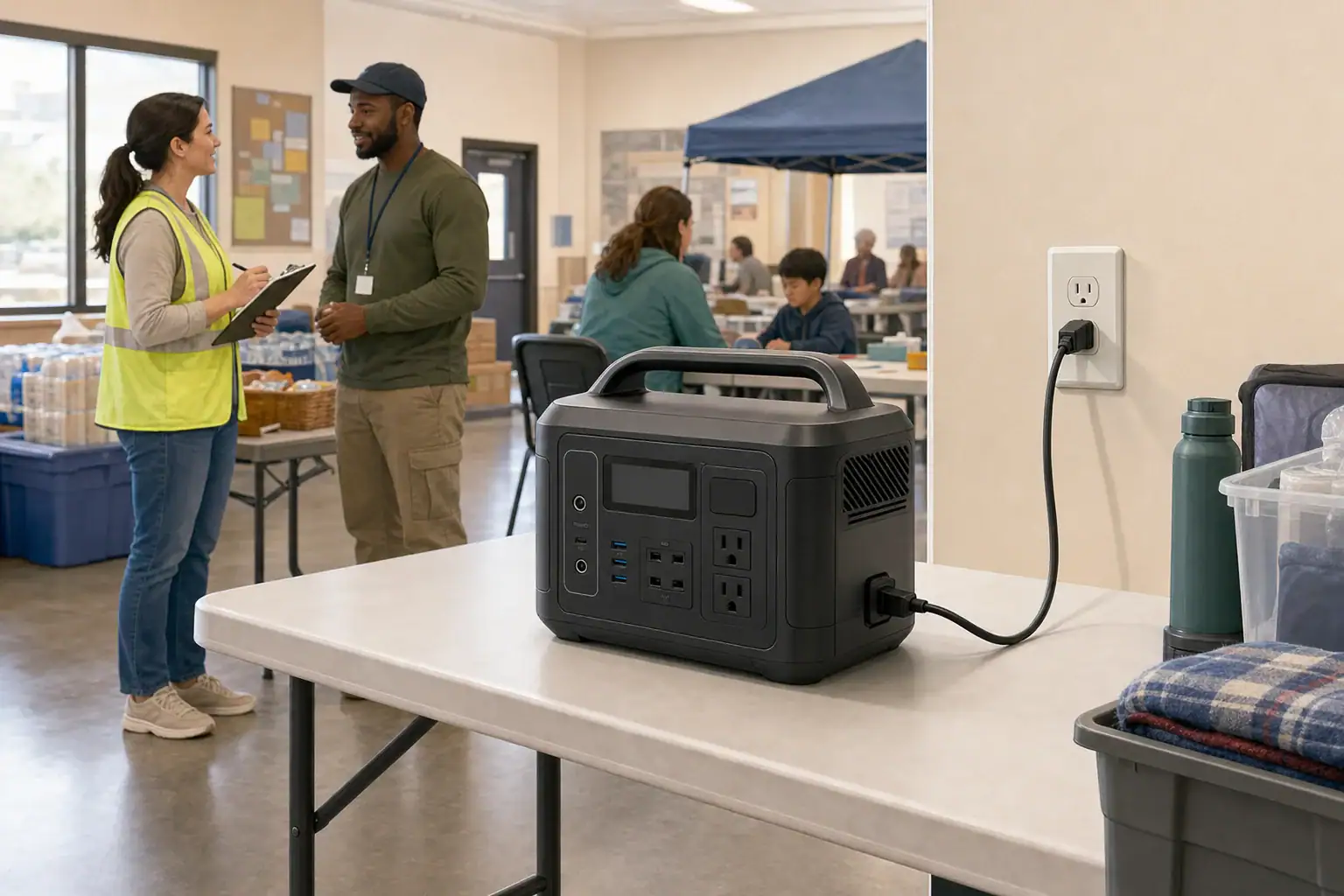
| Shelter or community resource center | AC cable and any identification required by staff | Whether the site is activated and whether staff permit a large battery |
| Vehicle outlet | A cable specified for the station and vehicle source | Supported voltage and current, outlet rating, fuse limit, and vehicle instructions |
| Portable generator | AC cable; an outdoor-rated cord only when allowed and needed | Station input demand, generator continuous output, and both manuals’ instructions |
| Portable solar | Compatible panels, connectors, and adapters | Voltage, current, polarity, wiring arrangement, and station input limits |
Where might you find a permitted outlet?
A friend’s home or workplace
A home or workplace outside the affected outage area may still have utility power. Get the owner’s permission before plugging in. Tell them the station’s selected or maximum AC input in watts, not merely its battery capacity in watt-hours. A high-input station can be a substantial continuous load, and other equipment may share the same circuit.
Use the outlet arrangement and cable specified by your own station manual. Manufacturer instructions differ by model. For example, the EcoFlow RIVER 2 Pro user manual instructs owners to use its included AC cable directly with a suitable wall outlet. That is model-specific guidance, not a rule that can be transferred to every power station.
Libraries, municipal buildings, and community sites
A library, school, municipal building, or community center may have backup power or may be outside the outage area, but availability and policies are local. A phone-charging policy does not automatically permit a large portable battery. Call first, describe the device, and ask whether its size and expected input watts are acceptable.
Do not assume public charging is free, unlimited, or available to everyone. A site may restrict access to customers, residents, people using emergency services, or essential communications needs.
Shelters and utility resource centers
Disaster sites can help with essential charging, but their capacity may be limited. The American Red Cross says some disaster service sites may offer charging stations for cell phones and medical devices; services vary by emergency and local plans. That does not guarantee acceptance of a portable power station. Check the Red Cross shelter finder and service information, then ask staff before bringing in or connecting the unit.
Utility resource centers also operate only when activated. PG&E states that visitors at its Community Resource Centers can charge devices and that medical-device charging may be prioritized during high demand. This is a regional program, not a nationwide promise, and it does not establish that every station will be accepted. See PG&E Community Resource Centers.
If you depend on electrically powered medical equipment, do not treat a public outlet or a portable station as a complete medical backup plan. Follow the device manufacturer’s backup-power instructions and seek device-specific professional guidance.
If no off-site outlet is available
Use a compatible vehicle connection
Use only the vehicle cable specified for the station. Check whether the station accepts the vehicle system voltage, how much current it may draw, and what the vehicle outlet and fuse are rated to supply. Follow both manuals, including any direction about whether the vehicle must be running and how to avoid draining its starting battery.
Vehicle charging is often limited by the outlet and cable rather than the station’s fastest advertised AC charging rate. Do not use improvised, unfused leads or connect directly to battery terminals unless the manufacturer supplies an approved system for that purpose. For more detail, see Charging From a Car: What’s Safe, What’s Slow, and What Can Break.
Use a compatible portable generator
A generator can run the station’s AC charger only when its continuous output can support the selected charging input and any other loads. A generator’s surge rating is for brief starting demand; it is not its continuous output. If the station offers a lower AC charging setting, use it only as allowed by the station manual and only after confirming that the generator can support the resulting load.
Operate a combustion generator outdoors only. The U.S. Consumer Product Safety Commission says to place generators at least 20 feet from a home and direct exhaust away from the building. Its carbon-monoxide guidance and portable-generator safety alert also call for undamaged, three-prong, outdoor-rated cords with a wattage rating above the connected load when a cord is used.
Never connect a generator or portable power station to home wiring through an ordinary receptacle. A home-backup connection requires approved transfer equipment installed for that purpose.
Use portable solar
Solar can be useful where no fueled or utility source is available, but advertised panel watts alone do not establish compatibility. Compare the array’s open-circuit voltage, current, connector, polarity, and series or parallel arrangement with the station manual. Remain within every published input limit, including limits that apply in cold conditions. See How to Read Solar Panel Specs for Power Stations for a manual-reading checklist.
Do not force mismatched connectors together or rely on an adapter to make an electrically incompatible panel safe. Disconnect and reassess if the station reports an input warning, the connector becomes hot, or equipment is wet or damaged.
How much energy can a short charging stop add?
Watts (W) measure power at a moment in time. Watt-hours (Wh) measure energy over time. For a rough planning estimate, multiply the average displayed input watts by charging hours:
average input watts × charging hours = energy presented to the station
Illustrative example: If the display averages 300 W for two hours:
300 W × 2 h = 600 Wh
If, purely for planning, you assume 10% total charging and conversion loss:
600 Wh × 0.90 = about 540 Wh stored
The 10% figure is an example assumption, not a measured or universal efficiency rating. Actual stored energy varies with the source, cable, charging stage, temperature, and how the station measures displayed input. Charging may also taper as the battery fills. Record starting and ending state of charge, elapsed time, and average displayed input to build a more useful estimate for your own station.
Checks before you plug in
- Permission: Ask the homeowner or staff specifically about charging a portable power station.
- Input limit: Find the station’s allowed AC, vehicle, or solar input in its manual.
- Source capacity: Confirm the outlet, vehicle connection, generator, or supplying source can handle the continuous load alongside other equipment.
- Cable and adapter: Use only the manufacturer-specified or manufacturer-approved charging lead.
- Condition: Do not use wet, scorched, loose, or visibly damaged outlets, plugs, cables, or connectors.
- Placement: Keep the station dry, stable, and ventilated as its manual requires. Do not block vents.
- Site rules: Check time limits, fees, extension-cord restrictions, and requirements to remain with the device.
An outlet’s label does not mean all of that capacity is available to you; other outlets and equipment may share its circuit. Likewise, a station’s battery capacity does not reveal its charging demand. The useful number to share with the source owner is the station’s selected input in watts.
Build an outage charging plan before you need it
Save the station manual and cable list offline. Label each charging lead, and identify two or three possible locations outside your immediate outage area. Keep official utility, emergency-management, and community-resource contact information available without relying on home internet.
For each potential source, note permission requirements, operating hours, expected input watts, and the travel needed to reach it. Recheck conditions during an outage: a site may close, run on limited backup power, or reserve outlets for higher-priority use. The best choice is the source that is confirmed, compatible, and likely to add enough useful energy for the trip.
Related guides: Energy Budget for a Power Outage: Lights, Phone, Internet, and Small Appliances · Emergency Preparedness: Building a Home Backup Plan Around a Power Station
Related guides
Browse this topic →
- Beginner-friendly sizing, runtime & specs
- Solar & charging (MPPT, fast charging, cables)
- Batteries (LiFePO4, cycles, care & storage)
- Safety, cold-weather performance, real-world tips
More in Charging
See all →- Pass-Through Solar Charging During an Outage: What Works and What to Avoid
- Can You Daisy-Chain Portable Power Stations? Why It Usually Isn’t a Good Idea
- USB-C Input vs AC Input on Portable Power Stations: Which Charging Method Makes Sense?
- Car Alternator Charging vs Cigarette Lighter Charging: What Changes for Power Stations?
- Charging a Portable Power Station From an RV Outlet: 12V, 24V, and Safety Limits
Keep reading
About this site
Portable Energy Lab publishes practical, independent guides about portable power—clear sizing, safe use, and real-world expectations.
Affiliate disclosure
Some links on this site may be affiliate links. If you buy through these links, we may earn a small commission at no extra cost to you. This helps support our content. Read our affiliate disclosure.