
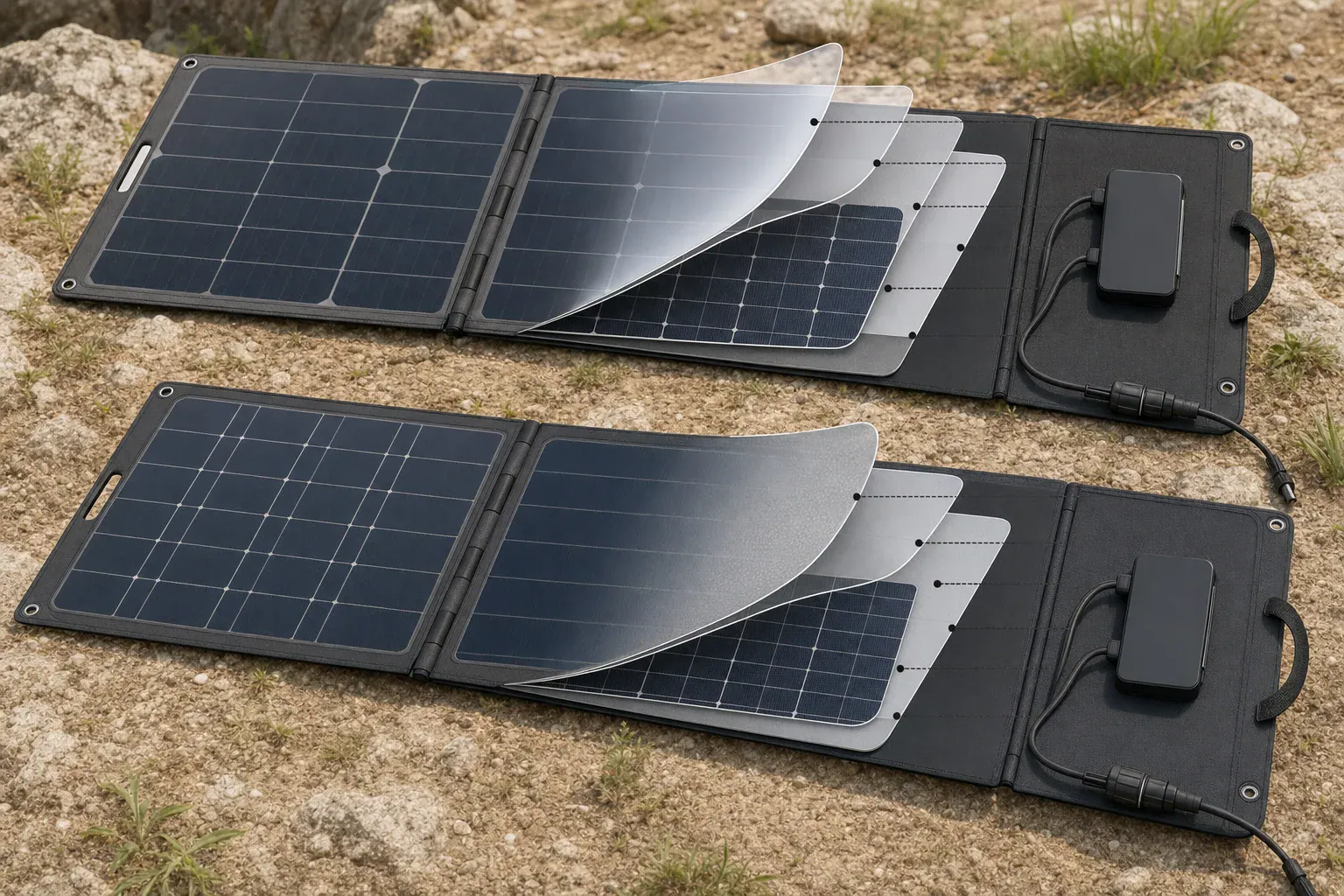
Quick answer: ETFE and PET alone do not establish a portable solar panel’s overall durability, weather resistance, or service life. They may identify only a surface film or laminate component. Compare the complete construction, model-specific environmental limits, connectors, fold design, care instructions, and warranty terms before choosing either type.
ETFE vs PET portable solar panels: what the labels mean
ETFE means ethylene tetrafluoroethylene, while PET means polyethylene terephthalate. On a portable solar panel, either name may refer to the exposed surface film or another laminate component. It does not automatically identify the encapsulant, rear layer, adhesive, edge seal, fabric, hinges, junction box, cable, or connector.
That distinction matters because a solar module is a joined system rather than a single material. IEC separates flexible polymeric frontsheet and backsheet constructions from polymeric encapsulants and their interactions with frontsheets, backsheets, adhesives, and edge seals. In other words, a listing that says “ETFE laminated” is not a complete construction specification. See the IEC 62788-2-1 overview and IEC 62788-1-1 overview.
What may be inside a folding panel
Exact construction varies by model, but a portable panel may include:
- Surface film or frontsheet: An exposed transparent ETFE, PET, or other polymer layer.
- Encapsulant: A material that surrounds and bonds the cells. It is not necessarily the same material as the surface film.
- Cells and interconnects: The electrically active parts, which can also be affected by impact and repeated flexing.
- Rear layer or substrate: A backsheet, composite support, rigid plate, or fabric-supported structure.
- Joining details: Adhesives, edge seals, stitching, welded seams, hinges, and fold gaps.
- Electrical hardware: The junction box, cable, strain relief, plugs, and adapters, which can have separate exposure limits.
If the product page says only “ETFE” or “PET,” these other layers and joining methods remain unknown.
What the surface material can—and cannot—tell you
The exposed polymer can influence how that layer responds to ultraviolet exposure, moisture, chemicals, impact, tearing, and abrasion. But the polymer name by itself omits important variables: material grade, thickness, coatings, surface treatment, manufacturing quality, and compatibility with the surrounding laminate.
For example, Chemours documents weathering, low moisture permeability, and mechanical properties for specified Tefzel ETFE films, while noting that its Type C film is not recommended for outdoor use. That does not make ETFE unsuitable outdoors; it shows that “ETFE” is not one universal performance grade and that film-level data cannot prove the durability of a finished solar panel. See the Chemours Tefzel ETFE film properties.
PET also exists in engineered forms. Toray describes U6V1 as a three-layer, UV-stabilized PET film with an adhesion-promoting coating. This is not evidence for any particular portable panel, but it demonstrates why a named and coated PET grade should not be treated as identical to unspecified PET. See the Toray U6V1 technical data sheet.
Without model-specific evidence, it is not reasonable to assign ETFE or PET a universal lifespan, output advantage, or overall durability ranking. Lamination quality, edge sealing, mechanical support, storage, and actual exposure can matter as much as the surface-film label.
Does ETFE or PET determine weather resistance?
No. Weather resistance is a property of the finished model and must be read alongside its manual. An IP code is separate from a polymer name: IEC 60529 defines the IP classification system for enclosure protection. See IEC 60529.
Even a model-specific IP rating needs context. The ETFE-laminated BLUETTI PV60F manual lists IP65, but also describes the product as splash resistant and says not to soak it or leave it in rain or water for a long time. Those instructions apply to the PV60F, not to every ETFE panel. See the BLUETTI PV60F manual.
Likewise, EcoFlow’s manual for model EF-Fold-P060-CG lists IP68 but instructs users not to soak the panel, to keep connectors away from liquids, and to avoid extended humidity. The accessible manual does not clearly identify the frontsheet material. Its instructions reinforce the practical rule: check exposure limits independently of an ETFE or PET marketing claim. See the EcoFlow 60W portable panel manual.
Do not assume an IP rating covers every connector, cable end, fabric pocket, zipper, or folded configuration. Follow the exact manual whenever its limits are narrower than a headline IP rating.
Folding and transport may matter more than the film
Portable modules encounter stresses that a surface-film comparison cannot capture. IEC TS 63163 states that consumer-module service life depends on design, environment, and operating conditions, and notes that portable products are more prone to mechanical damage than attached or mobile applications. See the IEC TS 63163 overview.
Inspect where a panel folds. A design that folds in gaps between active sections differs from one that repeatedly flexes a laminate close to its active area. Check cable routing, strain relief, exposed edges, stand hardware, and whether packed sections can rub against each other. “Flexible” does not mean a panel can be creased or bent anywhere; follow any stated bend restriction.
Care instructions are also model-specific. The EcoFlow manual cited above warns against puncturing its surface or using hard abrasive materials, and directs users to store that model folded in its case. Do not infer that a textured surface is scratch-proof, self-cleaning, or maintenance-free.
Decision table: evidence to prioritize for your use
| Expected use | How to treat ETFE or PET | Evidence that matters more |
|---|---|---|
| Occasional trips with indoor storage | Either may be suitable; do not pay for a label without supporting details. | Exact laminate wording, packed size, carried weight, care instructions, and warranty exclusions. |
| Frequent outdoor deployment | ETFE can be a favorable material signal, but not a durability verdict. | Disclosed grade, module-level weather evidence, seam construction, edge sealing, and connector protection. |
| Rainy, humid, or dusty locations | Do not choose by surface film alone. | Model-specific IP rating, tested configuration, connector exclusions, drying instructions, and exposure limits. |
| Frequent transport and folding | The surface is only one potential wear point. | Fold geometry, hinges or fabric construction, cable strain relief, bend restrictions, folded dimensions, and weight. |
| Extended or unattended deployment | Reject a model if its manual prohibits the intended exposure, regardless of film type. | Continuous-exposure language, operating limits, mounting restrictions, qualification scope, and warranty terms. |
Portable solar panel datasheet checklist
Use the manual and datasheet for the exact model and revision you are considering. A retailer’s short description can omit restrictions that affect real-world use.
- Laminate terminology: Does the documentation say frontsheet, surface film, coating, lamination, encapsulation, or merely “made with” ETFE or PET?
- Layer details: Are grade, film thickness, UV stabilization, coating, encapsulant, substrate, adhesive, or edge sealing disclosed?
- Environmental rating: Is there a model-specific IP code, and do the manual’s water, dust, humidity, and immersion exclusions limit the way you plan to use it?
- Qualification evidence: Is a finished module associated with a named standard, edition, report, or certificate rather than a vague “tested to standards” statement?
- Construction changes: Does the documentation identify the version being sold? IEC 62915 addresses retesting when critical module materials or construction change; see the IEC 62915 overview.
- Operating limits: Record the operating and storage temperature ranges, exposure restrictions, bend limits, and any prohibition on permanent installation.
- Fold design: Look at section count, hinge locations, fold gaps, edge protection, cable paths, pockets, stands, and closures.
- Size and carrying weight: Compare deployed and folded dimensions. Include required cables, adapters, and case weight if you will carry them together.
- Maintenance: Check permitted cleaning materials, drying requirements, storage orientation, and warnings about abrasives, punctures, chemicals, or pressure.
- Warranty language: Separate the product warranty from any power-output promise. Read exclusions for weather exposure, scratches, creases, delamination, connectors, commercial use, and improper storage.
A claim of compliance with a module standard can be useful, but its scope still matters. IEC 61215-2 includes design-qualification test procedures, including a bending test for flexible modules. It does not establish that every fold, hinge, accessory, or real-world exposure is covered. See the IEC 61215-2 overview.
The practical buying rule
Treat ETFE or PET as the beginning of a comparison, not the conclusion. Favor the panel whose manufacturer clearly documents the laminate, finished-module environmental limits, connector precautions, fold construction, storage rules, and warranty coverage that fit your intended use. If those details are missing, overall durability and weather resistance remain unknown regardless of the surface material named in the listing.
Related guides
Browse this topic →
- Beginner-friendly sizing, runtime & specs
- Solar & charging (MPPT, fast charging, cables)
- Batteries (LiFePO4, cycles, care & storage)
- Safety, cold-weather performance, real-world tips
More in Solar
See all →- Solar Generator With Panels Included: 7 Checks Before Buying
- Solar Panel Rated Watts vs. Real Charging Output
- How to Clean Portable Solar Panels Without Damage
- Solar Charging on Cloudy Days: What Output Can a Portable Power Station Expect?
- How Many Portable Solar Panels Do You Need for a 1,000Wh Power Station?
Keep reading
About this site
Portable Energy Lab publishes practical, independent guides about portable power—clear sizing, safe use, and real-world expectations.
Affiliate disclosure
Some links on this site may be affiliate links. If you buy through these links, we may earn a small commission at no extra cost to you. This helps support our content. Read our affiliate disclosure.