
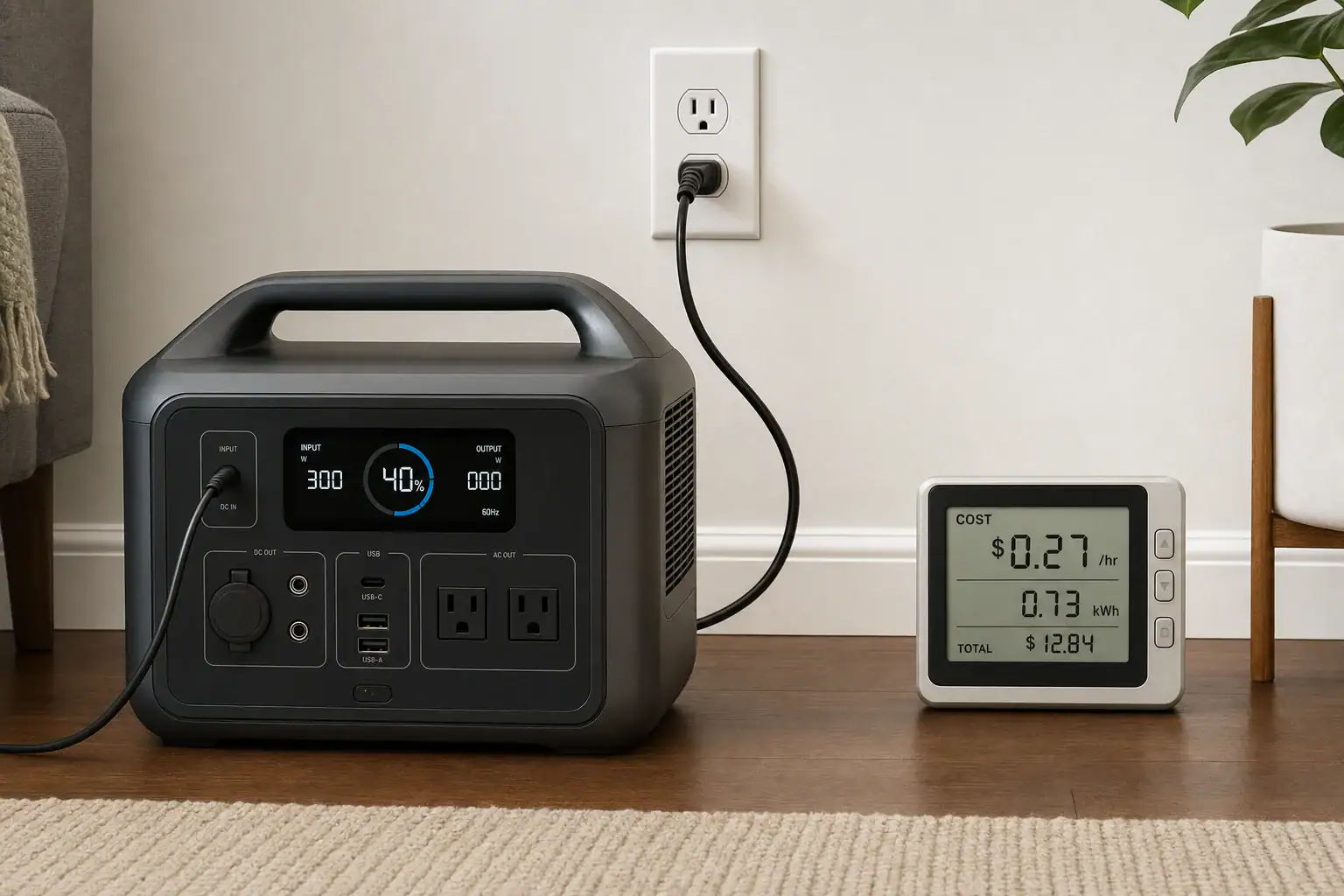
Charging a portable power station from the wall usually costs only a few cents to less than a dollar, depending on battery capacity, starting charge level, charging efficiency, and your electricity rate. For example, fully charging a 1,000-watt-hour unit may draw roughly 1.1 to 1.3 kilowatt-hours from the outlet. At an electricity price of $0.17 per kilowatt-hour, that would cost about $0.19 to $0.22.
The exact amount cannot be determined from battery capacity alone. Conversion losses in the AC charger, battery management system, and internal electronics increase wall consumption. Your local utility rate may also vary by season, time of use, or total household consumption. To calculate wall charging cost accurately, you need the power station’s watt-hour capacity, the percentage being replenished, expected charging efficiency, and the price paid per kilowatt-hour.
Understanding these factors helps compare charging modes, estimate operating expenses, and distinguish battery capacity from AC input watts or charging speed.
1. What Wall-Charging Cost Means and Why It Matters
The cost to charge a portable power station is the price of the electrical energy drawn from the wall outlet during a charging session. Utilities normally bill residential electricity in kilowatt-hours, abbreviated kWh. One kilowatt-hour equals 1,000 watt-hours of energy.
A power station rated at 1,000 Wh has a nominal capacity of 1 kWh, but a full recharge generally draws more than 1 kWh from the wall. Energy is lost as heat while AC electricity is converted to the voltage required by the battery. The battery management system, cooling fan, display, and other internal components may consume additional power.
This distinction matters when estimating long-term operating cost. A person charging occasionally for emergencies may spend very little over a year. Frequent users who recharge a large-capacity unit every day will have higher annual costs, although the cost of each individual cycle can still be modest.
Charging cost is separate from charging speed. A higher AC input limit can reduce the time required to recharge, but it does not necessarily reduce the total energy consumed. Fast charging may sometimes produce more heat, while a slower mode may run fans less aggressively. The actual difference depends on the charging system.
2. How to Calculate the Cost of a Wall Charge
The simplest estimate starts with the amount of battery capacity that needs to be replaced. Multiply the rated capacity by the missing charge percentage, account for efficiency losses, convert watt-hours to kilowatt-hours, and then multiply by the electricity rate.
Estimated cost = capacity in Wh × charge fraction ÷ efficiency ÷ 1,000 × electricity rate per kWh
For example, consider a 1,000 Wh power station being charged from 20% to 100%. The missing charge fraction is 0.80. If overall charging efficiency is estimated at 85%, the wall energy calculation is 1,000 × 0.80 ÷ 0.85 ÷ 1,000, or about 0.94 kWh. At $0.17 per kWh, the estimated cost is approximately $0.16.
Efficiency commonly varies with charger design, battery temperature, charging rate, and standby consumption. An assumed range of about 80% to 90% is useful for rough calculations when measured data is unavailable. For the most accurate result, use a plug-in energy meter to record the total kWh drawn during an entire charging session, then multiply that reading by the applicable utility rate.
| Calculation input | Example | Effect on cost |
|---|---|---|
| Battery capacity | 1,000 Wh | Larger capacities require more energy for a comparable percentage increase. |
| Starting charge | 20% | A lower starting level means more capacity must be replaced. |
| Ending charge | 100% | Stopping below full reduces energy used during that session. |
| Charging efficiency | 85% | Lower efficiency increases the energy drawn from the outlet. |
| Electricity rate | $0.17 per kWh | A higher utility price directly increases charging cost. |
3. Real-World Charging Cost Examples
The following examples use simplified assumptions rather than guaranteed consumption figures. Actual results can differ because nominal battery capacity may not equal usable capacity, and charging losses change throughout the charge cycle.
Small 300 Wh power station
A 300 Wh unit charged from empty to full at 85% efficiency would draw about 353 Wh, or 0.353 kWh, from the wall. At $0.17 per kWh, the estimated cost would be about $0.06. If it were charged from 50% to 100%, the cost would be roughly half that amount.
Mid-size 1,024 Wh power station
A full recharge of a 1,024 Wh battery at 85% efficiency would require approximately 1.20 kWh from the outlet. At $0.17 per kWh, the session would cost about $0.20. Recharging it once a week under similar conditions would cost roughly $10 to $11 per year.
Large 2,000 Wh power station
If a 2,000 Wh unit is charged from 25% to 100%, it needs to store approximately 1,500 Wh. At 88% efficiency, wall consumption would be about 1.70 kWh. At $0.17 per kWh, the estimated cost would be about $0.29.
Daily charging
Frequency makes a greater difference to annual cost than a small change in efficiency. If a charging session consumes 1.2 kWh every day, annual wall consumption would be about 438 kWh. At $0.17 per kWh, that equals approximately $74.46 per year. The same unit charged only twice a month would cost far less annually.
Time-of-use electricity plans can also affect the result. A utility may charge less overnight and more during peak afternoon or evening hours. When available and permitted by the manufacturer’s operating guidance, scheduling a charge during a lower-rate period can reduce cost without changing the amount of energy stored.
4. Common Calculation Mistakes and Troubleshooting Cues
One common mistake is treating watt-hours and watts as interchangeable. Watt-hours measure energy capacity, while watts measure the rate of power flow. A 1,000 Wh battery does not automatically consume 1,000 watts while charging. Its AC input might be 200 watts, 500 watts, or more, depending on the charger and selected charging mode.
Another mistake is multiplying the maximum input wattage by the entire advertised charging time. Charging power is rarely constant from start to finish. Many battery systems accept high power early in the cycle and reduce input near full charge to control heat and cell voltage. A 500-watt input rating therefore does not mean the unit draws exactly 500 watts for every minute of a two-hour session.
If measured wall consumption seems unusually high, check whether devices were running from the power station while it was charging. Pass-through operation can make the outlet supply both the battery and connected loads. Displays, wireless modules, heaters, or cooling fans can also add small amounts of consumption.
An unexpectedly long charge may indicate a low input setting, a shared circuit with voltage drop, excessive battery temperature, or charging near freezing conditions. It may also result from the normal taper near 100%. Check the displayed input watts and confirm that the correct charging mode and supplied cable are being used.
If the percentage rises quickly but falls soon after unplugging, the state-of-charge estimate may need time to recalibrate according to the manufacturer’s normal operating guidance. Persistent errors, abnormal heat, odors, repeated shutdowns, or a failure to accept a charge call for professional support rather than disassembly or modification.
5. Wall-Charging Safety Basics
Use a properly grounded wall outlet that is in good condition and appropriate for the charger’s current draw. Avoid loose receptacles, damaged cords, scorched plugs, or adapters that do not fit securely. High-input charging modes can place a meaningful continuous load on a household circuit, especially when heaters, appliances, or other high-wattage devices share that circuit.
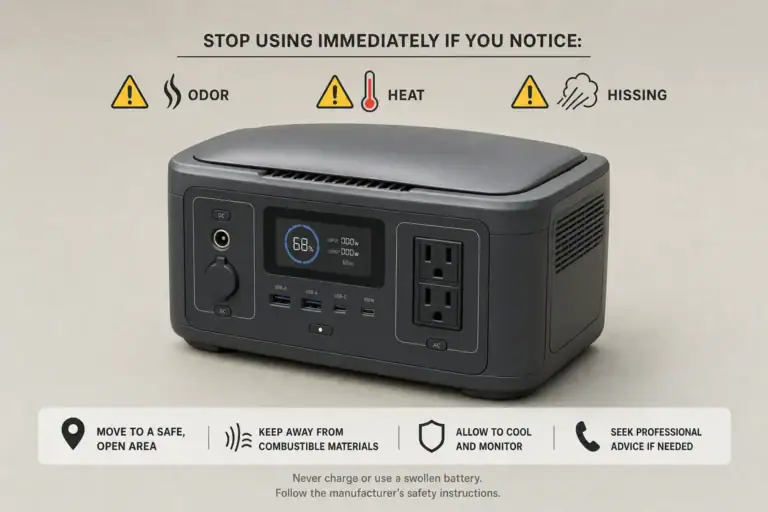
Place the power station on a stable, dry surface with clear space around its ventilation openings. Do not cover it while charging or place it near combustible materials. Charging naturally creates some heat, but excessive heat, swelling, smoke, unusual sounds, or a strong chemical odor are warning signs. Disconnect the unit if it is safe to do so and move away from the area.
Extension cords can add resistance and voltage drop. If one must be used, it should be appropriately rated for the charger’s input and fully uncoiled. A damaged, undersized, or loosely connected cord can overheat. Do not use wall charging in wet conditions unless every component is specifically designed for that environment.
A portable power station should not be connected directly to home wiring, an electrical panel, a transfer switch, or an interlock without equipment designed for that purpose and installation by a qualified electrician. Never open the enclosure, modify the battery pack, or bypass temperature, current, or charging protections.
6. Maintenance and Storage Factors That Affect Charging Cost
Battery condition can influence how efficiently energy is stored. As a battery ages, its usable capacity generally declines. An older unit may reach 100% after accepting less energy than when new, but it will also provide less runtime. A lower charging bill in that situation does not necessarily indicate improved efficiency.
Temperature also matters. Charging in very hot or cold conditions can trigger reduced input power, longer charging times, or protective shutdowns. Store and charge the unit within its stated temperature range, preferably in a dry, ventilated indoor location. Allow a unit moved from a cold environment to reach a suitable temperature before charging.
For long-term storage, follow the specified storage charge range and inspection interval. Many battery systems are better stored partially charged rather than left at 0% or held at 100% for months. Periodic top-ups use little electricity, but they help prevent excessive self-discharge and preserve readiness.
Turn off unnecessary outputs, wireless functions, and displays during storage. Even small standby loads can gradually drain the battery and require more frequent recharging. Record the charge percentage at the start and end of a storage period if unexplained losses are suspected.
| Storage or use pattern | Illustrative wall energy | Cost at $0.17 per kWh |
|---|---|---|
| Monthly 10% top-up of a 1,000 Wh unit at 85% efficiency | 0.118 kWh | About $0.02 |
| Quarterly 20% top-up of a 1,000 Wh unit at 85% efficiency | 0.235 kWh | About $0.04 |
| Full recharge of a 500 Wh unit at 85% efficiency | 0.588 kWh | About $0.10 |
| Full recharge of a 2,000 Wh unit at 85% efficiency | 2.353 kWh | About $0.40 |
7. Practical Takeaways and Specs to Look For
For a quick estimate, convert the capacity to kilowatt-hours, multiply by the portion being replenished, divide by estimated efficiency, and multiply by the local electricity rate. A plug-in energy meter provides a better answer because it captures conversion losses, charging taper, cooling, and standby consumption. Use the rate shown on your utility bill, including relevant energy charges, rather than relying on a national average.
Related guides: Portable Power Station Watt-Hours Explained • How Long Does It Take to Charge a Portable Power Station? • Fast Charging Explained: What “AC Input” and “DC Input” Speeds Mean
Cost should be evaluated alongside recharge time, usable capacity, cycle life, and charging controls. A low per-charge cost does not by itself indicate that a power station will meet a particular runtime or backup-power need.
Specs to look for
- Battery capacity: Look for a watt-hour rating such as 300 Wh, 1,000 Wh, or 2,000 Wh; capacity is the main factor determining energy required for a full recharge.
- Usable capacity: Look for tested or documented usable energy below the nominal rating; it gives a more realistic basis for runtime and recharge calculations.
- Maximum AC input: Values may range from about 100 watts on compact units to more than 1,000 watts on larger models; higher input can shorten recharge time when the circuit supports it.
- Adjustable charging rate: Look for quiet, standard, and fast settings; selectable input can reduce fan noise or circuit load when maximum speed is unnecessary.
- Full recharge time: Compare stated times under clearly defined conditions, such as 0% to 100% using AC power; this helps set realistic expectations for charging availability.
- Battery chemistry and cycle rating: Look for a cycle estimate tied to a remaining-capacity percentage, such as 2,000 cycles to 80%; this helps evaluate long-term durability rather than one-time charging cost.
- Operating and charging temperature range: Look for a range suitable for the expected environment; temperature restrictions can affect charging speed, safety, and availability.
- Standby consumption and automatic shutoff: Look for low idle draw and configurable shutdown timers; these features reduce unnecessary battery drain and repeat charging.
- Input energy display: Look for real-time input watts, estimated time remaining, and clear charge percentage; these readings make it easier to identify slow charging or unexpected consumption.
- Charging efficiency information: If available, look for measured wall-to-battery efficiency in the approximate 80% to 90% range; higher efficiency can modestly reduce energy use and heat.
In most households, a single wall charge is inexpensive. The most reliable estimate comes from measuring actual kWh at the outlet and multiplying that figure by the electricity price that applies at the time of charging.
Frequently asked questions
How much does it cost to charge a portable power station from the wall?
The cost depends on the amount of energy replaced, charging losses, and the electricity rate on your utility bill. As a rough example, a 1,000 Wh unit may draw about 1.1 to 1.3 kWh for a full charge, which costs about $0.19 to $0.22 at $0.17 per kWh. A plug-in energy meter provides the most accurate result for a specific unit.
Does charging a portable power station overnight cost less?
It can cost less if your utility uses time-of-use pricing and offers lower overnight rates. The station uses approximately the same amount of energy, but each kWh may be billed at a lower price. Check your utility plan to confirm whether off-peak rates apply.
What specifications matter most when comparing portable power station charging costs?
Battery capacity in watt-hours, documented usable capacity, and wall-to-battery charging efficiency are the main specifications for estimating energy use. Adjustable AC charging modes and standby consumption can also affect real-world usage. Maximum AC input primarily affects charging time rather than the basic energy needed for a recharge.
Is it a mistake to calculate charging cost using the maximum input wattage?
Yes. Maximum input wattage is a power rate, while charging cost is based on total energy consumed in kWh. Input power commonly changes during the session and tapers as the battery approaches full charge, so a meter reading is more reliable than multiplying a peak wattage by the advertised charge time.
Is it safe to leave a portable power station charging from a wall outlet?
Follow the manufacturer’s charging instructions and use an undamaged, properly grounded outlet and charging cable. Charge on a dry, stable surface with ventilation clear of obstructions and away from combustible materials. Stop charging and seek support if there is excessive heat, swelling, smoke, unusual odor, or repeated shutdowns.
Why does a power station use more electricity from the wall than its battery capacity?
Some electricity is lost during AC-to-DC conversion and battery charging, mainly as heat. Internal systems such as cooling fans, displays, and battery management electronics may also use power. Therefore, a station with a 1 kWh battery can require more than 1 kWh from the outlet for a full recharge.
Related guides
Browse this topic →

- Beginner-friendly sizing, runtime & specs
- Solar & charging (MPPT, fast charging, cables)
- Batteries (LiFePO4, cycles, care & storage)
- Safety, cold-weather performance, real-world tips
More in Charging
See all →- USB-C Input vs AC Input on Portable Power Stations: Which Charging Method Makes Sense?
- Car Alternator Charging vs Cigarette Lighter Charging: What Changes for Power Stations?
- Charging a Portable Power Station From an RV Outlet: 12V, 24V, and Safety Limits
- Fast AC Charging vs Battery Longevity: Should You Use Turbo Mode Every Time?
- Solid-State Batteries and Portable Power Stations: What Could Change?
Keep reading
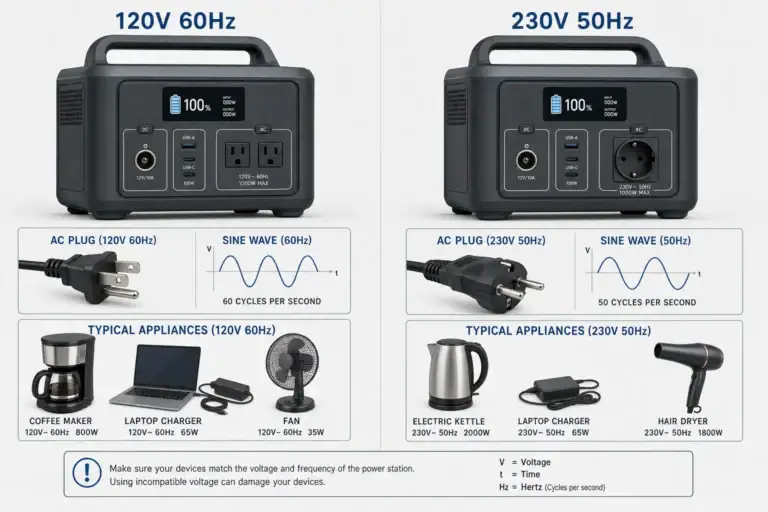
About this site
Portable Energy Lab publishes practical, independent guides about portable power—clear sizing, safe use, and real-world expectations.
Affiliate disclosure
Some links on this site may be affiliate links. If you buy through these links, we may earn a small commission at no extra cost to you. This helps support our content. Read our affiliate disclosure.