
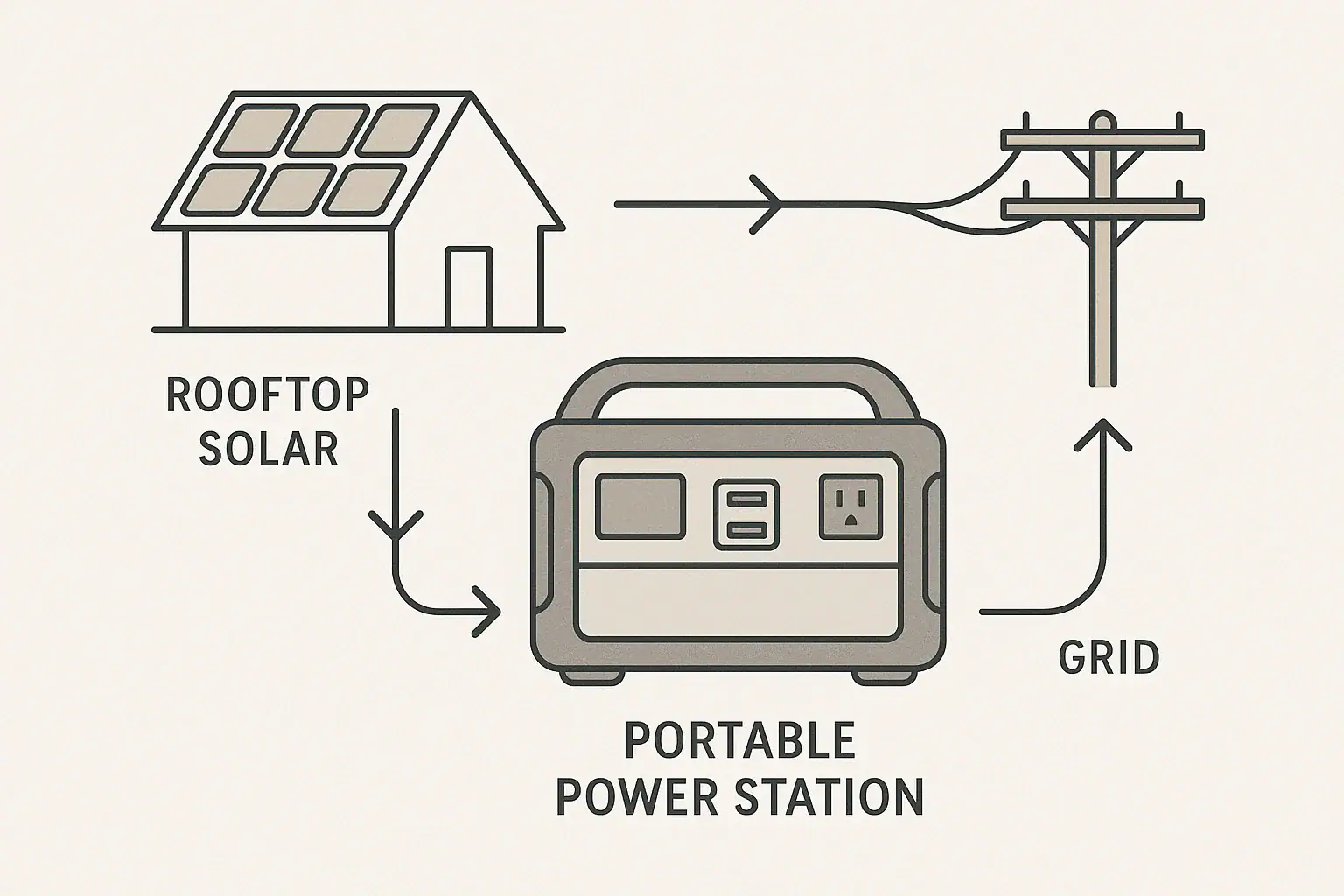
Small renewable energy systems and portable storage fit into the grid by smoothing out when and how electricity is used, storing extra power and releasing it later. In practice, that means turning variable solar or wind into more reliable watts, longer runtime, and better backup coverage when the grid goes down. People search for terms like “grid-tied battery”, “portable power station”, “surge watts”, and “solar input limit” because they want to know how these pieces actually work together.
Portable power stations are no longer just camping gadgets; they are miniature energy hubs that can charge from solar, wall outlets, or vehicles and then power household devices, tools, and electronics. When you understand capacity, inverter output, charge rate, and cycle life, you can match a small system to your own loads and backup needs. This guide explains how renewable energy and portable storage interact with the grid, what limits to watch for, and which specs matter most if you plan to rely on a compact system now or expand later.
Understanding Renewable Energy and Portable Storage in the Grid
Renewable energy plus portable storage describes a setup where small batteries, inverters, and solar inputs work alongside the larger electrical grid instead of replacing it outright. The grid still supplies most of the power, but portable systems add flexibility: they can charge when energy is cheap or abundant and discharge when the grid is stressed or unavailable.
For most households, this plays out as a portable power station that can plug into a wall outlet, solar panels, or a vehicle socket, then run critical loads like routers, laptops, lights, and small appliances. The system is not usually hardwired into the home panel; instead, you plug devices directly into the portable unit or use safe, temporary extension setups for specific circuits under guidance from an electrician.
This matters because the modern grid is shifting toward more distributed and variable generation. Rooftop solar, community solar, and small wind all change how and when energy flows. Portable storage helps by:
- Capturing excess energy from solar during sunny hours.
- Providing backup power during short outages without starting a generator.
- Reducing peak demand by powering some loads from stored energy.
- Improving power quality for sensitive electronics with clean inverter output.
In short, small systems do not replace the grid but act as a buffer between you and it, giving you more control over timing, reliability, and efficiency.
Key Concepts: How Small Systems Interact With Renewable Sources and the Grid
To understand how portable storage fits into the grid and renewable energy, it helps to break the system into a few core components and concepts.
Energy capacity and runtime
Battery capacity, usually measured in watt-hours (Wh), tells you how much energy the portable system can store. Runtime is how long it can power a given load. The relationship is straightforward: divide capacity by the watts your devices use, then adjust for real-world efficiency.
For example, a 1,000 Wh unit powering a 100 W device might run for 8–9 hours once inverter losses are considered. Higher capacity means longer runtime or the ability to run more devices at once, but also more weight and cost.
Inverter output and surge watts
The inverter converts DC battery power to AC power compatible with household devices. Two key specs are continuous output (in watts) and surge watts. Continuous output is what the system can supply steadily; surge watts cover short bursts needed to start motors or compressors.
If a device needs 600 W running power but 1,200 W on startup, your portable system’s surge rating must handle that momentary spike. Otherwise, the inverter may shut down or the device may fail to start.
Input power, charge rate, and solar integration
Input power describes how fast the system can recharge from AC, DC, or solar. For solar, you will see maximum input watts and a voltage range. These create an effective solar input limit, which caps how quickly you can refill the battery even if your panels are larger.
Small systems often accept between 100 W and 400 W of solar input. Matching your panel array to these limits ensures efficient charging and avoids wasting potential generation. Charge controllers built into the portable unit manage this process, converting variable solar power into stable charging current.
Grid role: source, backup, and buffer
In a typical setup, the grid is the primary source of power. The portable system becomes a backup during outages or a buffer when you want to shift some usage off-peak. When the grid is available, you can charge the battery from a wall outlet, from solar, or both. When the grid fails, the battery takes over for selected loads.
While larger stationary battery systems can sometimes be integrated directly with home circuits, portable units generally sit on the edge of the system: they plug into outlets and devices but do not manage the whole house. This makes them flexible and safer for non-specialists, while still supporting renewable integration.
Efficiency, conversion losses, and real-world performance
Every time energy changes form—AC to DC, DC to AC—there are losses. Inverter efficiency, charging efficiency, and battery chemistry all affect how much of the original energy you can actually use. A system rated for 1,000 Wh may deliver closer to 850–900 Wh in real conditions.
Understanding these losses helps you size your system realistically and avoid disappointment when runtime is shorter than the theoretical calculation.
| Concept | Typical Range | What It Affects |
|---|---|---|
| Battery capacity | 300–2,000 Wh | Runtime and number of devices supported |
| Continuous inverter output | 300–2,000 W | Maximum combined load you can run |
| Surge watts | 2x continuous (short bursts) | Ability to start motors and compressors |
| Solar input limit | 100–400 W | How fast solar can recharge the system |
| Cycle life | 500–3,000+ cycles | Long-term durability and cost per kWh |
Related guides: Portable Power Station Buying Guide • Inverter Efficiency Explained: Why Your Runtime Is Shorter Than Expected • Battery Cycle Life Explained: What “Cycles” Really Mean
Real-World Ways Small Systems Fit Into the Grid
Portable power stations and compact renewable setups are used in many everyday scenarios that complement the grid rather than replace it. These examples show how they function in practice.
Solar-assisted home office
A common use case is a home office powered partly by a portable system and a small solar array. During the day, solar panels charge the battery while also running a laptop, monitor, and router. When clouds roll in or the workday extends into the evening, the battery continues to supply power, reducing dependence on the grid.
This setup smooths out solar variability and keeps critical work devices running through brief outages without needing a full home backup system.
Load shifting to reduce peak usage
In regions with time-of-use rates, some users charge their portable system from the grid during off-peak hours, then run selected loads from the battery during higher-cost periods. While small systems cannot offset all household consumption, they can handle predictable loads such as networking gear, lighting, or small entertainment devices.
This approach effectively uses the portable station as a personal, small-scale energy storage resource that interacts with the grid through your normal outlets.
Emergency backup for critical circuits
During storms or grid instability, a portable system can keep essential circuits powered: internet, phone charging, medical devices that are approved for use with inverters, and small refrigeration. Instead of wiring into the panel, users typically plug these devices directly into the portable unit.
Where more permanent backup is desired, a licensed electrician can design a safe solution using appropriate transfer equipment, but the portable unit remains the energy source, not a replacement for utility infrastructure.
Portable support for off-grid cabins and RVs
In cabins, RVs, or tiny homes that may connect to shore power occasionally, a portable station acts as a bridge between off-grid solar and grid hookups. When parked at a site with grid access, the unit charges from AC; when off-grid, it charges from solar and powers lights, pumps, and electronics.
This hybrid pattern mirrors how larger grid-tied homes use rooftop solar and stationary batteries, just at a smaller scale and with more mobility.
Community and event applications
At community events, markets, or temporary work sites, portable systems provide quiet, zero-fuel power for lighting, point-of-sale devices, and audio equipment. When the event location has limited grid access, small renewable setups with foldable solar panels extend runtime without running extension cords from distant outlets.
In all these examples, small systems do not operate as standalone microgrids. Instead, they provide flexible, modular support that complements grid power and local renewable generation.
Common Mistakes and Troubleshooting Cues With Small Renewable Systems
When integrating portable storage with renewable energy and everyday grid use, certain patterns of misuse and confusion show up repeatedly. Recognizing them early can prevent downtime and equipment stress.
Overestimating runtime
One of the most frequent mistakes is assuming nameplate capacity translates directly to usable energy. Users may expect a 1,000 Wh system to run a 1,000 W device for an hour, only to find it shuts down sooner. Conversion losses, inverter efficiency, and battery protection reduce usable capacity.
Troubleshooting cue: If runtime seems too short, check the actual watt draw with a plug-in meter and compare to capacity. Consider that many devices draw more than their label rating under real use.
Ignoring surge watts and startup loads
Another common issue is trying to run devices with high startup currents—like refrigerators or power tools—on a system sized only for their running watts. The inverter may trip, or the device may click repeatedly without starting.
Troubleshooting cue: If devices fail to start or cause the inverter to shut down immediately, compare their startup or locked-rotor amps to your system’s surge rating. You may need a higher surge capacity or to avoid those loads.
Mismatched solar input and charge profiles
Users sometimes connect more solar panel wattage than the portable system can accept, expecting faster charging. In practice, the charge controller caps the input at its rated limit, so the extra panel capacity is unused.
Troubleshooting cue: If your solar array seems underperforming, check the portable system’s maximum solar input watts and voltage range. Ensure your panel configuration (series/parallel) fits within those limits without exceeding them.
Running at maximum load continuously
Operating a portable system near its continuous output limit for long periods can generate heat and stress components. While within spec, this reduces efficiency and may shorten lifespan if done regularly.
Troubleshooting cue: If the unit becomes very warm or the fan runs constantly, review your total load. Reducing average draw to 60–80% of continuous rating usually improves performance and longevity.
Using unsafe cords and ad-hoc connections
Some users attempt to backfeed a home circuit through improvised cords or adapters, which is unsafe and may be illegal. This can endanger utility workers and damage equipment.
Troubleshooting cue: If you feel tempted to plug the portable system into a wall outlet to “power the house,” stop. Use the unit as a dedicated power source for individual devices, or consult a qualified electrician for any panel-level integration.
Misinterpreting state-of-charge-indicators
Battery indicators are estimates, especially under fluctuating loads. A display might jump from 70% to 40% quickly when a heavy device turns on, then recover when the load stops.
Troubleshooting cue: If the percentage seems erratic, check the reading with no load connected after a few minutes of rest. Use watt and watt-hour readings, if available, for a more accurate picture.
Safety Basics When Combining Renewables, the Grid, and Portable Storage
Safety is central when dealing with any energy system, even small ones. Portable storage units are designed to be user-friendly, but there are still important boundaries to respect when they interact with the grid and renewable sources.
Respecting system limits
Every portable power station has clear ratings for voltage, current, and power. Staying within these limits prevents overheating, shutdowns, and premature wear. Do not attempt to modify the unit, bypass protections, or connect incompatible sources such as unregulated generators without proper conditioning.
Avoiding unsafe backfeeding
Never connect a portable system directly to household wiring through improvised means. Backfeeding through outlets or DIY transfer arrangements can energize circuits unexpectedly and pose shock or fire hazards. Any connection to fixed wiring should be designed and installed by a qualified electrician using appropriate equipment.
Ventilation and heat management
Portable systems generate heat during charging and discharging. Place them on stable, nonflammable surfaces with adequate airflow. Avoid enclosed cabinets, direct sunlight, and proximity to heat sources. High internal temperatures can trigger protective shutdowns or shorten battery life.
Safe solar handling
Solar panels can produce voltage whenever exposed to light. Use proper connectors, avoid damaged cables, and follow polarity markings carefully. Do not exceed the portable unit’s rated solar input voltage; doing so can damage internal electronics.
Moisture and weather exposure
Most portable power stations are not fully weatherproof. Keep them dry and protected from rain, condensation, and standing water. If using renewable setups outdoors, ensure that panels, cables, and any outdoor enclosures are rated for the environment.
Battery chemistry awareness
Different chemistries (such as lithium iron phosphate versus other lithium-ion types) have different thermal and cycle characteristics. While the user does not need to manage cells directly, it is important not to open the unit or attempt any internal repairs. If you suspect damage or swelling, discontinue use and contact the manufacturer or a qualified professional.
| Safety Area | Good Practice | Risk Reduced |
|---|---|---|
| Load management | Keep loads under 80% of continuous rating | Overheating and shutdowns |
| Grid interaction | Use only approved methods for any panel connection | Backfeed and shock hazards |
| Solar input | Match panel voltage to allowed range | Controller and inverter damage |
| Placement | Operate on stable, dry, ventilated surfaces | Fire and moisture damage |
| Handling | Do not open or modify the battery pack | Short circuits and thermal events |
Maintenance, Storage, and Long-Term Grid Compatibility
Proper maintenance and storage help small renewable systems remain reliable partners to the grid over many years. While portable units are largely self-contained, a few habits make a significant difference.
Battery care and cycling
Most modern portable systems prefer regular, moderate cycling rather than sitting fully charged or fully discharged for long periods. Using the battery periodically keeps it healthy. Avoid repeatedly draining to 0% or storing at 100% for months without use.
If the unit will sit unused, many manufacturers recommend storing it around 30–60% state of charge and topping it up every few months. This helps preserve capacity and cycle life, which in turn maintains your backup and renewable integration capability.
Environmental conditions
Store and operate the system in environments within the recommended temperature range, typically avoiding extremes below freezing or above hot summer attic conditions. Cold can temporarily reduce apparent capacity; heat accelerates aging.
For solar components, periodically inspect panels and cables for dirt, corrosion, and mechanical damage. Clean panels gently to maintain output and avoid scratching the surface.
Firmware and feature updates
Some portable units include firmware that can be updated to improve charging algorithms, add features, or enhance safety. Keeping firmware current can optimize how the system interacts with both the grid and renewable sources, especially as standards evolve.
Monitoring usage patterns
Modern systems often include displays or apps that track energy in and out. Reviewing these logs occasionally helps you understand your typical loads, charging sources, and how often you rely on the grid versus solar or battery. This insight can guide future upgrades or changes to your setup.
Planning for expansion
As your needs grow, you may add more solar capacity, additional portable units, or transition to a larger stationary battery. Maintaining your existing system well ensures it remains a useful part of a layered energy strategy—perhaps as a dedicated backup for networking gear, a travel unit, or a flexible supplement to a more permanent installation.
Good maintenance keeps your small system predictable, which is essential when you depend on it to bridge gaps in grid power or to make the most of local renewable resources.
Practical Takeaways and Specs to Look For in Small Grid-Connected Setups
Small renewable and portable storage systems fit into the grid by adding flexibility: they store surplus energy, provide targeted backup, and let you shift selected loads off-peak. They are not full replacements for utility service or whole-home batteries, but they can significantly improve resilience and efficiency when chosen and used thoughtfully.
When evaluating a system for use with the grid and renewables, think in terms of roles: everyday power hub, outage backup, solar companion, or mobile extension of your home energy. Then match the specs to those roles instead of chasing the largest numbers on the box.
Specs to look for
- Battery capacity (Wh) – Look for enough capacity to cover your critical loads for several hours (for example, 500–2,000 Wh). This determines how long you can ride through outages or run devices from solar after dark.
- Continuous inverter output (W) – Choose a rating that comfortably exceeds your typical combined load, often 300–1,500 W for small systems. This ensures the system can run multiple devices at once without overloading.
- Surge power rating – Aim for surge watts around 1.5–2 times the continuous rating. This helps start motors, compressors, and other devices with high inrush currents without tripping the inverter.
- Solar input capacity (W and V) – Match expected panel wattage to the unit’s solar input limit, commonly 100–400 W. Adequate input allows you to recharge fully within a reasonable daylight window.
- Charge rate from AC – Look for AC charging power that can refill the battery in 2–6 hours, depending on capacity. Faster AC charging makes it easier to top up between outages or during off-peak hours.
- Cycle life and battery chemistry – Prefer higher cycle counts (for example, 1,000–3,000+ cycles to 80% capacity) for systems used frequently. This lowers the long-term cost of stored energy and supports daily renewable use.
- Output waveform and ports – Ensure the inverter provides pure sine wave output and enough AC and DC ports for your devices. Clean output protects sensitive electronics and improves compatibility.
- Efficiency and standby consumption – Look for systems with high inverter efficiency and low idle draw. Better efficiency means more of your solar and grid energy is actually usable.
- Operating temperature range – Check that the unit’s temperature range matches your climate and storage location. This supports reliable performance in both grid-connected and portable scenarios.
- Monitoring and controls – Integrated displays or apps that show watts, watt-hours, and state of charge help you manage loads, plan runtimes, and optimize interaction with the grid and solar.
By focusing on these specifications and aligning them with how you plan to use the system, you can build a small renewable-plus-storage setup that works smoothly with the grid, enhances resilience, and remains useful as your energy needs evolve.
Frequently asked questions
Which specs and features matter most when choosing a renewable energy portable storage system?
Key specs include battery capacity (Wh), continuous inverter output (W), surge watts for startup loads, solar input limit (W and voltage range), AC charge rate, cycle life, and whether the inverter outputs a pure sine wave. Monitoring features and low standby consumption are also important for daily use and efficient integration with the grid.
What common mistakes lead to portable systems underperforming?
Typical mistakes are overestimating runtime by ignoring conversion losses and startup draws, mismatching solar panels to the unit’s input limits, and running the unit near its continuous rating for long periods. Measuring actual device wattage and allowing a safety margin usually prevents these issues.
Is it safe to connect a portable power station directly to household wiring or backfeed an outlet?
No. Directly backfeeding household wiring with improvised connections is unsafe and can energize circuits unexpectedly, endangering utility workers and damaging equipment. Any panel-level integration should be done by a qualified electrician using an approved transfer switch or isolation device.
How should I size solar panels to recharge a portable unit effectively?
Match the panel array’s wattage and voltage to the portable unit’s maximum solar input and allowed voltage range; oversizing beyond the input limit won’t increase charge speed. Also account for typical peak sun hours and real-world losses so the array can reliably top up the battery within the daylight window you expect to use.
Can portable storage safely power sensitive electronics and what should I check?
Many portable units can safely run sensitive electronics if they provide a pure sine wave inverter and stable voltage with low total harmonic distortion. Check the inverter waveform spec, output regulation, and the unit’s ability to handle startup currents for any connected equipment.
How often should I cycle and store a portable battery to maintain its lifespan?
Store the battery around 30–60% state of charge for long-term storage and top it up every few months; regular moderate cycling is healthier than leaving it fully charged or fully discharged. Avoid frequent deep discharges and follow the manufacturer’s recommendations for optimal cycle life.
Recommended next:
- Are Portable Power Stations the Future of Backup Power?
- Portable Power Stations and Renewable Energy
- Solar Panel Series vs Parallel: Which Is Better for Charging a Power Station?
- How Many Solar Watts Do You Need to Fully Recharge in One Day?
- Overpaneling Explained: Can You Connect Bigger Solar Panels Than the Input Limit?
- Shading and Angle: How Placement Changes Solar Charging Speed
- More in Solar →
Related guides
Browse this topic →
- Beginner-friendly sizing, runtime & specs
- Solar & charging (MPPT, fast charging, cables)
- Batteries (LiFePO4, cycles, care & storage)
- Safety, cold-weather performance, real-world tips
More in Solar
See all →- Can You Mix Different Solar Panels on One Power Station? A Safe Matching Checklist
- How to Read Solar Panel Specs for Power Stations: Voc, Vmp, Imp, and Why It Matters
- Solar Safety Basics: Cables, Heat, and Preventing Connector Melt
- Balcony Solar + Power Station: A Practical Setup for Apartments
- MC4, Anderson, DC Barrel: Solar Connectors and Adapters Explained
Keep reading
About this site
Portable Energy Lab publishes practical, independent guides about portable power—clear sizing, safe use, and real-world expectations.
Affiliate disclosure
Some links on this site may be affiliate links. If you buy through these links, we may earn a small commission at no extra cost to you. This helps support our content. Learn more.