
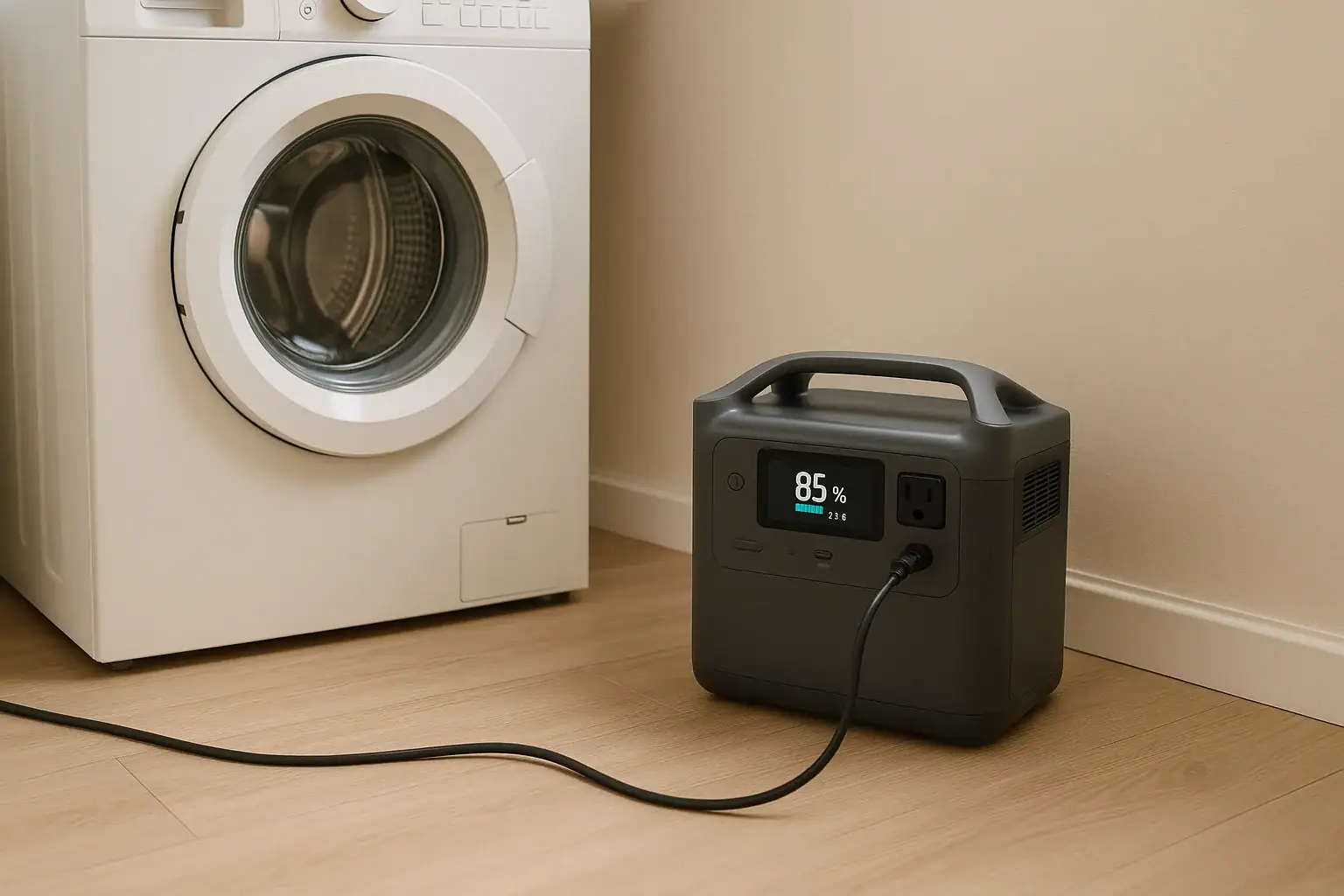
Yes, a portable power station can run some washing machines, but only if its inverter can handle the motor surge and its battery has enough usable capacity.
The hard part is not usually the average running watts. It is the short starting watts spike from the washer motor, plus changing loads during agitation, drain, and spin. A unit that looks large enough on paper may shut off with an overload warning if the surge watts exceed the inverter output.
Runtime also depends on the wash cycle, water temperature, machine type, and battery capacity. A small portable washer may be easy to run, while a full-size top-load or front-load washer can require a much larger power station with a pure sine wave inverter, strong surge rating, and enough watt-hours for the full cycle.
What It Means to Run a Washing Machine From a Portable Power Station
Running a washing machine from a portable power station means the station is acting as a temporary AC power source for the appliance. Instead of drawing electricity from a wall outlet, the washer draws from the power station’s battery through an inverter that converts stored DC power into household-style AC power.
This matters because washing machines are not steady, simple loads. A lamp or fan may draw a fairly consistent amount of power. A washer changes demand throughout the cycle. It fills using control valves, agitates or tumbles using a motor, drains using a pump, and spins at higher speed. The highest demand often appears for only a moment, but that moment can decide whether the power station keeps running or shuts down.
For backup use, the goal is not only to make the washer turn on. The goal is to complete a cycle without tripping the inverter, draining the battery too deeply, overheating cables, or leaving wet clothes stuck mid-cycle. That is why both power rating and runtime must be considered together.
How Washer Load, Motor Surge, and Inverter Output Work
A portable power station has two major limits for this use: continuous AC output and surge output. Continuous output is the wattage it can supply over time. Surge output is the brief peak it can tolerate when a motor starts or suddenly works harder. Washing machines can create surge demand when the drive motor starts, when the drum changes direction, or when the pump begins moving water.
Battery capacity is measured in watt-hours. A 1,000 watt-hour battery does not mean a 1,000-watt appliance will run for exactly one hour. Inverter losses, battery management limits, age, temperature, and the appliance’s cycling behavior all reduce usable energy. Many real-world AC loads use roughly 80% to 90% of the listed battery capacity after conversion losses, sometimes less under heavy load.
Modern high-efficiency washers may use less electricity than older machines, especially with cold water. However, a washer with an internal water heater or steam function can draw far more power than a motor-only cycle. Heated wash settings are usually the least practical option for a portable power station.
Pure sine wave output is also important. Most household appliances are designed for standard utility power. A pure sine wave inverter is generally the safer match for motors, pumps, and electronic controls because it more closely resembles grid power and may reduce motor noise, heat, and error behavior.
| Washer type or function | Typical running draw | Possible surge behavior | Practical note |
|---|---|---|---|
| Compact portable washer | 150 to 500 watts | Moderate motor and pump spikes | Often the easiest washer type for a power station |
| High-efficiency front-load washer | 300 to 900 watts during active phases | Motor surge can exceed running draw | Cold cycles may be manageable with a larger unit |
| Traditional top-load washer | 400 to 1,200 watts during agitation or spin | Higher surge possible with heavy loads | Load balance and cycle choice matter |
| Internal water heating or steam | 1,000 to 2,000+ watts | May stack with motor demand | Often impractical for battery-only operation |
Real-World Runtime Examples for Laundry Loads
Runtime depends on energy used per cycle, not just the washer’s highest wattage. A washer may briefly draw 800 watts, then drop to much lower levels between motor actions. That is why the total watt-hours consumed by a cycle can be much lower than multiplying the peak wattage by the full cycle length.
For example, a compact portable washer using roughly 200 watt-hours for a short cold-water cycle could complete several loads from a 1,000 watt-hour power station if the inverter can handle the motor surge. The same power station may only complete one or two full-size loads if each cycle uses 300 to 600 watt-hours in real conditions.
A high-efficiency front-load washer on a cold, normal cycle might be reasonable for a medium to large power station if the motor surge is within range. A heavy-soil cycle, high-speed spin, or heated wash can push the demand much higher. If the washer tries to heat water internally, the power station may shut down or drain very quickly.
Dryers are a separate issue. Electric clothes dryers usually draw several thousand watts and are not a practical match for most portable power stations. The washer may be possible; the electric dryer usually is not. If laundry backup is the goal, plan on washing only and using air drying, a drying rack, or another non-electric drying method.
To estimate runtime, start with the washer’s energy use per cycle if listed on its appliance label or manual. If you only know watts, use a conservative estimate. Multiply average watts by hours of operation, then add a margin for inverter losses. For instance, a cycle averaging 500 watts for half an hour uses about 250 watt-hours before losses; a practical estimate may be closer to 300 watt-hours from the battery.
Common Mistakes and Troubleshooting Cues
The most common mistake is sizing the power station only by the washer’s running watts. If a washer says it uses 600 watts while running, the startup or spin surge may still exceed 1,200 watts for a moment. If the inverter cannot absorb that spike, the station may beep, display overload, or shut off as soon as the motor starts.
Another mistake is ignoring cycle settings. Warm, hot, sanitize, steam, and heavy-duty cycles can add heating demand or longer motor time. A cold, normal, low-soil cycle is usually more realistic for backup power. Smaller loads can also reduce strain, especially during spin, because an unbalanced drum can cause repeated restarts and higher motor load.
If the washer powers on but stops during agitation, the motor load may be too high. If it stops during drain, the pump may be creating a surge or blockage-related strain. If it stops during high-speed spin, the load may be unbalanced, too heavy, or too wet. If the power station starts loudly ramping its fan before shutdown, the continuous load or internal temperature may be near its limit.
Pay attention to error codes from the washer as well as warnings from the power station. A washer error may indicate water supply, drain, lid lock, or load balance rather than a power problem. A power station overload or low-battery warning points more directly to inverter capacity or battery capacity.
Extension cords can also create trouble. Long, thin cords cause voltage drop, heat, and nuisance shutdowns. For a heavy appliance load, use a short, appropriately rated cord if one is needed at all. Avoid daisy-chaining power strips or adapters.
Safety Basics for Battery-Powered Laundry
Use a portable power station only within its published AC output limits and in a dry, ventilated location. Laundry areas combine water, vibration, and heavy appliances, so placement matters. Keep the power station off the floor if there is any chance of standing water, and do not place it where hoses, drains, or wet clothing can drip onto it.
Do not bypass overload protection, modify plugs, open the power station, alter the washing machine cord, or attempt to increase output beyond the design limits. Protective shutdowns are there to prevent overheating, battery stress, and electrical faults. If a washer repeatedly trips the station, the safer answer is usually a larger proper-rated power source or a lower-demand laundry method.
Do not connect a portable power station into home wiring unless the equipment and installation are specifically designed for that purpose and handled by a qualified electrician. Backfeeding a home circuit can be dangerous. For ordinary portable use, the washer should be plugged directly into the power station’s AC outlet while following the station’s appliance-load guidance.
Ventilation is also important. Inverters produce heat under load, and washers can run for 30 to 60 minutes or more. Leave space around the station for airflow, keep vents clear, and avoid enclosing it in a cabinet or laundry basket. If the unit becomes unusually hot, smells abnormal, or shows repeated faults, stop using it for that load.
Maintenance and Storage Considerations for Occasional Washer Backup
If the power station is intended for occasional outage laundry, store it in a moderate, dry location and keep it charged within the manufacturer’s recommended range. Batteries age faster when stored in high heat or left fully depleted for long periods. A station that has been sitting unused for months may not deliver the runtime you expect unless it has been maintained.
Before relying on it, test the washer with the same cycle you would use during an outage. A short test can reveal whether the inverter handles the start, agitation, pump, and spin phases. It also gives a more realistic sense of battery percentage used per load. Testing is better than discovering incompatibility when the washer is full of water.
Keep the AC outlet area, charging ports, and cooling vents clean and dry. Dust can reduce cooling performance, while moisture can increase electrical risk. Inspect cords for damage before use, and avoid using a cord that feels warm, has loose plugs, or shows cracking.
Battery age affects performance. Over time, usable capacity gradually declines, which shortens runtime. Cold temperatures can also reduce available battery output. If a station barely completes a washer cycle when new, it may become unreliable for that same load after years of use or in a cold garage.
| Maintenance item | What to check | Why it matters |
|---|---|---|
| Charge level | Store within a healthy partial-to-high range and recharge periodically | Helps preserve usable capacity for outage use |
| Test cycle | Run a cold normal cycle with a modest load | Confirms surge handling and realistic battery use |
| Ventilation | Keep vents clear before and during operation | Reduces heat-related shutdowns |
| Cords and plugs | Look for looseness, damage, or warmth | Reduces voltage drop and electrical risk |
Practical Takeaways and Specs That Matter Most
Related guides: Surge Watts vs Running Watts: How to Size a Portable Power Station • Portable Power Station Watt-Hours Explained • Pure Sine Wave vs Modified Sine Wave: Does It Matter for a Portable Power Station?
A portable power station can run a washing machine when three things line up: the continuous inverter output is high enough, the surge rating can handle motor startup and spin changes, and the battery has enough usable watt-hours for the selected cycle. Compact washers and cold-water high-efficiency cycles are the best candidates. Heated cycles, oversized loads, and older high-demand machines are much harder.
For troubleshooting, match the shutdown point to the washer phase. Failure at motor start suggests surge capacity. Failure near the end of the cycle may be low battery or high-speed spin demand. Failure with hot or steam settings suggests heating load. Reducing load size, using cold water, and selecting a normal cycle can make the difference between a completed wash and an overload stop.
Specs to look for
- Continuous AC output: Look for a rating above the washer’s likely active running load, such as 1,000 to 2,000 watts for many full-size machines, because the inverter must support the appliance beyond brief startup.
- Surge or peak output: Look for roughly 2x the expected running draw when possible, such as 2,000 to 4,000 watts, because washer motors and pumps can spike briefly.
- Usable battery capacity: Look for enough watt-hours for at least one full cycle plus margin, such as 800 to 2,000+ watt-hours, because conversion losses and cycle variation reduce runtime.
- Pure sine wave inverter: Look for pure sine wave AC output, because washing machine motors and electronic controls are generally better suited to clean household-style power.
- AC outlet current rating: Look for an outlet rating that matches appliance-level loads, commonly around 10 to 15 amps, because wattage alone does not tell the whole outlet limit.
- Overload and temperature protection: Look for clear fault indicators and automatic shutdown protections, because motor loads can stress an undersized inverter.
- Recharge speed: Look for AC or solar recharge rates that fit your outage plan, such as several hundred watts or more, because laundry can consume a meaningful share of stored energy.
- Display detail: Look for live watts, remaining percentage, and estimated runtime, because these readings help identify whether the washer is near the station’s limits.
- Operating temperature range: Look for ratings suitable for your laundry or storage location, because heat and cold can affect output, runtime, and battery health.
The safest sizing approach is to leave margin. If a washer’s demand is close to the power station’s maximum, normal changes in load balance, battery age, or temperature can cause shutdowns. A more comfortable power margin, cold-water cycles, and modest laundry loads make portable washer backup more dependable.
Frequently asked questions
Can a portable power station run a washing machine for a full cycle?
Yes, but only if the power station has enough continuous output, surge capacity, and battery capacity for that specific washer and cycle. Compact washers and cold-water cycles are the most likely to complete a full cycle. Heated settings, heavy loads, and older machines can exceed the station’s limits.
What specs matter most when choosing a power station for a washer?
The most important specs are continuous AC output, surge or peak output, usable watt-hours, and pure sine wave AC power. A washer motor can need a brief startup surge that is much higher than its running draw. Battery capacity then determines how many loads or how much of a cycle the station can actually support.
Why does my power station shut off when the washer starts?
This usually means the washer’s startup surge is higher than the inverter can handle. The running wattage may look acceptable, but the motor can briefly demand much more power at startup or during spin changes. A larger surge rating or a lower-demand cycle may solve the issue.
Is it a mistake to size the power station only by running watts?
Yes. Running watts do not show the short surge that happens when the motor starts or when the washer changes phases. If the surge exceeds the inverter’s limit, the station can overload even when the average wattage seems safe. Both surge and runtime need to be checked.
Is it safe to use a portable power station with a washing machine?
It can be safe when the station is used within its rated limits, kept dry, and placed with good ventilation. Do not bypass protection features or connect it to home wiring unless the setup is specifically designed for that purpose. If the washer repeatedly trips the station, the load is likely too high for that unit.
Can a portable power station run a washer and dryer?
Usually not both, and the dryer is the bigger challenge. Electric dryers typically need far more power than most portable power stations can supply. In a backup setup, the washer may be possible while drying is usually handled by air drying or another non-electric method.
Related guides
Browse this topic →
- Beginner-friendly sizing, runtime & specs
- Solar & charging (MPPT, fast charging, cables)
- Batteries (LiFePO4, cycles, care & storage)
- Safety, cold-weather performance, real-world tips
More in Home / Appliances
See all →Keep reading
About this site
Portable Energy Lab publishes practical, independent guides about portable power—clear sizing, safe use, and real-world expectations.
Affiliate disclosure
Some links on this site may be affiliate links. If you buy through these links, we may earn a small commission at no extra cost to you. This helps support our content. Read our affiliate disclosure.