
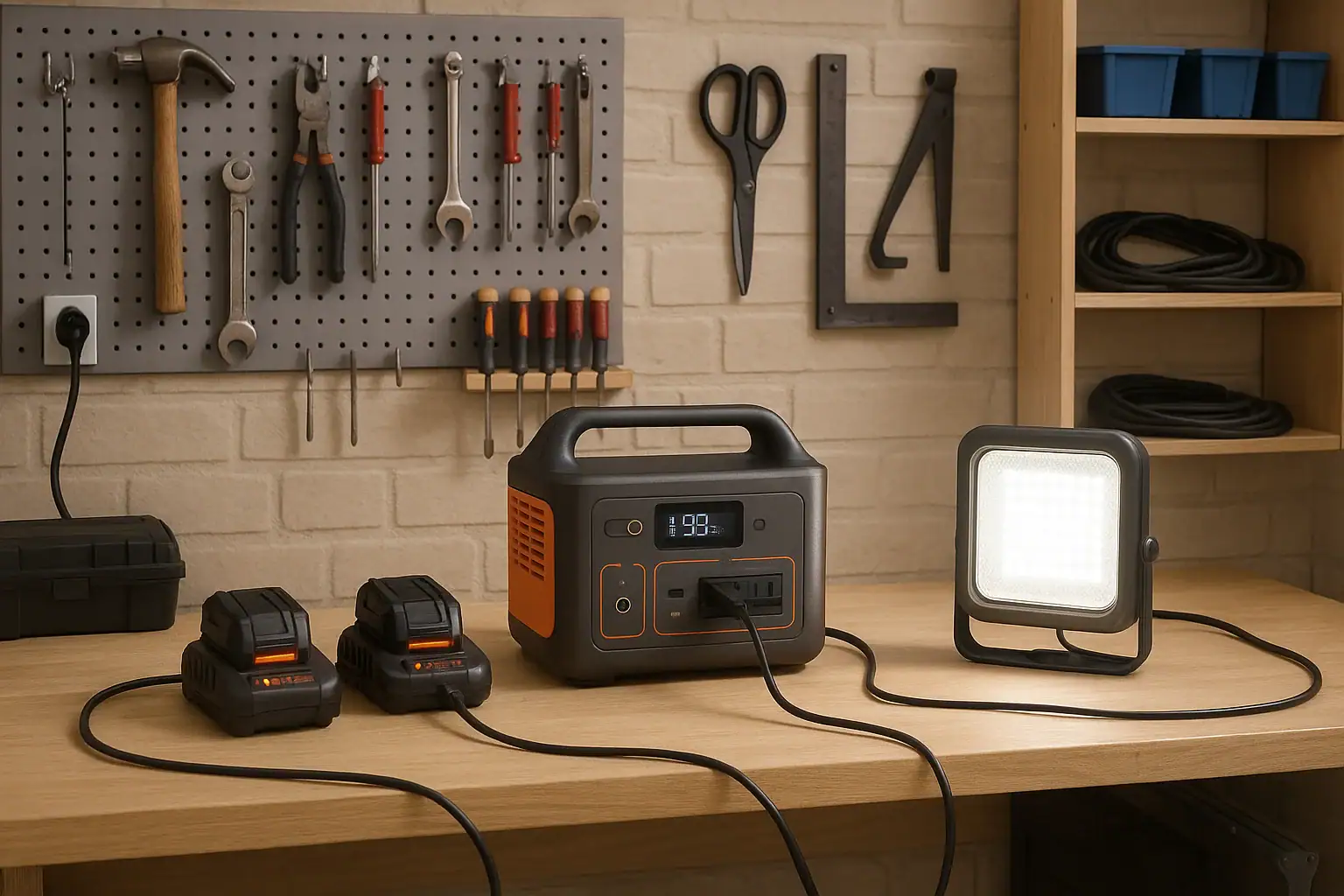
A portable power station can run many garage workshop tools and chargers if its continuous watts, surge watts, battery capacity, and outlets match the load. The main sizing questions are how much power each tool draws, how long you need the runtime, whether the inverter can handle motor startup, and whether the station has the right AC output, DC ports, input limit, and USB-C PD profile for your chargers.
In a garage, a power station is usually best for cordless tool chargers, LED lighting, small benchtop tools, electronics, and short jobs with moderate loads. It is not a replacement for a properly wired shop circuit when you need sustained high power for large compressors, welders, dust collectors, or heavy table saw work. Used correctly, it can reduce extension cord clutter, provide backup power during an outage, and make a detached garage or temporary work area more useful without running an engine indoors.
What a portable power station does in a garage workshop
A portable power station is a rechargeable battery system with built-in outlets and charging ports. In a garage workshop, it acts as a movable power source for tools, lights, chargers, and low-to-moderate shop equipment. It typically includes a battery, inverter, charge controller, display, safety protections, and several output types such as AC outlets, USB ports, and 12-volt DC connections.
The reason it matters in a workshop is that garage loads are mixed. A cordless drill charger may use very little power, while a shop vacuum, miter saw, grinder, or small air compressor may demand a high startup surge. Two tools with similar names can behave very differently electrically. A battery charger is usually steady and predictable. A motor load may spike, cycle, or briefly exceed the running wattage shown on its label.
A power station is most useful when it is treated as a limited energy source rather than a wall outlet with endless capacity. Wall outlets are constrained by circuit rating, while portable stations are constrained by inverter watts, battery watt-hours, thermal limits, and charging speed. Matching those limits to real workshop tasks is the difference between a smooth setup and frequent overload warnings.
Key power concepts for tools, chargers, and shop loads
The first concept is continuous watts. This is the amount of AC power the station can supply steadily. If a tool draws 900 watts while running, the station should have enough continuous AC output to support that load with margin, especially if anything else is plugged in at the same time.
The second concept is surge watts. Motors, pumps, compressors, and some saws can briefly draw more power at startup than they use while running. A station may start a small fan or charger easily but shut down when a compressor kicks on because the surge exceeds the inverter limit.
The third concept is battery capacity, usually listed in watt-hours. A 1,000 watt-hour station does not always deliver 1,000 usable AC watt-hours because the inverter, heat, and internal protections consume some energy. For simple planning, assume some losses and avoid sizing a station with no reserve.
The fourth concept is charging compatibility. Many cordless tool chargers use standard AC plugs, while phones, tablets, work lights, and laptops may need USB-A, USB-C, or a specific PD profile such as 20 volts. If the station has a strong USB-C Power Delivery portable power stations output, it may reduce the need to run a separate AC adapter.
The fifth concept is input limit. This affects how quickly the station can recharge from a wall outlet, vehicle port, or solar input. A garage user who drains the station during a project may care as much about recharge time as total capacity.
| Workshop load | Typical power behavior | What to check |
|---|---|---|
| Cordless tool charger | Low to moderate steady draw | AC outlet count, charger watts, total charging time |
| LED work lights | Low steady draw | Total watts for all lights and desired runtime |
| Shop vacuum | High running draw with motor surge | Continuous watts, surge watts, cord rating |
| Small air compressor | Cycling motor with strong startup surge | Surge capacity and restart behavior under pressure |
| Laptop or diagnostic tool | Low steady draw or USB-C draw | USB-C PD profile or AC adapter requirement |
Real-world garage workshop examples
For a cordless-tool-focused workshop, a portable station can be very practical. Several battery chargers, a phone, a task light, and a small radio may together draw far less power than a single high-demand corded tool. In this case, capacity and outlet count matter more than maximum surge rating. A station in the 500 to 1,000 watt-hour range may support many charging sessions, depending on charger wattage and battery pack size.
For a lighting and backup setup, the calculation is usually simple. If a group of LED shop lights uses 80 watts total, a station with several hundred usable watt-hours can run them for multiple hours. This can be helpful during an outage, when working in a detached garage, or when lighting a temporary bench before permanent electrical work is installed.
For a small benchtop tool setup, look more closely at watts and surge. A small drill press, rotary tool, soldering station, or bench grinder may be reasonable if the inverter rating is high enough. A tool that starts hard, bogs down under load, or has a large motor may trip overload protection even if it appears to be within the published running wattage.
For dust collection and cleanup, the station needs a stronger inverter. Shop vacuums often draw substantial power, especially at startup. Running a vacuum at the same time as a saw may exceed the station even if each tool individually works. A better pattern is often to run one major motor load at a time, with lights and chargers as the background loads.
For air tools, the compressor is the limiting device, not the pneumatic tool. A small inflator or compact compressor may work for occasional tire inflation or light tasks, while a larger compressor can require more surge power than many portable stations can supply. If the compressor struggles to restart under tank pressure, do not keep forcing repeated starts.
Common mistakes and troubleshooting cues
One common mistake is sizing only by battery capacity. A large battery with a modest inverter may run lights for a long time but still fail to start a high-surge tool. For garage use, inverter rating and surge behavior are just as important as watt-hours.
Another mistake is adding loads one at a time without tracking the total. A charger, light, fan, and vacuum can push the station over its limit. If the display shows rising output before an overload shutdown, unplug nonessential loads and test the highest-demand tool by itself.
If a tool starts and immediately shuts the station down, the likely issue is surge watts, not runtime. If the station runs for a while and then stops or derates, heat, battery state of charge, or sustained load may be the problem. If a charger works on a wall outlet but not on the station, check whether the station provides pure sine wave AC and whether the charger has unusual power requirements.
If USB-C charging is slow or inconsistent, the issue may be the PD profile or cable rating. A laptop that needs 20 volts may charge slowly from a low-output USB-C port. A high-watt USB-C port still needs a compatible cable and device negotiation.
If recharge time is longer than expected, check the input limit and the charging source. Some stations accept only a limited AC input, and vehicle ports are usually much slower than wall charging. Solar charging can be useful, but output changes with sun angle, temperature, panel rating, and controller limits.
Safety basics for a garage setup
Use the power station on a stable, dry, well-ventilated surface away from sawdust piles, metal shavings, solvents, paint fumes, and direct impact zones. A garage can be dusty and cluttered, so the safest location is usually a shelf or bench area where cords can be routed without crossing walkways or work paths.
Do not use a portable power station to backfeed a wall outlet or energize garage wiring. That can create shock, fire, and utility worker hazards. If you want a permanent backup-power connection for a garage or home circuit, use a qualified electrician and approved equipment. A portable station should power devices directly through its outlets unless a professional has designed a compliant system.
Use cords and power strips carefully. Extension cords should be in good condition, appropriately rated, and fully visible rather than buried under mats, lumber, or debris. Avoid daisy-chaining multiple power strips. If a cord, plug, or outlet becomes warm, damaged, loose, or discolored, stop using it.
Keep high-heat tools separate from the station. Grinders, soldering equipment, heat guns, and chargers can all add heat to a small work area. Leave space around the station vents and do not cover it with rags, jackets, cardboard, or tool cases. If the unit reports over-temperature, let it cool in a safe location before using it again.
For critical safety equipment such as garage door openers, medical devices, or security systems, verify compatibility in advance. A workshop power station is convenient, but it should not be the only plan for loads where failure would create a serious risk.
Maintenance and storage for dependable garage use
Good maintenance starts with keeping the station clean, dry, and within a reasonable temperature range. Garages can get very hot in summer and very cold in winter, both of which can affect battery performance and charging behavior. Avoid leaving the unit where it will freeze, bake in direct sun, or sit near chemicals and fuels.
Store the station with a partial charge if it will not be used for a while, and check it periodically. Many lithium-based power stations lose charge slowly over time, and the display may not be perfectly accurate after long storage. A quick top-off before storm season or a planned project is more reliable than assuming it is ready.
Inspect cords, plugs, charger bricks, and ports before use. Dust can accumulate around outlets and vents in a woodworking or metalworking space. Wipe exterior surfaces with the unit unplugged, avoid liquids, and do not open the case or attempt battery repairs. If a station is swollen, cracked, smells unusual, has been dropped hard, or behaves erratically, stop using it and follow the manufacturer’s service guidance.
Exercise the setup occasionally. Running the lights, chargers, and a typical tool load for a short test helps confirm that the station still meets your needs. It also reveals missing adapters, weak cables, overloaded power strips, and unrealistic runtime assumptions before a real outage or project deadline.
Practical takeaways and spec checklist
| Planning target | Example range | Garage relevance |
|---|---|---|
| Light charging station | 300 to 700 watt-hours | Tool batteries, phone charging, LED lights |
| General workshop backup | 700 to 1,500 watt-hours | Longer lighting runtime and multiple chargers |
| Motor-load support | 1,000 watts AC output or more | Small vacuums, compact tools, brief high loads |
| Heavy-duty use | Higher inverter and surge margin | Only for selected tools, not a full shop circuit |
Related guides: Surge Watts vs Running Watts: How to Size a Portable Power Station • Pure Sine Wave vs Modified Sine Wave: Does It Matter for a Portable Power Station? • Extension Cords and Power Strips: Safe Practices With Portable Power Stations
The best portable power station for a garage workshop is the one that matches your actual tool list, not the biggest number on a spec sheet. List the devices you expect to run, note their watts, identify which ones have motors, and decide whether your priority is charging, lighting, outage backup, or short tool operation.
For most garage users, a balanced setup includes enough inverter capacity for the largest single load, enough surge margin for motor startup, enough watt-hours for the desired runtime, and enough outlet variety to avoid unnecessary adapters. If your plan involves permanent wiring, fixed circuits, or powering multiple building loads, involve a qualified electrician instead of improvising.
Specs to look for
- Continuous AC output: Look for a rating above your largest running load, such as 600 to 2,000 watts for many light to moderate garage tasks, because this determines what can run steadily.
- Surge watts: Look for meaningful surge headroom, often roughly 1.5 to 2 times the running draw of motor loads, because compressors, vacuums, and saws can spike at startup.
- Battery capacity: Look for watt-hours that fit your runtime goal, such as 500 watt-hours for charging and lighting or 1,000 watt-hours or more for longer backup use, because capacity controls how long loads can run.
- Pure sine wave inverter: Look for pure sine wave AC output, because many chargers, variable-speed tools, and electronics operate more predictably on cleaner power.
- Outlet mix: Look for enough grounded AC outlets plus USB-A, USB-C, and 12-volt options, because a garage often uses chargers, lights, phones, and accessories at the same time.
- USB-C PD output: Look for ports such as 60 to 100 watts with common PD profiles when you charge laptops, tablets, or inspection tools, because wattage alone does not guarantee fast charging.
- Recharge input limit: Look for AC recharge rates that fit your schedule, such as several hundred watts or more on larger units, because a slow input can leave the station unavailable between projects.
- Operating temperature range: Look for a range suitable for your garage climate, because cold and heat can reduce performance, slow charging, or trigger protection.
- Display and load monitoring: Look for real-time watts, remaining runtime, and warning indicators, because they help identify overloads and manage battery reserve before a shutdown.
Use the station for the jobs it does well: charging batteries, running lights, supporting electronics, and powering selected tools within its limits. Treat high-surge equipment cautiously, keep the setup clean and ventilated, and plan around both watts and watt-hours for a safer, more reliable garage workshop.
Frequently asked questions
What size portable power station do I need for a garage workshop?
The right size depends on the largest tool you want to run and how long you need it to run. For charging batteries and LED lights, a smaller unit may be enough, while motor-driven tools usually need higher continuous watts and surge capacity. A portable power station for garage workshop use should be sized from the actual load list, not just the battery capacity.
Which specs matter most when choosing a unit for tools and chargers?
The most important specs are continuous AC output, surge watts, battery capacity, outlet mix, and recharge input speed. For garage use, pure sine wave output and USB-C PD support can also matter if you charge electronics or use sensitive chargers. The best choice is the one that matches both the power draw and the runtime you need.
Can I run a shop vacuum or small compressor from a portable power station?
Sometimes, but only if the inverter can handle both the running load and the startup surge. Shop vacuums and compressors often draw much more power at startup than their labels suggest. If the station overloads or the tool struggles to restart, it is not a good match for that load.
What is the most common mistake people make in a garage setup?
A common mistake is buying by watt-hours alone and ignoring inverter size and surge rating. Another is plugging in several devices at once without checking the total draw. In a garage workshop, a setup can fail even when each device seems reasonable on its own.
Is it safe to use a portable power station in a garage?
Yes, if it is used on a stable, dry, ventilated surface and kept away from dust, solvents, and heat sources. Use proper cords, avoid overloading outlets, and never backfeed house wiring through a wall outlet. For permanent backup wiring or critical circuits, a qualified electrician is the safer choice.
How long will it run my lights or chargers?
Runtime depends on the station’s usable watt-hours and the total load in watts. Low-draw LED lights and battery chargers can run for hours, while motor tools consume energy much faster. A simple estimate is to divide usable watt-hours by the load, then reduce the result to account for inverter losses and reserve.
Related guides
Browse this topic →
- Beginner-friendly sizing, runtime & specs
- Solar & charging (MPPT, fast charging, cables)
- Batteries (LiFePO4, cycles, care & storage)
- Safety, cold-weather performance, real-world tips
More in Home / Appliances
See all →Keep reading
About this site
Portable Energy Lab publishes practical, independent guides about portable power—clear sizing, safe use, and real-world expectations.
Affiliate disclosure
Some links on this site may be affiliate links. If you buy through these links, we may earn a small commission at no extra cost to you. This helps support our content. Read our affiliate disclosure.