
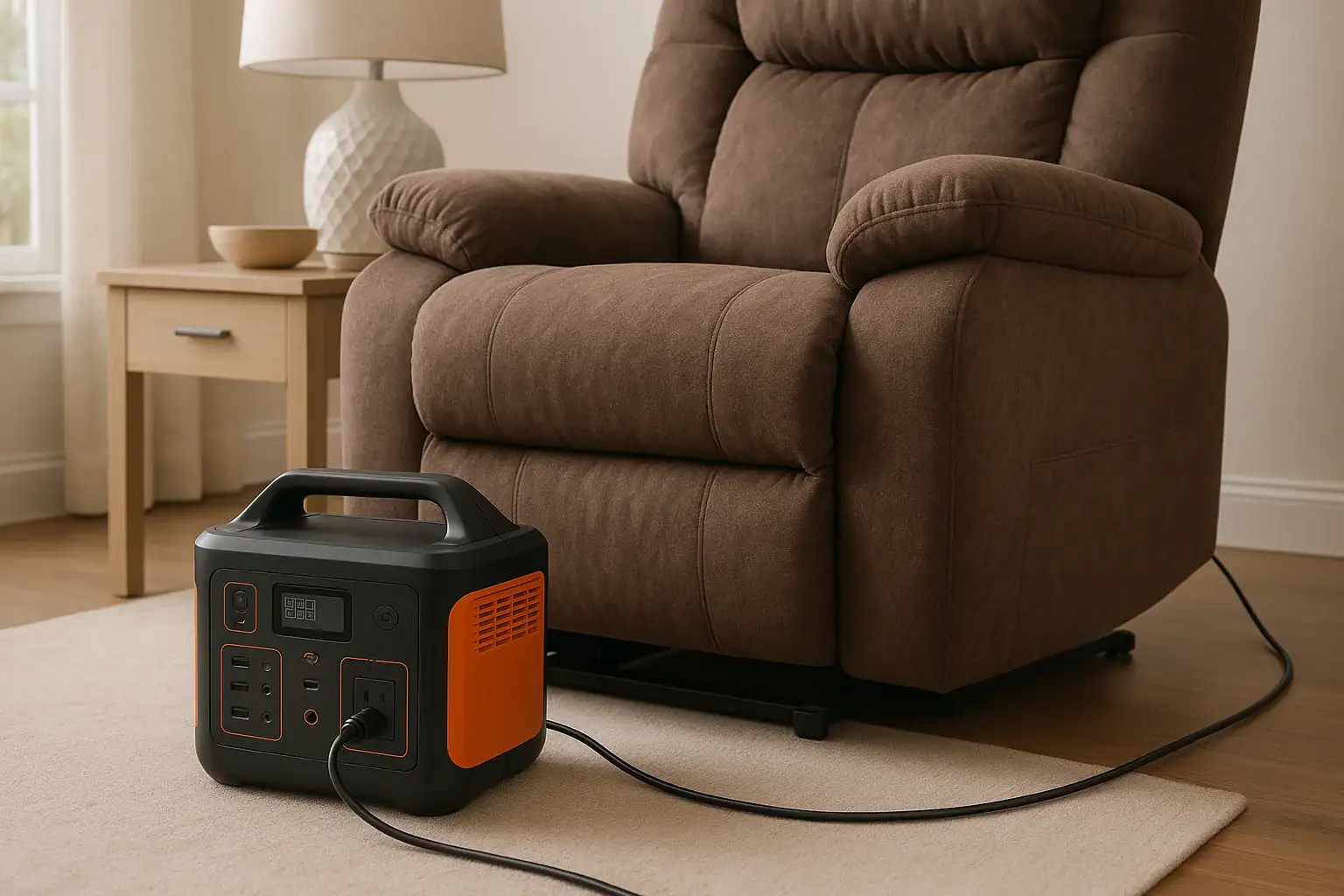
A 300 to 500 watt-hour portable power station with a 300-watt pure sine wave AC inverter is usually enough for one electric recliner or lift chair during a typical outage.
The exact size depends on the chair motor wattage, surge watts at startup, how many lift or recline cycles you need, and whether the chair has heat, massage, USB charging, or other powered features. For basic reclining and lifting only, the chair often uses power for less than a minute at a time, so runtime is based more on the number of cycles than on continuous hours.
If the chair is used for mobility support, size the station conservatively. Look at watt-hours, AC output watts, inverter type, output behavior at low loads, and safe indoor placement. The goal is not just to turn the chair on once, but to provide dependable backup power when someone may need to stand, sit, or return to an upright position.
What size portable power station means for an electric recliner or lift chair
For this use case, size has two meanings: how much power the station can deliver at one moment, and how much energy it can store. Power output is measured in watts. Stored energy is measured in watt-hours. A lift chair needs enough watts to start and move the motor, and enough watt-hours to repeat that movement through an outage.
Most electric recliners and lift chairs are intermittent loads. The motor runs only while the chair is moving. A basic chair may draw modest power during motion and almost nothing when idle. A larger lift chair, dual-motor chair, or chair with a heavier occupant may draw more. Features such as heat and massage can change the situation because they may run continuously for long periods.
For many homes, a compact power station in the 300 to 500 watt-hour range is a practical starting point for a single chair with no heat or massage. A larger 500 to 1000 watt-hour unit is more appropriate if the chair is used often, the outage may last all day, the person depends on it for safe transfers, or the same station also powers lights, phones, or medical-support accessories that are not life-sustaining.
The most important point is that the inverter must handle the chair’s startup demand. A station with plenty of watt-hours but a weak AC inverter may still shut off when the motor starts. For motorized furniture, inverter output is just as important as battery capacity.
How lift chair power use works
An electric recliner or lift chair usually uses one or more small electric motors controlled by a handset or side switch. When you press the control, the motor draws power from the wall through the chair’s power supply. During movement, the load rises. When the chair reaches position and the button is released, the load drops sharply.
Because this is not a continuous load, a simple hours-of-runtime estimate can be misleading. A chair that draws 150 watts while moving does not draw 150 watts for the entire outage. If each movement lasts 30 seconds, ten full movements may use only a small amount of stored energy. However, the station must still supply the short burst of power without tripping an overload.
There are three ratings to understand. Continuous watts describe what the station can supply steadily. Surge or peak watts describe a brief startup allowance for motors. Watt-hours describe the battery capacity. For motorized chairs, choose a station with continuous AC output comfortably above the chair’s running watts and surge capacity above the startup draw. Pure sine wave AC output is strongly preferred because it is the cleanest match for most household motor power supplies.
Heat and massage are different. Heat pads and massage motors can run for many minutes, so they consume far more energy than a quick lift cycle. If those features must be used during an outage, size the power station as a continuous appliance backup, not just a chair-position backup.
| Chair use case | Typical power behavior | Practical station size range | Why it matters |
|---|---|---|---|
| Basic recline only | Short motor use, often under 150 watts while moving | 300 to 500 watt-hours with about 300 watts AC output | Usually enough for many position changes with a margin for startup |
| Lift chair for mobility support | Higher motor load during lifting and standing assistance | 500 to 1000 watt-hours with 500 watts or more AC output | Adds reserve for repeated transfers and less ideal conditions |
| Dual-motor or heavy-duty chair | More motors, higher startup demand, longer movement time | 500 to 1000 watt-hours or larger with strong surge rating | Reduces overload trips when moving under load |
| Chair with heat or massage | Continuous accessory load in addition to motor use | 1000 watt-hours may be more suitable if accessories are used often | Continuous heating can drain small stations quickly |
Real-world sizing examples for recliners and lift chairs
Consider a basic electric recliner that draws about 100 watts while moving and takes 20 seconds to go from upright to reclined. One movement uses very little energy because it is only a fraction of a minute. Even after many movements, a 300 watt-hour station may still have substantial capacity remaining. In this case, inverter quality and startup handling may matter more than total battery size.
Now consider a lift chair used by someone who needs help standing several times during a power outage. The chair may draw 150 to 250 watts while lifting, with a higher startup spike. Each lift cycle may last 30 to 60 seconds. The energy per cycle is still modest, but reliability matters more. A 500 watt-hour station with a stronger pure sine wave inverter provides more confidence than a very small unit, especially if the person cannot easily get out of the chair without power.
A third example is a larger dual-motor chair with independent back and footrest controls. If both motors operate at times, the momentary load can be higher. The station should have enough continuous output for normal movement and enough surge capacity for motor startup. If the power station shuts off or beeps when the chair begins moving, the issue is often inverter overload rather than lack of stored energy.
A final example is a lift chair with heat and massage. A heat pad might draw power continuously while it is on, and massage motors add more consumption. Running heat for two hours can use far more energy than dozens of lift cycles. If comfort features are a priority during an outage, move up in watt-hours and confirm that the total AC load remains within the station’s rating.
Common mistakes and troubleshooting cues
One common mistake is buying only by watt-hours. A large battery with a small AC inverter may not start the chair motor. Check both battery capacity and AC output. For a lift chair, a station rated around 300 watts continuous is often the minimum practical range, while 500 watts or more gives more headroom for larger chairs.
Another mistake is ignoring surge watts. Motors can draw more current at startup than they do while running. If the station clicks off, shows overload, or stops the moment the chair begins moving, the motor’s startup draw may exceed the station’s surge capability. A stronger inverter is the proper fix; do not bypass protections or modify the chair.
Auto-shutoff can also cause confusion. Some portable power stations turn off AC output when the detected load is very low. Because a recliner may draw almost nothing while idle, the station may go to sleep before the next button press. If this happens, look for a unit with an AC output setting that can stay on, or be prepared to wake the station before using the chair.
Modified sine wave output is another possible problem. Some chair power supplies may buzz, run hot, behave erratically, or refuse to operate on lower-quality AC output. A pure sine wave vs modified sine wave inverter is the safer general choice for motorized furniture and electronics.
If the chair does not work from the station, test only at a high level: confirm the station is charged, AC output is turned on, the chair plug is fully seated, the chair works from a normal wall outlet, and the station is not showing overload or fault status. If the chair’s transformer, cord, or control system appears damaged, stop using it and contact a qualified service technician.
Safety basics for powering a lift chair during an outage
Use a portable power station as a plug-in backup source for the chair, not as a way to energize household wiring. Do not connect a power station to a home electrical panel, transfer switch, interlock, or wall receptacle unless the system is specifically designed for that purpose and installed by a qualified electrician. For a lift chair, the intended approach is simple: plug the chair into the station’s AC outlet within the station’s rated limits.
Place the station where it will not block walking paths, wheelchair movement, or caregiver access. Cords should not create a trip hazard near the chair, especially because the user may stand slowly or rely on a walker. Keep the station on a stable, dry surface with ventilation around it. Do not cover it with blankets, cushions, or clothing.
Protect the station from moisture, spilled drinks, and excessive heat. Indoor-rated portable power stations should remain indoors in a dry area. If charging from solar panels, keep the station itself protected according to its instructions while the panel is outside.
If the chair is medically necessary for safe transfers, have a backup plan beyond a power station. That may include the chair’s built-in battery backup if available, a caregiver plan, or a larger emergency power setup reviewed by a professional. A portable power station can be very useful, but it should not be the only plan for someone who cannot safely stand or reposition without assistance.
Maintenance and storage for reliable backup power
A portable power station is most useful when it is charged, reachable, and ready before the outage starts. Store it near the chair or in a known location, but not where it blocks access. Keep the AC charging cord with it. If the chair user depends on the backup, label the station clearly so caregivers know what it is for.
Check the battery level periodically. Many lithium power stations store best at a partial charge for long periods, but emergency equipment also needs enough charge to be useful. A practical compromise is to inspect it monthly and recharge when it drops below a comfortable reserve. Follow the unit’s storage guidance for charge level and temperature.
Test the chair with the station before relying on it. A brief functional test can reveal overload behavior, auto-sleep settings, or cord-placement issues. You do not need to run the chair repeatedly; the goal is to confirm that the chair moves normally and the station remains stable.
Keep vents clean and avoid stacking items on the station. Inspect the power cord and chair plug for obvious wear before use. Do not open the station, replace cells, alter the chair’s power supply, or defeat any safety shutoff. If something smells hot, sparks, melts, or repeatedly trips, stop using it and seek qualified help.
| Maintenance item | Suggested interval | What to check | Reason |
|---|---|---|---|
| Battery charge level | Monthly | Confirm the station has enough reserve for an outage | A fully forgotten station may be empty when needed |
| Chair function test | Every few months | Run a short lift or recline movement from the station | Verifies inverter compatibility and output behavior |
| Cord and placement check | Before outage season or after moving furniture | Look for trip hazards, pinched cords, or blocked vents | Reduces fall and overheating risks |
| Storage condition | Seasonally | Keep the unit dry, moderate in temperature, and easy to access | Improves battery life and emergency readiness |
Practical takeaways and specs to look for
Related guides: Portable Power Station Watt-Hours Explained • Surge Watts vs Running Watts: How to Size a Portable Power Station • Pure Sine Wave vs Modified Sine Wave: Does It Matter for a Portable Power Station?
For a basic electric recliner, a 300 to 500 watt-hour portable power station with a pure sine wave AC inverter is often enough. For a lift chair that supports mobility, a larger 500 to 1000 watt-hour station with more inverter headroom is the more conservative choice. If heat or massage will be used, size up because those features can run continuously and drain capacity much faster than lifting or reclining.
The best fit is not simply the biggest battery. It is the station that can start the chair motor, stay on when the chair is idle, provide enough cycles for the expected outage, and sit safely near the user without creating hazards.
Specs to look for
- Battery capacity: Look for about 300 to 500 watt-hours for a basic chair, or 500 to 1000 watt-hours for mobility-dependent use; this determines how many cycles and how much reserve you have.
- Continuous AC output: Look for at least 300 watts for many basic recliners and 500 watts or more for larger lift chairs; this helps the station support the motor while it is moving.
- Surge rating: Look for a surge capacity roughly 2 times the expected running load when possible; motor startup can briefly demand more power than normal movement.
- Pure sine wave inverter: Look for pure sine wave AC output rather than modified sine wave; it is the better match for chair power supplies and small motors.
- AC outlet behavior: Look for an option to keep AC output on or manage low-load standby; some chairs draw so little at idle that auto-sleep can interrupt use.
- Recharge time: Look for a wall recharge time that matches your outage planning, such as a few hours for smaller units; faster recovery helps between storms or rolling outages.
- Pass-through or UPS-style behavior: Look for clearly stated support if you intend to leave the chair connected while the station charges; this affects convenience but should still be used within the station’s limits.
- Portability and placement: Look for a manageable weight, stable shape, and easy-to-read display; the station must be safe to position near the chair without blocking movement.
- Battery chemistry and cycle life: Look for a chemistry and rated cycle life suited to standby use, such as long-cycle lithium options; this affects long-term reliability if the station is kept for emergency backup.
When in doubt, choose more inverter headroom before choosing more capacity. A chair that overloads the AC output will not work reliably even if the battery is large. For one recliner used only for occasional position changes, moderate capacity is usually sufficient. For a lift chair that someone relies on to stand safely, build in extra margin and test the setup before an outage.
Frequently asked questions
What specs matter most when choosing a portable power station for an electric recliner?
The most important specs are continuous AC output, surge or peak watts, watt-hours, and pure sine wave inverter type. Continuous output and surge capacity determine whether the chair motor can start and move reliably, while watt-hours determine how many cycles you can get during an outage. Low-load AC behavior also matters because some chairs draw very little power when idle.
Can a portable power station run a lift chair with heat or massage?
Yes, but heat and massage use much more energy than a short lift or recline cycle. If those features will be used for more than a brief period, you usually need a larger battery capacity than you would for chair movement alone. Check the total AC load and make sure it stays within the station’s continuous output rating.
What is the most common mistake people make when sizing a power station for a recliner?
The most common mistake is focusing only on watt-hours and ignoring inverter output and surge watts. A station can have a large battery but still fail if it cannot handle the motor’s startup demand. For motorized furniture, both energy capacity and AC output need to be checked together.
Is it safe to use a portable power station indoors with an electric recliner?
Yes, if the unit is used as intended, placed on a stable dry surface, and kept clear of vents and walkways. Do not connect it to household wiring unless the system is specifically designed for that purpose and installed by a qualified electrician. Keep cords arranged to reduce trip hazards near the chair.
Why does my power station shut off when the chair is not moving?
Some portable power stations turn off AC output when the load is very low. Because a recliner may draw almost nothing while idle, the station can go to sleep between uses. Look for a model with a stay-on AC setting or low-load standby behavior that works better with intermittent motor loads.
How much backup time do I need for one electric recliner?
That depends on how many lift or recline cycles you expect, not on continuous hours of use. A basic chair may use very little energy per movement, so even a modest station can provide many cycles. If the chair is needed for mobility support, it is wise to add extra reserve for repeated use and unexpected delays.
Related guides
Browse this topic →
- Beginner-friendly sizing, runtime & specs
- Solar & charging (MPPT, fast charging, cables)
- Batteries (LiFePO4, cycles, care & storage)
- Safety, cold-weather performance, real-world tips
More in Home / Appliances
See all →Keep reading
About this site
Portable Energy Lab publishes practical, independent guides about portable power—clear sizing, safe use, and real-world expectations.
Affiliate disclosure
Some links on this site may be affiliate links. If you buy through these links, we may earn a small commission at no extra cost to you. This helps support our content. Read our affiliate disclosure.