
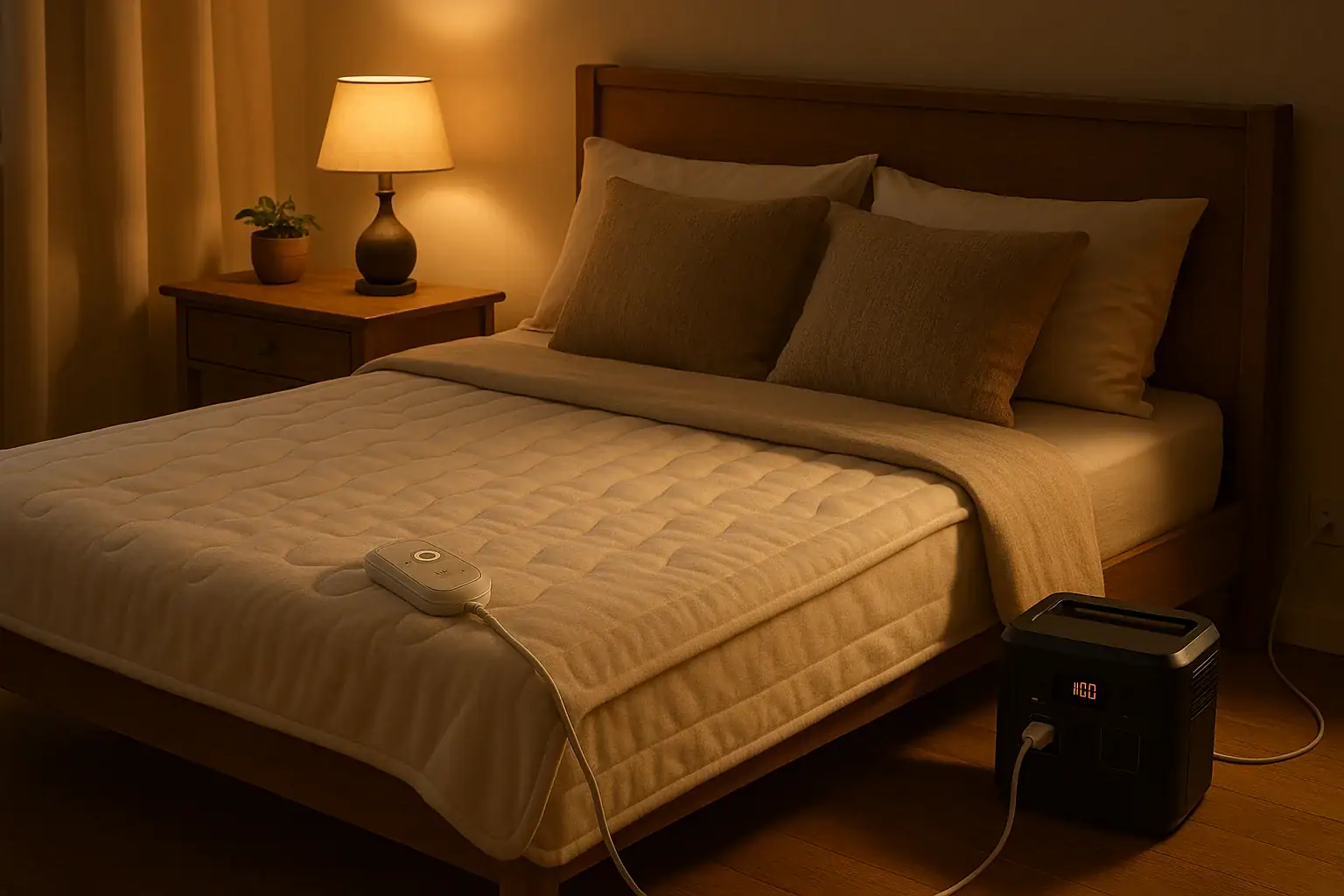
A portable power station can run a heated mattress pad or electric throw if its AC outlet supports the blanket’s wattage and its battery has enough usable watt-hours for the runtime you need. In most homes, these items are modest loads compared with space heaters, but their controllers, heat cycling, and auto shutoff features can change the real-world result.
The key terms are runtime, watt-hours, inverter capacity, AC outlet output, pure sine wave power, and automatic shutoff. A heated mattress pad may draw low to moderate power for many hours, while an electric throw often uses less area and may cycle more frequently. The main goal is not only making it turn on, but keeping it operating safely through the night, during an outage, or in a cold room without overloading the power station or misusing the bedding.
What Powering Heated Bedding Means and Why Runtime Matters
Powering heated bedding means using a portable power station as the energy source for a plug-in heated mattress pad, heated blanket, or electric throw. Instead of drawing from a wall outlet, the bedding draws from the power station’s inverter through a standard AC outlet. The power station converts stored battery energy into household-style AC power, and the bedding controller regulates heat output.
This matters because heated bedding is often used when comfort and safety are important: a winter outage, a chilly bedroom, recovery from illness, or reducing the need to heat an entire room. Compared with a space heater, a heated mattress pad or throw usually uses far less electricity because it warms a person directly rather than warming all the air in the room. That makes it one of the more practical comfort loads for a portable power station.
Runtime is still limited by battery capacity. A power station rated at a certain number of watt-hours does not deliver every watt-hour to the device. Some energy is lost in the inverter, internal electronics, DC-to-AC conversion, and standby consumption. A practical estimate often uses 80% to 90% of rated battery capacity for AC loads, depending on the model and conditions.
For example, if a mattress pad averages 70 watts after cycling and the power station can deliver about 450 usable watt-hours, the estimated runtime is about six hours. If the same bedding averages only 40 watts on a lower setting, the runtime may be closer to eleven hours. The heat setting, room temperature, insulation, and whether two zones are active all affect the final number.
How Heated Mattress Pads and Electric Throws Use Power
Heated bedding does not always pull the same amount of power continuously. Many pads and throws use resistance heating elements controlled by a thermostat, heat setting, or electronic controller. On a high setting, the item may draw near its rated wattage during warm-up. Once it reaches the selected temperature, it may cycle on and off, lowering the average wattage over time.
A heated mattress pad usually covers a bed and may have one or two controllers. A twin or single-zone pad may be a relatively light load. A queen or king pad with dual zones can draw more power, especially if both sides are set high. An electric throw covers a smaller area and is often used on a couch or chair, so its total wattage is commonly lower than a large mattress pad. However, the controller design matters more than size alone.
The power station’s inverter must support the bedding’s AC power requirement. Heated bedding is mainly a resistive load, so it generally does not have a large startup surge like a refrigerator or power tool. Still, the controller may not behave well with rough or modified waveforms. A pure sine wave inverter is preferred for electronic controls because it more closely matches normal household AC power and reduces the chance of buzzing, controller errors, or nuisance shutoffs.
Auto shutoff is another important factor. Many heated throws and mattress pads turn off after a fixed period, such as two to ten hours. That feature can be helpful for safety and power savings, but it also means the bedding may stop heating even if the power station still has charge. When estimating overnight comfort, include both battery runtime and the bedding’s built-in shutoff behavior.
| Heated bedding type | Typical draw while heating | Average draw after cycling | Runtime note |
|---|---|---|---|
| Small electric throw | 50 to 100 watts | 30 to 70 watts | Often practical for several hours on a mid-size power station |
| Twin heated mattress pad | 60 to 120 watts | 40 to 80 watts | Lower settings can extend overnight use |
| Queen dual-zone pad | 120 to 200 watts | 70 to 150 watts | Runtime depends heavily on whether one or both zones are active |
| King dual-zone pad | 150 to 250 watts | 90 to 180 watts | May require a larger battery for full-night use |
Real-World Runtime Examples for Home Comfort
The basic runtime formula is simple: usable watt-hours divided by average watts equals estimated hours. If a power station has 500 watt-hours of rated capacity and about 425 watt-hours are usable through the AC outlet, a 50-watt average load may run for about 8.5 hours. A 100-watt average load may run for about 4.25 hours.
Consider a small electric throw used on a low or medium setting in a cool living room. It might draw 80 watts during warm-up, then average about 45 watts after cycling. A compact power station with roughly 250 usable watt-hours could run it for about five to six hours, assuming the throw does not shut itself off sooner. This can be enough for evening use during an outage or while working in a cold room.
A twin heated mattress pad on medium may average around 60 watts. With 500 usable watt-hours, it may run for about eight hours. If the user preheats the bed for 30 minutes on high and then lowers the setting, the average consumption may be lower than leaving it on high all night. Bedding insulation also helps; a warm comforter above the pad can reduce how often the heating element cycles.
A queen dual-zone mattress pad with both sides active can change the equation. If it averages 120 watts, a power station with 500 usable watt-hours may run it for about four hours. If only one side is active or both sides are set low, the average may be closer to 70 watts, which could stretch runtime to seven hours or more. Dual controls are useful because they allow comfort without powering unused zones.
A cold room reduces runtime because the pad or throw loses heat faster. Drafts, thin blankets, cold floors, and an uninsulated bed can all increase cycling. For best results, use heated bedding as part of a layered warmth strategy: dry bedding, insulating blankets, warm clothing, and blocking drafts. The portable power station supplies electricity, but basic heat retention determines how efficiently that electricity becomes comfort.
Common Mistakes and Troubleshooting Cues
One common mistake is looking only at peak wattage or only at battery capacity. Both matter, but average wattage is what determines runtime. A blanket that says 100 watts may not consume 100 watts every minute after it warms up. Conversely, a large dual-zone pad may use more than expected if both sides are on high in a cold room.
Another mistake is using the wrong outlet type. Heated mattress pads and electric throws are usually designed for AC wall outlets, so they normally need the AC outlet on the power station. USB ports and low-voltage DC outputs are not substitutes unless the bedding was specifically designed for those outputs. If the controller does not power on, confirm that the power station’s AC inverter is turned on and that the outlet is not in an eco mode that shuts off low loads.
If the controller flashes, resets, buzzes, or refuses to heat, the inverter waveform or protection logic may be involved. Some electronic controllers prefer pure sine wave AC. Modified sine wave output can cause some devices to run poorly or not at all. A power station may also shut down if it senses overload, overheating, low battery, or an abnormal load. These are protective behaviors, not problems to bypass.
If runtime is shorter than expected, check the heat setting, room temperature, power station state of charge, and whether other devices are also plugged in. A phone charger, lamp, router, or CPAP machine may seem small individually, but combined loads reduce available hours. Also consider cold battery performance. Lithium batteries can deliver less usable energy in low temperatures, especially if the power station itself is stored in a cold area.
If the bedding turns off while the power station still has battery remaining, the cause may be the bedding’s auto shutoff timer. This is normal. Restarting the controller may be possible according to the bedding’s instructions, but avoid defeating or bypassing automatic shutoff. If heated bedding shows visible damage, unusual odors, scorch marks, hot spots, or intermittent operation, stop using it.
Safety Basics for Heated Bedding on Portable Power
Use heated bedding only as intended by its documentation. A heated mattress pad should lie flat in the proper position, and an electric throw should not be crushed, sharply folded, pinned, or trapped under heavy objects. Heating wires can be damaged by repeated creasing, pressure, pets, or furniture. Damaged wires can create hot spots even if the product still turns on.
Place the portable power station where it has ventilation and is protected from bedding, pillows, and clothing. Do not cover the power station to keep it warm. Inverters generate heat, and blocked vents can cause shutdown or create unsafe conditions. Keep the unit on a stable, dry surface away from spilled drinks, damp floors, and direct contact with snow or rain brought indoors.
Do not use damaged cords, loose plugs, cracked controllers, or extension cords that are undersized for the load. If an extension cord is necessary, it should be in good condition and rated appropriately for household AC use. Avoid running cords where people may trip, where bed frames may pinch them, or where recliners and chairs may crush them.
Heated bedding may not be suitable for everyone. Infants, people who cannot sense heat reliably, people with limited mobility, and anyone unable to operate the controller may be at higher risk of burns. Follow the product’s warnings for users, pets, laundering, and placement. If medical equipment is also in use, prioritize that equipment and consult the relevant professionals for backup power planning.
Do not open the power station, modify the battery, bypass protective circuits, or alter the heated bedding controller. Do not attempt to wire a power station into home electrical panels, transfer switches, or fixed circuits without qualified professional help. For whole-home power, panel connections, or permanent backup systems, use a qualified electrician and code-compliant equipment.
Maintenance and Storage for the Bedding and Power Station
Good maintenance improves reliability and reduces surprises during an outage. Before seasonal use, inspect the heated mattress pad or throw when it is unplugged. Look for worn fabric, exposed wires, stiff or kinked sections, damaged connectors, and controller issues. If the item has been stored tightly folded under heavy objects, give it time to relax flat before use and inspect creased areas carefully.
Follow the bedding’s cleaning instructions. Some heated bedding is machine washable only after detaching controllers; some requires gentle cycles or air drying. Never reconnect a controller to damp bedding. Moisture in connectors or controls can cause malfunction and may create a shock or fire hazard. If the care label conflicts with general advice, follow the product’s own instructions.
Store heated bedding loosely folded or rolled, not compressed under boxes. Keep it away from pets, sharp objects, and damp areas. Controllers and cords should be stored without tight bends. Labeling the controller with the matching bedding item can also prevent mix-ups, especially if you own multiple heated blankets or pads.
For the portable power station, store it within a moderate temperature range and recharge it periodically according to its instructions. Do not leave it fully depleted for long periods. Before winter storm season, test the setup for an hour or two at normal settings. Note the wattage shown on the display, how the bedding behaves, and how quickly the battery percentage drops. A short test gives a better estimate than a printed wattage rating alone.
| Item | What to check | Why it matters | Suggested timing |
|---|---|---|---|
| Heated pad or throw | Fabric, wires, plugs, controller, and hot spots | Damage can create uneven heating or unsafe operation | Before seasonal use and after washing |
| Power station | Charge level, vents, display, AC outlet, and fault messages | Confirms it can run the load when needed | Monthly during outage season |
| Cords and placement | Pinch points, trip paths, moisture, and ventilation | Reduces overheating, falls, and cord damage | Each use |
| Runtime estimate | Observed watts and battery drop over one to two hours | Provides a realistic overnight planning number | Before relying on it in cold weather |
Related guides: Portable Power Station Watt-Hours Explained • Pure Sine Wave vs Modified Sine Wave: Does It Matter for a Portable Power Station? • Why Does My Power Station Turn Off? Auto-Shutoff Explained
Practical Takeaways and Specs to Look For
A heated mattress pad or electric throw is usually a practical load for a portable power station because it provides direct warmth at relatively low wattage. The best results come from matching the bedding’s wattage to the inverter, estimating runtime from usable watt-hours, and using lower heat settings after preheating. Large dual-zone pads and high settings require more battery capacity than small throws or single-zone pads.
For planning, think in averages rather than absolutes. A short test at home is the most reliable way to estimate runtime because it reflects your bedding, your room, your heat setting, and your power station. If the setup is for outages, test it before severe weather and keep the power station charged. If anything smells hot, shows damage, or behaves unpredictably, stop using it and replace or service the affected item according to qualified guidance.
Specs to look for
- Battery capacity: Look for enough rated watt-hours to cover the desired runtime after losses, such as 300 to 600 watt-hours for shorter use or 700 watt-hours and above for longer overnight loads; this determines how many hours of heat are realistic.
- Usable AC capacity: Look for clear AC runtime expectations or efficiency information, often around 80% to 90% of rated capacity; this matters because heated bedding usually plugs into the inverter, not directly into the battery.
- Continuous AC output: Look for an inverter rating comfortably above the bedding’s maximum draw, such as at least 200 to 300 watts for many single items; this prevents overload when the pad or throw is warming up.
- Pure sine wave inverter: Look for pure sine wave AC output; this helps electronic blanket controllers operate more like they would on a normal wall outlet.
- Low-load behavior: Look for an option to disable eco shutoff or support small continuous AC loads; this reduces the chance that the station turns off when the bedding cycles to a low draw.
- Display and watt meter: Look for live watts, estimated time remaining, and battery percentage; these make it easier to confirm actual heated mattress pad runtime instead of guessing.
- Recharge options: Look for AC charging plus practical backup charging methods such as vehicle or solar input; this matters during extended outages when a single charge may not be enough.
- Thermal and overload protection: Look for automatic shutdown protections and clear fault indicators; these features help protect the power station if the load, temperature, or battery condition is outside a safe range.
- Operating temperature range: Look for storage and operating guidance suitable for indoor winter conditions; cold batteries can reduce runtime and may limit charging.
The simplest rule is to compare the bedding’s wattage with the power station’s AC output, then divide usable watt-hours by average watts. Add a margin for cold rooms, high settings, inverter losses, and other devices. Used within its limits, a portable power station can be an efficient way to power heated bedding for comfort, backup warmth, and targeted nighttime heat.
Frequently asked questions
How do I estimate heated mattress pad runtime from a portable power station?
Start with the power station’s usable watt-hours, not just its rated capacity, then divide by the bedding’s average watt draw. Because heated bedding cycles on and off, the average wattage is usually lower than the peak rating after warm-up. A short test is the most reliable way to confirm real-world runtime.
What specs matter most when choosing a power station for heated bedding?
Look for enough usable watt-hours, an AC inverter rated above the bedding’s draw, and a pure sine wave output. It also helps to have a display that shows live watts and battery percentage, plus low-load support if the bedding cycles down to a small draw. These features make heated mattress pad runtime easier to predict and more stable in use.
What is a common mistake people make with heated mattress pad runtime?
A common mistake is assuming the printed wattage equals constant power use for the entire night. In practice, the bedding may cycle, preheat at a higher draw, or shut off on its own before the battery is empty. Another frequent error is forgetting to account for inverter losses and other devices sharing the same power station.
Is it safe to run a heated mattress pad or electric throw from a portable power station?
It can be safe when the bedding is in good condition, the power station can handle the load, and the items are used according to their instructions. Keep the power station ventilated, avoid damaged cords or controllers, and do not fold or crush the heated bedding. If anything smells hot, shows damage, or behaves erratically, stop using it.
Why does my heated blanket shut off even though the power station still has charge?
Many heated blankets and mattress pads have built-in auto shutoff timers that turn the heat off after a set period. That feature is independent of the battery level in the power station. If the product is working normally, the controller may need to be restarted according to its instructions.
Will a modified sine wave inverter work for heated bedding?
Some simple resistive heating elements may run on modified sine wave power, but electronic controllers can behave poorly or shut down. A pure sine wave inverter is the safer choice because it more closely matches standard household AC power. It also reduces the chance of buzzing, errors, or nuisance shutdowns.
Related guides
Browse this topic →
- Beginner-friendly sizing, runtime & specs
- Solar & charging (MPPT, fast charging, cables)
- Batteries (LiFePO4, cycles, care & storage)
- Safety, cold-weather performance, real-world tips
More in Home / Appliances
See all →Keep reading
About this site
Portable Energy Lab publishes practical, independent guides about portable power—clear sizing, safe use, and real-world expectations.
Affiliate disclosure
Some links on this site may be affiliate links. If you buy through these links, we may earn a small commission at no extra cost to you. This helps support our content. Read our affiliate disclosure.