
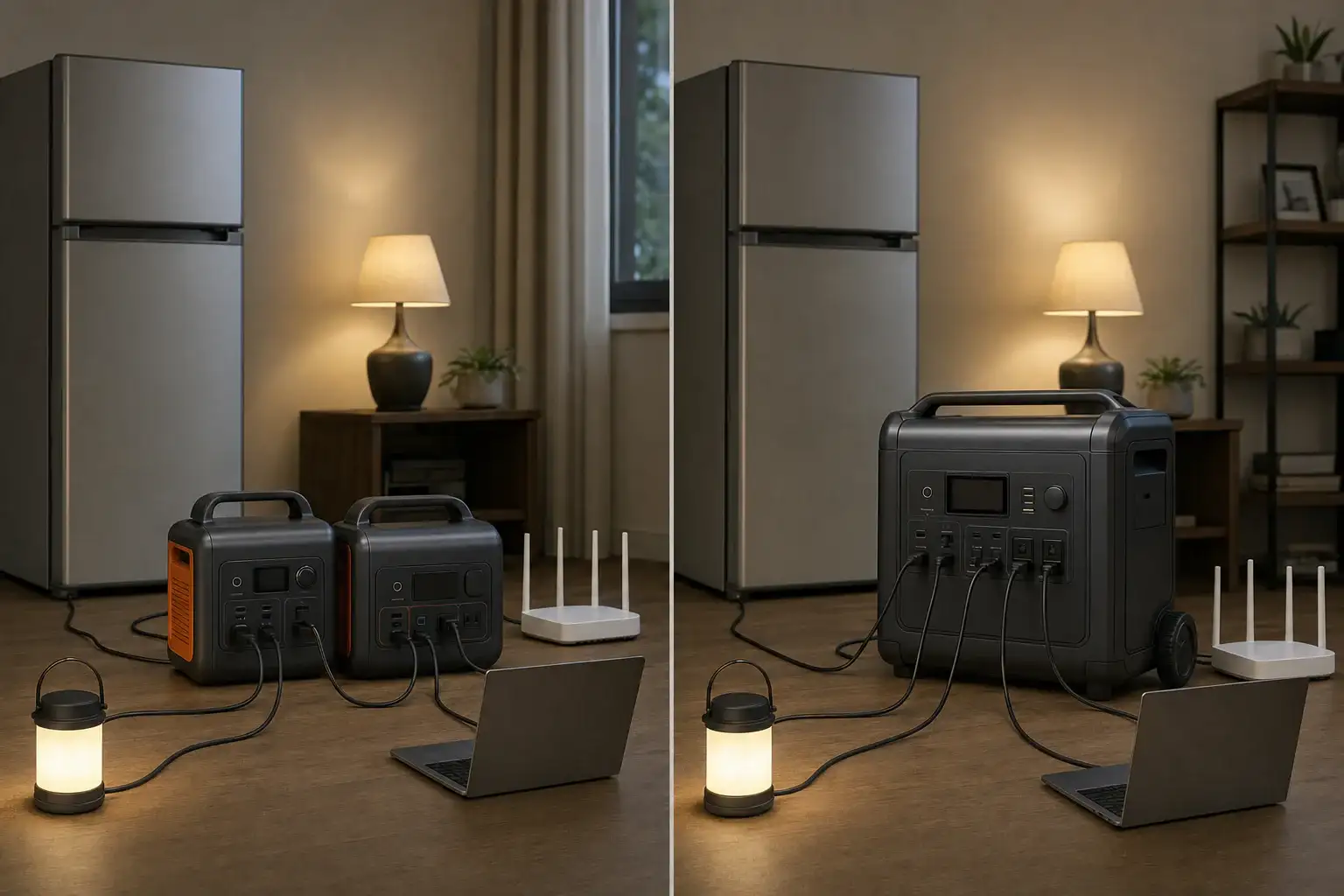
Two small power stations are usually better for redundancy, portability, and powering devices in separate locations, while one large power station is generally better for high-wattage appliances, longer uninterrupted runtime, and simpler management.
The right choice depends on more than total battery capacity. Compare usable watt-hours, continuous output, surge watts, charging speed, inverter efficiency, and the power requirements of your essential equipment. Two 1,000-watt-hour units may have roughly the same stored energy as one 2,000-watt-hour unit, but they do not necessarily deliver the same AC output or runtime to every appliance.
For basic outage coverage, two smaller units can keep a router, lights, medical equipment, or electronics separated from a refrigerator or freezer. A larger unit may be more practical when a single appliance has a demanding compressor start, heating element, pump, or motor. The better backup setup is the one that matches both your energy needs and your highest simultaneous load.
1. What the Two Backup Configurations Mean and Why the Choice Matters
A two-unit setup uses separate portable power stations, each with its own battery, inverter, charging system, outlets, and battery management system. The units can serve different rooms or appliance groups, or one can remain charged as a reserve while the other is in use. Unless the equipment specifically supports an approved expansion or parallel function, their AC outputs should be treated as independent power sources.
A one-unit setup concentrates the available energy and output in a single larger power station. This can simplify charging, monitoring, and appliance connections. It may also provide a higher continuous inverter rating, a larger surge allowance, more outlets, and support for loads that would exceed the rating of either small unit.
The distinction matters because battery capacity and inverter output measure different things. Watt-hours indicate approximately how much energy is stored. Watts indicate how much power can be delivered at one moment. Two small stations may offer plenty of combined watt-hours but still be unable to start an appliance if neither inverter can handle its surge independently.
Redundancy is the main advantage of two units. If one is depleted, unavailable, or develops a fault, the other may continue supporting a critical load. The main advantage of one large unit is consolidated performance: its full capacity and inverter output are available through one system without moving devices between separate supplies.
2. Capacity, Output, Runtime, and Charging Explained
Start with usable energy rather than advertised capacity alone. Conversion losses, inverter efficiency, standby consumption, temperature, battery condition, and load size reduce the energy that reaches an appliance. As a planning estimate, an AC-powered load may receive about 75% to 90% of the listed battery capacity. Efficient DC or USB connections may avoid some inverter losses.
Estimated runtime can be calculated by multiplying rated capacity by an assumed efficiency factor, then dividing by average load watts. A 2,000-watt-hour station at 85% usable efficiency would provide about 1,700 watt-hours to an AC load. A steady 200-watt load could therefore run for roughly 8.5 hours. Cycling appliances require an average-power estimate rather than their maximum label wattage.
With two stations, add their usable energy only when both can actually serve the planned loads. Their inverter wattage should not normally be added. For example, two units rated at 800 watts continuous do not create a single 1,600-watt outlet. They can run two separate loads of up to about 800 watts each, subject to surge ratings and other limits.
Charging logistics also differ. Two units may accept more combined solar or wall-charging power if they can charge simultaneously from suitable independent sources. However, they require more cables and monitoring. One large unit may have a higher input limit and simpler controls, but charging the entire energy reserve depends on that single charging system.
| Factor | Two small stations | One large station |
|---|---|---|
| Example capacity | 2 × 1,000 Wh | 1 × 2,000 Wh |
| Usable AC energy at 85% | About 850 Wh per unit | About 1,700 Wh total |
| Continuous output | Separate 800 W outputs | Single 2,000 W output |
| Load placement | Can serve separate rooms | Loads remain near one source unless safely extended |
| Failure tolerance | One unit may remain available | Single point of failure |
| Handling | More trips, lower weight per unit | Fewer pieces, higher weight per unit |
3. Real-World Backup Examples
Refrigerator, internet equipment, and lights
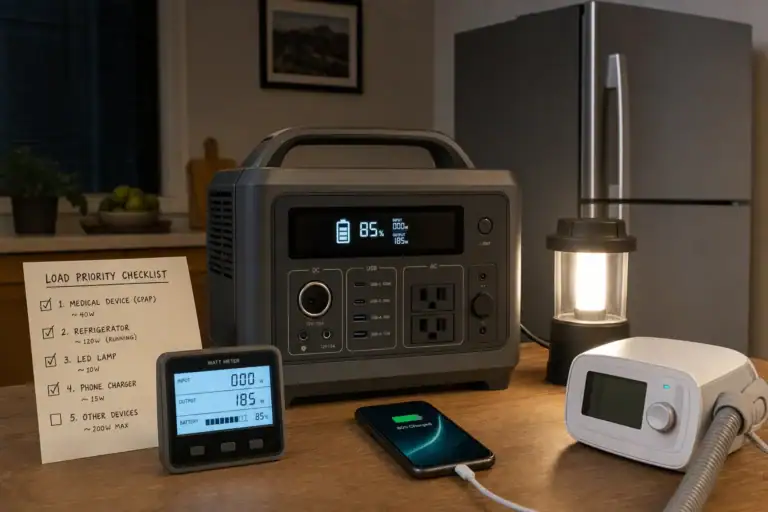
Assume a refrigerator averages 70 watts over time but briefly requires several hundred watts when its compressor starts. A router and modem use 20 watts, while several LED lights use 30 watts. Two small stations could isolate the refrigerator on one unit and the communications equipment and lights on the other. This arrangement protects the smaller critical loads from being shut down if the refrigerator drains its assigned battery.
One large station could power everything together and may handle the compressor surge more comfortably. Its display would also provide one combined estimate of remaining runtime. The tradeoff is that a shutdown, overload, or depleted battery affects every connected device.
Medical device and household appliances
For a critical medical device, redundancy may be more valuable than maximum output. One station can operate the device while the second remains charged or is recharging. Selection should be based on the device manufacturer’s power requirements, including whether it needs pure sine wave AC, heated accessories, or uninterrupted operation. A backup plan should not rely solely on a runtime estimate from a power station display.
If the household also needs to operate a high-draw appliance, a larger station may be appropriate because many compact units cannot support electric kettles, microwave ovens, space heaters, or cooking appliances. These loads can consume 1,000 to 1,800 watts or more and drain batteries quickly even when the inverter can support them.
Camping, remote work, and mobile use
Two smaller stations can be divided between a campsite and a vehicle, or between work equipment and general lighting. They are easier for one person to lift and can be charged at different times. One larger station reduces the number of devices and cables, but its weight may make frequent movement inconvenient. Wheels or sturdy handles can matter as much as nominal capacity in this use case.
4. Common Selection Mistakes and Troubleshooting Cues
A common mistake is comparing only total watt-hours. If a refrigerator needs a starting surge above a small station’s inverter limit, owning a second identical station does not solve the problem unless the system expressly supports a compatible combined-output mode. Repeated overload warnings, immediate AC shutdowns, or restarts when a compressor engages indicate an output or surge mismatch rather than insufficient battery capacity.
Another mistake is estimating runtime from the appliance’s maximum rating. Refrigerators, freezers, pumps, and some medical devices cycle on and off. Measure or estimate average consumption over several hours when possible. Conversely, do not use average wattage to select the inverter; inverter sizing must account for peak and startup demand.
Users also overlook idle losses. Running a 10-watt device through a large AC inverter may consume noticeably more than the device alone. A compatible DC or USB output can be more efficient for routers, phones, and laptops. If runtime is much shorter than expected, check the actual load, AC inverter overhead, cold temperature, battery state of charge, and whether an unplanned device is connected.
With two units, unbalanced use is another concern. One may cycle heavily while the other remains full, causing uneven aging. Assigning loads based only on outlet convenience can also leave one station overloaded and the other underused. Rotate duties when practical and monitor wattage on each display.
5. Safety Basics for Either Backup Setup
Use power stations in dry, ventilated locations and follow their specified temperature ranges. Do not cover cooling vents or place a unit next to combustible materials, direct heat, standing water, or heavy foot traffic. Inspect the enclosure, plugs, and cables before use. Stop using a unit that is swollen, cracked, unusually hot, wet, smoking, or producing a strong abnormal odor.
Never connect the AC output of one portable power station to another unit’s AC output. Do not improvise parallel connections, use double-ended power cords, bypass protection systems, or attempt to combine inverter outputs. Only use expansion batteries and connection methods specifically designed as compatible parts of the same system.
A portable power station should not be connected to household wiring through an improvised cord or wall receptacle. Supplying selected home circuits requires appropriate equipment and professional installation. Consult a qualified electrician for any transfer equipment, inlet, grounding, or code-compliance questions.
Extension cords should be correctly rated for the load, suitable for the environment, fully uncoiled when carrying substantial current, and positioned to avoid damage or trip hazards. A power station does not make a fuel-burning generator safe indoors; generators must remain outdoors at a safe distance according to their instructions because of carbon monoxide.
6. Maintenance, Charging, and Storage for Multiple or Single Units
For emergency readiness, inspect and recharge each station on a regular schedule instead of assuming it remained full in storage. Batteries gradually self-discharge, and displays consume a small amount of energy. Check the manual for the preferred long-term state of charge. Many battery systems are stored more comfortably at a partial charge, while emergency equipment may be kept higher and checked more often to prioritize availability.
A two-station setup requires labeling and recordkeeping. Note each unit’s last recharge date, battery percentage, cable set, and assigned loads. Rotate which unit receives regular use so one battery does not accumulate far more cycles than the other. Periodically test critical appliances under controlled conditions to confirm startup behavior and realistic runtime.
Store stations in a cool, dry area away from freezing conditions, excessive heat, and direct sunlight. Temperature can affect both available capacity and battery aging. Before an expected outage, bring a cold unit into its permitted operating range before charging or placing it under a heavy load.
Keep charging accessories organized and verify that solar panels fall within the station’s voltage, current, and power input ranges. Two smaller stations may need separate solar inputs or alternating charging sessions. One large unit may accept more solar wattage, but panel output still varies with weather, season, orientation, and shading.
| Maintenance task | Two-unit consideration | One-unit consideration |
|---|---|---|
| Charge check | Check and document both batteries | One battery percentage to monitor |
| Load test | Test each assigned appliance group | Test combined loads and startup surges |
| Battery rotation | Alternate primary and reserve roles | Avoid unnecessary full discharge cycles |
| Cable organization | Label chargers and accessories by unit | Keep the primary charging kit together |
| Emergency readiness | Confirm both units are accessible | Confirm the heavier unit can be moved if needed |
Related guides: Can You Use Two Portable Power Stations Together? Parallel Use Explained • Surge Watts vs Running Watts: How to Size a Portable Power Station • Energy Budget for a Power Outage: Lights, Phone, Internet, and Small Appliances
7. Practical Takeaways and Specs to Compare
Choose two small power stations when separate load zones, easier lifting, flexible charging, and backup redundancy are the priorities. This approach is especially useful for communications, lighting, electronics, and other modest loads that can be divided without combining AC outputs.
Choose one large power station when a demanding appliance requires higher continuous or surge output, when consolidated runtime is important, or when managing one charging system is preferable. A large unit may also offer more practical support for several simultaneous loads, provided their combined power remains within its limits.
For many households, the decision should begin with an appliance inventory. Record operating watts, startup watts, daily watt-hours, desired backup duration, and outlet type. Then compare those requirements with usable capacity and inverter performance rather than selecting by battery size alone.
Specs to look for
- Battery capacity: Look for watt-hours matched to the energy budget, such as 1,000 to 2,000 Wh for moderate backup needs; capacity largely determines potential runtime.
- Usable energy: Plan around roughly 75% to 90% of rated capacity for AC loads; conversion and standby losses reduce delivered energy.
- Continuous AC output: Choose a rating above the combined running watts, with approximately 20% to 30% headroom when practical; this reduces overload shutdowns.
- Surge output: Check both surge wattage and supported duration for compressors, pumps, and motors; a brief headline rating may not support a longer startup event.
- AC waveform: Look for pure sine wave output when powering sensitive electronics, medical equipment, variable-speed motors, or appliances that specify it.
- Charging input: Compare maximum wall and solar input, supported voltage range, and estimated recharge time; faster input can restore backup capacity during short utility windows.
- Port selection: Confirm the number and type of AC, USB-C power delivery, USB, and regulated DC ports; direct DC charging may improve runtime for compatible devices.
- Battery chemistry and cycle rating: Compare expected capacity retention after hundreds or thousands of cycles; this helps estimate durability under frequent use.
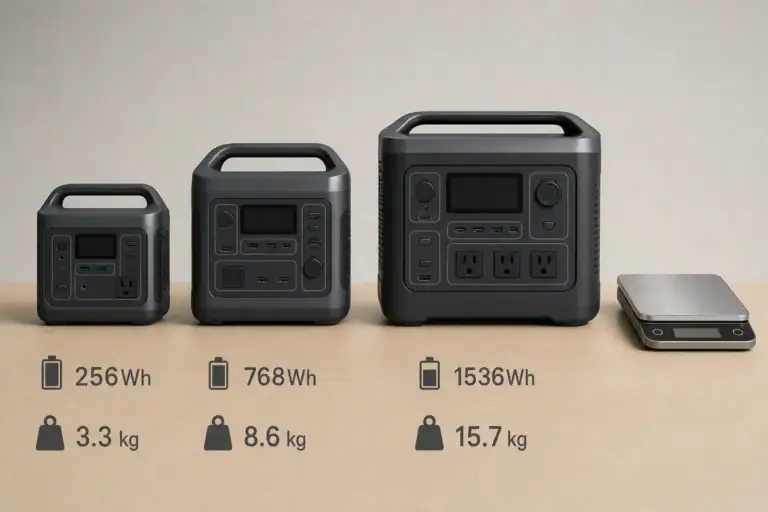
- Weight and handling: Compare total weight, weight per unit, handles, and wheels; a 20-pound unit and a 60-pound unit create very different transport demands.
- Expansion and monitoring: Look for clearly supported expansion options, accurate input and output displays, low-charge alerts, and per-port controls; these features simplify energy management without unsafe improvisation.
Neither arrangement is universally better. Two small stations favor resilience and flexibility, while one large station favors concentrated output and simplicity. Matching the setup to actual load measurements provides a more reliable answer than comparing capacity labels alone.
Frequently asked questions
Is it better to buy two small power stations or one large power station?
Two smaller units are often better when you want backup redundancy, easier lifting, or power in separate rooms. One larger unit is usually better when a single appliance needs more continuous wattage or startup surge capacity than either small unit can provide.
Can two small power stations run one high-wattage appliance?
Usually no. Unless the manufacturer specifically supports an approved combined-output or parallel configuration, each power station’s AC outlets remain independent and cannot be safely combined to increase wattage for one appliance.
What power station specs matter most for home backup?
Compare usable watt-hours, continuous AC output, surge capacity, charging input, outlet types, and expected recharge time. Also check inverter waveform, battery cycle rating, weight, and whether the unit can safely support the appliance’s startup demand as well as its normal running watts.
What is the most common mistake when choosing a power station?
A common mistake is comparing battery capacity alone while ignoring continuous and surge output. Two stations with the same combined watt-hours as one larger station may still fail to start a refrigerator, pump, or other motor-driven appliance if neither individual inverter can handle the startup load.
How long will two 1,000 Wh power stations last compared with one 2,000 Wh unit?
If efficiency, battery condition, and loads are similar, their total usable energy can be roughly comparable when both units are used. Actual runtime varies with inverter losses, temperature, standby draw, and whether the loads can be split between the two separate stations.
Is it safe to connect two portable power stations together?
Do not connect one station’s AC output to another station’s AC output or use improvised methods to combine inverters. Use only manufacturer-approved expansion batteries, cables, and connection methods, and keep the units dry, ventilated, and within their specified operating conditions.
Related guides
Browse this topic →
- Beginner-friendly sizing, runtime & specs
- Solar & charging (MPPT, fast charging, cables)
- Batteries (LiFePO4, cycles, care & storage)
- Safety, cold-weather performance, real-world tips
More in Capacity
See all →- Wh per Pound: How to Compare Portable Power Station Weight and Capacity
- How to Build a Load Priority List for a Portable Power Station During Blackouts
- Usable Capacity vs Advertised Capacity: Why 1,000Wh Doesn’t Mean 1,000Wh at the Outlet
- Why Output Ports Have Separate Watt Limits on Portable Power Stations
- Runtime Planning for Mixed Loads: AC, DC, and USB at the Same Time
Keep reading
About this site
Portable Energy Lab publishes practical, independent guides about portable power—clear sizing, safe use, and real-world expectations.
Affiliate disclosure
Some links on this site may be affiliate links. If you buy through these links, we may earn a small commission at no extra cost to you. This helps support our content. Read our affiliate disclosure.