
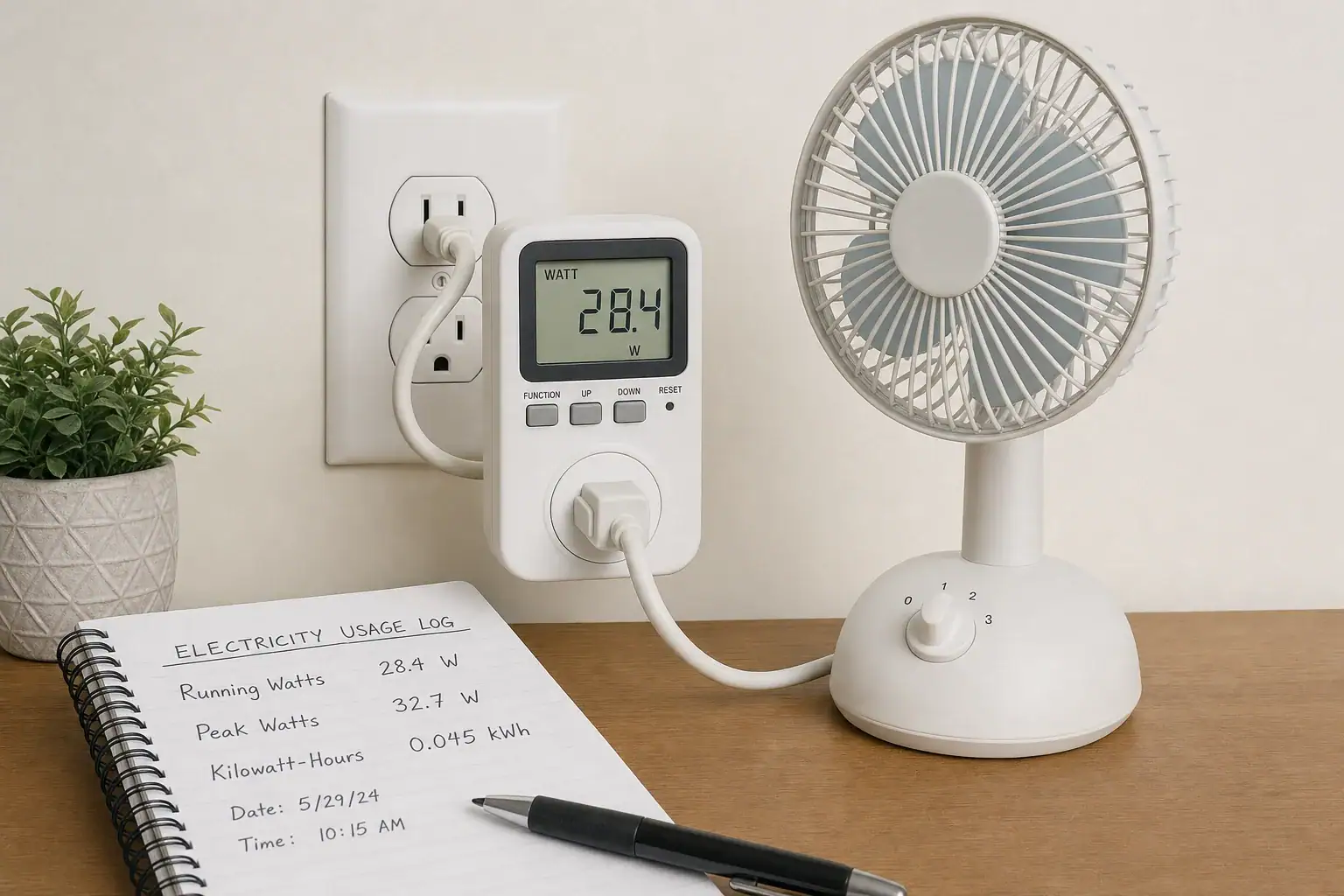
To measure appliance wattage before sizing a power station, use a properly rated plug-in electricity meter to record the appliance’s normal running watts, highest operating watts, and energy consumption in kilowatt-hours. Also check the appliance manual or manufacturer specifications for startup surge, because a basic meter may not capture a motor’s brief starting demand.
Use those readings for two separate decisions: running and startup watts determine the power station’s inverter rating, while watt-hours determine the battery capacity needed for the desired runtime. Measure every appliance you expect to operate, including loads that may run at the same time.
Start With the Appliance Label
Look for input watts on the appliance, power adapter, or manufacturer documentation. An input rating such as 120 V, 300 W provides a useful planning value, but it may represent maximum rather than typical consumption.
If the label lists only volts and amps, multiplying them gives volt-amperes:
Volts × amps = volt-amperes (VA)
VA and watts are not always equal for motors, compressors, and electronic power supplies because of power factor. For a simple resistive load, such as some heating elements, VA may be close to watts. For other appliances, measure real watts or use the manufacturer’s published wattage instead of assuming the two values are interchangeable.
Measure Real Power at the Outlet
A plug-in electricity meter is the most direct option for an ordinary cord-and-plug appliance. The meter must be rated for the outlet voltage, appliance current, plug type, and type of load. Follow its instructions, keep it dry, and do not use damaged cords or loose outlets.
- Connect the meter to the wall outlet according to its instructions.
- Connect the appliance to the meter.
- Run every mode you expect to use, including high heat, maximum speed, defrost, or other high-power settings.
- Record normal running watts and the highest displayed watts.
- For cycling appliances, leave the meter connected for a representative period and record kilowatt-hours.
Measure an appliance with its normal power adapter so the reading includes adapter losses. Do not use a household plug-in meter on hardwired equipment or circuits outside the meter’s rating. Hardwired or higher-voltage loads require appropriate instruments and qualified guidance. A portable power station should not be connected to home wiring, a panel, or a wall outlet as a power source unless a specifically designed, code-compliant system is installed under current official requirements.
Separate Running Watts From Startup Surge
Running watts are the power required after an appliance reaches normal operation. Startup surge is a short, higher demand produced when some motors, compressors, pumps, or transformers start.
A meter’s highest displayed value is not necessarily the true surge. Some meters update too slowly to capture a brief current spike. For a refrigerator, freezer, pump, or similar load, consult current manufacturer documentation for starting watts, locked-rotor information, or generator and inverter requirements. Do not repeatedly attempt to start an appliance from an undersized power station just to discover its limit.
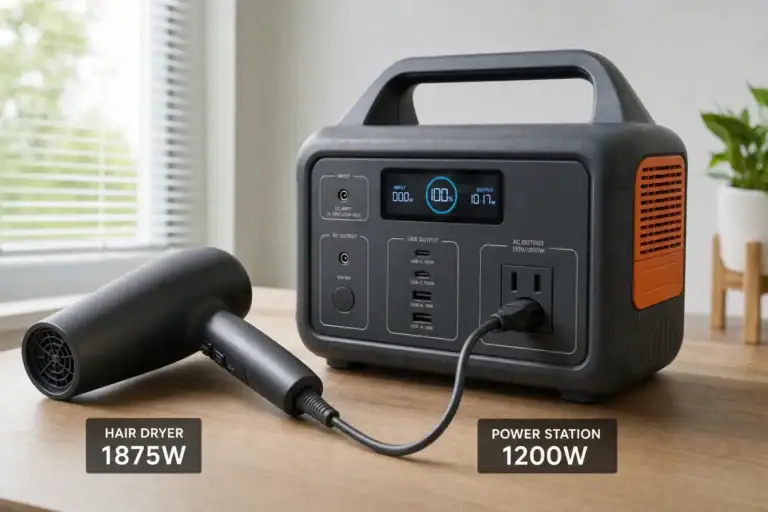
The power station’s continuous AC rating must cover the combined running demand. Its surge rating must cover the relevant starting demand for the duration required by the appliance. Surge ratings vary in duration and test conditions among manufacturers, so two stations with the same advertised surge wattage may not behave identically.
Account for Simultaneous Loads
Add the running watts of appliances that may operate together. Then consider what happens when a motor starts while the other loads remain on:
Required startup power = existing running loads + starting demand of the appliance starting
If more than one motor can start at the same time, account for that overlap or manage the loads so their starts do not coincide. A planning margin can accommodate meter uncertainty, voltage variation, and differences between appliance samples, but it does not override either manufacturer’s limits.
Measure Energy for Battery-Capacity Sizing
Watts indicate instantaneous power; watt-hours indicate energy consumed over time. For a steady load:
Energy in Wh = watts × hours
A 100-watt appliance running continuously for six hours would use 600 Wh at the appliance. Cycling equipment should be measured in kilowatt-hours over a representative period instead of estimating from its running wattage.
Convert the meter reading with:
1 kWh = 1,000 Wh
For example, if a refrigerator uses an illustrative 0.9 kWh during a measured 24-hour period, its average energy use is 900 Wh per day. A 12-hour estimate would be 450 Wh only if that measured day is representative and consumption scales evenly enough for planning. Ambient temperature, thermostat setting, door openings, and operating mode can change the result.
Include Conversion Losses and Reserve
A power station’s stated battery capacity is generally not the same as the energy delivered to an AC appliance. The inverter consumes energy, conversion is not perfectly efficient, and the station may reserve some capacity for battery protection. Low-power loads can also be affected by the station’s own operating overhead.
If you are using an explicit delivery-efficiency assumption, estimate nominal capacity as:
Required nominal Wh = appliance energy ÷ (delivery efficiency × usable fraction)
For an illustrative calculation, suppose an appliance needs 600 Wh, assumed AC delivery efficiency is 85%, and 10% of nominal capacity is kept as a reserve:
600 ÷ (0.85 × 0.90) ≈ 784 Wh
This is a planning estimate, not a guaranteed runtime. Use manufacturer-provided usable-capacity or efficiency information when available, and note the conditions under which it was specified. Battery temperature, load level, battery age, inverter behavior, and automatic shutoff settings can all affect delivered energy.
Build a Useful Measurement Record
For each appliance, write down:
- Normal running watts
- Highest measured operating watts
- Manufacturer-stated startup or surge requirement, if applicable
- Measured Wh or kWh over a representative interval
- Expected daily runtime or duty cycle
- Other loads that may operate simultaneously
When matching those figures to a power station, verify its continuous output rating, surge rating and duration, battery watt-hours, AC voltage and frequency, and any per-port current limits. All must be compatible; sufficient battery capacity does not compensate for an undersized inverter.
Use the Highest Credible Number
If the label, meter, and documentation disagree, determine what each number represents. A label may show maximum input, a meter may show typical operation, and the manual may list a separate startup requirement. Size continuous output around the highest credible simultaneous running load, size surge output around reliable starting data, and size battery capacity from measured energy use with clearly stated loss and reserve assumptions.
Related guides
Browse this topic →
- Beginner-friendly sizing, runtime & specs
- Solar & charging (MPPT, fast charging, cables)
- Batteries (LiFePO4, cycles, care & storage)
- Safety, cold-weather performance, real-world tips
More in Capacity
See all →- Two Small Power Stations vs One Large Power Station: Which Backup Setup Is Better?
- How to Build a Load Priority List for a Portable Power Station During Blackouts
- Usable Capacity vs Advertised Capacity: Why 1,000Wh Doesn’t Mean 1,000Wh at the Outlet
- Why Output Ports Have Separate Watt Limits on Portable Power Stations
- Runtime Planning for Mixed Loads: AC, DC, and USB at the Same Time
Keep reading
About this site
Portable Energy Lab publishes practical, independent guides about portable power—clear sizing, safe use, and real-world expectations.
Affiliate disclosure
Some links on this site may be affiliate links. If you buy through these links, we may earn a small commission at no extra cost to you. This helps support our content. Read our affiliate disclosure.