
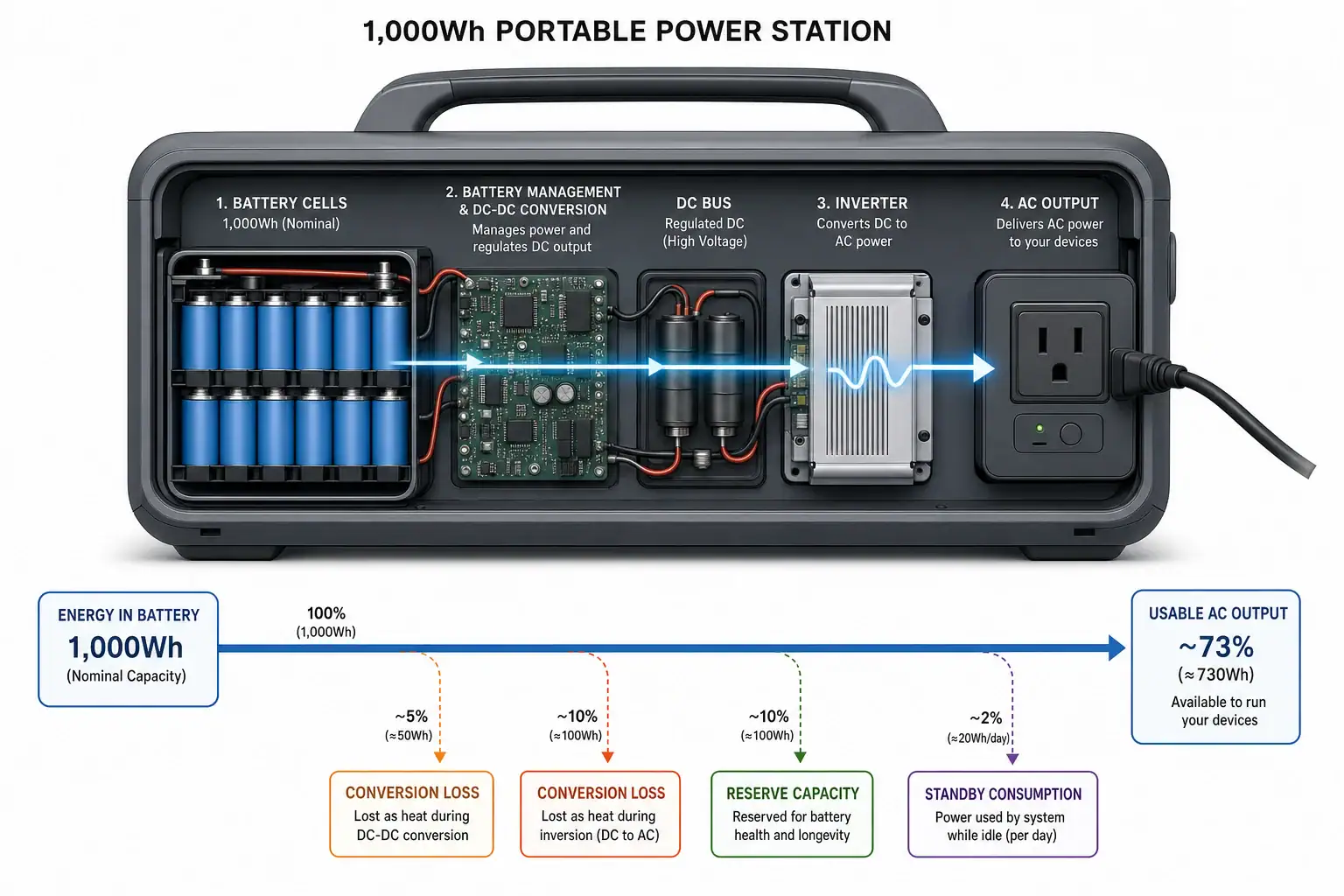
A 1,000Wh portable power station normally delivers less than 1,000Wh at the outlet because some stored energy is reserved or lost during voltage conversion, inverter operation, and system monitoring. The advertised watt-hours describe nominal battery energy, not a guaranteed amount available to every connected device.
Actual usable battery capacity depends on inverter efficiency, AC output load, battery temperature, discharge rate, and parasitic draw from the power station itself. A typical 1,000Wh unit might provide roughly 800Wh to 900Wh through its AC outlets under favorable conditions, with lower results possible at very light or very heavy loads. DC and USB outputs can produce different results because they use different conversion paths. Understanding these losses helps you estimate runtime, compare portable power stations fairly, and avoid assuming that watt-hours and outlet energy are interchangeable. It also explains why a simple calculation based only on advertised capacity often predicts more operating time than users experience.
1. What Advertised and Usable Capacity Mean
Advertised capacity is generally the nominal energy stored by the internal battery cells. It is expressed in watt-hours, or Wh. In simplified terms, watt-hours equal battery voltage multiplied by amp-hours. A nominal 25-volt battery rated at 40 amp-hours, for example, contains about 1,000Wh.
Usable capacity is the energy that can actually reach a connected load before the power station shuts down. It is lower because the battery management system usually maintains upper and lower charge boundaries, while internal electronics consume energy and lose some as heat.
Usable capacity is also output-specific. The same power station may deliver one result through an AC receptacle and another through a regulated DC or USB port. AC power requires an inverter, which creates an additional conversion stage. This distinction matters when comparing capacity claims, planning backup power, or calculating whether a station can operate an appliance for a required period.
2. How Energy Gets from the Battery to the Outlet
Battery cells store direct-current energy at a voltage that changes as they discharge. A battery management system monitors cell voltage, current, and temperature. It may stop discharge before every nominal watt-hour is removed to protect the cells from damaging conditions and preserve cycle life.
For an AC appliance, the station’s inverter converts battery DC into household-style AC. Inverter efficiency is not constant. It can be relatively high near an efficient part of the load range but lower when the load is extremely small, close to the inverter’s maximum rating, or highly reactive. Cooling fans, displays, wireless features, control boards, and relays may also consume energy.
A useful planning formula is:
Estimated AC energy = advertised capacity × accessible battery fraction × average inverter efficiency − operating overhead
For quick estimates, some users combine these factors into a single usable-capacity percentage. Multiplying 1,000Wh by an assumed 85% overall delivery rate gives about 850Wh at the AC outlet. This is a planning estimate rather than a fixed promise because load characteristics and operating conditions can change the result.
| Energy stage | Illustrative energy remaining | Reason for reduction |
|---|---|---|
| Advertised battery capacity | 1,000Wh | Nominal stored energy |
| After protected battery reserve | 950Wh | Charge and discharge boundaries |
| After DC-to-AC conversion | 855Wh | Inverter loss at 90% efficiency |
| After system overhead | 835Wh | Controls, display, fans, and standby use |
3. Real-World Runtime Examples
Runtime calculations should use estimated usable output energy rather than advertised watt-hours alone. The basic formula is:
Runtime in hours = usable energy in Wh ÷ average load in watts
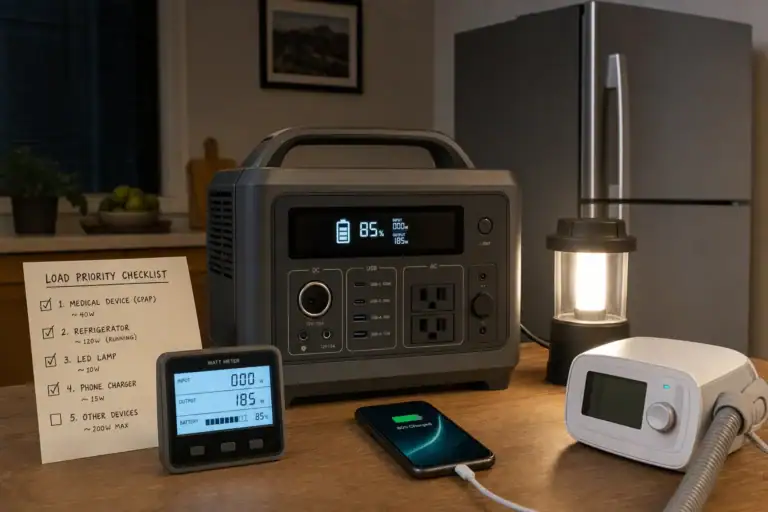
Suppose a 1,000Wh station provides an estimated 850Wh through its AC outlets. A device averaging 100W would have a theoretical runtime of 8.5 hours. In practice, its cycling behavior, startup events, and changes in inverter efficiency could make the result somewhat shorter or longer.
A 500W appliance supplied by the same 850Wh would have an estimated runtime of 1.7 hours. However, a heating appliance may maintain a fairly steady load, while a refrigerator or compressor cycles on and off. For cycling appliances, use measured average consumption over time rather than the number printed on the product label.
Very small loads can be unexpectedly inefficient on AC. If a 10W device runs from an inverter that also consumes several watts, total battery demand may be substantially higher than 10W. An appropriate DC or USB output may reduce conversion loss if the device supports it.
High-power loads create a different concern. A station might be rated to run a 900W appliance, but operating close to the continuous output limit can increase heat, fan use, and conversion losses. Startup surge watts may also cause an overload shutdown even when the appliance’s normal running wattage appears acceptable.
4. Common Calculation Mistakes and Troubleshooting Cues
A frequent mistake is dividing 1,000Wh directly by an appliance’s rated watts and treating the result as guaranteed runtime. That calculation ignores protected battery reserve, conversion losses, and the station’s own consumption. It also assumes that the appliance continuously draws exactly its label rating.
- Using maximum watts instead of average watts: Appliances with thermostats, compressors, or variable-speed motors may cycle. Measure or reasonably estimate average consumption.
- Ignoring AC overhead: Keeping the inverter active for a tiny load can consume a meaningful share of total energy.
- Confusing watts and watt-hours: Watts measure power at a moment; watt-hours measure energy used over time.
- Relying only on the percentage display: State-of-charge indicators are estimates and may adjust under changing loads or temperatures.
- Overlooking surge demand: A motor may briefly require several times its running power, triggering overload protection.
- Testing in cold conditions: Low battery temperature can temporarily reduce available energy and voltage performance.
If runtime seems abnormally short, compare the connected load shown on the display with an independent energy measurement when practical. Turn off unused outputs, check whether fans or wireless functions remain active, and repeat the test at a moderate temperature. A large or worsening capacity shortfall may indicate battery aging, calibration drift, an unusually inefficient load, or a fault requiring manufacturer-qualified service.
5. Capacity Testing and Safety Basics
Use equipment only within its stated continuous output, surge, temperature, and charging ranges. Capacity testing should use an ordinary compatible load in a ventilated location, away from moisture, combustible materials, and blocked cooling vents. Stop using the station if it becomes excessively hot, emits an unusual odor, swells, leaks, or repeatedly shuts down without a clear overload condition.
Do not open the enclosure, modify the battery pack, defeat temperature sensors, or bypass protection circuits to extract more capacity. The inaccessible reserve is generally part of the safety and longevity strategy, not energy intended for routine use.
Portable power stations should not be connected to building wiring through improvised cords or unsafe backfeeding methods. Any connection intended to supply household circuits requires appropriate listed equipment and evaluation by a qualified electrician. Capacity and inverter wattage alone do not establish that a device is suitable for whole-home integration.
6. How Storage, Temperature, and Aging Affect Usable Energy
Lithium-based batteries gradually lose capacity through calendar aging and charge-discharge cycles. Heat, long periods at very high charge, deep cycling, and heavy loads can accelerate degradation. After years of service, a station advertised as 1,000Wh when new may store and deliver less energy even if the display still reaches 100%.
For storage, follow the specified charge range and inspection interval for the unit. A moderate state of charge is commonly preferable for extended storage, but the appropriate level varies by battery management design. Store the station in a dry, temperature-controlled location and periodically confirm that it has not self-discharged below the recommended range.
Cold conditions usually reduce available power and capacity temporarily, while excessive heat can shorten long-term battery life. Allow a station to reach an approved operating temperature before charging. Occasional normal discharge and recharge use may help the state-of-charge estimate remain accurate, but repeated full discharges solely for calibration can add unnecessary cycle wear.
| Condition | Possible effect on outlet energy | Planning response |
|---|---|---|
| Moderate temperature and midrange load | Closer to expected usable capacity | Use the published efficiency data when available |
| Cold battery | Temporarily reduced capacity or power | Plan extra reserve and follow temperature limits |
| Very light AC load | Higher overhead as a percentage of consumption | Consider a compatible DC output |
| Aged battery | Permanent reduction from original capacity | Base plans on recent measured runtime |
Related guides: Inverter Efficiency Explained: Why Your Runtime Is Shorter Than Expected • AC vs DC Power: How to Maximize Efficiency and Runtime • Inverter Idle Consumption Explained: How Much Power You Lose Just Having AC On • How to Test Real Capacity at Home: A Simple Step-by-Step Method
7. Practical Takeaways and Specs to Compare
A 1,000Wh rating is best treated as a starting point for estimating energy, not as the amount guaranteed at an AC receptacle. For general planning, apply a realistic usable-energy factor and include a reserve for cold weather, battery aging, startup loads, or critical applications. When runtime matters, test the actual appliance because its average draw and power behavior can matter as much as the station’s capacity.
Comparisons are most useful when products are evaluated under similar conditions and through the same output type. A larger advertised battery does not automatically provide proportionally longer AC runtime if its inverter has higher standby consumption or lower efficiency at the intended load.
Specs to look for
- Advertised capacity: Look for watt-hours, such as 800Wh to 1,200Wh, rather than amp-hours alone; Wh allows more meaningful energy comparisons across battery voltages.
- Measured or stated usable AC energy: Look for test data at representative loads or an indicated delivery percentage, often roughly 80% to 90%; this better predicts outlet runtime.
- Inverter efficiency: Look for efficiency information across low, medium, and high loads rather than only a peak figure; conversion efficiency changes with power demand.
- Continuous AC output: Choose a rating with headroom above the appliance’s sustained draw, such as 20% to 30%; headroom can reduce overload risk and excessive heat.
- Surge output: Compare the surge-watt rating and supported duration with motor or compressor startup needs; a high capacity rating does not guarantee adequate starting power.
- Idle or standby consumption: Look for inverter no-load draw in watts or energy used over several hours; this matters for small devices and overnight operation.
- Output options: Look for regulated DC and appropriate USB power profiles in addition to AC; direct outputs may avoid unnecessary inverter losses.
- Battery chemistry and cycle rating: Look for retained-capacity context, such as around 70% to 80% after a stated number of cycles; this helps estimate long-term usable energy.
- Operating temperature range: Compare charging and discharging ranges with expected conditions; batteries can provide less energy or refuse charging outside suitable temperatures.
- Warranty and capacity criteria: Look for clear coverage periods and definitions of abnormal capacity loss; specific terms make long-term ownership expectations easier to evaluate.
For a simple runtime estimate, multiply advertised watt-hours by a conservative usable percentage, then divide by the appliance’s average watts. Adding a further reserve provides a more dependable plan than assuming every advertised watt-hour will appear at the outlet.
Frequently asked questions
How much usable capacity should I expect from a 1,000Wh power station?
AC outlet energy is often lower than the advertised battery rating because of battery reserve, inverter losses, and the station’s own operating power. Under favorable conditions, a 1,000Wh unit may deliver roughly 800Wh to 900Wh through AC outlets, but the result varies by load, temperature, and model. DC and USB outputs may provide a different usable-energy result.
Why does a power station lose battery percentage when nothing is plugged in?
Displays, battery monitoring, wireless functions, and standby circuits can consume energy even when no appliance is connected. Some units also keep the AC inverter active until it is manually turned off or an auto-shutoff setting is reached. Turning off unused output modes can reduce idle drain.
Is it a mistake to divide watt-hours by an appliance’s rated watts?
Dividing watt-hours by watts provides only a rough theoretical runtime, not a guaranteed result. It can overestimate runtime because it ignores conversion losses, battery reserve, and the power station’s overhead. It may also be inaccurate when an appliance cycles or draws substantially different power than its label rating.
What power station specs matter most for estimating real runtime?
In addition to advertised watt-hours, compare measured or stated usable AC energy, inverter efficiency at the intended load, and idle power consumption. Check continuous output and surge ratings to confirm that the station can support the appliance’s running and startup demand. Available DC and USB outputs can also matter for low-power devices because they may avoid AC inverter losses.
Will a portable power station run a refrigerator for longer than its wattage label suggests?
It can, because refrigerators usually cycle rather than draw their labeled running power continuously. Runtime depends on the refrigerator’s average energy use, ambient temperature, door openings, and compressor startup surge. Measure energy consumption over time when possible and ensure the station can handle the startup load.
Is it safe to use all of a portable power station’s available battery capacity?
Using a station normally until it shuts down through its built-in protections is generally the intended operating method when used within the manufacturer’s limits. Do not open the unit, bypass protective systems, or attempt to access battery reserve capacity. Keep vents clear, avoid moisture and excessive heat, and use qualified equipment for any connection to household wiring.
Related guides
Browse this topic →

- Beginner-friendly sizing, runtime & specs
- Solar & charging (MPPT, fast charging, cables)
- Batteries (LiFePO4, cycles, care & storage)
- Safety, cold-weather performance, real-world tips
More in Capacity
See all →- Wh per Pound: How to Compare Portable Power Station Weight and Capacity
- Two Small Power Stations vs One Large Power Station: Which Backup Setup Is Better?
- How to Build a Load Priority List for a Portable Power Station During Blackouts
- Why Output Ports Have Separate Watt Limits on Portable Power Stations
- Runtime Planning for Mixed Loads: AC, DC, and USB at the Same Time
Keep reading
About this site
Portable Energy Lab publishes practical, independent guides about portable power—clear sizing, safe use, and real-world expectations.
Affiliate disclosure
Some links on this site may be affiliate links. If you buy through these links, we may earn a small commission at no extra cost to you. This helps support our content. Read our affiliate disclosure.