
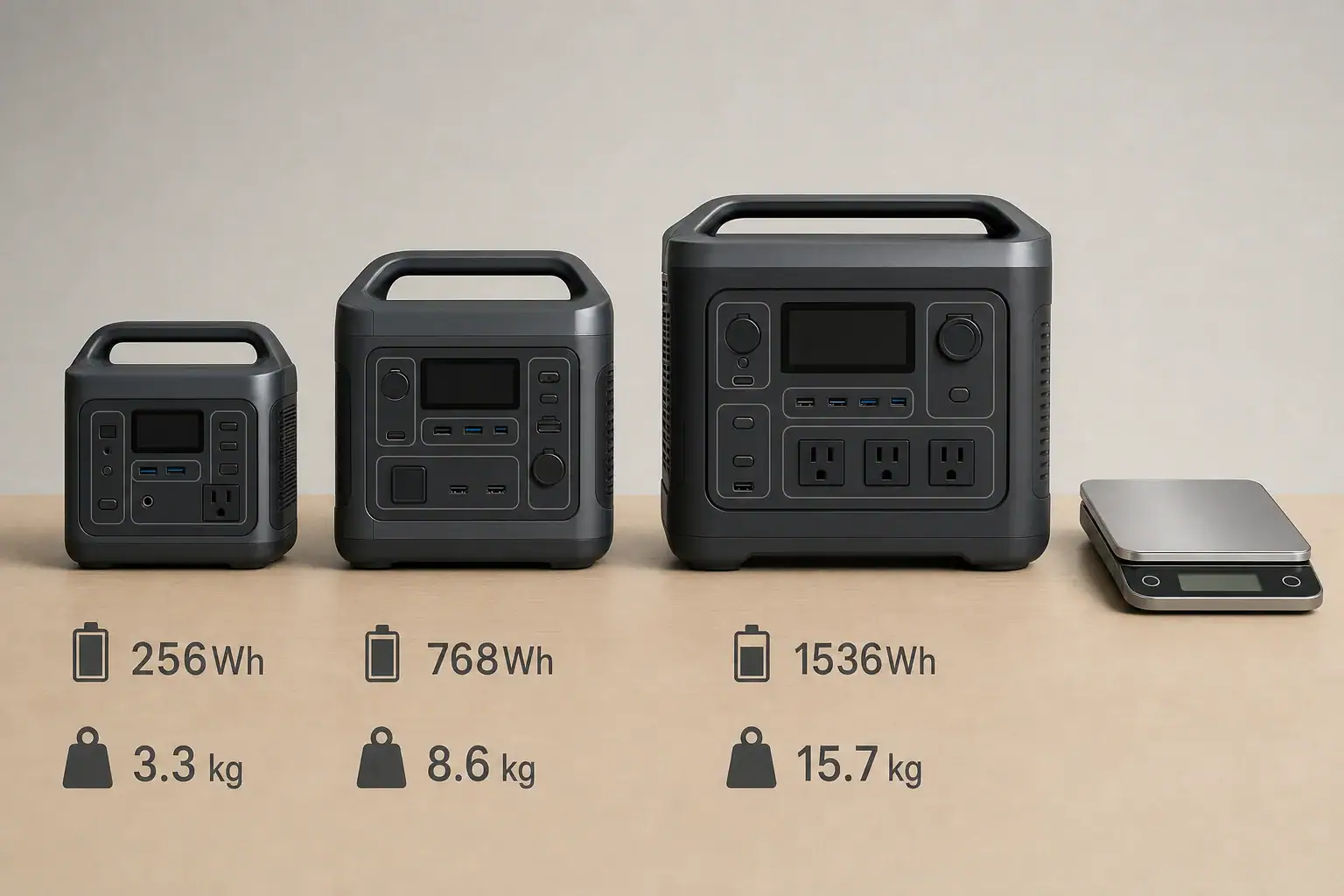
Wh per pound tells you how much listed battery capacity a portable power station carries for each pound of total product weight. A higher number generally indicates better capacity-to-weight efficiency, which can make a unit easier to carry for a given amount of stored energy.
This metric is useful when comparing portable power station weight, battery capacity, energy density, runtime, and portability. It can quickly reveal whether one model offers substantially more watt-hours without adding proportionate bulk. However, it does not measure output power, charging speed, battery longevity, or the amount of energy actually delivered through an outlet.
The best comparison therefore begins with a simple Wh-per-pound calculation and then considers usable capacity, inverter watts, surge watts, battery chemistry, ports, and intended loads. Weight efficiency matters most for camping, mobile work, emergency kits, and any situation in which the power station will be carried regularly.
1. What Wh per Pound Means and Why It Matters
Watt-hours per pound is a capacity-to-weight ratio. It compares the power station’s nominal energy capacity in watt-hours with its complete listed weight in pounds.
Wh per pound = listed watt-hour capacity ÷ total product weight in pounds
For example, a 1,000 Wh power station weighing 30 pounds has a ratio of about 33.3 Wh per pound. A 1,000 Wh model weighing 40 pounds provides 25 Wh per pound. Both list the same capacity, but the first carries that capacity in a lighter package.
This ratio matters because capacity and weight often increase together. More battery cells can provide longer runtime, but they also add mass. The enclosure, inverter, cooling system, charger, handles, ports, and structural protection contribute additional weight without increasing the listed watt-hour capacity.
A high ratio can be valuable when carrying equipment between a vehicle, campsite, job site, or storage area. A lower ratio is not automatically bad. Extra weight may come from a larger inverter, more durable enclosure, stronger cooling system, built-in charging hardware, or other features. Wh per pound should be treated as a comparison tool rather than a complete quality score.
2. How Capacity, Weight, and Runtime Work Together
A watt-hour measures stored energy. In simplified terms, a 500 Wh battery could theoretically supply 100 watts for five hours. Real runtime is shorter because the inverter, battery management system, wiring, and connected devices consume or lose some energy.
Nominal capacity is the energy rating associated with the battery pack. Usable capacity is what can actually reach a device after reserve margins and conversion losses. When using an AC outlet, a rough planning assumption might be 75% to 90% of nominal capacity, although results vary by load and system design. DC devices may avoid some inverter losses.
A practical runtime estimate is:
Runtime in hours = nominal Wh × expected usable fraction ÷ average load watts
If a 1,000 Wh station delivers about 85% of its capacity through AC, approximately 850 Wh is available to the appliance. A steady 100-watt load might then run for about 8.5 hours. Cycling appliances complicate the estimate because their average consumption can be much lower than their nameplate wattage.
Output power is separate from capacity. A lightweight station may have enough watt-hours for a task but lack the continuous inverter watts or surge watts needed to start an appliance. Likewise, a high-output model can operate a large load yet drain quickly if its battery capacity is modest.
| Listed capacity | Weight | Wh per pound | Approximate usable AC energy at 85% |
|---|---|---|---|
| 300 Wh | 8 lb | 37.5 Wh/lb | 255 Wh |
| 600 Wh | 18 lb | 33.3 Wh/lb | 510 Wh |
| 1,000 Wh | 30 lb | 33.3 Wh/lb | 850 Wh |
| 2,000 Wh | 55 lb | 36.4 Wh/lb | 1,700 Wh |
3. Real-World Wh-per-Pound Comparisons
Consider two power stations for a camping trip. Unit A lists 500 Wh and weighs 12 pounds, giving it 41.7 Wh per pound. Unit B lists 700 Wh and weighs 20 pounds, giving it 35 Wh per pound. Unit A is more weight-efficient, but Unit B still carries 200 Wh more total energy. If the user needs maximum runtime and moves the station only from a vehicle to a picnic table, the heavier option may be more practical.
For another example, compare a 1,200 Wh station weighing 32 pounds with a 1,500 Wh station weighing 43 pounds. Their ratios are 37.5 and 34.9 Wh per pound, respectively. The first is easier to carry per unit of capacity, while the second has more total stored energy. The right choice depends on whether mobility or runtime has priority.
Runtime also depends on the load. Suppose a station has 1,000 Wh of nominal capacity and 850 Wh of estimated usable AC energy:
- A 10-watt light could run for roughly 85 hours.
- A 50-watt portable refrigerator averaging 25 watts over time could run for roughly 34 hours.
- A steady 100-watt device could run for roughly 8.5 hours.
- A 500-watt appliance could run for roughly 1.7 hours.
These estimates do not account for temperature, battery age, intermittent inverter behavior, startup surges, or changing appliance demand. For refrigerators, pumps, and power tools, measured average consumption is usually more useful than the maximum nameplate rating.
4. Common Comparison Mistakes and Troubleshooting Cues
Comparing battery-only weight with total product weight: Use the complete ready-to-use weight. A battery module’s cell-level energy density is not directly comparable with a finished power station that includes an inverter, case, display, cooling, and charging electronics.
Confusing watts with watt-hours: Watts describe power at a moment in time. Watt-hours describe stored energy. A 2,000-watt inverter does not mean the station has 2,000 Wh of capacity.
Assuming listed capacity equals outlet energy: Some energy remains unavailable because of battery protection margins and conversion losses. If observed runtime is modestly below the nominal calculation, this may be normal rather than a fault.
Ignoring surge requirements: Motors and compressors may draw several times their running power briefly. If an appliance will not start even though expected runtime looks adequate, check continuous output, surge output, and whether other loads are connected.
Using peak load instead of average load: A refrigerator may draw 80 watts while its compressor runs but average much less over a full day. Conversely, a device with heating elements may remain near its rated wattage continuously.
Comparing different battery configurations: An expandable system may list the base unit and added battery separately. Include the weight and capacity of every component that must be transported. External power bricks and required adapters may also affect practical carry weight.
Overlooking test conditions: Very cold or hot temperatures can reduce available energy. If runtime is unexpectedly short, let the station reach an appropriate operating temperature, reduce unnecessary loads, verify that energy-saving modes are not shutting down low-power devices, and compare results using a stable measured load.
5. Safety Basics When Evaluating Capacity and Weight
Weight affects safe handling. A high-capacity station may require two hands, two people, or a cart even if it has built-in handles. Check the full weight before lifting, keep the load close to the body, and avoid carrying heavy equipment on unstable or wet surfaces.
Place the power station on a stable, dry surface with ventilation openings unobstructed. Do not operate or charge it in standing water, enclosed hot spaces, or locations where combustible materials can block airflow. Follow the stated operating and charging temperature ranges.
Connected devices must remain within the station’s continuous output, surge output, port rating, and total combined output. Extension cords should be appropriately rated and undamaged. A power station should not be connected to household wiring by improvised cords or methods. Any integration with home circuits requires suitable equipment and a qualified electrician.
Do not open the enclosure, modify battery packs, bypass protective electronics, or use damaged charging accessories. Stop using a unit that is swollen, cracked, unusually hot, leaking, emitting an unusual odor, or repeatedly shutting down under ordinary loads. Battery energy is substantial even when the Wh-per-pound figure appears modest.
6. Maintenance and Storage Factors That Preserve Useful Capacity
Wh per pound is calculated from fixed specifications, but useful capacity can decline as a battery ages. Cycle count, calendar age, storage charge, temperature, and frequent operation near maximum limits can all influence long-term performance.
For routine storage, follow the manufacturer’s recommended state of charge rather than assuming that permanently full or empty is best. Many battery systems are commonly stored at a moderate charge level and checked periodically. Recharge intervals vary because standby electronics and natural self-discharge can slowly reduce the displayed percentage.
Store the station in a dry, temperature-controlled area away from direct sunlight and freezing or extreme heat. Clean exterior vents without opening the enclosure. Before a planned trip or outage, charge the unit, confirm that its outlets work, inspect cables, and test it with a representative load.
If apparent capacity has fallen, first consider colder temperatures, higher-than-expected loads, AC conversion losses, and display calibration behavior. A controlled runtime test with a stable load can provide a more meaningful comparison than the percentage display alone. Persistent or severe capacity loss should be addressed through qualified service rather than battery modification.
| Storage factor | Better practice | Why it matters |
|---|---|---|
| Temperature | Use a dry, moderate indoor environment when possible | Extreme heat can accelerate aging, while cold can temporarily reduce output |
| State of charge | Follow the specified storage range, often a moderate level | Long periods at empty or full may increase stress in some battery chemistries |
| Periodic checks | Inspect and check charge every few months | Helps prevent deep discharge during long storage |
| Pre-use testing | Test outlets and a typical load before travel | Confirms that capacity and output are available when needed |
Related guides: Portable Power Station Buying Guide • Portable Power Station Watt-Hours Explained • Usable Capacity vs Advertised Capacity: Why 1,000Wh Doesn’t Mean 1,000Wh at the Outlet • LiFePO4 vs NMC Batteries: Weight, Cold Performance, Safety, and Real Cycle Life Differences
7. Practical Takeaways and Specs to Look For
Calculate Wh per pound by dividing nominal watt-hours by total product weight. Use the result to compare models in a similar capacity and output class, but do not choose solely by the highest ratio. Total capacity determines potential runtime, while inverter output determines which appliances can operate.
For frequent carrying, a ratio in the mid-30s or higher may indicate relatively efficient packaging, although battery chemistry and included hardware can shift the number. A lower ratio may still be reasonable when the design provides more output power, physical protection, ports, charging equipment, or expansion capability.
Specs to look for
- Nominal capacity: Look for watt-hours appropriate to the expected daily load, such as 300–600 Wh for light electronics or 1,000–2,000 Wh for longer appliance use; this establishes potential runtime.
- Total product weight: Compare the complete ready-to-use weight, including required external charging equipment when relevant; this reflects actual portability.
- Wh per pound: Calculate capacity divided by weight and compare units with similar functions; this shows how efficiently stored energy is packaged.
- Usable capacity or tested efficiency: Look for clear energy-delivery information or plan around roughly 75%–90% of nominal capacity through AC; this produces more realistic runtime estimates.
- Continuous inverter output: Select output above the combined sustained load, such as 1,000 watts for devices totaling about 700–800 watts; operating margin helps avoid overload shutdowns.
- Surge output: Check for short-duration capacity suitable for motors, pumps, and compressors, sometimes around 1.5–2 times continuous output; this affects whether an appliance can start.
- Battery chemistry and cycle rating: Compare the stated capacity-retention point after hundreds or thousands of cycles; this helps estimate long-term value and weight efficiency over time.
- Charging input: Compare maximum AC, vehicle, and solar input, such as 200 watts versus 800 watts; faster supported input can reduce recovery time between uses.
- Port and expansion details: Check AC outlets, regulated DC ports, USB power profiles, and optional battery capacity; these determine whether the stored energy can be delivered conveniently to intended devices.
The most useful model is not necessarily the lightest or the one with the most watt-hours. It is the one that provides enough usable energy and output for the intended loads at a weight that can be transported, positioned, and stored safely.
Frequently asked questions
What is a good Wh per pound for a portable power station?
A good Wh-per-pound figure depends on capacity class, battery chemistry, inverter size, and included features. Ratios in the mid-30s Wh per pound or higher can indicate efficient packaging for many finished portable power stations, but comparisons are most useful between models with similar output and functionality.
How do I calculate Wh per pound?
Divide the listed battery capacity in watt-hours by the complete product weight in pounds. For example, a 720 Wh unit weighing 24 pounds provides 30 Wh per pound. Use the ready-to-use weight rather than the battery-cell or battery-module weight.
What specs and features matter besides Wh per pound?
Check usable energy, continuous AC output, surge output, charging input, port types, battery chemistry, and cycle-life rating. These specifications determine what devices the station can run, how long it may run them, how quickly it can recharge, and whether it suits the intended use.
Does a higher Wh per pound mean a portable power station will run longer?
Not necessarily. A higher ratio means more listed capacity for each pound, while total watt-hours and the device’s average power draw determine potential runtime. A heavier model with lower Wh per pound can still run appliances longer if it has more total usable energy.
Is it a mistake to compare watts and watt-hours directly?
Yes. Watts measure the amount of power a station can supply at one time, while watt-hours measure stored energy. A station needs sufficient watts and surge capability to start and operate a device, plus enough usable watt-hours to run it for the desired duration.
Is it safe to carry and use a heavy portable power station?
It can be safe when the unit is handled within its weight limits and used according to its instructions. Lift carefully or use a cart or second person when needed, keep ventilation clear, operate on a stable dry surface, and avoid damaged cables or equipment. Do not connect a power station to home wiring without appropriate equipment and qualified installation.
Related guides
Browse this topic →

- Beginner-friendly sizing, runtime & specs
- Solar & charging (MPPT, fast charging, cables)
- Batteries (LiFePO4, cycles, care & storage)
- Safety, cold-weather performance, real-world tips
More in Capacity
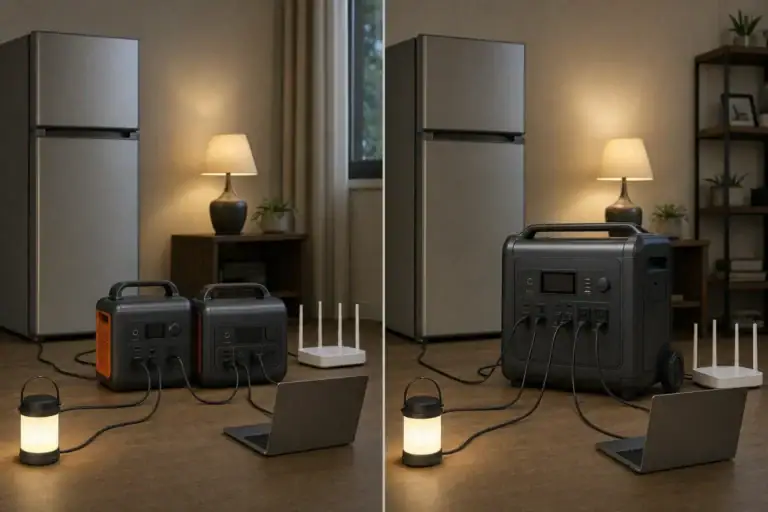
See all →- Two Small Power Stations vs One Large Power Station: Which Backup Setup Is Better?
- How to Build a Load Priority List for a Portable Power Station During Blackouts
- Usable Capacity vs Advertised Capacity: Why 1,000Wh Doesn’t Mean 1,000Wh at the Outlet
- Why Output Ports Have Separate Watt Limits on Portable Power Stations
- Runtime Planning for Mixed Loads: AC, DC, and USB at the Same Time
Keep reading

About this site
Portable Energy Lab publishes practical, independent guides about portable power—clear sizing, safe use, and real-world expectations.
Affiliate disclosure
Some links on this site may be affiliate links. If you buy through these links, we may earn a small commission at no extra cost to you. This helps support our content. Read our affiliate disclosure.