
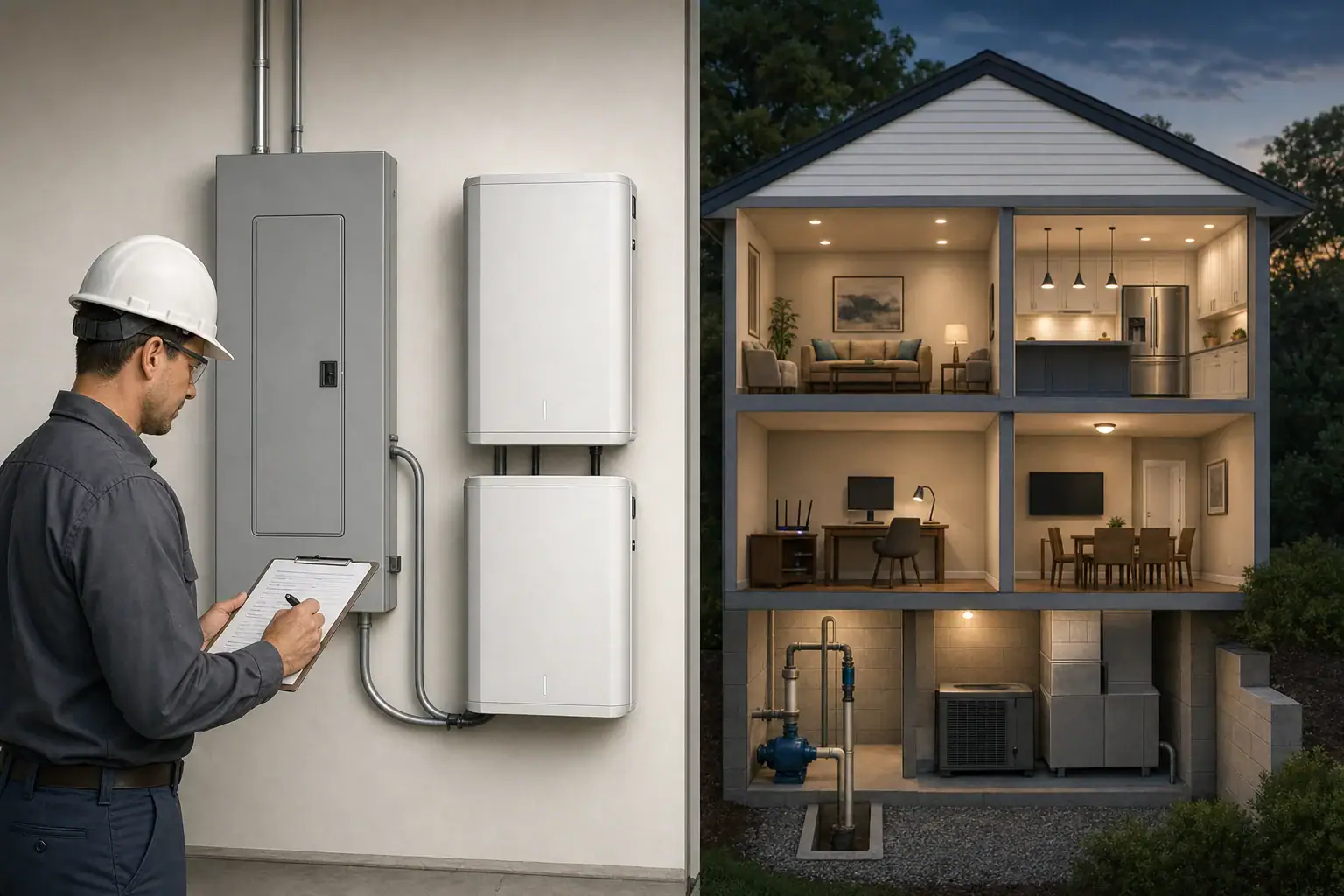
Quick answer: Size whole-house battery backup with two separate checks: total the loads that can run at the same time and verify motor-start capability, then total each essential load’s watts multiplied by expected operating hours. Adjust outage energy only for documented delivery losses and your chosen reserve, and verify 120/240V and load-shedding compatibility.
Start with a circuit and load inventory
Before selecting battery capacity, decide which circuits must remain available during an outage. Panel labels are a starting point, but they may not reveal every device on a circuit or how much power those devices actually draw.
Record the following for each candidate circuit:
- Panel position and circuit description
- Whether it is a 120V single-pole or 240V two-pole circuit
- Equipment make and model
- Running watts, or voltage and running current from reliable equipment documentation
- Motor or compressor starting information, including locked-rotor amps (LRA) when provided
- Expected operating hours during the target outage
- Whether the load can overlap with other high-demand equipment
- Whether it may be manually or automatically shed
Do not use a breaker’s ampere rating as an appliance’s normal consumption. The breaker identifies the circuit’s protection rating, not its actual running load. Use equipment nameplates, manufacturer documentation, energy-monitoring records, or measurements made with suitable instruments. An electrician should handle measurements inside a panel or on fixed wiring.
For a device specified in volts and amps, the U.S. Department of Energy gives the basic relationship watts = volts × amps. AC motors and variable-speed equipment can require additional manufacturer data, so this relationship is not a complete motor-start calculation.
Choose an essential-load tier
“Whole-house” can mean selected circuits distributed throughout a home or every circuit in the main panel. State which meaning applies, particularly when high-demand circuits will be excluded or shed.
| Backup tier | Candidate circuits | Main sizing issue | Decision to make |
|---|---|---|---|
| Continuity | Refrigeration, communications, selected lights and outlets, required controls | Long operating time | Which everyday functions must continue? |
| Property protection | Continuity loads plus a sump pump, well pump, heating controls, or blower | Motor starting and possible 240V service | Which equipment protects the home from damage? |
| Managed comfort | Property-protection loads plus selected HVAC or cooking equipment | Simultaneous power and load shedding | Which large loads may run, and which must wait? |
| Unmanaged whole panel | All desired circuits available without planned shedding | Highest continuous, starting, and energy requirements | Must occupants be able to operate large loads together? |
A medical device should not be added based on generic wattage or runtime estimates. Confirm backup-power requirements, power quality, transfer behavior, and acceptable outage duration with the device manufacturer and an appropriate medical or electrical professional.
Size whole-house battery backup power in kW
Power capacity determines what can run at the same time. Calculate it independently from outage duration.
Continuous power
Build a realistic worst-case operating scenario, then add the running watts of loads that may overlap:
Required continuous kW = simultaneous running watts ÷ 1,000
Do not automatically add every connected appliance. A refrigerator, pump, blower, and cooking load may not all run together if controls or household procedures prevent that overlap. Conversely, do not assume they will take turns unless the design actually enforces that behavior.
Starting power
Motors and compressors can briefly demand more power while starting. For each important start event, consider the equipment’s startup demand plus all other loads expected to remain on at that moment. Compare that event with the battery inverter’s model-specific short-duration capability and the duration for which it is available.
LRA or another nameplate value should be evaluated using the battery manufacturer’s approved design method rather than converted casually into an exact starting-kW figure. Tesla’s Powerwall 3 design material, for example, directs installers to evaluate air-conditioner starts using equipment-label LRA, but its procedures and limits apply to that product rather than every battery system. The same documentation illustrates why adding stored energy does not necessarily increase supported backup load: Tesla distinguishes expansion energy from backup-load capability.
If pump, blower, or compressor startup data are unavailable, mark the required starting kW as unknown. Do not select an inverter from running watts alone.
Size outage energy in kWh
Energy capacity determines how long selected loads can operate. For each load:
Load watt-hours = watts × equivalent operating hours
Equivalent operating hours account for cycling. A device that draws its listed running power for only part of the outage should not be calculated as though it runs continuously. Where power varies substantially, measured energy use over a representative period is more useful than a single instantaneous watt reading.
Transparent hypothetical worksheet
The following values are assumptions created only to demonstrate the calculation. They are not typical appliance ratings and must not replace measurements or equipment documentation.
| Selected load | Assumed watts | Equivalent hours | Calculated Wh |
|---|---|---|---|
| Refrigeration | 150 W | 12 | 1,800 Wh |
| Selected lighting | 200 W | 4 | 800 Wh |
| Communications | 50 W | 24 | 1,200 Wh |
| Heating controls and blower | 500 W | 6 | 3,000 Wh |
| Sump pump | 400 W | 2 | 800 Wh |
| Selected outlets | 80 W | 8 | 640 Wh |
| Total | — | — | 8,240 Wh |
The hypothetical loads require 8.24 kWh of AC energy during the modeled outage. DOE expresses the same conversion as kWh = wattage × hours ÷ 1,000.
Add delivery losses and a retained reserve
If a battery specification represents usable stored energy before AC delivery, one transparent calculation is:
Required battery kWh = load kWh ÷ delivery efficiency ÷ (1 − reserve fraction)
For this hypothetical example only, assume 90% delivery efficiency and a homeowner-selected 20% reserve:
8.24 kWh ÷ 0.90 ÷ 0.80 = 11.44 kWh
Both percentages are project assumptions, not universal battery values. Delivery efficiency may reflect inverter conversion, battery operation, controls, standby consumption, wiring, and operating conditions. Confirm what the manufacturer’s capacity figure includes. If a specification already states usable AC-delivered energy under relevant conditions, applying a separate conversion loss may double-count it. Likewise, distinguish a manufacturer’s built-in operating limits from the additional reserve the homeowner wants to retain.
Solar production is not included in this outage worksheet. If charging during an outage is part of the design, model it separately because production depends on weather, array conditions, equipment configuration, and the system’s permitted off-grid behavior.
When 120V, 240V, and load shedding change the design
Supporting a 240V circuit
A two-pole load requires more than sufficient total wattage. The backup inverter and transfer configuration must support the home’s 120/240V service arrangement and the particular circuit’s continuous and starting demand. A general claim of “240V output” does not prove that a specific air conditioner, well pump, range, dryer, or other load is supported.
Have the installer verify voltage, phase arrangement, neutral and grounding requirements, transfer equipment, and the manufacturer’s supported-load rules. Never energize household wiring through an improvised cord or backfeed a receptacle.
Using load shedding
Load shedding can reduce the inverter power required by preventing selected large loads from operating off-grid or by allowing them only when adequate capacity is available. The feature must be part of a compatible, professionally configured control system.
Implementation varies by manufacturer. As one product-specific example, Tesla documents a control circuit that turns a selected load off when its system goes off-grid. That behavior should not be assumed for another battery, gateway, or software version.
Document shed loads clearly. A system that disconnects central air conditioning or electric cooking during an outage may back up the home’s panel, but it does not provide unrestricted whole-panel operation.
Verification checklist before equipment selection
- Confirm every selected circuit and whether it operates at 120V or 240V.
- Identify credible simultaneous running loads rather than totaling all breaker ratings.
- Obtain manufacturer startup data for each essential motor or compressor.
- Compare continuous and short-duration ratings separately, including the surge duration.
- Complete the watts-times-hours worksheet for the intended outage period.
- Identify whether published battery capacity is nominal, usable stored energy, or usable AC-delivered energy.
- State delivery-loss and retained-reserve assumptions without double-counting either.
- Document circuits that are excluded, manually managed, or automatically shed.
- Verify transfer, shutdown, communications, and black-start behavior in the applicable manuals.
- Ask the installer and local authority having jurisdiction which permits, inspections, equipment listings, and adopted code provisions apply.
- Ask the serving utility whether its interconnection process applies to the proposed operating and export configuration.
UL explains that model installation codes call for stationary residential energy-storage systems to be listed to UL 9540 and installed according to their listing and manufacturer instructions; a portable-power-pack listing is not equivalent. Enforceable requirements depend on locally adopted codes and amendments.
Permitting and utility review are jurisdiction-specific. For example, PG&E treats storage devices as generators for its Rule 21 interconnection process, while Austin provides a local residential battery-backup permitting path and retains separate utility requirements. These examples do not establish rules outside those jurisdictions.
Related guides
How to Size a Solar Generator for Home Backup
The final sizing result
A complete design should end with two numbers and one configuration statement: required continuous and starting power in kW, required outage energy in kWh, and a clear description of which 120V and 240V circuits remain available or are shed. If motor-start data, usable-energy definitions, or transfer behavior remain unresolved, the system is not ready for final sizing.
Related guides
Browse this topic →
- Beginner-friendly sizing, runtime & specs
- Solar & charging (MPPT, fast charging, cables)
- Batteries (LiFePO4, cycles, care & storage)
- Safety, cold-weather performance, real-world tips
More in Capacity
See all →- Days of Autonomy Explained for Solar Generators and Portable Power Stations
- Wh per Pound: How to Compare Portable Power Station Weight and Capacity
- Two Small Power Stations vs One Large Power Station: Which Backup Setup Is Better?
- How to Build a Load Priority List for a Portable Power Station During Blackouts
- Usable Capacity vs Advertised Capacity: Why 1,000Wh Doesn’t Mean 1,000Wh at the Outlet
Keep reading
About this site
Portable Energy Lab publishes practical, independent guides about portable power—clear sizing, safe use, and real-world expectations.
Affiliate disclosure
Some links on this site may be affiliate links. If you buy through these links, we may earn a small commission at no extra cost to you. This helps support our content. Read our affiliate disclosure.