
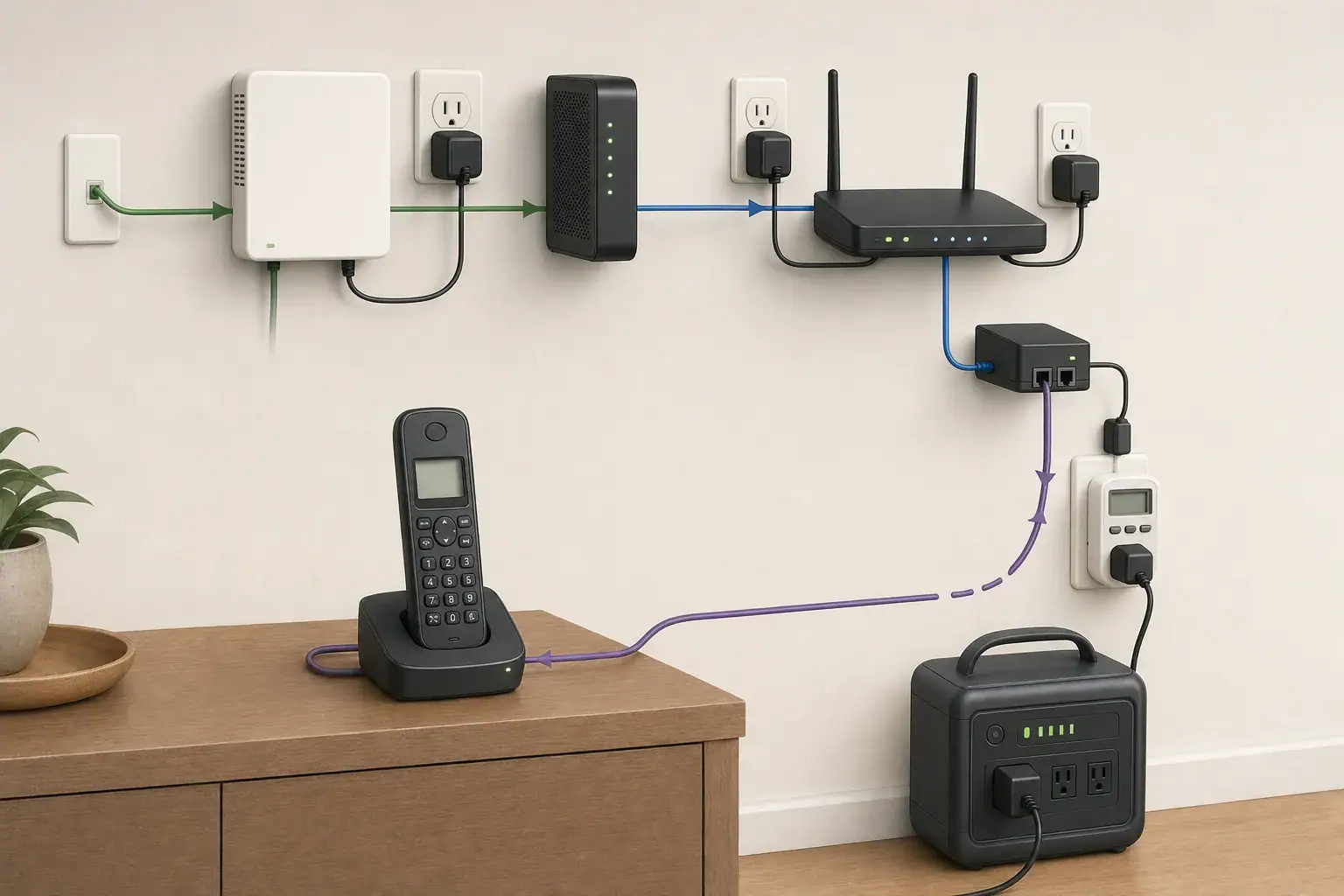
Quick answer: A cordless phone usually needs backup power for its base, but the base may be only one link in the call path. Identify every required powered device, including any modem, ONT, router, or phone adapter. Measure their combined average wall load, then divide documented usable AC-output watt-hours by that measured load.
Trace the complete cordless phone backup power path
Do not size a backup from the cordless base alone. Follow the phone cable or voice connection backward toward the provider and list every device that must have local power for calls to work. Modern home phone services can require battery power at more than one point; a battery associated with a telephone modem may support voice equipment without powering unrelated household devices. The FCC describes this distinction in its backup-power guidance.
- Cordless base or answering system: Treat it as a required load unless its exact manual documents a power-failure operating mode.
- Handset charging cradles: Include each separate cradle only if you intend to recharge that handset during the outage.
- Analog telephone adapter (ATA): Third-party VoIP service may use a separate box that supplies the phone jack.
- Cable voice modem or eMTA: Cable telephone service may pass through this device or a combined gateway.
- Router or internet gateway: Include it only if the particular voice service requires it.
- Fiber optical network terminal (ONT): Find its power supply and determine whether it has separate provider backup equipment.
- Provider battery unit: Record the exact device and functions it powers. Do not assume it also supplies the cordless base.
AT&T advises customers to account for each powered component used to provide voice service, including relevant gateways, modems, and ONTs, and notes that many cordless phones need their own power. Those details concern AT&T installations, but the inventory method is useful for any service: AT&T battery-backup guidance.
Does the cordless base need power during an outage?
For normal cordless-phone operation, plan on keeping the base powered. A charged handset by itself does not establish that the phone can place or receive calls when utility power fails.
A few phones have model-specific power-failure features. For specified Panasonic KX-TG785SK and KX-TGF57x configurations, a charged handset seated on the base can temporarily power the base. The handset must remain on the base, operating range is reduced, and the manual’s limits apply only to the cited models and supplied batteries. Check the manual for the exact phone rather than applying that behavior to another model. See the Panasonic instructions.
Provider backup equipment is separate from the phone’s own power needs. Verizon states that its PowerReserve supports compatible voice equipment but does not power a cordless telephone or internet equipment. See the Verizon PowerReserve documentation.
Which equipment needs backup by service type?
| Phone-service setup | Equipment to investigate | What to verify |
|---|---|---|
| Traditional provider-powered copper line | Cordless base and planned charging cradles | Confirm that the line is genuinely provider-powered copper. A compatible basic corded phone may avoid the cordless-base dependency. |
| Cable voice | Voice modem or eMTA, possibly a combined gateway, and cordless base | Ask whether provider backup supports voice, which installed hardware it covers, and whether its battery is serviceable. |
| Fiber voice | ONT, its power unit, cordless base, and possibly a gateway | Identify every power supply and confirm whether the ONT is inside or outside. |
| Third-party VoIP with an ATA | ONT or modem, required router or gateway, ATA, and cordless base | Confirm the precise network path with the provider and device manuals. |
| Cellular home-phone adapter | Cellular terminal or adapter and cordless base | Check the terminal manual for its battery behavior and supported phone connections. |
Verify every row with your provider and a controlled outage test. A powered local setup cannot guarantee telephone service if the provider’s upstream network is unavailable.
Measure the combined load instead of adapter labels
An adapter’s output volts and amps are ratings, not a measurement of the AC energy drawn at the wall. They may identify an electrical limit, but they do not provide the representative average watts needed for a runtime estimate.
Use a plug-in electricity meter according to its instructions and electrical rating. The P3 P4400 instructions describe displays for instantaneous watts, accumulated kilowatt-hours, and powered duration. Accumulated energy over a representative period is more useful than a single momentary reading when small loads change as handsets charge. See the P3 P4400 instructions.
Measurement checklist for cordless phone backup power
- Write down each device’s manufacturer, model, outlet location, adapter label, and whether it is required for voice.
- Measure the complete service path together when practical. If devices are in different locations, measure each over representative periods and add the average watts.
- Start with fully charged handsets and record the stable idle condition.
- Repeat with a nearly depleted handset charging on the base.
- Measure separate cradles that will remain connected during an outage.
- Include an active call and relevant answering-system use in the observation period.
- Record accumulated kWh and elapsed hours, not only instantaneous watts.
- Check the backup manual for energy-saving or low-load automatic shutoff, then verify that the output remains on under the small overnight load.
A useful worksheet has columns for device/model, required for voice, outlet location, adapter rating, idle watts, call watts, charging watts, cumulative kWh, test hours, and calculated average watts.
Convert measured energy into average watts
Watts (W) describe the rate of power use. Watt-hours (Wh) describe an amount of energy. Calculate a representative average from the meter’s accumulated energy and elapsed time:
Average W = measured kWh × 1,000 ÷ test hours
Illustrative calculation: If a meter records 0.096 kWh across a 12-hour representative test, the average load is 0.096 × 1,000 ÷ 12 = 8 W. This is arithmetic only, not a measured cordless-phone result. A longer test can include idle operation, calls, and a realistic charging cycle. A test conducted only with fully charged handsets can understate an outage in which handsets need recharging.
Calculate runtime from usable output watt-hours
Use this planning equation:
Runtime hours = usable AC-output Wh ÷ combined average W
Use usable AC-output energy, not automatically the advertised internal battery capacity. The backup converts battery energy to AC and the connected power adapters convert it again. The backup’s own consumption, output conversion, reserve settings, temperature, battery condition, and low-load behavior can affect delivered energy.
If the manufacturer documents usable AC output under conditions relevant to your load, use that figure. Otherwise, establish a conservative figure through product-specific documentation or a controlled output test. Do not insert a universal efficiency percentage.
Transparent hypothetical runtime example
Assume, solely for illustration, that documented or tested usable AC output is 240 Wh and the entire measured phone-service path averages 8 W:
240 Wh ÷ 8 W = 30 hours
The 240 Wh, 8 W, and 30-hour result are assumptions for this example, not product-performance claims. If only nominal battery watt-hours are published and no relevant usable-output figure has been established, the runtime is unknown.
Check output capability and test the setup
Average watts estimate energy use, but they do not establish whether the backup can operate the equipment. Its continuous output rating must cover the combined operating load. A surge rating applies to brief demand and is not a substitute for sufficient continuous output. For background, see surge watts versus running watts.
- Fully charge the backup and phone handsets.
- Connect only the equipment identified as necessary for the voice path.
- Remove utility power using the backup’s documented procedure.
- Confirm that the base remains registered and that a normal outgoing call works.
- Use another nonemergency phone to confirm that the home number can receive a call.
- Leave the setup running long enough to reveal low-load shutoff.
- Repeat with a handset charging if charging is part of the outage plan.
Use supplied or manufacturer-approved adapters. Do not improvise DC cables, backfeed a receptacle, or connect a portable backup to home wiring. Do not call 911 merely to test the setup. Test when temporary loss of phone service will not create a hazard, keep another communication method available, and recharge the backup afterward.
What a runtime estimate cannot guarantee
A runtime calculation is a planning estimate, not a promise that telephone service will remain available. Provider-network failures, temperature, battery condition, call duration, handset charging, and changes in equipment behavior can alter the result. A provider’s stated standby period should not be interpreted as continuous talk time or cordless-base runtime; the FCC distinguishes standby availability from continuous use in its backup-power rules and discussion.
Recheck the service path and repeat the measurement whenever the provider, modem, gateway, ONT, router, ATA, cordless phone, or backup supply changes.
Related guides
Browse this topic →

- Beginner-friendly sizing, runtime & specs
- Solar & charging (MPPT, fast charging, cables)
- Batteries (LiFePO4, cycles, care & storage)
- Safety, cold-weather performance, real-world tips
More in Home / Appliances
See all →Keep reading
About this site
Portable Energy Lab publishes practical, independent guides about portable power—clear sizing, safe use, and real-world expectations.
Affiliate disclosure
Some links on this site may be affiliate links. If you buy through these links, we may earn a small commission at no extra cost to you. This helps support our content. Read our affiliate disclosure.