
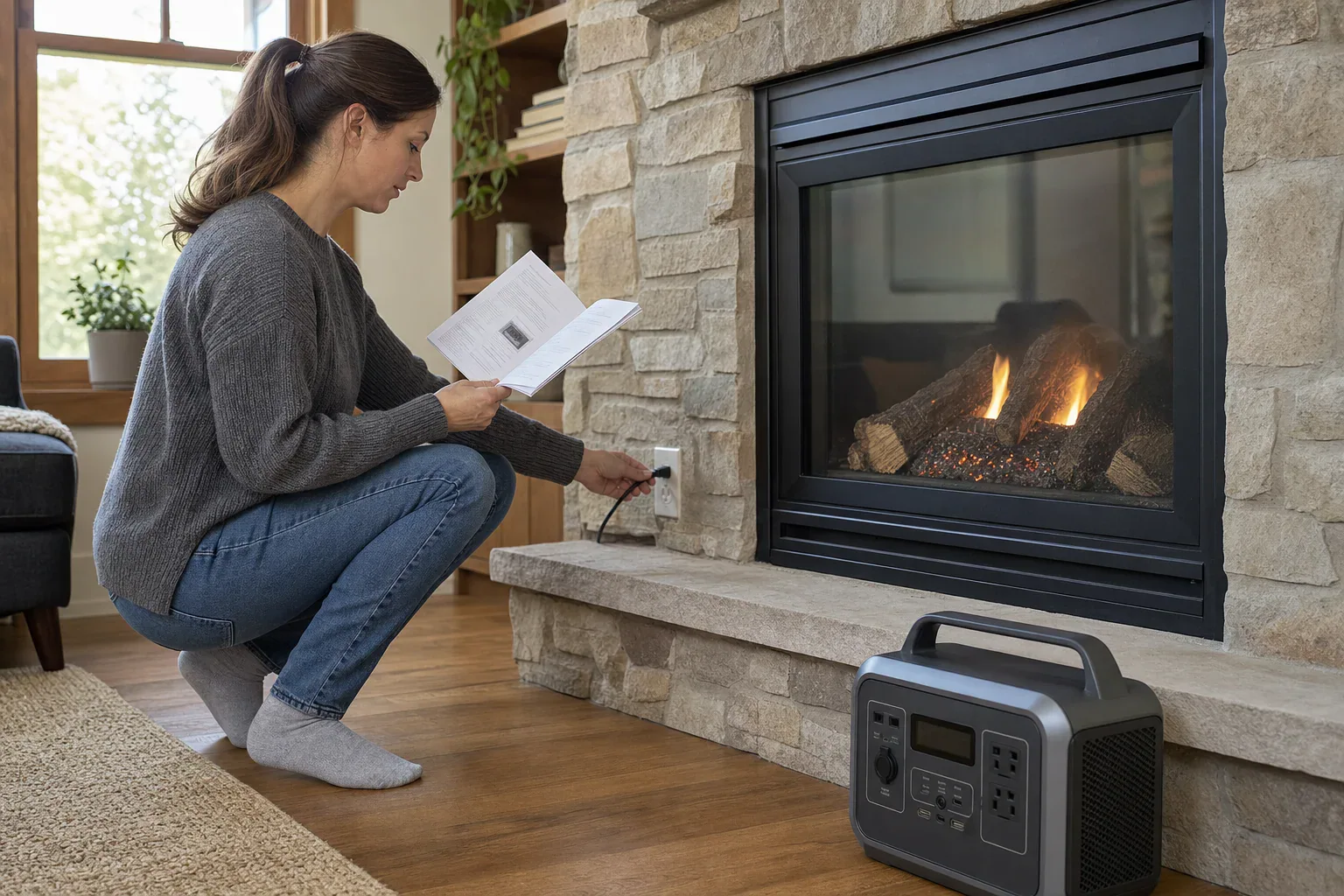
Quick answer: A portable power station can run some gas fireplaces, but the exact model determines whether it is needed at all. Standing-pilot units may provide burner heat without AC, while electronic controls, blowers, lights, or a required power vent may need electricity. Check the appliance manual, connection method, measured load, and station output limits.
Will a portable power station run your gas fireplace?
Start with the fireplace model number, not its BTU rating or gas input. Fuel specifications do not show whether burner controls, a comfort blower, lights, or venting equipment need electricity.
A standing-pilot or millivolt fireplace may be able to provide burner heat during a utility outage, although its blower may not run. A fireplace with electronic ignition may need utility AC or a manufacturer-approved battery backup. A power-vented model may require continuous electricity to operate safely.
Do not assume that every direct-vent fireplace has a powered vent. Confirm the venting arrangement and outage procedure in the exact owner’s and installation manuals for the appliance.
| Component | Possible outage result | What to verify |
|---|---|---|
| Standing-pilot or millivolt burner controls | Burner heat may remain available without utility AC | Follow the exact manual’s outage procedure; blower and lights may still be unavailable |
| Electronic ignition and controls | May need AC power or approved backup batteries | Confirm whether backup exists, what it powers, and the specified battery type |
| Comfort blower and lighting | May stop even if batteries can operate the burner | Measure the combined AC load of the features you intend to use |
| Power or combustion vent | Burner operation may not be permitted without electricity | Back up the complete required system, including its safety controls |
| Hardwired or inaccessible supply | Not appropriate for an improvised cord connection | Ask the manufacturer and a licensed electrician about an approved, code-compliant option |
Backup behavior is model-specific. The owner’s manual for certain Heatilator NBV models says that specified backup batteries are intended for emergency outages rather than long-term primary power. It also says some 110–120 V functions, including the fan and lights, are lost when operating on those batteries. That does not establish how other fireplaces operate. See the Heatilator NBV owner’s manual.
Power venting changes the decision. Instructions for one Regency G800P power-vent application state that the appliance will not operate when 120 V power is lost. Its system includes a vent fan and related controls, illustrating why a required vent cannot be treated like an optional comfort blower. See the Regency power-vent instructions.
How to check a portable power station for a gas fireplace
1. Identify the exact appliance and ignition system
Use the owner’s manual to locate the rating plate without removing sealed or service-only panels. Record the model and serial number, then find the matching manual and wiring information. Look for terms such as standing pilot, millivolt, intermittent-pilot ignition, electronic ignition, battery backup, blower, fan, power vent, combustion fan, and lighting.
2. Check the electrical supply and required features
- Record the rated voltage, frequency, watts, amps, and any stated maximum or starting load.
- Determine whether the appliance uses an accessible factory-installed grounded plug or fixed wiring.
- Identify exactly which components need backup power: controls, blower, lights, vent fan, or all of them.
- Check whether a vent fan must run before, during, or after burner operation.
- Check the fireplace manual for any AC waveform, grounding, or connection requirements.
- Include accessories that might run together, such as a blower and lighting.
If a nameplate lists volts and amps but not watts, multiplying them provides volt-amperes, not necessarily actual watts used by a motor or electronic control. Manufacturer data or a measured load is more useful for runtime planning.
3. Measure only an approved plug-in connection
If the fireplace has an accessible factory-installed grounded plug, a suitably rated plug-in watt meter can help establish normal operating load. Record controls-only consumption, blower consumption at each intended setting, and the total load with accessories operating. Do not alter fixed wiring or use an improvised connection to reach an internal receptacle.
A basic watt meter may not capture a brief motor-starting peak. Check the fireplace documentation or ask the manufacturer or a qualified technician how startup demand should be verified. There is no reliable universal startup multiplier for fireplace blowers.
4. Compare output capability before capacity
The power station’s continuous AC rating must cover every component that may run simultaneously. Its documented overload or surge behavior must also be adequate for any motor startup. A large watt-hour rating cannot make an undersized inverter start a load. See Surge Watts vs Running Watts: How to Size a Portable Power Station.
Low-load settings can also matter when only controls are running. For example, the US manual for the EcoFlow RIVER 3 Plus describes an AC timeout that can turn output off with intermittent loads and advises disabling that timeout when a continuous supply is necessary. This is a device-specific setting, not evidence of fireplace compatibility; check the manual for the station you own. See the EcoFlow RIVER 3 Plus manual.
Estimate controls-only and blower runtime
Watts (W) describe the rate of electricity use. Watt-hours (Wh) describe stored energy. Runtime depends on usable energy delivered through the AC outlet, not solely on the capacity printed on the power station.
Illustrative calculation only: assume a 512 Wh power station, an assumed 85% battery-to-AC efficiency, and a measured 45 W fireplace controls-and-blower load.
Estimated usable AC energy: 512 Wh × 0.85 = 435.2 Wh
Estimated runtime: 435.2 Wh ÷ 45 W = about 9.7 hours
This is not a test result or a promise for a particular fireplace or power station. Battery temperature and condition, inverter standby consumption, automatic shutdown settings, cycling behavior, and reserve settings can reduce runtime. For a small controls-only load, inverter overhead can be a large part of total consumption. See Inverter Idle Consumption Explained.
Before depending on the setup, perform a supervised trial using the approved connection method. Confirm normal ignition, blower startup if used, thermostat cycling, station low-battery behavior, and normal appliance shutdown. Do not treat a successful brief test as proof of long-duration runtime.
Use an approved connection method
Follow the fireplace manufacturer’s connection arrangement. If the appliance provides a manufacturer-approved battery tray, use only the batteries and procedure specified in that manual. If it has an accessible grounded plug, preserve the grounding connection and verify that the station’s AC output meets the fireplace manufacturer’s requirements.
Do not use grounding adapters, create a neutral-to-ground bond, backfeed a wall outlet, or modify fireplace wiring. The Regency power-vent instructions, for example, call for a properly grounded three-prong receptacle and licensed electrical work for the appliance. Local electrical and fuel-gas requirements may also apply.
A hardwired appliance or inaccessible internal receptacle needs direction from the fireplace manufacturer and a licensed electrician. A permanent transfer or backup arrangement is not an extension-cord project. For broader context, see Using a Transfer Switch With a Portable Power Station: Safe Alternatives and Grounding and GFCI: Do You Need Them With a Portable Power Station?.
Keep combustion safety in effect during an outage
Backup electricity does not correct a blocked vent, damaged appliance, failed safety control, or gas-supply problem. Never operate the burner when a required vent fan is unpowered, and never bypass a pressure switch or any other protective control.
The U.S. Consumer Product Safety Commission recommends professional inspection of fireplaces, flues, and vents, plus carbon-monoxide alarms on every level and outside sleeping areas. During an outage, those alarms need battery power or battery backup. See the CPSC winter heating safety guidance.
Keep the power station dry, ventilated, and outside clearance zones specified by both manufacturers. Keep its cable away from hot surfaces, sharp edges, walkways, and the fireplace opening. If the appliance’s manual does not clearly support outage operation, contact the manufacturer or a qualified fireplace technician before using it as an emergency heat source.
Related guides
Browse this topic →

- Beginner-friendly sizing, runtime & specs
- Solar & charging (MPPT, fast charging, cables)
- Batteries (LiFePO4, cycles, care & storage)
- Safety, cold-weather performance, real-world tips
More in Home / Appliances
See all →Keep reading
About this site
Portable Energy Lab publishes practical, independent guides about portable power—clear sizing, safe use, and real-world expectations.
Affiliate disclosure
Some links on this site may be affiliate links. If you buy through these links, we may earn a small commission at no extra cost to you. This helps support our content. Read our affiliate disclosure.