
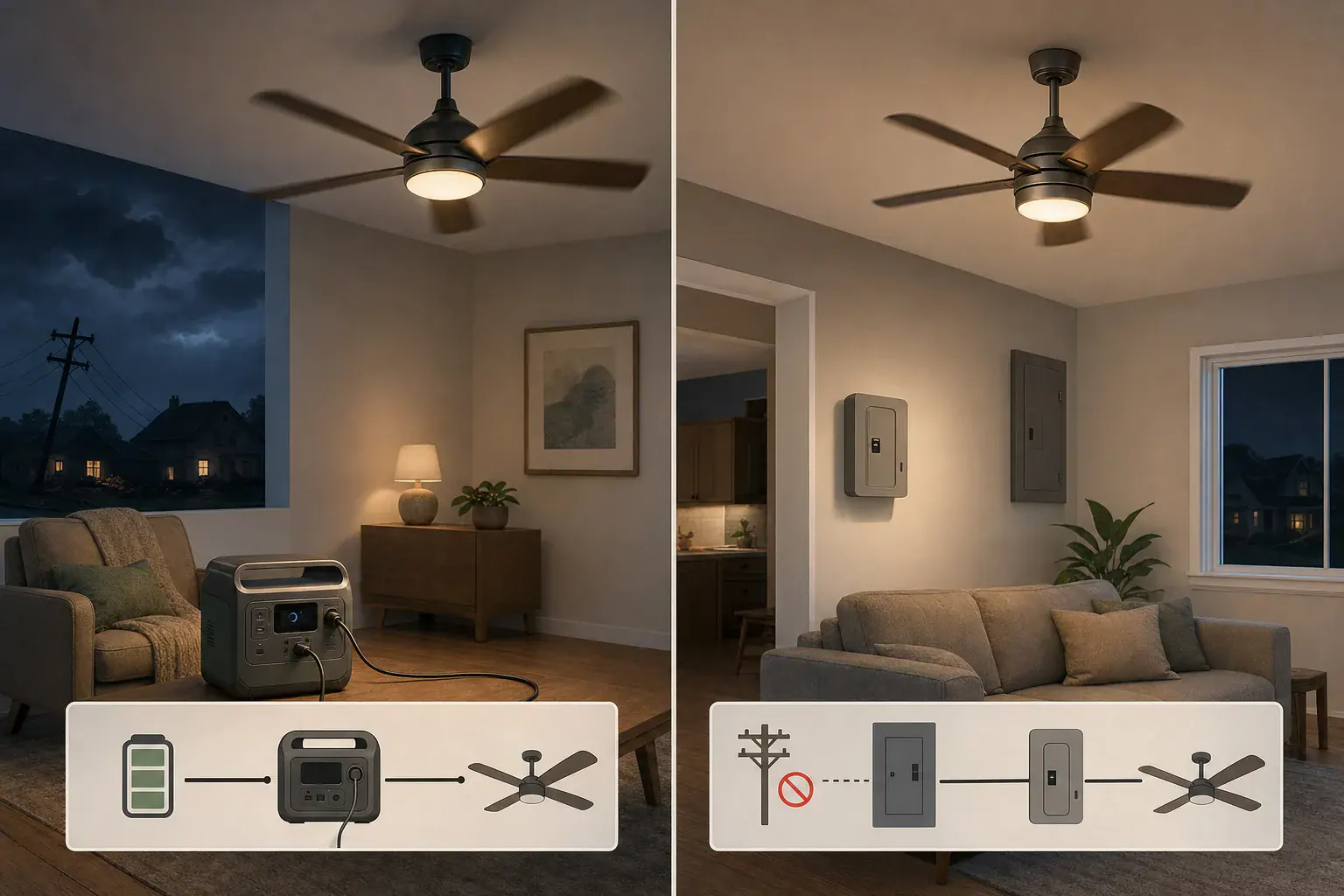
Quick answer: Yes, a portable power station can run a ceiling fan if the fan is factory cord-and-plug connected and its operating and startup demands fit the station’s AC ratings. A permanently wired ceiling fan needs compatible transfer equipment installed for the home’s wiring. Never backfeed power through a wall outlet.
Start with the fan’s connection type
The connection method matters before wattage does. Typical residential ceiling-fan installation instructions show the fan or receiver being connected to conductors in the ceiling box, making it part of the premises wiring rather than a plug-in appliance. Exact wiring varies by model; follow the fan manufacturer’s instructions and applicable local requirements. Hunter installation guidance
| Fan or connection | Appropriate approach |
|---|---|
| Factory cord-and-plug ceiling fan | Plug it directly into a compatible power-station AC outlet. Confirm voltage, frequency, operating load, and any documented startup requirement first. |
| Permanently wired fan with compatible transfer equipment | Have a qualified electrician review the power station, inlet, transfer arrangement, circuit load, neutral and grounding configuration, permits, and manufacturer instructions. |
| Permanently wired fan without transfer equipment | Do not add a makeshift cord or connect the station through a receptacle. Use a separate plug-in fan or arrange a compliant backup-power installation. |
| Male-to-male cord or wall-outlet backfeed | Never use it. It can leave energized prongs exposed and create serious shock and fire hazards. |
Size a portable power station for a ceiling fan
Check three separate things: the fan’s running load, its possible startup demand, and the energy needed for the desired runtime. The station must provide the AC voltage and frequency the fan requires, and the combined load must stay within both the station’s total continuous-output rating and any applicable outlet limit.
Continuous watts and startup demand
Continuous output is the load a power station can support during normal operation. Count the fan motor, any integrated light, and every other device using the station at the same time.
Motors can require more input while accelerating than during steady operation. However, there is no reliable universal startup multiplier for ceiling fans. The U.S. Department of Energy notes that motor starting demand exceeds steady operation and cautions that a current multiple does not directly equal the same power multiple. Use a startup specification from the fan manufacturer when one is available, and compare it with the station’s documented surge capability. DOE motor guidance
If no startup figure is published, treat it as unknown. A basic plug-in meter may show steady watts without capturing a very brief peak. For a factory plug-connected fan, a successful test on the intended power station can be useful confirmation for that specific fan and setup, but it does not establish a universal requirement for other fans.
Manual and measurement checklist
- Record the fan model number, required voltage and frequency, listed watts, and listed amperes.
- Read the manual to see whether a published energy figure covers the motor only or includes the light.
- Record the actual input watts of installed bulbs or the LED module; do not use a bulb’s brightness-equivalent label.
- For a factory plug-connected fan, use a properly rated plug-in power meter to check the speeds you expect to use.
- Measure light-only and fan-plus-light modes separately when available.
- Do not assume voltage multiplied by nameplate amps is the motor’s actual running watts. Prefer a published watt rating or an appropriate power measurement.
- Do not attach a temporary plug to a permanently wired fan. Ask a qualified electrician how to evaluate that circuit.
- Add all simultaneous loads before comparing the total with the station’s continuous-output rating.
Battery capacity, continuous AC output, and surge output are different specifications. For example, the EcoFlow DELTA 2 manual lists separate capacity, continuous-output, and surge-output figures for that model. Do not apply one station’s ratings to another model.
How speed settings and lights change the load
Fan consumption can change with speed, motor design, controls, and lighting. Measure the settings you expect to use rather than relying on a generic ceiling-fan wattage range. One Hunter model specification lists different power figures at low, medium, and high speed and separately lists a light-kit limit; those values apply only to that model. Hunter model specification
An integrated light increases the continuous load and reduces runtime. A remote receiver or electronic control can also use power, so measurement at the wall plug is more informative than adding only motor and bulb labels when the complete fan is factory plug-connected.
Estimate outage runtime with usable watt-hours
Watts describe the rate of power use; watt-hours describe stored energy. For a steady load:
Estimated runtime (hours) = usable AC energy (Wh) ÷ measured load (W)
Do not automatically use a station’s advertised battery watt-hours as usable AC energy. Energy is consumed by the inverter and conversion losses occur between the battery cells and AC receptacle. Battery condition, temperature, shutdown limits, and other loads can also change the result. Use AC-output information from the manufacturer or another defensible usable-energy figure, and identify any planning assumption. See usable capacity versus advertised capacity for the distinction.
Illustrative calculation: Assume that documentation or a suitable capacity assessment establishes 850 Wh of usable AC energy under the relevant conditions. Assume the fan measures 42 W, and its light adds 18 W.
- Fan only:
850 Wh ÷ 42 W = 20.2 hours - Fan plus light:
850 Wh ÷ 60 W = 14.2 hours
These are arithmetic estimates, not tested runtime promises. Keeping a reserve, adding other loads, or operating under different conditions can shorten actual runtime.
Hardwired fans need compatible transfer equipment
A permanently wired ceiling fan is part of the home’s electrical system. Supplying that circuit from a portable source requires equipment that prevents the utility supply and backup source from being interconnected inadvertently. NFPA code-development material describes transfer or interlocking equipment as suitable, listed, and designed to prevent source interconnection. Adopted code editions and local amendments vary, so this material is not a substitute for rules enforced by the local authority having jurisdiction. NFPA NEC code-development material
Not every power station is compatible with every inlet or transfer device. A qualified electrician should review the station manufacturer’s instructions, output configuration, neutral and grounding arrangement, circuit loads, and proposed transfer equipment. Ask the local building department or electrical inspector about permits and inspections. Requirements differ by jurisdiction; for example, Oregon guidance identifies anti-backfeed protection, permit, and licensing requirements for covered work. Oregon Building Codes Division guidance
Never connect a power station to household wiring through a wall receptacle. The CPSC warns that male-to-male cords can expose energized prongs, defeat household safety features, and create electrocution and fire hazards. CPSC safety warning
Bottom line
A factory plug-connected ceiling fan may run from a compatible portable power station after you verify its operating load, any documented startup requirement, and the station’s AC ratings. For a permanently wired fan, use compatible transfer equipment evaluated and installed for the premises wiring—not an improvised cord or outlet connection.
Related guides
Browse this topic →

- Beginner-friendly sizing, runtime & specs
- Solar & charging (MPPT, fast charging, cables)
- Batteries (LiFePO4, cycles, care & storage)
- Safety, cold-weather performance, real-world tips
More in Home / Appliances
See all →Keep reading
About this site
Portable Energy Lab publishes practical, independent guides about portable power—clear sizing, safe use, and real-world expectations.
Affiliate disclosure
Some links on this site may be affiliate links. If you buy through these links, we may earn a small commission at no extra cost to you. This helps support our content. Read our affiliate disclosure.