
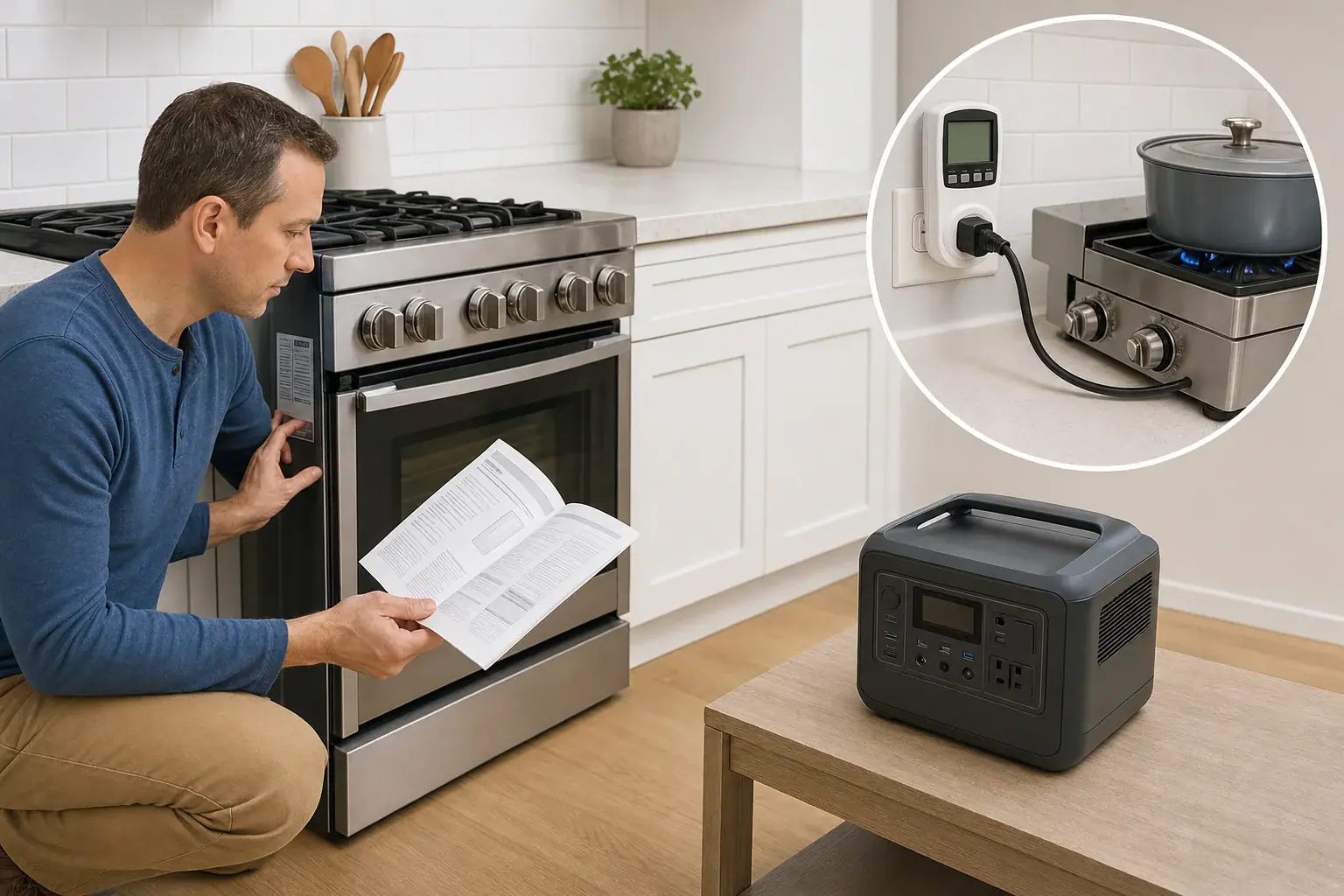
Quick answer: A portable power station for a gas range can work when the range has an accessible cord and plug, its required voltage and frequency match the station, and measured demand stays within the station’s continuous AC limits. Estimate cooking time from measured average watts and documented usable AC watt-hours, not battery capacity alone.
How to size a portable power station for a gas range
Start with the exact range model, not an assumed wattage for gas appliances. Electricity may operate the spark ignition, display, controls, oven ignition system, gas valve, light, convection fan, or other features. Some ranges that burn gas also have electrically heated cooking components.
- Find the range model number, nameplate, owner’s manual, and installation instructions.
- Record the required voltage, frequency, and connection type.
- Confirm the range has a safely accessible factory cord and plug that fits the power station directly.
- Measure normal cooking modes you plan to use.
- Compare the highest measured watts and VA with the station’s normal continuous-output limits.
- Estimate runtime from measured average power and documented usable AC energy.
Do not treat a branch-circuit requirement as actual operating consumption. For example, a Whirlpool installation guide specifies a 120-volt, 60-hertz, 15-amp supply for the covered models. That supply requirement does not establish the range’s continuous power draw. See the Whirlpool installation guide.
Cooktop and oven electrical needs can differ
A gas cooktop and gas oven may behave differently in an outage. GE states that its gas ovens cannot be manually lit because the ignition system and gas valve require power. See GE’s power-failure guidance. Maytag identifies electronic ignition, the control panel, and oven light as possible electrical loads, while noting that safety features vary by model. See Maytag’s explanation.
Outage behavior can differ even within one manufacturer’s range lineup. Wolf documents a particular model and serial-number group with an electronic solenoid affecting operation without power. See Wolf’s model-specific guidance. These examples show why the manual for your exact range matters; they are not universal rules for every gas range.
| Feature or item | What to verify or measure | Compatibility question |
|---|---|---|
| Cooktop spark ignition | Highest displayed watts and VA while ignition is operating | Does the range permit normal burner operation on backup power? |
| Display and electronic controls | Standby power and normal startup behavior | Does the control board start without errors? |
| Gas oven ignition and valve | Cold start, preheat, and thermostat-cycle readings | Can the station support maximum and sustained demand? |
| Convection fan, oven light, and accessories | Loads separately and in normal combinations | Does the combined load remain within station limits? |
| Dual-fuel or electrically heated oven | Nameplate voltage, plug, and maximum input | Does it require a voltage or outlet the station does not provide? |
| Portable power station | AC voltage, frequency, waveform, continuous watts, relevant VA limit, and usable AC Wh | Do the documented specifications match the range’s requirements and measured load? |
Nameplate, plug, and meter checklist
Before measuring the range
- Photograph accessible model and serial labels without moving the appliance.
- Read the owner’s manual and installation instructions for electrical requirements and outage restrictions.
- Inspect the existing plug without modifying it. Do not use an adapter to force an incompatible plug to fit.
- Confirm the appliance nameplate is within the meter’s voltage, current, and VA ratings.
- If accessing the plug requires moving the range or disturbing its gas connection or anti-tip device, use a qualified appliance professional.
Meter ratings are model-specific. The P3 P4400 displays volts, amps, watts, hertz, VA, and cumulative kWh; its manufacturer lists limits of 125 volts, 15 amps, and 1,875 VA. Those limits apply to that meter only. See the P3 meter specifications.
What to record
- Standby watts after controls settle.
- The highest displayed watts and VA during cooktop ignition.
- Cold oven-start and preheat readings.
- Readings while the oven cycles after reaching temperature.
- Convection-fan and oven-light loads separately and with the oven operating.
- Maximum watts, maximum VA, elapsed time, and cumulative kWh for a representative cooking session.
Measure only normal cooking modes permitted by the range manual and remain present while testing. A basic plug-in meter may not capture every very brief transient, so a reading just below a station limit does not establish compatibility by itself.
For a fluctuating load, calculate average power by dividing measured energy by elapsed time. This follows the U.S. Department of Energy’s general measurement guidance for varying electrical loads. See the DOE measurement guidance.
Match the range to the power station
Use the manual for the exact power-station model rather than relying on a product-family name or battery-capacity label. For example, the EcoFlow RIVER 3 Plus manual lists a pure-sine-wave 120-volt, 60-hertz AC output and a 600-watt total AC limit. Those specifications describe that model only, not all portable power stations. See the EcoFlow manual.
- Voltage and frequency: They must match the requirements in the range documentation.
- Continuous watts: The normal continuous rating must exceed the highest sustained combination measured. A surge rating does not support a load that stays on.
- VA and power factor: Watts and VA are not always equal. If the station does not publish a relevant VA limit, ask its manufacturer whether it supports the measured load.
- Waveform: Follow any waveform requirement or acceptance stated by the appliance manufacturer. Do not assume an unspecified output will work with electronic controls.
- Connection: The factory plug must fit a properly grounded station outlet directly. Do not alter wiring or use the station to energize a household receptacle.
- Operating mode: Use the station’s standard AC-output rating. Do not treat voltage-reduction or boost modes as substitutes for compatible continuous output.
Estimate runtime from measured watts and usable Wh
Watts are power at a moment in time; watt-hours are energy used or available over time. Runtime depends on average power, not only the highest ignition reading.
Estimated runtime in hours = usable AC watt-hours ÷ measured average watts
Illustrative calculation
Assume a meter records 0.64 kWh during a representative two-hour oven session. Converting 0.64 kWh to watt-hours gives 640 Wh. The measured average load is:
640 Wh ÷ 2 hours = 320 W average
Now assume the power-station manufacturer has established 800 Wh of usable AC energy under relevant conditions:
800 usable AC Wh ÷ 320 W = 2.5 hours
This 2.5-hour result is illustrative, not a measured runtime for a particular range or station. Cooking temperature, oven cycling, enabled accessories, ambient conditions, and station shutdown behavior can change the result.
Rated battery watt-hours and usable AC watt-hours are not interchangeable. The battery rating does not by itself account for inverter losses, station overhead, or shutdown reserve. If only nominal battery capacity is published, exact AC runtime is unknown unless the manufacturer provides suitable usable-energy data or an appropriate test establishes it.
Related guides: Peak Load Testing: How to Check If Your Power Station Can Start a Device and How to Estimate Runtime for Any Device: A Simple Wh Formula + 5 Worked Examples.
Use the range and power station safely
- Connect only an accessible cord-and-plug range directly to a compatible station outlet. Never backfeed a wall receptacle or alter home wiring.
- Do not attempt to power a hardwired or incompatible higher-voltage range from a standard station outlet.
- Do not manually light an oven, defeat a gas valve, bypass an interlock, or modify an ignition system.
- Follow both manuals for placement, ventilation, grounding, charging, and environmental limits. Keep the station dry and away from range heat, grease, and foot traffic.
- Stop using a battery product that becomes excessively hot, swells, leaks, smells unusual, or makes unusual noise. NFPA also advises using listed battery products and following manufacturer instructions. See NFPA’s lithium-ion battery guidance.
- Never use a gas stove or oven to heat the home. FEMA recommends working smoke and carbon-monoxide alarms with battery backup during outages. See the Ready.gov power-outage sheet.
A supervised trial in intended normal cooking modes can reveal control errors or overload shutdowns, but it cannot override either manufacturer’s restrictions. Stop if the range behaves abnormally or specifications are incomplete, and request model-specific guidance from the appliance and power-station manufacturers.
Related guides
Browse this topic →

- Beginner-friendly sizing, runtime & specs
- Solar & charging (MPPT, fast charging, cables)
- Batteries (LiFePO4, cycles, care & storage)
- Safety, cold-weather performance, real-world tips
More in Home / Appliances
See all →Keep reading
About this site
Portable Energy Lab publishes practical, independent guides about portable power—clear sizing, safe use, and real-world expectations.
Affiliate disclosure
Some links on this site may be affiliate links. If you buy through these links, we may earn a small commission at no extra cost to you. This helps support our content. Read our affiliate disclosure.